To start a sober living home in California, form an entity, check the city’s zoning and occupancy rules, decide on voluntary CCAPP certification, insure the home and budget the startup. California requires no state license for a sober living home that offers housing and peer support without treatment services, so most of the hard work happens at the city level. Each step below applies the national roadmap for how to start a sober living home to the rules in California.
Opening a sober living home in California puts you in the largest recovery housing market in the country, in a state with no license requirement for non-clinical recovery housing. California ranks 4 of 50 on the Vanderburgh Sober Living Operating Climate Index, with an Operating Climate Score of 8 and a Moderately Regulated classification (Foote, 2026). Almost everything difficult about opening here happens at the city level rather than the state level. The sequence a California operator follows is predictable once you know where the pressure sits: forming the entity, understanding what actually protects the home under local zoning, confirming occupancy classification with the building official, earning certification, insuring the home, and budgeting a startup with three lines no published source can price. Get the fair housing posture and the city selection right, and the rest is ordinary small-business execution.
Quick Answers
Do you need a license to open a sober living home in California?
No. California does not require a state license for a sober living home that provides housing and peer support and no alcohol or drug recovery or treatment services.
The Department of Health Care Services (DHCS) holds the sole authority in state government to license adult recovery or treatment facilities, and its own guidance states that “DHCS does not license, certify, or investigate complaints against sober living/transitional living homes.” A license attaches only where a premises provides one of the licensable services listed in 9 CCR §10501(a)(5): detoxification, individual sessions, group sessions, educational sessions, recovery or treatment planning, or incidental medical services.
Is California Consortium of Addiction Programs and Professionals certification required in California?
No. Certification is voluntary, and no California statute requires it.
CCAPP describes itself as “the only organization recognized by California’s Department of Health Care Services as providing certification for recovery residences.” DHCS does not publish a corresponding statement recognizing CCAPP; its guidance says only that it does not license, certify, or investigate complaints against sober living homes. What is independently verifiable is that CCAPP is California’s only NARR affiliate. California scores 6 for certification value (Foote, 2026).
What are the biggest early risks?
The three biggest early risks are a hostile municipal ordinance, an occupancy classification you did not confirm in writing, and a budget built without quoting general liability insurance.
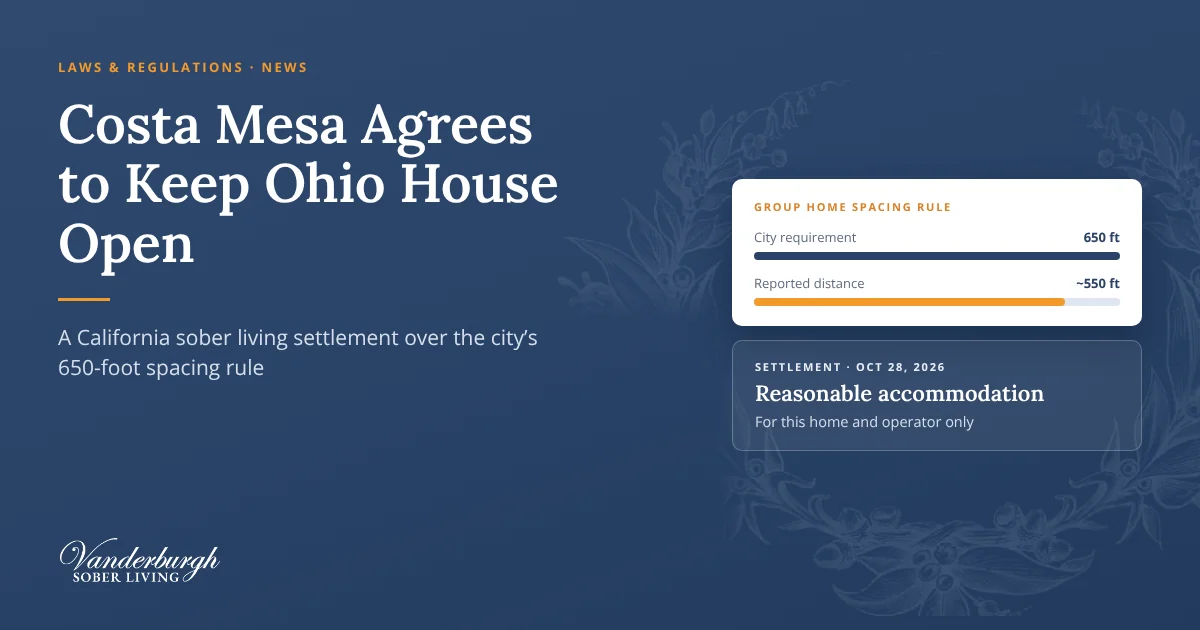
California scores 8 for legal climate (Foote, 2026), but that score describes state law. The Ninth Circuit upheld a jury verdict for Costa Mesa in The Ohio House, LLC v. City of Costa Mesa, 135 F.4th 645 (9th Cir. 2025), so the Fair Housing Act does not automatically defeat a local ordinance.
How long does it take to open a sober living home in California?
Most California operators open in three to six months.
Entity formation and property control take roughly four to eight weeks, policy and insurance work runs in parallel, and CCAPP publishes a 30-day application processing period before an on-site inspection is scheduled. Cities that require a permit or a special use permit add time that varies by jurisdiction.
Is a sober living home profitable in California?
A California sober living home can be profitable, and a 14-bed reference model runs $1,040 per bed per month against a 39% breakeven, about five of 14 beds, on the priced expense stack.
That model produces about $357 net per bed per month and a 45.7% net margin before owner’s labor. General liability insurance is not in that expense stack and cannot be priced from any published source, which will raise both the expense total and the breakeven. California scores 10 for market strength and 10 for operator funding access (Foote, 2026); its weakest scores are startup burden at 1 and return on capital at 2.
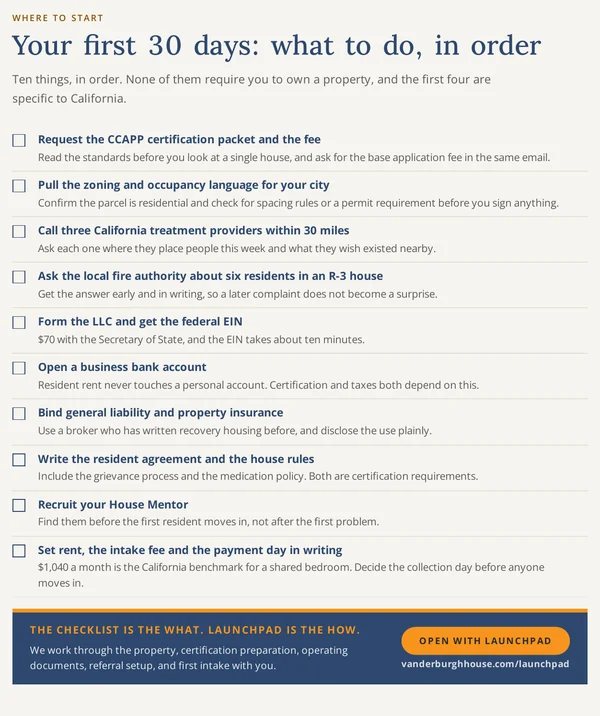
The unmet need and the bed shortfall, who pays the rent, what certification costs and what it unlocks, and the full operating model for buying versus leasing.
Get the Your State Starter Kit No cost, no obligation. Unsubscribe in one click.Watch: How to Open a Sober House in California
Before the step-by-step, here is the short version. It runs a little over three minutes and frames the two things that decide a California launch: what the state does and does not require of a non-clinical home, and how much of the real work sits with the city rather than with Sacramento.
Dr. Hunter T. Foote covers the license question, the local zoning and fair housing layer that actually governs an unlicensed home, CCAPP certification and why it works as a referral gate, what entry costs in this market, and the referral relationships that keep beds full.
- ✓Policies and house agreements to have signed
- ✓Inspections, insurance, and intake paperwork
- ✓What the first week actually requires
Do You Need a License to Open a Sober House in California?
California draws the licensure line at function, not at size, and that distinction is the first thing an operator here learns. The licensing statute is functional. Health and Safety Code §11834.02(a), as amended by SB 164 effective June 29, 2026, reaches a premises “that provides residential nonmedical services to adults who are recovering … and who need … recovery treatment or withdrawal management services.” A home providing none of the licensable services is outside that definition entirely. DHCS put the same point in ADP Bulletin 05-15: sober living environments “are not licensed residential treatment programs and do not provide treatment services.” A separate exemption at §1505(i) keeps the home outside community care licensing.
There is also no registry to join. As of September 2026, there is no statewide registration, roster, or licensure requirement for a non-clinical sober living home in California. Two provisions support that reading: §11857.4 places referral recordkeeping on the treatment provider, and §11831.5 directs DHCS to note that recovery-residence notices are excluded from its public list, which presupposes no register exists. Two statutes operators are often told bind them do not. §11833.05, amended by AB 2995 (Chapter 847, Statutes of 2024) effective January 1, 2025, obliges DHCS-licensed facilities and certified programs to disclose their ownership, control, or financial interest in a recovery residence; it imposes nothing on the sober living home itself, and it carries the statutory definition of “recovery residence” at subdivision (f). The anti-remuneration statute §11831.6 covers licensed facilities, certified programs, and their principals, 10% owners, and staff, and by its terms does not reach an unlicensed operator. §11831.7 authorizes DHCS to assess a penalty on a licensed facility, with amounts set by provider bulletin rather than by statute. What does carry real exposure is operating unlicensed while providing licensable services. §11834.31, amended by SB 164 (Chapter 27) effective June 29, 2026, authorizes “a civil penalty of two thousand dollars ($2,000) per day” plus a five-year bar on initial licensure. Both run from the notice date: the penalty accrues only after notice, and the five years run from notice. One date is commonly misread. §11834.01(d)’s January 1, 2027 deadline binds DHCS to offer a combined application; it is not an operator filing deadline. Practical compliance points:
- Keep licensable services out of the house: No detox, group sessions, individual sessions, educational sessions, or recovery and treatment planning on site.
- Write the services list before you open: Housing, peer support, house rules, and screening are housing functions.
- Describe the program accurately to every authority: The description is what decides licensure, occupancy classification, and insurance.
- Confirm the local layer separately: Business licensing, permits, and any sober living ordinance are city questions, not state questions.
Step-by-Step: Starting a Sober Living Home in California
Nine steps take a California home from idea to filled beds, in this order.
Step 1. Form the Right Business Entity
Most California operators file an LLC and hold the property in a separate entity from the operating business. The California Secretary of State charges $70 for Articles of Organization (Form LLC-1) and $20 for the Statement of Information (Form LLC-12), due within 90 days of formation and biennially thereafter. Articles of Incorporation with shares are $100, and a nonprofit public benefit filing on Form ARTS-PB-501(c)(3) is $30.
The California-specific cost is the annual tax, and the asymmetry matters. Every LLC doing business in or organized in California owes an $800 annual tax, and the first-year exemption that once relieved new LLCs applied only to tax years beginning January 1, 2021 through December 31, 2023, so an LLC formed today owes the $800 for its first year on Form 3522. A newly incorporated corporation is not required to pay the minimum franchise tax in its first taxable year, for corporations incorporated or qualified on or after January 1, 2020. A separate LLC fee is assessed on total California income rather than profit under Revenue and Taxation Code §17942(b)(1)(A), starting at $900 above $250,000 in gross receipts. It is $0 below $250,000, which is where most first-year single-house operators sit. First-year state cost for an LLC is $70 plus $20 plus $800, or $890 in unavoidable state costs, plus whatever a registered agent service charges if the operator hires one instead of serving as agent personally.
| Structure | Formation cost | Annual cost | Best for |
|---|---|---|---|
| LLC | $70 | $20 biennial Statement of Information plus the $800 annual tax from year one | Owner-operated home |
| Stock corporation | $100 with shares | $25 annual Statement of Information; $800 minimum franchise tax from year two | Multi-property operating company |
| Nonprofit public benefit corporation | $30 | Attorney General Form CT-1 registration and annual RRF-1; FTB exemption on Form 3500A | Grant-seeking and county contracting |
- File the LLC-1 and get the EIN: Both before you sign a lease or a purchase contract.
- Calendar the $800: Due the 15th day of the 4th month after the beginning of the LLC’s taxable year, which in year one runs from the date the Secretary of State files the articles.
- Name a real registered agent: The agent must be an individual who resides in California or a registered corporate agent, and “[a] business entity cannot act as its own agent for service of process.”
- File the DBA on time:Business and Professions Code §17910 requires filing within 40 days of commencing business under the name, with county fees set county by county.
Step 2. Review Zoning and Fair Housing Rules
California gives an unlicensed home a fair housing case rather than a zoning exemption, so this step is research and paperwork rather than an assumption. Confirm the property sits in a residential zone where single-family use is permitted, then ask the planning department in writing whether the city maintains a sober living ordinance, a registration program, a special use permit, or a spacing requirement.
The legal footing is federal and state anti-discrimination law. The Fair Housing Act’s reasonable accommodation duty at 42 U.S.C. §3604(f)(3)(B) and ADA Title II at 42 U.S.C. §12132 reach local land use decisions, and the Fair Housing Act is the instrument most California disputes turn on. On the state side, Government Code §12955(l) names “restrictive covenants, zoning laws, denials of use permits” verbatim, and Government Code §65008(a) and (d)(2)(A) make a local action “null and void” if it denies land use because of a characteristic protected by §12955(a) or (d). Civil Code §53 voids private covenants restricting use on the same grounds. Two more tools are worth having ready. The DOJ and HUD joint statement of November 10, 2016 answers the question cities raise most: at Q8, “The provision of support services is not required for a group home to be protected under the Fair Housing Act,” and at Q13, a code that lets any number of unrelated persons live anywhere but requires a permit of the same number of persons with disabilities “would violate the Fair Housing Act.” On household size, City of Santa Barbara v. Adamson (1980) 27 Cal.3d 123 struck a five-unrelated-person cap under the state constitutional privacy right. Learn what goes into requesting reasonable accommodation before a dispute starts rather than after.
- Get the answer in writing: A planner’s email is evidence later.
- File the accommodation request early: Waiting until enforcement begins weakens the record.
- Read the ordinance, not the summary: Costa Mesa prohibits sober living homes with more than six occupants in R1 outright, with no permit pathway, while imposing a 650-foot separation elsewhere.
Step 3. Choose a Property for a Sober House
The California property decision turns on occupancy classification, and the code names recovery homes directly. Permit applications filed on or after January 1, 2026 are reviewed against the 2025 Triennial Edition of Title 24, published July 1, 2025, with Part 2 as the California Building Code, Part 2.5 as the Residential Code, and Part 9 as the Fire Code. California Building Code §310.4 lists “Alcoholism or drug abuse recovery homes (ambulatory only)” among Group R-3 occupancies, with no resident-count qualifier on that line. Group R-4 under §310.5 is a conjunctive test: “more than six ambulatory clients, but not more than 16 persons, excluding staff, who reside on a 24-hour basis in a supervised residential environment and receive custodial care.” All three elements must be present, and §310.5 adds that R-4 “shall meet the requirements for construction as defined for Group R-3, except as otherwise provided for in this code.” R-3.1 and R-2.1 are licensed 24-hour care facility categories and do not describe an unlicensed recovery residence. The classification is the building official’s call. Confirm it in writing with the local building official and fire authority before signing a lease or closing, and describe the program accurately, because whether the home provides care, supervision, or medication assistance is the fact that decides the answer. Health and Safety Code §17960 puts enforcement on “the building department of every city or county,” and §13146(a)(1) requires each city or county to delegate R-3 fire-and-panic enforcement to the local fire chief or chief building official.
There is no seven-resident sprinkler cliff. The Residential Code requires sprinklers in all new one- and two-family dwellings, and the State Fire Marshal states that “[a]utomatic residential sprinkler systems are required in all new homes,” while the same section provides that sprinklers “shall not be required for additions or alterations to existing buildings that are not already provided with an automatic residential sprinkler system.” That section is R309 in the 2025 Residential Code, renumbered from R313. The real triggers are new construction, an occupancy classification the building official assigns, construction scope that brings in the Existing Building Code, or a local ordinance. §13143.6 adds a narrow separate hook, applying to buildings housing persons “referred to or placed within such home or institution for protective social care and supervision services by any governmental agency,” and its subdivision (b) removes both the sprinkler and fire alarm requirements where no resident is nonambulatory or handicapped. We do not publish a sprinkler retrofit estimate. No government or standards-body source we could find supports a residential sprinkler retrofit cost figure or per-square-foot range; the available authoritative cost research covers new construction only. If your building official or fire authority tells you a retrofit is required, get three bids from licensed C-16 contractors in your county and budget from those, not from a national figure.
- Confirm classification in writing before you commit: Verbal reassurance from a counter clerk is not a determination.
- Ask the fire authority about referral-based clearance: Government placements can trigger verification under §13143.6(a).
- Size the property to the beds, not to a statutory number: California housing averages about 1,500 square feet across all housing types including apartments, so a large single-family home is the realistic target.
Finding the building is usually the slowest part. You can see what is currently available in our listings of sober living homes for sale, including what each one is already set up to earn.
Step 4. Create House Rules, Intake Forms, and Resident Policies
Certification is document-driven, so writing policy early does double duty: the same documents keep the home defensible in a discharge dispute. CCAPP requires 12 documents, and operators “may choose to use your current forms.” The set is a Resident Confidentiality Agreement, a Mission and Vision Statement, a Recovery Residence Financial Agreement, Enforcement of Policies and Grievance Policies, a Statement of Recovery Residence Rights, House Rules, a Recovery Residence Weekly Schedule, a Good Neighbor Policy, a House Manager Contract, an Infectious Disease Control Policy, a Medication Policy, and the CCAPP Code of Ethics. Strong sober house rules are specific about money, guests, curfew, screening, and the conditions under which a resident leaves.
- Write the medication policy first: It is the highest-risk document in California.
- Put the financial agreement in writing: Rent, intake fee, deposit, and refund terms.
- Adopt the good neighbor policy before the first complaint: Parking and noise are the recurring flashpoints.
Step 5. Secure Insurance for a Sober Living Home
A sober living home is not an ordinary rental, and California carriers underwrite it that way. Expect property coverage plus general liability, and disclose the use accurately at application, because a misdescribed occupancy is a denied claim. The property side has a published benchmark: the average California homeowners multi-peril premium was $1,788 in 2023, up 43% from $1,247.63 in 2019. The liability side does not. No state or federal agency publishes premium data for general liability coverage on recovery residences. Operators should budget for it as a line item and obtain quotes from carriers writing habitational or social-service occupancy in California; the California Department of Insurance publishes premium data only for residential property lines, not commercial liability. One statutory requirement does attach in a specific case: §11853.5, added by AB 1158 (Chapter 443, Statutes of 2021), sets minimum coverage requirements for a recovery residence that contracts with a government entity. Getting sober house insurance right is worth the extra week it takes.
- Disclose the use in writing: “Sober living home” belongs on the application.
- Quote the property before you close: Wildfire scoring can change the deal.
- Quote general liability separately and early: It is one of three lines no published source can price for you.
Step 6. Hire and Train Staff or House Leadership
A monitored California home runs on a live-in house mentor rather than clinical staff. The mentor holds the schedule, runs screening, enforces house rules, and escalates problems, and CCAPP’s application requires a signed House Manager Contract and a signed Code of Ethics for owners and staff. Keep the role inside its lane. A mentor who begins running recovery-focused group sessions moves the home across the licensure line described above. The NARR levels of care define what monitored housing looks like, and VSL’s house mentors model shows how the role works in practice.
- Put the mentor agreement in writing: Compensation, rent offset, duties, and boundaries.
- Train on documentation, not counseling: Incident logs, screening records, and escalation.
- Do not promise 24-hour supervision: Monitored housing is not staffed care, and the claim can affect classification.
Step 7. Build Resident Referral Networks
California has the densest referral ecosystem in the country, and beds fill through relationships. Demand is not the constraint: 16.65% of Californians aged 12 and over met criteria for a substance use disorder in the 2023 to 2024 NSDUH annual average, about 5,556,000 people, and 55.3% of California renters pay 30% or more of household income toward rent. Four channels do most of the work. The justice channel is the largest pay-attached pipeline: the California Department of Corrections and Rehabilitation runs Specialized Treatment for Optimized Programming (STOP) through six statewide contracts with community-based organizations and six regional placement offices in Fresno, Los Angeles, Sacramento, San Bernardino, San Diego, and Santa Clara County (Campbell), serving parolees in their first year of release, with “services … up to 180 days, with the possibility of up to an additional 185 days, based on assessed need.” The courts add a second: California runs more than 400 collaborative justice courts, including 97 adult drug and SACPA courts, 18 reentry courts, and 20 DUI courts. Clinical step-down is the third, working through discharge planners at the state’s 1,495 substance use disorder treatment facilities, and county coordinated entry through 2-1-1 is the fourth. Certification is what gets a home onto the screen for all four. Knowing the referral sources worth cultivating turns a certificate into census, and after that keeping beds full is the discipline that protects the margin.
- Contract into the STOP network: Access runs through the prime contractors, not a listing.
- Meet the collaborative court coordinator: Court placements are stable and compliance-motivated.
- Get listed in the CCAPP registry: It is the directory referrers and counties actually search.
Step 8. Get Certified Through California Consortium of Addiction Programs and Professionals
CCAPP is a 501(c)(6) established in 1972 and based in Sacramento, and it is California’s only NARR affiliate, the single California entry in NARR’s affiliate directory. Certification is voluntary. Its value is credibility, referral access, funder eligibility, and a stronger reasonable-accommodation record; it does not substitute for licensure for zoning purposes. The standard behind it is national. NARR Standard 3.0, released in November 2018 and still the current edition as of September 2026, operationalizes the social model across four domains, Administrative and Operational, Physical Environment, Recovery Support, and Good Neighbor, containing 10 core principles and 31 standards, applied at four levels of support (Level I peer-run through Level IV clinical). CCAPP states that it has aligned its standards with NARR.
The process starts with a request, not a portal. CCAPP’s certification application is not available for online self-service; operators request it by email from CCAPP, and its full step count is not published. CCAPP does not publish its recovery residence application fee; the amount is quoted on request, and CCAPP will not begin processing an application until the fee is submitted. The published dollar amounts are a $100 cancellation fee where an inspection is not cancelled at least 24 hours ahead and a $100 reinspection fee. Certification is renewed through an annual peer site visit, and CCAPP investigates consumer complaints, which must be non-anonymous, complete, and against a CCAPP-certified residence. Operators who want the document list and the sequence before applying should work from CCAPP certification for sober living homes in California.
- Request the application early: The 30-day processing period runs after the fee is submitted.
- Have insurance and owner permission ready: A mortgage statement or a written owner letter.
- Budget for one reinspection: Deficiencies are common on a first visit.
Step 9. Budget Startup Costs and Explore California Funding
California offers the strongest operator-side funding position in the country, which is why it scores 10 for operator funding access (Foote, 2026). Lead with the recurring stream, not the closed one. Beginning in 2026, counties must spend 30% of their Behavioral Health Services Act allocation on housing interventions, with half of that, 15% of the total, prioritized for people experiencing chronic homelessness, and up to 25% of the 30%, or 7.5% of the total, available for capital development. DHCS names “Shared housing (including recovery housing)” as a permitted intervention and states directly that “[r]ecovery housing is an allowable use of BHSA Housing Intervention funds.” The FY 2026-27 statewide housing component is about $950 million, and the county behavioral health plan is where an operator pursues it.
The capital program is fully awarded. Proposition 1 authorized $4.4 billion (DHCS puts the available total at $4.393 billion) for the Behavioral Health Continuum Infrastructure Program. DHCS has now awarded all of it across two bond rounds: $2.99 billion in Bond BHCIP Round 1: Launch Ready, announced May 12, 2025, and $1.18 billion in Bond BHCIP Round 2: Unmet Needs, announced March 11, 2026, $4.17 billion total, funding 177 projects across 333 behavioral health facilities and producing 6,919 residential treatment beds and 27,561 outpatient treatment slots. Round 2 alone funded 66 projects and 130 facilities, adding 2,554 residential and inpatient beds and 4,273 outpatient slots. Counting all rounds since 2021, BHCIP and Bond BHCIP have awarded $5.8 billion, creating 9,553 beds and 47,163 outpatient slots. Awards remain conditional pending final DHCS verification. No BHCIP round is currently open; Round 2 applications closed October 28, 2025. When a round does open, for-profit organizations are eligible alongside counties, cities, tribal entities, and nonprofits, at a 25% match against 10% for local government and nonprofits and 5% for tribal entities. Opioid settlement dollars are the county-level complement. California expects up to $4.2 billion, split 70% to the California Abatement Accounts Fund, 15% to the CA Subdivision Fund, and 15% to the State Fund, which means 85% reaches local governments. Participating subdivisions must spend no less than 50% of Abatement Accounts Fund receipts each calendar year on High Impact Abatement Activities, and HIAA #1 is “Provision of matching funds or operating costs for substance use disorder (SUD) facilities within the Behavioral Health Continuum Infrastructure Program (BHCIP).” DHCS allowable expenditures expressly permit funds to “Provide access to housing for people with OUD … including supportive housing, recovery housing, housing assistance programs.” Separately, DHCS acts as a pass-through for the Substance Use Block Grant, allocating $230,354,367 to counties for SFY 2025-26 across more than 150 programs. The resident side changed on January 1, 2026. Transitional Rent became the fifteenth CalAIM Community Support on July 1, 2025 and is now mandatory for every Medi-Cal managed care plan to offer, covering up to six months of rent per household, once per five-year demonstration, with a 182-day cap across all room-and-board Community Supports in any 12 months, and DHCS names “Recovery housing” among allowable settings. Housing Deposits carries a $5,000 recommended maximum rate, two times HUD Fair Market Rent plus $1,000, available once per demonstration period and approvable one additional time with documentation of changed conditions. The corrected standing fact is narrower than either extreme: Medi-Cal does not pay ongoing or recurring rent for an independent sober living home. Transitional Rent can pay rent in a recovery-housing setting, but only for up to six months, once per five-year demonstration, and only for members who meet all three eligibility tests. DHCS is explicit that Transitional Rent “will not provide permanent housing or long-term housing stability on its own, as it is limited to six months.” No Medi-Cal benefit funds a sober living home’s rent roll. Braiding these sources is slower and more conditional than the totals imply, which is why California recovery housing funding rarely works the way operators expect.
- Start with the county, not the state: BHSA housing dollars and 85% of settlement funds are local.
- Build the pro forma on resident income first: Then add STOP and county programs.
- Watch for the next BHCIP round: Nothing is open as of September 2026.
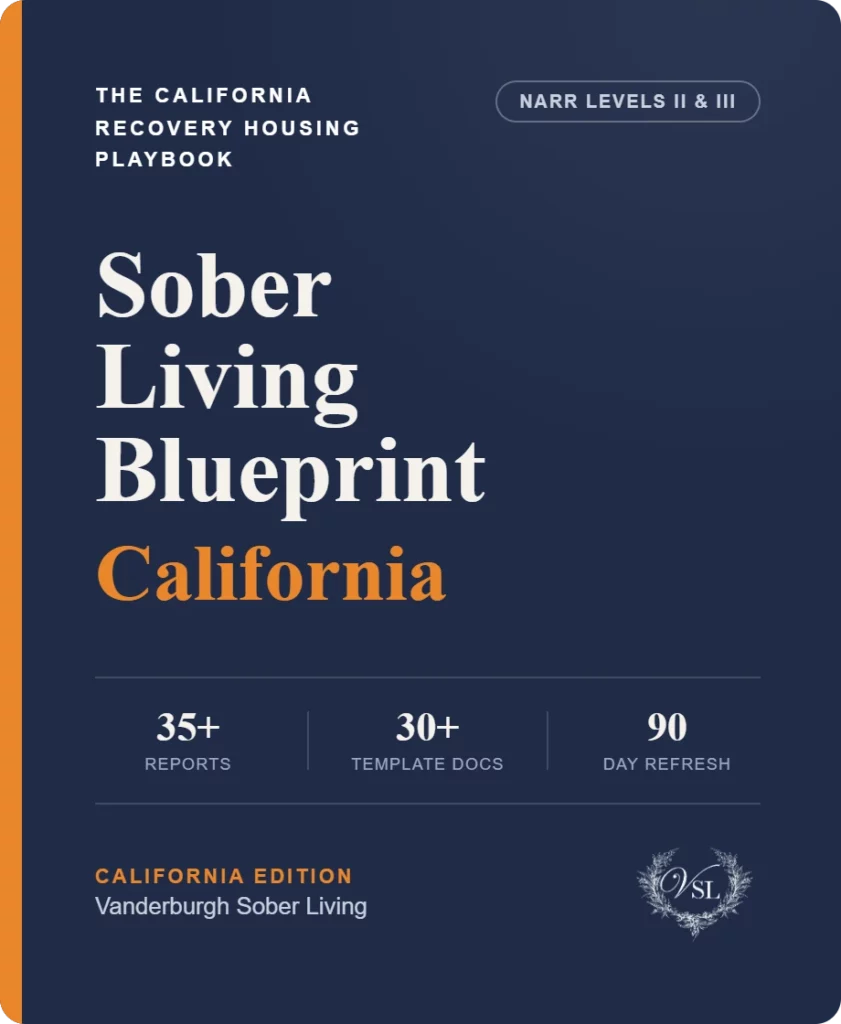
What Does It Cost to Start a Sober Living Home?
Two decisions drive California startup cost more than every other line combined: whether you lease or buy, and how large a reserve you carry into the ramp. The model below uses a 14-bed reference home and discloses its inputs, which are VSL model assumptions rather than sourced facts: a recovery-housing purchase premium of 1.08 times the median owner-occupied value, a lease premium of 1.60 times the statewide average HUD three-bedroom Fair Market Rent, $1,040 per bed per month, an 18% vacancy allowance, 20% down over a 30-year term, per-bed national bases scaled by the cost of living index, and property tax modeled at 0.75%. The underlying published figures are a median owner-occupied home value of $734,700 from the 2020 to 2024 American Community Survey five-year estimates, a statewide three-bedroom Fair Market Rent of $3,326 (the population-weighted average of HUD’s FY2025 area Fair Market Rents), a 30-year fixed mortgage rate of 6.66% for the week ending August 27, 2026, and a cost of living index of 140.5 against a U.S. baseline of 100 for Q1 2026, with a housing sub-index of 189.5, third-highest in the nation behind Hawaii and Massachusetts. That produces an adjusted purchase price of $793,476, a $158,695 down payment, a $634,781 loan, monthly principal and interest of $4,079, and a monthly lease payment of $5,322. HUD does not compute a statewide three-bedroom Fair Market Rent, so use the metro nearest the property. The figures below are FY2027 Fair Market Rents, effective October 1, 2026, and across California’s 51 FMR areas the FY2027 three-bedroom figures run from about $1,700 to $4,832. Every figure in the startup cost breakdown below is an estimated priced line for the 14-bed reference home.
Whichever route you take, the property side of the deal is covered in our recovery housing real estate section: what to look for when buying a sober house, how sober house loans are underwritten, and what a landlord expects on a long term lease.
FY2027 Three-Bedroom Fair Market Rents Across California
| Metro | FY2027 three-bedroom FMR | Demand |
|---|---|---|
| San Francisco | $4,832 | High |
| San Jose-Sunnyvale-Santa Clara | $4,396 | High |
| Los Angeles-Long Beach-Glendale | $3,760 | Very high |
| San Diego-Chula Vista-Carlsbad | $3,743 | High |
| Oakland-Fremont | $3,592 | High |
| Sacramento-Roseville-Arden-Arcade | $2,887 | Moderate |
| Riverside-San Bernardino-Ontario | $2,771 | Moderate |
| Fresno | $2,333 | Low, thinnest supply |
| Bakersfield-Delano | $2,293 | Low, thinnest supply |
California Startup Cost Breakdown
| Cost category | Estimated range |
|---|---|
| Entity, first-year state costs | Purchase path $890 · lease path $890 |
| Down payment, 20% | Purchase path $158,695 |
| Lease upfront, two to three months | Lease path $10,643–$15,965 |
| Furniture and setup, 14 beds | Purchase path $26,220 · lease path $26,220 |
| Supplies and linens | Purchase path $3,934 · lease path $3,934 |
| Utility deposits | Purchase path $843 · lease path $843 |
| Marketing and launch | Purchase path $702 · lease path $702 |
| Property insurance, year one | Purchase path $1,788 |
| Operating reserve, three months | Purchase path $17,865 · lease path $19,659 |
| Subtotal of priced lines | Purchase path $210,937 · lease path $62,891–$68,213 |
Both figures are subtotals of priced lines, not all-in totals. Three material lines have no authoritative price and must be quoted locally: general liability insurance, the CCAPP recovery residence application fee, which is not published and is quoted on request, and any code or safety upgrades including sprinkler work, which the authority having jurisdiction determines. Presenting a single all-in total would misrepresent what is known. On the operating side, the same 14-bed purchase-path model carries $5,955 in monthly expenses, comprising mortgage principal and interest of $4,079, real estate taxes of $496, property insurance of $149, electricity of $265, water and sewer of $228, natural gas of $100, internet and television of $83, urine drug screens of $128, house supplies of $175, repairs and maintenance of $150, administrative costs of $67, and print marketing of $35. Against $10,959 in total revenue, that leaves $5,004 in net operating income before owner’s labor, a 45.7% net margin, $357 net per bed per month, and a 39% breakeven, about five of 14 beds. General liability insurance is not in that expense stack and cannot be priced from any published source; once quoted, it raises both the expense total and the breakeven. On those numbers the $158,695 down payment recovers in about 32 months, roughly two years and eight months, at stable occupancy, before general liability is priced in. Operators who want the whole sequence with worksheets can work through the Mastery Program or start at get started.
California City Guides
City selection is the highest-leverage decision a California operator makes, and twenty-one California markets have their own startup guide covering local zoning posture, rent, and referral density. The guides run from Sacramento and the Bay Area through the Central Valley to Los Angeles, Orange County, the Inland Empire, and San Diego, listed north to south.
- Open Sober Living in Sacramento, CA
- Open Sober Living in Stockton, CA
- Open Sober Living in Oakland, CA
- Open Sober Living in San Francisco, CA
- Open Sober Living in Modesto, CA
- Open Sober Living in Fremont, CA
- Open Sober Living in San Jose, CA
- Open Sober Living in Fresno, CA
- Open Sober Living in Bakersfield, CA
- Open Sober Living in Santa Clarita, CA
- Open Sober Living in San Bernardino, CA
- Open Sober Living in Fontana, CA
- Open Sober Living in Los Angeles, CA
- Open Sober Living in Riverside, CA
- Open Sober Living in Moreno Valley, CA
- Open Sober Living in Anaheim, CA
- Open Sober Living in Long Beach, CA
- Open Sober Living in Santa Ana, CA
- Open Sober Living in Irvine, CA
- Open Sober Living in San Diego, CA
- Open Sober Living in Chula Vista, CA
Sober Living Guides Every Operator Needs
These evergreen guides apply in every state and cover the fundamentals every recovery housing operator should know.
About the Book: How to Open in California
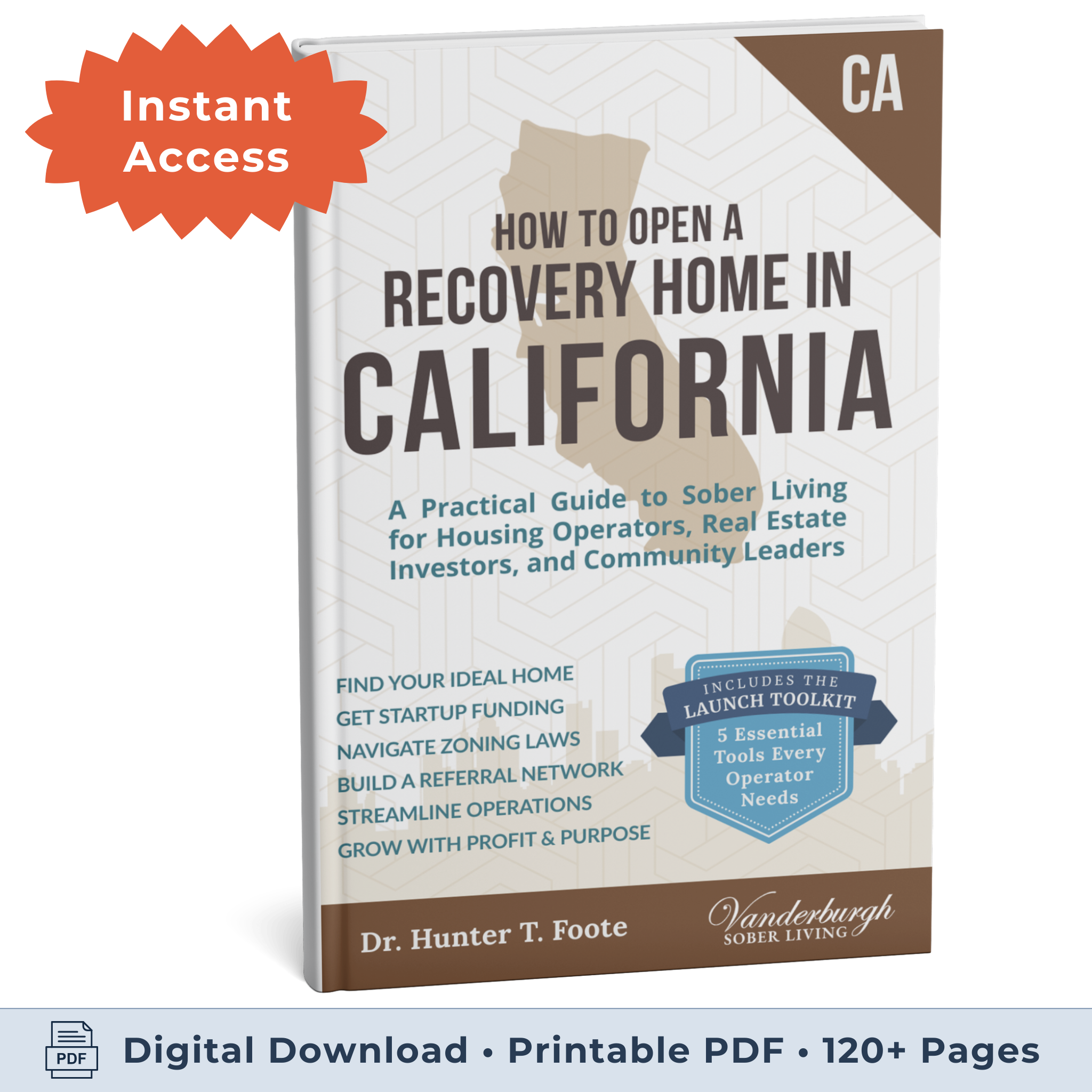
Everything we’ve learned about opening a certified home, written for California.
Start a Sober Living Home With VSL
California pairs the largest recovery housing market in the country with no state license requirement for non-clinical recovery housing. What decides your outcome is local: choose the city deliberately, keep licensable services out of the house, confirm occupancy classification in writing before you commit, and quote general liability insurance and any code upgrades rather than budgeting from a national figure. If you want help mapping that sequence to a specific California property, reach out to the Vanderburgh Sober Living team and we will walk it with you.
Learn How Sober Living Works
Understand how sober living works and whether operating is right for you before you commit.
Evaluate Your Property
See whether your property will pencil out with a custom California financial projection.
Build a California Home With VSL
Get hands-on startup, certification, and operating support and join the VSL Chartered Operator community.
Research & Sources
Research material and primary sources referenced in this guide:
- Foote, H. T. (2026). Vanderburgh Sober Living Operating Climate Index, 2026 Edition. Vanderburgh Sober Living.
- California Department of Health Care Services. Licensing and certification: Facility licensing.
- California Department of Health Care Services. Licensing and certification: Complaints.
- California Department of Health Care Services. ADP Bulletin 05-15.
- California Legislative Information. Health and Safety Code §§11834.01, 11834.02, 11834.20, 11834.23, 11834.31, 11833.05, 11831.6, 11831.7, 11853.5, 13143.6, 13146, 17960.
- City of Dana Point v. New Method Wellness, Inc., No. G056741 (Cal. Ct. App. 2019).
- California Attorney General. Opinion 07-601 (Dec. 18, 2007).
- California Department of Housing and Community Development. Group home technical advisory (Dec. 2022).
- SoCal Recovery, LLC v. City of Costa Mesa, 56 F.4th 802 (9th Cir. 2023).
- The Ohio House, LLC v. City of Costa Mesa, 135 F.4th 645 (9th Cir. 2025).
- California HCD, Civil Rights Department & Attorney General. Legal alert: Compliance with state housing laws re group homes (June 3, 2026).
- U.S. Department of Justice & U.S. Department of Housing and Urban Development. Joint statement on state and local land use laws and the Fair Housing Act (Nov. 10, 2016).
- CCAPP Recovery Residences. Start a recovery residence; Templates; Complaints.
- National Alliance for Recovery Residences. NARR Standard 3.0.
- California Department of General Services, Building Standards Commission. 2025 Title 24 California code changes.
- California State Fire Marshal / HCD. Information bulletin on residential sprinklers.
- California Department of Health Care Services. Proposition 1 BHSA: How to use BHSA/MHSA funds for housing.
- California Department of Health Care Services. Bond BHCIP Rounds 1 and 2 FAQ.
- California Attorney General. Opioid settlement guidance (Oct. 30, 2024).
- California Department of Health Care Services. Community Supports Policy Guide, Volume 2.
- California Department of Corrections and Rehabilitation. Specialized Treatment for Optimized Programming.
- Judicial Council of California. Collaborative justice courts fact sheet.
- SAMHSA. 2023–2024 NSDUH state releases; 2024 N-SUMHSS state profiles.
- U.S. Census Bureau. ACS 2020–2024 five-year estimates, Table DP04.
- U.S. Department of Housing and Urban Development. Fair Market Rents.
- Freddie Mac. Primary Mortgage Market Survey.
- Missouri Economic Research and Information Center. Cost of living data series.
- California Department of Insurance. Homeowners insurance studies and reports.
- California Secretary of State; California Franchise Tax Board. Business entity fees; LLC and corporation tax requirements.
- U.S. Census Bureau, State population totals and components of change: 2020–2025, Vintage 2025 (July 1, 2025 estimates)
Pick Your Path
Find the next step that fits where you are right now.
Just getting startedLearn how sober living works and browse California resources.Already have a propertyEvaluate readiness and run a custom projection.Ready to go deeperGet hands-on startup, certification, and operating support.
Will Your Property Pencil Out?
Get a custom financial projection for your California sober living property, then compare it with single-family and multifamily returns.