California is the clearest test of whether opening a sober house is profitable when the market is excellent and the entry price is punishing. Rent per bed is high, referral volume is enormous, and public capital is unusually reachable for a for-profit operator. The property that generates all of that costs more than in almost any other state, and the entitlement question of whether a city will let you open at all sits on top of the capital question. This post runs the whole model, revenue and cost, on California’s actual numbers. The national figures for all 50 states show whether sober living homes are profitable in every state, including California.
Before you read onHow to Open a Sober Living Home in CaliforniaThis post covers one piece of the process. The complete California guide walks through every step, from planning to your first resident.→Is It Profitable to Operate a Recovery Home in California?
Yes, a well-run California recovery home is profitable at the operating line. A 14-bed home at $1,040 per bed produces about $10,959 in monthly revenue against roughly $5,955 in priced monthly operating expenses, leaving near $5,004 in monthly net operating income before the owner’s own labor. What California punishes is not the operating line. It is the capital required to reach it and the permitting required to open.
Run your own numbersSober Living CalculatorThe model above uses one sample California home. Enter an address and square footage to see the beds, rent per bed and monthly revenue for your property.→That split is the whole California story, and the Vanderburgh Sober Living Operating Climate Index puts numbers on it. California ranks 4 of 50 with a composite Operating Climate Score of 8, and scores 10 for market strength and 10 for operator funding access (Foote, 2026). It also carries a Startup Burden Score of 1 and a Return on Capital Score of 2, close to the floor on both (Foote, 2026). Read those four together and the state resolves cleanly: demand and money are abundant, the return on each dollar of capital is thin, and the operators who win solve the capital and entitlement problems before they solve anything else.
Foote (2026) classifies California as moderately regulated with no mandatory operating license, which is what keeps the operating line healthy. The California Department of Health Care Services (DHCS) holds the sole authority in state government to license adult alcohol or other drug recovery or treatment facilities under Health and Safety Code section 11834.01, and DHCS states that it “does not license, certify, or investigate complaints against sober living/transitional living homes” (DHCS, Licensing and Certification). Licensure attaches only when a home provides one of the licensable services listed in 9 CCR sections 10505(a) and 10501(a)(5): detoxification, individual sessions, group sessions, educational sessions, recovery or treatment planning, or incidental medical services. As of September 2026 there is no statewide registration, roster, or licensure requirement for a non-clinical sober living home in California. No license means no licensing fee, no licensed-staffing floor, and no clinical cost structure sitting on top of the rent roll.
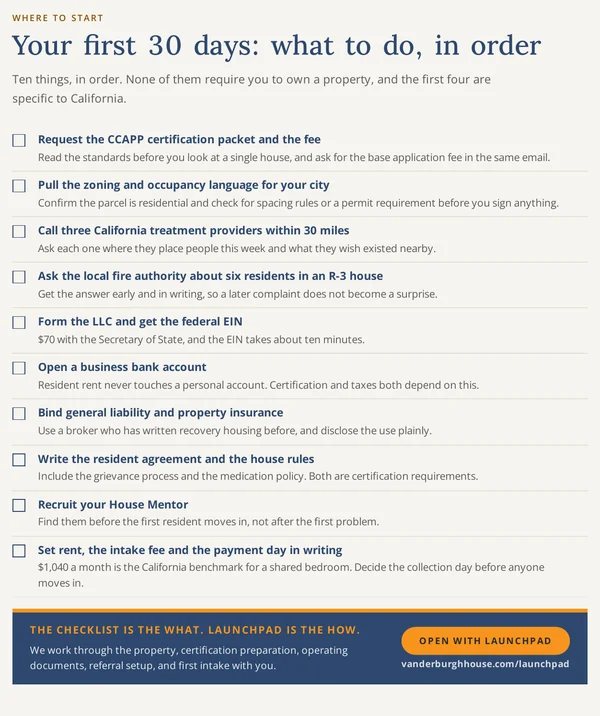
Most people ask whether they are allowed to open a recovery home. The better first question is whether the need and the money are there. This answers both, for your state.
- How many people need a bed, and how few beds exist
- Who actually pays the rent, and which programs are real
- What it costs to open on the purchase path and the lease path
Typical Revenue Per Bed
Revenue in a California home starts from a weekly rate, because that is how residents pay and how the referral market quotes.
- Rent per bed: $1,040 per month, or $240 per week, is the modeled California anchor. It sits above the national midpoint because the underlying market does. California’s cost-of-living index is 140.5 against a national 100, with a housing sub-index of 189.5, the third-highest in the nation behind Hawaii and Massachusetts (Missouri Economic Research and Information Center, Q1 2026).
- What the market will bear: Median gross rent statewide is $2,036 a month, and 55.3% of California renter households pay 30% or more of income on rent (U.S. Census Bureau, ACS 2020-2024 5-Year, Table DP04). A shared bed at $240 a week undercuts a private unit by a wide margin, which is why demand holds at a high nominal rate.
- Bed count: 14 beds in the reference model. Whether a given California city will permit 14 beds in the housing stock this model assumes is a separate question, covered under break-even.
- Target occupancy: An 18% vacancy allowance, so 82% average occupancy across the year. That is a working assumption, not a best case.
- Other income: Intake fees average $550 a month and laundry service adds $175.
- The referral lever: Occupancy in California is less a marketing problem than a credentialing one. The California Consortium of Addiction Programs and Professionals (CCAPP), a 501(c)(6) established in 1972, is California’s only affiliate of the National Alliance for Recovery Residences (NARR), the single California entry in NARR’s affiliate directory. CCAPP describes itself as “the only organization recognized by California’s Department of Health Care Services as providing certification for recovery residences.” DHCS publishes no corresponding statement of recognition. What is independently verifiable is that CCAPP is the state’s only NARR affiliate, which makes its searchable registry the screen courts, counties, and discharge planners consult.
Operating Costs
Every monthly expense line below is scaled to California rates, and the mortgage line assumes the home was purchased rather than leased.
| Monthly Operating Cost | Amount |
|---|---|
| Mortgage principal and interest | $4,079 |
| Real estate taxes | $496 |
| Property insurance | $149 |
| Electricity | $265 |
| Water and sewer | $228 |
| Natural gas | $100 |
| Internet and TV | $83 |
| Urine drug screens | $128 |
| House supplies | $175 |
| Repairs and maintenance | $150 |
| Administrative | $67 |
| Print marketing | $35 |
| Total Monthly Operating Costs | $5,955 |
The mortgage line is what separates California from almost everywhere else. It carries 69% of the entire priced expense stack on its own, at 6.66%, the Freddie Mac Primary Mortgage Market Survey rate for the week ending August 27, 2026. The utility lines are comparatively tame: California’s average monthly residential electricity bill is $160.86, at an average 31.97 cents per kilowatt-hour (U.S. Energy Information Administration), before the uplift a full house adds. The property insurance line reflects a $1,788 average annual written premium for Homeowners Multi-Peril coverage in California in 2023, a figure that rose 43% from $1,247.63 in 2019 (California Department of Insurance), so an operator quoting coverage today should expect to pay more than the table shows.
One material cost is missing from that table, and it is missing for a reason. No state or federal agency publishes premium data for general liability coverage on recovery residences. Operators should budget for it as a line item and obtain quotes from carriers writing habitational or social-service occupancy in California; the California Department of Insurance publishes premium data only for residential property lines, not commercial liability. General liability will raise both the expense total and the break-even occupancy shown further down this page once it is quoted.
One-time capital is a separate exercise, and sober living startup costs in California carries the full itemization.
This pro forma is an estimated model, not audited results. Revenue is built from a $240 weekly rate across 14 beds, less a house mentor bed, less a membership and scholarship allowance, less an 18% vacancy allowance applied to rent net of those deductions, plus intake and laundry income. The property basis is the $734,700 median value of owner-occupied California homes (ACS 2020-2024 5-Year, Table DP04), which is self-reported owner value rather than a sale price, multiplied by a disclosed 1.08 recovery-housing purchase premium to reach $793,476, financed at 20% down over 30 years. The lease path applies a disclosed 1.60 premium to the statewide average HUD FY2025 three-bedroom Fair Market Rent of $3,326, giving $5,322 a month. Per-bed operating bases are scaled by the 140.5 cost-of-living index, and property tax is modeled at 0.75%. The model prices no general liability insurance, no CCAPP application fee, and no code or safety upgrades, because no authoritative source publishes them. It also prices no entitlement cost: permit fees, permit timeline, and the possibility that a city’s separation or occupancy rules foreclose the site entirely are real expenses this model does not carry. Dollar figures are rounded to whole dollars.
A Sample Pro Forma for a California Sober House
AssumptionsHere is the model end to end, from potential rent at full occupancy down to the bottom line.
| Line Item | Monthly Amount |
|---|---|
| Potential rent at full occupancy (14 beds × $1,040) | $14,560 |
| Less: house mentor bed | ($1,040) |
| Less: membership and scholarship allowance | ($1,040) |
| Less: vacancy allowance (18%) | ($2,246) |
| Net rent income | $10,234 |
| Plus: intake fee income | $550 |
| Plus: laundry service income | $175 |
| Total revenue | $10,959 |
| Less: total priced operating expenses | ($5,955) |
| Net Operating Income, Before Owner’s Labor | $5,004 |
That bottom line is not take-home pay. It excludes the operator’s own time running the house, and in California that time is substantial: permitting conversations with a city, referral relationships across a county-by-county funding landscape, and the daily work of holding occupancy in a saturated coastal market. The house mentor is not part of that cost, because the mentor lives in the home rent-free and that bed is already deducted above. An owner who wants to be fully absentee hires an operator to run the house, a part-time role that typically costs $600 to $1,200 or more a month depending on the size of the house, which leaves roughly $3,804 to $4,404 of the net operating income shown. The general liability premium comes out of the same line.
Owners who do not want to run the house can lease it to a VSL-chartered operator instead.
If the model pencils out, the next question is what a house that produces those numbers costs to acquire. Our guide to buying a sober living home covers price ranges, what to look for, and how the purchase is usually structured.
Will your property pencil out?
Get a custom projection for your California property, then compare it with typical returns.
Get my projectionFree calculator with your property’s numbers.See California startup costsWhat it costs to open a certified home in California.What the Margin Really Looks Like
The model runs a net margin of 45.7% and an expense ratio of 54.3%, which works out to about $357 per bed per month on the priced expense stack. That is a strong operating margin by small-business standards and a thin one relative to the asset it sits on. Both readings are correct at once, and holding them together is the only way to understand California.
For an owner-operator who does the work, $357 per bed per month is real income that compounds with each additional bed and each point of occupancy held. For an owner who wants a passive return on a $793,476 property, the arithmetic is much less generous, and that is what a Return on Capital Score of 2 reflects (Foote, 2026). California rewards labor more than it rewards capital. Operators who understand that going in tend to do well. Investors who expected a market strength score of 10 to translate into a capital return are the ones who get surprised.
Sober Living vs. Standard Rental: Which Earns More?
The comparison is not close, and California is the state where it is least close. HUD does not publish a statewide three-bedroom fair market rent, so the honest comparison names a metro. The figures below are HUD’s FY2027 fair market rents, effective October 1, 2026, and HUD renamed several California areas in that publication, so an operator checking a specific county should search the current area name.
| Model | Monthly Figure | What It Means |
|---|---|---|
| Recovery home, total revenue | $10,959 | Monthly revenue from a 14-bed home at $1,040 per bed with an 18% vacancy allowance, plus intake and laundry income. |
| Recovery home, net operating income before owner’s labor | $5,004 | What is left after the priced operating expenses, before the owner’s own labor and before general liability is quoted. |
| Long-term rental, three-bedroom fair market rent, Riverside-San Bernardino-Ontario | $2,771 | Does not cover the $4,724 a month of mortgage, taxes, and property insurance on the modeled property. |
| Long-term rental, net of mortgage, taxes, and property insurance | ($1,953) | A median-priced California house does not pay for itself as a conventional single-family rental. |
The mortgage, taxes, and property insurance on the modeled property total $4,724 a month. A three-bedroom lease at the Riverside-San Bernardino-Ontario fair market rent of $2,771 does not cover that carry, and neither does Los Angeles-Long Beach-Glendale at $3,760. Only San Francisco, at $4,832, clears it, and by about $108. Across California’s 51 fair market rent areas, FY2027 three-bedroom figures run from roughly $1,700 to $4,832, so almost nowhere in the state does a median-priced house pay for itself as a conventional single-family rental. That is not a fair market rent problem. It is a rent-to-price problem: the median owner-occupied value is $734,700 against median gross rent of $2,036 (ACS 2020-2024 5-Year, Table DP04).
A house large enough for 14 beds would of course rent for more than a three-bedroom. Even at double the Riverside three-bedroom figure, a conventional lease clears a few hundred dollars a month against the recovery home’s $5,004. The extra effort is the counterweight. A conventional tenant pays once a month and calls twice a year. A recovery home is an operating business with residents, referral partners, a house mentor, turnover, and a community relationship to maintain.
What would your property do?
Start with the numbers, or start the conversation.
Run a custom income projectionFree calculator: see the numbers for your specific property.Get the investor book seriesDr. Foote’s guides to buying, financing, and upfitting recovery housing.Talk to VSL about your propertyExplore leasing to a vetted operator, no operating required.Or call (844) 762-3747, weekdays 8a to 5p.
How Long Until a California Sober House Breaks Even?
Monthly cash flow turns positive at 39% occupancy, about 5 of 14 beds filled, on the priced expense stack. General liability insurance, once quoted, raises that break-even, so treat 5 beds as the floor rather than the number. Most homes reach it inside the first 60 days if certification and referral relationships were built before the doors opened, and considerably later if they were not. Filling the back half of the house is where the discipline of keeping beds full starts paying for itself.
Recovering the capital takes far longer, and this is where a Startup Burden Score of 1 shows up in real time (Foote, 2026). The purchase path requires a $158,695 down payment, and priced startup lines subtotal $210,937. At $5,004 a month of net operating income, the down payment alone takes about 32 months, roughly two years and eight months, at stable occupancy and before general liability is priced in. The lease path substitutes a $5,322 monthly lease for the mortgage, tax, and property insurance lines, and its priced startup lines subtotal $62,891 to $68,213. Both figures are subtotals of priced lines only. Three material lines carry no authoritative price and must be quoted locally: general liability insurance, the CCAPP application fee, and any code or safety upgrades including sprinkler work, which the local building official determines. A single all-in entry number would be a guess dressed as a budget.
The larger timing risk is not the payback period. It is whether the city lets you open. Health and Safety Code section 11834.23 is a licensing-chapter provision, and its protections run to alcohol and drug recovery or treatment facilities that hold a DHCS license. Article 2 is invoked by “any person licensed under this chapter”, the article’s resident count is defined by reference to “the licensee”, and the only published decision to construe the section describes it as preempting local zoning “for drug abuse recovery facilities that are both licensed and serve six or fewer people” (City of Dana Point v. New Method Wellness, Inc., No. G056741). The Attorney General agrees and separates peer homes out: “The latter ‘sober living environments’ are not subject to licensing by the Department.” An unlicensed, peer-based sober living home should not plan around section 11834.23.
That does not leave an unlicensed home unprotected. California’s Department of Housing and Community Development advises that group homes “that do not provide licensable services should be allowed in single-family neighborhoods, subject only to the generally applicable, nondiscriminatory health, safety, and zoning laws that apply to all single-family residences,” and adds that “this is true even if these homes have more than six residents” (HCD Group Home Technical Advisory). HCD grounds that in the federal Fair Housing Act, the Fair Employment and Housing Act, Government Code section 65008, and the state’s affirmatively furthering fair housing and housing element laws. Practically: a licensed six-or-fewer facility has a statutory, self-executing shield. An unlicensed home has a fair-housing case, strong on the law, that a city can still make you answer through a permit process and a written reasonable-accommodation request.
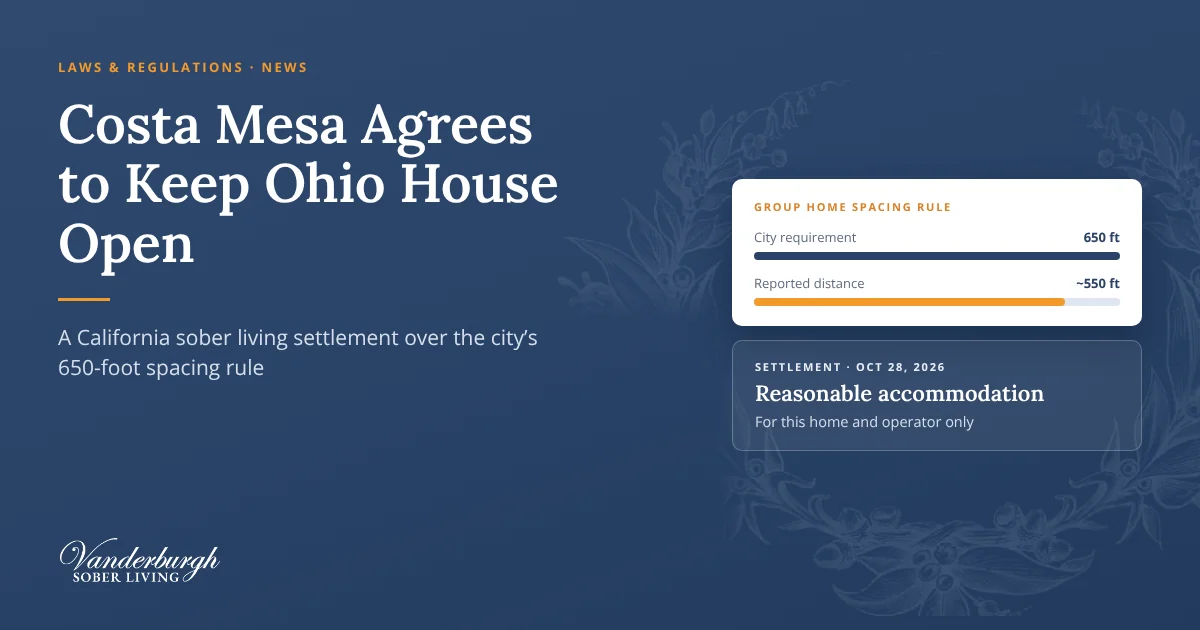
Three things actually govern bed count, and none is section 11834.23. The first is the local occupancy standard the city applies to any dwelling. The second is the occupancy classification the authority having jurisdiction assigns; the California Building Code lists “alcoholism or drug abuse recovery homes (ambulatory only)” among Group R-3 occupancies, and the building department of every city or county enforces that call under Health and Safety Code section 17960, so confirm it in writing with the building official and fire authority before signing a lease or closing. The third is entitlement risk, which is a real cost line. In Costa Mesa’s R1 zone a sober living home with six or fewer occupants requires a special use permit, and a home with more than six is prohibited outright with no permit pathway at all, which means the 14-bed model in this post cannot be built in that city’s single-family stock. Costa Mesa also imposes a 650-foot separation from any other sober living home, group home, or state-licensed treatment facility, measured from the closest property lines. The record in the Ninth Circuit case testing those rules showed that separation requirement disqualifying 22 of 26 group homes. Newport Beach’s code goes further: Table 2-1 affirmatively prohibits an unlicensed six-or-fewer home in its R-A, R-1, and R-BI/R-2 zones and allows it only with a discretionary use permit in RM and RMD, while a licensed six-or-fewer facility is permitted in all four.
That asymmetry is why some California operators consider licensure deliberately rather than by default. A DHCS license opens Article 2, including the section 11834.23 residential-use protections and the section 11834.22 business-tax and fee exemption for a six-or-fewer facility. It also brings DHCS application and renewal fees, inspections, and the standard-of-care and insurance obligations a licensed facility carries, and a licensed facility is a clinical business with a different cost structure than the model on this page. Neither path is free. The point is that the choice is an economic one, made before the property is bought.
What Drives Profitability (and What Hurts It)
Six levers move the number more than anything else in this state.
- Certification and referral access: CCAPP certification is the entry ticket to the referral screens that fill beds. CCAPP does not publish its recovery residence application fee; the amount is quoted on request, and CCAPP will not begin processing an application until the fee is submitted. The only amounts CCAPP publishes are a $100 cancellation fee and a $100 reinspection fee, alongside a 30-day processing period and an annual peer site visit. Sequencing matters more than cost, and how to certify a sober living home in California sets out the order of operations.
- Occupancy management: Every point of occupancy above the 82 percent assumption is close to pure margin, because the priced cost stack barely moves.
- City selection: After the Ninth Circuit’s decision in The Ohio House, LLC v. City of Costa Mesa, 135 F.4th 645 (9th Cir. 2025), choosing a city with a workable permit pathway is worth more to the pro forma than shaving any expense line.
- Fee setting: With 55.3% of California renters already paying 30% or more of income on rent, pricing sits between what residents can pay and what the property costs to carry (ACS 2020-2024 5-Year, Table DP04).
- Payer mix: Justice-referred residents come with funding attached. The California Department of Corrections and Rehabilitation runs Specialized Treatment for Optimized Programming through six statewide contracts and six regional placement offices, in Fresno, Los Angeles, Sacramento, San Bernardino, San Diego, and Santa Clara County (Campbell), placing parolees in their first year of release for “up to 180 days, with the possibility of up to an additional 185 days, based on assessed need.”
- Cost control: The mortgage is 69% of the priced stack, so the financing terms are the cost-control decision. Everything else is rounding.
Mistakes That Sink California Sober Living Margins
The failure patterns in California are consistent and mostly financial.
- Overpaying for the property. A purchase price that pushes principal and interest past $4,079 eats the margin at origination, and no amount of operating discipline recovers it.
- Underwriting a site before checking the code. Buying into a city where the bed count has no permit pathway, or where a separation rule forecloses the parcel, is the most expensive mistake available in this state.
- Building the pro forma on Medi-Cal rent. Medi-Cal does not pay ongoing or recurring rent for an independent sober living home. CalAIM’s Transitional Rent can pay rent in a recovery-housing setting, and has been mandatory for every Medi-Cal managed care plan to offer since January 1, 2026, but only for up to six months, once per five-year demonstration, and only for members who meet all three eligibility tests. DHCS is explicit that Transitional Rent “will not provide permanent housing or long-term housing stability on its own, as it is limited to six months.” No Medi-Cal benefit funds a sober living home’s rent roll. Housing Deposits’ $5,000 is DHCS’s recommended maximum rate, not a statutory lifetime cap.
- Skipping certification to save the fee. In a state with one NARR affiliate, an uncertified home is invisible to the referral sources that fill the back half of the house.
- Underpricing to fill fast. Dropping the weekly rate to chase occupancy trades permanent revenue for temporary beds.
- Leaving general liability out of the budget. It is absent from the table on this page because no agency publishes a price, not because it is optional.
- Weak house culture. Turnover is the most expensive line item that never appears on the expense table.
Why Demand for Recovery Housing Keeps Growing
California’s demand side is not a forecast. It is a standing condition.
Substance use disorder prevalence in California runs 16.65 percent of the population aged 12 and older, about 5,556,000 people (SAMHSA, NSDUH 2023-2024), against a population of 39,355,309 as of July 1, 2025. The state’s age-adjusted drug overdose death rate was 21.7 per 100,000 in 2024, down from 27.9 in 2023 and 26.9 in 2022, a genuine improvement that has not reduced the need for housing after treatment. California operates 1,495 substance use treatment facilities serving 90,954 clients, each of them a discharge point that needs somewhere to send people, plus more than 400 collaborative justice courts including 97 adult drug courts, 18 reentry courts, and 20 DUI courts.
The public investment behind that demand is what earns California its operator funding access score of 10 (Foote, 2026). Proposition 1 authorized $4.4 billion (DHCS puts the available total at $4.393 billion) for the Behavioral Health Continuum Infrastructure Program. DHCS has now awarded all of it across two bond rounds: $2.99 billion in Bond BHCIP Round 1: Launch Ready, announced May 12, 2025, and $1.18 billion in Bond BHCIP Round 2: Unmet Needs, announced March 11, 2026, for $4.17 billion total, funding 177 projects across 333 behavioral health facilities and producing 6,919 residential treatment beds and 27,561 outpatient treatment slots. Counting all rounds since 2021, BHCIP and Bond BHCIP have awarded $5.8 billion, creating 9,553 beds and 47,163 outpatient slots. Awards remain conditional pending final DHCS verification. No BHCIP round is currently open; Round 2 applications closed October 28, 2025.
The recurring money matters more to an operating pro forma than the capital rounds do. Beginning in 2026, counties must spend 30 percent of their Behavioral Health Services Act allocation on housing interventions, with half of that, 15 percent of the total, prioritized for people experiencing chronic homelessness, and up to 25 percent of the 30 percent available for capital development. DHCS names “Shared housing (including recovery housing)” as a permitted intervention and states directly that “recovery housing is an allowable use of BHSA Housing Intervention funds.” The FY 2026-27 statewide housing component runs about $950 million. County opioid settlement dollars can supply a BHCIP match: California expects up to $4.2 billion, split 70 percent to the California Abatement Accounts Fund, 15 percent to the California Subdivision Fund, and 15 percent to the State Fund, so 85 percent reaches local governments (Attorney General settlement guidance). Participating subdivisions must spend no less than 50 percent of their Abatement Accounts Fund receipts each calendar year on High Impact Abatement Activities, the first of which is “provision of matching funds or operating costs for substance use disorder (SUD) facilities within the Behavioral Health Continuum Infrastructure Program,” and DHCS allowable expenditures expressly permit funds to “provide access to housing for people with OUD … including supportive housing, recovery housing, housing assistance programs.”
Local governments also received a warning worth knowing about. On June 3, 2026, HCD, the Civil Rights Department, and the Attorney General jointly issued a legal alert on compliance with state housing laws regarding group homes, cautioning cities not to read Ohio House as a green light: the Ninth Circuit “declined to fully analyze California’s broader housing and anti-discrimination laws,” copying Costa Mesa’s approach “could expose localities to liability under California’s robust planning, zoning, and fair housing laws,” and a federal court’s reading of state law “does not bind California state courts.”
Nonprofit vs. For-Profit: Which Structure Fits?
Structure changes the numbers above more in California than in most states, mainly through grant eligibility and the franchise tax.
- For-profit LLC: first-year unavoidable state costs are $890, being the $70 Articles of Organization plus a $20 initial Statement of Information plus the $800 annual minimum franchise tax, plus whatever a registered agent service charges if the operator hires one instead of serving as agent personally. There is no first-year exemption: the relief that once applied to new LLCs covered only tax years beginning January 1, 2021 through December 31, 2023. The separate LLC fee is assessed on total California income rather than profit under Revenue and Taxation Code section 17942, and it is $0 below $250,000, which is where a single 14-bed house at this model’s revenue sits.
- Nonprofit corporation:Formation is $30, the entity registers with the Attorney General on Form CT-1 for $50 within 30 days of first receiving charitable assets, and an organization that obtains California exemption on FTB Form 3500A is not subject to the $800. A nonprofit that never obtains FTB exemption does owe it.
- The lever that actually moves money: BHCIP match requirements are 25 percent for for-profit organizations and 10 percent for local government and nonprofits, with Tribal entities at 5 percent, and for-profits are eligible applicants. On a large capital award that 15-point spread is worth more than any operating-line efficiency in this post.
- The trade-off: A nonprofit can pay its founder reasonable compensation for work actually performed but cannot distribute profit or build transferable equity. A for-profit builds a sellable asset and pays a higher match for public capital.
The entity mechanics themselves sit in how to form a legal entity for a sober living business in California. Which programs actually pay, on what schedule, and where operators most often misread the terms is the subject of California recovery housing funding.
California guideHow Recovery Housing Funding Works in CaliforniaGrants, settlement dollars, and the programs that help residents pay, plus the nonprofit funding angle.→Sober Living Guides Every Operator Needs
These evergreen guides apply in every state and cover the levers behind the numbers on this page: the occupancy and referrals that drive revenue, and the financing and property decisions that set your costs.
Frequently Asked Questions About California Sober Living Profitability
How much does a California sober house make per month?
A 14-bed model generates about $10,959 in monthly revenue and roughly $5,004 in monthly net operating income before the owner’s own labor, at $1,040 per bed and an 18 percent vacancy allowance. General liability insurance is not priced in that stack and will reduce it. Smaller homes earn less, and fixed costs do not shrink with bed count.
How long does it take to recover California startup costs?
The $158,695 down payment takes about 32 months at $5,004 of monthly net operating income and stable occupancy. Priced startup lines subtotal $210,937 on the purchase path and $62,891 to $68,213 on the lease path. Both are subtotals: general liability, the CCAPP fee, and any code upgrades are quoted locally.
Can a nonprofit sober living operator pay its founder?
Yes. A California nonprofit corporation may pay reasonable compensation for work actually performed, documented by the board. What it cannot do is distribute surplus as profit or build transferable equity for its founder. Nonprofits also face a 10 percent BHCIP capital match against 25 percent for for-profit applicants.
Are resident fees taxable income?
Yes. Rent and fee income is business revenue to a for-profit operator, reported and taxed accordingly, with operating expenses and depreciation deductible against it. California’s $800 annual minimum franchise tax applies to an LLC regardless of profitability. Confirm treatment with a California tax professional.
Does CCAPP certification pay for itself?
For most California homes, yes. CCAPP is the state’s only NARR affiliate, and its registry is the screen courts, counties, and discharge planners use. CCAPP quotes its application fee on request rather than publishing it, so the payback math starts with that quote, and a few points of sustained occupancy typically cover it.
How VSL Helps You Build a Profitable, Compliant Sober Living Home in California
California pairs a market almost no other state can match with an entry cost and a permitting process that punish anyone who underwrites them casually. The operating line works: a 45.7% net margin, break-even near 5 of 14 beds on the priced stack, about $357 per bed per month before your own labor and before general liability. The capital line and the city you choose are where California decides who gets to operate.
If you are running these numbers against a specific California property and want a second set of eyes on the assumptions before you commit, reach out to our team and we will work through them with you.
Start your sober house
Pick the path that fits where you are in the process.
Download the free guidePath to Purposeful Recovery Housing, by Dr. Hunter T. Foote.Explore the Mastery ProgramHands-on startup, certification, and operating support.See how starting with VSL worksThe opportunity, the community, and what a Charter includes.Prefer to talk now? Call (844) 762-3747, weekdays 8a to 5p.
Research & Sources
- Foote, H. T. (2026). Vanderburgh Sober Living Operating Climate Index, 2026 Edition. Vanderburgh Sober Living. https://www.vanderburghhouse.com/research/operating-climate-index-2026/
- California Health and Safety Code § 11834.01. California Legislative Information. https://leginfo.legislature.ca.gov/faces/codes_displaySection.xhtml?lawCode=HSC§ionNum=11834.01
- California Department of Health Care Services. Licensing and certification: Complaints. https://www.dhcs.ca.gov/individuals/licensing-and-certification-complaints/
- California Department of Health Care Services. Licensing and certification: Facility licensing (9 CCR §§ 10505(a), 10501(a)(5)). https://www.dhcs.ca.gov/provgovpart/Pages/Licensing-and-Certification-Facility-Licensing.aspx
- Missouri Economic Research and Information Center. Cost of living data series (Q1 2026). https://meric.mo.gov/data/cost-living-data-series
- U.S. Census Bureau. American Community Survey 2020-2024 5-year estimates, Table DP04. https://data.census.gov/table/ACSDP5Y2024.DP04?g=040XX00US06
- National Alliance for Recovery Residences. Affiliates. https://narronline.org/affiliates/
- CCAPP Recovery Residences. Start a recovery residence. https://ccapprecoveryresidences.org/start-recovery-residence/
- CCAPP Recovery Residences. Find a recovery residence. https://ccapprecoveryresidences.org/search/
- Freddie Mac. Primary Mortgage Market Survey (week ending August 27, 2026). https://www.freddiemac.com/pmms
- U.S. Energy Information Administration. Electric power sales, revenue, and energy efficiency. https://www.eia.gov/electricity/sales_revenue_price/
- California Department of Insurance. Homeowners insurance studies and reports. https://www.insurance.ca.gov/0400-news/0200-studies-reports/0250-homeowners-study/
- U.S. Department of Housing and Urban Development, Office of Policy Development and Research. Fair market rents (FY2027, effective October 1, 2026). https://www.huduser.gov/portal/datasets/fmr.html
- California Health and Safety Code § 11834.23. California Legislative Information. https://leginfo.legislature.ca.gov/faces/codes_displaySection.xhtml?lawCode=HSC§ionNum=11834.23
- California Health and Safety Code § 11834.20. California Legislative Information. https://leginfo.legislature.ca.gov/faces/codes_displaySection.xhtml?lawCode=HSC§ionNum=11834.20
- California Health and Safety Code § 11834.22. California Legislative Information. https://leginfo.legislature.ca.gov/faces/codes_displaySection.xhtml?lawCode=HSC§ionNum=11834.22
- California Health and Safety Code § 17960. California Legislative Information. https://leginfo.legislature.ca.gov/faces/codes_displaySection.xhtml?lawCode=HSC§ionNum=17960
- City of Dana Point v. New Method Wellness, Inc., No. G056741 (Cal. Ct. App. 2019). https://law.justia.com/cases/california/court-of-appeal/2019/g056741.html
- California Attorney General Opinion 07-601 (Dec. 18, 2007). https://www.oag.ca.gov/system/files/opinions/pdfs/07-601.pdf
- California Department of Housing and Community Development. Group home technical advisory (Dec. 2022). https://www.hcd.ca.gov/sites/default/files/docs/planning-and-community/group-home-technical-advisory-2022.pdf
- California Government Code § 65008. California Legislative Information. https://leginfo.legislature.ca.gov/faces/codes_displaySection.xhtml?lawCode=GOV§ionNum=65008.
- California Building Standards Commission. 2025 Triennial Edition, Title 24 (effective January 1, 2026). https://www.dgs.ca.gov/BSC/Codes
- Costa Mesa Municipal Code § 13-311 (R1 sober living homes). https://ecode360.com/42619209
- Costa Mesa Municipal Code §§ 13-322, 13-323 (separation requirement). https://ecode360.com/42619276
- Newport Beach Municipal Code Table 2-1. https://ecode360.com/50136154
- The Ohio House, LLC v. City of Costa Mesa, 135 F.4th 645 (9th Cir. 2025). https://cdn.ca9.uscourts.gov/datastore/opinions/2025/04/24/22-56181.pdf
- California Attorney General, Department of Housing and Community Development, and Civil Rights Department. Legal alert: Compliance with state housing laws re group homes (June 3, 2026). https://oag.ca.gov/system/files/attachments/press-docs/Legal%20Alert%20re%20Ohio%20House%20v.%20City%20of%20Costa%20Mesa%20-%20Final.pdf
- California Department of Corrections and Rehabilitation. Specialized Treatment for Optimized Programming. https://www.cdcr.ca.gov/rehabilitation/stop
- California Department of Health Care Services. Community Supports policy guide, volume 2. https://www.dhcs.ca.gov/Documents/MCQMD/DHCS-Community-Supports-Policy-Guide-Volume-2.pdf
- California Department of Health Care Services. Community Supports pricing resource. https://www.dhcs.ca.gov/wp-content/uploads/2026/05/Community-Supports-Pricing-Resource.pdf
- Substance Abuse and Mental Health Services Administration. NSDUH state releases, 2023-2024. https://www.samhsa.gov/data/data-we-collect/nsduh-national-survey-drug-use-and-health/state-releases/2023-2024
- U.S. Census Bureau. QuickFacts: California. https://www.census.gov/quickfacts/CA
- Centers for Disease Control and Prevention, National Center for Health Statistics. California state profile. https://www.cdc.gov/nchs/pressroom/states/california/ca.htm
- Substance Abuse and Mental Health Services Administration. 2024 N-SUMHSS state profiles. https://www.samhsa.gov/data/report/2024-n-sumhss-state-profiles
- Judicial Council of California. Collaborative justice courts fact sheet. https://courts.ca.gov/system/files/file/collaborativcourts_factsheet.pdf
- California Department of Health Care Services. Bond BHCIP rounds 1 and 2 FAQ. https://www.dhcs.ca.gov/behavioral-health-continuum-infrastructure-program/bond-bhcip-rounds-1-and-2-faq/
- California Department of Health Care Services. Bond BHCIP Round 2: Unmet Needs. https://www.dhcs.ca.gov/behavioral-health-continuum-infrastructure-program/bond-bhcip-round-2-unmet-needs/
- California Department of Health Care Services. Proposition 1 BHSA: How to use BHSA/MHSA funds for housing. https://www.dhcs.ca.gov/behavioral-health-transformation/proposition-1-behavioral-health-services-act-how-to-use-behavioral-health-services-act-mental-health-service-act-funds-for-housing/
- California Department of Justice, Office of the Attorney General. Opioid settlement guidance. https://oag.ca.gov/system/files/attachments/press-docs/Opioid%20Settlement%20Guidance.pdf
- California Department of Health Care Services. California opioid settlements: Allowable expenditures. https://www.dhcs.ca.gov/Documents/CSD/CA-OSF-Allowable-Expenses.pdf
- California Secretary of State. Limited liability companies forms and fees. https://www.sos.ca.gov/business-programs/cannabizfile/cannabis-forms-and-fees/limited-liability-companies-llc-california
- California Secretary of State. Corporations and cooperatives forms and fees. https://www.sos.ca.gov/business-programs/cannabizfile/cannabis-forms-and-fees/corporations-and-cooperatives-california
- California Secretary of State. Statements of information. https://www.sos.ca.gov/business-programs/business-entities/statements
- California Franchise Tax Board. Limited liability company. https://www.ftb.ca.gov/file/business/types/limited-liability-company/index.html
- California Revenue and Taxation Code § 17942. California Legislative Information. https://leginfo.legislature.ca.gov/faces/codes_displaySection.xhtml?lawCode=RTC§ionNum=17942.
- California Department of Justice, Registry of Charities and Fundraisers. Initial registration. https://oag.ca.gov/charities/initial-reg