Certifying a sober living home in California runs through one organization, and knowing which one saves months. The California Consortium of Addiction Programs and Professionals (CCAPP) is California’s only affiliate of the National Alliance for Recovery Residences, a 501(c)(6) nonprofit established in 1972 and based in Sacramento. Certification is voluntary as a matter of law. It is not optional as a matter of business.
There is no state credential to earn alongside it. As of September 2026 there is no statewide registration, roster, or licensure requirement for a non-clinical sober living home in California, and DHCS states that it “does not license, certify, or investigate complaints against sober living/transitional living homes”. That leaves CCAPP certification as the only recognized quality marker in the largest recovery housing market in the country. California scores 6 for certification value and 10 for market strength (Foote, 2026), and those two numbers describe the situation precisely: enormous demand, and a credential no statute compels you to hold.
Before you read onHow to Open a Sober Living Home in CaliforniaThis post covers one piece of the process. The complete California guide walks through every step, from planning to your first resident.→Who Certifies Sober Living Homes in California?
CCAPP issues certification under the brand CCAPP Recovery Residences and grades applicants against the NARR standard. NARR Standard 3.0, released in November 2018 and still the current edition as of September 2026, operationalizes the social model across four domains, Administrative and Operational, Physical Environment, Recovery Support, and Good Neighbor, containing 10 core principles and 31 standards, applied at four levels of support (Level I peer-run through Level IV clinical). Those four domains are the scoring frame for everything that follows, including the site visit. CCAPP states that it has aligned its standards with NARR, and the NARR standards library is where the underlying document lives.
The level framework is worth understanding before you apply, because it describes what your home looks like on paper. Level I is peer-run and democratically governed with no paid staff. Level II is monitored, with house rules, peer accountability, and a live-in house mentor. Level III is supervised, with structured programming and trained staff. Level IV integrates on-site clinical treatment, which in California is a licensing question rather than a certification question.
One claim about CCAPP circulates widely and needs care. CCAPP describes itself as “the only organization recognized by California’s Department of Health Care Services as providing certification for recovery residences.” DHCS does not publish a corresponding statement recognizing CCAPP; its guidance says only that DHCS does not license, certify, or investigate complaints against sober living or transitional living homes. What is independently verifiable is that CCAPP is California’s only NARR affiliate.
Certified homes appear in CCAPP’s searchable registry of certified recovery residences and receive a certificate plus display badges. The listing is the concrete asset. It is what a discharge planner, a court coordinator, or a family searching “CCAPP certified sober living” actually looks at. How NARR affiliate certification works nationally is covered in the site-wide walkthrough of how to certify a sober house, so this page spends its words on California.
California guideCalifornia Consortium of Addiction Programs and Professionals: The California Certifying Agency, ExplainedWho CCAPP is, the standard it upholds, and what certification signals to the California recovery community.→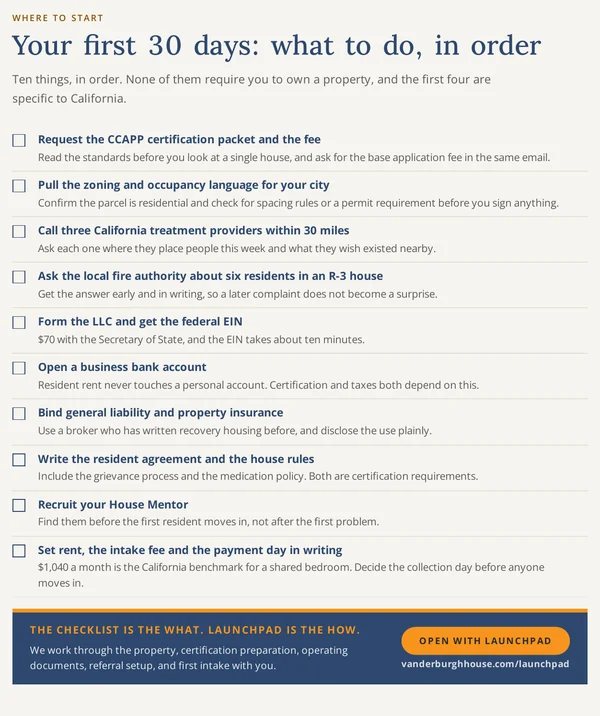
Most people ask whether they are allowed to open a recovery home. The better first question is whether the need and the money are there. This answers both, for your state.
- How many people need a bed, and how few beds exist
- Who actually pays the rent, and which programs are real
- What it costs to open on the purchase path and the lease path
Is Certification Required to Open a Sober Living Home in California?
No. California does not require sober living homes to be certified. As of September 2026 there is no statewide registration, roster, or licensure requirement for a non-clinical sober living home, and DHCS neither licenses nor certifies them. CCAPP certification is voluntary. In practice, referral sources, counties, and courts treat it as the screening filter for placements.
The statutory basis sits in the licensure trigger, which attaches to services rather than to housing. Under 9 CCR sections 10505(a) and 10501(a)(5), as DHCS states them, a license is required to provide 24-hour non-medical residential recovery or treatment services, and the licensable services are detoxification, individual sessions, group sessions, educational sessions, or alcoholism or drug abuse recovery or treatment planning, plus incidental medical services. A peer-supported home providing none of those is outside the licensing scheme. DHCS said the same thing in ADP Bulletin 05-15: sober living environments “are not licensed residential treatment programs and do not provide treatment services.” Where that line sits in detail, including where a house meeting becomes a group session, belongs to the deeper treatment of whether you need a license to open a sober living home in California.
Certification does not change your land-use position, and one widely repeated shortcut needs correcting before you plan around it. Health and Safety Code section 11834.23 is a licensing-chapter provision. Its protections run to alcohol and drug recovery or treatment facilities that hold a DHCS license: Article 2 is invoked by “any person licensed under this chapter,” the article’s resident count is defined by reference to “the licensee,” and the only published decision to construe the section, City of Dana Point v. New Method Wellness, Inc. (Cal. Ct. App. 2019) No. G056741, describes it as preempting local zoning “for drug abuse recovery facilities that are both licensed and serve six or fewer people.” An unlicensed, peer-based sober living home should not plan around section 11834.23.
That does not leave an unlicensed home unprotected. California HCD advises in its Group Home Technical Advisory that group homes “that do not provide licensable services should be allowed in single-family neighborhoods, subject only to the generally applicable, nondiscriminatory health, safety, and zoning laws that apply to all single-family residences,” and adds that “this is true even if these homes have more than six residents.” HCD grounds that in the federal Fair Housing Act, FEHA, Government Code section 65008, and the state’s AFFH and Housing Element laws. Practically: a licensed six-or-fewer facility has a statutory, self-executing shield. An unlicensed home has a fair-housing case, strong on the law, that a city can still make you answer through a permit process and a written reasonable-accommodation request. On June 3, 2026, HCD, the Civil Rights Department, and the Attorney General jointly issued a legal alert warning local governments that copying Costa Mesa’s approach “could expose localities to liability under California’s robust planning, zoning, and fair housing laws.” The land-use side is handled in full by California zoning laws for sober living homes.
Three credentials get confused at the county desk. A license is state permission to provide treatment services. Certification is a third-party audit against the NARR standard, issued by CCAPP. A charter is neither: it is a membership agreement between a home and a private network whose standards the home agrees to run by, it comes from the network rather than the state, no agency issues or revokes it, and it is entirely voluntary. Oxford House charters homes that are democratically self-run and financially self-supporting, require immediate departure on a return to use, and operate with no paid staff in the house. Vanderburgh Sober Living charters independently operated homes into a cooperative network, where the operator keeps ownership of the business and gains the brand, the operating standards, and the startup and certification support of the Chartered Operator community. A charter is not a state credential and never claims to be.
California guideDo You Need a License to Open a Sober Living Home in California?What California actually requires, and where voluntary certification fits instead.→Why Certification Unlocks the California Referral Pipeline
Certification pays for itself through placements, not through compliance. What it buys is credibility, referral access, funder eligibility, and a stronger record if you ever have to make a reasonable-accommodation request. What it does not buy is any change to your licensing or zoning position.
California’s referral machinery is unusually dense, and most of it screens on standards before it sends anyone.
- Justice and corrections: CDCR’s Specialized Treatment for Optimized Programming (STOP) delivers substance use treatment and recovery and reentry housing through six statewide contracts with community-based organizations and six regional placement offices in Fresno, Los Angeles, Sacramento, San Bernardino, San Diego, and Santa Clara County (Campbell). Services run up to 180 days, with the possibility of up to an additional 185 days based on assessed need, for parolees in their first year of release.
- Collaborative-justice courts: California operates more than 400 collaborative justice courts, including 97 adult drug and SACPA courts, 18 reentry courts, and 20 DUI courts. Court coordinators place people on mandates and favor documented standards.
- Treatment step-down: Homes receive residents leaving licensed residential programs and running concurrent with outpatient care. Discharge planners screen for certification because it is the only recognized filter available to them.
- Public funding proximity: DHCS names shared housing including recovery housing as a permitted Behavioral Health Services Act housing intervention and states directly that “recovery housing is an allowable use of BHSA Housing Intervention funds”. Certification is not a stated condition of any specific payment, but it is the credential a county asks about first. What the money can and cannot do is worked through in California recovery housing funding.
You are listed, screenable, and contractable, with an annual peer review to point to when a county asks who checks your work.
You are competing on price and word of mouth in the most saturated recovery housing market in the country, with no third-party answer to the standards question.
One California-specific caution about how these relationships are structured. Two statutes police the money between treatment providers and recovery residences, and both run in the same direction: they bind the licensed or certified provider, not your sober living home. Health and Safety Code section 11831.6 bars licensed facilities, certified programs, and their principals, 10% owners, and staff from giving or receiving anything of value for a referral, and section 11831.7 authorizes DHCS to assess a penalty on a licensed facility, with amounts set departmentally by provider bulletin rather than fixed in the statute. Section 11833.05, as amended by AB 2995 (Ch. 847, Stats. 2024, effective January 1, 2025), obliges licensed facilities and certified programs to disclose to DHCS any ownership, control, or financial interest they hold in a recovery residence. The practical read for an operator: a treatment partner who offers to pay you for beds is proposing something that puts their license at risk and your reputation with it. Build referral relationships on outcomes.
Keep readingTypes of Referral Sources for Recovery HomesThe three tiers of referral partners that keep quality recovery homes full.→How to Certify a Sober Living Home With California Consortium of Addiction Programs and Professionals
The process is documented, but not self-service. CCAPP’s certification application is not available for online self-service; operators request it by email from CCAPP, and its full step count is not published. What follows is the documented sequence, in the order it actually happens.
Step 1. Request the Application
CCAPP’s certification page carries a short email-request form. Ask for the current fee schedule in the same message, so the number lands in your budget before you build a timeline.
Step 2. Choose the Level That Matches the Home You Run
Pick against the NARR standard’s four levels and your real staffing model, not the model you intend to grow into. A monitored home with a live-in house mentor and written house rules is a different application from a peer-run home with no paid staff.
Step 3. Sign the Agreements
CCAPP requires signed acceptance of its Code of Ethics for Certified Recovery Residences, a Statement of Understanding, a Statement of Agreement Regarding Employees, and an Ethical Advertising Agreement. The Code of Ethics is also printed and signed by every owner and staff member, and those signed copies are retained for inspection.
Step 4. Assemble the Required Documentation
Twelve documents are required, and CCAPP publishes templates for them while stating that operators “may choose to use your current forms.” The full list is in the checklist below. This is where applications sit for weeks, and it is the one part of the process entirely under your control.
Step 5. Pay the Fee
CCAPP will not begin processing an application until the fee is submitted, and it does not offer refunds. Payment also gates inspection scheduling, so it comes before the site visit rather than after.
Step 6. Schedule and Pass the Site Visit
You select convenient times and a CCAPP inspector conducts an on-site visit against the published inspection checklist. Deficiencies can require a return visit.
Step 7. Receive the Decision
Certification is discretionary and contingent on demonstrated compliance with all standards throughout the review, so approval is not automatic on submission. On approval, the certificate is available online and a hard copy is mailed.
CCAPP publishes a 30-day processing period for applications. That clock covers CCAPP’s review, not your document preparation or the calendar gap to an inspector’s availability, so plan on a 30-day review inside a longer sequence whose length you largely determine.
What You Need Before You Apply
Everything below should exist before you request the application, because CCAPP asks for it as a document rather than a promise.
- A formed legal entity: The certificate names the operating entity, so decide the structure first. Sequencing and cost sit with the guide to how to form a legal entity for a sober living business in California.
- Current liability insurance: Required as a document. No state or federal agency publishes premium data for general liability coverage on recovery residences. Operators should budget for it as a line item and obtain quotes from carriers writing habitational or social-service occupancy in California; the California Department of Insurance publishes premium data only for residential property lines, not commercial liability. Coverage design for a house is worked through in the operator guide to sober house insurance.
- Higher limits if you plan to contract with government: Health and Safety Code section 11853.5, added by AB 1158 (Chapter 443, Statutes of 2021), requires a recovery residence contracting with a government entity to carry commercial general liability of at least $1,000,000 per occurrence, auto liability of at least $1,000,000, workers’ compensation without self-insurance, employer’s liability of at least $100,000 per occurrence, and professional liability of $1,000,000 per occurrence and $2,000,000 aggregate, with the government entity named as an additional insured.
- Written property authority: A property tax or mortgage statement if you own, or a signed permission letter from the owner if you lease.
- A house mentor and a signed agreement: CCAPP’s required document set includes a House Manager Contract, which is the form’s own title; the role in a VSL home is the house mentor.
- Naloxone on site, with trained people: The inspection checklist requires that naloxone be accessible at each location and that appropriate individuals be knowledgeable and trained in its use.
- A medication policy that accepts prescribed MAT: A residence cannot deny admission solely because an applicant takes physician-prescribed medication for opioid use disorder, and a written medication policy is required. Blanket exclusions, capped beds, taper demands, and dose ceilings all read as discrimination.
- A written answer on occupancy from your local officials: Classification is the building official’s call, so confirm it in writing with the local building official and fire authority before signing a lease or closing, and describe the home accurately, because whether it provides care, supervision, or medication assistance is the fact that decides the answer. Health and Safety Code section 17960 puts enforcement with the city or county building department. If you take government-referred placements, note that section 13143.6 requires the referring agency to request fire-authority verification within seven days, with the placement subject to rescission if verification cannot be given; its sprinkler and alarm requirements attach above six residents, and subdivision (b) removes both where no resident is nonambulatory or handicapped.
Support for every stage
Pick the level of support that fits where you are.
Just getting startedSee how the sober living opportunity works and what starting with VSL looks like.LaunchpadGuided pre-launch program: one-on-one strategy, Academy training, weekly coaching, and templates.MasteryHands-on startup, certification, and operating support inside the Chartered Operator community.Questions first? Call (844) 762-3747, weekdays 8a to 5p.
California Sober Living Document Checklist
These are the 12 documents CCAPP requires, published with downloadable templates that operators may replace with their own equivalent forms.
CCAPP Certification Cost and What It Includes
CCAPP does not publish its recovery residence application fee; the amount is quoted on request, and CCAPP will not begin processing an application until the fee is submitted. Ask for the figure in your first email. Two amounts are published outright, and both are avoidable.
| Fee | Amount |
|---|---|
| CCAPP recovery residence application fee — due before CCAPP begins processing; non-refundable | Not published, quoted on request |
| Site-visit cancellation fee — if a scheduled inspection is not cancelled at least 24 hours ahead | $100 |
| Reinspection fee — if the inspector must return after deficiencies are found | $100 |
| Annual renewal — each year, alongside the annual peer site visit | Quoted at renewal |
| Avoidable fees to budget beyond the application fee | $200 |
Both $100 figures come from CCAPP’s certification page, and neither is a cost of certification. Each is a cost of being unprepared, which is why the checklist above belongs to the budget and not only to the paperwork. The CCAPP application fee is one of three startup lines that cannot be priced from any published source, alongside general liability insurance and any code or safety upgrades the local authority determines; how the priced lines add up is set out in sober living startup costs in California.
On timing, plan against the published 30-day processing period for the review itself. For the full span from first email to mailed certificate there is no guaranteed timeline, because document readiness and inspector scheduling both sit outside that window.
What to Expect During the CCAPP Inspection and Interview
A CCAPP inspector visits in person and works through the published inspection checklist. Nothing on it is hidden, which means an unprepared home is a choice. Expect the inspector to verify, at minimum:
- Sleeping space: 50 or more square feet per bed per sleeping room.
- Sanitation ratio: A minimum of one sink, one toilet, and one shower per six residents.
- Smoke detectors: Functional units in all bedroom spaces and elsewhere as code demands.
- Carbon monoxide detectors: Functional units where the home has gas HVAC, gas hot water, or gas appliances.
- Fire extinguishers: Functional, in plain sight or in clearly marked locations.
- Fire escape ladders: One for each level in a multi-story home with only one staircase to the upper levels.
- Evacuation drills: Conducted regularly and documented, which the checklist does not require of Level I residences.
- Naloxone: Accessible at each location, with trained people on hand.
- Physical condition: In good repair, clean, well maintained, and furnished like a home rather than an institution.
- Governance and rights: Resident involvement in decision-making, posted resident rights and grievance procedures, and secure resident records.
The checklist marks a further group of items as applying to Level 2 residences specifically, covering a developmental recovery approach with peer support, staff modeling of recovery skills and boundaries, staff training in the social model, cultural competence, and supervision procedures.
The interview portion is not adversarial and is not a test of jargon. Inspectors are looking for a home that runs on documented practice rather than on the operator’s memory, so the fastest way to pass is to have the binder on the kitchen table and a house mentor who can explain the grievance process without reading it.
- ✓Alarms, egress, and extinguisher placement
- ✓Sleeping-room rules and posted plans
- ✓The drill documentation inspectors ask for
CCAPP Renewal and Ongoing Compliance
Certification is maintained through an annual site visit conducted by peers from other recovery residences, who review the home to confirm standards are still being met. It is not a one-time exercise, and the annual visit re-verifies the same documents you produced at application.
Keep continuously current: liability insurance, house rules, resident rights and grievance policies, the medication policy, the infectious disease control policy, the good neighbor policy, and signed Code of Ethics copies for every owner and staff member. Those signed acknowledgments must be retained and producible on request, not reconstructed the week before a visit.
CCAPP also runs external oversight between visits. It accepts complaints through a public complaint form, only against CCAPP-certified residences, only when every field is completed, and never anonymously. A complainant must identify which part of the CCAPP and NARR standards they believe was violated. Deficiencies found at any point can require a return visit, which triggers the $100 reinspection fee, so the cheapest compliance posture is a home that would pass on any random Tuesday.
CCAPP Sober Living Certification at a Glance
| Item | Detail | What it means |
|---|---|---|
| Certifying body | California Consortium of Addiction Programs and Professionals (CCAPP) | One affiliate statewide, so there is no agency to shop between |
| Standard | NARR Standard 3.0, four domains, 10 core principles, 31 standards | Build your policies to the published standard, not to a local interpretation |
| Level framework | NARR defines four levels, Level I peer-run through Level IV clinical | Pick the level that matches your real staffing model |
| State registration | None as of September 2026; DHCS does not license or certify sober living homes | Certification is the only recognized quality marker available to you |
| Application fee | Not published, quoted on request; non-refundable | Confirm the amount before scheduling anything |
| Published ancillary fees | $100 cancellation, $100 reinspection | Both avoidable with preparation and a kept appointment |
| Required documents | 12, with CCAPP templates or your own equivalents | The part of the timeline you control |
| Site visit | Required, against a published checklist | Nothing is hidden; you can self-audit before applying |
| Renewal | Annual peer site visit | Documents stay current year-round, not application-year-only |
| Processing period | 30 days for application review | Your document readiness usually sets the total timeline |
Sober Living Guides Every Operator Needs
These evergreen guides apply in every state and cover the fundamentals around certification: the standards you certify to, the coverage you carry, and the referrals and occupancy that certification is meant to unlock.
Frequently Asked Questions About CCAPP Certification
Is CCAPP certification required to operate a sober living home in California?
No. As of September 2026 there is no statewide registration, roster, or licensure requirement for a non-clinical sober living home in California, and DHCS neither licenses nor certifies them. CCAPP certification is voluntary. Referral sources, counties, and courts nonetheless screen for it, so most operators treat it as a business requirement.
How much does CCAPP certification cost?
CCAPP does not publish its recovery residence application fee; the amount is quoted on request, and CCAPP will not begin processing until the fee is submitted. Two amounts are published: a $100 site-visit cancellation fee if an inspection is not cancelled 24 hours ahead, and a $100 reinspection fee if the inspector must return. Fees are non-refundable.
How long does CCAPP certification take?
CCAPP publishes a 30-day processing period for applications. For the full span from first contact to mailed certificate there is no guaranteed timeline, because it depends on how quickly you produce the 12 required documents and when an inspector can visit. Operators who prepare documents first move fastest.
What happens if I skip certification in California?
You can operate legally, since no California statute requires certification for a non-clinical sober living home. What you lose is access: the CCAPP registry, most treatment and hospital step-down referrals, court and probation placements, and county or CDCR-contracted beds all screen on standards, and certification is the only recognized filter available.
Does CCAPP certification need to be renewed?
Yes. Certification is maintained through an annual site visit by peers from other recovery residences. The annual review re-verifies liability insurance, house rules, resident rights and grievance policies, and the medication, infectious disease, and good neighbor policies, plus signed Code of Ethics copies for owners and staff.
How CCAPP Certification Fits Your Path in California
Certification in California is a documentation project with an inspection at the end, and the operators who move fastest write the 12 policies before they ever request the application. The credential is voluntary, its published costs are small, and it is the difference between a home referral sources can send to and a home that cannot get on the list. Keep clinical services out of the house, settle your local occupancy and fire questions in writing, and certify before the beds sit empty.
If you want a person to look at your specific home, your level, and your document set before you apply, reach out to the Vanderburgh Sober Living team and we will walk the checklist with you.
The self-guided path: training, coaching, and 130+ done-for-you templates to certify and open with confidence.
Explore the LaunchpadDone-with-you: concierge certification, our 2,000+ source referral network, and unlimited support.
See if Mastery fitsResearch & Sources
- Foote, H. T. (2026). Vanderburgh Sober Living Operating Climate Index, 2026 Edition. Vanderburgh Sober Living. https://www.vanderburghhouse.com/research/operating-climate-index-2026/
- National Alliance for Recovery Residences. (n.d.). California Consortium of Addiction Programs and Professionals. https://narronline.org/affiliate/california-consortium-of-addiction-programs-and-professionals/
- California Department of Health Care Services. (n.d.). Licensing and certification: Complaints. https://www.dhcs.ca.gov/individuals/licensing-and-certification-complaints/
- National Alliance for Recovery Residences. (2018). NARR standard version 3.0. https://narronline.org/wp-content/uploads/2018/11/NARR_Standard_V.3.0_release_11-2018.pdf
- National Alliance for Recovery Residences. (n.d.). Standards. https://narronline.org/standards/
- CCAPP Recovery Residences. (n.d.). Start a recovery residence. https://ccapprecoveryresidences.org/start-recovery-residence/
- CCAPP Recovery Residences. (n.d.). Certified recovery residence search. https://ccapprecoveryresidences.org/search/
- California Department of Health Care Services. (n.d.). Facility licensing and certification. https://www.dhcs.ca.gov/provgovpart/Pages/Licensing-and-Certification-Facility-Licensing.aspx
- California Department of Alcohol and Drug Programs. (n.d.). Bulletin 05-15. https://www.dhcs.ca.gov/wp-content/uploads/2025/10/ADP_05-15_ADA_CHK.pdf
- California Legislative Information. (n.d.). Health and Safety Code § 11834.23. https://leginfo.legislature.ca.gov/faces/codes_displaySection.xhtml?lawCode=HSC§ionNum=11834.23
- City of Dana Point v. New Method Wellness, Inc., No. G056741 (Cal. Ct. App. 2019). https://law.justia.com/cases/california/court-of-appeal/2019/g056741.html
- California Department of Housing and Community Development. (2022). Group home technical advisory. https://www.hcd.ca.gov/sites/default/files/docs/planning-and-community/group-home-technical-advisory-2022.pdf
- California Office of the Attorney General. (2026, June 3). Legal alert reaffirming compliance with state housing laws re group homes. https://oag.ca.gov/news/press-releases/attorney-general-bonta-newsom-administration-issue-legal-alert-reaffirming
- California Department of Corrections and Rehabilitation. (n.d.). Specialized Treatment for Optimized Programming. https://www.cdcr.ca.gov/rehabilitation/stop
- Judicial Council of California. (2025). Collaborative justice courts fact sheet. https://courts.ca.gov/system/files/file/collaborativcourts_factsheet.pdf
- California Department of Health Care Services. (n.d.). How to use BHSA/MHSA funds for housing. https://www.dhcs.ca.gov/behavioral-health-transformation/proposition-1-behavioral-health-services-act-how-to-use-behavioral-health-services-act-mental-health-service-act-funds-for-housing/
- California Legislative Information. (n.d.). Health and Safety Code § 11831.6. https://leginfo.legislature.ca.gov/faces/codes_displaySection.xhtml?lawCode=HSC§ionNum=11831.6
- California Legislative Information. (n.d.). Health and Safety Code § 11831.7. https://leginfo.legislature.ca.gov/faces/codes_displaySection.xhtml?lawCode=HSC§ionNum=11831.7
- California Legislative Information. (n.d.). Health and Safety Code § 11833.05. https://leginfo.legislature.ca.gov/faces/codes_displaySection.xhtml?lawCode=HSC§ionNum=11833.05
- CCAPP Recovery Residences. (n.d.). Templates. https://ccapprecoveryresidences.org/templates/
- California Legislative Information. (n.d.). Health and Safety Code § 11853.5. https://leginfo.legislature.ca.gov/faces/codes_displaySection.xhtml?lawCode=HSC§ionNum=11853.5
- California Department of Insurance. (n.d.). Homeowners premium study. https://www.insurance.ca.gov/0400-news/0200-studies-reports/0250-homeowners-study/
- California Legislative Information. (n.d.). Health and Safety Code § 17960. https://leginfo.legislature.ca.gov/faces/codes_displaySection.xhtml?lawCode=HSC§ionNum=17960
- California Legislative Information. (n.d.). Health and Safety Code § 13143.6. https://leginfo.legislature.ca.gov/faces/codes_displaySection.xhtml?lawCode=HSC§ionNum=13143.6
- CCAPP Recovery Residences. (2023). Recovery residence inspection checklist. https://ccapprecoveryresidences.org/wp-content/uploads/2023/02/CCAPP-Recovery-Residence-Inspection-Checklist.pdf
- CCAPP Recovery Residences. (n.d.). File a complaint. https://ccapprecoveryresidences.org/complaints/