
The City of Costa Mesa has agreed to let The Ohio House, a sober living home, stay open, settling a disability discrimination complaint the home and several residents filed with the California Civil Rights Department (CRD). CRD announced the Costa Mesa sober living settlement in an October 28, 2026 release. It turns on a reasonable accommodation from the city’s spacing and permit rules, which makes it a live example of how California sober living zoning plays out at the city level.
The settlement is narrow. It keeps one operator’s home open and commits the city to talk about changes, not to make them. For anyone planning a California sober living home, here is what Costa Mesa agreed to, what it did not, and why state law carried a dispute that federal courts had already decided in the city’s favor.
| Item | Detail |
|---|---|
| Announced | October 28, 2026, by the California Civil Rights Department |
| Parties | The Ohio House LLC and several residents; City of Costa Mesa |
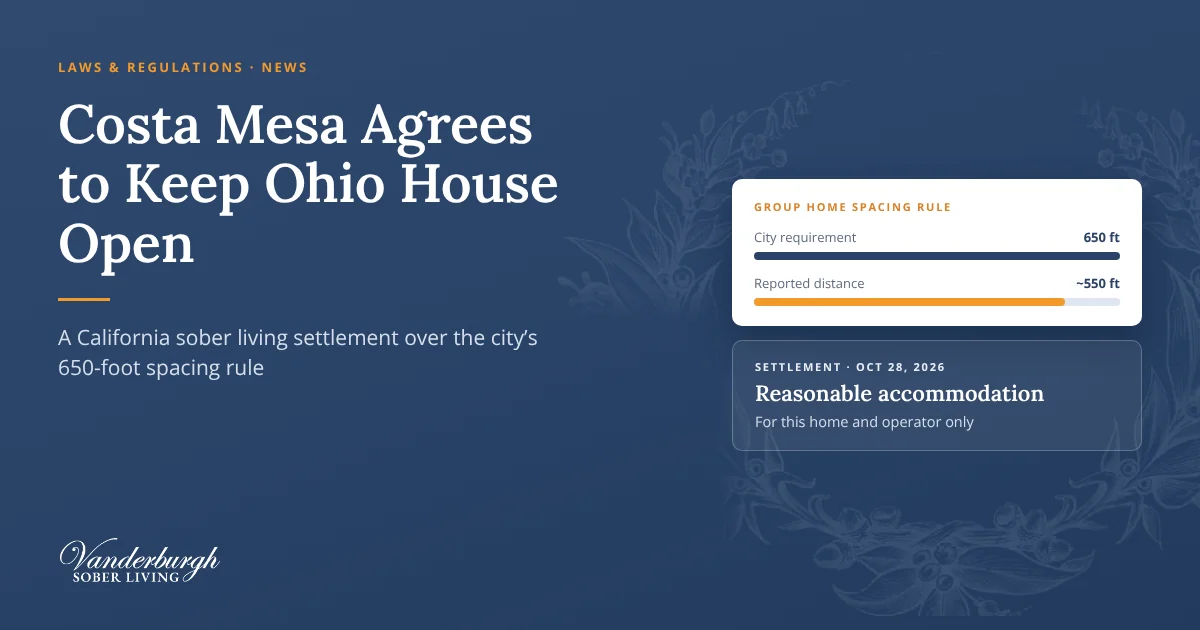
| Rule at issue | A 650-foot separation requirement between group homes |
| Reported distance | About 550 feet from a city-permitted sober living home |
| Relief | A reasonable accommodation, limited to this property and this operator |
| City commitments | Discuss code revisions with CRD and report compliance within 60 days |
| Admission | None; no party admits liability or wrongdoing |
What the Costa Mesa Sober Living Settlement Says
Under the signed settlement agreement, the city relieves Ohio House from strict compliance with three parts of the Costa Mesa Municipal Code, as reasonable accommodations:
- Land use matrix: Title 13, Chapter IV, Table 13-30, the citywide land use matrix.
- Group home zoning permits: Title 13, Chapter XVI, Section 13-323, which covers permits for group homes in multiple-family zones.
- Operator’s permit: Title 9, Chapter II, Article 23, the group home operator’s permit.
The accommodation does not run with the land. It applies only to this property, only while The Ohio House LLC operates it, and only while it is used as housing for people with disabilities. The city signed on October 26, 2026, and CRD signed on October 28.
The settlement also binds the operator. Ohio House agreed to close its complaint and release related claims. When it runs criminal background checks on job applicants after a conditional offer, it must follow California’s Fair Chance Act and make the individualized assessment that law requires.
Spacing rules, group home permits and operator permits are where many California plans stall. Learn how homes get classified, where fair housing law applies, and what to do if the city says no.
How the 650-Foot Separation Rule Reached a Settlement
The dispute is years old. According to a June 2026 technical assistance letter from the California Department of Housing and Community Development (HCD), Ohio House has housed up to eight residents in each of five adjacent homes on its site since 2012. The sequence that led to the settlement:
- Federal case: Ohio House sued the city in federal court. In The Ohio House, LLC v. City of Costa Mesa (amended opinion April 24, 2025), the Ninth Circuit affirmed rulings for the city and held that the jury had an evidentiary basis to find an exception to the separation requirement unreasonable.
- New request: On May 2, 2025, Ohio House and five residents filed a new reasonable accommodation request with new evidence, citing state housing laws.
- Denial: The city denied it on July 2, 2025, and its Planning Commission upheld the denial on September 22, 2025.
- State complaint: In 2025, CRD received the complaint alleging the city unlawfully denied the request and applied the 650-foot rule retroactively.
- HCD letter: HCD told the city in June 2026 that, in its view, the denial violated state law and the city council had to grant the appeal.
- Settlement: After an initial investigation, CRD offered mediation, and the parties settled in October 2026.
CRD’s own summary is direct. “This settlement is a major victory for the rights of people with disabilities,” said CRD Director Kevin Kish.
Read next Reasonable Accommodation for Sober Living Homes in CaliforniaDid Costa Mesa Change Its Group Home Rules?
No, not yet. The settlement commits Costa Mesa to take part in good faith in discussions with CRD’s legal staff about possible revisions to its zoning code’s group home definitions and regulations and to its reasonable accommodation process. Those talks must, at a minimum, address the issues HCD raised in its November 29, 2023 technical assistance letter and its June 2026 letter.
If the city and CRD cannot agree, either side can ask for mediation, and CRD keeps the right to file its own complaint or lawsuit. HCD’s separate enforcement authority, including a possible referral to the Attorney General, is unaffected. Within 60 days, the city must report to CRD and to Ohio House’s counsel that it has met its obligations.
Why State Law Mattered in the Ohio House Case
The federal route ended in the city’s favor; the state route produced an accommodation. CRD enforces California’s Fair Employment and Housing Act, and HCD’s letters rest on state anti-discrimination, fair housing and housing element laws. Operators in California have more than one place to take a zoning dispute.
That matches how VSL reads the state. VSL’s Operating Climate Index scores California 8 out of 10 for legal climate and 8 overall (Foote, 2026b). VSL’s Recovery Housing Legal Tracker lists an earlier Costa Mesa case, SoCal Recovery, LLC v. City of Costa Mesa (9th Cir. 2023), which held that sober living operators may prove disability status through collective evidence rather than resident by resident (Foote, 2026a).
The federal side How the Fair Housing Act Protects Sober Living Homes The federal protections Ohio House relied on first, and how they differ from the state route that produced this settlement. →What This Means for Operators
Costa Mesa’s rules are its own, and every California city writes its zoning code differently. Before you sign a lease or buy, work through this list:
- Check for spacing and permit rules: Look for separation distances, group home zoning permits and operator’s permits in the city code before you commit to an address.
- Measure the distance yourself: Find out how close the nearest permitted group home or licensed facility sits, since roughly 100 feet stood between this home and compliance.
- Put the request in writing and include residents: Ohio House’s 2025 request added five residents as applicants and new evidence about their needs.
- Know your state options: A CRD complaint, explained in the department’s reasonable accommodation fact sheet, is a separate path from a federal lawsuit.
- Do not assume an accommodation transfers: This one is tied to the operator and the use, so a buyer or new operator would have to ask again.
- Keep your own house in order: Settlements can bind the operator too, as the Fair Chance Act term here shows.
The Ohio House settlement keeps one home open and starts a conversation about Costa Mesa’s code. It does not change the rules for anyone else yet, so the next operator in Costa Mesa still starts from the same ordinances.
If you are earlier in the process and still choosing a California city, start with how the whole path to a first home works.
This article is general information about a California settlement, not legal advice.
Sources
Primary sources
- California Civil Rights Department. (2026, October 28). After state investigation, City of Costa Mesa agrees to allow sober living home to remain open [Press release]. https://calcivilrights.ca.gov/2026/10/28/after-state-investigation-city-of-costa-mesa-agrees-to-allow-sober-living-home-to-remain-open/
- California Civil Rights Department. (2026). Settlement agreement: The Ohio House LLC and City of Costa Mesa (redacted). https://calcivilrights.ca.gov/wp-content/uploads/sites/32/2026/10/Ohio-House-Settlement-Agreement_Redacted.pdf
- California Department of Housing and Community Development. (2026, June 8). City of Costa Mesa: Request for reasonable accommodation, letter of technical assistance. https://www.hcd.ca.gov/sites/default/files/docs/planning-and-community/HAU/costa-mesa-hau-2311-ta-060826.pdf
- California Department of Housing and Community Development. (2023, November 29). City of Costa Mesa: Group home letter of technical assistance. https://www.hcd.ca.gov/sites/default/files/docs/planning-and-community/HAU/costa-mesa-group-home-ta-112923.pdf
- The Ohio House, LLC v. City of Costa Mesa, No. 22-56181 (9th Cir. Dec. 4, 2024), amended April 24, 2025. https://cdn.ca9.uscourts.gov/datastore/opinions/2025/04/24/22-56181.pdf
- California Civil Rights Department. (2026). Reasonable accommodations [Fact sheet]. https://calcivilrights.ca.gov/wp-content/uploads/sites/32/2026/02/Reasonable-Accommodations_ENG.pdf
VSL research
- Foote, H. T. (2026a). Vanderburgh Recovery Housing Legal Tracker, as of September 12, 2026. Vanderburgh Sober Living. https://www.vanderburghhouse.com/research/legal-tracker-2026/
- Foote, H. T. (2026b). Vanderburgh Sober Living Operating Climate Index, 2026 edition. Vanderburgh Sober Living. https://www.vanderburghhouse.com/research/operating-climate-index-2026/