
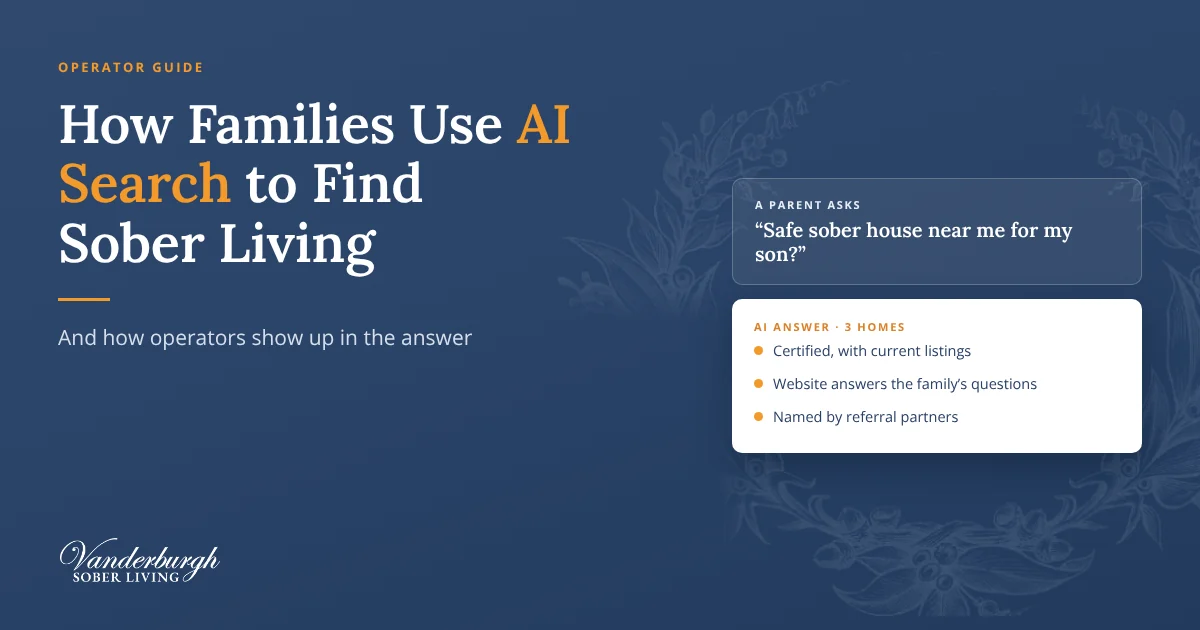
A sober living home recommended by ChatGPT or a Google AI answer is now one of the ways families find a bed. A parent types “safe sober house near Worcester for my son” into a chatbot, gets three names back, and calls the one that looks most trustworthy. Search results still matter, but the short list often forms before anyone clicks a link.
That changes what an operator has to get right. AI tools build their answers from what is already public about your sober house: your website, your listings, your certification status, and what other organizations say about you. Here is how families, discharge planners and referral partners use AI search, what those tools look at, and the practical steps that help an accurate picture of your home show up.
Do Families Really Use ChatGPT to Find a Sober Living Home?
Yes, and the share is large enough to plan for. As of February 2026, 49% of U.S. adults said they use AI chatbots, 44% had used ChatGPT, and 42% used a chatbot to search for information, according to the Pew Research Center’s Americans and AI 2026 survey.
Health questions are part of that. A KFF poll fielded in February and March 2026 found that 32% of adults used an AI chatbot for health information in the past year, and 16% asked about mental health. A family member looking for recovery housing after a treatment stay fits that pattern: they want a fast, plain answer at a stressful moment.
Google’s own results are moving the same way. In a Pew study of 900 adults’ browsing in March 2025, 18% of Google searches produced an AI summary. When one appeared, users clicked a regular search result on 8% of visits, compared with 15% when there was no summary, and clicked a link inside the summary only 1% of the time.
How Discharge Planners and Referral Sources Use AI Search
Referral sources use AI tools differently from families. A hospital discharge planner, a case manager at a treatment center, or a probation officer usually needs a short list of options that fit one person’s situation, often by the end of a shift.
The questions they ask are specific, and each one is a detail your sober house can publish:
- Fit: Does the home accept residents on medication for opioid use disorder, residents on probation, or people leaving a 28-day program?
- Standards: Is the sober living home certified, and by which organization?
- Access: What does it cost per week, what is due at move-in, and how fast can someone get in?
- Contact: Who answers the phone, and can a referral be made after hours?
Some referral decisions also have rules behind them. Under Massachusetts General Laws chapter 17, section 18A, state agencies, their contracted vendors, and officers setting parole or release terms may refer a person only to certified alcohol and drug free housing. The Bureau of Substance Addiction Services announced the rule took effect September 1, 2016. A referral source in a state like that is looking for proof of certification first, and an AI answer that cannot find it may leave your home off the list.
Keep reading Types of Referral Sources for Recovery Homes The three tiers of referral partners that keep quality recovery homes full. →What AI Tools Look at Before They Recommend a Sober Living Home
There is no separate sign-up or ranking list for sober houses in AI search. These tools read the public web, and Google states that there are no additional requirements to appear in AI Overviews or AI Mode: a page must simply be indexed and eligible to show with a snippet. OpenAI’s publishers FAQ says any public website can appear in ChatGPT search.
What decides whether your sober house is named, and named correctly, is how clear and consistent the public record is. These are the signals worth working on:
| Signal | What AI Tools Can Check | What to Publish |
|---|---|---|
| Consistent name and contact details | Whether your website, Google Business Profile and directories agree | One exact home name, phone number and city, used everywhere |
| Certification | Your listing on the state affiliate or certifying body registry | Your certification level and certifying organization, with a link to the registry |
| Clear house information | Plain-text answers on your website | Cost range, house rules, medication policy, who the home serves and how to apply |
| Third-party mentions | Partner resource pages, county guides, local news and directory listings | Accurate listings with the partners who actually refer to you |
| Reviews | Ratings and review text on Google and directories | Honest reviews, never paid for, with calm replies to concerns |
| Freshness | Dates on pages and recent updates | A last-updated date on cost and availability information |
Keep Every Sober Living Listing Accurate and Consistent
Inconsistent listings are one of the easiest ways for an AI answer to get a sober house wrong. If your website says 10 beds, your directory profile says eight, and an old listing shows a phone number you no longer use, the tool has to guess.
Audit these places at least once a quarter and make them match:
- Your own website: The home’s name, city, bed count, gender served, weekly cost range, certification and phone number, in plain text on the page.
- Google Business Profile: Use the home’s real-world name only; Google’s guidelines for representing your business do not allow extra keywords in the name, and they set rules for when an address can be shown.
- Your certification registry: Your state’s certifying organization, plus the National Alliance for Recovery Residences (NARR) national certified residence locator where your state’s data is included.
- Housing directories: A verified listing on Sober House Directory and any state or county recovery housing lists your referral partners use.
- Partner pages: Treatment centers, recovery community organizations and local resource guides that list your home.
Certification is one of the first details many referral sources check, and it is not available everywhere. The Vanderburgh Recovery Housing Certification Landscape records 33 states with a certifying affiliate recognized by NARR and 17 with none as of August 2026 (Foote, 2026a). Where certification exists, the value of sober living certification includes being findable on the lists that referral sources and AI tools trust. The Vanderburgh Sober Living Operating Climate Index also treats certification value as one of its six sub-indices, weighted at 20% of each state’s score (Foote, 2026b).
Publish the Answers Families Ask Before They Call
A family member asking an AI tool about sober living usually asks the same handful of questions. If your website answers them in plain sentences, an AI tool can quote you instead of guessing or naming a competitor.
Give each of these its own short section or FAQ on your site:
- Cost: The weekly or monthly rent range, the move-in amount, and what rent includes.
- House rules: Curfew, guests, drug testing, meeting expectations and what happens after a return to use.
- Medication policy: Whether residents on prescribed medications, including medication for opioid use disorder, can live in the home.
- How to get in: The steps to apply, what to bring, and how quickly a bed can open.
- Who lives there: Men, women or another group served, and the level of support, such as a house mentor living on site.
- Location: The neighborhood or city and what is nearby, such as transit and meetings, without publishing anything that identifies a resident.
The listings on the VSL homes directory follow this pattern, with cost, house details and location stated on each Chartered home’s page.
Write each answer so it makes sense on its own. A sentence such as “Rent at our Springfield sober living home is $175 to $200 per week, including utilities” can be quoted by an AI tool; “It depends, call us” cannot. Keep resident privacy and fair housing in mind as you write: describe the house and its rules, never individual residents, and do not publish admission criteria that would exclude a protected group.
How to Market a Sober Living Home When Search Starts With AI
Traditional search engine work still does most of the heavy lifting. Google’s guidance for AI features lists the same fundamentals as ordinary search: let search engines crawl the site, link to your content internally, keep important information in text, match any structured data to the visible page, and keep your Business Profile current. Google adds that you do not need special AI files or a special type of schema markup to appear.
On top of those fundamentals, a few steps carry extra weight for AI answers:
- Do not block AI search crawlers: OpenAI’s crawler documentation says sites that opt out of OAI-SearchBot will not be shown in ChatGPT search answers, so check your robots.txt file and any security plugin or CDN setting.
- Earn mentions from real partners: A listing on a treatment center’s resource page, a county recovery guide, or a local news story is a third-party citation an AI tool can weigh alongside your own claims.
- Keep pages current: Date your cost and availability information and update it when it changes; an AI answer built on a two-year-old rent figure sends a family to the wrong expectation.
- Answer the question first: Start each page section with the direct answer, then the detail, so the answer can be lifted cleanly.
Filling beds still depends on relationships, and the strategies for lasting occupancy that work offline are the same ones that give AI tools something credible to cite. Operators still planning a first home can build these pages from day one while following the steps for how to start a sober living home.
- ✓Policies and house agreements to have signed
- ✓Inspections, insurance, and intake paperwork
- ✓What the first week actually requires
How to Check What ChatGPT and Google Say About Your Sober House
You cannot control an AI answer, but you can see what it says and fix the sources behind it. Run this check every month or two:
- Ask like a family would: Type questions such as “sober living for women in [your city]” or “sober house that accepts Suboxone near [your city]” into ChatGPT, Google, Gemini and Copilot.
- Ask about your home by name: “What is [home name] in [city]?” shows what each tool believes about your cost, rules and certification.
- Write down every error: Note the wrong bed count, old phone number or missing certification, and which source the tool cited.
- Fix the source, not the answer: Correct the listing, page or directory profile the tool relied on; the answer changes once the tool reads the corrected source again.
- Recheck after a few weeks: Google says recrawling can take several days to several months.
How to Measure AI-Referred Visits and Inquiries
Measurement keeps this work honest. Track AI referrals the same way you track any other referral source, and judge them by the inquiries and move-ins they produce, not by visits alone.
- ChatGPT visits: OpenAI says ChatGPT automatically adds
utm_source=chatgpt.comto referral links, so those visits show up by source in Google Analytics. - Other AI tools: Look for referral sessions from domains such as perplexity.ai, gemini.google.com and copilot.microsoft.com in your analytics traffic report.
- Google AI Overviews and AI Mode: Google reports these clicks inside the regular Web search data in Search Console, so watch impressions and clicks for your key pages over time.
- Intake question: Add “How did you hear about us?” with an “AI tool such as ChatGPT” option to your inquiry form or intake call, because many AI-assisted searches end in a phone call with no click to track.
What Not to Do: Fake Reviews, Keyword Stuffing and Paid “AI Ranking” Schemes
Shortcuts tend to backfire, and some are illegal. Avoid these:
- Fake or paid reviews: The Federal Trade Commission’s final rule on fake reviews and testimonials, announced August 14, 2024, bans buying or creating fake reviews, including AI-generated ones, and undisclosed reviews from staff.
- Keyword-stuffed names: Calling your profile “Best Sober Living Boston Recovery Home” breaks Google’s naming rules and puts the profile at risk of suspension.
- Guaranteed AI placement: No vendor can promise that ChatGPT or Google will recommend your home. Neither OpenAI’s publishers FAQ nor Google’s guidance describes any way to pay for a place in an AI answer.
- Overstated claims: Saying the home offers treatment, guaranteed recovery or certification it does not hold misleads families, and AI tools repeat it.
Frequently Asked Questions About AI Search and Sober Living
Can I pay to have ChatGPT recommend my sober living home?
No. OpenAI’s publishers FAQ describes no paid placement in ChatGPT search, and Google says there are no special requirements to appear in AI Overviews. What you can do is keep your website crawlable, your listings accurate, and your certification and house information easy to find.
Does my sober house website still matter if people use AI search?
Yes. AI tools build answers from public web pages, and your website is the one source you fully control. A page that states cost, house rules, medication policy and certification in plain sentences gives ChatGPT and Google something accurate to quote about your sober living home.
How do families find sober living homes with AI tools?
Many families type a plain question, such as “sober house for women near Lowell,” into ChatGPT, Gemini or Google, then call the homes named in the answer. As of February 2026, 42% of U.S. adults used chatbots to search for information, according to the Pew Research Center.
How can I tell if ChatGPT is sending visitors to my website?
ChatGPT automatically adds utm_source=chatgpt.com to the links it sends, according to OpenAI, so those visits appear by source in Google Analytics. Also ask every caller how they heard about you, because many AI-assisted searches end in a phone call instead of a click.
Does certification help a sober living home show up in AI search?
It can. Certification is a verifiable fact listed on registries that referral sources trust, and in some states it controls referrals: Massachusetts state agencies and their vendors may refer only to certified sober homes. A registry listing gives AI tools an independent source for your standards.
Be the Sober Living Home an AI Answer Can Trust
AI search rewards the same things referral partners always have: accurate information, verified standards, and a sober living home that answers questions plainly. Keep every listing consistent, publish the answers families ask, earn real third-party mentions, and measure what turns into inquiries. If you are opening or growing a sober house and want help building that foundation, contact Vanderburgh Sober Living.
Research & Sources
- Foote, H. T. (2026a). Vanderburgh Recovery Housing Certification Landscape, 2026 Edition. Vanderburgh Sober Living.
- Foote, H. T. (2026b). Vanderburgh Sober Living Operating Climate Index, 2026 Edition. Vanderburgh Sober Living.
- Pew Research Center. (2026, June 17). Americans and AI 2026: Chatbots, smart devices and views on impact.
- KFF. (2026, March 25). Poll: 1 in 3 adults are turning to AI chatbots for health information.
- Pew Research Center. (2025, July 22). Google users are less likely to click on links when an AI summary appears in the results.
- Massachusetts General Court. (n.d.). General Laws chapter 17, section 18A: Alcohol and drug free housing.
- Massachusetts Bureau of Substance Addiction Services. (2016, September 21). State agencies and their vendors shall only be able to refer clients to certified sober homes.
- Google Search Central. (n.d.). AI features and your website.
- OpenAI. (n.d.). Publishers and developers FAQ.
- OpenAI. (n.d.). Overview of OpenAI crawlers.
- Google. (n.d.). Guidelines for representing your business on Google.
- National Alliance for Recovery Residences. (n.d.). National NARR-certified residence locator.
- Federal Trade Commission. (2024, August 14). Federal Trade Commission announces final rule banning fake reviews and testimonials.