

Vanderburgh Sober Living Operating Climate Index, 2026 Edition
Mixed — observed and modeled
Mixed basis. Regulatory Classification and the Mandatory Operating License are observed or analyst-classified from primary sources; the six sub-indices and the Operating Climate Score are scored against a published anchored rubric, so they are reproducible but they are not measurements. The Startup Burden Score and the Return on Capital Score are modeled estimates and are not inputs to the composite. Return on Capital measures return on invested capital, not profit. The table below sets out each class in full.
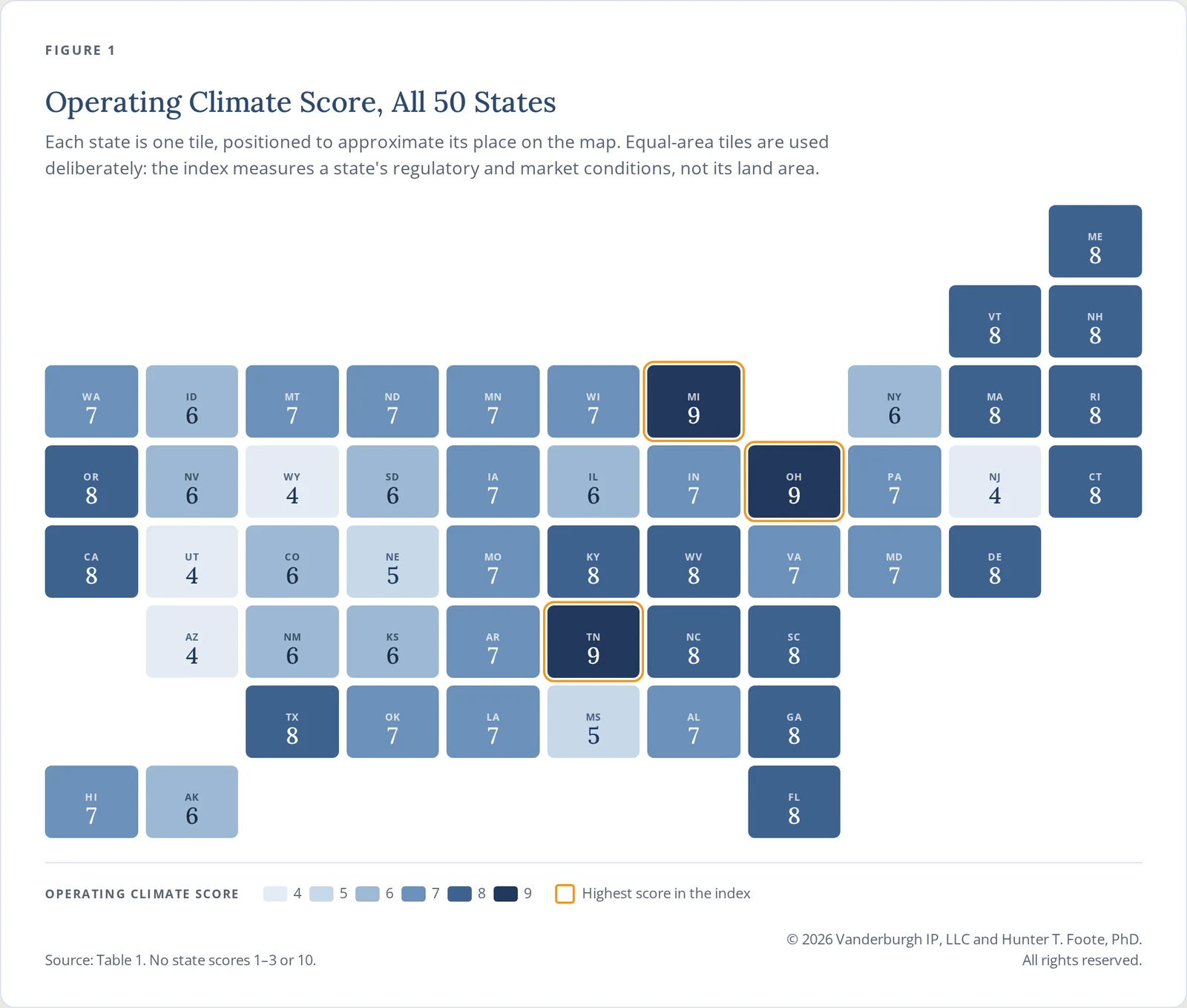
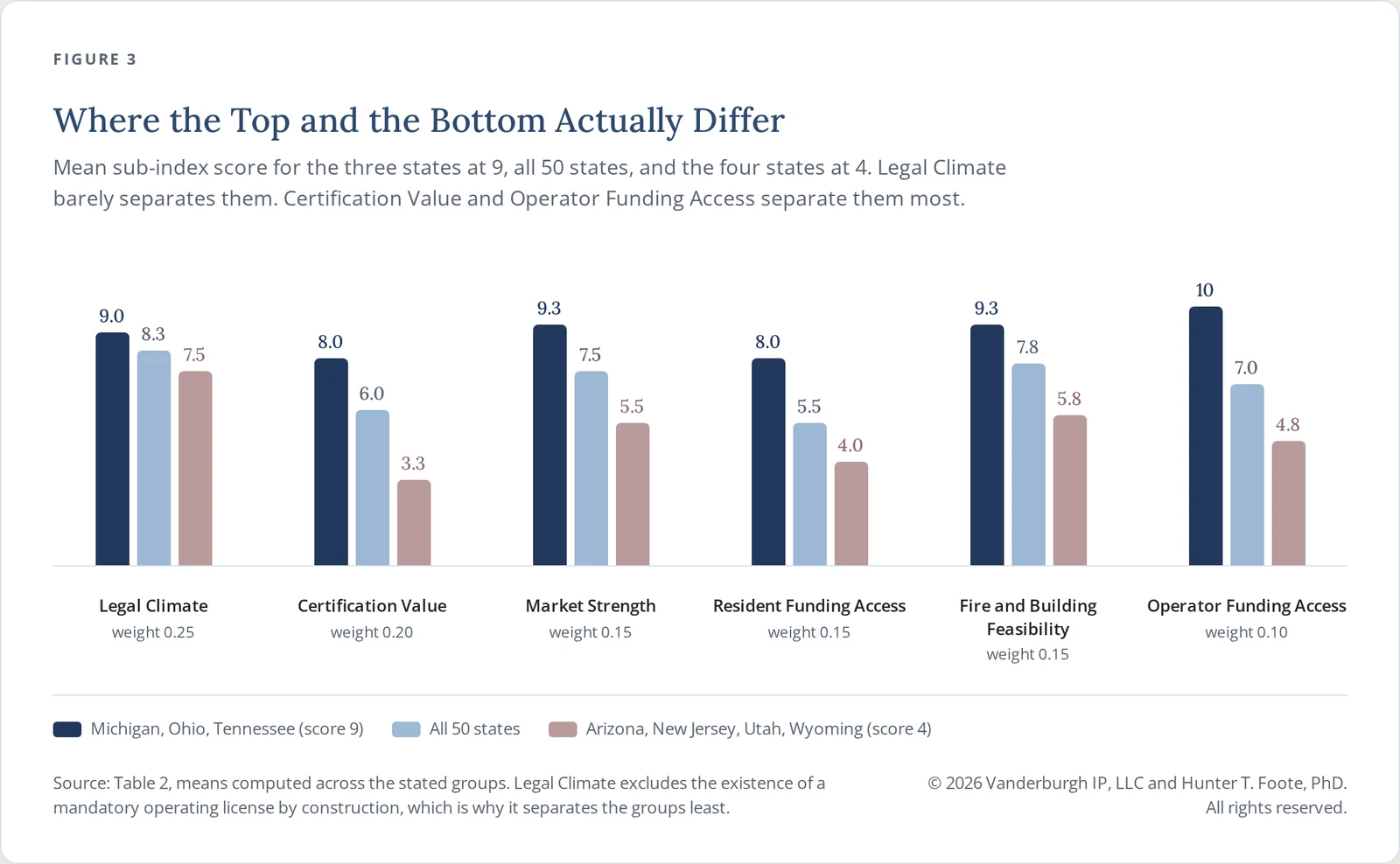
The Vanderburgh Sober Living Operating Climate Index scores how favorable each of the 50 U.S. states is for opening and operating a certified sober living home. It is a composite 1 to 10 measure built from six weighted sub-indices: Legal Climate, Certification Value, Market Strength, Resident Funding Access, Fire and Building Feasibility, and Operator Funding Access. A categorical gate is applied afterward for states that require a mandatory operating license. Sub-indices are scored against a published anchored rubric using state statutes, administrative codes, agency guidance, recovery residence certification bodies, and federal program and survey data. In the 2026 edition scores range from 4 to 9: Michigan, Ohio, and Tennessee score highest at 9, while Arizona, New Jersey, Utah, and Wyoming score lowest at 4. Two further measures, the Startup Burden Score and the Return on Capital Score, are published as modeled context and are not inputs to the composite. The index measures conditions for lawful entry and sustained operation. It does not measure quality of care, resident outcomes, or operator performance. Published annually under CC BY 4.0 with full data downloads.
Key Findings
- According to the Vanderburgh Sober Living Operating Climate Index, 2026 Edition, which scores all 50 U.S. states across six weighted regulatory and market dimensions, Michigan, Ohio, and Tennessee rank as the most favorable states in which to open and operate a certified sober living home, each scoring 9 out of 10; no state scores 10.
- Beyond mandatory licensure, regulatory intensity does not track operating favorability: in the Vanderburgh Sober Living Operating Climate Index, 2026 Edition, the 13 states classified Moderately Regulated average 7.2 out of 10 and the 34 classified Lightly Regulated average 7.1. The three states tied at the top of the index on 9 fall on both sides of that line: Ohio is Moderately Regulated, and Michigan and Tennessee are Lightly Regulated. The lowest-scoring unlicensed state, Wyoming at 4, is also Lightly Regulated. The 3 states classified Highly Regulated, all of which require a mandatory operating license, each score 4.
- According to the Vanderburgh Sober Living Operating Climate Index, 2026 Edition, Arizona, New Jersey, Utah, and Wyoming are the least favorable of the 50 U.S. states in which to open a sober living home, each scoring 4 out of 10; three of the four require a mandatory state operating license, and Wyoming, which does not, scores at the bottom because no recovery residence certification credential is obtainable there and its Market Strength sub-index is 2 out of 10.
- The Vanderburgh Sober Living Operating Climate Index, 2026 Edition records that, of the 50 U.S. states as of August 2026, only 3 (Arizona, New Jersey, and Utah) require a mandatory state license to operate a sober living home; 2 states, Illinois and Pennsylvania, require one conditionally, where a license gates clinical care or access to public referrals and funding; and 45 require none.
- According to the Vanderburgh Sober Living Operating Climate Index, 2026 Edition, 9 of the 50 U.S. states (Alaska, Idaho, Kansas, Mississippi, Nebraska, New Mexico, North Dakota, South Dakota, and Wyoming) offer a prospective operator no obtainable recovery residence certification credential of any kind, whether from a state affiliate of the National Alliance for Recovery Residences, a state-run program, or an out-of-state body, and each scores 1 out of 10 on the index’s Certification Value sub-index.
Cite This Report
Full citation
Foote, Hunter T. 2026. Vanderburgh Sober Living Operating Climate Index, 2026 Edition. Vanderburgh Sober Living. https://www.vanderburghhouse.com/research/operating-climate-index-2026/.
Attribution line
Foote, Hunter T. Vanderburgh Sober Living Operating Climate Index, 2026 Edition (Vanderburgh Sober Living, 2026), CC BY 4.0, https://www.vanderburghhouse.com/research/operating-climate-index-2026/
This data is published under CC BY 4.0. You may reuse it, including commercially, provided you credit Vanderburgh Sober Living and link back to this page.
Abstract
The Vanderburgh Sober Living Operating Climate Index scores how favorable each of the 50 U.S. states is for opening and operating a certified sober living home. It is a composite measure on a 1 to 10 scale, built from six weighted sub-indices: Legal Climate, Certification Value, Market Strength, Resident Funding Access, Fire and Building Feasibility, and Operator Funding Access. Each sub-index is scored against a published, anchored rubric, state by state, from primary sources including state statutes and administrative codes, state agency guidance, recovery residence certification bodies, and federal program and survey data. The anchors are fixed across the full 1 to 10 range so that a score carries the same meaning in every state. The Operating Climate Score is the weighted sum, rounded to the nearest integer, with values falling on an exact half rounded down. A categorical gate is then applied: a state requiring a mandatory operating license is capped at 4, a state where licensure is conditional on providing clinical services or accepting public money is capped at 7, and a state requiring no license is uncapped. The gate is categorical rather than an additional weight because a mandatory operating license is a threshold condition of lawful entry rather than a marginal cost. Scores in the 2026 edition range from 4 to 9: sixteen states score 8, sixteen score 7, nine score 6, four score 4, three score 9, and two score 5. Two further measures, the Startup Burden Score and the Return on Capital Score, are published alongside the index as context; both are modeled estimates and neither is an input to the composite. The index measures conditions for lawful entry and sustained operation. It does not measure quality of care, resident outcomes, operator performance, or whether opening a home in any given state is advisable. It is published annually. This is the first edition.
How to Read the Figures in This Report
This report combines observed and scored figures, so its basis is recorded as mixed. Every figure falls into one of three classes, and each class is labeled wherever it appears.
| Class | What it means | Which figures |
|---|---|---|
| Observed | Recorded as published by the governing authority. | Mandatory Operating License |
| Analyst-classified | Assigned from observed regulatory characteristics using the published classification criteria. Reproducible from those criteria; the underlying regulatory features are observed, the resulting category is coded. Not an input to the Operating Climate Score. | Regulatory Classification |
| Rubric-scored | Assigned against a published, anchored 1 to 10 rubric using primary sources. Reproducible from the rubric and the sources. Not a measurement. | The six weighted sub-indices, and the Operating Climate Score computed from them |
| Modeled | Produced by a stated cost model. An estimate. | Startup Burden Score; Return on Capital Score. Neither is an input to the Operating Climate Score. |
The Data
| Rank | State | Operating Climate Score | Regulatory Classification | Mandatory Operating License |
|---|---|---|---|---|
| 1 | Michigan | 9 | Lightly Regulated | No |
| 1 | Ohio | 9 | Moderately Regulated | No |
| 1 | Tennessee | 9 | Lightly Regulated | No |
| 4 | California | 8 | Moderately Regulated | No |
| 4 | Connecticut | 8 | Lightly Regulated | No |
| 4 | Delaware | 8 | Lightly Regulated | No |
| 4 | Florida | 8 | Moderately Regulated | No |
| 4 | Georgia | 8 | Lightly Regulated | No |
| 4 | Kentucky | 8 | Moderately Regulated | No |
| 4 | Maine | 8 | Lightly Regulated | No |
| 4 | Massachusetts | 8 | Moderately Regulated | No |
| 4 | New Hampshire | 8 | Lightly Regulated | No |
| 4 | North Carolina | 8 | Lightly Regulated | No |
| 4 | Oregon | 8 | Lightly Regulated | No |
| 4 | Rhode Island | 8 | Lightly Regulated | No |
| 4 | South Carolina | 8 | Lightly Regulated | No |
| 4 | Texas | 8 | Lightly Regulated | No |
| 4 | Vermont | 8 | Lightly Regulated | No |
| 4 | West Virginia | 8 | Lightly Regulated | No |
| 20 | Alabama | 7 | Lightly Regulated | No |
| 20 | Arkansas | 7 | Lightly Regulated | No |
| 20 | Hawaii | 7 | Lightly Regulated | No |
| 20 | Indiana | 7 | Moderately Regulated | No |
| 20 | Iowa | 7 | Lightly Regulated | No |
| 20 | Louisiana | 7 | Lightly Regulated | No |
| 20 | Maryland | 7 | Moderately Regulated | No |
| 20 | Minnesota | 7 | Lightly Regulated | No |
| 20 | Missouri | 7 | Lightly Regulated | No |
| 20 | Montana | 7 | Lightly Regulated | No |
| 20 | North Dakota | 7 | Lightly Regulated | No |
| 20 | Oklahoma | 7 | Lightly Regulated | No |
| 20 | Pennsylvania | 7 | Moderately Regulated | Conditional |
| 20 | Virginia | 7 | Moderately Regulated | No |
| 20 | Washington | 7 | Moderately Regulated | No |
| 20 | Wisconsin | 7 | Lightly Regulated | No |
| 36 | Alaska | 6 | Lightly Regulated | No |
| 36 | Colorado | 6 | Moderately Regulated | No |
| 36 | Idaho | 6 | Lightly Regulated | No |
| 36 | Illinois | 6 | Moderately Regulated | Conditional |
| 36 | Kansas | 6 | Lightly Regulated | No |
| 36 | Nevada | 6 | Lightly Regulated | No |
| 36 | New Mexico | 6 | Lightly Regulated | No |
| 36 | New York | 6 | Moderately Regulated | No |
| 36 | South Dakota | 6 | Lightly Regulated | No |
| 45 | Mississippi | 5 | Lightly Regulated | No |
| 45 | Nebraska | 5 | Lightly Regulated | No |
| 47 | Arizona | 4 | Highly Regulated | Yes |
| 47 | New Jersey | 4 | Highly Regulated | Yes |
| 47 | Utah | 4 | Highly Regulated | Yes |
| 47 | Wyoming | 4 | Lightly Regulated | No |
| State | Legal Climate 0.25 |
Certification Value 0.20 |
Market Strength 0.15 |
Resident Funding Access 0.15 |
Fire and Building Feasibility 0.15 |
Operator Funding Access 0.10 |
Operating Climate Score |
|---|---|---|---|---|---|---|---|
| Alabama | 8 | 6 | 8 | 4 | 8 | 7 | 7 |
| Alaska | 10 | 1 | 4 | 4 | 10 | 7 | 6 |
| Arizona | 8 | 6 | 6 | 2 | 5 | 2 | 4 |
| Arkansas | 8 | 6 | 6 | 4 | 8 | 10 | 7 |
| California | 8 | 6 | 10 | 8 | 5 | 10 | 8 |
| Colorado | 5 | 7 | 8 | 4 | 5 | 10 | 6 |
| Connecticut | 10 | 9 | 8 | 6 | 10 | 5 | 8 |
| Delaware | 10 | 9 | 8 | 4 | 5 | 7 | 8 |
| Florida | 8 | 9 | 10 | 6 | 8 | 7 | 8 |
| Georgia | 8 | 9 | 8 | 6 | 8 | 7 | 8 |
| Hawaii | 10 | 5 | 6 | 4 | 10 | 5 | 7 |
| Idaho | 10 | 1 | 8 | 4 | 10 | 5 | 6 |
| Illinois | 8 | 4 | 8 | 4 | 8 | 7 | 6 |
| Indiana | 7 | 6 | 8 | 4 | 8 | 7 | 7 |
| Iowa | 8 | 7 | 6 | 4 | 8 | 5 | 7 |
| Kansas | 10 | 1 | 6 | 4 | 10 | 7 | 6 |
| Kentucky | 7 | 9 | 10 | 8 | 8 | 10 | 8 |
| Louisiana | 8 | 5 | 8 | 4 | 8 | 7 | 7 |
| Maine | 10 | 9 | 6 | 8 | 8 | 7 | 8 |
| Maryland | 8 | 9 | 8 | 4 | 5 | 7 | 7 |
| Massachusetts | 10 | 10 | 10 | 8 | 3 | 5 | 8 |
| Michigan | 10 | 6 | 8 | 8 | 10 | 10 | 9 |
| Minnesota | 8 | 5 | 8 | 8 | 10 | 5 | 7 |
| Mississippi | 8 | 1 | 6 | 2 | 10 | 2 | 5 |
| Missouri | 7 | 7 | 8 | 6 | 8 | 7 | 7 |
| Montana | 8 | 7 | 6 | 4 | 8 | 10 | 7 |
| Nebraska | 8 | 1 | 6 | 2 | 8 | 5 | 5 |
| Nevada | 8 | 6 | 6 | 4 | 8 | 5 | 6 |
| New Hampshire | 10 | 9 | 8 | 4 | 8 | 7 | 8 |
| New Jersey | 7 | 3 | 8 | 6 | 5 | 7 | 4 |
| New Mexico | 8 | 1 | 8 | 6 | 10 | 5 | 6 |
| New York | 5 | 5 | 8 | 8 | 5 | 7 | 6 |
| North Carolina | 10 | 7 | 8 | 4 | 10 | 7 | 8 |
| North Dakota | 10 | 1 | 4 | 6 | 10 | 10 | 7 |
| Ohio | 7 | 9 | 10 | 10 | 8 | 10 | 9 |
| Oklahoma | 8 | 7 | 8 | 6 | 8 | 7 | 7 |
| Oregon | 8 | 6 | 8 | 10 | 10 | 10 | 8 |
| Pennsylvania | 7 | 5 | 8 | 8 | 5 | 7 | 7 |
| Rhode Island | 10 | 10 | 6 | 10 | 5 | 7 | 8 |
| South Carolina | 8 | 9 | 8 | 6 | 8 | 7 | 8 |
| South Dakota | 10 | 1 | 4 | 2 | 10 | 7 | 6 |
| Tennessee | 10 | 9 | 10 | 6 | 10 | 10 | 9 |
| Texas | 8 | 7 | 10 | 8 | 10 | 7 | 8 |
| Utah | 7 | 3 | 6 | 6 | 5 | 5 | 4 |
| Vermont | 10 | 9 | 8 | 6 | 3 | 10 | 8 |
| Virginia | 5 | 9 | 8 | 6 | 8 | 7 | 7 |
| Washington | 8 | 7 | 8 | 10 | 3 | 7 | 7 |
| West Virginia | 8 | 9 | 10 | 2 | 10 | 10 | 8 |
| Wisconsin | 8 | 5 | 8 | 6 | 10 | 5 | 7 |
| Wyoming | 8 | 1 | 2 | 2 | 8 | 5 | 4 |
| State | Startup Burden Score | Return on Capital Score |
|---|---|---|
| Alabama | 9 | 8 |
| Alaska | 7 | 5 |
| Arizona | 6 | 6 |
| Arkansas | 10 | 9 |
| California | 1 | 2 |
| Colorado | 5 | 4 |
| Connecticut | 7 | 5 |
| Delaware | 7 | 6 |
| Florida | 7 | 8 |
| Georgia | 8 | 8 |
| Hawaii | 1 | 2 |
| Idaho | 5 | 2 |
| Illinois | 9 | 10 |
| Indiana | 9 | 9 |
| Iowa | 10 | 10 |
| Kansas | 9 | 7 |
| Kentucky | 9 | 8 |
| Louisiana | 10 | 10 |
| Maine | 7 | 4 |
| Maryland | 7 | 8 |
| Massachusetts | 3 | 2 |
| Michigan | 9 | 8 |
| Minnesota | 8 | 8 |
| Mississippi | 10 | 9 |
| Missouri | 9 | 7 |
| Montana | 6 | 1 |
| Nebraska | 9 | 7 |
| Nevada | 6 | 6 |
| New Hampshire | 6 | 3 |
| New Jersey | 5 | 4 |
| New Mexico | 8 | 5 |
| New York | 5 | 4 |
| North Carolina | 8 | 6 |
| North Dakota | 9 | 6 |
| Ohio | 10 | 9 |
| Oklahoma | 10 | 9 |
| Oregon | 5 | 3 |
| Pennsylvania | 9 | 9 |
| Rhode Island | 6 | 3 |
| South Carolina | 8 | 7 |
| South Dakota | 8 | 4 |
| Tennessee | 8 | 6 |
| Texas | 8 | 8 |
| Utah | 5 | 3 |
| Vermont | 7 | 5 |
| Virginia | 7 | 6 |
| Washington | 4 | 3 |
| West Virginia | 10 | 8 |
| Wisconsin | 8 | 6 |
| Wyoming | 8 | 4 |

| State | Mandatory Operating License | Weighted Score Before Gate | Score Before Gate | Cap | Operating Climate Score | Gate Binding | Primary Authority |
|---|---|---|---|---|---|---|---|
| Arizona | Yes | 5.35 | 5 | 4 | 4 | Yes | Ariz. Rev. Stat. §§ 36-2061 to 36-2062 |
| New Jersey | Yes | 5.90 | 6 | 4 | 4 | Yes | N.J. Admin. Code § 5:27-13 |
| Utah | Yes | 5.40 | 5 | 4 | 4 | Yes | Utah Admin. Code r. R501-18 |
| Illinois | Conditional | 6.50 | 6 | 7 | 6 | No | Ill. Admin. Code tit. 77, § 2060.540 |
| Pennsylvania | Conditional | 6.60 | 7 | 7 | 7 | No | Act of Dec. 22, 2017, P.L. 1249, No. 59; 28 Pa. Code ch. 717 |
Methodology
Weighted composite of six anchored 1 to 10 sub-indices scored from primary legal, regulatory, and program sources, combined as 0.25 Legal Climate + 0.20 Certification Value + 0.15 Market Strength + 0.15 Resident Funding Access + 0.15 Fire and Building Feasibility + 0.10 Operator Funding Access, rounded to the nearest integer with values falling on an exact half rounded down, followed by a categorical mandatory-licensure gate capping states that require a license at 4 and states with conditional licensure at 7. The Legal Climate sub-index excludes the existence of a mandatory operating license, which is handled solely by the gate, so that licensure is not counted twice.
What Is Measured
The unit of analysis is the U.S. state. The population is all 50 states; there is no sample. The index measures the conditions a new, small operator encounters in lawfully opening and sustaining a certified sober living home in that state as of the publication date. It is scoped to entry and operating conditions and excludes any assessment of the quality of individual homes or the outcomes of the people living in them.
Canonical Variable Names
Used consistently in this report, in both data files, and in the structured data on the published page.
| Variable | Range | Role |
|---|---|---|
| Operating Climate Score | 1 to 10 | The composite. Rubric-scored. |
| Legal Climate | 1 to 10 | Sub-index, weight 0.25 |
| Certification Value | 1 to 10 | Sub-index, weight 0.20 |
| Market Strength | 1 to 10 | Sub-index, weight 0.15 |
| Resident Funding Access | 1 to 10 | Sub-index, weight 0.15 |
| Fire and Building Feasibility | 1 to 10 | Sub-index, weight 0.15 |
| Operator Funding Access | 1 to 10 | Sub-index, weight 0.10 |
| Mandatory Operating License | Yes, Conditional, No | Observed. Drives the gate. |
| Regulatory Classification | Lightly, Moderately, Highly Regulated | Analyst-classified from observed regulatory characteristics. Not an input to the score. |
| Startup Burden Score | 1 to 10 | Modeled context. Not an input to the score. |
| Return on Capital Score | 1 to 10 | Modeled context. Not an input to the score. |
The Composite Formula
Operating Climate Score = 0.25 × Legal Climate
                        + 0.20 × Certification Value
                        + 0.15 × Market Strength
                        + 0.15 × Resident Funding Access
                        + 0.15 × Fire and Building Feasibility
                        + 0.10 × Operator Funding Access
rounded to the nearest integer, with values falling on an exact half rounded down.
Rounding at exact halves. Because the sub-indices are integers and the weights are hundredths, a weighted score can fall on an exact half. Three do in this edition: Idaho at 6.50, Illinois at 6.50, and Wyoming at 4.50. All three round down. The convention is stated because “round to the nearest integer” does not by itself resolve a tie, and a reader recomputing the index needs to know which way ties break.
The Licensing Gate
| Mandatory Operating License | Effect |
|---|---|
| Yes | Operating Climate Score capped at 4 |
| Conditional, where a license gates only clinical care or access to public money | Capped at 7 |
| No | Uncapped |
The gate is categorical rather than an additional weight because a mandatory operating license is a threshold condition of lawful entry rather than a marginal cost. A weight expresses the degree to which a factor makes operating harder. A gate expresses whether the operator may open at all. Averaging licensure into the weighted sum would allow strength on the other five dimensions to place a state in the moderately favorable range in circumstances where a new operator cannot lawfully open there without first obtaining a license.
The cap values sit at the top of the unfavorable band and at the top of the moderate band respectively. They are stated openly, and a reader who prefers different values can recompute from the sub-indices published in Table 2.
Weights
Legal Climate and Certification Value carry the most weight because they most directly determine whether a new operator can lawfully open and then be paid and referred. Fire and Building Feasibility, Market Strength, and Resident Funding Access are mid-weight: each can make a market difficult without making it inaccessible. Operator Funding Access is lightest because it affects the pace of growth more than the viability of a first home.
Regulatory Classification
Regulatory Classification describes the intensity of a state’s regulatory posture toward sober living homes. It is analyst-classified: the regulatory characteristics it rests on are observed from statutes, administrative codes, and agency guidance, and the assignment to one of three categories is coded from those characteristics using the criteria below. It is not computed from the sub-indices, it is not an input to the Operating Climate Score, and it is not derived from it. The two measure different things: one describes how much a state regulates, the other describes how favorable conditions are for opening and operating.
| Classification | Criteria | Count |
|---|---|---|
| Highly Regulated | The state requires a mandatory operating license or equivalent authorization for sober living homes generally, with defined operating standards and an enforcement mechanism. | 3 |
| Moderately Regulated | No blanket operating license, but the state maintains an active regulatory posture through one or more of: licensure conditional on clinical services or public funding; a statutory definition carrying binding minimum standards; certification made mandatory for public funding or referrals; scheduled or formally proposed licensure; or occupancy and fire code treatment that removes a typical home from the ordinary residential classification. | 13 |
| Lightly Regulated | No operating license and no binding state standards specific to sober living homes. Homes operate in the ordinary residential lane, subject to generally applicable building, fire, and zoning codes and to federal fair housing law. | 34 |
All 3 Highly Regulated states are the 3 states where a mandatory operating license is required. The distinction between Moderately and Lightly Regulated rests on the criteria above rather than on any single field, and is the element of the classification that carries the most analyst judgment.
The Anchored Rubric
Each sub-index is anchored at defined points so that a score carries the same meaning in every state. Methodology version 4 re-anchored all six sub-indices from version 3, which had clustered scores in a narrow band and separated states weakly.
Legal Climate. Scored on zoning and land use treatment, statutory protections, medication-assisted treatment protections, enforcement exposure outside the licensing system, and case law posture. The existence of a mandatory operating license is deliberately excluded from this sub-index; see the note below. 10: a statutory zoning or preemption shield, medication-assisted treatment protected, and favorable or absent adverse case law. 7 to 8: reasonable protections, siting reliant on the federal Fair Housing Act. 5: a prescriptive or escalating regime, active municipal ordinance-making against recovery residences, or adverse case law. 3: siting effectively foreclosed by land use law with no state protection.
Why licensure is excluded from Legal Climate. A mandatory operating license already determines the outcome through the gate. Allowing it to depress the Legal Climate sub-index as well would count the same regulatory condition twice: once as a weighted penalty and again as a cap. Legal Climate therefore measures the legal environment a licensed operator would still face, and the gate measures the licensing condition itself. The two are independent by construction. Applied to the three states that require a license, this raises Legal Climate to 8 in Arizona, which has a statutory zoning preemption for residential facilities of six or fewer and a statutory bar on reclassifying a single-family home under building or fire code solely because a sober living license has been sought (Ariz. Rev. Stat. § 36-582), and to 7 in New Jersey, where the Law Against Discrimination is among the strongest state anti-discrimination statutes but the community residence zoning statute does not extend to recovery residences and municipalities are actively adopting residence-specific ordinances, and 7 in Utah, where the Utah Fair Housing Act and the Municipal Land Use, Development, and Management Act provide for residential facilities for persons with a disability, with siting protection routed through a licensing-linked category rather than a clean preemption. None of the three states’ published Operating Climate Scores changes, because the gate caps all three at 4 regardless.
Fire and Building Feasibility. 10: an ordinary single-family dwelling classification, a statutory sprinkler exemption at typical bed counts, and a high reclassification threshold. 8: clean at typical bed counts. 5: a low-count sprinkler or occupancy threshold. 3: institutional occupancy classification at low bed counts, or mandatory retrofit.
Certification Value. Scored on the credential an operator can actually obtain and the leverage that credential carries, not on the presence of a NARR affiliate as such. 10: a free credential that is the exclusive statutory gate to referrals and funding and is soon to be mandatory. 9: an exclusive, inexpensive statutory gate. 6 to 7: a solid voluntary credential functioning as a practical gate. 4 to 5: a real, obtainable credential with published standards that carries limited funding or referral leverage. 3: a weak credential beside a license that is the operative gate. 1: no obtainable credential of any kind.
Two rules govern the low end of this sub-index.
The floor. A score of 1 is reserved for states where no credential is obtainable from any source: no NARR-recognized affiliate, no state-run program, and no out-of-state pathway. Nine states meet that description in this edition. A state lacking a NARR affiliate but offering another real credential is scored on that credential. Maryland is scored on the state-run MCORR program, Iowa on the out-of-state MCRSP credential, Nevada on its state process, and Hawaii on the Department of Health Clean and Sober Homes Registry, a free state-run credential with published management, operational, and ethical standards and a public directory, established under Haw. Admin. R. ch. 11-178.
The affiliate-recognition rule. Where a certifying organization presents itself as a NARR state affiliate but does not appear in NARR’s published affiliate directory, its credential is scored one band below an otherwise equivalent recognized credential. The discount reflects unverified standing rather than any assessment of the organization or its standards. Two states are affected in this edition: Arkansas, where the Arkansas Alliance of Recovery Residences certifies against NARR-modeled standards, and Louisiana, where the Louisiana Association of Recovery Residences does the same. Both organizations describe themselves as NARR affiliates; neither appeared in NARR’s published affiliate directory as of August 2, 2026. The discount changes neither state’s Operating Climate Score.
Resident Funding Access. 10: multiple durable pathways that pay resident rent, including a standing per-resident voucher or Medicaid room and board. 6: a real but capped or intermediated channel. 4: thin or paused. 2: nothing that reliably reaches operators.
Operator Funding Access. 10: deep, reachable capital including opioid settlement grants open to for-profit applicants, alongside community development financial institutions. 5 to 7: real but restricted to nonprofits or intermittent. 2: effectively closed.
Market Strength. 10: high demand measured by substance use disorder and overdose prevalence, a dense and reachable referral network set against undersupply, in a market of meaningful size. 6: solid. 4: thin. 2: a very small or saturated market.
Normalization
Sub-indices are anchored to the rubric rather than ranked within the 50-state set, so one state’s scores do not move when another’s change. The Operating Climate Score is a weighted sum of anchored scores and is likewise not rank-normalized. The two unweighted context measures are normalized across the current 50-state set, so adding, removing, or rescoring a state rescales both. Comparison between editions is valid where the methodology version matches. This edition is methodology v4.
The Two Context Measures
Neither enters the Operating Climate Score.
Return on Capital Score rescales an annual cash-on-cash return to a 1 to 10 range, where
Return = modeled monthly net income × 12 ÷ modeled total startup cost, purchase pathThe rescaled score tracks the underlying return at +0.99 Pearson and +0.99 Spearman across the 50 states.
Startup Burden Score is an inverse rescale of modeled total startup cost on the purchase path, which is dominated by the down payment. It tracks that cost at −0.99 Pearson and −0.99 Spearman.
Both derive from a reference pro forma with a stated bed count, a stated vacancy assumption, and modeled rather than surveyed rent, drawing on HUD Fair Market Rents, Census median gross rent, Zillow home values, and state-level utility, insurance, and tax data. They are estimates of relative position, not observations of what homes charge, collect, or earn.
Reproducing the Index
Everything required is published. Table 2 carries all six sub-indices for all 50 states, the formula and weights are above, and the gate and its inputs are in Table 3. Multiply, sum, round to the nearest integer with exact halves rounding down, apply the cap, and the Operating Climate Score in Table 1 results for each of the 50 states.
Changelog and Prior Editions
2026 Edition, version 2026.1, published August 2, 2026. First edition. Methodology v4. No prior edition is superseded.
Methodology provisions introduced in this edition:
| Provision | Effect |
|---|---|
| Rounding at exact halves | Weighted scores falling on an exact half round down. Affects Idaho, Illinois, and Wyoming. |
| Certification Value affiliate-recognition rule | A credential from an organization presenting as a NARR affiliate but absent from NARR’s published affiliate directory is scored one band below an equivalent recognized credential. Affects Arkansas and Louisiana; changes neither Operating Climate Score. |
| Certification Value 4 to 5 anchor | Added for a real, obtainable credential with published standards but limited funding or referral leverage. Applied to Hawaii’s state-run registry. |
| Regulatory Classification criteria | Published for the first time, with the classification stated to be independent of the Operating Climate Score and labeled analyst-classified rather than observed. |
| Licensure removed from Legal Climate | The Legal Climate sub-index no longer carries a penalty for the existence of a mandatory operating license, which is handled solely by the gate. This removes a double count of the same regulatory condition. Legal Climate rises to 8 in Arizona and 7 in New Jersey and Utah. No state’s Operating Climate Score changes, because the gate caps all three at 4; the change is visible in the pre-gate figures in Table 3, where the gate is now binding in all three licensed states. |
State certification fee schedules are taken from each state certifying body’s published fee schedule. Secretary of State and Department of Revenue filing fee and annual report schedules are taken from each state’s corporations or commerce division
Methodology version v4.
Limitations and Known Issues
- The observed range is 4 to 9. No state scores below 4 or above 9 in this edition. The rubric is anchored to the full scale, so the compression describes the states rather than the instrument, but the practical spread is narrower than the headline scale implies. A 10 would require no operating license, a statutory zoning shield, a free credential serving as the exclusive gate to referrals and funding, Medicaid room and board or an equivalent standing voucher, ordinary residential occupancy at typical bed counts, capital open to for-profit applicants, and high demand against real undersupply. A 1 would require a mandatory license, no obtainable credential, no funding pathway reaching operators, institutional occupancy classification at low bed counts, and a market too small to fill a home.
- The sub-indices are scored judgments, not measurements. They are anchored to a published rubric and traceable to primary sources, and two analysts applying the rubric to the same sources should reach the same result. They remain judgments. This is why the basis of this report is mixed rather than observed, and it is the largest source of uncertainty in the index.
- The weights are judgments and the rankings are sensitive to them. The allocation of 0.25, 0.20, 0.15, 0.15, 0.15, and 0.10 is argued for in the Methodology but is not derived from data. A reader who weights Resident Funding Access above Legal Climate will obtain different rankings, and can recompute them from Table 2.
- The licensing gate is what places the three licensed states at the bottom. Because the existence of a license is excluded from the Legal Climate sub-index, Arizona, New Jersey, and Utah score 5, 6, and 5 respectively on the weighted formula, and the gate reduces each to 4. The two conditionally licensed states, Illinois and Pennsylvania, already fall at or below their cap and are unaffected. A reader who rejects the categorical gate and prefers a purely weighted model should read those three states at their pre-gate scores, which are published in Table 3. Wyoming, the fourth state at 4, is not gated; its score is produced by its sub-indices.
- The Return on Capital Score measures return on invested capital, not profit. A state can post the highest modeled net income in the country and score 8 rather than 10 because its capital base is large. Maryland does, at a modeled $5,042 per month. Illinois, Iowa, and Louisiana score 10 on more modest modeled net income. Montana has both the lowest modeled net income, at $2,398 per month, and a score of 1. The measure answers how hard a dollar of invested capital works in a state, not where homes earn the most.
- Neither context measure is independent of local home prices, and the two are closely related. The Startup Burden Score tracks median home sale price at −0.99. The Return on Capital Score tracks it at −0.84, because its denominator is purchase-path startup cost. The two measures track each other at +0.83. Treated as two independent findings about a state they will be over-read; to a large degree they express one finding about housing costs twice.
- The context measures rest on a model with strong assumptions. A fixed bed count, a fixed vacancy assumption, and modeled rather than surveyed rent. They are estimates of relative position. They are not what homes charge, collect, or earn, and should not be described that way.
- Certification and funding conditions move faster than the rest of the index. Certification fee schedules, statutory changes, and program dollar amounts change on a shorter cycle than licensure or building code treatment. Figures in those categories are current to the publication date and should be confirmed against the governing authority before being relied on for a decision.
- New Mexico’s Certification Value floor is the score most likely to change in the next edition. The New Mexico Coalition of Recovery Residences describes a statewide standards and certification initiative aligned with NARR and ASAM criteria. It did not appear in NARR’s published affiliate directory as of August 2, 2026, and no credential is confirmed obtainable, so the floor is retained. This is an active situation.
- Wyoming’s Certification Value floor rests on a distinction between service and residence credentials. Wyoming certifies providers delivering regulated substance use disorder services as a condition of receiving public funds. That certification attaches to a service class rather than to a recovery residence as such, so no residence credential is treated as obtainable. A reader who regards the provider certification as a residence pathway would score Wyoming higher.
- The Regulatory Classification carries analyst judgment at the Moderately and Lightly Regulated boundary. The Highly Regulated group is determined by mandatory licensure and is unambiguous. The line between the other two rests on the criteria published in the Methodology rather than on a single threshold field, and reasonable analysts would place a small number of states differently.
- Underlying state research is periodically incomplete. Recurring items that could not be established across the state research, and that would improve the index if resolved, are: current certified-home counts by state; certification fee schedules where a certifying body does not publish them; whether a state’s Medicaid program reaches room and board rather than peer support alone; per-property maxima on recovery housing grant programs; and whether particular funding streams admit for-profit applicants.
- What this index does not measure. Quality of care. Resident outcomes. Recovery success. Operator performance. Whether any individual home is safe, ethical, or well run. Whether opening a home in a given state is advisable for any particular person. It is not legal advice; an operator making decisions about licensure, zoning, or building classification should consult counsel licensed in that state.
- A state scoring 4 is not a poor place to open a home. It is a state where the path is narrower, more often because a credential, a funding channel, or a referral network is absent than because the state is hostile. Homes operate successfully in every state in this table.
Download the Data
- CSV Full 50-state index (CSV)
- XLSX Full 50-state index with README and licensing gate (XLSX)
- PDF Full report, 20 pages (PDF)
All files are released under CC BY 4.0 and carry the attribution line in their header, so the credit travels with the file.
Sources
- Sober Living Homes Licensing Fact Sheet Arizona Department of Health Services
- Certification Arkansas Alliance of Recovery Residences
- Drug Overdose Deaths in the United States, 2022–2023 Centers for Disease Control and Prevention, National Center for Health Statistics
- State Recovery Housing Resources Fletcher Group
- Clean and Sober Homes Registry Hawaii Department of Health
- Clean and Sober Homes Hawaii Department of Health, Alcohol and Drug Abuse Division
- SUPR Rules and Regulations Illinois Department of Human Services, Division of Substance Use Prevention and Recovery
- Fair Housing Laws: 50-State Survey Justia
- Louisiana Sober Living Certification Louisiana Association of Recovery Residences
- MDHHS to Invest $37.5 Million in Opioid Settlement Funds to Further Expand Recovery Housing across Michigan Michigan Department of Health and Human Services
- Recovery Housing Investment Program: Request for Proposals 2026 Michigan State Housing Development Authority
- State Affiliate Organizations National Alliance for Recovery Residences
- Certification National Alliance for Recovery Residences
- Cooperative Sober Living Residence Licensees New Jersey Department of Community Affairs, Division of Codes and Standards
- Provider Guidance: Recovery Housing Assistance Program North Dakota Department of Health and Human Services, Behavioral Health Division
- ORH Measures Ohio Recovery Housing
- Licensing Pennsylvania Department of Drug and Alcohol Programs
- Licensed Recovery Houses Pennsylvania Department of Drug and Alcohol Programs
- 2023–2024 NSDUH State Prevalence Estimates Substance Abuse and Mental Health Services Administration
- 2023 N-SUMHSS State Profiles Substance Abuse and Mental Health Services Administration
- Affiliate Certification Tennessee Alliance of Recovery Residences
- Recovery Residences Tennessee Department of Mental Health and Substance Abuse Services
- Human Services Rules Utah Department of Health and Human Services, Office of Licensing
- Personal Income by State Bureau of Economic Analysis
- The Cost of Staying Connected in 2026 BroadbandNow Research
- Facts and Statistics: Homeowners and Renters Insurance Insurance Information Institute
- Cost of Living Data Series Missouri Economic Research and Information Center
- Utility Bills 101: Average Monthly Cost of Utilities by State Move.org
- American Community Survey, 2024 5-Year Estimates U.S. Census Bureau
- Building Permits Survey U.S. Census Bureau
- Housing Vacancy Survey, Annual Statistics: Table 1, Rental Vacancy Rates by State U.S. Census Bureau
- State Population Totals and Components of Change, 2020–2024 U.S. Census Bureau
- Fair Market Rents, FY2025 U.S. Department of Housing and Urban Development, Office of Policy Development and Research
- Electric Power Sales, Revenue, and Energy Efficiency, Table 5.A: Average Monthly Bill, Residential U.S. Energy Information Administration
- Residential Energy Consumption Survey: State Square Footage U.S. Energy Information Administration
- Median Home Size in Every American State Visual Capitalist
- Zillow Home Value Index, State Pages Zillow
- Ariz. Rev. Stat. § 36-2061 (2026) (defining sober living home)
- Ariz. Rev. Stat. § 36-2062 (2026) (civil penalty for operating an unlicensed sober living home)
- Haw. Admin. R. ch. 11-178 (2026) (clean and sober homes registry standards)
- Ill. Admin. Code tit. 77, pt. 2060 (2026) (substance use disorder treatment and intervention services)
- Ill. Admin. Code tit. 77, § 2060.540 (2026) (recovery home requirements)
- N.J. Admin. Code § 5:27-1.6 (2026) (rooming and boarding house license classes)
- N.J. Admin. Code § 5:27-2.1 (2026) (definitions)
- N.J. Admin. Code § 5:27-13 (2026) (cooperative sober living residences)
- Act of Dec. 22, 2017, P.L. 1249, No. 59, 2017 Pa. Laws 1249 (authorizing recovery house licensure)
- 28 Pa. Code ch. 717 (2026) (drug and alcohol recovery house licensing)
- Tenn. Code Ann. § 33-2-1401 (2026) (approval of recovery residence certification organizations)
- Tenn. Code Ann. § 33-2-1402 (2026) (certification and state referrals)
- Utah Code Ann. §§ 26B-2-104, 26B-2-117 (2026) (authorizing human services licensure rules)
- Utah Admin. Code r. R501-18 (2026) (recovery residence services)
Disclosure
Vanderburgh Sober Living sells state-specific operating guides and training for the states covered in this report. These include the state Sober Living Blueprints, the Opening Doors to Recovery Housing state title series, and the Mastery program for chartered operators.
This research was funded by the Vanderburgh Foundation, Inc., a 501(c)(3) charitable foundation, and received no external or commercial sponsorship.
Scores were not adjusted for commercial opportunity. No state’s score was set, raised, or lowered by reference to product sales, market presence, or business development priorities in that state, and the scoring rubric was fixed before the scores were assigned. Vanderburgh Sober Living operates chartered homes in a subset of the states ranked here; those states receive no scoring preference, and the network’s own states do not occupy the top of the index.
Corrections and methodological challenges are welcome and will be recorded in the changelog of the next edition.