A San Francisco rent control rooming house exclusion runs out after 31 days. Administrative Code § 37.2(r)(1) holds rooming and boarding house accommodations outside the definition of a rental unit, then takes that back: at 32 continuous days the accommodation “shall become a rental unit subject to the provisions of this chapter.”
For a recovery residence the exclusion closes before anyone can use it, since residents stay for months. What it does instead is give San Francisco a mechanical way to reach a house let room by room, one covered unit per room.
How San Francisco’s Rent Ordinance Works Under Chapter 37
The San Francisco Residential Rent Stabilization and Arbitration Ordinance is Administrative Code Chapter 37, and § 37.2(r) defines rental units as “all residential dwelling units in the City.” No unit-count threshold, no owner-occupancy exemption: single-family homes, condominiums, duplexes, and small buildings all start inside.
Rent limits sit in a different section from coverage. Under § 37.3(a)(1) the Rent Board sets the annual allowable increase at 60% of local CPI: 1.6% from March 1, 2026 through February 28, 2027.
What would your property do?
Start with the numbers, or start the conversation.
Run a custom income projectionFree calculator: see the numbers for your specific property. Get the investor book seriesDr. Foote’s guides to buying, financing, and upfitting recovery housing. Talk to VSL about your propertyExplore leasing to a vetted operator, no operating required.Or call (844) 762-3747, weekdays 8a to 5p.
What the San Francisco Rent Ordinance Exempts, and What Exemption Does Not Buy
Two provisions move recovery-suitable property out from under the cap.
| Exemption | What It Does |
|---|---|
| New construction | A dwelling first issued a certificate of occupancy after June 13, 1979, or certified as substantially rehabilitated, lets the owner set all rates under § 37.3(g)(1). That cutoff sits in § 37.3, not in the definition of rental unit, and reaches only the rent increase limitations. |
| Separate alienability | Civil Code § 1954.52(a)(3)(A), the Costa-Hawkins Rental Housing Act, frees the rate on a dwelling alienable separate from the title to any other dwelling unit. A standalone single-family house qualifies. |
Neither one takes the property out of the ordinance. Section 37.9 settles that: “Notwithstanding Section 37.3, this Section 37.9 shall apply as of August 24, 1980, to all landlords and tenants of rental units as defined in Section 37.2(r).” Section 37.3(d)(4) adds that separate alienability leaves untouched the City’s authority “to regulate or monitor the basis or grounds for eviction.”
A 2015 apartment building and a separately alienable Victorian both sit outside the 1.6% cap and inside § 37.9 just cause eviction, along with the ordinance’s relocation payment, buyout disclosure, harassment, and reporting requirements. The accurate phrase is “exempt from rent increase limits,” never “exempt from the Rent Ordinance,” a line that holds across all seven markets where rent control and sober living intersect.
The 32-Day Rule: How Chapter 37 Treats Rooms, Boarders, and Shared Occupancy
Section 37.2(r)(1) excludes accommodations in “hotels, motels, inns, tourist houses, rooming and boarding houses, provided that at such time as an accommodation has been occupied by a tenant for thirty-two (32) continuous days or more, such accommodation shall become a rental unit subject to the provisions of this chapter.” An anti-evasion clause bars a possession action brought to keep a unit outside the chapter, and deems any eviction “for a purpose not permitted under Sec. 37.9(a)” to be exactly that.
Conversion is self-executing, and that clause deems rather than presumes, so the owner’s intent is beside the point. For recovery housing the exclusion never engages, because every resident who completes a first month crosses 32 days.
The useful point is second order: San Francisco reaches room-by-room letting on its own terms, where Los Angeles needs case law. Chun v. Del Cid, 34 Cal.App.5th 806 (2019), held that occupants with exclusive use of individual bedrooms lack the common use of living areas that would make them one family, which drives the Los Angeles rent control analysis. Chun construes Los Angeles definitions, and no San Francisco decision applying it was located as of September 10, 2026. San Francisco needs none: § 37.2(r)(1) converts each let accommodation on a calendar.
One term to keep straight. “Group housing” appears nowhere in Chapter 37 as of September 10, 2026. It is a Residential Use in Planning Code § 102, amended by Ordinance No. 50-22, for lodging arranged “for 30 days or more at a time.” Thirty days is a floor for a zoning classification an operator may want. Thirty-two attaches rent coverage an operator may not.
What “To the Exclusion of Others” Means in Section 37.2(t)
Section 37.2(t) defines a tenant as a person entitled “to occupy a residential dwelling unit to the exclusion of others.” The phrase attaches to the dwelling unit, not the bedroom, so the grammar makes housemates sharing a whole home tenants of that unit. No decision or Rent Board ruling construing it for shared bedrooms was located as of September 10, 2026, which makes it a question for counsel, not a position to build on. The related fair housing argument, that a house run as one functional household is not the landlord-tenant relationship rent stabilization contemplates, is untested in the same way: no court has applied the Fair Housing Act to a municipal rent regulation.
Keep reading House Rules in Sober Houses The rules that keep a recovery home safe, structured, and worth living in. →Is There a Recovery Residence Exemption in San Francisco Rent Control?
No. As of September 10, 2026, Chapter 37 contains no exemption or special provision for recovery residences, sober living homes, transitional housing, or substance use disorder treatment settings, in any of its 27 sections.
Section 37.2(r) carries exactly four exclusion subparts: (1) the rooming and boarding house rule above, (2) resident-controlled nonprofit cooperatives, (4) units a government agency already rent-regulates, and (3) the institutional exclusion owners ask about. Subpart (3) covers accommodations “in any hospital, convent, monastery, extended care facility, asylum, residential care or adult day health care facility for the elderly which must be operated pursuant to a license issued by the California Department of Social Services,” plus dormitories.
The word “elderly” is load-bearing, and the cross-reference runs to Health and Safety Code Chapters 3.2 and 3.3: Residential Care Facilities for the Elderly and the Adult Day Health Care Act, both Department of Social Services regimes. An adult alcohol or other drug treatment setting is licensed instead by the Department of Health Care Services, which § 11834.01 gives “the sole authority in state government to license adult alcohol or other drug recovery or treatment facilities.” A certified recovery residence holds no state license at all, so subpart (3) names neither.
Per-Bed Economics Under a 1.6% Annual Cap
A rent cap regulates the rate charged for a dwelling unit, while a sober living home collects a weekly or monthly fee from each resident sharing that unit. Let a whole house to one household and the 1.6% ceiling governs that single rent while revenue attaches to a bed count the cap does not reach.
Costa-Hawkins removes the local cap from a separately alienable house entirely, and Civil Code § 1947.12(a)(1), the AB 1482 cap, becomes the ceiling instead: 5% plus the change in the cost of living, or 10%, whichever is lower. Its own single-family exemption at § 1947.12(d)(5) requires both that the owner is not a real estate investment trust, a corporation, or an LLC with a corporate member, and that the statutory notice appeared in the rental agreement.
Most people ask whether they are allowed to open a recovery home. The better first question is whether the need and the money are there. This answers both, for your state.
- How many people need a bed, and how few beds exist
- Who actually pays the rent, and which programs are real
- What it costs to open on the purchase path and the lease path
What San Francisco Property Owners Should Verify Before Converting
Zoning and rent regulation answer different questions, and California sets separate sober living startup requirements that apply alongside this list.
- Pull the certificate of occupancy date. June 13, 1979 sets the rate cap only, never coverage.
- Read the dormant Costa-Hawkins trigger. Ordinance No. 248-24, effective November 24, 2024, added § 37.3(g)(1)(E): if Civil Code § 1954.52(a)(1) and (2) are amended or repealed, the cutoff moves by operation of law to as late as June 13, 1994, with no further Board action. Costa-Hawkins survived, so 1979 holds today.
- Confirm separate alienability and its limits. Section 37.3(d)(1)(B) withholds the rate-setting right where serious health, safety, fire, or building code violations stood cited and unabated for six months or longer before the vacancy. Check the ownership entity against the AB 1482 single-family exemption too, and confirm its notice sits in the rental agreement.
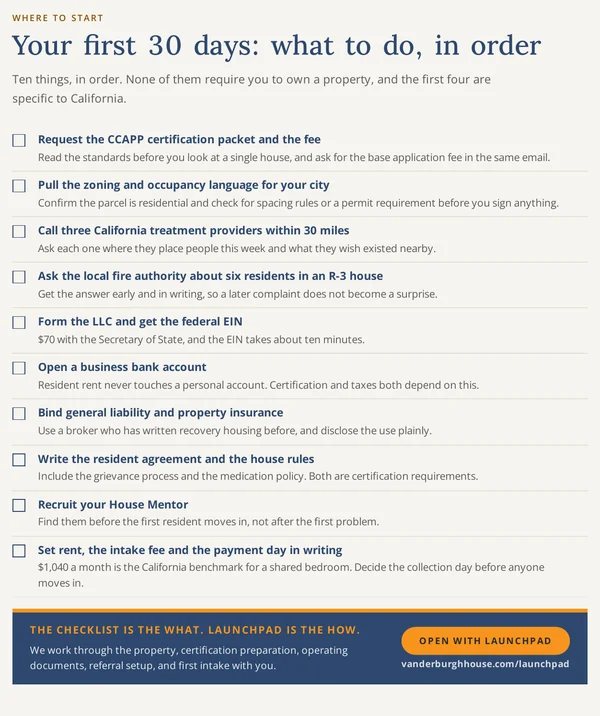
- Decide the letting structure before signing. One household, one agreement, shared access to all living, kitchen, and eating areas, no locking bedroom doors. That preserves the exemption and matches NARR certification standards.

Certification, zoning, licensing and setup for a California recovery residence, start to finish.
Frequently Asked Questions About San Francisco Rent Control and Recovery Housing
What is the 32-day rule in the San Francisco Rent Ordinance?
Administrative Code § 37.2(r)(1) excludes rooming and boarding house accommodations from coverage only until a tenant occupies one for 32 continuous days. The accommodation then becomes a covered rental unit automatically, and an eviction on any ground outside § 37.9(a) is deemed an action taken to avoid coverage.
Are sober living homes exempt from San Francisco rent control?
No. As of September 10, 2026, Chapter 37 carries no exemption for recovery residences, sober living homes, or substance use treatment settings. Its institutional exclusion at § 37.2(r)(3) names Department of Social Services licensed residential care and adult day health care facilities for the elderly, a license no recovery residence holds.
Does the June 13, 1979 cutoff exempt a property from the whole ordinance?
No. It exempts a unit from rent increase limits only, under § 37.3(g)(1). Section 37.9 applies just cause eviction to all rental units notwithstanding § 37.3, so post-1979 buildings remain subject to eviction control, relocation payments, buyout disclosure, harassment liability, and reporting requirements.
What is San Francisco’s allowable rent increase for 2026?
The San Francisco Rent Board set the annual allowable increase at 1.6%, effective March 1, 2026 through February 28, 2027. Section 37.3(a)(1) calculates it as 60% of the increase in the Consumer Price Index for the San Francisco-Oakland metropolitan area. It applies to units subject to rent increase limits.
Does renting bedrooms individually change rent control coverage in San Francisco?
Yes. Separately let bedrooms are rooming house accommodations that convert to covered rental units at 32 days under § 37.2(r)(1), each with its own base rent and ceiling. Separate alienability under Costa-Hawkins also fails, because one bedroom cannot be conveyed apart from another in the same structure.
What the 32-Day Rule Really Tells a San Francisco Owner
The Rent Ordinance never asks who lives in the house. It asks how the house is let, and § 37.2(r)(1) answers on a calendar: let as one household, a house is one rental unit; let room by room, it becomes several. The build-date and separate-alienability exemptions decide only whether the 1.6% cap applies, never whether Chapter 37 does.
If you are weighing a San Francisco conversion or a lease to a recovery housing operator, reach out to our team.
Research & Sources
Research material and primary sources referenced in this guide:
- City and County of San Francisco, Administrative Code § 37.2, definitions
- City and County of San Francisco, Administrative Code § 37.3, rent limitations
- City and County of San Francisco, Administrative Code § 37.9, evictions
- San Francisco Rent Board, Learn about rent increases in San Francisco
- San Francisco Board of Supervisors, Ordinance No. 248-24
- San Francisco Board of Supervisors, Ordinance No. 50-22
- California Civil Code § 1954.52, Costa-Hawkins Rental Housing Act
- California Civil Code § 1947.12, statewide rent cap and single-family exemption
- California Health and Safety Code § 11834.01, licensure of alcoholism and drug abuse recovery facilities
- Chun v. Del Cid, 34 Cal.App.5th 806 (2019)