An owner running the NYC rent stabilization sober living math lands in the same place: the rent on a covered apartment is capped, a recovery residence collects a fee per bed, and conversion looks like the way out. The arithmetic is right. The conclusion is not.
New York City answers the conversion question with occupancy law, not rent law. The Housing Maintenance Code decides how many unrelated adults may share a dwelling unit and whether a rooming unit may be created, stabilized building or not. It closes both structures that make recovery housing work elsewhere.
How Rent Stabilization Covers a New York City Building
Rent stabilization runs on the Rent Stabilization Law of 1969, whose coverage grant sits at NYC Administrative Code § 26-504. Its two thresholds sit in the Emergency Tenant Protection Act of 1974. ETPA § 5(a)(4) excludes “housing accommodations in a building containing fewer than six dwelling units,” and § 5(a)(5) excludes buildings “completed or buildings substantially rehabilitated as family units on or after January first, nineteen hundred seventy-four.” Rent control proper reaches buildings completed before February 1, 1947 under Administrative Code § 26-403(e)(2).
Two guidelines orders are live in 2026. Order #57 allows 3% and 4.5% on one- and two-year renewals commencing October 1, 2025 through September 30, 2026. Order #58, adopted June 25, 2026, sets 0% for both, October 1, 2026 through September 30, 2027. The Housing Stability and Tenant Protection Act of 2019 repealed vacancy bonuses and high-rent deregulation, so a stabilized building stays stabilized.
What the ETPA Exempts, and What Exemption Does Not Buy
A one- to five-unit building sits outside the Rent Stabilization Law under ETPA § 5(a)(4). That exemption buys less than it looks like.
The Non-Profit Charitable Exemption Is the Only Institutional Door
ETPA § 5(a)(10) also excludes buildings “operated exclusively for charitable purposes on a non-profit basis,” and § 5(a)(6) excludes a non-profit “hospital, convent, monastery, asylum, public institution, or college or school dormitory.” A sober living home is none of them, so this route takes a bona fide non-profit, not an LLC.
Good Cause Eviction Applies in New York City Automatically
Exemption from stabilization is not freedom. Good Cause Eviction fills the space. Real Property Law § 212 reads: “Upon the effective date of this section, this article shall apply to the city of New York.” Section 213 is the opt-in for everyone else. Stabilized units are excluded as already regulated, so Good Cause lands on the exempt buildings.
RPL § 211 exempts a small landlord, “a landlord of no more than (i) ten units in the state.” Crossing that line pulls the whole portfolio under just-cause eviction, the same way the DC small landlord exemption fails scaling operators.
The Two-Boarder Limit in NYC Administrative Code § 27-2078
Administrative Code § 27-2078(a) provides that “a family may rent one or more living rooms in an apartment to not more than two boarders, roomers or lodgers,” subject to egress and plumbing conditions. Subdivision (b) supplies the consequence: renting to more than two “shall constitute a use of the apartment for single room occupancy and such rental in an apartment of a converted dwelling shall constitute an unlawful use as a rooming unit.” Subdivision (c) applies the same cap in a private dwelling.
That sentence does two things. In any multiple dwelling, exceeding two converts the use to single room occupancy. In a converted dwelling, defined at § 27-2004 to include a pre-1929 one- or two-family building later occupied as a multiple dwelling, the same rental is an unlawful use as a rooming unit. That is much of the pre-war stock a buyer would look at.
Why the Multiple Dwelling Law Says Four and the City Says Two
Both numbers are primary. Multiple Dwelling Law § 4(5) defines a family as persons maintaining a common household “with not more than four boarders, roomers or lodgers.” The Housing Maintenance Code cuts that to two at § 27-2004 and § 27-2078, and the stricter City rule governs occupancy in the five boroughs. An owner reading the state statute alone plans around the wrong number.
The Housing Maintenance Code Caps Unrelated Occupants at Three
This matters more than the boarder cap. Administrative Code § 27-2004 defines a “family” to include “not more than three unrelated persons occupying a dwelling unit and maintaining a common household,” and repeats it for a shared living arrangement. Its one express expansion covers seven unrelated students at one accredited college, conditioned on sprinklering and a fire plan. The City wrote no equivalent for anyone else.
Eight residents sharing an apartment as one household, with no locking doors, still fails the cap. That is why the single-household structure that preserves a rent control exemption elsewhere does not solve New York.
Support for every stage
Pick the level of support that fits where you are.
Just getting startedSee how the sober living opportunity works and what starting with VSL looks like. LaunchpadGuided pre-launch program: one-on-one strategy, Academy training, weekly coaching, and templates. MasteryHands-on startup, certification, and operating support inside the Chartered Operator community.Questions first? Call (844) 762-3747, weekdays 8a to 5p.
How the City Treats Rooming Units, SROs, and Shared Occupancy
Administrative Code § 27-2077(a) is the hard stop. No rooming unit may be created in any dwelling unless it was classified and recorded before May 15, 1954, and the exceptions run only to hospital-operated, non-profit institutional, and agency-operated units. Room-by-room letting, the structure that makes per-bed revenue work elsewhere, is closed.
Where an SRO use exists lawfully, stabilization reaches it. DHCR Fact Sheet #42 covers a hotel, SRO, or rooming house “constructed on or before July, 1969, and contain six or more housing accommodations,” with Class B multiple dwellings regulated from June 4, 1981. Permanent tenant status attaches at six months under 9 NYCRR § 2520.6(j), or on request for a six-month lease under § 2522.5.
Read Multiple Dwelling Law § 302(1)(b) first. Where a dwelling is occupied in violation of § 301, “no rent shall be recovered by the owner of such premises for said period, and no action or special proceeding shall be maintained therefor.” Fines are survivable. Uncollectible fees are not.
Keep reading Sober Houses vs. Halfway Houses: What Is the Difference? Two terms people use interchangeably, and why the difference matters. →Is There a Recovery Residence Exemption in New York Rent Regulation?
No. As of September 10, 2026, we found no exemption for recovery residences or sober living homes in the Rent Stabilization Law, the ETPA, the City Rent and Rehabilitation Law, or the Multiple Dwelling Law. The carve-outs name hospitals, asylums, dormitories, public institutions, and non-profit charitable operation, and RPL § 214 adds assisted living and adult care facilities.
None is an Office of Addiction Services and Supports (OASAS) category, and the words “substance use,” “recovery,” “sober,” and “OASAS” appear nowhere in RPL § 214. Mental Hygiene Law § 41.34 deems a qualifying community residence “a family unit, for the purposes of local laws and ordinances,” which would answer the three-person cap, but it names only residences licensed by the Office of Mental Health or the Office for People With Developmental Disabilities.
OASAS launched New York’s certification program for recovery residences on January 31, 2025, voluntary and non-clinical, with up to $75,000 per site in Opioid Settlement Fund support. It exempts no one from the code.
How Per-Bed Economics Run in the New York City Market
The per-bed model assumes two things New York City withholds. Bed count is one: a code-compliant dwelling unit holds three unrelated adults, or a household plus two boarders, a third of a Los Angeles or Newark model. Collectible revenue is the other, which MDL § 302(1)(b) removes when occupancy does not conform.
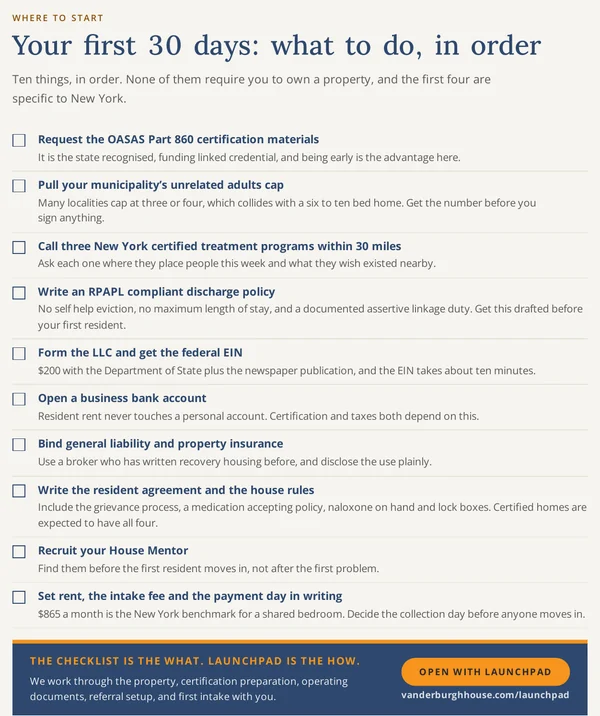
Most people ask whether they are allowed to open a recovery home. The better first question is whether the need and the money are there. This answers both, for your state.
- How many people need a bed, and how few beds exist
- Who actually pays the rent, and which programs are real
- What it costs to open on the purchase path and the lease path
What a Property Owner Should Verify Before Converting in New York City
| Item | What to Verify |
|---|---|
| The certificate of occupancy | MDL § 302(1)(b) keys the loss of rent recovery to it. Confirm building class, permitted occupancy, unit count, and build date. |
| Whether it is a converted dwelling | That status triggers § 27-2078(b). |
| Your statewide unit count | Above ten units, the small landlord exemption ends. |
| The Zoning Resolution | Section 27-2078(c) defers to it, so the boarder cap is a floor. |
| The entity holding title | Every institutional exemption here is written for non-profit or licensed operation, not an LLC. |
What Does Work for a New York City Property Owner
- Lease to an established operator: The owner holds the real estate and one lease; the operator carries compliance, certification, and residents. This is the cleanest path here.
- Partner with a non-profit: ETPA § 5(a)(10) and § 27-2077(a) both open for non-profit operation.
Owners weighing New York against a lighter-touch market also face the statewide New York sober living startup rules.

Certification, zoning, licensing and setup for a New York recovery residence, start to finish.
Frequently Asked Questions About NYC Rent Stabilization and Sober Living
Can you open a sober living home in a rent stabilized apartment in NYC?
Not at typical recovery housing capacity. Administrative Code § 27-2004 caps a dwelling unit at three unrelated persons, and § 27-2078 allows a family two boarders. Those Housing Maintenance Code limits apply whether or not the apartment is stabilized, so occupancy law decides the question before rent law.
How many boarders can a New York City household legally take?
Two. Administrative Code § 27-2078(a) permits a family to rent living rooms to not more than two boarders, roomers, or lodgers, with egress and plumbing conditions attached. Multiple Dwelling Law § 4(5) permits four statewide, but the stricter City rule governs occupancy inside the five boroughs.
Does rent stabilization cover SROs and rooming houses in New York?
Yes. DHCR Fact Sheet #42 covers a hotel, SRO, or rooming house constructed on or before July 1969 with six or more housing accommodations, and Class B multiple dwellings became regulated on June 4, 1981. Permanent tenant status follows six months of continuous residence.
Is there a sober living exemption in New York rent regulation?
No. As of September 10, 2026, we found none in the Rent Stabilization Law, the Emergency Tenant Protection Act, the City Rent and Rehabilitation Law, or the Multiple Dwelling Law. The carve-outs name hospitals, asylums, dormitories, public institutions, and non-profit charitable operation, not recovery residences.
Does Good Cause Eviction apply to sober living homes in New York City?
It applies automatically to covered New York City housing, because Real Property Law § 212 says the article applies to the city of New York with no local opt-in. Owners of ten or fewer units statewide are exempt as small landlords under § 211, and growth ends that exemption.
Why the Honest New York City Answer Is No
Conversion at scale does not work in New York City, and the obstacle is occupancy law, not rent law. The three-unrelated-persons cap closes the single-household structure and the rooming unit prohibition closes the room-by-room structure. None of that is a verdict on recovery housing, which New York City needs as much as any market. It is a reading of one city’s occupancy code, and it points an owner toward leasing to an operator or partnering with a non-profit instead.
If you own New York City property and want a candid read on leasing it to a recovery housing operator, talk with our team.
Research & Sources
Research material and primary sources referenced in this guide:
- New York City Administrative Code § 26-501 et seq., Rent Stabilization Law
- New York City Administrative Code § 26-403, rent control definitions
- New York City Administrative Code § 27-2004, Housing Maintenance Code definitions
- New York City Administrative Code § 27-2077, restrictions on rooming units
- New York City Administrative Code § 27-2078, boarders in a family unit
- New York State Senate, Emergency Tenant Protection Act of 1974, § 5
- New York City Rent Guidelines Board, Apartment and Loft Order No. 58, 2026 to 2027
- New York City Rent Guidelines Board, Apartment and Loft Order No. 57, 2025 to 2026
- New York Multiple Dwelling Law § 4, definitions
- New York Multiple Dwelling Law § 302, unlawful occupancy
- New York Real Property Law § 211, definition of a rooming house
- New York Mental Hygiene Law § 41.34, community residences and site selection
- New York State Homes and Community Renewal, Fact Sheet #42, occupancy standards
- 9 NYCRR § 2520.6, Rent Stabilization Code definitions
- 9 NYCRR § 2522.5, Rent Stabilization Code lease requirements
- New York State Senate, S6458 (2019), Housing Stability and Tenant Protection Act
- New York State Office of Addiction Services and Supports, Certified Recovery Residences