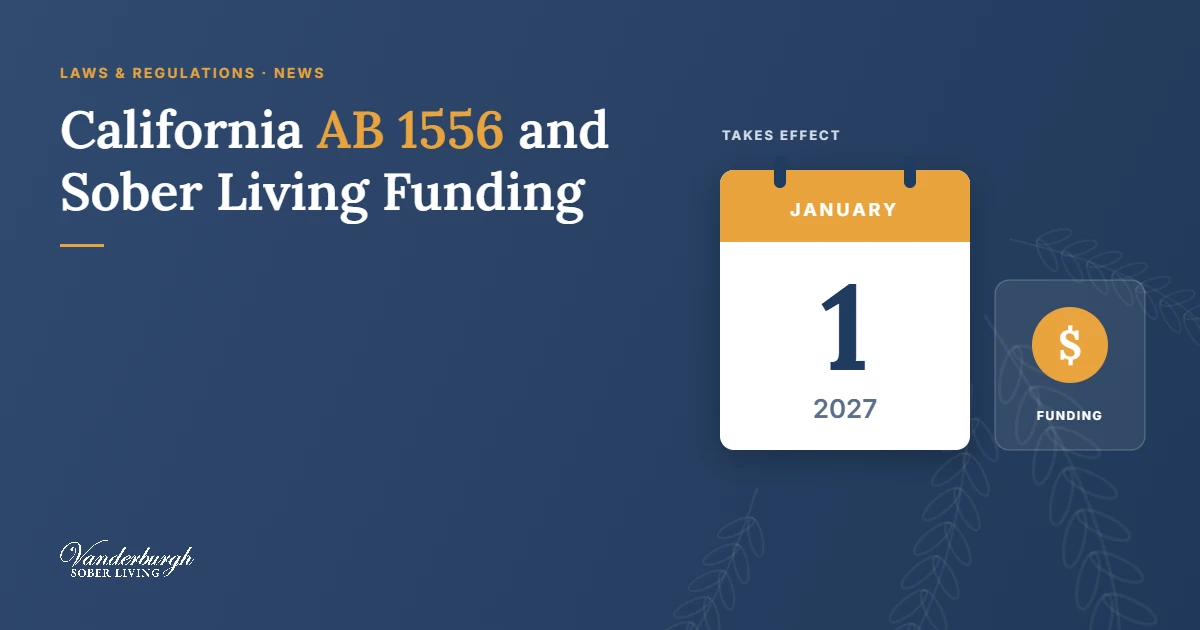
California AB 1556 is the new state law that makes sober living homes serving people experiencing homelessness clearly eligible for state homelessness funding. Governor Gavin Newsom signed Assembly Bill 1556, authored by Assemblymember Matt Haney (D-San Francisco), on September 29, 2026, as Chapter 779, Statutes of 2026. It takes effect January 1, 2027.
The law does not license private sober living homes, and it does not create a new pot of money. It sets the rules recovery housing must follow to receive state homelessness dollars, including a written relapse policy and a path to other housing for residents who return to use. Below is what the law says, who can use the funding, what it leaves untouched, and what it means if you run or plan to open a sober living home in California.
California AB 1556 (Chapter 779, Statutes of 2026) lets state homelessness funds pay for drug-free recovery housing that follows Housing First rules. Funded homes need a NARR-affiliate-approved return-to-use policy, cannot evict for relapse alone, and must offer a harm-reduction placement first. It takes effect January 1, 2027, and does not license private sober living homes.
What Does California AB 1556 Do?
AB 1556 sets the conditions under which abstinence-based recovery housing can receive California state homelessness funding. It adds a new Division 10.95, “Recovery Housing,” to the Health and Safety Code (Sections 11999.45 and 11999.50), according to the chaptered bill text. The Governor’s office described the law as making Housing First-compliant recovery housing “clearly eligible for state funding” in its September 29, 2026 signing announcement.
- Defines recovery housing for funding purposes: The term takes its meaning from Welfare and Institutions Code Section 8256(c)(3), sober living housing in a recovery-focused, peer-supported community, limited to housing funded through state programs.
- Sets eligibility conditions: Recovery housing must meet 12 requirements in Section 11999.50(a) to receive state funds.
- Adds a jurisdiction test: Local applicants for state homelessness money must show a range of options, including harm-reduction permanent housing, under Section 11999.45(b).
- Clarifies fair housing status: Funded recovery housing counts as a housing provider, not a treatment facility, under fair housing law solely because it offers nonclinical services.
Because the bill carried no urgency clause, it follows the default rule in California Constitution Article IV, Section 8(c): a regular-session statute takes effect on January 1 after a 90-day period from enactment. For AB 1556, that date is January 1, 2027.
Why California Needed a Sober Housing Funding Law
California requires state-funded homelessness programs to follow the Housing First core components in Welfare and Institutions Code Section 8255. Those components include accepting applicants regardless of sobriety and not evicting for alcohol or drug use alone. Many providers read that framework as closing state money to any home that asks residents to stay sober.
Haney tried twice before. AB 2479 died in 2024, and Governor Newsom vetoed AB 255 in 2025, writing that current law already allowed recovery housing within Housing First, according to the Assembly Housing and Community Development Committee analysis. The same analysis notes that the California Interagency Council on Homelessness (Cal-ICH) published guidance in 2025 on running recovery housing inside Housing First. CalMatters reported that Haney saw the guidance as unclear and that providers still treated state funds as off-limits for sober housing.
AB 1556 writes the key parts of that guidance into statute, so a county or continuum of care no longer has to guess whether a drug-free home can qualify. For the wider picture of how public money reaches sober living in the state, including the Behavioral Health Continuum Infrastructure Program and county contracts, see the card below.
Read next California Recovery Housing Funding: Why It Rarely Works the Way Operators ExpectThe Conditions Recovery Housing Must Meet for State Funding
Section 11999.50(a) lists the requirements recovery housing must meet to receive state funding. The table groups them by what an operator would have to put in place, based on the chaptered text of Section 11999.50.
| Requirement Area | What a Funded Sober Living Home Must Do |
|---|---|
| Housing First Alignment | Meet the core components of Housing First in Welfare and Institutions Code Section 8255, offer permanent housing with a lease or interim housing, and disclose house rules to prospective residents in writing. |
| Recovery Design | Emphasize abstinence and use substance use-specific, peer support, and physical design features that support recovery. |
| Voluntary Entry | Let the resident start residency and choose the home after being offered at least one harm-reduction housing option, unless placement is court-ordered. |
| Relapse | Do not evict for relapse alone without another lease violation, and provide relapse support. |
| Medications | Support, and do not restrict, prescribed medications such as buprenorphine, methadone, and naltrexone, without prescribing or dispensing them. |
| Overdose Readiness | Train staff and residents in emergency preparedness and overdose response, and keep overdose reversal medication readily accessible on site. |
| Return-to-Use Policy | Adopt a written policy approved by a NARR affiliate or similar entity. |
| Services | Offer participant-driven, nonclinical services and voluntary links to licensed providers. |
| Resident Agreements and Exits | Meet the recovery housing requirements in Section 8256(c)(1)(C): a signed resident agreement at entry, documented help finding other housing at exit, and annual outcome reports to the funder. |
Two of those conditions change daily operations the most. Relapse alone is not grounds for eviction unless there is another lease violation, and the home must support, not restrict, residents’ prescribed medications such as buprenorphine, methadone, and naltrexone. Neither requirement lets the home provide clinical treatment itself; the law keeps funded recovery housing nonclinical.
How the Return-to-Use Policy and Transition Placement Work
Every funded sober living home must adopt a written return-to-use policy approved by an affiliate of the National Alliance for Recovery Residences (NARR) or a similar entity. In California, the NARR affiliate is the California Consortium of Addiction Programs and Professionals (CCAPP). The policy must cover:
- Substance rules: The home’s policy on alcohol, cannabis, and other controlled substances.
- Support contacts: Contact information for treatment providers, mutual aid groups, and recovery coaches.
- A non-punitive response: A statement that the response to a return to use is not punitive, plus the steps the home will take.
- Eviction triggers: The conduct that may lead to eviction or discharge.
- Transfer protection: A resident facing eviction or discharge may stay until the operator secures a comparable harm-reduction placement; if the resident declines it, the operator may proceed.
The law also adds a paper trail. When an operator files an unlawful detainer or discharges a participant over an alleged violation, it must send documentation to the local grantor of the state funds. The grantor forwards that record to the state agency that administers the money and includes it in annual reporting.
For a home already certified through CCAPP, much of this will look familiar. VSL’s Recovery Housing Certification Landscape records that CCAPP certification is required for listing on California’s state registry and for referrals (Foote, 2026b). What is new is that the relapse response must now be written down, approved, and reported when it ends in a move-out. Operators who want a refresher on handling a return to use within fair housing rules can read what to do when a resident relapses in a sober living home.
Who Can Use AB 1556 Funding in California
AB 1556 funding flows through existing state homelessness programs, not to sober living operators directly. The law covers “state programs” as defined in Section 8255(e): any program a state agency funds or runs to provide housing or housing-based services to people experiencing or at risk of homelessness.
- Local applicants: Counties, cities, and continuums of care apply for state homelessness funds. The Homeless Housing, Assistance and Prevention (HHAP) Round 6 program, for example, is open only to 44 continuums of care, 14 large cities, and 58 counties, with about $760 million available, according to the California Grants Portal.
- Recovery housing programs: Nonprofit or private sober living operators can receive that money through a local grant or contract, if the home serves people experiencing or at risk of homelessness and meets every condition above.
- Residents: People in recovery who opt into a drug-free home, after being offered at least one harm-reduction housing option, unless their placement is court-ordered.
In practice, an operator does not apply to the state under AB 1556. You partner with the county, city, or continuum of care that already receives state homelessness funds and show that your sober living home meets the law’s conditions. If you are still working out how to pay for opening a home in the first place, the funding route finder below walks through the options that do not depend on a government contract.
- Loans
- Payment plans
- Employer aid
- Campaigns
- Voc Rehab
- VA (soon)
- Open
What AB 1556 Does Not Do
Much of the early coverage framed AB 1556 as new money for sober housing. The text and the committee record point to a narrower change.
- No new appropriation: The bill appropriates no money. The Assembly Appropriations Committee analysis estimated about $200,000 a year in state costs for one Department of Social Services position to track and guide the funding.
- No license for sober living homes: California still does not license non-clinical sober living homes; the Assembly committee analysis states these homes are not licensed by the Department of Health Care Services or any other state or local government. Licensure applies only where a home provides treatment, as explained under licensing rules for sober living homes in California.
- No rules for private-pay homes: The conditions apply only to recovery housing funded through state homelessness programs. A sober living home funded by resident fees is not covered by Section 11999.50.
- No funding cap: Unlike AB 255, AB 1556 does not reserve or limit a share of state homelessness funds for recovery housing.
- No clinical role: Funded homes link residents to licensed providers but may not provide clinical treatment or prescribe medication.
What AB 1556 Means for California Sober Living Operators
For most California sober living homes, AB 1556 changes nothing on January 1, 2027, because most homes run on resident fees. It changes things if you want to house people leaving homelessness and are willing to work under a county or continuum of care contract. VSL’s Operating Climate Index scores California 8 overall and classifies it as Moderately Regulated, with Resident Funding Access at 8 and Operator Funding Access at 10 (Foote, 2026a). Read together, those scores describe a state where public dollars exist but arrive through local grantors; AB 1556 widens which sober homes can sit inside that channel rather than opening a new one.
VSL’s Recovery Housing Legal Tracker, as of September 12, 2026, recorded no state credential requirement for non-clinical sober living homes in California and no recovery-specific tenancy or discharge law (Foote, 2026c). AB 1556 adds a tenancy rule of that kind, but only for state-funded recovery housing. If you are considering that route, these steps come first:
- Get certified: Start CCAPP certification, since a NARR affiliate must approve your return-to-use policy. How to certify a sober living home in California explains the process.
- Write the policy: Draft a return-to-use policy that covers every element the law lists, then have it approved.
- Use leases: Offer permanent tenants a lease with full tenant rights, as Housing First requires.
- Line up partners: Identify harm-reduction housing providers in your county for transition placements.
- Contact the grantor: Ask your county or continuum of care how it will apply AB 1556 in its next funding round.
- Check local rules: Confirm the property works under California zoning, fair housing, and land use rules for sober living before you sign a contract.
County contracts often pay for specific residents or services rather than the whole cost of the house, so plan the property finances before you bid. The playbook below lays out how operators fund the property itself.
A county or continuum of care contract under AB 1556 can help pay for residents, but someone still has to buy or lease the house. The playbook covers the paths that close for a first-time operator: conventional and portfolio loans, seller financing, leasing instead of buying, and where grant money does and does not fit.
Frequently Asked Questions About California AB 1556
What is California AB 1556?
California AB 1556 is a 2026 state law, Chapter 779, Statutes of 2026, that sets the rules for drug-free recovery housing to receive state homelessness funding. Funded homes must follow Housing First, adopt a NARR-affiliate-approved return-to-use policy, and offer residents who relapse a harm-reduction housing placement before any eviction.
When does AB 1556 take effect?
AB 1556 takes effect January 1, 2027. Governor Newsom signed it on September 29, 2026, and because it has no urgency clause, it follows California’s default rule that a regular-session statute takes effect on January 1 after a 90-day period from enactment.
Does AB 1556 require sober living homes in California to get a license?
No. AB 1556 creates no license or registration for sober living homes. California still does not license non-clinical sober living homes. The law only sets conditions that recovery housing must meet to receive state homelessness funding, and it bars funded homes from providing clinical treatment.
Can a private sober living home get AB 1556 funding?
Yes, if it serves people experiencing or at risk of homelessness and meets every condition in Health and Safety Code Section 11999.50. The money does not come from the state directly. It flows through counties, large cities, and continuums of care that receive state homelessness funds and contract with providers.
Does AB 1556 let recovery housing evict residents for relapse?
Not for relapse alone. A funded home cannot evict for relapse without another lease violation and must provide relapse support. If a resident faces eviction or discharge under the return-to-use policy, the operator must first secure a comparable harm-reduction placement; if the resident declines, the operator may proceed.
Where AB 1556 Leaves California Sober Living Operators
AB 1556 does not license sober living homes or fund them directly. It gives counties and continuums of care a clear legal basis to fund drug-free recovery housing for people experiencing homelessness, starting January 1, 2027, as long as the home follows Housing First rules and a written, approved return-to-use policy. If you want help deciding whether that route fits your sober living home, contact Vanderburgh Sober Living.
Research & Sources
- Foote, Hunter T. (2026a). Vanderburgh Sober Living Operating Climate Index, 2026 Edition. Vanderburgh Sober Living.
- Foote, Hunter T. (2026b). Vanderburgh Recovery Housing Certification Landscape, 2026 Edition (Report VSL-RR-2026-03). Vanderburgh Sober Living.
- Foote, Hunter T. (2026c). Vanderburgh Recovery Housing Legal Tracker, as of September 12, 2026. Vanderburgh Sober Living.
- California Legislature. (2026). AB 1556, Recovery housing: funding (Chapter 779, Statutes of 2026). California Legislative Information.
- CalMatters Digital Democracy. (2026). AB 1556 (Haney): Recovery housing: funding, bill status, votes, and text. CalMatters.
- Office of Governor Gavin Newsom. (2026, September 29). Governor Newsom signs housing legislation, cementing California’s record progress to reduce unsheltered homelessness and build more homes.
- Assembly Committee on Housing and Community Development. (2026, April 15). AB 1556 (Haney) bill analysis, hearing packet.
- Assembly Committee on Appropriations. (2026, May 6). AB 1556 (Haney) bill analysis. California Legislative Information.
- California Welfare and Institutions Code Section 8255 (Housing First core components). Justia.
- California Welfare and Institutions Code Section 8256 (recovery housing). Justia.
- California Constitution, Article IV, Section 8. Justia.
- California Grants Portal. (2025). Homeless Housing, Assistance and Prevention Program Round 6.
- National Alliance for Recovery Residences. (n.d.). California Consortium of Addiction Programs and Professionals (CCAPP), NARR affiliate.
- Kendall, M. (2026, September 29). New California law frees up funds for sober homeless housing. CalMatters.