
Sober living home requirements come from several places at once: local building and zoning rules, federal fair housing law, state licensing or certification rules, and the standards a certifying body uses when it reviews a home. Most aspiring operators expect one state license that covers everything, and in most states that license does not exist.
What follows breaks the requirements into the groups you will work through before opening: the property, zoning and fair housing, state credentials, certification standards, house policies, and insurance and business setup. Each section names where the requirement comes from, so you can check it against your own state and city.
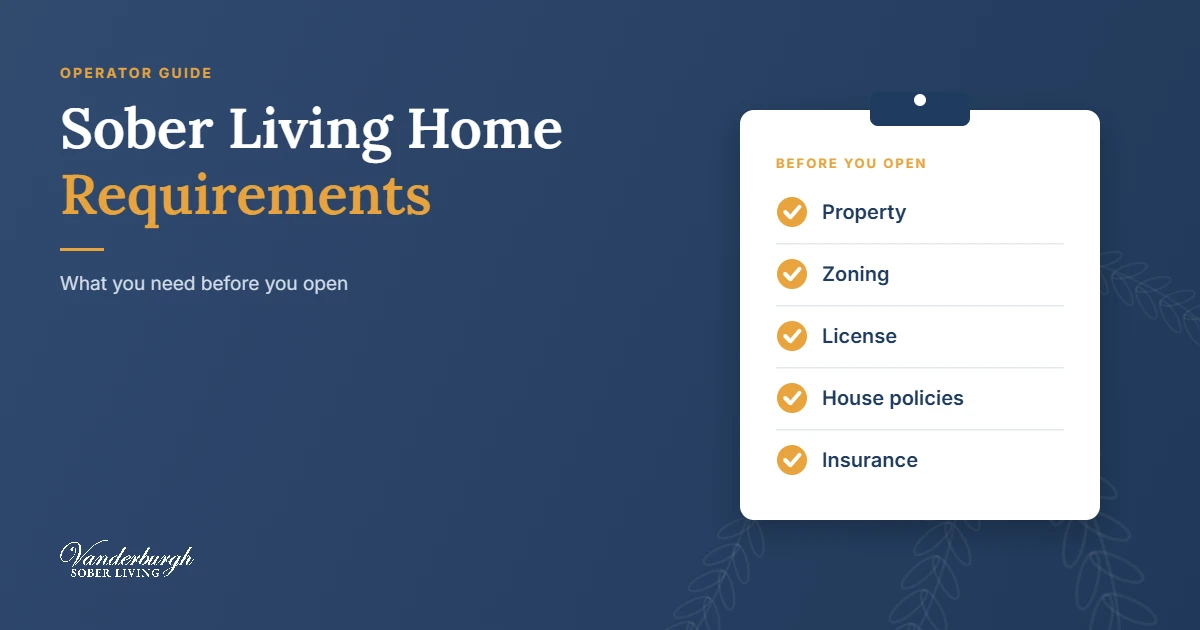
A sober living home needs a code-compliant property, a location where local zoning allows the use, written house policies and resident agreements, liability insurance, and a legal business entity. Most states do not license sober living homes, but several require registration or certification, and many tie funding and referrals to certification.
What Are the Requirements for a Sober Living Home?
Sober living home requirements are the legal, safety, and operating conditions a home must meet before it can house people in recovery. They fall into six groups, and only one of them changes much from state to state.
- Property and fire safety: The house meets the applicable local building, fire, and health codes for the number of people living there.
- Zoning and fair housing: Local zoning decides where residential uses can go, and the federal Fair Housing Act limits how a city can treat a sober living home.
- State credentials: A few states license sober living homes, more require registration or certification, and most require neither.
- Certification standards: Voluntary certification against the NARR standard is the benchmark most funders, referral sources, and states use.
- House policies: Written resident agreements, resident rights, and grievance, drug and alcohol, and medication policies.
- Insurance and business setup: A legal entity, a federal tax ID, owner permission if you lease, and liability insurance.
As of September 12, 2026, 38 states require no state credential for a non-clinical sober living home, according to the Vanderburgh Recovery Housing Legal Tracker (Foote, 2026b). That does not make the other groups optional. In 17 of the 31 states the tracker reviewed on this point, public funding, public referrals, or the right to advertise as recovery housing depends on a credential that is nominally voluntary.
Certification is also widely available. A NARR-recognized affiliate operates in 33 states, according to the Vanderburgh Recovery Housing Certification Landscape (Foote, 2026a), so most operators can earn a credential even where the state does not require one.
Property and Fire Safety Requirements for a Sober Living Home
The property is the first requirement and the one cities check most directly. A sober living home should comply with the applicable local building, fire, and health codes for its size and number of residents, and the rules can change once occupancy passes a set number of people.
That threshold catches many new operators off guard. In 29 states, the point at which a residence can be reclassified from a single-family dwelling into a different occupancy type sits below 14 residents (Foote, 2026b). Before you set a bed count, read how your city counts residents and how the unrelated persons rule for sober living homes applies at your address.
Certification adds its own safety items. The NARR Standard 3.0 asks operators to:
- Attest to code compliance: Confirm the home meets local health and safety codes, or provide documentation from a government agency or credentialed inspector.
- Keep alarms working: Verify smoke detectors, plus carbon monoxide detectors and fire extinguishers where applicable, and document the inspections.
- Run evacuation drills: Hold and document regular drills; Level I homes are exempt.
- Stock naloxone: Keep naloxone accessible at each location, with people trained to use it.
Keep the inspection records in one place. An affiliate reviewer, an insurer, or a referral partner may ask for them before anything else.
Zoning and Fair Housing Rules That Apply to Sober Living Homes
Zoning decides whether a house can be used as a sober living home at a given address, and that decision usually sits with the city or county. As of September 2026, 35 states leave the siting of recovery housing to local home rule, while 15 provide some form of state preemption (Foote, 2026b).
Federal law limits what a city can do with that power. The Fair Housing Act’s definition of handicap at 42 U.S.C. § 3602(h) covers people in recovery from a substance use disorder, though it excludes current, illegal use of a controlled substance. Under 42 U.S.C. § 3604(f)(3)(B), refusing a reasonable accommodation in rules, policies, or practices can be discrimination.
That is why operators often request a reasonable accommodation when a zoning rule caps the number of unrelated residents. The Supreme Court addressed that kind of rule in City of Edmonds v. Oxford House, Inc. (1995), holding that a family definition limiting unrelated occupants is not a maximum-occupancy restriction exempt from the Act. Those protections apply to the residents. The home itself still follows the same health and safety codes as any other residence.
Keep reading The Federal Fair Housing Act and Sober Living: Everything You Need to Know How the Fair Housing Act limits zoning rules, and when to ask a city for a reasonable accommodation. →State Licensing and Certification Requirements for Sober Living Homes
State rules are the requirement that varies most. As of September 12, 2026, states fall into four groups, according to the Legal Tracker (Foote, 2026b).
| State Credential Type | States | What It Means for an Operator |
|---|---|---|
| Mandatory operating license | Arizona, New Jersey, Utah | A state license is needed before the home houses residents. |
| License only when a trigger applies | Illinois, Pennsylvania, Rhode Island | A license or certification applies in defined cases, such as taking state-funded referrals or public funds. |
| Registration or certification required | Indiana, Kentucky, Montana, Ohio, Virginia, West Virginia | The home must register or be certified, and the rule is enforced by penalty. |
| No state credential | The other 38 states | No state permission is needed, though funding and referrals may still depend on certification. |
The three licensing states each set the rule in their own code:
- Arizona: The Arizona Department of Health Services licenses every home that meets the statutory definition of a sober living home, as its sober living home fact sheet explains.
- New Jersey: The Department of Community Affairs issues a Class F license to cooperative sober living residences under N.J.A.C. 5:27.
- Utah: The Division of Licensing and Background Checks regulates recovery residence services under Utah Admin. Code R501-18.
One line applies in every state. Providing clinical services, such as counseling, medication management, or withdrawal care, can turn a sober living home into a setting that needs a treatment license. State-by-state detail, including how the registration states work, is in the national licensing guide.
National licensing guide Do You Need a License to Open a Sober Living Home? Every state sorted by license, registration, or certification, and where treatment licensure begins. →NARR Standards and Certification Requirements for Sober Living Homes
Certification is the requirement most operators choose rather than inherit. The National Alliance for Recovery Residences (NARR) publishes the national standard, and state affiliates certify homes against it. SAMHSA’s Best Practices for Recovery Housing recommends that recovery housing be certified.
The NARR Standard 3.0 is organized into four domains:
- Administrative operations: Integrity, resident rights, resident leadership, and staff training.
- Physical environment: A home-like setting that is safe and healthy.
- Recovery support: Active recovery, prosocial skills, and a sense of community inside the home.
- Good neighbor: Responsiveness to neighbors and courtesy rules for the property.
Cost and process vary by affiliate. Across the 26 affiliate states that publish a first-year fee, the median standardized first-year cost for one eight-bed Level II home is $512.50, ranging from $0 in Kentucky to $2,000 in Michigan (Foote, 2026a). Affiliates expect groundwork before they review a home, so settle the prerequisites for certifying a sober living home before you apply.
Keep reading NARR Levels of Care: The 4 Levels of Sober Living Explained Which level fits your house, and how structure and staffing change from Level I to Level IV. →House Policies and Resident Agreements Every Sober Living Home Needs
Written policies are where requirements turn into daily practice. The NARR standard and most funders look for these documents, and they protect residents and operators when a disagreement comes up.
- Resident agreement: A written agreement, signed before move-in, that covers fees, house rules, and resident rights.
- Posted rights and grievance process: Resident rights and requirements available in common areas, plus a grievance procedure that lets residents take unresolved complaints to an outside oversight body.
- Alcohol and drug policy: A clear rule that the home is free of alcohol and illicit drugs, with a written drug screening procedure.
- Medication policy: Rules for storing, counting, and documenting prescribed medications, including medications for opioid use disorder.
- House meetings: Resident meetings at least once a week.
- Good neighbor policy: A named contact for neighbors and courtesy rules for parking, smoking, and loitering.
Medication policies deserve extra care. SAMHSA’s best practices describe lock boxes, medication counts, and staff training as ways to manage risk. Residents using medication for opioid use disorder may not lawfully be excluded in 31 states, and the question is unsettled in the other 19 (Foote, 2026b).
The guide to MAT and Suboxone policy in sober living explains what a policy can and cannot require, and common sober house rules show how these policies read to residents.
Support for every stage
Pick the level of support that fits where you are.
Just getting startedSee how the sober living opportunity works and what starting with VSL looks like. LaunchpadGuided pre-launch program: one-on-one strategy, Academy training, weekly coaching, and templates. MasteryHands-on startup, certification, and operating support inside the Chartered Operator community.Questions first? Call (844) 762-3747, weekdays 8a to 5p.
Insurance and Business Setup Requirements for Sober Living Operators
The business side of a sober living home has its own short list. The NARR standard asks operators to document each item, and lenders, landlords, and referral partners tend to ask for the same proof.
- Legal business entity: Incorporation papers, LLC documents, or a business license for the organization that runs the home.
- Federal tax ID: An Employer Identification Number, which the IRS issues free of charge.
- Owner permission: Written permission from the property owner of record if you lease the house rather than own it.
- Liability insurance: Current liability coverage, plus other insurance suited to the home’s level of support.
Start insurance quotes early so coverage is in place before the first resident moves in. The guide to sober living insurance for operators explains which policies operators carry and what carriers ask for.
Frequently Asked Questions About Sober Living Home Requirements
Do sober living homes need a license?
Usually not. As of September 2026, Arizona, New Jersey, and Utah require a state license for sober living homes, and Illinois, Pennsylvania, and Rhode Island license them only in defined cases. Six more states require registration or certification. The remaining 38 states require no state credential for a non-clinical sober living home.
What does NARR certification require?
NARR certification reviews a home against the NARR Standard 3.0, which covers administrative operations, the physical environment, recovery support, and being a good neighbor. A state affiliate checks documents such as the resident agreement, grievance policy, proof of insurance, and safety inspection records before it certifies the sober living home.
Can a city use zoning to block a sober living home?
A city can apply ordinary zoning and safety codes, but the Fair Housing Act covers people in recovery as people with a disability and requires reasonable accommodations in rules and policies. In City of Edmonds v. Oxford House (1995), the Supreme Court held that caps on unrelated residents are not exempt occupancy limits.
Does a sober living home need staff on site?
Not as a blanket rule. Staffing depends on the home’s NARR level and any state rules. SAMHSA describes Level I homes as entirely peer-run, and many Level II homes are monitored by a senior resident or house mentor. Providing clinical services can trigger treatment licensing instead of sober living rules.
How many residents can a sober living home have?
It depends on local zoning and building codes rather than one national number. In 29 states, the point at which a residence can be reclassified into a different occupancy type sits below 14 residents. Check your city’s family definition and occupancy limits before you set a bed count for the sober living home.
Meeting Sober Living Home Requirements Before Your First Resident
Sober living home requirements come down to a safe property in a location zoning allows, the state credential your state requires, written policies that meet the NARR standard, and a properly insured business. Working through them in that order keeps most openings on schedule, and the national guide to how to start a sober living home puts them in the full startup sequence.
To talk through the requirements for your own state and property, contact Vanderburgh Sober Living.
Talk to VSL about your opening checklist
Call (844) 762-3747, weekdays 8a to 5p, or start with these:
Start a sober houseHow opening a home with VSL works, end to end. Explore the Mastery ProgramHands-on startup, certification, and operating support.Research & Sources
- Foote, H. T. (2026a). Vanderburgh recovery housing certification landscape, 2026 edition (Technical Report No. VSL-RR-2026-03). Vanderburgh Sober Living.
- Foote, H. T. (2026b). Vanderburgh recovery housing legal tracker, 2026 edition (Report No. VSL-RR-2026-04). Vanderburgh Sober Living.
- Arizona Department of Health Services. (n.d.). Sober living homes fact sheet.
- City of Edmonds v. Oxford House, Inc., 514 U.S. 725 (1995).
- Internal Revenue Service. (n.d.). Get an employer identification number.
- Legal Information Institute. (n.d.). 42 U.S. Code § 3602: Definitions.
- Legal Information Institute. (n.d.). 42 U.S. Code § 3604: Discrimination in the sale or rental of housing and other prohibited practices.
- National Alliance for Recovery Residences. (2018). NARR standard 3.0.
- New Jersey Department of Community Affairs. (2025). N.J.A.C. 5:27: Regulations governing rooming and boarding houses.
- Substance Abuse and Mental Health Services Administration. (2023). Best practices for recovery housing (Publication No. PEP23-10-00-002).
- Utah Division of Licensing and Background Checks. (n.d.). R501-18: Recovery residence services.