
Whether you need a license to open a halfway house comes down to which kind of house you plan to run. The phrase covers three different businesses: a reentry house that holds people leaving prison under a government contract, a residential treatment house licensed to deliver addiction care, and a sober living home where adults in recovery live together under house rules. Each one answers to a different authority.
Most people asking the question picture the third model, and that is the one with the lightest rules. Below is what each kind of halfway house needs before it can open, which states license sober living homes, and how to check the rules where you plan to operate.
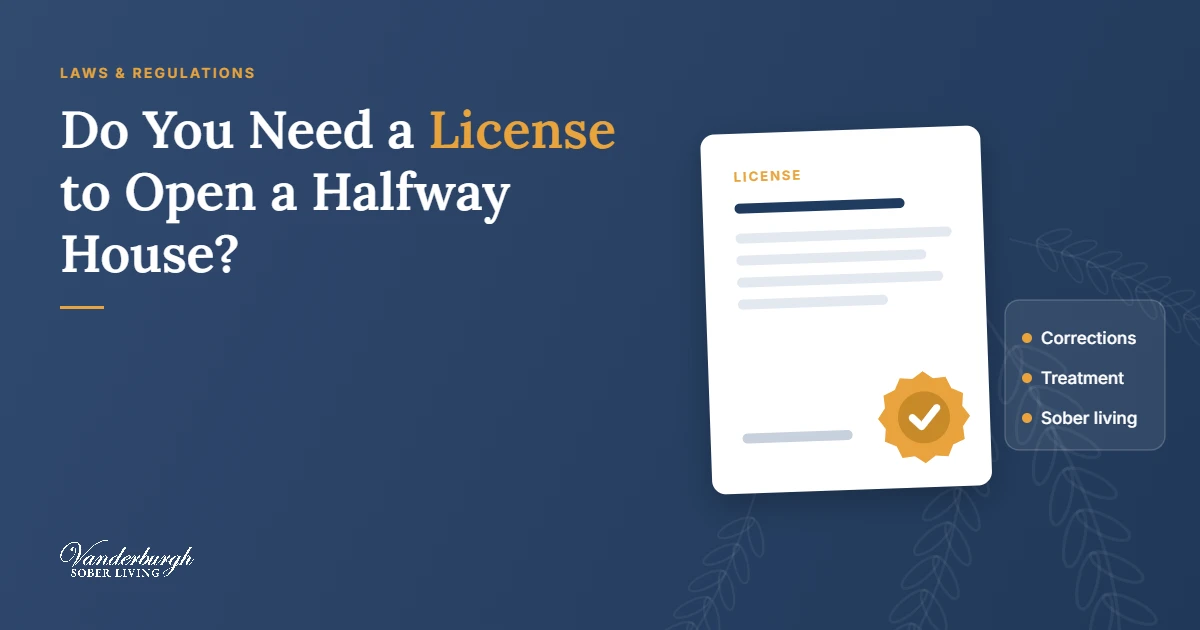
A license to open a halfway house depends on which kind you mean. A corrections halfway house runs under a government contract with its own standards, and a halfway house that delivers addiction treatment needs a state treatment license. A sober living home needs no state operating license in most states; as of November 2026, three states require one.
Do You Need a License to Open a Halfway House?
Yes for two of the three models, and usually no for the third. A corrections halfway house needs a contract with, or approval from, the agency that places its residents. A treatment halfway house needs a state treatment license. A sober living home needs no state operating license in 45 states, according to VSL’s Operating Climate Index, which classifies Arizona, New Jersey, and Utah as requiring one and Illinois and Pennsylvania as requiring one only in certain situations (Foote, 2026).
The word “halfway” is the source of the confusion. It originally described housing halfway between prison or treatment and independent life, and agencies still use it that way. Starting a halfway house as a business means choosing between a corrections contract and a sober living home first, because that choice decides every requirement after it.
Three Kinds of Halfway House and the License Each One Needs
The table below lines up the three models by what each one needs to operate and who grants it.
| Type of House | What It Needs to Operate | Who Grants It |
|---|---|---|
| Corrections Halfway House (Federal or State Reentry) | A government contract or agency approval, plus the agency’s program standards | Federal Bureau of Prisons, a state corrections agency, or a local corrections board |
| Treatment Halfway House (Licensed Residential Care) | A state substance use treatment license | The state health or drug and alcohol agency |
| Sober Living Home (Peer-Supported Housing) | No state operating license in most states; a license, registration, or certification in some | Varies by state; voluntary certification usually comes from a NARR affiliate |
Local zoning, building codes, and fire codes apply to all three. A business license or registration with your city and state is also routine for any company that collects rent. Neither of those is the operating license people usually mean when they ask the question.
Federal Halfway House Contracts: What the Bureau of Prisons Requires
The Federal Bureau of Prisons does not license halfway houses; it contracts with them. The Bureau of Prisons reentry page says it contracts with residential reentry centers, also known as halfway houses, and treats the terms halfway house and residential reentry center (RRC) as interchangeable. Under 18 U.S.C. § 3624(c), a person may spend up to the final 12 months of a federal sentence in prerelease custody, which can include an RRC.
The Bureau of Prisons RRC contracting page sets out how a provider gets there:
- Solicitation: The Bureau of Prisons advertises RRC contracts publicly on SAM.gov and awards them competitively.
- Statement of Work: Each bidder answers a Statement of Work with a plan for administration, programs, and services.
- Background checks: Executive staff pass NCIC and NLETS checks before award, and staff who will have contact with residents are fingerprinted.
Zoning is often where bids fail. In a September 2025 audit of three RRC contracts, the Department of Justice Office of the Inspector General reported that limited competition for these contracts is common mainly because of zoning and other local requirements, and that one bidder was excluded for lacking valid zoning documentation. The same report describes four Bureau of Prisons monitoring visits per RRC each year.
State Corrections Halfway Houses: Contract Standards and Local Approval
State reentry houses work much the same way, with a state or local agency in place of the Bureau of Prisons. Colorado is a clear example of how layered the approvals can be.
- State standards: Under C.R.S. § 17-27-108, Colorado’s Division of Criminal Justice sets standards for community corrections programs, audits programs against them at least once every five years, and can recommend ending a contract when material findings go uncorrected.
- Local approval: Under C.R.S. § 17-27-103, a local government, or the community corrections board it delegates to, can approve or reject a program in its jurisdiction and can accept or reject individual referrals.
Other states use different names, such as community corrections center or residential reentry program, and the structure is similar. The contracting agency’s standards and the local government’s approval take the place of a license, so read the specific solicitation before buying or leasing a property.
When a Halfway House Is a Licensed Treatment Program
Some states use the term halfway house for a level of addiction treatment, and treatment always requires a state license. Two examples:
- Massachusetts: Mass. Gen. Laws ch. 111B, § 6A requires the Department of Public Health to license each halfway house for alcoholism, issues licenses for two-year terms, and allows a fine of up to $500 for knowingly running one without a license.
- Pennsylvania: The Pennsylvania Department of Drug and Alcohol Programs (DDAP) lists “Residential (Halfway House)” among the treatment settings that require a license.
A sober living home that adds counseling, medication management, or other clinical services can cross into this category. Keeping clinical care off site, with residents attending outpatient treatment elsewhere, is what keeps a sober living home outside treatment licensing in most states.
Keep reading How to Certify a Sober House: An Overview of NARR Affiliate Certification Where no license applies, certification is the credential referral sources look for. Here is how it works. →Sober Living Homes: Usually No State License, With Exceptions
A sober living home is a peer-supported residence where adults in recovery share a house, pay rent, and follow house rules such as staying sober, with no clinical services on site. Most states do not license that model, and a few do.
- Licensed states: Arizona, New Jersey, and Utah require a state license to operate a sober living home (Foote, 2026). In Arizona, A.R.S. § 36-2062 bars anyone from operating a sober living home without a current license from the state health department.
- Conditional states: Pennsylvania requires a DDAP recovery house license only for homes that accept referrals from state agencies or state-funded facilities, or that receive federal or state funding for recovery house services.
- Certification states: Florida’s certification is voluntary, but under Fla. Stat. § 397.4873 licensed treatment providers may not refer patients to a recovery residence unless it holds a certificate of compliance.
Several other states now require registration or certification instead of a license, and the rules change often. The state-by-state breakdown is in the sober living license requirements by state. Check it before you sign a lease.
Licensing and zoning, answered
Start with the federal protections, then plan your state and local steps.
Read the sober living startup guideThe national guide, with links to the rules in every state. Understand your Fair Housing rightsHow the federal Fair Housing Act applies to sober living homes. Get zoning support in the LaunchpadTemplates and guidance for local approvals, at your own pace.Zoning and Fair Housing Rules for a Halfway House or Sober Home
Zoning treats the two models differently because federal fair housing law does. The Fair Housing Act’s list of protected characteristics in 42 U.S.C. § 3604 includes disability, and HUD’s definition at 24 CFR § 100.201 covers drug addiction other than current illegal use. People in recovery who live in a sober living home can therefore ask a city for a reasonable accommodation when a local rule blocks the home.
A criminal record is not on that list of protected characteristics. A corrections halfway house usually goes through the city’s ordinary approval process for that use, often a special or conditional use permit, which is part of why zoning limits competition for reentry contracts.
- ✓How cities classify a sober living home
- ✓Where fair housing protection applies, and where it stops
- ✓How to ask for a reasonable accommodation
How to Check Halfway House License Rules in Your State
The same short sequence answers the license question in any state.
- Pick the model: Decide whether you are bidding on a corrections contract, offering treatment, or opening a sober living home.
- Read the solicitation: For a reentry house, the agency’s contract documents list the standards, staffing, and inspections you must meet.
- Check treatment licensing: If any clinical service will happen on site, contact the state agency that licenses substance use treatment.
- Check sober living rules: Confirm whether your state licenses, registers, or certifies sober living homes, and whether referral sources expect certification.
- Confirm local zoning: Ask the city how it classifies the use at your address before you buy or lease.
Most new operators who work through those steps land on the sober living model, because it needs no government contract and, in most states, no operating license.
Frequently Asked Questions About Halfway House Licenses
Do you need a license to run a halfway house for people on parole or probation?
Usually you need a contract or agency approval rather than a standalone license. Federal halfway houses operate under Bureau of Prisons contracts, and state reentry houses answer to the corrections agency or local board that places residents. That agency sets the standards, background checks, and inspections, and local zoning still applies.
Is a sober living home the same as a halfway house?
No. A halfway house is usually tied to corrections or to licensed treatment, and residents are often placed there by an agency. A sober living home is peer-supported housing that residents choose and pay for, with house rules and no clinical services, and it usually needs no state operating license.
Can you open a halfway house without a license?
You can open a sober living home without a license in most states, but not a corrections or treatment halfway house. A reentry house needs a contract or agency approval, and a house that provides treatment needs a state treatment license. Operating a licensed category without a license can bring fines.
Do any states license sober living homes the way they license halfway houses?
A few do. As of August 2026, VSL’s Operating Climate Index classifies Arizona, New Jersey, and Utah as requiring a state license to operate a sober living home, and Illinois and Pennsylvania as requiring one only in certain situations, such as accepting state referrals or public funding. Check your own state’s rules.
Who issues a halfway house license?
It depends on the type of house. The Bureau of Prisons or a state corrections agency approves reentry houses through contracts, a state health or drug and alcohol agency licenses treatment halfway houses, and a sober living home licensed in one of the few states that require it answers to that state’s designated agency.
Choose Your Halfway House Model Before You Apply for Anything
The license question has three answers because “halfway house” names three businesses. Settle the model first, then check the agency, state, and city rules that go with it. If you are leaning toward a sober living home and want help planning the steps, contact Vanderburgh Sober Living.
Support for every stage
Pick the level of support that fits where you are.
Just getting startedSee how the sober living opportunity works and what starting with VSL looks like. LaunchpadGuided pre-launch program: one-on-one strategy, Academy training, weekly coaching, and templates. MasteryHands-on startup, certification, and operating support inside the Chartered Operator community.Questions first? Call (844) 762-3747, weekdays 8a to 5p.
Research & Sources
- Foote, Hunter T. (2026). Vanderburgh Sober Living Operating Climate Index, 2026 Edition. Vanderburgh Sober Living.
- Federal Bureau of Prisons. (n.d.). Residential reentry management centers. U.S. Department of Justice.
- Federal Bureau of Prisons. (n.d.). Residential reentry center contracting. U.S. Department of Justice.
- U.S. Department of Justice, Office of the Inspector General. (2025). Audit of the Federal Bureau of Prisons’ residential reentry center contracts awarded to The Kintock Group, Inc. (Report 25-099).
- Imposition of a sentence of imprisonment: Release of a prisoner, 18 U.S.C. § 3624.
- Division of criminal justice of the department of public safety: Duties, community corrections contracts, Colo. Rev. Stat. § 17-27-108.
- Community corrections boards: Establishment, duties, Colo. Rev. Stat. § 17-27-103.
- Licensing and approval of halfway houses, Mass. Gen. Laws ch. 111B, § 6A.
- Pennsylvania Department of Drug and Alcohol Programs. (n.d.). Apply for a license to operate a drug and alcohol treatment facility.
- Pennsylvania Department of Drug and Alcohol Programs. (n.d.). Apply to become a licensed recovery house.
- Licensure required; standards; administrative clearance from local jurisdiction; use of title, Ariz. Rev. Stat. § 36-2062.
- Certified recovery residences; referrals, Fla. Stat. § 397.4873.
- Discrimination in the sale or rental of housing and other prohibited practices, 42 U.S.C. § 3604.
- Definitions, 24 C.F.R. § 100.201.