
A sober living home for women in the Town of Beekman, in Dutchess County, can open under a preliminary injunction that the town and the federal government agreed to and a federal judge entered on October 28, 2026. The U.S. Attorney’s Office for the Southern District of New York announced the order on October 29, 2026. The case shows how sober living zoning in New York is still settled town by town, through special permits, reasonable accommodation requests and, when those stall, federal court.
Keep the scale in view. This is one home, and the order is a temporary agreement that holds while the lawsuit continues, not a final ruling on who was right. For anyone planning a New York sober house, it is still a useful map of where local approval tends to break down and what a town can and cannot waive.
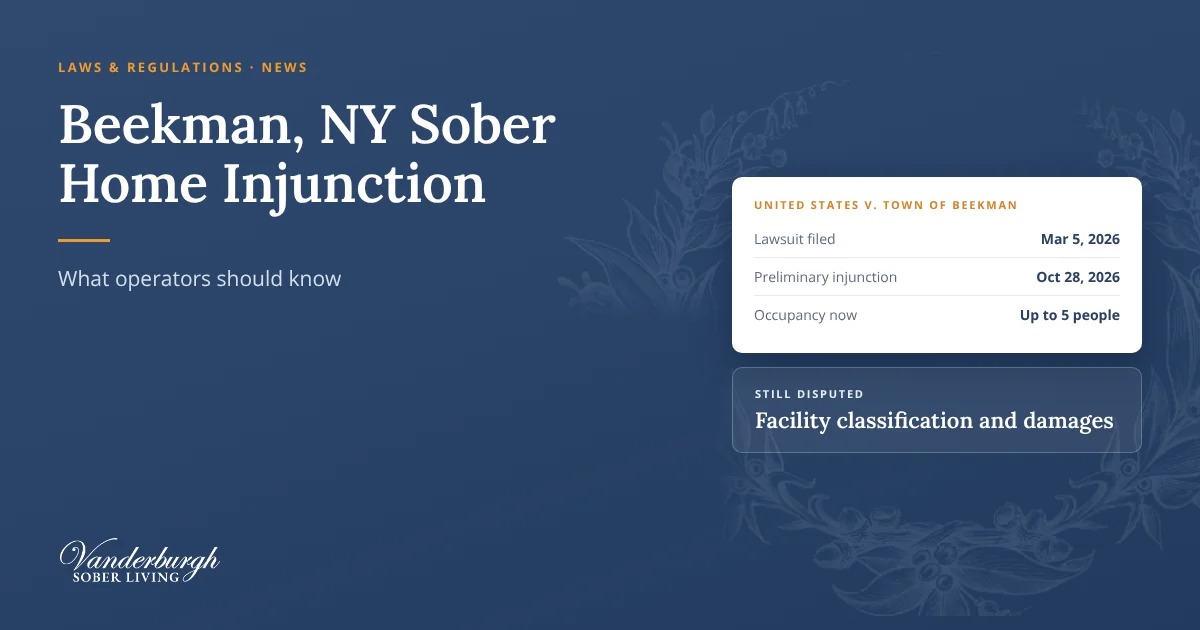
| Item | Detail |
|---|---|
| Case | United States v. Town of Beekman, No. 7:26-cv-01816-JGLC (S.D.N.Y.) |
| Lawsuit filed | March 5, 2026 |
| Order | Preliminary injunction entered by agreement, October 28, 2026 |
| Home | Hudson Valley Collective, a sober living home for women in Poughquag |
| Occupancy now | No more than five people, including resident staff |
| Occupancy later | Up to what Dutchess County and New York State allow, whichever is lower |
| Still disputed | The town’s “alternate care facility” classification and the damages claims |
What the Beekman Sober Home Lawsuit Is About
The dispute started with a different plan for the same house. According to the government’s complaint, filed March 5, 2026, the founder of Bunkhouse Recovery Ranch set out to run a sober living home there for male veterans and first responders. The government alleges the town treated the house as an “alternate care facility,” took no action on his application for more than ten months and failed to consider whether federal law required a reasonable accommodation. Patch reported the suit on March 6, 2026.
The complaint also alleges that parts of Beekman’s town code do not comply with the Fair Housing Act. The town denies all allegations of wrongdoing, a position recorded in the injunction itself. While the case was pending, the founder’s company, Hudson Valley Collective, applied to use the house as a home for up to eight women in recovery.
The law behind this case How the Fair Housing Act Protects Sober Living Homes Why people in recovery are protected under the Fair Housing Act, and what that means for a town reviewing a sober living home. →What the Preliminary Injunction Requires
The preliminary injunction (ECF No. 75) requires the town to let Hudson Valley Collective operate as a sober living home while the case continues. Its main terms:
- Single-family treatment: Except as the order allows, the town may not enforce zoning provisions that treat the home as anything other than a single-family dwelling.
- Occupancy cap: The home is limited to five people, including resident staff, until Dutchess County and New York State confirm it can run at full capacity.
- Safety before move-in: The operator must install Knox boxes and UL-listed smoke and carbon monoxide alarms before anyone moves in.
- Self-evacuation: Residents must be able to leave the building on their own, or the operator must provide uninterrupted help to do so in an emergency.
- State codes still apply: The town keeps its duty to enforce the state Uniform Fire Prevention and Building Code and the Dutchess County Sanitary Code.
The order states that it is not an admission of liability by anyone and does not make any party a “prevailing party.”
Facing a label like “alternate care facility”? Learn how sober living homes get classified, where the Fair Housing Act applies, and what to do if the town says no.
How the Reasonable Accommodation Request Played Out
The local approval came first. The Beekman Planning Board resolution, attached to the order as Exhibit A, records a unanimous vote of all five members on October 15, 2026, granting a special use permit and site plan approval. The resolution was signed the next day.
The board still treated the house as an alternate care facility, but it used its waiver authority as a reasonable accommodation under the Fair Housing Act. It waived 39 site plan requirements and eight special use permit requirements, and it dropped the rule that such a facility must sit on a state or county highway.
What the board said it could not waive matters as much. It found that septic and well approvals belong to the Dutchess County health department, and that fire code variances belong to a state regional board of review. It also recorded that the earlier 15-resident plan had been classified as Group R-4 under the state code, while the reduced plan was classified as Group R-3, which still calls for an automatic sprinkler system and a fire alarm system.
Read next Sober Living Zoning and Legal ProtectionsWhat Is Still Unresolved in United States v. Town of Beekman
Most of the legal fight is still open. The government, the founder and Hudson Valley Collective continue to dispute the alternate care facility label and accepted some town conditions only for the life of the injunction. According to the U.S. Attorney’s Office, the claim that the label had no factual basis, and the damages claims on behalf of the founder, Bunkhouse and Hudson Valley Collective, remain pending.
The town’s motion to dismiss is also undecided. The order directs the parties to file a revised schedule by November 20, 2026, with discovery to close by April 30, 2027.
The local fight fits the state picture. VSL’s Recovery Housing Legal Tracker describes New York as a home rule state where local codes control land use and siting relies on the federal Fair Housing Act and the New York Human Rights Law (Foote, 2026a). VSL’s Operating Climate Index scores New York 5 out of 10 for legal climate and 6 overall (Foote, 2026b).
Certification came up too. The resolution notes that New York regulates a sober living home under 14 NYCRR Part 860 only when it advertises as a “Certified Recovery Residence,” and it bars this home from using that label without proof of approval by the Office of Addiction Services and Supports (OASAS). OASAS describes its voluntary certification program online, and VSL walks through the OASAS application step by step.
New York guide Do You Need a License to Open a Sober Living Home in New York? Beekman tied the “Certified Recovery Residence” label to OASAS approval. See what New York requires, and where certification is optional. →What This Means for Operators
Beekman is a single case, but the pattern repeats across New York towns. Before you buy or lease, work through this list:
- Get the classification in writing: Ask the building official how the town classifies your planned use before you commit, since that label drives every permit that follows.
- Request the accommodation early and in writing: Name the rule, the change you need and how it relates to residents’ disabilities; the Fair Housing Act, at 42 U.S.C. § 3604(f)(3)(B), treats refusing a reasonable accommodation as discrimination.
- Separate town rules from county and state rules: A planning board can waive its own requirements, but septic, well and fire code approvals usually come from other agencies.
- Size the occupancy plan deliberately: In Beekman, the move from 15 residents to nine changed the building code classification, so model the code impact of each bed count before you apply.
- Budget for fire safety: Plan for sprinklers, alarms and emergency access whether or not zoning goes smoothly.
- Keep a dated record: Log every submission, meeting and response, because the government’s claims here rest partly on alleged delay.
Beekman’s planning board ended up approving the home, but only after a federal lawsuit and long stretches without a decision. Getting the classification and the accommodation request right at the start is the cheaper path.
If you are weighing a property in a New York town now, talk the zoning and code questions through before you sign anything.
Talk to VSL about your New York property
Call (844) 762-3747, weekdays 8a to 5p, or start with these:
Start a sober houseHow opening a home with VSL works, from zoning to first residents. Explore the Mastery ProgramHands-on startup, certification, and operating support.This article is general information about a pending federal case, not legal advice.
Sources
Primary sources
- U.S. Attorney’s Office, Southern District of New York. (2026, October 29). U.S. Attorney’s Office obtains preliminary injunction requiring the Town of Beekman to allow opening of a sober home (Press Release No. 26-308). U.S. Department of Justice. https://www.justice.gov/usao-sdny/pr/us-attorneys-office-obtains-preliminary-injunction-requiring-town-beekman-allow
- United States v. Town of Beekman, No. 7:26-cv-01816-JGLC-AEK (S.D.N.Y. Oct. 28, 2026) (preliminary injunction, amended Oct. 27, 2026, ECF No. 75). https://www.justice.gov/usao-sdny/media/1469231/dl
- Town of Beekman Planning Board. (2026). Resolution: Application of Hudson Valley Collective for a special use permit and site plan approval for a sober living residence (filed as ECF No. 74-2, Exhibit A). https://www.justice.gov/usao-sdny/media/1469226/dl
- United States v. Town of Beekman, No. 7:26-cv-01816 (S.D.N.Y. filed Mar. 5, 2026) (complaint, ECF No. 1). https://www.justice.gov/crt/media/1430901/dl
- Fair Housing Act, 42 U.S.C. § 3604. Legal Information Institute, Cornell Law School. https://www.law.cornell.edu/uscode/text/42/3604
- New York State Office of Addiction Services and Supports. (n.d.). Become a certified recovery residence. https://oasas.ny.gov/providers/become-certified-recovery-residence
VSL research
- Foote, H. T. (2026a). Vanderburgh Recovery Housing Legal Tracker, as of September 12, 2026. Vanderburgh Sober Living. https://www.vanderburghhouse.com/research/legal-tracker-2026/
- Foote, H. T. (2026b). Vanderburgh Sober Living Operating Climate Index, 2026 edition. Vanderburgh Sober Living. https://www.vanderburghhouse.com/research/operating-climate-index-2026/
News
- News: Edwards, J. (2026, March 6). Feds sue town under the Fair Housing Act for blocking “sober home” for vets. Patch. https://new.patch.com/new-york/midhudsonvalley/feds-sue-town-under-fair-housing-act-blocking-sober-home-vets