Sober living startup costs in New York run wider than in almost any other state, from roughly $51,375 for a lean upstate launch on a lease to about $205,554 for a downstate purchase with a full reserve in the bank. The gap is not padding. It is the distance between a suitable house in Onondaga County and a comparable property in Westchester, and it is the single most important thing to settle before writing a budget for a New York recovery home.
New York rates a Startup Burden Score of 5 and a Return on Capital Score of 4 (Foote, 2026), which is the honest summary: entry is mid-pack in difficulty, and capital works harder here than the state’s rent levels suggest. What follows is the full itemized budget, the lease-versus-buy cash comparison at real New York prices, the fire-code triggers that decide your renovation number, and the costs first-time operators leave out. The national figures for all 50 states show what it costs to open a sober living home in every state, including New York.
Before you read onHow to Open a Sober Living Home in New YorkThis post covers one piece of the process. The complete New York guide walks through every step, from planning to your first resident.→How Much Does It Cost to Start a Sober Living Home in New York?
New York startup cost snapshotThe range is driven almost entirely by two decisions: whether you lease or buy, and where in the state you open. Everything else on the budget, the filings, the furniture, the certification fees, the deposits, moves within a few thousand dollars no matter which county you pick. Property is the variable that swings the total by a factor of five, and every figure on this page is an estimated model total rather than a quote.
The geographic spread is real and it is measurable. The median value of an owner-occupied home is $200,200 in Onondaga County and $233,800 in Erie County, against $663,200 in Westchester County, all on 2020 to 2024 American Community Survey estimates. Applied to a recovery-adjusted purchase price, a 20% down payment lands near $43,000 around Syracuse, $51,000 around Buffalo, and $143,000 in Westchester. Same business, same model, three completely different capital requirements.
New York also adds one line item most states do not have at all. Under Limited Liability Company Law §206, a new LLC must publish notice in two newspapers designated by the county clerk of the county named in its articles, then file a Certificate of Publication within 120 days of formation. Because the newspapers set their own rates and the county clerk designates them, an operator forming in a rural county pays a fraction of what the same filing costs in Manhattan. Any publication figure on this page is an estimated band rather than a fixed fee.
The unmet need and the bed shortfall, who pays the rent, what certification costs and what it unlocks, and the full operating model for buying versus leasing.
Get the Your State Starter Kit No cost, no obligation. Unsubscribe in one click.What Goes Into a New York Startup Budget
The table below itemizes a 14-bed New York recovery home from formation through first stabilized occupancy. The low column reflects an upstate launch on a lease; the high column reflects a downstate purchase. Every line is a real cost an operator writes a check for, and the total is the arithmetic sum of the lines above it, including insurance and the operating reserve that most published budgets leave out.
| Cost item | Estimated cost | What it means |
|---|---|---|
| Entity formation & state filing fee | $400 to $1,750 | $200 Articles of Organization plus a $50 Certificate of Publication, plus newspaper publication set by county |
| Lease deposit or property down payment | $13,526 to $108,720 | Three months upfront on a lease, or 20% down on a recovery-adjusted purchase |
| Renovation and safety/code upgrades | $6,000 to $55,000 | Egress, alarms, bathroom count, and a sprinkler retrofit if the occupancy classification changes |
| Furniture and setup | $7,496 to $12,000 | Beds, common areas, kitchen, and secure personal storage for 14 residents |
| Supplies and linens | $1,124 to $1,800 | Opening stock of bedding, kitchen, and household consumables |
| Utility deposits | $562 to $1,200 | Electric, gas, water, and internet deposits at New York utility rates |
| Insurance (first year) | $3,600 to $6,530 | General liability for every operator; property coverage adds to it when you own |
| Certification fee | $500 to $2,000 | NYSARR membership and application; peer credentialing for the residence manager under Part 860 |
| Marketing and launch | $469 to $1,500 | Signage, listings, referral outreach, and intake materials |
| Operating reserve | $15,054 to $17,698 | Three months of carrying the home to stabilized occupancy before fees cover expenses |
| Estimated all-in to open (low to high) | $51,375 to $205,554 | The realistic total to open a certified home in New York, reserve included. |
Methodology & sources. Filing figures come from the New York Department of State fee schedule: $200 for Articles of Organization, $50 for the Certificate of Publication required within 120 days of formation, and $9 for the biennial statement. Newspaper publication cost is an estimate, never a fixed fee, because rates are set by the papers the county clerk designates rather than by the state. The lease basis is New York’s statewide average HUD FY2025 three-bedroom Fair Market Rent of $2,818, weighted by population, carried at a 60% recovery-housing rent premium to $4,509 a month and three months upfront. The purchase basis is New York’s median closed sale price of $503,333 (Zillow Home Values, as of May 31, 2026), carried at an 8% recovery-housing purchase premium to $543,600, with 20% down. The mortgage figures used elsewhere on this page assume a 30-year term at 6.66%, the Freddie Mac Primary Mortgage Market Survey average as of August 27, 2026. Renovation, furnishing, supplies, deposits, insurance, marketing, and the reserve are estimated model figures scaled to New York cost levels, not quoted prices. Every line above is included in the total: $51,375 low and $205,554 high are the exact arithmetic sums of the ten line items, insurance and reserve included. Entity choice and the filings behind that first line are covered where forming a legal entity for a sober living business in New York is worked through in full.
Lease vs. Buy: How the Startup Number Changes
Leasing cuts the day-one cash requirement by roughly $101,000 at statewide prices and hands the code-upgrade risk to a landlord. Buying costs far more upfront, carries a higher monthly obligation, and is the only path that builds equity in an asset class New York has very little of. The comparison below uses the same 14-bed model home on both sides.
The filter we use before we ever call an agent: what makes a property work as a Level II home, the zoning and occupancy questions to ask before you tour, and the red flags that should end a showing in five minutes.
Get the guide free →| Factor | Leasing | Buying |
|---|---|---|
| Upfront cash | $13,526, first month, last month, and security | $108,720, 20% down at the recovery-adjusted median |
| Monthly cost | $4,509 rent | $3,628, mortgage plus real estate tax and property insurance |
| Year-one insurance | $3,600, general liability | $6,530, general liability plus property coverage |
| Three-month reserve | $17,698 | $15,054 |
| Control over the property | Code-upgrade exposure is negotiable with the landlord | Code-upgrade exposure is yours in full |
| Equity | None | Builds, and the property can be refinanced later |
| Main risk | A rent premium of roughly 60% over market, paid every month of the term | A six-figure down payment tied up in a thin buyer market |
| Exit | End of term | Sale, and a slower one in a thin buyer market |
If you lease
- Day-one property cash is $13,526, first month, last month, and security.
- You skip the down payment and the property insurance line, and the three-month reserve is $17,698, above the purchase path’s $15,054 because the modeled lease costs more each month than the mortgage, tax, and insurance it replaces.
- You pay a rent premium of roughly 60% over the three-bedroom Fair Market Rent, $4,509 a month on the model home, and you hold no equity at the end of the term.
- Code-upgrade exposure is negotiable with the landlord.
If you buy
- Day-one property cash is $108,720, 20% down on the recovery-adjusted median price of $543,600.
- Monthly carrying cost is $3,628, mortgage plus real estate tax and property insurance.
- Year-one insurance is $6,530 and the three-month reserve is $15,054.
- Code-upgrade exposure is yours in full, but the property builds equity and can be refinanced later.
New York Fire Code, Sprinklers, and the Bed-Count Cliff
Renovation is the least predictable line on the budget because it depends entirely on how the local code enforcement officer classifies the building. Most of the state runs on the Uniform Fire Prevention and Building Code at 19 NYCRR Parts 1220 to 1229, which incorporates the Building Code of New York State and the Residential Code of New York State. New York City is the exception and runs its own Construction Codes through the Department of Buildings.
- The five-resident line: Under BCNYS §310.4.1, as explained in Department of State Technical Bulletin TB-1203, a dwelling housing five or fewer persons receiving care may stay on the Residential Code path provided an automatic sprinkler system is installed.
- The six-to-16 band: Six to 16 persons receiving custodial care classifies as Group R-4, which pulls the building into commercial plan review and the alarm and sprinkler requirements that come with it.
- The non-clinical argument: A peer-run recovery home provides no care or treatment, which is the definition 14 NYCRR Part 860 uses, so it can remain a Group R-3 dwelling. The authority having jurisdiction decides, and being non-clinical is the argument that keeps a home in the lighter classification.
- Building shape triggers: More than three stories above grade plane, or three or more dwelling units, moves a property out of the Residential Code path regardless of head count.
Once the classification is settled, two further requirements drive what the work actually costs on a 14-bed home.
- Certified-home standards: 14 NYCRR §860.8(d) layers a sanitary-fixture ratio of one toilet, one sink, and one tub or shower per six residents on top of the Uniform Code, along with secure personal storage and medication lock boxes.
- Change of use: Converting a single-family house to a larger unrelated-occupancy home typically triggers a permit, plan review, and a new certificate of occupancy before the first resident moves in.
A sprinkler retrofit is the single most expensive thing a classification decision can do to a budget, which is why the renovation line spans $6,000 to $55,000 rather than sitting on a tidy average. Walking the property with the code enforcement officer before closing or signing is the cheapest hour in the entire launch, and the practical mechanics of sober living fire safety are worth understanding before you tour a single house.
Know your rights before you spendThe Federal Fair Housing Act and Sober Living: Everything You Need to KnowPeople in recovery are a protected class; understand these protections before you accept a costly local requirement.→The Costs First-Time Operators Underbudget
Three lines account for most of the gap between what new operators plan for and what they actually spend.
- Insurance: A general liability policy for a recovery residence prices well above a landlord policy, and an owned property needs property coverage on top. Year one runs $3,600 to $6,530 in this model, and carriers who understand the use are not everywhere. What a policy needs to cover is set out in sober house insurance.
- The operating reserve: A 14-bed home does not fill in week one. Carrying three months of expenses, $17,698 on a lease and $15,054 on a purchase, is the difference between a slow start and a failed one. This is not optional capital, and leaving it off a budget is the most common reason a New York launch stalls.
- Code compliance after the walkthrough: Egress windows, interconnected smoke and carbon monoxide alarms, a fourth bathroom to hit the Part 860 fixture ratio, and sprinklers if the classification moves. None of it shows up on a listing sheet.
- The publication requirement: Operators forming an LLC downstate are routinely surprised by a four-figure newspaper bill for a filing they assumed cost $200.
- Peer credentialing: 14 NYCRR §860.6(b) requires a residence manager to hold or obtain the Certified Recovery Peer Advocate credential within one year of appointment, which means training hours and an examination that belong in a year-one budget.
How to Lower Your Startup Costs
The levers that actually move a New York budget are geographic, structural, and sequential, in that order.
- Open upstate first: The same 14-bed model costs roughly $100,000 less to enter around Syracuse, and roughly $92,000 less around Buffalo, than in Westchester, measured on the same 20% down payment against Census county medians. Demand upstate is real and competition is thinner.
- Lease before you buy: Leasing removes the down payment and the property insurance line, and lets you prove occupancy before committing capital. The trade-offs between the two positions are laid out in lease vs. operate.
- Stay under the classification cliff: Choosing a property that already supports your bed count under its existing certificate of occupancy avoids the most expensive renovation trigger in the state.
- Phase the furnishing: Furnish occupied rooms and common areas first, then the remaining bedrooms as beds fill. It moves several thousand dollars from day one into month three.
- Form in the right county: Where the articles name the county, they set the publication bill. Forming where the business will actually operate is both correct and usually cheaper.
- Do not economize on the wrong things: Skipping certification forfeits referral standing and grant eligibility, and underinsuring a group residence is a business-ending decision rather than a saving.
The order matters. County and the lease-or-buy decision are settled before you tour a property, and phasing the furnishing is the only lever still available once the doors are open.
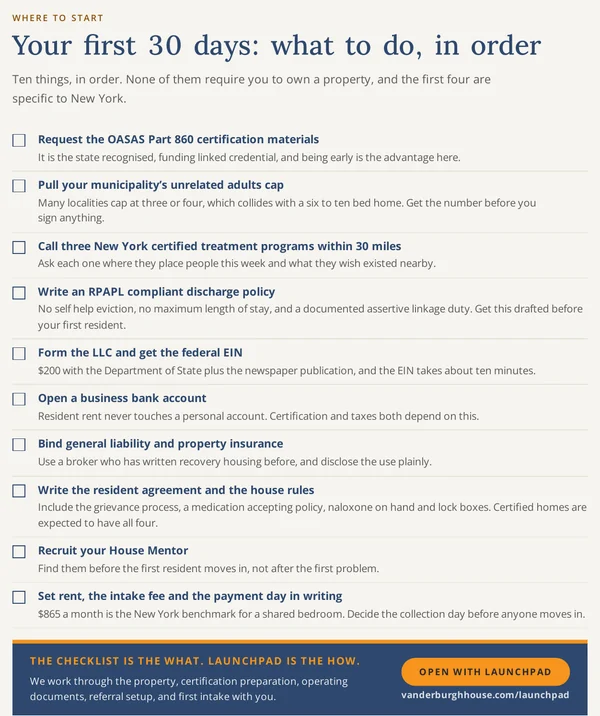
Keep readingHow to Certify a Sober House: An Overview of NARR Affiliate CertificationWhat certification involves, what it costs, and how the process works in every state.→Your New York Startup Checklist
New York Funding That Offsets the Upfront Outlay
New York rates 7 for operator funding access (Foote, 2026), and the reason the score is not higher is structural: the largest pools are gated behind nonprofit status. State grant dollars from the Office of Addiction Services and Supports (OASAS) generally require a 501(c)(3) that is registered and prequalified in the Statewide Financial System, which most first-time for-profit operators are not.
- The settlement round is behind us: OASAS opioid-settlement funding under request for applications SETT-24029 put approximately $5,000,000 in play, up to $75,000 per site and up to $225,000 across a maximum of three sites, for services, minor capital and renovation, equipment, and staff development, on an 18-month contract paid 50% in advance. That application window closed at 4:00 p.m. on July 31, 2026, and we found no successor round announced as of September 2, 2026, so nothing on this budget should be planned against it.
- It was never money that opens a home: The award reimburses program work at a site an operator already controls, and it is gated to nonprofits registered and prequalified in the Statewide Financial System, so a for-profit LLC could not apply.
- Mission-based lending: Mission-based lenders and community development financial institutions finance acquisition and rehabilitation for recovery housing when conventional banks will not.
Which programs an operator can actually reach, and in what order to approach them, is worked through in New York recovery housing funding.
New York guideHow Recovery Housing Funding Works in New YorkGrants, settlement dollars, and the programs that help offset what it costs to open.→Sober Living Guides Every Operator Needs
These evergreen guides apply in every state and go deeper on the pieces behind your startup budget: the standards your home certifies to, the property you choose, the insurance you carry, and the referral partners who keep the beds full.
Frequently Asked Questions About Sober Living Startup Costs
What Is the Minimum Realistic Amount to Open a Sober Living Home in New York?
About $51,375 for a leased upstate home, covering formation and publication, three months of rent upfront, modest renovation, furnishing, deposits, insurance, certification, and a three-month operating reserve. Opening on less usually means skipping the reserve, which is the line that most often decides whether a new home survives its first quarter.
Can You Start a Recovery Home in New York by Leasing Instead of Buying?
Yes, and most first-time operators should. Leasing removes the $108,720 down payment and the property insurance line, cuts the three-month reserve, and shifts code-upgrade exposure toward the landlord. The trade is a rent premium of roughly 60% over market and no equity at the end of the term.
How Much Does Certification Cost in New York?
The New York State Alliance of Recovery Residences (NYSARR) charges $250 for membership and $300 for the voluntary certification application, $500 when the two are filed together and $550 when they are filed separately. OASAS certification under 14 NYCRR Part 860 carries no application fee and no renewal fee; its cost is compliance work, including peer credentialing for the residence manager within one year.
Do Grants Cover Sober Living Startup Costs in New York?
Not for most new operators, and the main settlement round is behind us. OASAS request for applications SETT-24029 offered up to $75,000 per site and up to $225,000 across three sites toward renovation and equipment, but its application window closed at 4:00 p.m. on July 31, 2026 and we found no successor round announced as of September 2, 2026. That round also required 501(c)(3) status plus Statewide Financial System registration and prequalification, so a for-profit LLC could not apply. Grant money of this kind offsets program costs at an operating site rather than opening the home.
How Long Before Resident Fees Cover Operating Costs?
Plan on one full quarter. A 14-bed home reaching break-even needs roughly half its beds filled, and filling them depends on referral relationships that take weeks to build. The three-month reserve on this budget exists precisely to carry the home through that ramp without borrowing.
Plan Your New York Startup Budget With VSL
New York asks for between $51,375 and $205,554 to open, and the number you land on is decided mostly by county and by whether you lease or buy. Build the budget line by line before you tour a property, price insurance before you sign anything, fund the reserve as seriously as the down payment, and model your own bed count, rent, and property assumptions against these lines with the Sober Living Calculator.
To talk through a specific New York property and the budget behind it with people who have opened recovery homes before, get in touch with Vanderburgh Sober Living.
Start your sober house
Pick the path that fits where you are in the process.
Download the free guidePath to Purposeful Recovery Housing, by Dr. Hunter T. Foote.Explore the Mastery ProgramHands-on startup, certification, and operating support.See how starting with VSL worksThe opportunity, the community, and what a Charter includes.Prefer to talk now? Call (844) 762-3747, weekdays 8a to 5p.
Research & Sources
- Foote, H. T. (2026). Vanderburgh Sober Living Operating Climate Index, 2026 edition. Vanderburgh Sober Living. Operating Climate Index, 2026 edition
- New York Department of State, Division of Corporations. (2026). Fee schedules. New York State. Division of Corporations fee schedules
- New York Department of State. (2026). Certificate of Publication for a domestic limited liability company (Limited Liability Company Law §206). New York State. Certificate of Publication guidance
- U.S. Department of Housing and Urban Development, Office of Policy Development and Research. (2024). FY2025 Fair Market Rents. https://www.huduser.gov/portal/datasets/fmr.html
- U.S. Census Bureau. (2025). QuickFacts: Onondaga County, New York. U.S. Department of Commerce. QuickFacts: Onondaga County
- U.S. Census Bureau. (2025). QuickFacts: Erie County, New York. U.S. Department of Commerce. QuickFacts: Erie County
- U.S. Census Bureau. (2025). QuickFacts: Westchester County, New York. U.S. Department of Commerce. QuickFacts: Westchester County
- Zillow. (2026). New York home values: median sale price (as of May 31, 2026). Zillow Group. Zillow Home Values: New York
- Freddie Mac. (2026). Primary Mortgage Market Survey (August 27, 2026). Federal Home Loan Mortgage Corporation. Primary Mortgage Market Survey
- New York Department of State, Division of Building Standards and Codes. (2024). Technical Bulletin TB-1203: Care facilities. New York State. Technical Bulletin TB-1203
- New York Department of State, Division of Building Standards and Codes. (2026). Uniform Fire Prevention and Building Code (19 NYCRR Parts 1220 to 1229). New York State. Building Standards and Codes
- New York State Office of Addiction Services and Supports. (2024). Recovery residences: 14 NYCRR Part 860. New York State. Recovery Residences, Part 860
- New York State Office of Addiction Services and Supports. (2024). 14 NYCRR Part 860, adopted rule text. New York State. Part 860 adopted rule text (PDF)
- New York State Office of Addiction Services and Supports. (2026). Request for applications SETT-24029: Recovery residences. New York State. Request for Applications SETT-24029
- New York State Alliance of Recovery Residences. (2026). New York State Alliance of Recovery Residences. NYSARR. NYSARR home page
- New York State Alliance of Recovery Residences. (2026). How to join NYSARR: membership and certification fees. NYSARR. How to Join NYSARR
- National Alliance for Recovery Residences. (2026). New York State Alliance of Recovery Residences affiliate page. NARR. NARR affiliate page: NYSARR