Learning how to fund a sober living home in Pennsylvania usually starts with a search for a grant office that does not exist. Operators picture a state program that pays a portion of every resident’s rent, or a startup grant that covers the down payment and the furniture. Pennsylvania has real money moving through recovery housing, and quite a lot of it. It is simply not organized the way a first-time operator expects, and almost none of it is reachable without a Department of Drug and Alcohol Programs (DDAP) recovery house license.
Two things shape every funding conversation in this state. The first is the license: DDAP states plainly that recovery housing that receives referrals from state agencies or state-funded facilities, or federal or state funding, must be licensed by the department under 28 Pa. Code Ch. 717. The second is fragmentation. There is no central state fund to apply to. The money is split across 47 Single County Authorities covering all 67 counties, 67 county opioid settlement pools, county HealthChoices reinvestment accounts, and a much smaller Commonwealth share. Understanding that structure is the difference between six months of productive relationship building and six months of chasing an application that was never built for you.
Before you read onHow to Open a Sober Living Home in PennsylvaniaThis post covers one piece of the process. The complete Pennsylvania guide walks through every step, from planning to your first resident.→How Does Recovery Housing Funding Work in Pennsylvania?
Pennsylvania funds recovery housing through counties, not through a statewide grant window. Public dollars flow from DDAP and Medicaid to 47 Single County Authorities, county behavioral health entities, and county opioid settlement accounts, which contract with DDAP-licensed recovery houses. The license is the gate, resident fees remain the base revenue, and every public pathway is county-negotiated.
That structure explains a scoring result operators often find surprising. The Vanderburgh Sober Living Operating Climate Index scores Pennsylvania 8 for resident funding access and 7 for operator funding access, against a composite operating climate score of 7 (Foote, 2026). The high resident-funding score reflects the number of pathways that exist, not how easy any one of them is to reach. Pennsylvania has more ways to get a resident’s rent paid than most states. It also asks more of the operator before any of them open.
- Licensure is the gate, not a preference: DDAP’s recovery housing page ties referrals from state agencies and any federal or state funding to holding a DDAP license under 28 Pa. Code Ch. 717. Whether you need a license to open a sober living home in Pennsylvania depends entirely on whether you intend to touch public money or public referrals.
- The county is the customer: The 47 Single County Authorities are the county drug and alcohol offices that hold contracts, referrals, and in many counties the settlement grant cycle. An operator’s business relationship is with a county office, not with Harrisburg.
- The licensed pool is still small: DDAP reported more than 450 licensed recovery houses as of August 19, 2026, 284 of them licensed since 2023 and an 11% increase in a single year. In a state with thousands of sober living homes, licensure is still the exception, which is exactly why it functions as a filter.
- Money is time-limited by design: Grant rounds, scholarships, and settlement allocations carry end dates, reporting duties, and eligibility conditions. None of them behave like recurring revenue.
Read together, those four mechanics describe a system with no single front door. The Commonwealth sets the rules and holds a minority share of the settlement money, counties hold the contracts and the referral lists, and county behavioral health entities hold the HealthChoices reinvestment that pays for housing supports. An operator who wants public money in Pennsylvania is really planning a licensure project and a county relationship project at the same time.
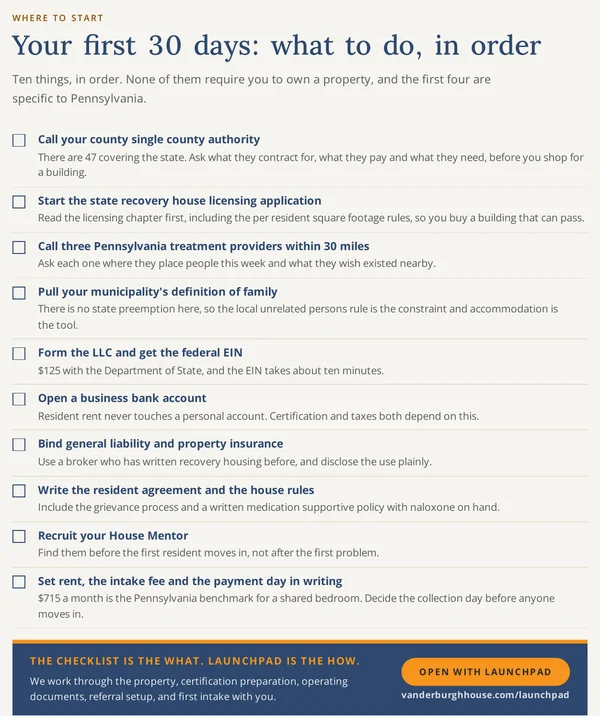
Fourteen pages: the bed shortfall, who pays the rent, and what it costs to open. Built from your state‘s own numbers.
Are There Grants to Open a Sober Living Home in Pennsylvania?
No, not in the way most operators expect. Pennsylvania has no standing grant that an individual can apply to for opening a sober living home. DDAP runs occasional competitive rounds, counties run their own opioid remediation cycles, and both favor licensed homes and established organizations. The realistic path is a county contract, not a startup grant.
The mechanism behind that answer explains every other pathway on this page. A sober living home is a housing business with a recovery environment, not a licensed treatment provider billing a payer. Public dollars in Pennsylvania are appropriated to build system capacity: treatment slots, recovery support services, county infrastructure. They travel to entities that can absorb reporting obligations and audit trails. DDAP’s own competitive channel makes this concrete. Its grant application page carries Grant Initiative Funding Announcements when a round opens, and rounds open, close, and are gone.
- Capital improvement rounds: In January 2024, DDAP and the Department of Community and Economic Development (DCED) offered close to $300,000 for recovery house health and safety upgrades, with awards of up to $50,000 each to roughly five applicants, conditioned on DDAP licensure and on permitting FDA-approved medications for opioid use disorder on the premises.
- Intermediary rounds: In December 2024, DDAP put $2.5 million in opioid settlement funds into a round of up to $500,000 per award for organizations that would connect people to existing licensed recovery houses, not for the houses themselves. That money became the statewide scholarship described below.
- County remediation rounds: Counties such as Montgomery and Dauphin run their own competitive opioid remediation applications on local calendars, funded from the county share of the settlement.
- Loans
- Payment plans
- Employer aid
- Campaigns
- Voc Rehab
- VA (soon)
- Open
The practical read is to watch the DDAP announcement page, treat any open round as a bonus, and build the plan around money you control. The capital to open still comes from the operator, and how much it costs to open a sober living home in Pennsylvania is the number to solve before any application gets written.
Pennsylvania guideSober Living Startup Costs in PennsylvaniaThe one-time cost to open, and where a small amount of outside funding can offset it.→Resident Fees Still Fund Most Sober Living Homes
Private pay is the default revenue model for Pennsylvania sober living homes, and it should be the model any new home is built on. Resident fees are predictable, tied to occupancy you control, and free of the reporting and end-date conditions attached to public dollars. Every funding pathway on this page supplements that base or fills a gap in it.
The discipline that follows is simple to state and hard to hold. Price the home so it covers its mortgage or lease, utilities, insurance, and house mentor support at realistic occupancy, before a single scholarship or contract exists. Operators who model whether a Pennsylvania recovery home is profitable on the assumption that a county contract will arrive in month three end up rationing food money in month five.
Scholarships change this picture in one specific way worth planning for. Because most Pennsylvania rent assistance covers the first 30 to 90 days, it solves the move-in problem rather than the ongoing revenue problem. A resident who enters on a scholarship needs a job and a rent plan before the scholarship ends, which is why how to set rent pricing for your sober living home matters more in a scholarship-fed house, not less.
Pennsylvania guideIs It Profitable to Operate a Recovery Home in Pennsylvania?Realistic revenue, operating costs, and the resident-fee margins that keep a home running.→Which Pennsylvania Programs Fund Recovery Housing?
These are the live pathways that can put money toward a resident’s rent in Pennsylvania in 2026. Every one of them requires the home to hold a DDAP license, and most require an additional registration, contract, or site review on top of it.
| Program | What It Primarily Funds | Who Typically Receives It |
|---|---|---|
| County Single County Authority (SCA) contracts | Recovery house beds and recovery support services for county-referred residents | DDAP-licensed recovery houses under contract with one of the 47 SCAs |
| Bridge to Recovery Housing (B2R) scholarship | The first month of recovery housing cost including entry fees, renewable up to three months | Residents with financial need; paid to the licensed house after it signs a registration agreement |
| County opioid settlement allocations | Recovery housing and recovery supports as an Exhibit E approved use | County governments, which subgrant to providers on local cycles |
| HealthChoices reinvestment supportive housing | Bridge rental subsidies, master leasing, housing support services, capital projects | County behavioral health entities and their contracted housing providers |
| DDAP State Opioid Response (SOR) recovery housing grants | Expanded recovery housing capacity and supports for adults ages 18 to 24 | SCAs in the awarded counties, which pass through to licensed houses |
| HUD Recovery Housing Program (RHP) | Transitional housing support for people in recovery from substance use disorder | The Commonwealth through DCED, then subrecipients |
| SSVF and HUD-VASH | Rent, deposits, arrears, and case management for veterans | Veteran residents through VA grantees and public housing agencies |
Methodology & sources. The SCA structure and licensure gate come from DDAP; the B2R terms from The Bridge Foundation; the settlement distribution and approved uses from the Pennsylvania Opioid Misuse and Addiction Abatement Trust and its Exhibit E list of opioid remediation uses; the HealthChoices strategies from the Pennsylvania Department of Human Services; the SOR awards from DDAP’s January 2026 announcement; the RHP allocation from DCED’s 2025 Annual Action Plan; and the veteran pathways from HUD and the U.S. Department of Veterans Affairs.
Two separate systems sit inside that table, and conflating them is the most common planning error we see. Resident rent funding pays for a person’s stay, arrives in 30 to 90 day increments, and follows the resident. Operator capital buys the building, pays for renovation, and covers working capital to stabilized occupancy. The three groupings below sort every pathway by how the money actually reaches a home.
Support for every stage
Pick the level of support that fits where you are.
Just getting startedSee how the sober living opportunity works and what starting with VSL looks like.LaunchpadGuided pre-launch program: one-on-one strategy, Academy training, weekly coaching, and templates.MasteryHands-on startup, certification, and operating support inside the Chartered Operator community.Questions first? Call (844) 762-3747, weekdays 8a to 5p.
Direct Operating Support
Direct support means money that lands in the home’s operating account against a specific resident’s stay. Pennsylvania has more of this than most states, and all of it is short-duration.
- Bridge to Recovery Housing (B2R): Launched January 2, 2026 and available in all 67 counties, this scholarship pays the first month of recovery housing cost including entry fees, and is renewable month to month up to three months while funds remain. Applications are due within 14 days of a resident’s entry, and a licensed house must complete a registration agreement and file monthly invoices and outcome reports before it can receive funds, per The Bridge Foundation. PARR announced the statewide launch to its members in February 2026.
- County recovery house scholarships: Terms are set locally. The Capital Area Behavioral Health Collaborative, serving Cumberland, Dauphin, Lancaster, Lebanon, and Perry counties, covers a participating home’s documented rent for the first 30 days of residency and up to $300 toward rent for the second 30 days. Because the funding stems from Medicaid dollars, the home must be DDAP-licensed, apply in writing, and pass a site review.
- SCA bed contracts: A county drug and alcohol office may contract for beds or per-diem placements directly with licensed houses in its county. This is the closest thing Pennsylvania offers to recurring public revenue, and it is negotiated county by county.
Indirect Support
The larger dollars in Pennsylvania do not pay your rent line. They fund the system that sends you residents who can pay, and they fund the services that keep those residents housed and employed.
- The opioid settlement: Pennsylvania expects up to $1.07 billion from the first wave of national settlements with Johnson and Johnson and the three major distributors, paid over roughly 18 years. That first wave is distributed 70% to county governments, 15% to the Commonwealth, and 15% to litigating subdivisions, as tracked by the National Academy for State Health Policy and overseen by the Pennsylvania Opioid Misuse and Addiction Abatement Trust. Recovery housing is an approved use under Exhibit E, which removes the eligibility objection before you ever walk into a county meeting.
- State Opioid Response funding: In January 2026, DDAP awarded more than $1.2 million across nine grants running through September 30, 2026 to SCAs serving 14 counties, to expand recovery housing and recovery support services for young adults ages 18 to 24 with opioid or stimulant use disorders and to serve roughly 240 people. The announcement names each recipient SCA, which is a ready-made target list for any operator in those counties.
- HealthChoices reinvestment: Counties may direct behavioral health Medicaid reinvestment into permanent supportive housing through seven strategies including bridge rental subsidies, master leasing, housing support services, and capital projects, with the tenant’s share ideally set at 30% of monthly income. This is Medicaid-adjacent money for housing, administered by county behavioral health entities.
- HUD Recovery Housing Program: Pennsylvania participates through DCED. The Commonwealth’s federal fiscal year 2025 RHP allocation was $1,232,750, targeted entirely to affordable housing and described as housing support for people affected by the opioid crisis, per DCED’s 2025 Annual Action Plan. RHP remains a HUD community planning and development formula program in fiscal year 2026.
- Veteran pathways: Screen every veteran resident. Supportive Services for Veteran Families provides time-limited rental assistance, deposits, and arrears, and HUD-VASH pairs a housing choice voucher with VA case management. These reach residents no SCA scholarship covers.
- What Medicaid does and does not do: Medicaid does not pay rent in Pennsylvania, and nothing in the state Medicaid plan supports recovery housing directly. What Medicaid supports is counseling, case management, and peer support, plus the HealthChoices reinvestment structure above, and those are services rather than housing payments. Operators who plan around a Medicaid rent line are planning around something that is not there.
Infrastructure and Capital Support
Infrastructure money buys, builds, or repairs the property. It does not run the home, and it almost always arrives through a partner rather than a direct application. In Pennsylvania the two consistent public routes are the county settlement cycle, where a capital request for a recovery housing project is an Exhibit E approved use, and the affordable housing development stack administered by the Pennsylvania Housing Finance Agency (PHFA).
PHFA administers the Low-Income Housing Tax Credit program, PennHOMES, tax-exempt multifamily bonds, and the Pennsylvania Housing Affordability and Rehabilitation Enhancement fund created by Act 105 of 2010, which directs a share of funding to households below 50% of area median income. In June 2026 the Commonwealth awarded $93.4 million in PHARE funding across 432 initiatives in all 67 counties. On the business-lending side, the Pennsylvania Minority Business Development Authority Revolving Loan Fund Capitalization Program capitalizes community lenders to make loans to minority-owned businesses for land and building acquisition, construction, renovation, equipment, and working capital, up to $400,000 per applicant at 1.5% interest for five years.
The Federal Home Loan Bank of Pittsburgh Affordable Housing Program provides subsidy for construction and rehabilitation of housing for very-low to moderate-income households through its member institutions, community development financial institutions active in Pennsylvania finance acquisition and predevelopment on terms banks will not match, and regional funders such as the Claude Worthington Benedum Foundation have backed recovery home operators in southwestern Pennsylvania. This money reaches nonprofits far more readily than it reaches limited liability companies, which is one reason choosing a legal entity for a Pennsylvania sober living business is a funding decision as much as a liability decision. The Fletcher Group, a rural center of excellence supported by the Health Resources and Services Administration, provides no-cost help with site selection, fundraising, and financing applications to Pennsylvania operators.
Most Pennsylvania homes are bought with conventional or commercial mortgage debt, which carries the largest equity requirement of the options here. Debt service coverage ratio loans underwrite the property’s income rather than the borrower’s tax returns, and bank and credit-union loans remain the lowest-cost option for operators with local relationships and strong personal credit. For smaller acquisitions, a seller-held note remains one of the most practical tools in Pennsylvania’s older housing stock: it closes faster, avoids appraisal friction on unusual floor plans, and can be refinanced into conventional debt once the home has 12 months of operating history.
Why Eligibility Often Depends on Certification and Partnerships
Eligibility in Pennsylvania is a question of standing, not need. Every pathway above screens for the same three things: a DDAP license under 28 Pa. Code Ch. 717, documentation a county can audit, and a working relationship with the people who make placements. A home with all three gets a call when a scholarship expands. A home with none of them does not, no matter how badly its beds need filling.
The license is the legal gate. Certification through the Pennsylvania Alliance of Recovery Residences (PARR) is the credibility layer that sits on top of it. PARR certifies compliance with the national standard and its own code of ethics, and county offices, treatment providers, and reentry programs use that certification as shorthand for a home that runs by a published rulebook. Operators who work through how to certify a sober living home in Pennsylvania generally find the certification file and the funding file contain the same documents, and the PARR fee schedule and application process set the pace of that work.
Sober living homes are voluntarily certified, not licensed as treatment, and that standing is set by the National Alliance for Recovery Residences (NARR) and its Pennsylvania affiliate. In Pennsylvania that voluntary standing sits alongside a mandatory operating license for any home that takes public money or public referrals, so the two files are built together rather than in sequence. One eligibility condition catches operators off guard. Public funding here consistently requires that the home permit FDA-approved medications for opioid use disorder on the premises, and 28 Pa. Code § 717.19 already bars licensed homes from excluding residents on that basis. A no-medication house policy is not a neutral preference in this state. It disqualifies the home from the funding stack.
Why Funding Is Competitive and Temporary
Every pathway on this page has an end date written into it. The DDAP State Opioid Response grants to SCAs run through September 30, 2026. The statewide scholarship caps at three months per resident and only while funds remain. County settlement cycles are annual and oversubscribed.
Applications also take time operators rarely budget for. A county remediation application, a scholarship registration agreement, and a PHFA-linked development application are three different documents on three different calendars, and none of them produce revenue while pending. Awards are not guaranteed, and reporting obligations begin the day the money arrives.
The practical consequence is a budgeting rule rather than a warning. Build the pro forma so the home breaks even on resident fees alone. Then treat every public dollar as capacity you can add, a resident you can accept earlier, or a repair you can make sooner. Homes that reshape their cost structure around a single grant cycle are the ones that close when the cycle ends.
How Strong Pennsylvania Operators Use Funding Strategically
The operators who actually receive money in Pennsylvania tend to look the same on paper before they ever apply. They have built the thing the funder is trying to buy, and the funding accelerates it.
- Stable occupancy first: A home running at consistent occupancy on resident fees is a credible partner. One with empty beds and an application is a risk.
- A DDAP license already in hand: Licensure takes time and is a prerequisite, not a parallel task. Start it before the funding conversation, not because of one.
- Clean, auditable documentation: Resident agreements, fee schedules, incident logs, and outcome tracking are what a county needs before it can send you money.
- Existing referral relationships: County drug and alcohol offices, treatment providers, probation, and reentry programs decide who fills your beds. Building referral sources is worth more over five years than any single award.
- Reporting capacity: The statewide scholarship requires monthly invoices and outcome reports. If nobody in the organization owns that task, the money becomes a liability.
- A specific objective: Fund a named thing, such as a sprinkler upgrade, an accessibility retrofit, or four additional beds. Open-ended requests lose to specific ones.
None of those six items requires a grant to start. They are the same records a county asks for, the same records PARR reviews, and the same records a lender reads, which is why building them once serves every funding path in Pennsylvania at the same time.
A Practical Way to Evaluate Any Funding Opportunity
Before spending a month on an application, run the opportunity through five questions. If the answers are unclear, the opportunity is probably built for a different kind of organization, and the generic grant mechanics below apply in every state while the doors described above are specific to Pennsylvania.
- What the program is designed to accomplish: Read the enabling language. A program built to expand treatment capacity will not fund a housing business, no matter how the summary reads.
- Who the intended recipient is: If the named applicants are counties, SCAs, or community-based organizations, your route in is a subcontract or a partnership, not a direct application.
- What obligations come attached: Reporting cadence, audit rights, medication policy, admission criteria, and length-of-stay limits all change how the home operates.
- What happens when it ends: If losing the money would put the home underwater, it is not funding, it is a dependency.
- Whether it improves occupancy stability: The pathways that fund move-in costs remove the single biggest barrier to filling a bed, which is why they outperform larger awards that arrive once.
The funding paths that actually close, and what a lender wants from a first-time operator.
Get the playbook freeNo cost, no obligation. Unsubscribe in one click.Sober Living Guides Every Operator Needs
These evergreen guides apply in every state and cover the fundamentals behind the money on this page: the capital you raise, the beds you fill, and the referral partners who keep resident fees flowing.
Frequently Asked Questions About Recovery Housing Funding
Does Pennsylvania Medicaid pay for sober living?
No. Nothing in Pennsylvania’s Medicaid plan pays a recovery house’s rent. Medicaid supports counseling, case management, and peer support, and county HealthChoices reinvestment can fund supportive housing subsidies and services through the Department of Human Services framework, but the rent line itself stays with the resident.
Can opioid settlement money pay for recovery housing in Pennsylvania?
Yes. Recovery housing is an approved use under Exhibit E of the settlement agreements, and 70% of Pennsylvania’s first-wave allocation goes to county governments that decide locally how to spend it, per the Pennsylvania Opioid Misuse and Addiction Abatement Trust. Operators apply to individual county remediation programs, not to the Trust.
Do I need a DDAP license to receive any of this funding?
Yes. DDAP requires licensure for any recovery house receiving referrals from state agencies or state-funded facilities, or receiving federal, state, or local public funding, under its housing guidance and 28 Pa. Code Ch. 717. Private-pay homes may operate without it, but they also sit outside every pathway on this page.
How does a resident get a Bridge to Recovery Housing scholarship?
The resident applies within 14 days of entering a Pennsylvania-licensed recovery house, and the house must have a registration agreement on file first. The scholarship covers the first month including entry fees and can renew monthly up to three months while funds last, per The Bridge Foundation.
Plan Your Pennsylvania Funding Strategy With VSL
Pennsylvania has more recovery housing money in motion than most states, and almost none of it works like a grant application. It moves through 47 county drug and alcohol offices, 67 county settlement accounts, county behavioral health reinvestment, and a small set of statewide scholarships, and every door opens with a DDAP license and a documented, occupied home behind it. Build the home so it stands on resident fees, get licensed, get certified, then work the counties one relationship at a time. If you want help sequencing licensure, certification, and funding in the right order, reach out to the Vanderburgh Sober Living team and tell us where you are in the process.
Research & Sources
- Foote, H. T. (2026). Vanderburgh Sober Living Operating Climate Index, 2026 Edition. Vanderburgh Sober Living. https://www.vanderburghhouse.com/research/operating-climate-index-2026/
- Pennsylvania Department of Drug and Alcohol Programs. (2026). Recovery housing. https://www.pa.gov/agencies/ddap/treatment-and-support/housing
- Pennsylvania Department of Drug and Alcohol Programs. (2026, August 19). More than 280 of PA’s recovery homes licensed since Governor Shapiro took office. https://www.pa.gov/agencies/ddap/newsroom/more-than-280-of-pa-s-recovery-homes-licensed-since-governor-sha
- Pennsylvania Code. (2021). 28 Pa. Code Ch. 717: Standards for drug and alcohol recovery house licensure. https://www.pacodeandbulletin.gov/Display/pacode?file=/secure/pacode/data/028/chapter717/chap717toc.html
- Pennsylvania Department of Drug and Alcohol Programs. (2026). Apply for drug and alcohol program funding. https://www.pa.gov/services/ddap/apply-for-drug-and-alcohol-program-funding
- Pennsylvania Department of Drug and Alcohol Programs. (2024, January 22). Shapiro Administration makes funding available for licensed recovery houses. https://www.pa.gov/agencies/ddap/newsroom/shapiro-administration-makes-funding-available-for-licensed-recovery-houses-to-provide-safe-housing-for-those-recovering-from-a-substance-use-disorder
- Pennsylvania Department of Drug and Alcohol Programs. (2024, December 16). Shapiro Administration invests $2.5 million to create a bridge for recovery housing. https://www.pa.gov/agencies/ddap/newsroom/shapiro-administration-invests–2-5-million-to-create-a-bridge-f
- Pennsylvania Department of Drug and Alcohol Programs. (2026, January 27). Shapiro Administration invests $1.2 million to expand access to recovery housing. https://www.pa.gov/agencies/ddap/newsroom/shapiro-administration-invests–1-2-million-to-expand-access-to-
- The Bridge Foundation. (2026). Bridge to Recovery Housing program. https://bridge-foundation.org/bridgetorecoveryhousing/
- Pennsylvania Alliance of Recovery Residences. (2026). Statewide recovery house scholarships available in 2026 through The Bridge Foundation. https://www.parronline.org/single-post/statewide-recovery-house-scholarships-available-in-2026-through-the-bridge-foundation
- Capital Area Behavioral Health Collaborative. (2026). Recovery house scholarship program. https://www.cabhc.org/resources/recovery-house-scholarship-program/
- Pennsylvania Opioid Misuse and Addiction Abatement Trust. (2026). Opioid settlement funds in Pennsylvania. https://www.paopioidtrust.org/
- Pennsylvania Opioid Misuse and Addiction Abatement Trust. (n.d.). Exhibit E: List of opioid remediation uses. https://www.paopioidtrust.org/getmedia/4877e10e-cb3f-44b7-acbc-465affc880e4/Exhibit-E-List-of-Opioid-Remediation-Uses.pdf
- National Academy for State Health Policy. (2026). State opioid settlement spending decisions: Pennsylvania. https://nashp.org/state-tracker/state-opioid-settlement-spending-decisions/pennsylvania/
- Pennsylvania Department of Human Services. (2026). Supportive housing. https://www.pa.gov/agencies/dhs/resources/mental-health-substance-use-disorder/supportive-housing
- Pennsylvania Department of Community and Economic Development. (2025). Commonwealth of Pennsylvania 2025 annual action plan. https://dced.pa.gov/download/2025-annual-action-plan/?wpdmdl=126923
- U.S. Department of Housing and Urban Development. (2026). Community planning and development formula program allocations for FY 2026. https://www.hud.gov/hud-partners/community-budget-26
- U.S. Department of Housing and Urban Development. (2026). HUD-VASH: Housing choice vouchers for veterans experiencing homelessness. https://www.hud.gov/helping-americans/housing-choice-vouchers-homeless-veterans
- U.S. Department of Veterans Affairs. (2026). Supportive Services for Veteran Families. https://department.va.gov/homeless/supportive-services-for-veteran-families/
- Pennsylvania Housing Finance Agency. (2010). Act 105 of 2010: Pennsylvania Housing Affordability and Rehabilitation Enhancement Act. https://www.phfa.org/legislation/act105.aspx
- Office of the Governor of Pennsylvania. (2026, June 11). Gov. Shapiro’s annual increases to PHARE fund continue for affordable housing. https://www.pa.gov/governor/newsroom/2026-press-releases/gov-shapiro-s-annual-increases-to-phare-fund-continue-for-afford
- Pennsylvania Department of Community and Economic Development. (2026). Pennsylvania Minority Business Development Authority Revolving Loan Fund Capitalization Program. https://dced.pa.gov/programs/pennsylvania-minority-business-development-authority-revolving-loan-fund-capitalization-program-pmbda-rlfcp/
- Federal Home Loan Bank of Pittsburgh. (2026). Affordable Housing Program. https://www.fhlb-pgh.com/ahp
- Fletcher Group. (2026). Pennsylvania resources. https://www.fletchergroup.org/pennsylvania-resources/
- Substance Abuse and Mental Health Services Administration. (2026). Substance Use Prevention, Treatment, and Recovery Services Block Grant. https://www.samhsa.gov/grants/block-grants/subg