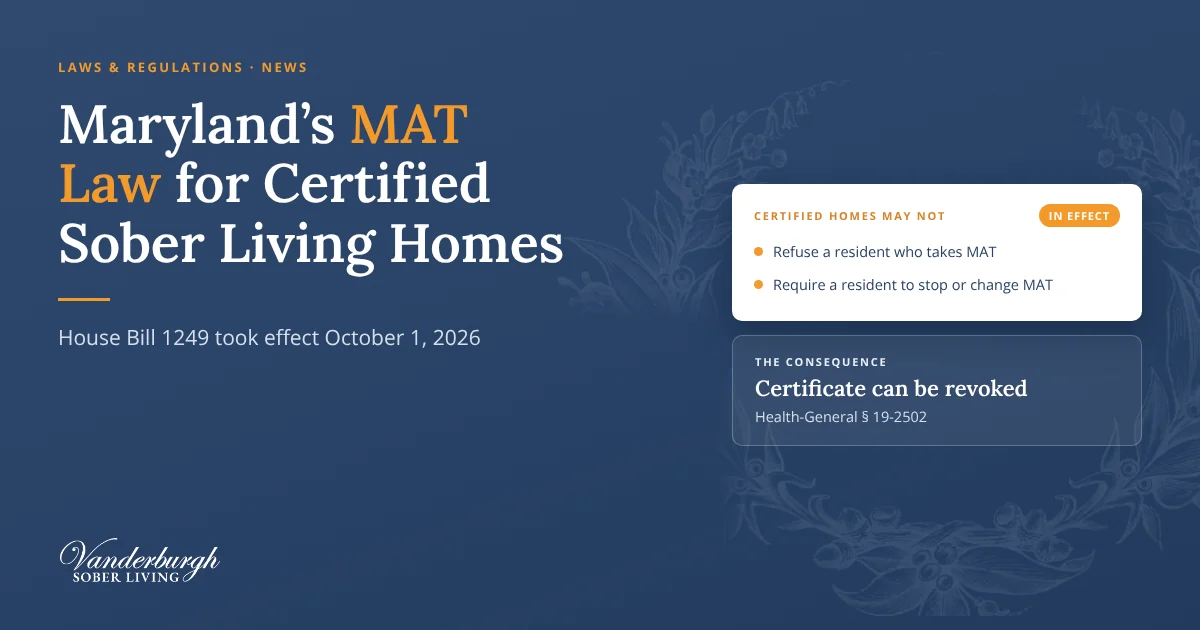
Maryland sober living homes that hold state certification can no longer turn away a person because they take medication for opioid use disorder. House Bill 1249, enacted as Chapter 793 of the 2026 Laws of Maryland, took effect on October 1, 2026. It changes the standards behind every certified recovery residence in Maryland, so a home that refuses residents on medication-assisted treatment (MAT) now puts its certificate at risk.
The law is short, and for most certified operators it confirms existing practice rather than inventing a new one. Anyone planning a Maryland sober living home should still read it closely, because the rule now sits in the statute that governs the credential itself. Governor Wes Moore signed the bill on May 26, 2026. As of November 10, 2026, it has been in force for about six weeks.
| Item | Detail |
|---|---|
| Law | House Bill 1249 (2026), Chapter 793 |
| Statute amended | Md. Code, Health-General § 19-2502 |
| Signed | May 26, 2026 |
| In effect | October 1, 2026 |
| Applies to | Certified recovery residences (homes holding a certificate of compliance) |
| Consequence | The credentialing entity may revoke a certificate for noncompliance |
What Maryland’s MAT Law for Recovery Residences Requires
Maryland’s MAT law requires the certification standards for recovery residences to prohibit two practices. Both apply to medication-assisted treatment for opioid use disorder, which the Department of Legislative Services fiscal and policy note describes as including medications such as buprenorphine (Suboxone) and naltrexone (Vivitrol).
- Refusing services: A certified recovery residence may not refuse services to a person because that person receives MAT for opioid use disorder.
- Forcing a change: A certified home may not require a person to stop MAT, or to change how they receive it, before they can receive services at the home.
The law works through the credential rather than through a standalone ban. Chapter 793 adds a new subsection (c) to Health-General § 19-2502 that tells the credentialing entity to write both prohibitions into its certification requirements. Under the same section, a certificate of compliance is valid for one year, and the credentialing entity may revoke it if a home is not in compliance with those requirements.
The bill had broad support. The General Assembly’s record for HB 1249 shows it passed the House 102 to 33 and the Senate 36 to 10 before the governor signed it.
Maryland guide Do You Need a License to Open a Sober Living Home in Maryland? Chapter 793 works through voluntary certification, not a license. See how the two differ in Maryland. →Who Enforces Maryland Recovery Residence Certification
The Behavioral Health Administration (BHA) inside the Maryland Department of Health is the approved credentialing entity, and it runs the work through the Maryland Certification of Recovery Residences (MCORR) office, which keeps a MCORR program page. The fiscal note records that BHA told legislators it already has nondiscrimination policies in place, and it describes the bill as codifying current practice.
What changes is the footing. A policy an agency can revise on its own is now a requirement written into state law, and the General Assembly has named the consequence. For most certified operators, that reads as one more written expectation rather than a new process.
Certificate status is also public. The same fiscal note explains that a 2017 law, the Recovery Residence Residential Rights Protection Act, requires the Maryland Department of Health to publish a list of recovery residences in each county, showing whether each owner holds a valid certificate of compliance. A revoked certificate does not stay a private matter between an operator and MCORR.
Read next The Maryland Certification of Recovery Residences (MCORR)Does the Maryland MAT Law Apply to Uncertified Sober Living Homes?
No, not directly. The text of Chapter 793 reaches certified recovery residences, meaning homes that hold a certificate of compliance, so a private-pay sober living home that has never certified is outside this particular statute.
That does not make exclusion safe. VSL’s Recovery Housing Legal Tracker records that residents on MAT in uncertified Maryland homes are still protected by federal law, through the Americans with Disabilities Act and the Fair Housing Act (Foote, 2026a). Those federal rules shape what a sober living MAT policy can and cannot require.
The statute also leaves some things alone. It does not set rules for how medication is stored, counted or self-administered, and it names only treatment for opioid use disorder. Those questions stay with your written medication policy, applied the same way to every prescription.
Why the MAT Rule Matters More for Maryland Operators
Certification carries unusual weight in Maryland. VSL’s Operating Climate Index scores the state 9 out of 10 for certification value and 7 overall, with a Moderately Regulated classification (Foote, 2026b). A rule that can cost a home its certificate deserves attention even when the house already admits residents on MAT.
The practical risk sits in old paperwork. Intake forms, resident agreements and house rules written years ago sometimes carry a taper deadline, a “no Suboxone” line or a requirement to switch medications. Under Chapter 793, language like that conflicts with the standards your certificate depends on.
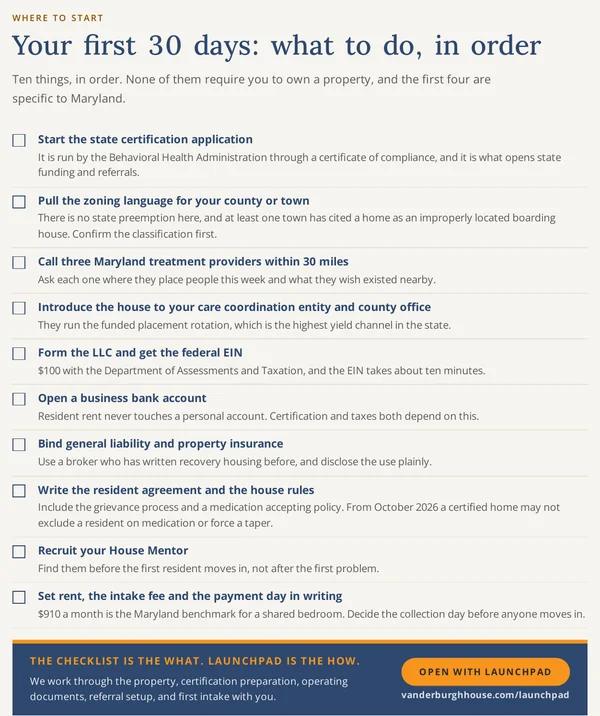
Still deciding whether to open, certify or expand in Maryland? Certification rules are one input. The kit adds the demand, payer and startup cost picture for Maryland.
- How many people need a bed, and how few beds exist
- Who actually pays the rent, and which programs are real
- What it costs to open on the purchase path and the lease path
What This Means for Operators
For certified Maryland operators, most of the work is paperwork. Work through these in order:
- Audit admission criteria: Remove any intake question, screening rule or waiting period that excludes or delays applicants who take MAT for opioid use disorder.
- Check your medication policy: Make sure it governs storage and self-administration the same way for every prescription and never requires a resident to stop, taper or switch MAT.
- Update the handbook and resident agreement: Both documents usually carry your medication rules, so align them with the new standard and date the revision.
- Brief your house mentor: Make sure the person answering applicant calls gives the same answer about MAT that your written policy gives.
- Confirm with MCORR: Ask the MCORR office whether its certification standards were updated for October 1, 2026, and keep a copy with your certification file.
None of these steps requires a new process. The harder part is keeping one consistent answer on MAT across the handbook, the resident agreement and what staff say on the phone.
Maryland’s rule is narrow in reach but firm in consequence. It applies to certified homes, and the certificate is what is at stake. Homes outside certification still answer to federal disability law.
If a renewal is coming up, or you are still deciding whether to certify a new house, plan both around the standard that took effect October 1, 2026.
This article is general information about a Maryland law, not legal advice.
Sources
Primary sources
- Maryland General Assembly. (2026). Chapter 793 (House Bill 1249): Certified recovery residences, refusing services to individuals receiving medication-assisted treatment, prohibition. 2026 Laws of Maryland. https://mgaleg.maryland.gov/2026RS/Chapters_noln/CH_793_hb1249t.pdf
- Maryland General Assembly. (2026). HB1249, 2026 regular session: Legislation details and history. https://mgaleg.maryland.gov/mgawebsite/Legislation/Details/hb1249?ys=2026RS
- Department of Legislative Services. (2026). Fiscal and policy note, House Bill 1249 (third reader). Maryland General Assembly. https://mgaleg.maryland.gov/2026RS/fnotes/bil_0009/hb1249.pdf
- Maryland Department of Health, Behavioral Health Administration. (n.d.). Maryland Certification of Recovery Residences. https://health.maryland.gov/bha/Pages/Maryland-Certification-of-Recovery-Residence-License-.aspx
VSL research
- Foote, H. T. (2026a). Vanderburgh Recovery Housing Legal Tracker, as of September 12, 2026. Vanderburgh Sober Living. https://www.vanderburghhouse.com/research/legal-tracker-2026/
- Foote, H. T. (2026b). Vanderburgh Sober Living Operating Climate Index, 2026 edition. Vanderburgh Sober Living. https://www.vanderburghhouse.com/research/operating-climate-index-2026/