Maryland is the rare state where the recovery housing credential comes straight from the government. There is no private affiliate office to call, no membership dues, and no third-party board. Certification runs through the Maryland Certification of Recovery Residences (MCORR), a program the Behavioral Health Administration (BHA) inside the Maryland Department of Health administers itself.
It also runs on something most guides to this topic get wrong. Maryland set up recovery residence certification by statute rather than by regulation. Health-General 19-2501 through 19-2504 define the certificate of compliance, direct the Department to approve a credentialing entity, and leave the standards themselves to that entity, which is why MCORR applies the NARR standards directly and why no COMAR chapter has governed recovery residences until now. The adopted chapters of COMAR Subtitle 10.63 run 01 through 08, and Chapter 08 is titled Civil Money Penalty. A recovery residence certification chapter was proposed in the Maryland Register in November 2017 and never adopted. If you have seen a page cite "COMAR 10.63.08" as the rule governing your home, it is quoting a nine-year-old proposal.
That is about to change. MDH’s rewrite of COMAR 10.63, published in the Maryland Register on August 21, 2026 with comment closing September 21, 2026, would codify the program for the first time as COMAR 10.63.27 Recovery Residence Program. This guide covers the process as it works today under the statute, and flags separately what the proposal would change. Maryland ranks 20th of 50 states on the Vanderburgh Sober Living Operating Climate Index with an overall operating climate score of 7, and it scores 9 for certification value, one of the highest certification scores in the country (Vanderburgh Sober Living, 2026).
Before you read onHow to Open a Sober Living Home in MarylandThis post covers one piece of the process. The complete Maryland guide walks through every step, from planning to your first resident.→Who Certifies Sober Living Homes in Maryland?
The certifying body is the Maryland Certification of Recovery Residences, operated by the Behavioral Health Administration’s Division of Policy and Planning out of 55 Wade Avenue in Catonsville. The Department’s MCORR program page states the program’s legal authority as Health-General 19-2501, 2502, 2503 and 2504, cites no COMAR chapter, and gives 410-402-8300 and [email protected] as the contact points.
Maryland has no independent affiliate of the National Alliance for Recovery Residences (NARR). NARR’s affiliate directory lists 33 state affiliates, and Maryland is not among them. What the state did instead was delegate the standards to a credentialing entity and then designate itself as that entity. Health-General 19-2502 gives the credentialing entity authority to establish the certification requirements, administer application and recertification, monitor and inspect, and issue and revoke the certificate. MCORR exercises that authority by applying the NARR standards. So a Maryland certificate is a NARR-standards credential issued by a state agency, and the standards reach you through the agency rather than through a rulebook you can pull off the shelf. If you have read the general NARR certification overview and expected to find an affiliate here, that is why you could not.
MCORR certifies at all four NARR support levels: Level I peer-run with no staff, Level II monitored with a house mentor, Level III supervised with a facility coordinator and a case manager, and Level IV service provider, which must be operated by a provider MDH separately licenses to deliver clinical treatment. The proposed COMAR 10.63.27.03B would put all four levels into regulation for the first time. Most new operators certify at Level II. Choosing correctly matters because the level drives your staffing and documentation obligations, which the NARR levels of care framework lays out in detail.
Maryland guideMaryland Certification of Recovery Residences: The Maryland Certifying Agency, ExplainedWho MCORR is, the standard it upholds, and what certification signals to the Maryland recovery community.→Is Certification Required to Open a Sober Living Home in Maryland?
Short answer: Certification is not required to open a private-pay recovery home in Maryland. It becomes mandatory on two triggers: Health-General 19-2504(a) makes it unlawful to advertise, represent, or imply that a residence is certified without a current certificate, and the Department states that recovery residences require certification to receive State or federal funds. MCORR certification is the gate to state-funded placements and public referrals.
The statutory basis sits in Health-General Title 19, Subtitle 25, and nowhere else. There is no state license for a recovery residence as housing, and COMAR 10.63.01.04(A)(4) expressly exempts recovery residences from behavioral health program licensure. The enforcement teeth are statutory too: Health-General 19-2504(b)(1) authorizes a civil penalty of up to $1,000 for each offense against anyone claiming certified status without a certificate. The distinction between certification and licensure is the one the Maryland licensing rules for sober living homes work through in full.
The funding trigger comes from the Department’s own words. Its 2025 Recovery Residence Grant Program report states that recovery residences require certification to receive State or federal funds. Demand closes whatever gap the law leaves open. Treatment programs discharging clients, drug courts, reentry coordinators, and county behavioral health authorities all work from the state’s certified list. A private-pay home can operate lawfully outside the system, but it is competing for residents without the referral channels most Maryland homes rely on to stay full.
Chartered Oxford Houses sit outside this in practice, and the reason is statutory rather than regulatory. A chartered Oxford House takes no State funds and does not hold itself out as certified, so nothing in Health-General 19-2504 compels it to certify. That is worth naming precisely, because a charter is often confused with a credential. A charter is a membership agreement between a home and a private network whose standards the home agrees to run by. It is not government permission and it is not a third-party certification. It comes from the network rather than the state, no agency issues or revokes it, and it is voluntary. Oxford House charters homes that are democratically self-run and financially self-supporting, require a resident to leave immediately on a return to use, and operate with no paid staff in the house. Vanderburgh Sober Living charters independently operated homes into a cooperative network, where the operator keeps ownership of the business and gains the brand, the operating standards, and the startup and certification support of the Chartered Operator community. Neither charter substitutes for certification once State money or the word certified enters the picture.
Maryland guideDo You Need a License to Open a Sober Living Home in Maryland?What Maryland actually requires, and where voluntary certification fits instead.→Why Certification Unlocks the Maryland Referral Pipeline
Certification is what moves a home from private-pay only into the state-recognized universe. As of October 2025, Maryland counted 259 certified recovery residences and 2,468 certified beds statewide, with Anne Arundel County holding 89 residences and 553 beds and Baltimore City holding 69 residences and 220 beds, according to the Department’s Recovery Residence Grant Program report. An earlier Department report published weeks before gives a somewhat higher count, so treat these as the most recent published figures rather than a census.
Four channels open once the certificate is in hand:
- Public listing. Health-General 19-2503(b) and (c) require the Department to publish and maintain a list of certified recovery residences in each county and Baltimore City, and to note whether each holds a valid certificate. Referrers find you because the state published you.
- State-funded bed days. Maryland RecoveryNet, the state’s recovery housing payer, reaches only certified residences, and the Department’s oversight report to the General Assembly under HB 722 records that BHA is maintaining a pause on new MDRN provider locations. Treat certification as the prerequisite and build the rest of the revenue stack from the channels described in the Maryland recovery housing funding programs.
- County grant dollars. The Recovery Residence Grant Program carries a $500,000 annual appropriation through FY2027 under Health-General 19-2505, and the Department’s 2025 report shows $410,582 awarded in FY2025 across four jurisdictions: Cecil County at $179,200, Garrett County at $114,907, Harford County at $63,675, and Howard County at $52,800. Eligibility runs to nonprofits in good standing with the IRS that hold a current Form 990, carry Level I, II, or III certification, and decline reimbursement from private insurance and the Maryland Medical Assistance Program.
- A protected marketing claim. Only certified homes may use the word certified, and the $1,000 per offense penalty at Health-General 19-2504(b)(1) gives the claim real weight with families and referrers.
Maryland scores 4 for resident funding access on the Operating Climate Index, the weakest of its six sub-indices, while certification value scores 9 (Vanderburgh Sober Living, 2026). Read together, those two numbers describe the state accurately: the credential is worth a great deal, and the payer behind it is thin. Certify early, then diversify the census. Referral relationships still have to be built by hand, which is why the mechanics of working referral sources matter as much as the certificate.
You appear on the county-by-county list the Department publishes under Health-General 19-2503, you are eligible for Maryland RecoveryNet bed days and Recovery Residence Grant Program dollars, and you may lawfully describe the home as certified.
A private-pay home can operate lawfully, but state-funded placements and the published referral list stay closed, and claiming certified status without a certificate carries a civil penalty of up to $1,000 for each offense under Health-General 19-2504(b)(1).
How to Certify a Sober Living Home With Maryland Certification of Recovery Residences
Because the standards sit with the credentialing entity rather than in an adopted rule, the process is defined by what MCORR asks for and by the NARR standards it applies. The sequence below reflects the framework MDH set out when it proposed the certification chapter at 44:23 Md. R. 1108, the review workflow the Department described to the General Assembly in its HB 722 oversight report, and the statutory requirements that are in force.
Step 1. Pick Your NARR Level and Build to It
Decide between Level I, II, III, and IV before anything else. Level II is the common landing spot for an owner-operated home with a house mentor and no clinical services on site. Level III adds a case manager and a facility coordinator. Level IV is off the table unless you separately hold an MDH treatment license.
Step 2. Clear Zoning, Occupancy, and Code First
Compliance with local zoning, building and occupancy, and fire requirements is attested in the application packet, and you cannot certify around a zoning problem. The Maryland recovery housing zoning laws that govern siting and reasonable accommodation are the place to start, and Maryland scores 5 for fire and building feasibility on the Index (Vanderburgh Sober Living, 2026), so treat the code review as real work.
Step 3. Write the Policy Manual Against the NARR Standards
This is the largest single piece of the application. Your policy and procedure manual, mission and vision statements, resident handbook, and sample resident service agreement all have to line up with the NARR standards MCORR applies. The handbook and agreement together carry your house rules, grievance procedure, medication policy, drug-screening policy, search policy, and involuntary-vacation policy.
Step 4. Assemble the Document Package
The checklist below reproduces what the packet contains. Every document is site-specific: one application per address, and the proposed COMAR 10.63.27.03C would write one certificate per residence into regulation.
Step 5. Submit to BHA and Complete Required Trainings
Applications go to MCORR at [email protected] or to the Behavioral Health Administration at 55 Wade Avenue, Catonsville, MD 21228. Confirm the current submission route and the required trainings on the call, since the program contact is a live state office rather than a portal.
Step 6. Survive the Two-Level Document Review
As the Department described it to the General Assembly, a first reviewer logs the packet and verifies that every required document is present. If it is complete, the MCORR Manager assigns it to a Field Assessor for a Level 2 review that checks the substance of the documents and may generate calls or emails to you. Incomplete packets are cited and returned, which is where most delays originate.
Step 7. Pass the On-Site Inspection
Health-General 19-2502(b)(4) requires the credentialing entity to conduct an on-site inspection before issuing a certificate of compliance, and again at least once during each certification renewal period. Correct anything the assessor cites and expect a return visit if the corrections are substantial.
Step 8. Receive the Certificate
The MCORR Manager issues the certificate of compliance once the NARR standards and Department requirements are satisfied. Under Health-General 19-2502(c) it is valid for one year from the date of issuance.
Because completeness, inspector scheduling, and your own correction speed all move the clock, there is no guaranteed timeline. Operators who submit a clean packet with policies already written move fastest.
What You Need Before You Apply
Certification rewards preparation. Have these in place before the packet goes out:
- A formed legal entity in good standing. The packet asks for proof of a legal business entity, which means the Maryland legal entity for a sober living business has to exist and be current with SDAT first.
- Site control. Proof of ownership, or a letter from the property owner authorizing use of the property as a recovery residence.
- Insurance. A certificate of liability insurance, plus fire and hazard coverage on the building. Getting sober house insurance bound early prevents a late scramble.
- A written policy suite. Manual, mission and vision, handbook, service agreement, nondiscrimination affidavit, safety self-assessment, and an emergency preparedness plan covering emergency numbers, evacuation map, relocation, and continuity of operations.
- A criminal background check policy for anyone with direct, regular resident contact, with the hiring bars and the documented review decision written into it.
- A house mentor identified. For Level II, name the person and be ready to describe the role. Strong sober house rules and a mentor who can explain them are what an assessor is looking for.
- A MAT-compliant admission policy. As of October 1, 2026, this is mandatory, and it is covered below.
Support for every stage
Pick the level of support that fits where you are.
Just getting startedSee how the sober living opportunity works and what starting with VSL looks like. LaunchpadGuided pre-launch program: one-on-one strategy, Academy training, weekly coaching, and templates. MasteryHands-on startup, certification, and operating support inside the Chartered Operator community.Questions first? Call (844) 762-3747, weekdays 8a to 5p.
Maryland Sober Living Document Checklist
This is the packet MCORR asks for, following the framework MDH set out at 44:23 Md. R. 1108 and the NARR standards the program applies. Under the proposed COMAR 10.63.27.06, read together with the general application chapter at COMAR 10.63.06.02 to .04, this list would become a codified filing requirement. Assemble it as one packet, per site, and confirm the current contents with MCORR before you submit.
MCORR Certification Cost and What It Includes
Maryland is unusual on price. No application fee, per-bed fee, inspection fee, or renewal fee is established in Health-General 19-2501 through 19-2504, in any adopted chapter of COMAR Subtitle 10.63, or in the proposed Recovery Residence Program chapter. MCORR is financed from State general funds rather than through operator fees, so the certificate itself is free and the cost of certifying is the cost of complying.
| Fee | Amount |
|---|---|
| MCORR application fee | $0 |
| MCORR per-bed fee | $0 |
| MCORR renewal fee | $0 |
| On-site inspection | $0 |
| Policy manual and handbook development | Operator cost |
| Fire and safety inspection report | Local fee, set by the county or municipal authority |
| Liability, fire, and hazard insurance | Operator cost |
| Code and occupancy corrections | Property-specific |
| All-in MCORR credential cost | $0 |
What this means in practice: budget your certification money for policy work, insurance, and the physical corrections an assessor will expect, not for the credential. Two space standards in the 2026 proposal are worth designing around now, because retrofitting them is expensive. The proposed COMAR 10.63.27.08C, which would take effect January 1, 2027, would require a minimum of 50 square feet per participant and no more than four participants per bedroom. The proposed COMAR 10.63.05.04F would set two separate plumbing ratios that are often collapsed into one: one toilet and one bathroom sink per four participants, and one tub or shower per six participants. Worth noting for anyone reading the proposal closely, proposed 10.63.05.04E(1)(m) refers to at least 60 square feet of personal space, which sits in tension with the 50 square feet in 10.63.27.08C, and the comment period is the place to raise it. All of these interact directly with determining maximum occupancy and with your pro forma.
What to Expect During the MCORR Inspection and Interview
The inspection is a document review and a walkthrough at the same time. It is required by Health-General 19-2502(b)(4) before the first certificate issues and at least once during each renewal period, and MCORR staff or a BHA-approved designee schedule it. The assessor is checking whether the home you described on paper is the home that exists. Expect attention to:
- Sleeping rooms and bathrooms, measured against the space and plumbing standards above. Build to the proposed January 1, 2027 figures rather than to the minimum you can currently defend.
- Posted materials. Resident rights, the grievance procedure, and emergency and evacuation information in a common area. Missing postings are an easy, avoidable citation.
- Resident records. Identifying information, emergency contacts, medical conditions and allergies, medications and dosages, referral source, intake and admission dates, an individualized recovery plan, a signed fee agreement, and an itemized payment record. The proposed COMAR 10.63.27.05C would require records to be retained at least seven years after discharge, so build the retention practice now.
- The financial accounting system, manual or electronic, capable of producing a resident account statement on request.
- Fire and life safety. Alarms, extinguishers, egress, and the evacuation map, alongside whatever the local sober living fire safety requirements demand for your occupancy classification.
- Staff and volunteer files, documenting the background review and the hiring decision for anyone with direct resident contact.
Residents and the house mentor may be spoken with. The most useful preparation is walking the home yourself, room by room, against your own policy manual the week before.
- ✓Alarms, egress, and extinguisher placement
- ✓Sleeping-room rules and posted plans
- ✓The drill documentation inspectors ask for
MCORR Renewal and Ongoing Compliance
Two things are true at once here, and keeping them apart matters. A short set of obligations is in force today, all of it statutory. A much longer set is proposed and not yet law. What is in force:
- Certificate term: Valid 1 year from the date of issuance (Health-General 19-2502(c)).
- On-site inspection: Before issuance, and at least once during each renewal period (Health-General 19-2502(b)(4)).
- Monitoring and revocation: The credentialing entity monitors, inspects, and may revoke for noncompliance (Health-General 19-2502(b)).
- Certified status claims: Civil penalty up to $1,000 per offense for claiming certification without a certificate (Health-General 19-2504(b)(1)).
- Public listing: The Department publishes and maintains the county-by-county certified list (Health-General 19-2503(b)-(c)).
Beyond the statute, ongoing compliance is what MCORR asks of you as the credentialing entity and what the NARR standards require. Ask the program directly at 410-402-8300 rather than working from a rule set that was never adopted. In FY2025, BHA received 53 complaints and incident reports involving substance use disorder programs, 18 of which involved certified recovery residences, according to the HB 722 oversight report, so complaints do reach the Department and do generate contact.
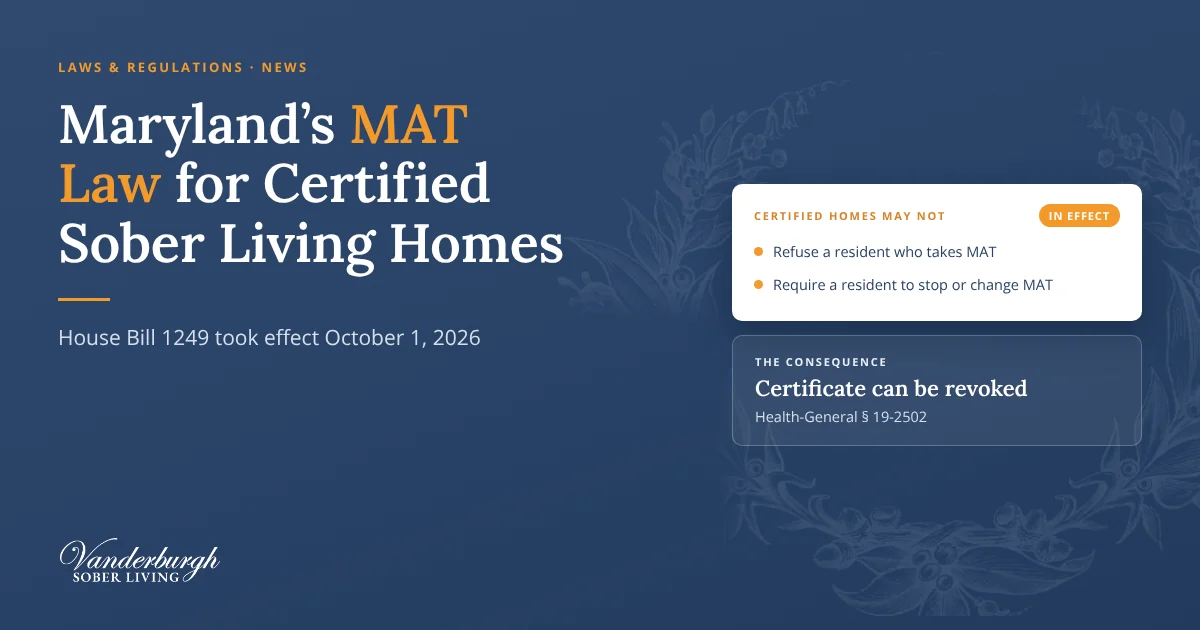
One change to your admission policy is already law. House Bill 1249 of 2026, signed as Chapter 793 on May 26, 2026 and effective October 1, 2026, prohibits a certified recovery residence from refusing services to a person receiving medication-assisted treatment for opioid use disorder, or from requiring a person to stop or change how they receive that treatment as a condition of services. Rewrite any abstinence-only admission language before that date.
For nine years Maryland has certified recovery residences with no adopted regulation behind the program. MDH’s COMAR 10.63 regulatory revisions would end that. The transmittal filed with the AELR Committee on July 10, 2026 proposes to adopt new Regulations .01 through .08 under a new chapter, COMAR 10.63.27 Recovery Residence Program, and to recodify the existing Civil Money Penalty chapter out of 10.63.08 and into 10.63.38. The package was published in the Maryland Register on August 21, 2026, and comment closes September 21, 2026. None of it is law yet.
For an operator, these are the provisions worth reading before the window shuts:
- A two-year certificate. Proposed 10.63.27.07A would allow a certificate term of up to two years, against the one year the statute fixes today.
- NARR Standard 3.0 by reference. Proposed 10.63.27.02 would incorporate the 2018 NARR Standard 3.0, replacing the informal application of whatever standard version the program currently uses.
- Space rules with a date on them. Proposed 10.63.27.08C, effective January 1, 2027, would set a minimum of 50 square feet per participant and cap bedrooms at four participants.
- Staffing written by level. Proposed 10.63.27.04 would require a live-in house manager at Level II, and at Level III a case manager employed at least 20 hours per week plus a facility coordinator.
- A ban on tied housing. Proposed 10.63.27.03D would bar conditioning housing on participation in an affiliated program or business, which is the housing-and-treatment bundling Maryland has been pursuing as patient brokering.
- New clocks. Proposed 10.63.27.05C would require the recovery plan and move-out contingency plan within 10 business days of move-in and records kept at least seven years after discharge. Proposed 10.63.06.07B would set renewal filing at least 40 and no more than 120 business days before expiration. Proposed 10.63.02.04A(2) would set critical incident reporting at three business days. Proposed 10.63.06.18A would require closure notice no less than 60 business days before the intended discontinuation date. Proposed 10.63.39.10B would keep the appeal window at 10 business days, matching the 2017 draft.
- Two things that are absent. No provisional certificate appears anywhere in the proposal, and neither does any Oxford House provision. Operators who have planned around either should say so during the comment period.
Proposed 10.63.01.04(B) would also state that recovery residences are exempt from licensure and shall be certified by MCORR in accordance with COMAR 10.63.27, which is the sentence that finally ties the credential to a rule.
MCORR Sober Living Certification at a Glance
Everything below is in force in Maryland today unless the row says proposed.
| Item | Detail | What it means |
|---|---|---|
| Certifying body | Maryland Certification of Recovery Residences (MCORR), BHA, MDH | You deal with a state agency, not a private affiliate |
| Legal authority | Health-General 19-2501 through 19-2504 | The framework is statutory, not regulatory |
| Governing regulation | None adopted; proposed COMAR 10.63.27 Recovery Residence Program | Comment closes September 21, 2026 |
| NARR affiliate | None in Maryland; 33 state affiliates nationally | The state applies NARR standards itself |
| Standard applied | NARR standards; the proposal would incorporate NARR Standard 3.0 (2018) | Your policy suite is written to NARR |
| Levels certified | I, II, III, IV | Level IV needs a separate MDH treatment license |
| State registration | No separate housing license | Certification is the only recovery housing credential |
| Application and per-bed fee | $0 | Costs are compliance costs, not credential costs |
| Certificate term | 1 year; the proposal would allow up to 2 | Annual renewal today |
| Inspection | Before issuance and at least once per renewal period | Required by statute |
| Enforcement | Civil penalty up to $1,000 per offense | For claiming certified status without a certificate |
| Certified inventory | 259 residences, 2,468 beds as of October 2025 | A mature, competitive certified market |
Sober Living Guides Every Operator Needs
These evergreen guides apply in every state and cover the fundamentals around certification: the standards you certify to, the coverage you carry, and the referrals and occupancy that certification is meant to unlock.
Frequently Asked Questions About MCORR Certification
Is MCORR certification required in Maryland?
Not to open a private-pay home. Health-General 19-2504(a) makes it unlawful to advertise, represent, or imply that a residence is certified without a current certificate, and the Department states that recovery residences require certification to receive State or federal funds. Those two triggers are what make the credential mandatory in practice.
What regulation governs recovery residence certification in Maryland?
None, as of today. The program runs on Health-General 19-2501 through 19-2504, which delegate the standards to the credentialing entity. A certification chapter was proposed in 2017 and never adopted, and adopted COMAR 10.63.08 is the Civil Money Penalty chapter. Proposed COMAR 10.63.27 would change that.
How much does MCORR certification cost?
The credential itself is free. No application, per-bed, inspection, or renewal fee is established in the statute, in any adopted chapter of COMAR Subtitle 10.63, or in the 2026 proposal, and the program is financed from State general funds. Your real costs are the policy manual, insurance, the local fire inspection, and any code corrections.
How long does MCORR certification take?
There is no guaranteed timeline. The clock depends on packet completeness, the two-level document review, inspection scheduling, and how fast you correct anything the assessor cites. Operators who submit a clean packet with the policy suite already written move through fastest.
How often is a certified Maryland recovery residence inspected?
Health-General 19-2502(b)(4) requires an on-site inspection before the first certificate issues and at least once during each certification renewal period. The same section gives the credentialing entity ongoing authority to monitor and inspect, and complaints reaching BHA can prompt contact.
How MCORR Certification Fits Your Path in Maryland
Maryland gives you an unusual combination: a free, state-run credential built on NARR standards, a published referral list that flows from it, and no housing license standing in the way. What it asks in return is that you deal with a program rather than a rulebook, at least until the proposed Recovery Residence Program chapter is adopted. Operators who write the policy suite properly, clear zoning and fire before applying, build to the proposed space standards, and talk to MCORR directly tend to hold their certificate without drama.
The self-guided path: training, coaching, and 130+ done-for-you templates to certify and open with confidence.
Explore the LaunchpadDone-with-you: concierge certification, our 2,000+ source referral network, and unlimited support.
See if Mastery fitsResearch & Sources
- Vanderburgh Sober Living. (2026). Vanderburgh Sober Living operating climate index, 2026 edition. https://www.vanderburghhouse.com/research/operating-climate-index-2026/
- Maryland General Assembly. Md. Code, Health-General 19-2501. https://mgaleg.maryland.gov/mgawebsite/Laws/StatuteText?article=ghg§ion=19-2501&enactments=false
- Maryland General Assembly. Md. Code, Health-General 19-2502. https://mgaleg.maryland.gov/mgawebsite/Laws/StatuteText?article=ghg§ion=19-2502&enactments=false
- Maryland General Assembly. Md. Code, Health-General 19-2503. https://mgaleg.maryland.gov/mgawebsite/Laws/StatuteText?article=ghg§ion=19-2503&enactments=false
- Maryland General Assembly. Md. Code, Health-General 19-2504. https://mgaleg.maryland.gov/mgawebsite/Laws/StatuteText?article=ghg§ion=19-2504&enactments=false
- Maryland General Assembly. Md. Code, Health-General 19-2505. https://mgaleg.maryland.gov/mgawebsite/Laws/StatuteText?article=ghg§ion=19-2505&enactments=false
- Maryland Division of State Documents. COMAR Subtitle 10.63, Community-Based Behavioral Health Programs and Services (chapter index). https://regs.maryland.gov/us/md/exec/comar/10.63/index
- Maryland Department of Health, Behavioral Health Administration. Maryland Certification of Recovery Residence (MCORR). https://health.maryland.gov/bha/Pages/Maryland-Certification-of-Recovery-Residence-License-.aspx
- Maryland Department of Health. COMAR 10.63 regulatory revisions. https://health.maryland.gov/regs/Pages/BHA10.63Revisions.aspx
- Maryland Department of Health. (2026). Transmittal of proposed action 26-079-P-I, COMAR 10.63. https://health.maryland.gov/regs/SiteAssets/Pages/BHA10.63Revisions/Transmittal-Proposed-26-079.pdf
- Maryland Department of Health. (2026). Proposed COMAR 10.63 regulation text (COMAR 10.63.27 Recovery Residence Program at p. 99). https://health.maryland.gov/regs/SiteAssets/Pages/BHA10.63Revisions/10.63%20NOPA%20Reg%20Text%20-%20Final%20JFB%2005.26.2026%20Clean%20for%20Submission.pdf
- Maryland Register. (2017). Vol. 44, Issue 23, November 13, 2017 (proposed recovery residence certification at p. 1108). Maryland State Archives. https://msa.maryland.gov/megafile/msa/speccol/sc5300/sc5339/000113/022300/022370/20170738e.pdf
- Maryland Department of Health. (2025). Substance use disorder treatment programs: Improvements to oversight (HB 722, Ch. 697). https://dlslibrary.state.md.us/publications/Exec/MDH/HB722Ch697%282025%29.pdf
- Maryland Department of Health. (2025). Recovery Residence Grant Program report (Health-General 19-2505(h)). https://dlslibrary.state.md.us/publications/Exec/MDH/HG19-2505%28h%29_2025.pdf
- Maryland General Assembly. (2026). House Bill 1249, Ch. 793. https://mgaleg.maryland.gov/mgawebsite/Legislation/Details/hb1249
- National Alliance for Recovery Residences. Affiliates. https://narronline.org/affiliates/