The Maryland Certification of Recovery Residences (MCORR) is the credential every certified sober living home in the state holds, and it is unusual among the fifty states because no private nonprofit issues it. MCORR sits inside the Maryland Department of Health, in the Behavioral Health Administration (BHA), and state employees review the applications, run the inspections, and sign the certificates. Most states route recovery housing certification through an independent state affiliate of the National Alliance for Recovery Residences (NARR). Maryland does not have one. It applies NARR’s quality standards through a state office instead. This article profiles that office, what it is, where it came from, what it certifies, and how a Maryland operator deals with it. Operators who want the filing sequence itself will find it in the walk-through of how to certify a sober living home in Maryland. These Maryland rules sit inside the national framework that governs how to certify a sober house through a NARR affiliate.
Looking for a sober house in Maryland?
Sober House Directory lists recovery residences across Maryland, with location, house rules, pricing and contact details so you can reach a house manager directly. If MCORR certification matters to you, ask the house manager whether the home currently holds it.
See sober houses in Maryland on Sober House Directory →
In another state? See who certifies recovery residences in each state.
What Is the Maryland Certification of Recovery Residences (MCORR)?
The Maryland Certification of Recovery Residences is a state-run certification program administered by the Behavioral Health Administration within the Maryland Department of Health. It issues one-year certificates of compliance to recovery residences that meet the NARR quality standards it applies, at Levels I through IV, and it publishes the resulting list of certified homes by county. Its authority is statutory, at Health-General §§19-2501 through 19-2504; no adopted Maryland regulation governs the credential today, though a proposed chapter would change that.
MCORR is a program, not an association. There are no dues, no membership vote, and no board of member operators. The authority comes from statute: Health-General §19-2502 directs the Department to approve a credentialing entity to develop and administer a certification process for recovery residences and to issue a certificate of compliance after the application review and the inspection. In practice BHA is that entity, and MCORR is the office inside BHA that carries the work.
The NARR affiliate directory lists 33 state organizations, and Maryland is not among them. A Maryland operator cannot buy a NARR affiliate certification in Maryland, because no body exists to sell one. That single fact reshapes several decisions. It changes who holds the file, because a denial or a revocation is a state administrative action rather than a private organization’s decision, so the review path runs through the Department rather than a membership body’s internal grievance committee. It changes the cost picture, because affiliate certification in other states usually carries an application fee plus a per-bed charge, renewed annually, while Maryland’s certification runs on the Department’s own appropriation and the certificate of compliance application and the governing chapter set out documentation, inspection, and renewal duties without attaching an operator fee schedule to them. That absence of a recurring credentialing bill is a real part of why Maryland scores 9 out of 10 for certification value in the 2026 Operating Climate Index (Vanderburgh Sober Living, 2026). It also changes the tone of the relationship. An affiliate is a trade body that certifies its members and lobbies for them. MCORR is a regulator that certifies homes and refers complaints against them. Operators used to the affiliate model often expect advocacy from their certifying body and are surprised when a state office keeps its distance.
The identity facts a Maryland operator needs before dealing with the program:
- Full name: Maryland Certification of Recovery Residences, abbreviated MCORR
- Administering body: Behavioral Health Administration, Maryland Department of Health
- Legal footing: statute alone. Health-General §§19-2501 through 19-2504 create the credential; MDH cites no regulation for it on the MCORR program page
- Standards applied: the NARR quality standards, applied directly by MCORR because the statute leaves the requirements to the credentialing entity
- Instrument issued: a certificate of compliance, valid one year, tied to a single address
- Jurisdiction: every county and Baltimore City
Set against the more familiar affiliate model, the differences line up like this:
| Item | Detail |
|---|---|
| Who Issues the Credential | A state agency office inside BHA, where the typical NARR affiliate elsewhere is an independent nonprofit. |
| Relationship to NARR | Applies NARR standards and is not a NARR member body, where the typical affiliate elsewhere is a chartered affiliate of NARR. |
| What Operators Pay | No published operator fee schedule, where the typical affiliate elsewhere charges application and per-bed fees, often annual. |
| Who Inspects | State staff or a Department-approved designee, where the typical affiliate elsewhere uses affiliate staff or trained peer reviewers. |
| Where Appeals Go | A state administrative process at the Department, where the typical affiliate elsewhere runs an internal grievance process. |
| Enforcement Teeth | Civil money penalty, denial, revocation, where the typical affiliate elsewhere can only withdraw certification. |
The History of MCORR
Maryland built its credential by statute rather than by association. House Bill 1411, “Health – Recovery Residences – Certification,” became Chapter 711 of the 2016 laws and took effect October 1, 2016. It required the Department to approve a credentialing entity, to establish requirements and inspection procedures, and to issue one-year certificates of compliance. Before that, a private membership organization, the Maryland State Association of Recovery Residences, was the closest thing the state had to a standards body, and its approvals fed the grandfathering provisions that appear in the regulation to this day. It is no longer the operative certifier.
Here is the part almost every page about Maryland certification gets wrong. The General Assembly delegated the standards to the credentialing entity rather than to regulation. Health-General §19-2502 tells the Department to approve an entity and tells that entity to develop and administer the certification process, set the requirements, inspect, and issue the certificate. It does not tell the Department to write rules. MDH drafted a chapter anyway, publishing “Recovery Residence Certification” as a proposal in the Maryland Register on November 13, 2017, at 44:23 Md. R. 1108. That proposal was never adopted. The consequence is that for nine years no regulation has governed recovery residence certification in Maryland. The adopted chapters of COMAR Subtitle 10.63 run from 01 to 08, and Chapter 08 is titled Civil Money Penalty, a different subject entirely. What has governed instead is the statute plus the NARR standards MCORR applies directly, which is why MDH’s own program page cites Health-General §§19-2501 through 19-2504 and no regulation at all.
That gap is closing. MDH proposed a comprehensive rewrite of COMAR 10.63 in May 2025 and withdrew it that August. The Department refiled with the legislature’s review committee on July 10, 2026, and the current proposal was published in the Maryland Register on August 21, 2026 with comment closing September 21, 2026. Its transmittal directs the adoption of new Regulations .01 through .08 under a new chapter, COMAR 10.63.27 Recovery Residence Program, which would put recovery residence certification into Maryland regulation for the first time. The existing Civil Money Penalty chapter would move to COMAR 10.63.38. Any Maryland operator holding a certificate has a live interest in that comment window.
Is MCORR Certification Required, and Is It Legitimate?
Certification in Maryland is conditional rather than universal. Running a peer-supported sober living home is lawful without a certificate, and COMAR 10.63.01.04(A)(4) lists recovery residences among the providers exempt from behavioral health licensure. Two things turn the credential into a legal gate. Health-General §19-2504(a) provides that a person “may not advertise, represent, or imply to the public that a recovery residence is a certified recovery residence” without a certificate of compliance. And state money is conditioned on it: recovery residences require certification to receive State or federal funds, as MDH states in its 2025 report to the legislature on the Recovery Residence Grant Program.
MCORR is an active regulator rather than a records office, and the certificate is a year-long relationship. The review runs through a first reviewer who logs and verifies the documentation, a Field Assessor assigned by the MCORR Manager for a second-level review, and the MCORR Manager, who issues the certificate once the standards are met, as MDH described the workflow in its oversight report to the legislature. The on-site inspection is not discretionary: Health-General §19-2502(b)(4) directs the credentialing entity to inspect before issuing a certificate and at least once during each renewal period.
The practical consequences of those triggers:
- State-funded residents: Maryland RecoveryNet, the state behavioral health program that pays for recovery housing stays, routes clients only to certified residences. Without the certificate, that census is closed. The Maryland recovery housing funding picture is largely a certified-home picture for that reason.
- The word “certified”: Using it without the credential exposes the operator to a civil money penalty of up to $1,000 for each violation under Health-General §19-2504(b).
- Referral visibility: Certification is what places a home on the state’s published county list, which is what county behavioral health authorities and discharge planners work from.
Two clocks are law today. Everything below them sits in the pending proposal, and a Maryland operator reading this in 2026 works to the statute while watching the rest. In force: the certificate term runs one year from issuance under Health-General §19-2502(c); the on-site inspection is required before issuance and at least once each renewal period under Health-General §19-2502(b)(4); the civil money penalty reaches up to $1,000 for each violation of the advertising prohibition under Health-General §19-2504(b); and the Department publishes the certified residences by county under Health-General §19-2503(b) and (c).
Proposed, and not law yet, is everything else. The certificate term ceiling would rise to no more than two years at COMAR 10.63.27.07A. The renewal application would be due at least 40 and no more than 120 business days before expiration at proposed COMAR 10.63.06.07B. A critical incident report would be due within three business days at proposed COMAR 10.63.02.04A(2). A recovery plan and a move-out contingency plan would be due within 10 business days of move-in, with records kept at least seven years after discharge, at proposed COMAR 10.63.27.05C. An adverse action appeal would run 10 business days at proposed COMAR 10.63.39.10B. A closure notice would be due no less than 60 business days before the intended discontinuation date at proposed COMAR 10.63.06.18A.
The appeal window is worth a second look, because the 2017 proposal and the 2026 proposal both land on 10 days. Two drafting generations nine years apart agreeing on a number is about as strong a signal as an unadopted rule gives. The closure clock moved in the opposite direction: the 2017 draft set 60 days as a ceiling, the 2026 draft sets it as a floor.
Complaints reach BHA through an online complaint or critical incident form, and BHA investigates those involving certified residences, with unannounced site visits available as a tool. The volume is modest. Of 53 substance use disorder program complaints and incident reports BHA received in fiscal 2025, 18 involved certified recovery residences, per the Department’s oversight report to the legislature.
One structural rule catches buyers off guard. The certificate attaches to the residence rather than to the business, and proposed COMAR 10.63.27.03C would keep it that way with one certificate per residence, so a buyer of an operating Maryland sober house applies in their own right rather than inheriting the seller’s credential. The same proposal would bar conditioning a resident’s housing on participation in an affiliated program or business, which is aimed at operators who tie a bed to their own outpatient services.
Certification is also a different animal from a license and from a charter, and Maryland operators conflate all three often enough that the distinction is worth stating. A license is government permission to operate; Maryland issues none for a recovery residence as housing, which the licensing question for Maryland sober living homes works through in detail. A certificate is a finding that the home meets a published standard. A charter is neither. A charter is a membership agreement between a home and a private network whose standards the home agrees to run by. It is not government permission and not a third-party audit. It comes from the network rather than the state, no agency issues it and no agency revokes it, and it is entirely voluntary. What it carries is a rulebook, a name, and accountability to the organization behind it. Oxford House charters homes that are democratically self-run and financially self-supporting, that remove a resident immediately on a return to use, and that operate with no paid staff in the house. Vanderburgh Sober Living charters independently operated homes into a cooperative network, where the operator keeps ownership of the business and gains the brand, the operating standards, and the startup and certification support of the charter membership community.
The charter distinction has real consequences in Maryland, and it works through the statute rather than through any exemption clause. A chartered Oxford House takes no State funds and does not hold itself out to the public as a certified recovery residence, so neither branch of Health-General §19-2504 reaches it. The charter is what keeps the home outside the certification gate, not a carve-out written for it.
Maryland guideDo You Need a License to Open a Sober Living Home in Maryland?What Maryland actually requires, and where voluntary certification fits instead.→What NARR Level II Certification Means in Maryland
MCORR issues the certificate at a specific level, and the level appears on the certificate itself alongside the bed count, the gender designation, the address, and the certificate number.
The four level definitions at proposed COMAR 10.63.27.03B track the NARR framework, and most independent Maryland sober living homes land at Level I or Level II.
- Level I, peer run: No staff. Self-governance, drug screening, and house meetings carry the structure.
- Level II, monitored: A house mentor is present, along with house rules, life-skills expectations, and referrals out to services.
- Level III, supervised: An organizational hierarchy, a designated manager responsible for the property plus at least one case manager, and a life-skills curriculum delivered on site.
- Level IV, service provider: A Department-licensed or certified provider with clinical and administrative oversight and on-site licensed clinical staff delivering treatment. This is the level where a separate treatment license enters the picture, and the license covers the clinical program, not the housing.
Level selection is not cosmetic. It sets the staffing the inspector expects to find, the records the file has to hold, and the way referral sources read the home. Operators choosing between Level I and Level II can compare the tiers against the national framework in the breakdown of NARR levels of care.
Keep readingUnderstanding the NARR Levels of CareHow the four levels of recovery housing differ in structure, staffing, and support.→The Standards MCORR Homes Are Measured Against
MCORR applies the NARR quality standards directly, which is what the statute contemplates when it leaves the requirements to the credentialing entity, and applicants agree to comply with those standards and the NARR code of ethics.
The domains an inspector works through, following the framework MDH set out when it proposed a certification chapter in 2017 and has applied since:
- Governance and business integrity: A policy and procedure manual, mission and vision statements, proof of a legal business entity, and proof of ownership or written owner permission for the property.
- Resident rights and orientation: Rights and responsibilities, house rules, the complaint and grievance procedure, the service agreement, privacy and confidentiality, toxicology and medication storage policies, the search policy, and the involuntary discharge policy, all delivered verbally and in writing at orientation, with rights, grievance steps, and emergency information posted in a common area.
- Nondiscrimination: A clause barring discrimination by race, creed, color, gender, sexual orientation, gender identity, national origin, marital status, and disability, citing the Americans with Disabilities Act and the Fair Housing Act.
- Recordkeeping and financial transparency: An individual record per resident covering intake, emergency contacts, medications, referral source, the recovery plan, the signed fee agreement, and an itemized payment record, plus an accounting system that records every resident financial transaction and produces an account statement on request.
- Staffing integrity: A written criminal background investigation policy for anyone with direct, regular resident contact, with absolute bars on hiring anyone convicted of child abuse or child sexual abuse in homes serving minors, or abuse or neglect of a vulnerable adult in homes serving adults.
- Property and safety: Fire, liability, and hazard insurance, compliance with health, safety, building, occupancy, fire, and zoning requirements, a safety self-assessment, and an emergency preparedness plan with evacuation map, relocation plan, and continuity of operations. Space and plumbing benchmarks are about to be fixed in regulation for the first time. Proposed COMAR 10.63.27.08C would set a minimum of 50 square feet per participant and no more than four participants per bedroom, effective January 1, 2027, while proposed COMAR 10.63.05.04F would set one toilet and bathroom sink per four participants and one tub or shower per six. Those two ratios are separate, and the older shorthand of one bath per six collapses them. The same proposal package elsewhere states at least 60 square feet of personal space at proposed 10.63.05.04E(1)(m), a tension the Department has not yet resolved on the face of the drafts.
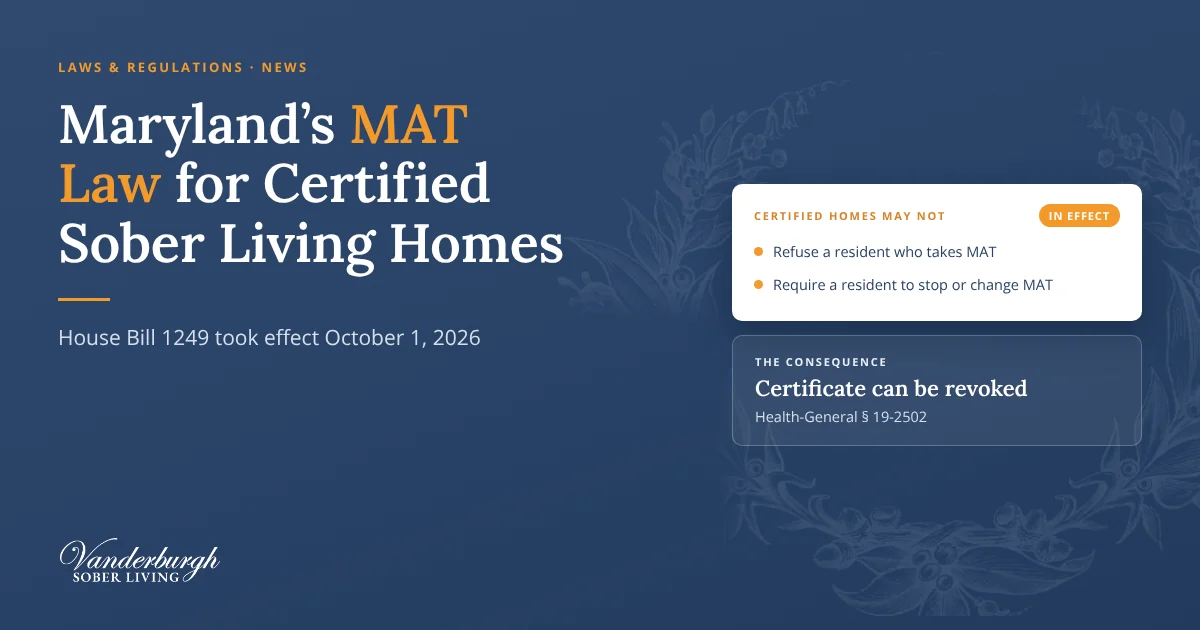
One standard is about to change. House Bill 1249 of the 2026 session, Chapter 793, takes effect October 1, 2026 and directs that certification standards prohibit a certified recovery residence from refusing services to a person receiving medication-assisted treatment for opioid use disorder, or from requiring that person to discontinue or alter that treatment as a condition of residency. Maryland homes with MAT-restrictive house policies have a short runway.
Maryland guideHow to Certify a Sober Living Home with Maryland Certification of Recovery Residences in MarylandThe step-by-step Maryland Certification of Recovery Residences application, costs, timelines, and inspection checklist.→How Many Sober Living Homes Does MCORR Certify?
Maryland’s certified network is mid-sized and heavily clustered, and the state reported those totals as of October 2025 in the Recovery Residence Grant Program report delivered under Health-General §19-2505(h). Geography drives most of what they mean for a new operator. Anne Arundel County alone accounted for 89 of those residences and 553 of those beds, and Baltimore City for 69 residences and 220 beds, which leaves large parts of the Eastern Shore and Western Maryland with thin certified capacity and a correspondingly thin field of competitors. That imbalance is the target of the Recovery Residence Grant Program created under Health-General §19-2505, whose FY2025 awards of $410,582 went to four counties: Cecil at $179,200, Garrett at $114,907, Harford at $63,675, and Howard at $52,800.
Grant eligibility is narrow, and the statute sets the conditions: nonprofit status in good standing with the IRS, a current Form 990, certification at Level I, II, or III, and a commitment to decline reimbursement from private insurance and the Maryland Medical Assistance Program. A Level IV clinical residence and a for-profit operator both fall outside it, which is one reason certification level is a business decision rather than a labeling one.
Certification in Maryland is cheap in cash and expensive in preparation. Nothing in Health-General §§19-2501 through 19-2504 establishes an application, per-bed, inspection, or renewal fee, and the Department carries the program on its own appropriation rather than on a schedule billed to operators. Compared with affiliate states, where an application fee plus a per-bed annual charge is normal, the direct credentialing spend in Maryland rounds to the cost of assembling the packet.
Where the money actually goes is the compliance floor underneath the certificate: liability, fire, and hazard coverage, a fire and safety inspection report, any code work the inspection surfaces, and the staffing a Level III or Level IV designation implies. Those line items sit inside the broader sober living startup costs in Maryland picture rather than inside a certification invoice, and they are the reason certification feels expensive to operators who budgeted only for a fee. Insurance in particular is worth pricing before the application goes in, since the certificate of insurance is a documentation item and sober house insurance for recovery housing is a specialty line.
Where MCORR Fits in Maryland’s Recovery Ecosystem
MCORR is one node in a system that also includes the Local Behavioral Health Authorities and Local Addiction Authorities in each jurisdiction, State Care Coordination, and the Maryland RecoveryNet funding stream. When BHA certifies, denies, or revokes, it notifies the county authority, which is how certification converts into local referral flow rather than just a certificate on a wall.
The credential also carries a publication duty. Health-General §19-2503(b) and (c) requires the Department to publish a list of certified recovery residences by county, with the residence name, the owner or operator name, and contact information. That published list is a referral asset, and for many new Maryland operators it is the first inbound channel that produces move-ins before word of mouth and clinical relationships mature. Building the rest of that channel mix is a separate discipline, and the referral sources that matter most in recovery housing rarely start with a directory.
Reputationally, MCORR is quiet. No public controversy surrounds the office itself. The friction in Maryland’s recovery housing conversation has attached to the pace of the COMAR rewrite and to oversight of treatment programs more broadly, not to MCORR’s handling of individual certifications.
Support for every stage
Pick the level of support that fits where you are.
Just getting startedSee how the sober living opportunity works and what starting with VSL looks like. LaunchpadGuided pre-launch program: one-on-one strategy, Academy training, weekly coaching, and templates. MasteryHands-on startup, certification, and operating support inside the Chartered Operator community.Questions first? Call (844) 762-3747, weekdays 8a to 5p.
How to Reach MCORR
MCORR keeps a single point of contact for applications, questions, and status checks, which is one advantage of a state-run program over a distributed affiliate network. The office sits at the Behavioral Health Administration on the Spring Grove Hospital Center campus: Maryland Certification of Recovery Residences, Behavioral Health Administration, Hill Building, 55 Wade Avenue, Catonsville, MD 21228. Email is [email protected] and the phone is 410-402-8300, and the Maryland Certification of Recovery Residence page at the Department of Health carries the statutory authority behind the credential.
Emailing MCORR for the current application packet before assembling anything is worth the message. The Department has taken its older MCORR documents offline while the rewrite is pending, so the office itself is the reliable source for which forms are live this month.
Every step between signing the lease and taking your first resident, in order.
Sober Living Guides Every Operator Needs
These evergreen guides apply in every state and cover what a certification connects to: the standards behind it, the referrals it unlocks, the occupancy it supports, and the coverage a certified home carries.
Frequently Asked Questions About MCORR
Does MCORR certify sober living homes in Baltimore City?
Yes. Baltimore City is one of the two heaviest concentrations of certified capacity in the state, with 69 certified recovery residences and 220 certified beds as of the October 2025 count. MCORR certification is statewide and jurisdiction-neutral, and Baltimore City homes apply to the same BHA office in Catonsville as homes anywhere else in Maryland.
Why does Anne Arundel County have so many certified recovery residences?
Anne Arundel accounted for 89 certified residences and 553 certified beds in the state’s October 2025 reporting, the largest county total in Maryland. The concentration reflects the county’s treatment corridor around Annapolis and Glen Burnie and a long history of recovery housing there, not any county-level certification of its own.
Can a Montgomery County or Frederick County operator get certified faster by working with the county?
No. Counties do not certify. The Local Behavioral Health Authority receives notice of a certification, denial, or revocation and works with certified homes on referrals, but the application, the inspection, and the certificate all run through MCORR at the state level.
Is there an MCORR office outside the Baltimore area?
MCORR operates from one location, at 55 Wade Avenue in Catonsville. Field inspections travel to the residence, so an Eastern Shore or Western Maryland operator does not travel to Catonsville for the site visit, but correspondence and the application packet go to the single office.
Does a certified home in Maryland also need an Oxford House charter or a NARR credential?
No. A certified Maryland recovery residence holds one credential, the MCORR certificate of compliance. A chartered Oxford House is exempt from the certification requirement instead of holding both, and there is no Maryland NARR affiliate credential to hold.
The Bottom Line on MCORR Certification in Maryland
The Maryland Certification of Recovery Residences (MCORR) is a state office applying national standards, which makes Maryland certification cheaper to obtain and harder to argue with than the affiliate credential most operators expect. The certificate opens state-funded referrals, protects the word “certified,” and puts the home on a published county list. It also brings annual inspections, unannounced audits, a 10-working-day appeal clock, and a regulation that is being rewritten as of this year. Operators who treat certification as an operating discipline rather than a filing tend to renew without drama.
If you are working toward a certified sober living home in Maryland and want a second set of eyes on the plan, get in touch with our team.
Research & Sources
- Vanderburgh Sober Living. (2026). Vanderburgh Sober Living operating climate index, 2026 edition. https://www.vanderburghhouse.com/research/operating-climate-index-2026/
- Maryland Health-General Article §19-2501, Definitions. https://law.justia.com/codes/maryland/health-general/title-19/subtitle-25/section-19-2501/
- Maryland Health-General Article §19-2502, Credentialing entity; certificate of compliance. https://law.justia.com/codes/maryland/health-general/title-19/subtitle-25/section-19-2502/
- Maryland Health-General Article §19-2503, Publication of lists of recovery residences and of credentialing entities. https://law.justia.com/codes/maryland/health-general/title-19/subtitle-25/section-19-2503/
- Maryland Health-General Article §19-2504, Prohibited acts; civil penalty. https://law.justia.com/codes/maryland/health-general/title-19/subtitle-25/section-19-2504/
- Maryland Health-General Article §19-2505, Recovery Residence Grant Program. https://law.justia.com/codes/maryland/health-general/title-19/subtitle-25/section-19-2505/
- Maryland Department of Health, Behavioral Health Administration. Maryland Certification of Recovery Residence. https://health.maryland.gov/bha/Pages/Maryland-Certification-of-Recovery-Residence-License-.aspx
- Code of Maryland Regulations, Subtitle 10.63, Community-based behavioral health programs and services (adopted chapters index). https://regs.maryland.gov/us/md/exec/comar/10.63/index
- COMAR 10.63.01.04, Exempt providers. https://regs.maryland.gov/us/md/exec/comar/10.63.01.04
- Maryland Department of Health. Transmittal of proposed action 26-079-P-I (new COMAR 10.63.27 Recovery Residence Program). https://health.maryland.gov/regs/SiteAssets/Pages/BHA10.63Revisions/Transmittal-Proposed-26-079.pdf
- Maryland Department of Health. COMAR 10.63 notice of proposed action, regulation text (proposed 10.63.27 at p. 99). https://health.maryland.gov/regs/SiteAssets/Pages/BHA10.63Revisions/10.63%20NOPA%20Reg%20Text%20-%20Final%20JFB%2005.26.2026%20Clean%20for%20Submission.pdf
- Maryland Department of Health. COMAR 10.63 regulatory revisions. https://health.maryland.gov/regs/Pages/BHA10.63Revisions.aspx
- Maryland Register, Vol. 44, Issue 23 (November 13, 2017), pp. 1065–1136; proposed Recovery Residence Certification at p. 1108. Maryland State Archives. https://msa.maryland.gov/megafile/msa/speccol/sc5300/sc5339/000113/022300/022370/20170738e.pdf
- Maryland Department of Health. Recovery Residence Grant Program, 2025 report (Health-General §19-2505(h)). https://dlslibrary.state.md.us/publications/Exec/MDH/HG19-2505%28h%29_2025.pdf
- Maryland Department of Health. Substance use disorder treatment programs: Improvements to oversight (2025, Ch. 697). https://dlslibrary.state.md.us/publications/Exec/MDH/HB722Ch697%282025%29.pdf
- Maryland General Assembly. House Bill 1411 (2016), Health – Recovery Residences – Certification, Ch. 711. https://mgaleg.maryland.gov/mgawebsite/Legislation/Details/HB1411?ys=2016rs
- Maryland General Assembly. House Bill 1249 (2026), Certified Recovery Residences – Refusing Services to Individuals Receiving Medication-Assisted Treatment – Prohibition, Ch. 793. https://mgaleg.maryland.gov/mgawebsite/Legislation/Details/hb1249
- National Alliance for Recovery Residences. (n.d.). Affiliates. https://narronline.org/affiliates/