Whether you need a license to open a sober living home in New York is the first question worth answering, because the answer changes what you can budget, when you can open, and what you are allowed to say about the home once residents move in. New York does not require a state operating license for a peer-run recovery home, but it does run a state certification program, it does license clinical treatment, and it leaves most of the real permitting to your city, town, or village. Those four facts get blended together constantly, and mixing them up is how operators end up either paying for approvals they never needed or opening without the local approvals they did.
Before you read onHow to Open a Sober Living Home in New YorkThis post covers one piece of the process. The complete New York guide walks through every step, from planning to your first resident.→Do You Need a License to Open a Sober Living Home in New York?
No. New York does not require a state license to operate a peer-run, non-clinical sober living home. The New York State Office of Addiction Services and Supports (OASAS) offers voluntary certification under 14 NYCRR Part 860, which states plainly that certification “is not required for recovery residences to provide housing that supports recovery.” Local permits still apply.
That is the whole answer, and the rest of this page is about the edges of it. The state’s regulation of recovery residences runs through Mental Hygiene Law §32.05-a, which directs the OASAS commissioner to promulgate regulations “for the voluntary certification of certified recovery residences.” The word voluntary is in the statute itself.
OASAS adopted the implementing rule, Part 860, on September 25, 2024, and opened applications on January 31, 2025, describing it as the first recovery support service ever certified in New York.
New York rates a 6 on the Operating Climate Score and ranks 36 of 50, with the Index classifying the state Moderately Regulated and rating it as having no mandatory operating license (Foote, 2026). That combination is the thing to hold onto: light at the state door, heavy once you are inside, because the constraints in New York come from tenancy law, building code, and municipal permitting rather than from a licensing board.
How your home gets classified, where Fair Housing applies, and what to do if the city says no.
New York Sober Living Licensing at a Glance
Here is the full regulatory picture in one place, with the governing authority for each line, before the sections below take each item apart.
| Item | Detail | What it means |
|---|---|---|
| State license required | No, for a non-clinical, peer-run home (14 NYCRR §860.3) | You can open without state permission |
| Registry or certification mandate | None. Certification under 14 NYCRR Part 860 is voluntary, and as of September 2, 2026 we found no mandatory state registry of recovery residences | Nothing has to be filed with the state before you open |
| Administering agency | New York State Office of Addiction Services and Supports (OASAS) | One agency runs both treatment licensure and housing certification |
| Governing statute | Mental Hygiene Law §32.05-a, implemented by 14 NYCRR Part 860, adopted September 25, 2024 | Directs OASAS to run a voluntary certification program |
| Thresholds that trigger licensure | Operating a residential program for the care, custody, or treatment of people with a substance use disorder (MHL §32.05(a)(1)) | Add clinical services and you need an operating certificate |
| Express statutory mention | MHL §32.05-a and MHL §32.05(a)(1-a) name the “certified recovery residence” | The statute names the credential and the mechanism that issues it, not a duty to obtain it |
| Voluntary certification body | OASAS under Part 860, and the New York State Alliance of Recovery Residences (NYSARR), $250 membership plus $300 application, or $500 combined | Two separate voluntary tracks; only OASAS confers state standing |
Most people ask whether they are allowed to open a recovery home. The better first question is whether the need and the money are there. This answers both, for your state.
- How many people need a bed, and how few beds exist
- Who actually pays the rent, and which programs are real
- What it costs to open on the purchase path and the lease path
How New York Regulates Sober Living Homes
OASAS is the lead agency for addiction services in New York, and it wears two hats that operators need to separate. Under Mental Hygiene Law §32.05, OASAS issues operating certificates to treatment providers: residential programs for the care, custody, or treatment of people with chemical abuse or dependence, hospital units delivering chemical dependence services, and outpatient programs. Those are the licensed entities. The corresponding regulations are the clinical parts of Title 14 NYCRR, including Part 816, withdrawal and stabilization services, and Part 820, residential services, which replaced the older Part 819 residential rehabilitation and community residence rules in a conversion that took effect October 1, 2022.
Part 860 sits outside all of that. It defines a recovery residence as “a unique and essential non-clinical service in the OASAS continuum of care,” a home-like environment built on the social model of recovery rather than a treatment setting. A residence that certifies under Part 860 takes on real obligations: written policies across admission, termination, and grievances; a residence manager holding or earning a Certified Recovery Peer Advocate credential; naloxone stocked and staff trained; a written policy allowing all forms of legally prescribed medication for addiction treatment; and discharge that follows the Real Property Actions and Proceedings Law rather than a lockout. A residence that does not certify takes on none of them as a matter of Part 860, though tenancy law and building code still apply in full.
There is one wrinkle worth stating precisely, because it is where most confusing write-ups go wrong. MHL §32.05(a)(1-a) does list “operation of a certified recovery residence” among the activities requiring an OASAS operating certificate. That is not a mandate to certify. It is the mechanism by which certification is issued and enforced: if you hold yourself out as a Certified Recovery Residence, you must have the OASAS certificate that makes the claim true. Part 860 §860.3 resolves any ambiguity by stating that certification is voluntary and is not required to provide housing that supports recovery.
License vs. Certification vs. Registration: What Each Term Means
These three words describe three different relationships between a home and an authority, and New York uses all three in different places. Sorting them out is most of the work of answering the title question.
License
A license is government permission to do something otherwise prohibited. In New York’s addiction system, the equivalent instrument is the OASAS operating certificate under MHL §32.05, and it attaches to treatment, not to housing. It is issued by the state, it can be denied, and operating a program that requires one without holding one is a misdemeanor under §32.05(e).
A peer-run recovery home that delivers no care and no treatment does not fall within §32.05(a)(1). New York also has no general statewide business license: as of September 2, 2026, we found no recovery residence or sober living license category in the state’s business license and permit finder.
Certification
Certification is a third-party attestation that a home meets a published standard. New York has two versions. The state version is OASAS certification under Part 860, which is voluntary, carries the protected “Certified Recovery Residence” designation, places the home on the OASAS listing required by MHL §32.05-a(3), and opens the door to settlement-funded support.
The private version is NYSARR, the New York state affiliate of the National Alliance for Recovery Residences (NARR), which certifies to the national standard across the NARR levels of care. Operators can pursue either, both, or neither. The full application walkthrough lives in how to certify a sober house with OASAS in New York, and the private track in how to certify a sober house with NYSARR in New York.
Registration
Registration is a mandatory listing on a roster, short of full licensure. New York runs no such roster for recovery housing: as of September 2, 2026, we found no state registry a sober living home must join, and the OASAS listing under MHL §32.05-a(3) follows from voluntary certification rather than from any duty to register.
Where registration does bite is at the municipal level. In New York City, HPD requires annual property registration for multiple dwellings of three or more units and for one- and two-family dwellings where neither the owner nor a family member lives, at a $13 annual fee due each year by September 1, and many upstate cities run their own rental registry and inspection programs. Registration of that kind is a housing filing about the building, not an approval of the recovery program inside it.
So the map for New York is short: no license unless you add treatment, no mandatory registration at the state level, and voluntary certification through OASAS or NYSARR or both. A fourth relationship sits outside all three. A charter is a membership agreement between a home and a private network whose standards the home agrees to run by, so no agency issues it and no agency revokes it. Oxford House charters homes that are democratically self-run and financially self-supporting, require immediate departure on a return to use, and operate with no paid staff in the house. Vanderburgh Sober Living charters independently operated homes into a cooperative network, where the operator keeps ownership of the business and gains the brand, the operating standards, and the startup and certification support of the Chartered Operator community.
| Credential | Required? | Administering body |
|---|---|---|
| License | Only if the home provides care, custody, or treatment | OASAS, operating certificate under MHL §32.05 |
| Certification | No, voluntary on both tracks | OASAS under Part 860; NYSARR under the NARR standard |
| Registration | No state roster; local rental registration where a municipality runs one | Municipal housing agencies, such as NYC HPD |
When a Sober Living Home Crosses Into Licensed Treatment
The line New York draws is between housing and care. Cross it and you are no longer running a recovery residence, you are running a program that needs an operating certificate under MHL §32.05. The triggers to watch:
- Clinical services on site. Delivering counseling, clinical assessment, or treatment planning on site turns the home into a residential program for the care or treatment of substance use disorder under §32.05(a)(1).
- Handling medication. Administering or dispensing medication rather than letting residents self-administer their own lawfully prescribed medication from a locked box.
- Withdrawal management. Providing withdrawal management or medically supervised stabilization, the domain of Part 816.
- A staffed level of care. Operating a staffed residential level of care with a treatment component, the domain of Part 820.
- Advertising treatment. Under §32.05(c), no entity may hold itself out to the public in a way that indicates the availability of treatment, programs, or services for chemical abuse or dependence without an operating certificate. Website copy alone can create exposure.
- Billing for clinical care. Billing insurance or Medicaid for clinical services delivered in the house.
Staying non-clinical is not a loophole. It is the model. Residents in a Part 860-style residence get treatment from the provider of their choosing, off site, while the home supplies housing, structure, and peer accountability.
What’s Changed in New York Sober Living Law
New York’s recovery housing law moved faster between 2019 and 2026 than in the two decades before it, and the sequence below is the part that still governs what an operator has to do today. Where a change is still pending, it is marked as pending.
Housing Stability and Tenant Protection Act. Anti-lockout protection extended to occupants in possession 30 or more consecutive days, and RPAPL §768 made removal without a court order unlawful. This reshaped discharge practice for every recovery home in the state, certified or not.
Part 819 converts to Part 820. OASAS consolidated its residential treatment rules into Part 820 residential services, sharpening the boundary between licensed residential treatment and non-clinical housing.
Part 860 adopted. OASAS adopted 14 NYCRR Part 860, creating New York’s first state certification for recovery residences and reserving the “Certified Recovery Residence” designation to certified homes.
Applications open with funding attached. OASAS began accepting applications and made approximately $5,000,000 available from the Opioid Settlement Fund through request for applications SETT-24029, capped at $75,000 per site and $225,000 across a maximum of three sites. The application window closed at 4:00 p.m. on July 31, 2026, and because applications were taken first-come, first-served until funds were exhausted, the pool may have closed earlier. We found no successor round announced as of September 2, 2026.
Mandatory certification still pending. Assembly Bill A3797, which would make OASAS certification a condition of operating a sober living home and add inspections, a complaint hotline, and daily fines, was re-referred to the Assembly Committee on Alcoholism and Drug Abuse. As of September 2, 2026, it has not passed, and we found no announced schedule for when or whether it will move.
New York’s Occupancy and Building-Safety Thresholds
The approvals that actually gate an opening in New York are dimensional, not clinical. They turn on how many people live in the house, how the building is classified, and what the local code officer decides.
- Certificate of occupancy and change of use. Outside New York City, Executive Law §381 and the Department of State’s 19 NYCRR Part 1203 require every local government to administer the Uniform Code, issue building permits, and issue certificates of occupancy. Converting a single-family house into a larger congregate use is a change of use, and it runs through the building department.
- The care-and-bed-count cliff. Department of State guidance on care facilities within dwellings explains that a dwelling housing five or fewer people receiving care may stay in the Residential Code if sprinklered, while six to sixteen people receiving custodial care become Group R-4. A truly non-clinical home provides no care, which is the argument for remaining a standard Group R-3 dwelling, but the authority having jurisdiction makes that call.
- Rooming and lodging classification. Under the Multiple Dwelling Law §4, a building occupied as the home of three or more families living independently is a multiple dwelling, and a building with fewer than thirty sleeping rooms in which people are housed for hire is a rooming house. That law applies automatically to cities of 325,000 or more under §3, and the Multiple Residence Law covers much of the rest of the state. How your lease and rent structure is written can decide which label you get.
- Rental registration. In New York City, HPD requires annual property registration for multiple dwellings of three or more units and for one- and two-family dwellings where neither the owner nor a family member lives, at a $13 annual fee due each year by September 1. Many upstate cities run their own rental registry and inspection programs.
- Fire and life safety. Interconnected smoke and carbon monoxide alarms are the baseline for residential occupancies, and sprinklers arrive with the care-occupancy path or an R-4 classification. Getting sober living fire safety right early is cheaper than retrofitting.
Every one of those calls belongs to a local official, not to OASAS, which is why the practical move is to get the change-of-use and classification questions answered by the building department in writing before you sign anything.
New York guideNew York Zoning, Fair Housing, and Land Use Laws for Sober LivingWhere sober homes can operate in New York and the legal protections that apply.→What’s Still Required Without a License
No state license is not the same as no requirements. Every New York recovery home carries this floor, whether or not it ever applies to OASAS.
- A legal entity. Filed with the Department of State, with the operating agreement and publication steps that forming a legal entity for a sober living business in New York covers in full.
- Zoning compliance and fair housing. Local zoning compliance and, where the definition of family or an unrelated-occupants cap gets in the way, a reasonable accommodation request under the Fair Housing Act and Executive Law §296, the state Human Rights Law parallel enforced by the Division of Human Rights.
- A matching certificate of occupancy. A certificate of occupancy that matches the actual use, plus any local rental registration or lodging permit.
- A defensible occupancy number. Occupancy is a code and lease question before it is a business one. Determining maximum occupancy is where most first-time operators guess and later pay for it.
- A residency agreement written for New York. Occupants of 30 or more days are protected under RPAPL §711 and §768, and no license status changes that. The 2019 Housing Stability and Tenant Protection Act closed off the argument that a program participant is a mere licensee who can be removed without process, which is the single most expensive surprise for out-of-state operators and the reason resident tenant rights deserve attention before your first move-in.
- Insurance. Property and general liability coverage written for congregate recovery housing.
None of those six depend on certification. They are the actual gate, and an operator who clears them has done the substance of what a licensing regime would have asked for anyway.
How Voluntary OASAS Certification Works Here
Certification in New York is applied for by email rather than through a portal: the New York State Office of Addiction Services and Supports directs prospective applicants to request application materials from the Bureau of Certification, and review covers policies, staffing, financial stability, criminal history review, and landlord consent to operate a recovery residence at the address. Initial certification runs for no more than a year and is renewable, so it behaves like an annual compliance cycle rather than a one-time filing.
Because the program is young, its value today is mostly forward-looking: the settlement funding, the protected designation, the state listing, and standing with discharge planners who will increasingly ask. New York rates a 5 for certification value and a 5 for legal climate on the Operating Climate Index, against an 8 for market strength and an 8 for resident funding access (Foote, 2026). The gap between those numbers is the opportunity, and sober house certification in New York compares the two tracks side by side.
New York guideHow to Certify a Sober Living Home with OASAS in New YorkThe step-by-step OASAS application, costs, timelines, and inspection checklist.→What Skipping OASAS Certification Costs You
An uncertified New York recovery home is a lawful business. What it gives up is standing. It cannot call itself a Certified Recovery Residence, because §860.3 reserves that designation and the accompanying OASAS listing to certified homes. It was outside the up-to-$75,000-per-site Opioid Settlement Fund support attached to the certification launch, and that support is not available to apply for now: the SETT-24029 window closed at 4:00 p.m. on July 31, 2026, and we found no successor round announced as of September 2, 2026. And it is a harder referral for a Part 820 discharge planner who has a certified option down the road.
Enforcement risk attaches to certified homes rather than uncertified ones: MHL §32.05-a(4) gives OASAS authority to inspect certified residences and to limit, suspend, or revoke certification. The exposure for an uncertified operator runs the other way, through the local code officer, the Division of Human Rights, and housing court. If A3797 or a successor ever passes, that calculus changes and the cure path becomes an application rather than a defense.
Steps to Open a New York Sober House Legally
Put in order, the New York sequence looks like this. Each step is a gate the one after it depends on, and skipping ahead is how operators end up paying twice.
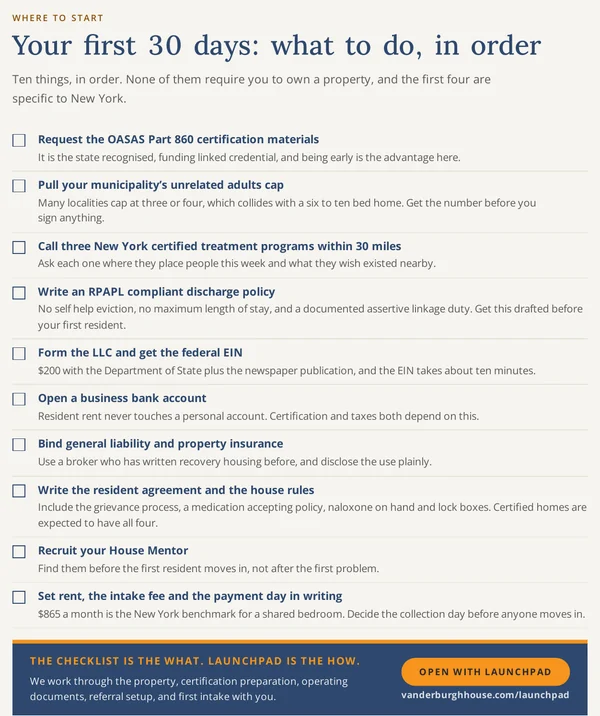
- Form your legal entity. File with the Department of State, following the publication requirement that catches out-of-state operators.
- Confirm zoning first. Check the definition of family for the parcel before you sign anything, and identify your reasonable accommodation argument if the numbers do not fit.
- Secure a compliant property. Choose a property whose certificate of occupancy matches the use you intend, and get the change-of-use question answered by the building department in writing.
- Meet fire and life safety at your bed count. Include alarms, egress, and any sprinkler trigger your classification carries.
- Complete local registration. File any rental registration or lodging permit your municipality runs.
- Write the residency agreement. Build the agreement and the discharge policy around RPAPL process, not lockouts.
- Decide on certification. Choose OASAS or NYSARR or both, and build the policy manual the application requires.
- Open your doors. Bind insurance, open, and start the referral relationships that fill beds.
Support for every stage
Pick the level of support that fits where you are.
Just getting startedSee how the sober living opportunity works and what starting with VSL looks like. LaunchpadGuided pre-launch program: one-on-one strategy, Academy training, weekly coaching, and templates. MasteryHands-on startup, certification, and operating support inside the Chartered Operator community.Questions first? Call (844) 762-3747, weekdays 8a to 5p.
Sober Living Guides Every Operator Needs
These evergreen guides apply in every state and cover what matters once you know the licensing picture: the standards you certify to, the fair-housing protections behind you, the property you choose, and the referrals that certification unlocks.
Frequently Asked Questions About Sober Living Licensing in New York
Do you need a license to open a sober living home in New York?
No. New York requires no state operating license for a peer-run, non-clinical recovery home. OASAS certification under 14 NYCRR Part 860 exists, but §860.3 states it is voluntary and not required to provide housing that supports recovery. Local zoning, occupancy, and rental registration requirements still apply in every municipality.
What does OASAS certification cost?
As of September 2, 2026, we found no published application fee and no renewal fee for Part 860 certification; applicants request materials from the Bureau of Certification by email. The real cost is compliance: policies, a credentialed residence manager, naloxone, and lockable medication storage. NYSARR’s separate NARR certification costs $250 for membership plus $300 to apply, or $500 combined.
Is an uncertified sober living home legal in New York?
Yes. Operating without OASAS certification is lawful, provided the home delivers no treatment and complies with local code. What an uncertified home cannot do is call itself a Certified Recovery Residence, appear on the OASAS listing, or claim the Opioid Settlement Fund support that was tied to the certification program, whose application window closed at 4:00 p.m. on July 31, 2026.
When does a New York sober home need a treatment license?
When it stops being housing. Under MHL §32.05, an OASAS operating certificate is required to run a residential program for the care, custody, or treatment of people with substance use disorder, and §32.05(c) bars any entity from advertising treatment services without one. Counseling, dispensing medication, or withdrawal management on site all cross that line.
Is New York about to require licensing?
Not currently. Assembly Bill A3797 would make OASAS certification mandatory to operate a sober living home, adding a $10,000 fine for uncertified operation, a $500 biennial recertification fee, fines of up to $1,000 per day capped at $5,000 a year, inspections, and a toll-free complaint hotline, but it remained in the Assembly Committee on Alcoholism and Drug Abuse after being re-referred on January 7, 2026. As of September 2, 2026, we found no floor vote scheduled in either chamber.
Your Next Step Toward Opening Legally in New York
New York gives you an open door and a demanding house. No state license stands between you and opening, but the certificate of occupancy, the occupancy math, the discharge process, and eventually the certification decision all will. Operators who treat those four as the real licensing regime open faster and get sued less. If you want help mapping your city’s requirements and deciding whether Part 860 certification belongs in your first year, talk with the Vanderburgh Sober Living team.
Research & Sources
- Foote, H. T. (2026). Vanderburgh Sober Living Operating Climate Index, 2026 Edition. Vanderburgh Sober Living. Operating Climate Index, 2026 Edition
- New York State Office of Addiction Services and Supports. (2024). Notice of adoption, 14 NYCRR Part 860: Recovery residences. OASAS, Recovery Residences (Part 860)
- New York State Office of Addiction Services and Supports. (2024). 14 NYCRR Part 860, adopted rule text. OASAS, Part 860 adopted rule text (PDF)
- New York State Legislature. Mental Hygiene Law §32.05-a: Certified recovery residences. NY Open Legislation, MHL §32.05-a
- New York State Legislature. Mental Hygiene Law §32.05: Operating certificate required. NY Open Legislation, MHL §32.05
- New York State Office of Addiction Services and Supports. (2025, January 31). First certification program for recovery residences in NYS. OASAS, First certification program for recovery residences in NYS
- New York State Office of Addiction Services and Supports. Become a certified recovery residence. OASAS, Become a certified recovery residence
- New York State Office of Addiction Services and Supports. (2026). Request for applications SETT-24029: Recovery residences. OASAS, Request for applications SETT-24029
- New York State Office of Addiction Services and Supports. Residential services (Part 820). OASAS, Residential services (Part 820)
- New York State Office of Addiction Services and Supports. Conversion from Part 819 to Part 820 residential services. OASAS, Residential services conversion (Part 819 to Part 820)
- New York State Office of Addiction Services and Supports. Withdrawal and stabilization services (Part 816). OASAS, Withdrawal and stabilization services (Part 816)
- New York State Assembly. (2026). Assembly Bill A3797 (2025-2026 session). NY Open Legislation, Assembly Bill A3797
- New York State Legislature. Executive Law §381: Administration and enforcement of the Uniform Fire Prevention and Building Code. NY Open Legislation, Executive Law §381
- New York State Department of State. (2021). Rule text, 19 NYCRR Part 1203. NYS Department of State, full text rule 19 NYCRR Part 1203
- New York State Department of State, Division of Building Standards and Codes. (2024). Technical bulletin: Care facilities within dwellings. NYS Department of State, Technical bulletin: care facilities within dwellings
- New York State Legislature. Multiple Dwelling Law §3 and §4. NY Open Legislation, Multiple Dwelling Law §4
- New York State Legislature. Multiple Residence Law §3. NY Open Legislation, Multiple Residence Law §3
- New York State Legislature. Real Property Actions and Proceedings Law §711 and §768. NY Open Legislation, RPAPL §768
- New York State Legislature. Executive Law §296: Unlawful discriminatory practices. NY Open Legislation, Executive Law §296
- New York State Legislature. Town Law §261: Grant of power (zoning). NY Open Legislation, Town Law §261
- New York City Department of Housing Preservation and Development. Register your property. NYC HPD, Register your property
- New York State. Find licenses and permits needed for your business. NY.gov, Find licenses and permits needed for your business
- New York State Alliance of Recovery Residences. How to join NYSARR. NYSARR, How to join NYSARR
- National Alliance for Recovery Residences. (n.d.). NARR standard and affiliate directory. NARR, Standards and affiliate directory
- U.S. Department of Justice, Civil Rights Division. The Fair Housing Act. U.S. Department of Justice, The Fair Housing Act