Operators researching a license to open a sober living home in Pennsylvania run into two answers that both sound authoritative, and both are half right. One says Pennsylvania has licensed recovery houses since 2021 and you cannot open without one. The other says private-pay sober homes in Pennsylvania have never needed a license and still do not. The law supports both statements, because Pennsylvania wrote a conditional licensing scheme rather than a universal one. The condition is narrow, written into statute, and easy to trip without noticing: it turns on where your residents and your rent money come from, not on how many beds you have or what you call the house. Get the line right before you sign a lease, because the same decision drives your budget, your bed count, your admissions policy, and whether the county will send you anyone at all. The Pennsylvania answer sits within the national picture of whether you need a license to open a sober living home, which differs widely from state to state.
Before you read onHow to Open a Sober Living Home in PennsylvaniaThis post covers one piece of the process. The complete Pennsylvania guide walks through every step, from planning to your first resident.→Do You Need a License to Open a Sober Living Home in Pennsylvania?
The answer is conditional. Pennsylvania requires a Department of Drug and Alcohol Programs (DDAP) recovery house license only when a home accepts referrals from state agencies or state-funded facilities, or receives federal or state funding to deliver recovery house services. A purely private-pay home that takes neither may lawfully operate unlicensed. The trigger is public referrals or public money, not bed count.
That trigger is statutory, not a matter of agency practice. Act 59 of 2017 added subarticle B of Article XXIII-A to The Administrative Code of 1929, codified at 71 P.S. §§ 613.11 through 613.18, and § 613.12(a) states the rule in three parts: all referrals from state agencies or state-funded facilities go to licensed or certified recovery houses; only licensed or certified houses may receive federal or state funding to deliver recovery housing services; and individuals whose treatment is publicly funded may be referred only to a certified house. Courts are directed to give first consideration to a certified house when making residential recommendations.
Read that as an operator rather than a lawyer and it reduces to one sentence. You need the license the moment you accept a referral from a state agency or a state-funded treatment provider, or take a dollar of federal, state, or county money for recovery housing services. Until then, DDAP’s licensing rules do not reach you, and the department’s own registry carries notice that not all recovery houses require licensure, per 28 Pa. Code § 717.33.
Pennsylvania sits in the middle of the national picture as a result. Foote (2026) scores Pennsylvania 7 for legal climate and 7 on the composite Operating Climate Score, classifies the state as Moderately Regulated, and rates its mandatory operating license status as Conditional, which is exactly what a referral-and-funding trigger produces (Operating Climate Index, 2026 Edition).
How your home gets classified, where Fair Housing applies, and what to do if the city says no.
Pennsylvania Sober Living Licensing at a Glance
The table below is the whole regulatory picture in one screen, with each figure tied to the provision that sets it.
| Item | Detail | What it means |
|---|---|---|
| State license required | Conditional | Required on public referrals or public funding; not required for a pure private-pay home (71 P.S. § 613.12(a)) |
| Registry or certification mandate | DDAP registry listing, automatic once the department licenses or certifies the house | 71 P.S. § 613.15 and 28 Pa. Code § 717.33 require a public registry of licensed or certified houses. There is no separate registration an operator applies for on its own. |
| Administering agency | Pennsylvania Department of Drug and Alcohol Programs (DDAP) | Single statewide licensor for drug and alcohol recovery houses |
| Governing statute | Act 59 of 2017, at 71 P.S. §§ 613.11 through 613.18 | Created the licensing power and the referral and funding trigger |
| Thresholds that trigger licensure | A referral from a state agency or a state-funded facility, or federal, state, or county money for recovery housing services | Bed count does not trigger the license. The source of your residents and your revenue does. |
| Governing regulation | 28 Pa. Code Ch. 717, §§ 717.1 through 717.33 | Standards for Drug and Alcohol Recovery House Licensure, adopted December 10, 2021 at 51 Pa.B. 7670 |
| Initial application fee | $250 | 28 Pa. Code § 717.6(a)(3), due with the Initial Provider Application |
| Renewal fee | $250 | § 717.6(b)(3), with a $250 provisional fee at § 717.6(c) and $100 more for a complaint-based provisional license |
| License term | One year from date of issuance | 28 Pa. Code § 717.7(c); licensed homes renew annually |
| Fine for unlicensed publicly funded operation | Up to $1,000 per violation | 71 P.S. § 613.16(a); 28 Pa. Code § 717.14(b) makes each day a separate violation |
| Bed-count constraint | 60 sq ft per resident in a shared bedroom, 50 sq ft with bunk beds, 70 sq ft in a single | 28 Pa. Code § 717.29 sets the licensed home’s real capacity ceiling |
| Express statutory mention | “Drug and alcohol recovery house,” defined at 71 P.S. § 613.11 | Names the use in the Administrative Code and sets the definition DDAP licenses against: housing providing a safe, supportive, drug and alcohol free environment. It does not by itself require a private-pay home to hold anything. |
| Voluntary certification body | Pennsylvania Alliance of Recovery Residences (PARR) | The Pennsylvania affiliate of the National Alliance for Recovery Residences; certification is separate from licensure and does not satisfy Act 59 |
Most people ask whether they are allowed to open a recovery home. The better first question is whether the need and the money are there. This answers both, for your state.
- How many people need a bed, and how few beds exist
- Who actually pays the rent, and which programs are real
- What it costs to open on the purchase path and the lease path
How Pennsylvania Regulates Sober Living Homes
DDAP wrote the operating rulebook at 28 Pa. Code Chapter 717, “Standards for Drug and Alcohol Recovery House Licensure,” adopted December 10, 2021 and published at 51 Pa.B. 7670. The chapter runs from § 717.1 to § 717.33 and covers everything a licensed house does: the duties of the role the chapter calls the house manager, personnel screening, training, resident rights, records, medication control, physical plant, safety, and incident reporting. Recovery houses live in Chapter 717, not Chapter 715, which governs narcotic treatment programs. The scheme is also small relative to the market around it. DDAP reported more than 450 licensed recovery houses statewide on August 19, 2026, with 284 of those licensed since 2023 and an 11% increase over the prior year, while the far larger number of private-pay homes across Pennsylvania sits outside the chapter entirely.
There are two license classes. DDAP issues a full license after an on-site inspection confirms compliance, and that license expires one year from issuance under § 717.7. Where a house is in substantial but not full compliance, § 717.8 allows a provisional license instead, and § 717.9 lets the department attach restrictions. The department may enter and inspect under § 717.10, issue deficiency notices under § 717.11, and refuse or revoke a license under § 717.12, with a hearing right at § 717.13.
Three provisions change day-to-day operations more than anything else in the license. A licensed home may not run a no-MAT admissions policy: § 717.19(a)(2) bars discrimination on the basis of disability and § 717.19(a)(6) provides that residents may attend a treatment facility of their choice outside the house, which the licensee may not require or prohibit. Section 717.24(4) requires overdose reversal medication on the premises at all times alongside written emergency procedures. And ending a residency is a documented process under § 717.23, which requires written notice stating the reason and a timeframe plus an opportunity to request reconsideration before the decision takes effect, so same-day removals after a rule violation have to be rebuilt around that step. Staff training runs on a 90-day clock under § 717.18, and the house mentor, whom the chapter calls the house manager, completes at least six hours of training within six months of appointment and annually after that under § 717.15. Private-pay homes outside the license are not bound by these sections, though they remain exposed on the MAT question, because people in recovery are a protected disability class under federal fair housing and disability law.
License vs. Certification vs. Registration: What Each Term Means
Pennsylvania has all three, run by two different bodies, and operators lose money by treating them as interchangeable. Each term is defined below with who issues it and what it actually unlocks.
License
A license is government permission to operate, granted and revocable by a state agency. In Pennsylvania that is the DDAP recovery house license issued under Chapter 717. Section 717.6 sets a $250 application fee for an initial license and a $250 fee at renewal, adds a $250 fee where DDAP issues a provisional license, and adds a further $100 where the provisional license follows a violation found through a complaint, which the department may waive once the correction plan is fully implemented. A full license runs one year from issuance under § 717.7(c), and DDAP will not issue or renew until every form, document, and fee under § 717.6 is in.
The license is required only when the referral or funding trigger applies, and it is the only credential that opens the public referral and public funding pipeline. The application runs through DDAP’s online provider portal. DDAP’s recovery house application service has applicants create a portal account, complete the Initial Provider Application, and submit it with the $250 payment and a document set covering ownership and business management filings, a certificate of occupancy attestation, proof of zoning approval, floor plans, the consent to residency form, information on the person serving as house mentor, articles of incorporation and state business filings, bylaws or operating agreements, the orientation handbook with house rules and fees, photo identification for anyone holding 5% or more, proof of fire-retardant mattresses, criminal history background checks, and written policies across personnel, training, resident rights, medication, finances, complaints, safety, and incidents. A licensing specialist then reviews the policies, walks the house, and inspects medication storage, so the physical plant work has to be finished first. There is no guaranteed timeline; the real constraint is how fast an operator can assemble that package.
Certification
Certification is a voluntary third-party review against a private standard. In Pennsylvania that is PARR certification, measured against the NARR 3.0 standard of four domains, 10 principles, and 31 standards. PARR is not a government body, cannot license anyone, and its certificate does not satisfy the Act 59 trigger.
What certification carries instead is credibility, technical assistance, and a directory listing, which is why operators in both lanes pursue it. The full application path is covered in certifying a sober living home in Pennsylvania with PARR, and the body itself is profiled at Pennsylvania Alliance of Recovery Residences.
Registration
Registration is a state roster rather than a permission. Pennsylvania has one: 71 P.S. § 613.15 directs DDAP to create and annually update a public registry of every licensed or certified recovery house, and 28 Pa. Code § 717.33 sets what it shows, including each house’s name, address, maximum occupancy, and whether its license is full, provisional, or operating pending appeal.
Listing follows from licensure. There is no separate registration a home applies for, no registration fee, and nothing an unlicensed private-pay home has to file to stay lawful. The practical consequence runs the other way: a home outside the license is also outside the registry, and so invisible to anyone searching it.
Mapped onto Pennsylvania, one of the three is conditionally mandatory, one is voluntary, and one is automatic. The DDAP license is required only on public referrals or public funding and is the credential that unlocks them. PARR certification is optional everywhere in the state and unlocks credibility and referral relationships rather than legal access. The registry listing is not something you apply for at all.
| Credential | Required? | Administering body |
|---|---|---|
| License | Only on public referrals or public funding | Pennsylvania Department of Drug and Alcohol Programs |
| Certification | No, voluntary in every county | Pennsylvania Alliance of Recovery Residences |
| Registration | Automatic once DDAP licenses or certifies the house | Pennsylvania Department of Drug and Alcohol Programs |
When a Sober Living Home Crosses Into Licensed Treatment
A recovery house and a treatment provider sit under different licenses in Pennsylvania, and the line is the service, not the setting. Under 71 P.S. § 613.11 a drug and alcohol recovery house is housing that provides a safe, supportive, drug and alcohol free environment and may include peer support and other recovery support services. Add clinical services and the home is no longer being licensed as a recovery house at all. Signals that a home has crossed the line include:
- Clinical services delivered on site: Assessment, counseling, therapy, or withdrawal management provided by or on behalf of the house rather than by an outside provider the resident chose.
- Staff administration of medication: Section 717.24 builds the recovery house model on resident self-administration and locked storage of controlled substances. A house whose staff dispense medication is describing a clinical operation.
- Custodial or personal care: Hands-on assistance with daily living moves the property out of ordinary dwelling classification under the building code and toward a care occupancy.
- Billing a payer for services rather than housing: Charging insurance or Medicaid for a treatment service is the clearest indicator that a separate DDAP treatment license applies.
A home that keeps residents independent, self-administering, and free to attend the outside treatment provider of their choice stays inside the recovery house definition and inside Chapter 717.
What’s Changed in Pennsylvania Sober Living Law
Pennsylvania’s licensing scheme is younger than most operators assume, and each of the dates below changed what a home could do with public money. Nothing further is pending with a set effective date.
Act 59 added subarticle B of Article XXIII-A to The Administrative Code of 1929 at 71 P.S. §§ 613.11 through 613.18, giving DDAP the power to license drug and alcohol recovery houses and tying state referrals and state funding to that license.
DDAP adopted 28 Pa. Code Chapter 717 on December 10, 2021, published at 51 Pa.B. 7670, turning the statutory authority into operating standards covering staffing, resident rights, medication, physical plant, and safety.
The licensure grace period closed on December 31, 2022, and from January 1, 2023 the single county authorities that fund most publicly supported placements may fund only DDAP-licensed recovery houses.
DDAP reported more than 450 licensed recovery houses statewide on August 19, 2026, 284 of them licensed since 2023, an 11% increase over the prior year.
Pennsylvania’s Occupancy and Building-Safety Thresholds
For a licensed house the ceiling on beds comes from the licensing regulation before it comes from the building code, and the numbers are measured wall to wall.
- Bedroom floor area: Section 717.29 requires at least 60 square feet per resident in a shared bedroom, at least 50 square feet per resident in a shared bedroom with bunk beds, and at least 70 square feet in a single bedroom. Multiplied across a real floor plan, those numbers decide capacity, which is why determining maximum occupancy is a measuring exercise before it is a business projection.
- Bedroom placement and egress: Bedrooms need direct access to a corridor or external exit and cannot serve as the only route to a stairway or basement. Basement bedrooms need a protective fire wall between the bedroom and any furnace plus direct egress to the outside, mattresses must be fire retardant, and portable space heaters are prohibited.
- Exits, detectors, and extinguishers: Section 717.30 requires two unobstructed exits at least 15 feet apart on every floor with resident bedrooms, an operable smoke detector on each floor including basement and attic plus one within 15 feet of each bedroom door, carbon monoxide detectors where they apply, monthly detector testing, and at least one ABC-rated portable extinguisher per 2,000 square feet on each floor plus one in each kitchen, inspected annually. Sober living fire safety upgrades are where a marginal property turns expensive.
- Occupancy classification: The Pennsylvania Uniform Construction Code, administered by the Department of Labor and Industry and running on the 2021 ICC code series effective January 1, 2026, decides the fire-protection tier. An independent-living home whose residents are capable of self-preservation is generally treated as an ordinary dwelling under the residential code, while a home providing custodial care to between six and 16 people is a Group R-4 care occupancy carrying institutional sprinkler and alarm obligations.
Keeping the home an independent-living dwelling is the single largest cost decision in the property, and it is made when you choose the house and write the program, not when the inspector arrives.
Pennsylvania guidePennsylvania Zoning, Fair Housing, and Land Use Laws for Sober LivingWhere sober homes can operate in Pennsylvania and the legal protections that apply.→What’s Still Required Without a License
Skipping the license does not produce an unregulated home. A private-pay Pennsylvania sober living home still carries a compliance floor, and every item below applies whether or not Chapter 717 does.
- A legal entity and state filings: Register the business with the Pennsylvania Department of State before signing anything, and keep the operating entity separate from the property owner. Forming a legal entity for a sober living business in Pennsylvania covers the filings and the fees.
- Local business registration and zoning clearance: Municipal requirements vary widely under Pennsylvania’s home rule structure, and the definition of “family” in a local ordinance is usually the real fight. Sober living zoning laws in Pennsylvania cover that ground in full.
- Building and fire code compliance: The property should comply with the applicable Uniform Construction Code requirements and local fire ordinances enforced by the municipality or an approved third-party agency.
- Fair housing and disability law: The federal Fair Housing Act, the Americans with Disabilities Act, and the Pennsylvania Human Relations Act at 43 P.S. § 955 protect people in recovery as a disability class and support reasonable accommodation requests against restrictive local rules.
- Insurance: General liability at minimum, and more if you intend to certify. Pricing sober house insurance early avoids a surprise in the certification file.
- Written house rules and resident agreements: Not required by state law for an unlicensed home, and still the document that decides how a dispute ends.
None of that is optional, and none of it is waived by staying private pay. What staying private pay removes is Chapter 717’s inspection cycle, not the underlying duty to run a safe, lawful house.
How Voluntary Pennsylvania Alliance of Recovery Residences Certification Works Here
The Pennsylvania Alliance of Recovery Residences (PARR) is the state affiliate of the National Alliance for Recovery Residences, and its certification is voluntary in every county. Certification is assessed against the NARR 3.0 standard, which organizes four domains, 10 principles, and 31 standards, and PARR positions the review as consultative rather than punitive. Sorting where a home fits in the NARR levels of care is the first step, because the level sets the fee. PARR’s published schedule is a $200 annual application fee in all counties plus a per-bed capacity fee of $0.50 at Level 1, $0.70 at Level 2, $1.00 at Level 3, and $1.50 at Level 4.
Applicants provide liability insurance of $500,000 or more along with zoning, occupancy, and lease documentation, homes are inspected annually with unannounced audits possible at any time, and yearly training is required of owners, directors, and house mentors. What certification does not do is satisfy Act 59: a certified but unlicensed home still cannot take a state-funded referral.
Pennsylvania guideHow to Certify a Sober Living Home with Pennsylvania Alliance of Recovery Residences in PennsylvaniaThe step-by-step PARR application, costs, timelines, and inspection checklist.→What Skipping Pennsylvania Alliance of Recovery Residences Certification Costs You
For a private-pay home that never touches public money, no fine applies and no license is owed, so the cost of skipping certification is commercial rather than legal. Publicly funded treatment providers may refer only to licensed houses, courts are directed to give first consideration to certified houses, and an uncertified, unlicensed home is invisible on both DDAP’s licensed-housing locator and PARR’s residence directory. That removes most of the institutional referral sources an operator would otherwise build a census on, leaving self-pay and word of mouth to carry the whole house.
Where the license genuinely is owed, the penalty provision is specific. Under 71 P.S. § 613.16(a), a person operating a recovery house funded in whole or in part by the department or a federal, other state, or county agency that has failed to attain or maintain licensure shall pay a fine of up to $1,000 for each violation, and 28 Pa. Code § 717.14(b) provides that each day of operating a house that requires a license without a current license is a separate violation. The exposure compounds daily. The cure path is the same application every licensed house runs, and the department must also refer suspected violations of other federal, state, or local law to the appropriate agency under § 613.16(b).
Steps to Open a Pennsylvania Sober House Legally
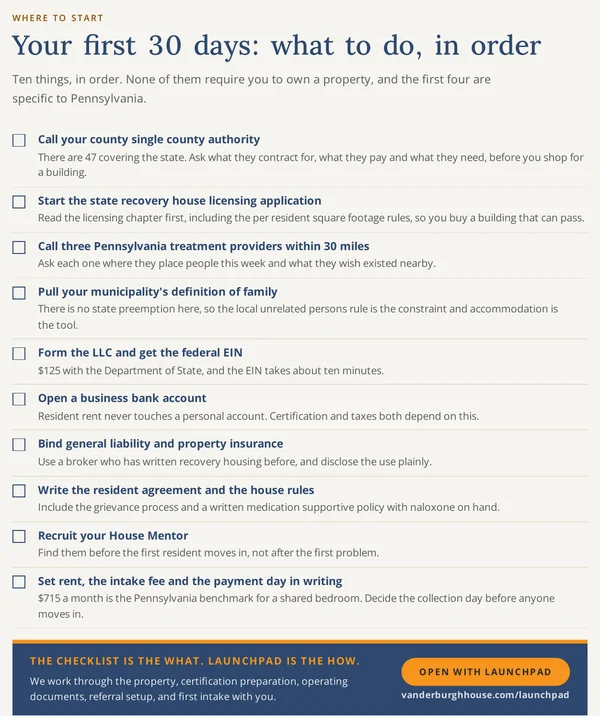
The sequence below works for either lane, with the licensing steps applying once you decide to reach public referrals or public funding. Pick the lane first: whether the home will take state agency or state-funded referrals and public dollars is the single decision that sets everything that follows.
- Form your legal entity. Register with the Pennsylvania Department of State and keep the operating company separate from the property. Forming a legal entity for a sober living business in Pennsylvania covers the filings and the fees.
- Secure a compliant property. Confirm zoning and the local definition of “family”, then measure bedrooms against the § 717.29 minimums before you commit, because those numbers set your bed count.
- Meet local building, fire, and occupancy codes. Handle Uniform Construction Code permitting through the municipality or an approved third-party agency, and install the § 717.30 detector and extinguisher package if you are licensing.
- Register or certify as Pennsylvania requires. Write the policy set first: personnel, training, resident rights, medication and self-administration, finances, complaints, safety, and incident procedures. Then submit the Initial Provider Application with the $250 fee and the full document package if the trigger applies, and certify with PARR either way.
- Open your doors. A licensed and certified home carries two annual renewal and inspection cycles, and neither one forgives a missed date. Put both on the calendar the week you open.
Support for every stage
Pick the level of support that fits where you are.
Just getting startedSee how the sober living opportunity works and what starting with VSL looks like.LaunchpadGuided pre-launch program: one-on-one strategy, Academy training, weekly coaching, and templates.MasteryHands-on startup, certification, and operating support inside the Chartered Operator community.Questions first? Call (844) 762-3747, weekdays 8a to 5p.
Sober Living Guides Every Operator Needs
These evergreen guides apply in every state and cover what matters once you know the licensing picture: the standards you certify to, the fair-housing protections behind you, the property you choose, and the referrals that certification unlocks.
Frequently Asked Questions About Sober Living Licensing in Pennsylvania
Do you need a license to open a sober living home in Pennsylvania?
Only if the home accepts referrals from state agencies or state-funded facilities, or receives federal or state funding for recovery housing services. That trigger comes from 71 P.S. § 613.12(a). A home operating entirely on private pay with no public referrals may lawfully operate without a DDAP license.
How much does a DDAP recovery house license cost?
The application fee is $250 and renewal is $250 under 28 Pa. Code § 717.6. A provisional license carries an additional $250, and a provisional license issued after a complaint-based violation adds $100, which DDAP may waive once the correction plan is fully implemented. Compliance costs far exceed the fee.
How long does a Pennsylvania recovery house license last?
A full license expires one year after issuance under 28 Pa. Code § 717.7(c), so licensed homes renew annually. DDAP issues the full license only after an on-site inspection confirms compliance with Chapter 717, and can issue a provisional license instead where a house is in substantial but not full compliance.
What happens if an unlicensed home takes public referrals?
Under 71 P.S. § 613.16(a) the operator of a publicly funded recovery house without licensure pays a fine of up to $1,000 per violation, and 28 Pa. Code § 717.14(b) makes each day of unlicensed operation a separate violation. Single county authorities have been barred from funding unlicensed homes since January 1, 2023.
Can a licensed Pennsylvania recovery house refuse residents on MAT?
No. Section 717.19(a)(2) bars disability-based discrimination and § 717.19(a)(6) provides that residents may attend the outside treatment facility of their choice, which a licensee may not require or prohibit. Unlicensed private-pay homes still face federal fair housing exposure for a blanket medication ban.
Your Next Step Toward Opening Legally in Pennsylvania
Pennsylvania gives operators a real choice that most states do not. Stay private pay and you may lawfully open without a DDAP license, carrying only the compliance floor every housing provider carries. Reach for public referrals or public funding and the license becomes mandatory, along with Chapter 717’s square-footage limits, MAT protections, discharge procedure, and annual renewal. Decide which lane you are in before the lease, not after the first county referral call. If you want experienced eyes on that decision and on the property you are considering, reach out to the Vanderburgh Sober Living team and tell us where in Pennsylvania you are looking.
Research & Sources
- Foote, H. T. (2026). Vanderburgh Sober Living Operating Climate Index, 2026 Edition. Vanderburgh Sober Living. https://www.vanderburghhouse.com/research/operating-climate-index-2026/
- Pennsylvania General Assembly. (2017). Act 59 of 2017 (Senate Bill 446), amending The Administrative Code of 1929, 71 P.S. §§ 613.11-613.18. https://www.legis.state.pa.us/
- Pennsylvania Department of Drug and Alcohol Programs. (2021). 28 Pa. Code Chapter 717, Standards for Drug and Alcohol Recovery House Licensure. https://www.law.cornell.edu/regulations/pennsylvania/title-28/part-V/chapter-717
- Pennsylvania Department of Drug and Alcohol Programs. (2021). 28 Pa. Code § 717.6, Application and renewal. https://www.law.cornell.edu/regulations/pennsylvania/28-Pa-Code-SS-717-6
- Pennsylvania Department of Drug and Alcohol Programs. (2021). 28 Pa. Code § 717.7, Full licensure. https://www.law.cornell.edu/regulations/pennsylvania/28-Pa-Code-SS-717-7
- Pennsylvania Department of Drug and Alcohol Programs. (2021). 28 Pa. Code § 717.14, Fines. https://www.law.cornell.edu/regulations/pennsylvania/28-Pa-Code-SS-717-14
- Pennsylvania Department of Drug and Alcohol Programs. (2021). 28 Pa. Code § 717.19, Resident rights. https://www.law.cornell.edu/regulations/pennsylvania/28-Pa-Code-SS-717-19
- Pennsylvania Department of Drug and Alcohol Programs. (2021). 28 Pa. Code § 717.23, Notification of decision to end residency. https://www.law.cornell.edu/regulations/pennsylvania/28-Pa-Code-SS-717-23
- Pennsylvania Department of Drug and Alcohol Programs. (2021). 28 Pa. Code § 717.24, Medication control and self-administration. https://www.law.cornell.edu/regulations/pennsylvania/28-Pa-Code-SS-717-24
- Pennsylvania Department of Drug and Alcohol Programs. (2021). 28 Pa. Code § 717.29, Physical plant standards. https://www.law.cornell.edu/regulations/pennsylvania/28-Pa-Code-SS-717-29
- Pennsylvania Department of Drug and Alcohol Programs. (2021). 28 Pa. Code § 717.30, Safety and emergency procedures. https://www.law.cornell.edu/regulations/pennsylvania/28-Pa-Code-SS-717-30
- Pennsylvania Department of Drug and Alcohol Programs. (2021). 28 Pa. Code § 717.33, Drug and alcohol recovery house registry. https://www.law.cornell.edu/regulations/pennsylvania/28-Pa-Code-SS-717-33
- Pennsylvania Department of Drug and Alcohol Programs. (n.d.). Recovery house licensing. https://www.pa.gov/agencies/ddap/for-professionals/licensing
- Pennsylvania Department of Drug and Alcohol Programs. (n.d.). Apply to become a licensed recovery house. https://www.pa.gov/services/ddap/apply-to-become-a-licensed-recovery-house
- Pennsylvania Department of Drug and Alcohol Programs. (2026, August 19). More than 280 of PA’s recovery homes licensed since Governor Shapiro took office. https://www.pa.gov/agencies/ddap/newsroom/more-than-280-of-pa-s-recovery-homes-licensed-since-governor-sha
- Pennsylvania Department of Labor and Industry. (n.d.). Uniform Construction Code. https://www.pa.gov/agencies/dli/programs-services/labor-management-relations/bureau-of-occupational-and-industrial-safety/uniform-construction-code-home
- National Alliance for Recovery Residences. (n.d.). NARR standard and affiliate directory. https://narronline.org/
- Pennsylvania Alliance of Recovery Residences. (n.d.). Application process and fee schedule. https://www.parronline.org/application-process