
The cost to open a sober living home in Pennsylvania comes to roughly $17,631 if you lease the property and roughly $76,308 if you buy it, and almost the entire difference is the down payment. Everything else in the budget, the furnishings, the deposits, the supplies, the launch marketing, and the certification fee, is identical on both paths and runs a little under $12,000 for a 14-bed house.
Those figures are built from Pennsylvania inputs rather than national averages: the state median sale price of $298,517 as of June 30, 2026, the Freddie Mac Primary Mortgage Market Survey 30-year average of 6.66% for the week of August 27, 2026, the state median gross rent of $1,209 in the American Community Survey 2024 five-year estimates, and the published fee schedules of the two Pennsylvania bodies an operator actually deals with. What follows is the line-item budget on both paths, the regulatory fees and which of them apply to you, the building-code costs the Commonwealth construction code can create, and the working capital you need on top of the opening budget to reach break-even. The national figures for all 50 states show what it costs to open a sober living home in every state, including Pennsylvania.
Before you read onHow to Open a Sober Living Home in PennsylvaniaThis post covers one piece of the process. The complete Pennsylvania guide walks through every step, from planning to your first resident.→How Much Does It Cost to Start a Sober Living Home in Pennsylvania?
Pennsylvania startup cost snapshotThe spread between the two paths is not a difference in how much house you get. It is a difference in what happens to the money. Total startup capital before the reserve is an estimated $17,631 on a lease and $76,308 on a purchase for the same 14-bed home. On a lease, the $5,803 you put up for three months at a recovery-housing rent of $1,934 a month, which is the $1,209 state median gross rent plus an explicit 60% premium, is spent. On a purchase, the 20% down payment converts into equity in a property that the Pennsylvania median sale price of $298,517 puts at $322,398 after an 8% recovery-housing premium for a house with the bedroom count and common space a full home needs. Financed at the Freddie Mac 30-year average of 6.66%, the remaining $257,919 carries a monthly payment of $1,657, which is less than the lease payment on the same house.
Pennsylvania is an unusually forgiving state to open in relative to what a full home earns. The Vanderburgh Sober Living Operating Climate Index scores Pennsylvania 9 for startup burden and 9 for return on capital, against a composite operating climate score of 7 (Foote, 2026). The composite sits below both capital scores because the state public money is gated behind a real license and split across county authorities, which is a compliance problem rather than a budget problem. You can model your own bed count, rent, and market against these inputs with the Sober Living Calculator.
The unmet need and the bed shortfall, who pays the rent, what certification costs and what it unlocks, and the full operating model for buying versus leasing.
Get the Your State Starter Kit No cost, no obligation. Unsubscribe in one click.What Goes Into a Pennsylvania Startup Budget
Every figure below is either a published Pennsylvania source or a labeled estimate, the lease-path number comes first in each cell and the purchase-path number second, and the total row is the arithmetic sum of the dollar lines above it. Two fee lines need a word before you copy them into a spreadsheet. Entity formation is real but small, $125 for a Certificate of Organization plus a $7 annual report in year one, and forming a legal entity for a sober living business in Pennsylvania walks the choice between a limited liability company and a nonprofit corporation. The $250 initial recovery house license fee is conditional: it applies only where the home accepts a referral from a state agency or a state-funded treatment provider, or takes federal, state, or county money for recovery housing services. A home funded entirely by residents paying their own rent never pays it and skips the license altogether, and whether you need a license to open a sober living home in Pennsylvania settles which lane a given plan sits in.
| Cost item | Estimated cost | What it means |
|---|---|---|
| Entity formation & state filing fee | $132 | Certificate of Organization at $125 plus the $7 annual report that keeps a for-profit entity in good standing through its first year. |
| Lease deposit or property down payment | $5,803 lease $64,480 purchase | Three months upfront at $1,934 a month on a lease, or 20% down on the $322,398 adjusted purchase price. This single line is the whole spread between the two paths. |
| Furniture and setup | $9,024 | Beds, common-area furniture, kitchen, laundry, and storage for a full 14-bed house furnished at once. Operators who phase it buy the first six beds and add the rest as occupancy climbs. |
| Supplies and linens | $1,354 | Opening stock of bedding, towels, cleaning supplies, and paper goods. |
| Utility deposits | $676 | Electric, gas, water and sewer, and internet accounts opened in the entity name. |
| Marketing and launch | $564 | Signage, print materials, referral outreach, and directory listings before the first resident arrives. |
| Renovation and safety/code upgrades | Property specific | Detectors, extinguishers, exit lighting, and fire-retardant mattresses land in the low thousands on a house that already reads as a dwelling. A change of occupancy classification is a different project, so this line is set during due diligence rather than statewide. |
| Insurance (first year) | Carried in the reserve | General liability at $250 a month plus property coverage at $168 a month on an owned home sits inside the operating reserve below, funded once rather than counted twice. PARR will not schedule an inspection without proof of $500,000 or more in liability coverage. |
| Certification fee | $210 | PARR’s $200 annual application fee plus the Level 2 per-bed capacity fee of $0.70 at 14 beds. |
| Recovery house license fee | $250 | 28 Pa. Code § 717.6, and only where the home takes public referrals or public funding. Private-pay homes carry $0 here. |
| Operating reserve | $9,810 lease $10,350 purchase | Ninety days of the full operating cost stack, $3,270 a month on a lease and $3,450 a month on a purchase, sitting in the account on opening day. |
| Estimated all-in to open (low – high) | $27,823 – $87,040 | The realistic total to open a certified home in Pennsylvania, reserve included. |
Methodology & sources. The purchase price starts from the Zillow Pennsylvania median sale price of $298,517 as of June 30, 2026 and adds an explicit 8% recovery-housing premium, reflecting that a viable home needs more bedrooms and more common space than the median transaction. Financing assumes 20% down on a 30-year term at 6.66%, the Freddie Mac PMMS 30-year fixed average for the week of August 27, 2026. The lease payment starts from Pennsylvania’s median gross rent of $1,209 in the ACS 2024 five-year estimates, Table DP04 and adds an explicit 60% recovery-housing lease premium, producing $1,934 a month with three months upfront. Furnishings, supplies, utility deposits, and launch marketing are Vanderburgh Foundation estimates scaled to Pennsylvania cost of living, and are the only estimated dollar lines in the table. Certification is the published PARR fee schedule, entity formation the Pennsylvania Department of State fee schedule, and the license fee 28 Pa. Code § 717.6. The reserve is three months of the operating stack the Pennsylvania profitability model carries. Adding the dollar lines gives $27,823 on a lease and $87,040 on a purchase; strip the license, the formation fee, and the reserve and the pure startup totals are $17,631 and $76,308. Bed count is not a free variable here, because licensed homes are capped by the per-resident square footage in 28 Pa. Code § 717.29, which is why some operators look hard at bunk beds for recovery housing before ordering furniture, and sober living rent pricing is the input that decides how fast the startup number comes back.
Lease vs. Buy: How the Startup Number Changes
The choice changes your opening check by $58,677 and changes almost nothing else about the house. Leasing is the right first move for most people, and not only because it is cheaper: it lets you prove the model in a specific Pennsylvania market before committing six figures to a specific street. Buying costs more up front, carries a lower monthly property cost at current Pennsylvania prices, and pays a second return that never appears in an operating statement. Either way, sober living profitability in Pennsylvania is where the monthly economics that repay this capital are modeled in full.
The filter we use before we ever call an agent: what makes a property work as a Level II home, the zoning and occupancy questions to ask before you tour, and the red flags that should end a showing in five minutes.
Get the guide free →| Factor | Leasing | Buying |
|---|---|---|
| Upfront cash | $17,631 at opening | $76,308 at opening |
| Monthly cost | $1,934 lease payment, taxes and property insurance on the landlord under a gross lease | $1,657 mortgage payment, plus real estate taxes and property insurance |
| Control over the property | Limited by the lease term and the landlord’s willingness to renew | Full, including bed layout, renovations, and the exit |
| Equity | None | Principal paid down from month one on a $257,919 loan |
| Main risk | The landlord declines to renew after you have built the referral relationships that make the address work | Six figures committed to one street before the model is proven |
If you lease
- Open for about $17,631 plus a $9,810 reserve, and prove the market before you commit to a street.
- Have the lease read for occupancy limits, guest policy, and the right to rent rooms individually, because a standard residential lease rarely contemplates a 14-bed congregate home.
- Look at the deal from the other side of the table first; common leasing mistakes property owners make is the landlord’s version of the same negotiation.
If you buy
- Plan on about $76,308 at closing plus a $10,350 reserve, and expect financing and closing to add weeks to the opening date.
- Vet the building before the offer with a due diligence checklist for recovery housing property, because occupancy classification and bedroom square footage decide the bed count.
- Line up sober house financing early, since lenders price a congregate recovery residence differently from a single-family rental.
Pennsylvania Fire Code, Sprinklers, and the Bed-Count Cliff
The Commonwealth construction rules are where a startup budget either stays flat or doubles, and the deciding factor is occupancy classification rather than bed count alone. Pennsylvania building and fire standards are set by the Uniform Construction Code under Act 45 of 1999, administered by the Department of Labor and Industry, which adopted the 2021 International Code Council series effective January 1, 2026, with the 2018 accessibility provisions left in force by a Commonwealth Court injunction. Enforcement runs through the municipality in most of the state.
- Independent living keeps you in the residential tier. A recovery home whose residents live independently and are capable of self-preservation is treated as an ordinary dwelling under the International Residential Code, the same as any single-family house. That tier carries no sprinkler retrofit and no institutional upgrade path.
- Custodial care moves you to R-4 and changes the number. Under the International Building Code as adopted by the Uniform Construction Code, a building housing between 6 and 16 people receiving custodial care is Group R-4, which brings heavier fire-protection obligations. Providing personal or custodial care is the line, not the head count by itself. Recovery housing is housing, not treatment, and a home that keeps its service model clean stays out of R-4.
- A change of use or construction is what triggers a permit. Where there is no change of occupancy classification and no construction, an ordinary dwelling generally triggers no Uniform Construction Code permit. Where there is, plan review and inspection costs enter the budget, and they are property-specific rather than statewide.
Chapter 717 then sets its own physical requirements for licensed homes, and these are the standards that actually produce a renovation line on the budget.
- Exits and alarms are prescribed, not optional. 28 Pa. Code § 717.30 requires two unobstructed exits at least 15 feet apart on every floor with resident bedrooms, a smoke detector on each floor including basement and attic plus one within 15 feet of every bedroom door, and carbon monoxide detectors where combustion heating or an attached garage is present.
- Extinguishers and documented testing carry a small hard cost. The same section requires at least one ABC-rated extinguisher per 2,000 square feet on each floor plus one in each kitchen, and monthly documented testing. Detectors, extinguishers, exit lighting, and fire-retardant mattresses are the concrete cost list here, and on a sound property they land in the low thousands rather than the tens of thousands.
- Square footage caps the bed count. 28 Pa. Code § 717.29 sets per-resident minimums of 60 square feet in a shared bedroom, 50 with bunk beds, and 70 in a single, which means the ceiling on beds is set by the floor plan you buy or lease. Check it before the furniture order, because the revenue side of the model scales with beds and the cost side does not.
Budget code work as a property-specific range rather than a fixed line, and settle it during due diligence. A house that already reads as a dwelling and needs detectors, extinguishers, and mattresses costs a few thousand dollars to bring current. A house that needs a change of occupancy is a different project with a different budget, and it is usually the wrong house.
Know your rights before you spendThe Federal Fair Housing Act and Sober Living: Everything You Need to KnowPeople in recovery are a protected class; understand these protections before you accept a costly local requirement.→The Costs First-Time Operators Underbudget
Startup capital opens the doors. Working capital keeps them open until the beds fill, and it is the line first-time operators most often leave out. Plan on 90 days of full operating costs in the account on opening day, $9,810 on a lease path and $10,350 on a purchase path at the Pennsylvania cost stack. That reserve is sized to the ramp rather than to a crisis: a 14-bed Pennsylvania home turns cash-flow positive at 44% occupancy, six of 14 beds at $715 a bed, and most homes reach it inside the first 60 to 90 days when the operator works referral relationships from day one. Four lines account for most of the gap between a first budget and a real one, and none of them are exotic.
- Insurance. PARR requires liability coverage of $500,000 or more, and carriers price a congregate recovery residence differently from a single-family rental. The Pennsylvania model carries $250 a month in general liability plus $168 a month in property coverage on an owned home, and the first premium is due at binding rather than at first occupancy. Sober house insurance is the line most often quoted too low.
- The operating reserve. It is not optional and it is not the same as startup capital. A home that opens with a full furniture order and no reserve is a home that discounts rent to fill beds fast, which sets a price ceiling it lives with for years.
- Code and safety work. Detectors, extinguishers, exit lighting, and fire-retardant mattresses are cheap. A change of occupancy classification is not. The cost is decided at the property-selection stage, not after closing.
- Month-one vacancy. The pro forma assumes a stabilized house. Month one is not stabilized. Every empty bed in the first quarter is real money the reserve is there to absorb.
How to Lower Your Startup Costs
The startup number is more controllable than it looks, and the controls that work are the ones that do not compromise the home. Funding a sober living home in Pennsylvania covers the public and philanthropic money that can offset part of the outlay, but the levers below are the ones an operator holds directly.
- Choose the path deliberately. Lease to prove the market, then buy once the model works. That one decision is worth $58,677 at current Pennsylvania prices.
- Buy the house that already reads as a dwelling. Code work stays in the low thousands when there is no change of occupancy classification, and balloons when there is.
- Phase the furnishings. Outfit the first six beds, which is also the break-even count, and add the rest as occupancy climbs. That defers roughly half of the $9,024 furniture line.
- File the entity yourself. $132 in year one at the Department of State fee schedule against several hundred dollars for a formation service that files the same two documents.
- Certify in year one anyway. $210 is the cheapest credibility in the budget, and recovery housing for landlords and property owners is the other half of the same argument when you are asking an owner to lease to you.
The false economies are easy to name. Skipping certification saves $210 and costs the referral relationships that fill beds. Underinsuring saves a few hundred dollars a year and puts the entity at risk. Buying the cheapest property in the county saves on the down payment and spends the savings twice over on code work. Nothing on that list is a real saving.
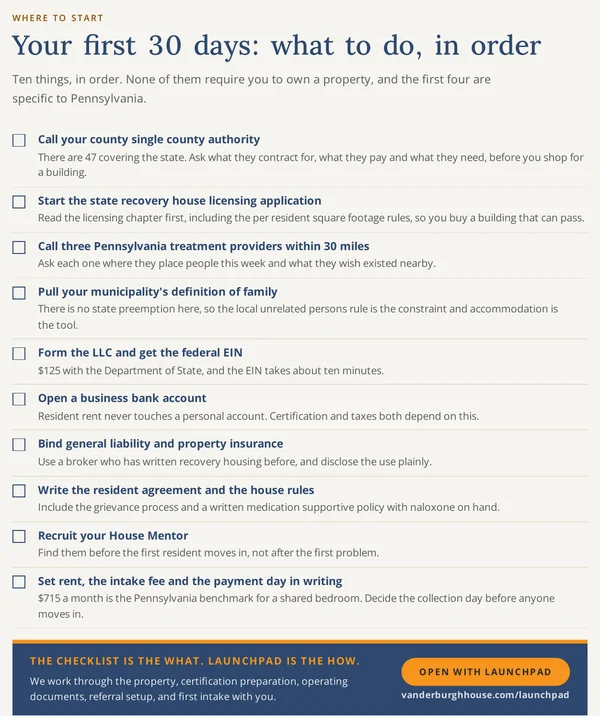
Keep readingHow to Certify a Sober House: An Overview of NARR Affiliate CertificationWhat certification involves, what it costs, and how the process works in every state.→Your Pennsylvania Startup Checklist
Pennsylvania Funding That Offsets the Upfront Outlay
Pennsylvania has real money in the recovery housing system, and almost none of it arrives as a startup grant. The Commonwealth’s first wave of opioid settlement funds, $1.07 billion, is distributed under a split that sends 70% to counties, 15% to the Commonwealth, and 15% to litigating subdivisions, which means the decisions that matter to a new operator are made by a county authority rather than in Harrisburg.
- County single county authority contracts. The 47 single county authorities that cover all 67 counties contract with licensed recovery houses for beds and scholarships. This is resident revenue rather than startup capital, and it requires the recovery house license first.
- State Opioid Response dollars. The Department of Drug and Alcohol Programs passes federal State Opioid Response money to single county authorities, which use part of it for recovery housing support. It reaches an open home, not a planned one.
- Real estate financing. On the purchase path the largest single line is the $64,480 down payment, and the cheapest way to shrink the opening check is a better loan rather than a grant. Financing the purchase of a sober living property is where that work happens.
The practical point for a startup budget is sequencing. Most Pennsylvania public money pays for residents once a home is open and licensed, not for the furniture that opens it. Build the budget assuming resident rent funds the ramp, then layer public money on top once the license is in hand and the county relationship exists.
Pennsylvania guideHow Recovery Housing Funding Works in PennsylvaniaGrants, settlement dollars, and the programs that help offset what it costs to open.→Sober Living Guides Every Operator Needs
These evergreen guides apply in every state and go deeper on the pieces behind your startup budget: the standards your home certifies to, the property you choose, the insurance you carry, and the referral partners who keep the beds full.
Frequently Asked Questions About Sober Living Startup Costs
What is the minimum to open a sober living home in Pennsylvania?
The realistic minimum is about $17,631 on a lease path for a 14-bed home, plus a 90-day operating reserve of roughly $9,810. A smaller house with phased furnishings can open for less, but cutting the reserve rather than the furniture order is the mistake that closes homes in the first year.
Can I start by leasing instead of buying?
Yes, and most first-time Pennsylvania operators do. Leasing cuts the opening check from about $76,308 to about $17,631, because you put up three months at $1,934 instead of a $64,480 down payment. You give up equity and long-term control of the building in exchange for speed and a much smaller commitment.
Do I have to pay the $250 recovery house license fee?
Only if the home takes referrals from state agencies or state-funded treatment providers, or receives federal, state, or county money for recovery housing services. A home funded entirely by residents paying their own rent operates without the license and pays nothing. The document package and inspection behind the fee are the real cost.
How long before resident fees cover the startup cost?
A Pennsylvania home reaches cash-flow break-even at 44% occupancy, six of 14 beds, typically inside 60 to 90 days. Lease-path startup capital is recovered in five or six months of stabilized operation. Purchase-path cash is recovered over roughly 20 months, with equity building the entire time.
Do grants cover startup costs in Pennsylvania?
Rarely. Most Pennsylvania public money, including settlement dollars and State Opioid Response funds, pays for resident beds and scholarships at homes that are already open and licensed. Treat resident rent as the funding source for the ramp and public money as revenue that arrives afterward.
Plan Your Pennsylvania Startup Budget With VSL
Pennsylvania is a cheap state to open in and a demanding one to operate in. About $17,631 opens a leased 14-bed home and about $76,308 buys one, the regulatory fees total $592 even on the licensed path, and the line that decides whether the home survives its first quarter is the operating reserve rather than any of the fees.
Get the property classification right, size the beds to the square footage rule, and fund the runway before the furniture. If you are pricing a specific Pennsylvania property or working out which path your capital supports, tell us what you are working on and we will help you pressure-test the budget before you sign anything.
Start your sober house
Pick the path that fits where you are in the process.
Download the free guidePath to Purposeful Recovery Housing, by Dr. Hunter T. Foote.Explore the Mastery ProgramHands-on startup, certification, and operating support.See how starting with VSL worksThe opportunity, the community, and what a Charter includes.Prefer to talk now? Call (844) 762-3747, weekdays 8a to 5p.
Research & Sources
- Foote, H. T. (2026). Vanderburgh Sober Living Operating Climate Index, 2026 edition. https://www.vanderburghhouse.com/research/operating-climate-index-2026/
- Zillow. (2026). Pennsylvania home values. https://www.zillow.com/home-values/47/pa/
- Freddie Mac. (2026). Primary Mortgage Market Survey. https://www.freddiemac.com/pmms
- U.S. Census Bureau. (2024). American Community Survey 5-year estimates, Table DP04: Selected housing characteristics. https://data.census.gov/table/ACSDP5Y2024.DP04
- Pennsylvania Alliance of Recovery Residences. (2026). Certification application process and fee schedule. https://www.parronline.org/application-process
- Pennsylvania Department of State. (2026). Bureau of Corporations and Charitable Organizations fees and payments. https://www.pa.gov/agencies/dos/programs/business/fees-and-payments
- Commonwealth of Pennsylvania. (2021). 28 Pa. Code § 717.6: Fees. https://www.law.cornell.edu/regulations/pennsylvania/28-Pa-Code-SS-717-6
- Commonwealth of Pennsylvania. (2021). 28 Pa. Code § 717.29: Physical environment. https://www.law.cornell.edu/regulations/pennsylvania/28-Pa-Code-SS-717-29
- Commonwealth of Pennsylvania. (2021). 28 Pa. Code § 717.30: Safety and emergency procedures. https://www.law.cornell.edu/regulations/pennsylvania/28-Pa-Code-SS-717-30
- Pennsylvania Department of Drug and Alcohol Programs. (2026). Drug and alcohol recovery house licensing. https://www.pa.gov/agencies/ddap/treatment-and-support/housing
- Commonwealth of Pennsylvania. (1999). Pennsylvania Construction Code Act, Act 45 of 1999. https://www.legis.state.pa.us/WU01/LI/LI/US/HTM/1999/0/0045..HTM
- Pennsylvania Department of Labor and Industry. (2026). Uniform Construction Code. https://www.pa.gov/agencies/dli/programs-services/labor-management-relations/bureau-of-occupational-and-industrial-safety/uniform-construction-code-home
- Pennsylvania Opioid Misuse and Addiction Abatement Trust. (2026). Distribution of Pennsylvania opioid settlement funds. https://www.paopioidtrust.org/