Choosing a legal entity for a sober living business in Pennsylvania is the step that turns a plan into something a bank, an insurer, a county agency, and the Department of Drug and Alcohol Programs (DDAP) will each recognize. The filing itself is inexpensive and quick, and the Commonwealth charges $125 to form almost any domestic entity and $7 a year to keep a for-profit one in good standing, so price will not settle the question. What settles it is the decision behind the filing, whether to run as a limited liability company, a corporation, or a nonprofit, because that choice shapes how you get paid, which funders can reach you, and how much of your personal life sits behind the business. Pennsylvania carries a composite Operating Climate Score of 7 and a Startup Burden Score of 9, and Foote (2026) classifies the state as moderately regulated.
The Pennsylvania filing steps come after a bigger decision: choosing a nonprofit or for-profit structure for a sober living home.
Before you read onHow to Open a Sober Living Home in PennsylvaniaThis post covers one piece of the process. The complete Pennsylvania guide walks through every step, from planning to your first resident.→Why Pennsylvania Sober Living Businesses Need a Legal Entity
An entity is not paperwork for its own sake. In recovery housing it is the thing that lets you sign, borrow, insure, and apply.
- Personal liability separation: A recovery home signs leases, contracts with a house mentor, and houses people around the clock, and an entity keeps those obligations off your personal balance sheet.
- Leases and mortgages: Landlords and lenders want a named borrower or tenant with organizational documents behind it, not an individual with a business idea.
- Banking and bookkeeping: A dedicated business account is what keeps resident payments, rent, and reimbursements separable at tax time and provable to a funder.
- Insurance eligibility: General liability, property, and professional coverage are written to a named insured, and that named insured is your entity.
- State licensure paperwork: DDAP’s recovery house application asks for the articles, certificates, or other documents establishing the legal existence of the applicant, along with bylaws or an operating agreement and photo identification for anyone holding 5% or more of the company.
- Referral credibility: Single county authorities, treatment providers, and probation offices route people to organizations they can look up, contract with, and hold accountable.
That last point matters more in Pennsylvania than in lightly regulated states, because 28 Pa. Code Chapter 717 ties licensure to public referral and public funding. The entity is the applicant, so the entity has to exist before the application, and whether a license applies to you at all is settled in whether you need a license to open a sober living home in Pennsylvania.
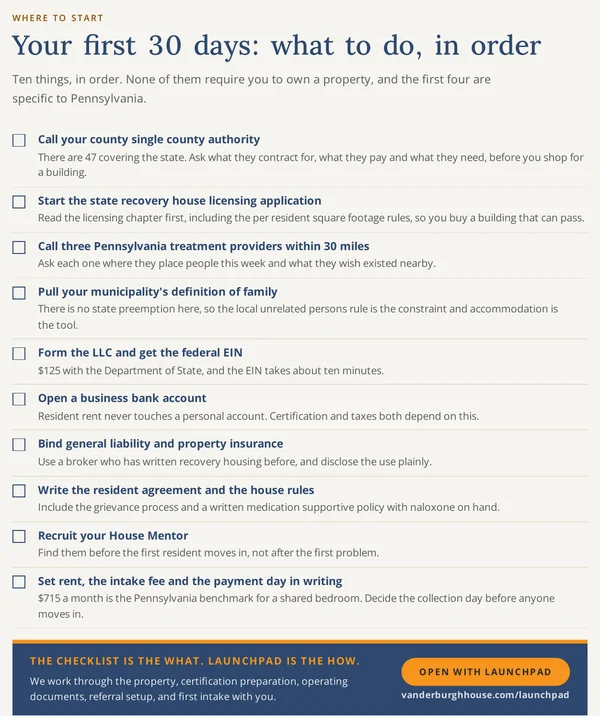
Most people ask whether they are allowed to open a recovery home. The better first question is whether the need and the money are there. This answers both, for your state.
- How many people need a bed, and how few beds exist
- Who actually pays the rent, and which programs are real
- What it costs to open on the purchase path and the lease path
Which Legal Entity Is Best for a Sober Living Home in Pennsylvania?
For most independent operators, a Pennsylvania limited liability company is the right structure. It costs $125 to file and $7 a year to maintain, passes income through to your personal return, and imposes no board. A nonprofit corporation with 501(c)(3) status makes sense when grants, donations, and county contracts will carry the budget rather than resident rent.
The honest version is that the choice tracks your revenue model, not your intentions. Plenty of mission-driven operators run for-profit LLCs and reinvest every dollar. Plenty of nonprofits struggle because their founders wanted grant money without wanting a board, an annual audit trail, and a governance calendar.
Start with an LLC when weekly resident payments will cover operating costs, when you want to be paid as an owner, and when you want to move quickly. Start with a nonprofit when the plan depends on money that only flows to charities, or when you intend to build something that outlives you and answers to a community board. Converting later is possible in either direction, but it is a real project involving new filings, new tax elections, and often a new bank relationship, so pick deliberately rather than by default.
LLC vs. Corporation vs. Nonprofit for Sober Living
The three structures diverge on taxes, funding access, and how much governance you are willing to carry. This table compares them for a recovery housing business specifically.
| Factor | LLC | Corporation | Nonprofit |
|---|---|---|---|
| Liability protection | Members are shielded from company debts and claims | Shareholders are shielded from company debts and claims | Directors, officers, and members are shielded from company debts and claims |
| Taxation | Pass-through to owners at the Pennsylvania personal income tax rate | C corporation by default, or S corporation by election | Exempt once the IRS recognizes 501(c)(3) status |
| Funding access | Limited, mostly resident payments, contracts, and loans | Limited, mostly contracts, loans, and outside investment | Broad, including foundation grants, deductible donations, and most charitable funders |
| Founder compensation | Distributions and guaranteed payments | Salary plus dividends | Reasonable salary only, no profit distributions |
| Governance & filing burden | Operating agreement, no board required | Board, bylaws, minutes, officers | Board, bylaws, minutes, Form 990, state charitable registration |
| Pennsylvania formation document | Certificate of Organization (DSCB:15-8821) | Articles of Incorporation (DSCB:15-1306) | Articles of Incorporation (DSCB:15-5306/7102) |
| Pennsylvania filing fee | $125 | $125 | $125 |
| Newspaper advertising | Not required | Two publications required | Two publications required |
| Pennsylvania annual report | $7, due by September 30 | $7, due by June 30 | $0, due by June 30 |
| Best fit | Independent operator funded by resident rent | Multi-owner venture planning outside investment | Mission organization funded by grants and county contracts |
Two Pennsylvania details change how the table reads. A federal S corporation election flows through to state taxation automatically, because Pennsylvania treats a federal S corporation as a Pennsylvania S corporation unless the company files form REV-976 to be taxed as a C corporation here, with pass-through income taxed to owners at the state personal income tax rate. And Pennsylvania layers no annual franchise tax on top of the $7 report, because the capital stock and foreign franchise tax expired for tax years beginning after December 31, 2015. An S corporation election is a tax election rather than an entity type, an LLC can make one, and it is an accountant calculation on real numbers rather than a formation-day decision.
Support for every stage
Pick the level of support that fits where you are.
Just getting startedSee how starting with VSL works and what a Charter includes.LaunchpadGuided pre-launch program: strategy, Academy training, weekly coaching, and templates.MasteryHands-on startup, certification, and operating support.Questions first? Call (844) 762-3747, weekdays 8a to 5p.
For-Profit or Nonprofit: How the Choice Shapes Funding and Operations
This is where recovery housing differs from a generic small business, because a meaningful share of Pennsylvania’s recovery housing money moves through charitable channels. Tax exemption is a funding key, and it comes with a lock.
What 501(c)(3) recognition requires, in Pennsylvania and federally, is a governance package rather than a single filing.
- A charitable purpose in the articles: The corporate purpose and dissolution clauses have to match the language the Internal Revenue Service (IRS) expects, which is why nonprofit articles run longer than the state minimum.
- No private inurement: Earnings cannot flow to founders, members, or insiders, which rules out profit distributions permanently.
- An independent board: Real governance, real minutes, and conflict-of-interest handling, not a family roster on paper.
- A federal application: Form 1023 carries a $600 user fee, and the streamlined Form 1023-EZ carries $275 for smaller organizations that qualify.
- Annual reporting: A Form 990, 990-EZ, or 990-N every year, plus a Pennsylvania charitable registration renewal due by the 15th day of the eleventh month after the close of the fiscal year.
- Pennsylvania charitable registration: Under the Solicitation of Funds for Charitable Purposes Act, 10 P.S. § 162.1 et seq., an organization soliciting contributions from Pennsylvania residents files Form BCO-10 with the Bureau of Corporations and Charitable Organizations unless it is excluded or exempted, at $15 at or below $25,000 in gross contributions, $100 from $25,001 to under $100,000, $150 from $100,000 to under $500,000, and $250 at $500,000 and above.
- Registration timing: An organization using paid solicitors registers before anyone solicits, and an organization without paid solicitors registers within 30 days of receiving more than $25,000 in gross contributions, with audited financial statements required once contributions pass $750,000.
What that status unlocks is access to money that never reaches a for-profit applicant, and founders still get paid, as employees drawing a reasonable salary rather than as owners taking profit.
- Opioid settlement dollars: County-directed abatement spending is a live source for recovery housing in Pennsylvania, and most of it is contracted or granted to charitable organizations.
- Single county authority contracts: SCA-administered recovery house support tends to be built for nonprofit contractors.
- Foundation and corporate giving: Community foundations, hospital community-benefit funds, and Department of Community and Economic Development tax-credit programs are essentially closed to for-profit applicants.
- Deductible donations: Individual and congregational giving becomes materially easier when the gift is deductible.
- Sales tax relief: A charitable organization that qualifies can apply for Pennsylvania sales tax exemption on its purchases, which is real money on furnishings and repairs.
Founders of Pennsylvania nonprofits draw a salary for work actually performed, documented and approved by the board, and that is the difference between compensation and inurement. What they cannot do is take profit, sell the organization, or treat retained earnings as equity. Resident payments still carry most recovery homes either way, Pennsylvania recovery housing funding rarely arrives as an unrestricted check, and operators planning to raise philanthropic money should understand what nonprofit fundraising takes and how sober living grants actually work before building a budget around them. Operators who prefer to keep ownership and still serve the mission are describing recovery housing social enterprise, which is a for-profit answer to the same problem.
Pennsylvania guideHow Recovery Housing Funding Works in PennsylvaniaGrants, settlement dollars, and the nonprofit funding angle behind the for-profit-or-nonprofit choice.→How to Form an LLC for a Sober Living Business in Pennsylvania: Step by Step
Pennsylvania files business documents through the Department of State’s Business Filing Services portal. The full sequence for a for-profit recovery housing LLC runs like this, with the nonprofit fork noted at the end.
- Run a name availability search. Check the name in the Department of State business entity search and confirm it is distinguishable from existing records. The Bureau will also run a preliminary search of three names for $15 if you want written confirmation before you file.
- Set the registered office. Pennsylvania asks for a registered office address in the Commonwealth rather than a registered agent in the sense other states use. List your own Pennsylvania street address, or name a commercial registered office provider under 15 Pa.C.S. § 109 and use the provider’s name in place of a street address.
- File your formation documents. Submit form DSCB:15-8821 with the accompanying docketing statement (DSCB:15-134A) and the $125 filing fee to the Department of State, Bureau of Corporations and Charitable Organizations. Online filing through Business Filing Services is the fastest route, and expedited handling is available for an additional fee on top of the statutory one.
- Register a fictitious name if you trade under a different name. A trade name that differs from the entity’s legal name is registered on form DSCB:54-311 for $70, filed at the state level rather than at the county courthouse, under the Fictitious Names Act, 54 Pa.C.S. §§ 301 et seq. An unregistered fictitious name can block you from enforcing a contract in a Pennsylvania court.
- Create an operating agreement. Pennsylvania does not file it, but DDAP asks for it, banks ask for it, and it is what a court looks at when a member relationship goes sideways. Cover ownership percentages, management authority, capital contributions, and what happens when someone exits.
- Get your EIN from the IRS. Apply for an Employer Identification Number online at no cost using Form SS-4 information. The number is issued immediately and is required for the bank account, payroll, and the state tax registration below.
- Register for state taxes and local business licenses. Enterprise registration runs through the Department of Revenue myPATH system for employer withholding, unemployment compensation, and any sales tax account the business needs, and municipal requirements sit on top of that, from a Philadelphia commercial activity license to business privilege and mercantile taxes elsewhere. The nonprofit fork changes three steps: you file Articles of Incorporation for a domestic nonprofit corporation (DSCB:15-5306/7102) at the same $125 fee, you publish notice of the intent to file or the filing itself in two newspapers of general circulation, one a legal journal where possible, and you follow the state filing with IRS Form 1023 or 1023-EZ and, where solicitation is planned, Form BCO-10. Business corporations carry the same two-newspaper duty, and LLCs do not.
- ✓Every document a carrier or broker asks for
- ✓Coverages a Level II home is expected to hold
- ✓Wording that gets applications kicked back
What It Costs to Form and Maintain an Entity
Pennsylvania is one of the least expensive states in which to hold a business entity. Every figure below comes from the Department of State’s fees and payments schedule, the Bureau’s charitable registration page, or the IRS user fee schedule.
| Item | Cost | What it means |
|---|---|---|
| LLC formation filing fee | $125 | Certificate of Organization DSCB:15-8821, the entire state cost of forming a for-profit LLC |
| Corporation or nonprofit Articles of Incorporation | $125 | The same state fee for either, plus two newspaper notices billed by the publications |
| Annual report / franchise tax | $7 LLC, $7 business corporation, $0 nonprofit corporation | Pennsylvania charges no franchise tax, because the capital stock and foreign franchise tax expired for tax years beginning after December 31, 2015 |
| EIN (IRS) | Free | Issued immediately through the IRS online application, and required for the bank account and the DDAP file |
| Optional: DBA, expedited processing | $70 fictitious name, $15 preliminary name search | Neither is required to form the entity, and expedited handling costs extra on top of the statutory fee |
| IRS Form 1023 or 1023-EZ | $600 or $275 | The federal 501(c)(3) application, full or streamlined for smaller organizations that qualify |
| Charitable registration (Form BCO-10) | $15 to $250 | Tiered to gross annual contributions for nonprofits soliciting in Pennsylvania |
| Typical first-year (for-profit LLC) | $132 | The $125 Certificate of Organization plus the first $7 annual report, using your own Pennsylvania registered office address. |
A nonprofit taking the streamlined federal route lands around $415 in one-time filing costs, counting the state articles, Form 1023-EZ, and the entry-level charitable registration, and a nonprofit filing the full Form 1023 lands around $740. Entity cost is a rounding error inside a full recovery housing budget, and the rest of it is laid out in the cost to open a sober living home in Pennsylvania. One deadline deserves attention because it is still new. Pennsylvania replaced the old decennial report with an annual report under Act 122 of 2022, and the decennial requirement for filing associations has been repealed. Annual reports began in 2025, and the penalty phase starts with reports due in 2027, when associations that fail to file become subject to administrative dissolution six months after the due date. Missing a $7 filing is a poor way to lose the entity holding your lease.
Should the Property Be in a Separate LLC?
Experienced operators usually run two entities: an operating company that runs the recovery home and a holding company that owns the real estate, connected by a lease. The separation does specific work. If a claim arises from operations the building is not sitting inside the entity being sued, and if something happens at the property the operating business and its resident relationships are not automatically exposed.
It also makes the business sellable later, because an operating company with a lease is a cleaner thing to transfer than a company whose only real asset is a house. It is not free. Two entities mean two Certificates of Organization, two $7 annual reports, two bank accounts, and a lease a court would recognize as arm’s length, and Pennsylvania offers no series LLC, so each entity is a separate filing rather than a cell inside one.
Your exposure is operational, the landlord carries the building, and the lease terms matter more than the entity chart. Keep the entity as the named tenant so the lease and the liability sit in the same place.
Title the real estate in a holding LLC, run the home in an operating LLC, and put a written lease between them at a defensible rent. Confirm the structure with an attorney and your insurer before you close, because a transfer after financing can trip a due-on-sale clause.
Whichever version you choose, point the lease, the insurance, and the bank account at the same entity. A holding company that never signs a real lease with its operating company is a structure on paper, and that is the version a court or a carrier looks straight through.
After Formation: EIN, Bank Account, and Insurance
Formation day is not the finish line. Four moves in the first month decide whether the liability protection you paid for actually holds.
- Get the EIN: Apply through the IRS online and keep the confirmation letter, because banks, insurers, and DDAP all ask for it.
- Open a dedicated business bank account: Bring the stamped Certificate of Organization, the docketing statement, the operating agreement, and the EIN letter.
- Bind insurance in the entity name: General liability, property, and any professional or abuse-and-molestation coverage your carrier recommends belong to the entity, and the way operators handle sober house insurance decides how much of the risk actually transfers.
- Keep the finances separate: No personal expenses through the business account, no business expenses on a personal card, and a real set of books, because commingling is the fastest way to undo a liability shield.
Both compliance tracks assume the entity already exists. The DDAP recovery house application asks for the documents establishing the applicant legal existence, the bylaws or operating agreement, and photo identification for anyone holding 5% or more, and the license carries a $250 fee set by 28 Pa. Code § 717.6, with the same amount at renewal. The Pennsylvania Alliance of Recovery Residences (PARR), the state affiliate of the National Alliance for Recovery Residences (NARR), charges a $200 annual application fee plus per-bed capacity fees and requires liability insurance of at least $500,000, and an insurer writes that policy to an entity rather than to a person.
Pennsylvania guideDo You Need a License to Open a Sober Living Home in Pennsylvania?What Pennsylvania actually requires once the entity is formed, and where certification fits instead.→Pennsylvania Entity Formation at a Glance
Every state-level detail a Pennsylvania recovery housing operator needs, in one place.
| Item | Detail | What it means |
|---|---|---|
| Filing office | Pennsylvania Department of State, Bureau of Corporations and Charitable Organizations | One office handles both entity filings and charitable registration |
| LLC filing fee | Certificate of Organization, $125 | Filed with a docketing statement through Business Filing Services |
| Corporation filing fee | Articles of Incorporation, $125 | Two newspaper notices required, unlike an LLC |
| Nonprofit filing fee | Articles of Incorporation, $125 | Same fee, plus IRS Form 1023 or 1023-EZ for federal tax exemption |
| Registered agent required | No, Pennsylvania requires a registered office address in the Commonwealth | Use your own street address, or name a commercial registered office provider under 15 Pa.C.S. § 109 |
| Annual report / franchise tax | $7 for an LLC by September 30, $7 for a business corporation and $0 for a nonprofit corporation by June 30, and no franchise tax | The annual report requirement began in 2025 under Act 122 of 2022 |
| Decennial report | Repealed under Act 122 of 2022 | Replaced by the annual report, so there is nothing to file every ten years |
| Fictitious name (DBA) | $70, filed at the state level | Not a county filing in Pennsylvania |
| Charitable registration | Form BCO-10, $15 to $250 by contribution level | Applies to nonprofits soliciting in Pennsylvania, with exclusions and exemptions |
| Filing portal | Business Filing Services at file.dos.pa.gov | Online filing, with optional expedited handling |
Sober Living Guides Every Operator Needs
These evergreen guides apply in every state and cover what sits around the entity you form: the property it holds, the insurance it carries, the financing it enables, and the standards the home certifies to.
Frequently Asked Questions About Sober Living Business Entities
This article is general information, not legal or tax advice. Entity selection, tax elections, and property structuring carry consequences specific to your situation, so confirm your plan with a qualified Pennsylvania attorney or accountant before you file.
Research & Sources
- Foote, H. T. (2026). Vanderburgh Sober Living Operating Climate Index, 2026 edition. Vanderburgh Sober Living. https://www.vanderburghhouse.com/research/operating-climate-index-2026/
- Pennsylvania Department of State. (2026). Fees and payments, Bureau of Corporations and Charitable Organizations. https://www.pa.gov/agencies/dos/programs/business/fees-and-payments
- Pennsylvania Department of State. (2026). Annual reports. https://www.pa.gov/agencies/dos/programs/business/types-of-filings-and-registrations/annual-reports
- Pennsylvania Department of State. (2026). Business reports. https://www.pa.gov/agencies/dos/resources/business-resources/reports1
- Pennsylvania Department of State. (2026). Pennsylvania nonprofit corporations. https://www.pa.gov/agencies/dos/programs/business/types-of-filings-and-registrations/pennsylvania-nonprofit-corporations
- Pennsylvania Department of State. (2026). Fictitious names. https://www.pa.gov/agencies/dos/programs/business/types-of-filings-and-registrations/fictitious-names
- Pennsylvania Department of State. (2026). Charitable organizations. https://www.pa.gov/agencies/dos/programs/charities/information-for-charities/-charitable-organizations
- Pennsylvania Department of State. (2024). Instructions for charitable organization registration statement, Form BCO-10. https://www.pa.gov/content/dam/copapwp-pagov/en/dos/programs/charities/BCO-10-instructions-REV-2024.pdf
- 15 Pa.C.S. § 109. Name of commercial registered office provider in lieu of registered address. https://law.justia.com/codes/pennsylvania/title-15/chapter-1/section-109/
- 28 Pa. Code Chapter 717. Standards for licensure of drug and alcohol recovery house facilities. https://www.pacodeandbulletin.gov/Display/pacode
- Pennsylvania Department of Drug and Alcohol Programs. (2026). Apply to become a licensed recovery house. https://www.pa.gov/services/ddap/apply-to-become-a-licensed-recovery-house
- Pennsylvania Department of Revenue. (2026). Partnerships, S corporations and LLCs. https://www.pa.gov/agencies/revenue/resources/tax-types-and-information/partnerships-s-corporations-llcs
- Pennsylvania Department of Revenue. (2026). Capital stock and foreign franchise taxes. https://www.pa.gov/agencies/revenue/resources/tax-types-and-information/corporation-taxes/capital-stock-and-foreign-franchise-taxes
- Pennsylvania Department of Revenue. (2026). Apply for non-profit sales tax exemption. https://www.pa.gov/services/revenue/apply-for-non–profit-sales-tax-exemption
- Internal Revenue Service. (n.d.). Form 1023 and 1023-EZ: Amount of user fee. https://www.irs.gov/charities-non-profits/form-1023-and-1023-ez-amount-of-user-fee
- Internal Revenue Service. (n.d.). Get an employer identification number. https://www.irs.gov/businesses/small-businesses-self-employed/get-an-employer-identification-number
- Pennsylvania Alliance of Recovery Residences. (2026). Membership and application process. https://parronline.org/