

Sober house certification in New York runs through two separate organizations, and telling them apart is the first thing an operator here has to get right. One is a state agency with statutory authority and a funding pipeline. The other is a small nonprofit that carries the national standard used in more than thirty states with a NARR affiliate. The New York State Office of Addiction Services and Supports (OASAS) certifies recovery residences under its own regulation, 14 NYCRR Part 860. The New York State Alliance of Recovery Residences (NYSARR) is the state affiliate of the National Alliance for Recovery Residences (NARR) and certifies to the NARR standard. This article profiles both bodies, what they answer to, and what each credential is actually worth. The application steps for each live in their own guides.
These New York rules sit inside the national framework that governs how to certify a sober house through a NARR affiliate.
Looking for a sober house in New York?
Sober House Directory lists recovery residences across New York, with location, house rules, pricing and contact details so you can reach a house manager directly. If OASAS or NYSARR certification matters to you, ask the house manager whether the home currently holds it.
See sober houses in New York on Sober House Directory →
In another state? See who certifies recovery residences in each state.
What Are the New York State Office of Addiction Services and Supports (OASAS) and the New York State Alliance of Recovery Residences (NYSARR)?
Two bodies certify sober living homes in New York, and neither certificate is required to operate. OASAS, the state addiction agency, issues the government credential under 14 NYCRR Part 860, adopted September 25, 2024. NYSARR, a Rochester-based 501(c)(3), issues the private NARR credential. OASAS carries state recognition and funding access; NYSARR carries national standards alignment.
New York arrived at this arrangement late and from two directions at once. For most of the last decade the state had no certification of any kind for non-clinical recovery housing, and NYSARR filled that vacuum as the NARR affiliate. Then in 2024 OASAS adopted Part 860 and stood up the first government certification for recovery residences in the state’s history. The two schemes now run in parallel rather than in sequence, which is unusual. In most states the NARR affiliate is the only certifying body, and a home either holds that certificate or holds nothing.
OASAS is the New York executive agency responsible for the state’s addiction services system, and it oversees approximately 1,700 prevention, treatment, harm reduction, and recovery programs statewide. Recovery housing was outside that system until the Legislature added Mental Hygiene Law §32.05-a, which directs the commissioner to promulgate regulations for the voluntary certification of certified recovery residences and sets the minimum subjects those regulations cover: staffing, referrals to and coordination with community and peer based supports, resident safety, resident rights, confidentiality, reoccurrence support, application of tenants rights, administrative and operational policies, and housing standards that meet or exceed housing quality standards. That statute is the whole reason OASAS is in this business, and it explains the shape of the rule that followed. The same section gives the commissioner authority to inspect certified recovery residences and to impose penalties, including limiting, revoking, or suspending a certification. A NYSARR certificate has no equivalent enforcement hook.
NYSARR came at the same problem from the private side. The New York State Alliance of Recovery Residences is a 501(c)(3) nonprofit based in Rochester and listed by NARR as the New York state affiliate, and NARR’s own affiliate profile describes it as the emerging New York state affiliate, a designation NARR uses for affiliates still building capacity. Its stated mission is to support people in recovery from substance use disorders by improving their access to quality recovery residences that operate according to standards and ethics. It holds no statutory power at all. Nothing in the Mental Hygiene Law mentions it, it cannot inspect a home under color of law, and it cannot penalize one. What it can do is certify a home against a national standard, and decertify a home that stops meeting it.
A short set of fixed facts defines each credential.
- Type of body: OASAS is a New York State executive agency, the state’s addiction services authority. NYSARR is a Rochester-based 501(c)(3) nonprofit and NARR’s emerging New York affiliate.
- Governing rule: OASAS certifies under 14 NYCRR Part 860, adopted September 25, 2024. NYSARR certifies to NARR Standard 3.0, released in November 2018.
- Legal authority: OASAS acts under Mental Hygiene Law §32.05-a. NYSARR acts under an affiliate charter from NARR, which carries no statutory power.
- Status of the certificate: Both are voluntary. Section 860.3(b) makes the OASAS certificate optional and not required to provide housing, and no New York law requires the NYSARR credential either.
- Certification term: OASAS certification runs no longer than one year and is renewable under §860.11(b). NYSARR recertifies its certified New York homes annually.
- Appeals: An OASAS denial carries an administrative appeal under Part 831.9. A NYSARR decision is reviewed inside the affiliate, with no state forum behind it.
- Protected designation: Only the OASAS certificate confers the “Certified Recovery Residence” title and the state listing. NYSARR confers a NARR level designation, which carries no state standing.
Set side by side, the division of labor is clear. OASAS holds the legal instrument and everything the state attaches to it, and its certificate is a recurring regulatory relationship rather than a badge a home earns once. NYSARR holds the national standard and a peer review run by people who operate homes in New York. Neither certificate substitutes for the other, and the sections below take each question about the two in turn: history, authority, standards, footprint, cost, and reach.
| Item | Detail |
|---|---|
| Type of Body | OASAS: state executive agency. NYSARR: private 501(c)(3) nonprofit. |
| Governing Framework | OASAS: 14 NYCRR Part 860. NYSARR: NARR Standard 3.0 and Code of Ethics. |
| Legal Authority | OASAS: Mental Hygiene Law §32.05-a. NYSARR: affiliate charter from NARR. |
| Certification Began | OASAS: 2024. NYSARR: NARR-affiliate certification, ongoing. |
| Published Fee | OASAS: $0, no application fee and no renewal fee; forms are obtained by email request. NYSARR: $500 bundled, $550 separately. |
| Protected Title | OASAS: “Certified Recovery Residence.” NYSARR: NARR level designation. |
| Answers To | OASAS: the OASAS commissioner and the Mental Hygiene Law. NYSARR: its board and NARR. |
Fourteen pages: the bed shortfall, who pays the rent, and what it costs to open. Built from your state‘s own numbers.
The History of OASAS and NYSARR
OASAS adopted 14 NYCRR Part 860 on September 25, 2024, citing Mental Hygiene Law §§19.09(b), 32.05-a, 32.01, 32.06, and 32.07(a) as its legal base. Part 860 defines a recovery residence as a non-clinical service in the OASAS continuum of care rather than a treatment setting, which keeps certified homes out of the far heavier Article 32 treatment-program regime. Section 860.3(b) states plainly that certification is voluntary and is not required for recovery residences to provide housing, while reserving the “Certified Recovery Residence” designation and the state listing to homes that hold the certificate.
NYSARR is the older certifying body in practice, and for most of the last decade it was the only one. It certifies to NARR Standard 3.0, released in November 2018, and NARR still lists it as an emerging affiliate, the designation NARR uses while an affiliate builds capacity. The two histories are connected rather than parallel. NYSARR filed extensive public comment on Part 860 while OASAS was drafting it, and the finished rule points back at the national standard NYSARR certifies to, so a home built to NARR 3.0 arrives at the state rule with much of its policy work already done.
An OASAS certificate runs for no longer than one year and is renewable, per §860.11(b), and an applicant denied certification may file an administrative appeal under Part 831.9. That annual cycle is the practical difference between the two credentials: OASAS certification is a recurring regulatory relationship with a state agency, not a badge a home earns once. NYSARR runs an annual cycle too, recertifying previously certified New York homes each year, but what lapsing costs differs: a lapsed NYSARR certificate costs a home its NARR level and its place on the affiliate’s list, while a lapsed OASAS certificate costs it the protected designation, the state listing, and its standing for state recovery residence money.
What changed once Part 860 existed was the money. The OASAS RFA SETT-24029 offered approximately $5,000,000 in Opioid Settlement Fund dollars for recovery residences, up to $75,000 per site and a maximum of three sites, so up to $225,000, on an 18-month contract beginning roughly 90 days after the award letter, with 50% advanced and the balance claimed against expense reports and unspent funds returned. That application window closed at 4:00 p.m. on July 31, 2026, applications were taken first-come, first-served until funds were exhausted, and we found no successor round announced as of September 2, 2026. That grant carried a gate of its own, separate from certification: an applicant had to be a nonprofit with tax-exempt status and be registered and prequalified in the Statewide Financial System, so a for-profit LLC could not apply. Part 860 certification itself is open to for-profit and nonprofit applicants alike.
NYSARR has never had a comparable chapter in its history, because it controls no grant program and distributes no state or settlement dollars. Nothing in the NYSARR credential turned on that round, and nothing in it will turn on a successor round either. Money in New York recovery housing moves through the state agency, which is the single largest practical difference between holding one certificate and holding the other.
Is OASAS or NYSARR Certification Required, and Is It Legitimate?
Both certificates are voluntary. New York does not require a license or a certificate to open and run a sober living home, and Foote (2026) rates the state as having no mandatory operating license while classifying it as moderately regulated. What certification changes in New York is standing, not permission.
The trap to avoid is assuming the NARR credential carries state standing. It does not. Where a payer, a county, or a settlement-funded program asks for a certified recovery residence in New York, it means the OASAS certificate specifically. Operators who want the plain answer on whether any of this is compulsory will find it in do you need a license to open a sober living home in New York.
The substance of the OASAS credential sits in the operating requirements a certified home carries continuously. These are worth understanding as the content of the certificate rather than as an application checklist, and every one of them is enforceable against the certificate itself.
- Written policy architecture: §860.5(a)(1) requires policies reflecting nationally and locally recognized best practices, which is the clause that quietly imports the NARR standard into New York’s state rule.
- Credentialed leadership: §860.6(b) requires the residence manager to hold a Certified Recovery Peer Advocate (CRPA) credential, or to obtain one within a year of appointment, with annual training for all staff under §860.6(g).
- Medication and MAT policy: §860.5(a)(16) requires policies allowing all forms of legally prescribed medication for addiction treatment with non-discrimination in admission, and §860.9(c) bars a certified home from prohibiting lawfully prescribed medications.
- Overdose readiness: §860.5(g) requires an emergency medical kit with naloxone at each location, in a quantity sufficient for the residence, plus training for staff and residents.
- Anti-exploitation rules: §860.5(d) prohibits requiring residents to relinquish public benefits, sign over payments, or pay anything resembling a commission or kickback beyond written rent.
- Tenancy protections: §§860.9 and 860.10 tie discharge to the residency agreement and the Real Property Actions and Proceedings Law, bar a maximum length of stay, and require assertive linkage to care before terminating a residency after a return to use. New York operators who assume a resident is a licensee rather than a tenant are the ones most often caught out, and the resident tenant rights question is settled differently here than in most states.
Operators weighing whether that load is worth carrying will find the sequencing, document set, and regional office routing in how to certify a sober house with OASAS in New York.
The NYSARR credential is legitimate on a different footing. No New York law recognizes it, so it grants no permission and creates no protected title, and NYSARR can neither inspect a home under statutory authority nor fine one. Its weight comes from the instrument it applies and from who applies it: NARR Standard 3.0 and the NARR Code of Ethics, reviewed by an affiliate whose board runs recovery homes in this state. A certificate issued on that basis reads immediately to referral sources across the more than thirty states with a NARR affiliate, which is more than the OASAS certificate can claim outside New York. The enforcement asymmetry is the point to hold on to. Under Mental Hygiene Law §32.05-a OASAS can inspect, limit, suspend, or revoke a certification and impose penalties; the strongest sanction NYSARR holds is decertification.
New York guideDo You Need a License to Open a Sober Living Home in New York?What New York actually requires, and where voluntary certification fits instead.→What NARR Level II Certification Means in New York
NYSARR certifies to the NARR Standard, currently version 3.0, released in November 2018, together with the NARR Code of Ethics. The standard is a national instrument, which is what makes the NYSARR credential portable in a way the OASAS certificate is not. A referral source in another state recognizes a NARR level immediately.
The standard organizes recovery housing into four levels of support, and the level a home certifies at should match how it actually runs rather than how it markets itself.
- Level I, peer-run: Democratically governed houses with no paid staff in the home, house guidelines, and peer accountability.
- Level II, monitored: The ordinary sober living home, with house rules, peer accountability, and a senior resident or house mentor designated by the owner-operator. Most non-clinical New York homes sit here.
- Level III, supervised: Weekly structured programming, life-skills development, and trained or credentialed staff.
- Level IV, clinical: The social model combined with clinical addiction treatment delivered onsite.
Underneath the levels, the standard rests on the six domains of the Social Model Philosophy Scale: physical environment, staff role, authority base, recovery orientation, governance, and community orientation. Those domains are what a NARR-model review is actually testing, and they are the reason the credential reads as a statement about how a house is run rather than a statement about the building. Operators new to the framework will get the most out of the NARR levels of care before choosing a level, and the mechanics of applying through NYSARR are set out in how to certify a sober house with NYSARR in New York.
Keep readingUnderstanding the NARR Levels of CareHow the four levels of recovery housing differ in structure, staffing, and support.→The Standards OASAS and NYSARR Homes Are Measured Against
A certified New York home is measured against one of two rulebooks, or against both. OASAS measures against 14 NYCRR Part 860, a state regulation with a statutory subject list standing behind it and an agency able to enforce it. NYSARR measures against the NARR Standard 3.0 and Code of Ethics described above. The first is law and reads like it, clause by clause. The second is a social-model instrument and reads like a description of how a house is actually run.
Six instruments decide what these two certificates mean.
- 14 NYCRR Part 860: The state regulation OASAS certifies to, adopted September 25, 2024, covering written policies, manager credentialing, medication access, overdose readiness, anti-exploitation rules, and tenancy.
- Mental Hygiene Law §32.05-a: The statute that fixes the minimum subjects Part 860 must reach, from staffing and resident safety to confidentiality, application of tenants rights, and housing standards that meet or exceed housing quality standards.
- NARR Standard 3.0: Released in November 2018, the national instrument NYSARR certifies to.
- The NARR Code of Ethics: Applied alongside the standard in every NYSARR certification.
- The social model domains: What a NARR-model review tests, so the NYSARR credential reads as a statement about how a house is run rather than about the building.
- Alignment between the two: §860.5(a)(1) requires policies reflecting nationally and locally recognized best practices, which points the OASAS rule back at the same national standard.
The two rulebooks are not rival systems, and the overlap runs mostly one way. Because §860.5(a)(1) already points at nationally recognized best practices, a NYSARR-certified home comes to a Part 860 review with most of its policy architecture written, which makes the national standard the cheapest way to prepare for the state certificate later. The reverse does not hold. Part 860 says nothing about NARR levels, and OASAS does not assign one, so a Part 860 certificate tells a referral source in another state very little on its own.
New York guideHow to Certify a Sober Living Home with New York State Office of Addiction Services and Supports in New YorkThe step-by-step New York State Office of Addiction Services and Supports application, costs, timelines, and inspection checklist.→How Many Sober Living Homes Do OASAS and NYSARR Certify?
Only one of the two bodies publishes a count, and the two figures above are NYSARR’s. New York rates 5 for certification value in the 2026 Operating Climate Index (Foote, 2026), and that middling score reflects a real split: the credential with legal weight is new and barely populated, while the credential with national recognition is held by a handful of homes. NYSARR’s public certified recovery residences list carries eight operators, spread from Jeffersonville and Elmira to Rochester, Johnson City, Stony Point, Holtsville, Pleasant Valley, and New York City. OASAS publishes something different. Its recovery residence page said it was accepting applications and expected to announce the first certified recovery residences as soon as they became available, and the agency’s public material is the rule, the statutory authority, and the become-certified instructions rather than a roster. We found no published OASAS count of certified recovery residences and no published state list as of September 2, 2026, so there is no state number to set beside NYSARR’s eight. Both footprints are small, which is exactly why early certification in New York is a positioning move rather than a catch-up move.
The price picture is asymmetric in the other direction. NYSARR posts its fees openly: membership runs $250 and the voluntary certification application runs $300, and the NYSARR join page states that submitting both at the same time discounts the total to $500, while fees submitted separately remain $250 and $300 “for a total of $550.” Membership is a prerequisite to certifying, so the two are effectively one purchase for an operator. OASAS charges no application fee and no renewal fee for Part 860 certification, and it publishes no fee schedule because there is nothing on it; applicants request the materials from the agency by email with “Certified Recovery Residence” in the subject line. So the credential with legal weight costs nothing at the counter and the credential without it costs $500 filed together or $550 filed separately. The real cost of the OASAS certificate is compliance labor and the CRPA-credentialed manager, which is the larger number of the two by a wide margin.
Where OASAS and NYSARR Fit in New York’s Recovery Ecosystem
OASAS sits at the center of the system both certificates stand next to. Part 860 places a certified recovery residence inside the OASAS continuum of care as a non-clinical service, which is what connects a certified home to the treatment providers and discharge planners already working inside that system, and it is also what puts the home on the state’s own list. NYSARR has no equivalent position, because no state program routes through it.
The OASAS certificate buys four things a private credential cannot. It confers the protected “Certified Recovery Residence” designation and the state listing under §860.3. It puts a home inside the state system that dedicated recovery residence money runs through. It gives discharge planners inside the OASAS treatment network a state-sanctioned reason to send someone. And it produces a documented compliance posture that holds up when a municipality, an insurer, or a landlord starts asking questions.
NYSARR’s own record of work shows an affiliate operating in support of the state system rather than around it: annual recertification of previously certified New York homes carried out in partnership with the Pennsylvania Alliance of Recovery Residences, technical assistance and training delivered with the Opioid Response Network, more than thirty consultations to operators and prospective members, monthly open meetings reaching over 150 stakeholders, grant support from ESL Federal Credit Union and United Way, a statewide platform partnership with Friends of Recovery New York, and an electronic records system standing behind the certification process.
The gap between the two bodies is authority. OASAS can inspect, condition, suspend, and revoke. NYSARR can certify, decertify, and speak for its members. That difference also shapes the legislative picture: Assembly Bill A3797, referred again to the Assembly Alcoholism and Drug Abuse Committee on January 7, 2026, would make OASAS certification mandatory for anything marketed as a sober living home, with a $10,000 penalty for uncertified operation. The bill page lists prior versions in every legislative session back to 2015-2016, none of which passed, and its recurrence is a reasonable signal about where New York is headed.
Beyond certification, NYSARR functions as a member organization. It holds monthly open meetings, maintains a member database and resource library, circulates funding notices, and gives members a channel into state and national policy discussion. The NYSARR certificate buys standards credibility and reach: a NARR level is legible to referral sources, families, and out-of-state partners who have never heard of Part 860, and NYSARR’s public list is one of the few statewide places a New York home can be found. Certification is one input into occupancy rather than the whole answer, and it pays off fastest for operators who have already built out their referral sources.
Support for every stage
Pick the level of support that fits where you are.
Just getting startedSee how the sober living opportunity works and what starting with VSL looks like. LaunchpadGuided pre-launch program: one-on-one strategy, Academy training, weekly coaching, and templates. MasteryHands-on startup, certification, and operating support inside the Chartered Operator community.Questions first? Call (844) 762-3747, weekdays 8a to 5p.
How to Reach OASAS and NYSARR
Both bodies are reachable directly, and an early conversation is usually more useful than a cold application. NYSARR takes mail at PO Box 120114, Rochester, NY 14608, email at [email protected], and hosts its membership and certification forms on nysarr.org, alongside monthly open meetings for members and prospective members. NYSARR is run by people who operate recovery homes in New York rather than by career association staff, and its leadership team is led by executive director and co-founder Van Smith, CRPA, who also founded Recovery Houses of Rochester, alongside board members drawn from the Hope Foundation of Binghamton, Thomas’ Hope Foundation, Rockland Recovery Homes, and the Finger Lakes Area Counseling and Recovery Agency.
OASAS is reached through its own web presence rather than a mailing address. The Part 860 rule text, guidance, and certification pages sit on oasas.ny.gov, and the certification mailbox listed on the agency’s become a certified recovery residence page is the front door for application materials. NARR publishes the standard, the code of ethics, and the affiliate directory that lists NYSARR at narronline.org. The contrast is worth noting before an operator picks up the phone: at NYSARR the people reading the application run homes of their own, while at OASAS the reviewer is a state regulator applying a rule, and the tone of each conversation follows from that.
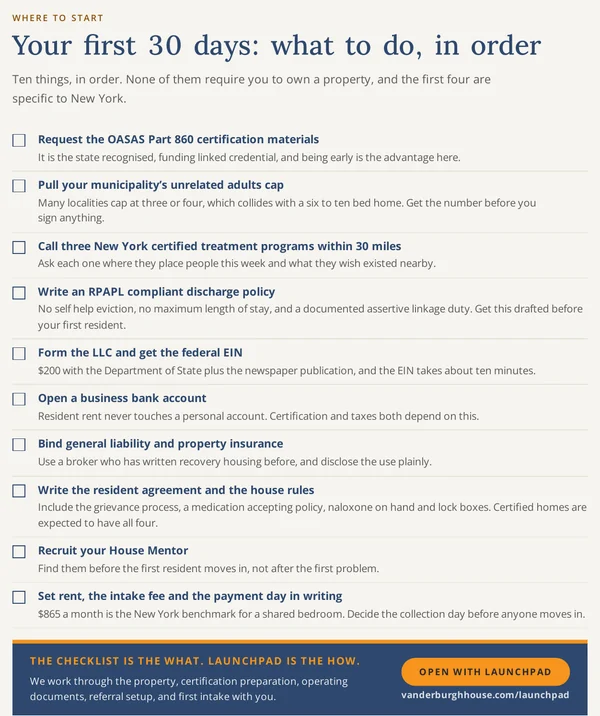
Every step between signing the lease and taking your first resident, in order.
Sober Living Guides Every Operator Needs
These evergreen guides apply in every state and cover what a certification connects to: the standards behind it, the referrals it unlocks, the occupancy it supports, and the coverage a certified home carries.
Frequently Asked Questions About OASAS and NYSARR
Does a sober living home in Buffalo or Syracuse need OASAS certification to open?
No. Part 860 §860.3(b) states that certification is voluntary and is not required for recovery residences to provide housing, and that applies statewide. Certification changes what a home may call itself and what funding it can reach, not whether it may operate.
Can a home in New York City hold both the OASAS certificate and NYSARR certification?
Yes. The two schemes are independent, and one NYSARR-listed operator already runs in New York City. Holding both is the strongest position available to a New York operator today.
Does an Albany-area home certified by NYSARR qualify for opioid settlement money?
Not on that basis. The OASAS recovery residence settlement funding ran through the state certification pathway and was limited to nonprofit applicants, and that round closed on July 31, 2026 with no successor announced as of September 2, 2026. A home positioning for a future round pursues the OASAS certificate.
Which New York certification do Rochester-area referral sources recognize?
Both, unevenly. NYSARR is headquartered in Rochester and several of its certified operators are upstate, so the NARR credential has more local visibility there than in most of the state. Discharge planners working inside the OASAS treatment network work from the state certification pathway instead, so a home courting both kinds of referral wants both certificates.
The Bottom Line on OASAS and NYSARR Certification in New York
New York gives operators a rare thing: a state credential with real legal and funding weight, and a national credential that costs $500 and signals quality anywhere in the country. Sober house certification in New York therefore means two different certificates. OASAS holds the authority, the protected designation, and the money. NYSARR holds the standard, the peer network, and the head start on the policy work Part 860 requires. Most serious New York operators will end up with both, and the order they pursue them in depends on whether their next resident is coming from a state-funded referral or a private one.
If you are weighing which certification fits the home you are building, or you want a second read on where your policies stand against Part 860 and the NARR standard, tell us about your project and we will point you at the right pathway.
Research & Sources
- Foote, H. T. (2026). Vanderburgh Sober Living Operating Climate Index, 2026 Edition. Vanderburgh Sober Living.
- New York State Office of Addiction Services and Supports. (2024). 14 NYCRR Part 860, Recovery Residences.
- New York State Office of Addiction Services and Supports. (2024). Part 860 adopted rule text (PDF).
- New York State Legislature. (n.d.). Mental Hygiene Law §32.05-a, Certified recovery residences.
- New York State Office of Addiction Services and Supports. (2026). Request for Applications SETT-24029, Recovery Residences Funding.
- New York State Office of Addiction Services and Supports. (2026). RFA SETT-24029 questions and answers.
- New York State Office of Addiction Services and Supports. (2025). September 2025 RFA SETT-24029 questions and answers.
- New York State Office of Addiction Services and Supports. (n.d.). Certified Recovery Residences.
- New York State Office of Addiction Services and Supports. (n.d.). Become a Certified Recovery Residence.
- New York State Office of Addiction Services and Supports. (n.d.). About OASAS.
- National Alliance for Recovery Residences. (n.d.). New York State Alliance of Recovery Residences affiliate profile.
- National Alliance for Recovery Residences. (n.d.). Affiliate directory.
- National Alliance for Recovery Residences. (2018). NARR Standard 3.0 and Code of Ethics.
- New York State Alliance of Recovery Residences. (n.d.). How to Join NYSARR.
- New York State Alliance of Recovery Residences. (n.d.). Voluntarily Certified Recovery Residences.
- New York State Alliance of Recovery Residences. (n.d.). Leadership Team.
- New York State Alliance of Recovery Residences. (n.d.). Accomplishments.
- New York State Assembly. (2026). Assembly Bill A3797 (2025-2026).