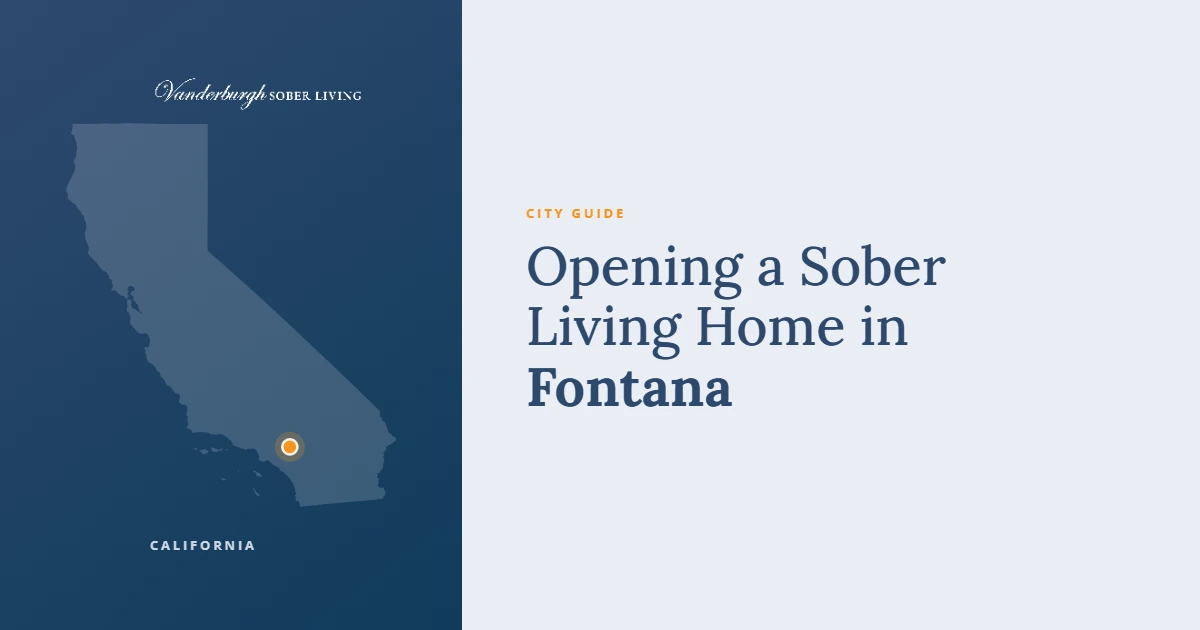
Opening a sober living home in Fontana means working inside three sets of rules at once, and only one of them is a license. California does not license sober living homes, and a house crosses into licensed treatment only if it provides detoxification, individual or group sessions, educational sessions, or treatment planning. Fontana has no sober living ordinance and no spacing rule as of September 17, 2026, though a group-home amendment has been pending before its Planning Commission since June 2025. San Bernardino County is the layer that decides whether beds fill: its Department of Behavioral Health contracted 38,300 recovery residence bed days at an average $64 per bed day through June 2027, in a county that recorded 278 fentanyl-related deaths in 2024 and counted 3,718 people without housing in January 2026.
What follows is specific to Fontana: how Chapter 30 of the municipal code reads a shared house, the pending amendment and what it does and does not change, the city desks that issue what you need, the local lease and purchase anchors, and the agencies that keep beds full. Statewide licensing, the CCAPP certification process, and the full startup and revenue model belong to the California guide, and the shared figures on this page are restated from it rather than recalculated. Where a number is local, it carries its own source at the claim.
Before you read onHow to Open a Sober Living Home in CaliforniaThis post covers one piece of the process. The complete California guide walks through every step, from planning to your first resident.→Watch: How to Start a Sober Living Home in California
The video walks through the statewide picture: where the line sits between housing and treatment, what CCAPP certification asks for, how zoning review works in California cities, and what planning a startup actually involves. Everything below applies those steps to Fontana, San Bernardino County, and the code Fontana actually has on its books.
The California book covers the same ground in print, with the checklists and templates an operator needs on day one.
Is Fontana a Good Place to Open a Sober Living Home?
Yes, on the operating side, with one condition. Fontana pairs the lowest property cost of any large city in the Inland Empire with a county that buys recovery residence beds under contract, which is a better combination than most California markets offer. The condition is that the city has no use category for an unlicensed sober living home, so the household reading has to be built deliberately rather than assumed.
Recovery Housing Demand in San Bernardino County
Residents reach a Fontana home through five channels, and four of them are public. Understanding which one a person came through tells you who is paying, who is following up, and how long the stay is likely to last.
- County behavioral health: The SARC Helpline screens people into a level of care and, where a bed is funded, into a contracted recovery residence. This is the largest single pipeline in San Bernardino County.
- Probation and reentry: Formal probation, post-release community supervision and mandatory supervision covered 10,172 adults on average each month in FY2023-24, and the reentry center that serves them sits on Arrow Boulevard in Fontana.
- Treatment discharge: 19 licensed residential programs in the county discharge people on a rolling basis, according to the state facility dataset. Each discharge planner needs a next address.
- Coordinated entry: The January 2026 point-in-time count found 3,718 people, and 533 of the 1,276 unsheltered adults surveyed met HUD’s substance use definition.
- Hospital emergency and behavioral health: Arrowhead Regional and Kaiser Permanente Fontana both discharge people whose next stop determines whether the admission repeats.
These are the figures a lender asks for in underwriting and a referral partner asks for in a first meeting. Each one is countywide unless the row says otherwise, because the systems that produce residents are organized at the county level.
| Indicator | Fontana figure | Why it matters to an operator |
|---|---|---|
| Fentanyl-related deaths, San Bernardino County | 278 in 2024, down 36% from 436 in 2023 | Deaths fell sharply, but the 2024 figure is still more than forty times the 2016 count. The clinical system that produced those cases is the system that discharges people who need a bed. |
| Drug-induced death rate, San Bernardino County | 26.1 per 100,000 (2023) | The county sits just under the California rate of 27.3, so demand here is a statewide problem at local scale rather than an outlier crisis. |
| Point-in-time homeless count, San Bernardino County | 3,718 people counted in January 2026 | Of 1,276 unsheltered adults surveyed, 533 met HUD’s substance use definition. Coordinated entry is a real intake channel here, not a theoretical one. |
| Licensed and certified treatment facilities in the county | 58 records, 19 of them licensed residential | 19 residential programs discharge people on a rolling basis. Every one of them is a discharge planner who needs somewhere to send a person on a Friday afternoon. |
| Adults under county probation supervision | 10,172 average monthly, FY2023-24 | Formal probation, post-release community supervision and mandatory supervision all generate housing referrals, and Fontana has its own reentry center. |
| County-funded recovery residence bed days | 38,300 bed days contracted at an average $64 per bed day | San Bernardino County buys recovery residence beds directly under contract. That is the single biggest difference between operating here and operating in a county with no public payer. |
VSL’s Operating Climate Index scores California 8 of 10 overall and classifies it as moderately regulated with no mandatory operating license, with Market Strength at 10 of 10 and Legal Climate at 8 of 10 (Foote, 2026). Fontana is part of what produces that Market Strength score: a city of 221,223 people inside a county of 2.2 million, with a public payer buying beds and 19 licensed residential programs discharging into the same market. The Index also scores Return on Capital at 2 of 10, which is the California property market showing up as a capital problem rather than an operating one.
The two halves of California’s Index reading pull in opposite directions, and Fontana is where they meet. Demand and legal climate are strong statewide, while the cost of capital is the worst part of the model, so a market with the county’s lowest median sale price is the place that reading is least painful.
Most people ask whether they are allowed to open a recovery home. The better first question is whether the need and the money are there. This answers both, for your state.
- How many people need a bed, and how few beds exist
- Who actually pays the rent, and which programs are real
- What it costs to open on the purchase path and the lease path
How to Open a Sober House in Fontana: Step-by-Step
The statewide sequence lives in the California guide. This version is ordered for Fontana, where the address question has to be settled before anything else, because the city has no use category for an unlicensed sober living home and the specific plan governing the parcel matters more than the base zoning district. Expect four to seven months from first offer to first resident.
Ten steps, in the order the risk actually arrives.
Step 1. Settle the address before anything else
Start on the Fontana Zoning Viewer, which takes a street address and returns the zoning district. Then check the land use and specific plan layer, because most residential land in Fontana sits inside one of 28 adopted specific plans under an R-PC designation, and the specific plan’s use table is what a planner reads first. Confirm the parcel is inside city limits on the LAFCO boundary map: Bloomington and parts of the sphere of influence are unincorporated, where the county’s own permit regime applies instead.
Then look at the block. An existing recovery home nearby is not a legal obstacle inside Fontana, because the city has adopted no spacing rule, but it is exactly the fact pattern that produced Municipal Code Amendment 25-0003, and the amendment is still live. Two facilities on one block would be over the line one street away in unincorporated county territory.
California guideCalifornia Zoning, Fair Housing, and Land Use Laws for Sober LivingWhere sober homes can operate in California and the legal protections that apply.→Step 2. Form the entity and register the business
The entity signs the lease or holds the deed, not you. Articles of Organization cost $70 and the initial Statement of Information $20 with the Secretary of State, and the $800 minimum franchise tax is due in year one, for $890 before anything else. Get the EIN and open the operating account before the first resident pays anything.
Fontana requires a business license, issued by the Business License Division at 8353 Sierra Avenue. It runs a $35 application fee plus a $4 state fee, with a services-schedule tax starting at $25 for gross receipts under $25,000, and it renews annually from the issue date.
California guideHow to Form a Legal Entity for a Sober Living Business in CaliforniaLLC, nonprofit, or both: how California operators structure the business and the property.→Step 3. Choose a property that passes the household test
Fontana defines family as “one or more individuals occupying a dwelling unit and living in a single household unit,” with no relationship test and no cap. That definition is generous, and the way to stay inside it is to run the house as one household rather than as rented rooms.
- Six or fewer residents plus a live-in house mentor, so the household stays inside the size the state protections and the county standard both use.
- Shared cooking and shared living space, with no lockable bedroom doors and no separate kitchens, because a house that operates as separate units reads as a boarding home rather than a family.
- One parking space per bedroom on site, which is what the county requires next door and what a Fontana neighbor complaint will measure you against.
- No sublease, no per-room rental agreement, and one lease or one deed in the entity’s name.
Two numbers set the budget. The FY2027 fair market rent for the Riverside-San Bernardino-Ontario area is $2,771 for three bedrooms and $3,336 for four, effective October 1, 2026, and the San Bernardino County median sale price was $488,280 in July 2026. Both drive the cost table further down this page.
California guideSober Living Startup Costs in CaliforniaEvery one-time cost to open, on the lease path and the purchase path, with the California figures behind each line.→Step 4. Clear fire, building and occupancy before the inspection
Every dwelling in Fontana runs under the 2025 California Residential Code, which took effect January 1, 2026. That means interconnected smoke alarms in every sleeping room, outside each sleeping area and on every story, plus carbon monoxide alarms where there is a fuel-burning appliance, a fireplace or an attached garage. A CCAPP peer inspector will look for the same things plus posted exit routes and a working extinguisher.
The trap is the certificate of occupancy. A converted garage, a bedroom added without a permit, or a prior care-facility use has to be reconciled with Building and Safety, and that is a slow problem to discover after a lease is signed. The fire and building section below carries the citations.
Step 5. Write the governing documents before you open
CCAPP reviews house rules, admission and discharge policies, a grievance process, medication handling, and a resident agreement at application. Writing them after opening means writing them during the first crisis, which is the worst time to decide what your policy is. Add the one most templates skip: a neighbor-relations plan naming who answers a neighbor’s call, what they say, and how fast they call back.
Keep readingHouse Rules in Sober HousesThe rules that keep a recovery home safe, structured, and worth living in.→Step 6. Bind insurance on the actual address
Get a quote for the specific property before signing, because insurance is one of the lines the statewide cost model leaves unpriced and carriers price recovery housing unevenly. Ask directly whether the carrier writes sober living, whether the policy covers residents as occupants rather than tenants, and what it says about a house mentor living on site. Bind before move-in, not after.
Step 7. Recruit the live-in house mentor
The house mentor lives in the home, holds the daily routine, and is what makes a NARR Level II home work in practice rather than on paper. Recruit through the Inland Empire AA central office and the Eastern Inland Empire area of NA, both of which cover Fontana. Put the arrangement in writing, move the mentor in before the first resident, and remember the mentor’s bed is unpaid in the revenue model.
Step 8. Apply for CCAPP certification
Certification is voluntary in California law and close to mandatory in practice here, because referral control sits with the county and county and hospital staff check the registry before they send anyone. The process is short; the certification guide carries the detail.
- Request the recovery residence application from CCAPP and submit it with the fee. Applications carry a 30-day processing period.
- Host the site visit. Peer reviewers from other recovery residences inspect the house against the standards, and a canceled or repeated visit carries a $100 fee.
- Maintain compliance and stay listed on the public registry, which is where county and hospital staff look you up.
Step 9. Open the referral doors before you open the house
Publicly funded referrals in San Bernardino County run through the Department of Behavioral Health screening line, and discharge planners send people to homes they have already met. Call the partners in the table below while the house is still being set up, invite three of them to tour it, and get listed on the CCAPP registry. Those weeks are far cheaper before the mortgage starts than after.
Step 10. Open and hold occupancy
The California reference model breaks even at 39% occupancy, about five of fourteen beds, and Fontana’s lower property cost pulls that to roughly 30% (estimated). The first quarter is for building the referral habit, not for filling every bed, so admit at a pace the house can absorb. Hold a weekly house meeting, track occupancy daily, and send referral partners a short monthly note.
Keep readingHow Sober Houses Fill Beds and Stay FullProven occupancy strategies from established recovery housing operators.→The phases below overlap in practice, and the estimate assumes a property that needs no permit corrections.
| Phase | Weeks (estimated) | What gets done |
|---|---|---|
| Zoning and address diligence | 1 to 3 | Confirm the parcel is inside Fontana city limits, check the zoning district and the governing specific plan, and read the pending group-home amendment file. |
| Entity, registration and banking | 2 to 4 | File the Articles of Organization, obtain the EIN, open the operating account, and apply for the Fontana business license. |
| Property, lease or purchase, and setup | 6 to 14 | Secure the house, resolve any certificate of occupancy questions, furnish it, and install alarms. |
| Documents, insurance and the house mentor | 3 to 6 | Write the house rules, admission and discharge policies, and neighbor-relations plan; bind insurance; recruit and move in the house mentor. |
| Certification and referral outreach | 8 to 16 | Apply to CCAPP, host the peer inspection, and meet the county and hospital discharge planners before the first bed is filled. |
Timelines are estimated. What adds months in Fontana is almost always the property: an unpermitted bedroom or a converted garage that has to be reconciled with Building and Safety, or a parcel that turns out to sit in an unincorporated pocket where a county permit applies.
Best Neighborhoods for a Sober Living Home in Fontana
A workable Fontana address passes four tests, and the order matters, because failing the first one makes the other three irrelevant.
- The household test: The house has to read as one household sharing a kitchen and a living room, because that is the only frame in which Fontana’s definition of family reaches it.
- The transit test: A resident without a car has to be able to reach work and outpatient appointments, which in practice means a short walk to an Omnitrans stop or to the Metrolink station.
- The provider test: The address should sit within a reasonable drive of the treatment programs and county offices that will refer to you, most of which cluster along the Foothill and Baseline corridors and in San Bernardino and Colton.
- The block test: A block with an existing recovery home, an active HOA, or a recent code enforcement history is a block where a complaint arrives faster than a welcome does.
Five areas follow. Housing stock comes from the city’s general plan and the individual specific plans that govern each area, and transit from Omnitrans and Metrolink.
| Area | Housing stock and transit | Siting notes for a sober living home |
|---|---|---|
| Downtown Fontana and the Sierra Avenue corridor | The city’s oldest housing: the General Plan describes central Fontana as ranch-style houses built from the 1960s to the 1980s, set back and facing the street. Transit is the strongest in the city, with Fontana Metrolink Station at 16777 Orange Way and Omnitrans 14, 15, 61, 66 and 82 meeting there. | A resident without a car can hold a job from Pomona to Redlands out of one house. The risk is the Downtown Core Project, which rezones roughly 478 acres into form-based districts and would close a quarter mile of Sierra Avenue. |
| South Fontana and Southridge Village | The Southridge Village Specific Plan covers about 2,640 acres between Jurupa Avenue and the Riverside County line, predominantly single-family with some multifamily, built out from the mid-1980s. Omnitrans 82 touches the northwest edge at Cherry and Jurupa; the rest is a car or a transfer from Metrolink. | The largest inventory of four-bedroom detached homes at the city’s lowest acquisition cost, with schools and two retail centers inside the plan area. The risk is that a specific plan and an HOA sit above the base zoning, and a planner reads the specific plan’s use table first. |
| North Fontana and Sierra Lakes | The Sierra Lakes Specific Plan allows up to 2,035 detached homes on lots from 3,015 square feet to over 6,000, built from the late 1990s, with a 150-acre golf course at the center. Omnitrans 82 is the only fixed route, with a Summit and Lytle Creek timepoint. | The best bedroom count per dollar in a house that still reads as a normal family home, close to Kaiser Permanente Fontana and the I-210 and I-15 interchange. The risk is small lots, tight parking and a single bus line for residents without cars. |
| Citrus Heights North and the Summit corridor | The Citrus Heights North Specific Plan allows up to 1,161 detached and attached homes between Summit Avenue, Citrus Avenue and Lytle Creek Road, and parts are still building out. Omnitrans 82 runs the Summit frontage; everything else is car-dependent. | The newest housing stock in the city, which means the least deferred maintenance to fix before a fire inspection. The risk is active developer and HOA governance and roughly six miles to the Metrolink station. |
| Coyote Canyon and Hunter’s Ridge | The Coyote Canyon Specific Plan covers 283 acres at 2.3 dwellings per acre, detached homes only, on lots of 7,200, 8,500 and 10,000 square feet, with 56.6 acres of open space against I-15. No Omnitrans fixed route serves it. | Large lots and real separation if the model depends on a low-stimulus setting. The risk is the highest cost per bed in Fontana, a hillside overlay on exterior work, and a house that only functions with a van and paid drivers in the budget. |
Beyond the neighborhood, five features decide whether a specific house works anywhere in Fontana.
- Bedroom count: Four or more bedrooms, because the state model runs on 14 beds and the margin collapses at half that.
- Bathrooms: At least two full bathrooms, which is the line between a house that holds occupancy and a house that loses residents to friction.
- Common space: A living room and a dining area large enough for a weekly house meeting with every resident present.
- Parking: Off-street parking for one car per bedroom, which keeps the street frontage from becoming the neighbors’ first complaint.
- Permit history: A clean certificate of occupancy with no converted garage and no unpermitted bedroom addition.
Neighboring cities in the same county run under their own codes and their own numbers, including San Bernardino to the east and Riverside and Moreno Valley across the county line.
- ✓Room-by-room requirements for a Level II home
- ✓Zoning and occupancy questions to ask before you tour
- ✓The red flags that should end a showing early
Who Regulates Sober Living Homes in Fontana?
No single agency regulates a sober living home in Fontana, which is why the question is confusing. The state licenses treatment and protects licensed facilities from local zoning, the city controls zoning, building and business registration, the county controls the money and the referrals outside city limits and inside them, and a private body certifies homes voluntarily.
A sober living home is a shared residence where people in recovery live together under house rules, pay their own way, and receive no clinical services on site. That last clause is the whole of it: the moment the house delivers treatment rather than housing, it becomes a facility the state licenses.
| Layer | Agency | What it controls for a sober living home |
|---|---|---|
| State licensing | California Department of Health Care Services (DHCS) | Licenses treatment, not housing. A home crosses into licensure when it provides detoxification, individual or group sessions, educational sessions, or recovery or treatment planning, per DHCS facility licensing. Operating without a license draws a $2,000 per day civil penalty and a five-year bar on licensure. |
| State residential-use protection | California Legislature | Health and Safety Code 1566.3 and 11834.23 make a licensed facility serving six or fewer people a residential use and its residents a family for zoning purposes. Both reach licensed facilities only. |
| City zoning | Fontana Planning Division | Fontana Municipal Code Table No. 30-430 permits a licensed residential care facility of six or fewer by right in R-E, R-1, R-2, R-3 and R-PC, and requires a conditional use permit at seven or more. An unlicensed sober living home appears nowhere in the table. |
| City building and fire | Fontana Building and Safety Division; Fontana Fire Protection District (FFPD) | The 2025 California Residential Code governs alarms and life safety. The Fontana Fire Protection District is the governing body, and all inspection and prevention work is contracted to the San Bernardino County Fire Department. |
| County land use, outside city limits | San Bernardino County Land Use Services | The county, unlike the city, defines a sober living facility outright and requires an Unlicensed Residential Care Facility Permit. This governs Bloomington and other unincorporated pockets near Fontana, not the city itself. |
| County money and referrals | San Bernardino County Department of Behavioral Health (DBH) | Screens through the SARC Helpline and buys recovery residence beds under contract. This is the layer that decides whether beds fill. |
| Voluntary certification | California Consortium of Addiction Programs and Professionals (CCAPP) | CCAPP is the state’s only NARR affiliate and runs the recovery residence registry. Certification is voluntary in law and close to expected in practice for referral partners. |
The short version for an operator in Fontana:
- State license: Not required, and not available, for a home that provides housing rather than treatment.
- City license: A Fontana business license is required, renewed annually.
- Certification: Voluntary in law. CCAPP certification is what county and hospital staff look for.
- Referrals: Controlled by the county, through the DBH screening line and its contracted recovery residence beds.
Licensing is the easy part here, because there is nothing to apply for. Zoning is the part that actually constrains an address, and it turns on a table that does not list the use you are running.
Fontana Zoning Laws for Sober Living Homes
As of September 17, 2026 Fontana has no sober living ordinance, no spacing rule, and no resident cap aimed at recovery housing. A search of the municipal code, the city ordinance archive, the city website and the council and planning commission records returned nothing sober-living-specific. What Fontana does have is a use table that reaches licensed facilities, a prohibition on everything the table does not list, and a group-home amendment that has been pending since 2025.
How the Fontana Zoning and Development Code Treats a Sober Living Home
Chapter 30 carries categories for licensed facilities and nothing for an unlicensed one. The definitions below are what decide the classification.
- Family: “One or more individuals occupying a dwelling unit and living in a single household unit,” under Fontana Municipal Code Section 30-12. There is no relationship test and no occupant cap in the definition.
- Residential care facility: “A state licensed family home, group care facility or similar facility which provides 24-hour non-medical services,” also at Section 30-12. The word licensed is what excludes a sober living home from the category.
- Community care facilities: Defined at seven or more people and expressly excluding “recovery houses or other similar facilities,” at Section 30-12.
- Residential zones: A licensed residential care facility of six or fewer is permitted by right in R-E, R-1, R-2, R-3 and R-PC, and a facility of seven or more requires a conditional use permit in all five, under Table No. 30-430.
- Prohibited uses: “Any use not specifically permitted by Table No. 30-430 shall be prohibited,” unless the Director of Community Development issues a written similar-use determination, under Section 30-431.
A house of six or fewer residents sharing a kitchen and a living room under one lease is analyzed as a household, and Fontana’s family definition is broad enough to hold it. The exposure comes from Section 30-431: because an unlicensed sober living home is not a listed use, the code’s default is prohibition unless the Director of Community Development issues a written similar-use determination. Ask for that determination in writing rather than relying on a counter conversation.
Get the similar-use determination under Section 30-431 in writing before you sign. A verbal answer at the planning counter is not a defense in a code enforcement case, and the written determination is the document that makes the household reading the city’s position rather than yours.
What the Six-or-Fewer Rule Does and Does Not Do in California
Almost every California operator has heard that six or fewer residents makes a home a residential use that no city can zone out. The rule is real, it is quoted accurately, and it does not cover an unlicensed sober living home.
- Health and Safety Code 1566.3: A residential facility serving six or fewer people “shall be considered a residential use of property,” and its residents and operators “shall be considered a family” for zoning, under the statute.
- Health and Safety Code 11834.23: The same treatment applies to an alcohol or other drug recovery or treatment facility serving six or fewer, under the statute.
- Government Code 65008: A local land use action that denies residence because of a protected characteristic is “null and void,” under the statute.
- Unlicensed homes: Both Health and Safety Code sections reach licensed facilities. A sober living home that provides no licensable service is not licensed, so neither statute reaches it, and the protection has to come from federal disability law instead.
The protection for an unlicensed home comes from federal disability law instead. People in recovery from substance use disorder are protected under the Fair Housing Act and the Americans with Disabilities Act, and the Ninth Circuit has held that an operator may rely on its admissions policies and house rules rather than individualized medical evidence. California also has its own reasonable accommodation route for overcoming single-family zoning.
Keep readingThe Federal Fair Housing Act and Sober Living: Everything You Need to KnowThe federal protections every operator, neighbor, and local official should understand.→Municipal Code Amendment 25-0003 and the Pending Group Home Standards
Fontana initiated Master Case No. 25-0017 and Municipal Code Amendment No. 25-0003 in February 2025, an ordinance amending Chapter 30 “regarding group homes and boardinghouses.” It went to the Planning Commission on April 15, May 6 and June 3, 2025, and on June 3 the commission voted 5-0 to continue the public hearing again.
- Amends Chapter 30 of the Fontana Municipal Code “regarding group homes and boardinghouses,” per the Legistar matter record.
- Was introduced as Master Case No. 25-0017 and Municipal Code Amendment No. 25-0003, and retitled at the second hearing as “establishing standards for group homes.”
- Went to the Planning Commission three times, on April 15, May 6, and June 3, 2025, and was continued each time.
Nothing changed on that date. The amendment has no passed date, no enactment date and no ordinance number, and no council item on group homes or boardinghouses exists in the city’s legislative record as of September 17, 2026. The rules that govern a Fontana sober living home today are the same ones that governed it before the file opened, and the authorities below are what actually constrain the city if it does adopt something.
- City of Edmonds v. Oxford House, Inc., 514 U.S. 725 (1995): A rule about who may live together is a family-composition rule, not a maximum-occupancy rule, and gets no exemption from the Fair Housing Act, per the opinion.
- SoCal Recovery, LLC v. City of Costa Mesa (9th Cir. 2023): An operator does not need individualized medical evidence for each resident to show its residents are people with disabilities, and may rely on admissions policies and house rules, per the opinion.
- Pacific Shores Properties, LLC v. City of Newport Beach, 730 F.3d 1142 (9th Cir. 2013): A facially neutral ordinance passed with discriminatory intent toward recovery homes states a claim, with no comparator required, per the opinion.
- California Department of Housing and Community Development, December 21, 2021: Reviewing Fontana’s housing element, the department flagged the city’s conditional use permit requirement for group homes of seven or more and directed Fontana to “promote approval certainty and objectivity for housing for persons with disabilities,” in its letter.
For an operator today, the file is a watch item rather than an obstacle, and the way to stay clear of it is to stay outside its subject.
- Size the first house at six or fewer residents plus a live-in house mentor, which keeps it outside the conditional use permit row of Table No. 30-430 and outside the amendment’s stated subject.
- Read the pending amendment file before signing anything, and check whether it has moved since the June 2025 continuance.
- Put the disability-status argument in writing before you need it, with the admissions policy and house rules that SoCal Recovery treats as evidence.
- Ask the Planning Division for a written similar-use determination under Section 30-431 rather than relying on a counter conversation.
Unincorporated San Bernardino County: A Stricter Test One Street Away
Bloomington sits between Fontana and Rialto and is entirely unincorporated, and parts of Fontana’s sphere of influence are county territory too. The county’s definitions are stricter than the city’s, and unlike Fontana the county names sober living outright.
- Single housekeeping unit: “The functional equivalent of a traditional family or one household, whose members are an interactive group of persons jointly occupying a single dwelling unit,” under San Bernardino County Development Code Section 810.01.210.
- Sober living facility: “An unlicensed residential care facility with more than two residents who are not living together as a single housekeeping unit,” also at Section 810.01.210. The county names the use outright, where the city does not.
- The permit and the block cap: An unlicensed facility of six or fewer needs an Unlicensed Residential Care Facilities Permit, and Section 84.32.030 allows no more than two such facilities on the same block in a single-residential zone, with one qualified on-site supervisor and one parking space per bedroom. The permit application runs $545.
How your home gets classified, where Fair Housing applies, and what to do if the city says no.
Fontana Fire and Building Code Rules for Sober Living Homes
A Fontana sober living home of six or fewer residents with no treatment services is analyzed as a single-family dwelling, which means the residential code applies rather than an institutional standard. That is the good news. The complication is that no inspector arrives to tell you so, which puts the entire compliance burden on the operator.
- The client-count line: Six or fewer residents with no treatment services keeps the building analyzed as a single-family dwelling. Adding a licensable service changes both the license question and the building classification.
- Certificate of occupancy: A converted garage, an unpermitted bedroom, or a prior care-facility use has to be reconciled with Building and Safety before anyone moves in, and it is the slowest problem to find late.
- The fire department’s scope: The Fontana Fire Protection District is the governing body, and the county fire marshal’s Community Safety Division runs plan review, construction inspection and annual inspections out of the Fontana office at 8353 Sierra Avenue.
Alarms are where first-time operators fall short of both the code and the CCAPP inspection, usually because an older Fontana house has alarms that are not interconnected. Interconnection is the requirement that gets missed and the one a peer inspector checks first.
| Requirement | What the rule says | Authority |
|---|---|---|
| Smoke alarms | Required in every sleeping room, outside each separate sleeping area, and on every story, interconnected so that all sound together. | 2025 California Residential Code R314 |
| Carbon monoxide alarms | Required outside each separate sleeping area in a dwelling with a fuel-burning appliance, a fireplace, or an attached garage. | 2025 California Residential Code R315 |
| Code edition in force | The 2025 California Building Standards Code took effect January 1, 2026 and supersedes the 2022 edition; Fontana adopts it through the building chapter of the municipal code. | Fontana Building and Safety |
| Certificate of occupancy | A converted garage, a permitted-as-storage bedroom or a prior care-facility use has to be reconciled before anyone moves in. Building and Safety, not the fire inspector, resolves it. | Fontana Building and Safety Division, (909) 350-7640 |
| Fire inspection and clearance | Plan review, construction inspection and annual fire inspections are run by the county fire marshal’s Community Safety Division out of the Fontana office at 8353 Sierra Avenue. | San Bernardino County Fire, Community Safety Division |
| Occupancy classification | A house of six or fewer residents with no treatment services is analyzed as a single-family dwelling under the residential code. Adding licensable services moves the building into an institutional classification with a different standard. | DHCS facility licensing |
Nobody inspects a single-family home in Fontana unless something prompts it, which means a complaint, a claim, or a certification visit is when the gap surfaces. Have the alarms, the extinguisher, the exit routes and the certificate of occupancy settled before any of those three happens, and set the resident count with the bedroom and square-footage math rather than by guess.
Alarms, egress, extinguishers, and the documentation an inspector expects on file.
Get the checklist freeNo cost, no obligation. Unsubscribe in one click.How Much Does It Cost to Open a Sober House in Fontana?
The statewide California model prices the lease path at $52,572 to $55,830 and the purchase path at $210,937 on the priced lines. Fontana changes two of those lines and leaves the rest alone. The local anchors are the FY2027 fair market rent for the metro area and the San Bernardino County median sale price, and both point the same direction: this is one of the cheapest places in Southern California to put capital into recovery housing.
| Line item | Fontana figure | Source |
|---|---|---|
| Articles of Organization and initial Statement of Information | $90 | California Secretary of State fee schedule |
| Minimum franchise tax, year one | $800 | Franchise Tax Board |
| Fontana business license, year one | $64 ($35 application, $4 state fee, $25 minimum services tax) | City of Fontana fee schedule and application |
| Lease upfront, two to three months | $5,542 to $8,313 at the three-bedroom rate; $6,672 to $10,008 at the four-bedroom rate | FY2027 fair market rent of $2,771 and $3,336 for the Riverside-San Bernardino-Ontario area, HUD |
| Purchase down payment, 20% (estimated) | $105,468 on an adjusted price of $527,342 | San Bernardino County median sale price of $488,280 in July 2026, C.A.R., with the state model’s 1.08 recovery-housing premium applied |
| Furniture, setup, supplies and linens | $30,154 | Restated from the California startup model at $1,873 and $281 per bed across 14 beds |
| Property insurance, year one | $1,788 | California Department of Insurance homeowners multi-peril average |
| Operating reserve, three months | $17,865 on the purchase path; $13,467 on the lease path | Restated from the California startup model |
| Everything else | Unchanged | Restated from the statewide California startup model rather than repriced here |
Two adjustments turn the statewide model into a Fontana budget.
- Purchase path: The California model prices a 20% down payment at $158,695 against a statewide adjusted value. Fontana’s July 2026 county median sale price of $488,280 puts the same 20% at about $105,468 (estimated) on an adjusted price of $527,342, roughly $53,000 below the statewide figure. General liability insurance, the CCAPP application fee, and any code upgrades are still unpriced.
- Lease path: Far less capital moves. The FY2027 fair market rent for the Riverside-San Bernardino-Ontario area is $2,771 for three bedrooms and $3,336 for four, and that is the number to test a landlord’s quote against before agreeing to a recovery-housing premium.
Local offsets exist here, which is unusual, but none of them is startup money.
- County-contracted recovery residence beds: San Bernardino County contracted 38,300 bed days at an average of $64 per bed day for the period running to June 2027, per the board item. Contracts go to named providers, so this is a revenue channel to pursue, not a grant to apply for.
- Behavioral Health Bridge Housing: The county put $1.3 million of state bridge housing money into reopening an 18-bed recovery residence in San Bernardino, per the county announcement. The money reached an existing operator with a building, not a startup.
- CalAIM community supports: Inland Empire Health Plan offers housing navigation, deposits and tenancy sustaining services, but its provider network is not currently accepting new applications.
None of these is a grant a new operator applies for and receives before opening. The county bed days go to providers already under contract, the bridge housing money reached an existing operator with a building, and the health plan network is closed. Plan the opening on capital you control, and treat county revenue as something to earn in year two.
California guideCalifornia Recovery Housing Funding: Why It Rarely Works the Way Operators ExpectBlock grants, opioid settlement dollars, Medicaid, and county contracts: what reaches a sober living home and what does not.→Is a Sober Living Home Profitable in Fontana?
Yes, and the margin starts better here than the statewide model, on the condition that occupancy holds. The California reference model runs 14 beds at $1,040 per bed, $10,959 in total monthly revenue against $5,955 in operating costs, for $5,004 in net operating income and a 39% breakeven. Fontana changes the two property lines and nothing else.
The score is a statewide reading, and Fontana sharpens both sides of it. Capital costs less here than almost anywhere in Southern California, and the county pays for beds, so the return-on-capital problem is smaller and the revenue side is stronger. The table below restates the California model and scales only the property lines.
| Line | California reference model (14 beds) | Fontana adjustment (estimated) |
|---|---|---|
| Beds | 14 | Unchanged |
| Monthly rent per bed | $1,040 | Unchanged |
| Total monthly revenue | $10,959 | Unchanged |
| Mortgage principal and interest | $4,079 | $2,711 (estimated), on a $421,874 loan against the July 2026 county median sale price |
| Real estate taxes | $496 | $486 (estimated), at the FY2025-26 Fontana rate of roughly 1.106% |
| Property insurance | $149 | Unchanged |
| Electricity, water and sewer, natural gas, internet and TV | $676 | Unchanged |
| Urine drug screens | $128 | Unchanged |
| House supplies | $175 | Unchanged |
| Repairs and maintenance | $150 | Unchanged |
| Administrative and print marketing | $102 | Unchanged |
| Total monthly operating costs | $5,955 | $4,577 (estimated) |
| Net operating income | $5,004 | $6,382 (estimated) |
| Breakeven occupancy | 39% | About 30% (estimated) |
The adjustment holds revenue, per-bed rent and every other operating expense constant and changes only the mortgage and the property tax, using the county median sale price with the state model’s 1.08 recovery-housing premium and 6.66% rate. It is an estimate, not a quote. On those figures the margin moves from $5,004 to roughly $6,382 a month.
- Occupancy: Two empty beds cost $2,080 a month, which is more than the entire mortgage difference between Fontana and the statewide model. Filling beds beats financing them.
- The county referral relationship: A contracted or well-connected home fills from the county screening line. A home that nobody at DBH has met fills from word of mouth, slowly.
- Property tax in a community facilities district: Fontana levies Mello-Roos special taxes in newer tracts on top of the base rate, and the city does not publish typical amounts. Pull the actual tax bill for the specific parcel before you model it.
- Utilities in an inland summer: The California model holds utilities at $676 a month statewide. Fontana summers run hot enough that cooling a full house can push electricity past the statewide average, and it is an operating cost, not a one-time one.
Your property will not match the model, and the fastest way to find out by how much is to run the actual purchase price, rate and tax bill through the numbers yourself.
Will your property pencil out?
Get a custom projection for your California property, then compare it with typical returns.
Get my projectionFree calculator with your property’s numbers.See California profitabilityRealistic revenue, operating costs, and margins in California.How to Get Residents for a Sober Living Home in Fontana
San Bernardino County controls publicly funded referrals, and private pay, courts and hospital discharge fill the rest. Three doors matter most.
- The SARC Helpline, (800) 968-2636: Screens 24 hours a day for substance use disorder and routes people to a level of care and, where the bed is funded, to a contracted recovery residence, per county behavioral health.
- SUDRS Recovery Residences: The county contracts directly with named providers for recovery residence beds, 38,300 bed days at an average $64 per bed day, described as temporary substance-free housing for people transitioning to permanent housing. Prior authorization applies to residential admissions.
- CCAPP certification: California has no mandatory license, so the CCAPP registry is what a discharge planner checks. No San Bernardino County document requires it for contracting, but it is the credential the market reads.
Sixteen organizations follow. Public agencies lead the list because they control the funded referrals, and the nonprofit providers below them are the discharge points that produce the steadiest flow.
| Organization | Type | How residents reach you |
|---|---|---|
| San Bernardino County DBH, Substance Use Disorder and Recovery Services | County agency | The SARC Helpline at (800) 968-2636 screens 24 hours a day and routes people to a level of care and, where funded, to a contracted recovery residence bed. |
| San Bernardino County DBH Access Unit | County agency | General behavioral health intake at (888) 743-1478. People leaving outpatient or residential care are referred out to sober housing from here. |
| Fontana Day Reporting and Reentry Services Center | County probation | A co-located site at 17830 Arrow Boulevard with a dedicated homeless services coordinator who places people on supervision into transitional and sober housing. |
| San Bernardino County Office of Homeless Services | County agency | Runs coordinated entry through 211 and a countywide case coordination process. Assessors refer people in a housing crisis who need an abstinence-based setting. |
| Fontana Homeless Outreach Support Team | City program | A police officer, a probation officer and an outreach worker who place people into housing, rehabilitation, or shelter directly from the street. |
| Arrowhead Regional Medical Center, Behavioral Health | County hospital | Inpatient psychiatric and emergency discharges in Colton. Clinical social work makes the housing hand-off. |
| Kaiser Permanente Fontana Medical Center | Hospital | The chemical dependency recovery program and behavioral health discharge planners at 9961 Sierra Avenue refer locally. |
| VA Loma Linda Healthcare System, homeless veteran care | Federal agency | Veterans needing transitional housing alongside addiction treatment arrive through HCHV and HUD-VASH case managers. |
| San Bernardino County Superior Court, mental health and CARE Act division | Court | Court-supervised participants who need structured housing as a condition of a treatment plan. The Fontana courthouse itself hears civil matters, so criminal referrals originate at other districts. |
| Cedar House Life Change Center | Nonprofit provider | Detoxification, residential and perinatal treatment in Bloomington, five miles away, discharging people who need a next step. |
| Inland Valley Recovery Services | Nonprofit provider | A county-contracted recovery residence provider and treatment agency serving roughly 4,000 people a year across Upland, San Bernardino and Colton. |
| VARP, Inc. | Nonprofit provider | Residential treatment and the operator of Harris House, an 18-bed recovery residence reopened with $1.3 million in state bridge housing funding. |
| Mary’s Mercy Center | Nonprofit provider | Faith-based homeless services and 237 transitional beds in San Bernardino, referring people in recovery who need an abstinence-based setting. |
| San Bernardino County Workforce Development Department | County agency | America’s Job Centers serve justice-involved job seekers, which matters when residents have to work to pay program fees. |
| San Bernardino County Department of Public Health clinics | County agency | Clinic touchpoints at (800) 782-4264 that surface people who need sober housing alongside medical care. |
Beyond the agencies, the recovery fellowships are how a house builds a reputation. The Inland Empire Central Office of Alcoholics Anonymous in Colton answers at (909) 825-4700, and the Eastern Inland Empire Area of Narcotics Anonymous, which names Fontana in its service area, runs a helpline at (909) 370-3568. Residents who walk into meetings are also the people who tell others where a good house is.
If you came here looking for a bed rather than a business plan, the path is different and shorter.
Take the next step
Apply, browse homes, or search the national directory.
Apply onlineGet a call back within 24 hours.View VSL homesSee Chartered recovery homes and find the right fit.Search the national directoryCertified sober houses anywhere in the US.Or call (844) 762-3747, weekdays 8a to 5p.
Common Mistakes When Opening a Sober House in Fontana
These are the errors that show up in Fontana homes that struggle in year one, and each one ties back to something above.
- Assuming the six-or-fewer rule protects an unlicensed house: Health and Safety Code 1566.3 and 11834.23 reach licensed facilities. A Fontana sober living home is not licensed, so the argument has to be built on federal disability law from day one, not discovered during a code enforcement case.
- Buying in an unincorporated pocket without checking: Bloomington and parts of Fontana’s sphere of influence are county territory, where an Unlicensed Residential Care Facilities Permit and a two-per-block cap apply. Confirm the parcel on the LAFCO boundary map before the offer.
- Ignoring the specific plan: Most Fontana residential land sits in one of 28 specific plans under an R-PC designation, so a planner reads the specific plan’s use table before Chapter 30’s. Checking only the base district is checking the wrong document.
- Treating the county contract as guaranteed revenue: Contracted bed days go to named providers under a board-approved award. A new home has no contract, and modeling around $64 a day before one exists is modeling around money that has not arrived.
- Crossing into treatment by accident: Running group sessions, individual sessions, educational sessions or treatment planning turns a house into an unlicensed treatment facility, exposed to a $2,000 per day penalty and a five-year bar on licensure.
- Skipping the neighbors: The pending group-home amendment did not arrive from nowhere. A neighbor-relations plan naming who answers a call and what they say costs nothing and is the cheapest insurance in the budget.
The California book and the Blueprint carry the checklists, templates and worked numbers behind every step on this page.

The book gives you the map to open a home. When you’re ready to launch, certify, and sustain, the Blueprint is the full playbook covering funding, legal, insurance, and operations.
Frequently Asked Questions About Opening a Sober House in Fontana
Do you need a license to open a sober living home in Fontana?
No. California does not license sober living homes, and neither does Fontana. A license becomes necessary only if the house provides detoxification, individual or group sessions, educational sessions, or recovery or treatment planning, which moves it into the category the Department of Health Care Services licenses. Operating a treatment facility without that license carries a $2,000 per day civil penalty and a five-year bar on licensure.
Does Fontana have a sober living ordinance?
Not as of September 17, 2026. A search of the Fontana municipal code, the city ordinance archive, and the council and planning commission records found no adopted sober-living-specific ordinance. One amendment on group homes and boardinghouses, Municipal Code Amendment 25-0003, went to the Planning Commission three times in 2025 and was continued on June 3, 2025 with no council action since.
What zoning allows a sober living home in Fontana?
A licensed residential care facility of six or fewer people is permitted by right in the R-E, R-1, R-2, R-3 and R-PC districts under Table No. 30-430, and seven or more requires a conditional use permit. An unlicensed sober living home is not a listed use, which means Section 30-431 prohibits it unless the Director of Community Development issues a written similar-use determination, and federal disability law is what supports the household reading in the meantime.
How much does it cost to open a sober house in Fontana?
The statewide California model prices the lease path at $52,572 to $55,830 and the purchase path at $210,937. In Fontana the purchase path is cheaper: a 20% down payment works out to roughly $105,468 (estimated) against the county median sale price, about $53,000 below the statewide figure. Entity filings, the franchise tax and the city business license add about $954 in year one.
Who pays for sober living beds in San Bernardino County?
The county does, through the Department of Behavioral Health. Its board contracted 38,300 recovery residence bed days at an average of $64 per bed day for the period running through June 2027. Those contracts go to named providers, so a new operator reaches that money by building a relationship with the county rather than by applying for a grant.
Is a sober living home profitable in Fontana?
It can be, and the margin here starts better than the statewide model because property costs are lower. Holding the California reference model constant and adjusting only the mortgage and the property tax, monthly operating costs fall from $5,955 to roughly $4,577 (estimated) and net operating income rises to about $6,382 (estimated). That is an estimate, not a quote, and occupancy moves it far more than the mortgage does.
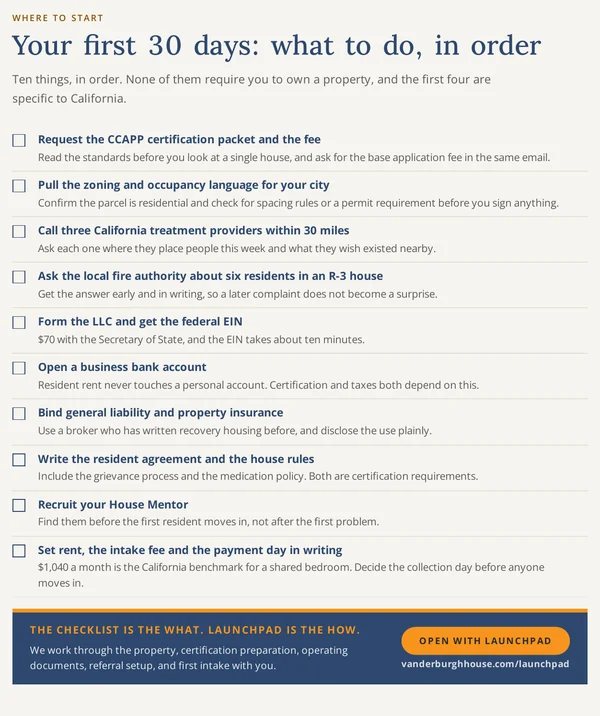
Your Fontana Sober House Startup Checklist
Every item below is covered somewhere on this page, and none of them is optional in Fontana. Work down it in order and the expensive surprises arrive before the money does.
Four guides cover the operating questions that come after the doors open.
How VSL Helps You Open a Sober House in Fontana
Vanderburgh Sober Living charters independently operated recovery homes into a cooperative network, where the operator keeps ownership of the business and gains the brand, the operating standards, and the startup and certification support of the Chartered Operator community. The help lands at the points this page kept returning to: reading a use table that does not list your use, writing the documents a certifying body reviews, and meeting the county before the mortgage starts.
There are two routes in. The self-guided route is the Launchpad program, which walks through the startup in your own time, and the done-with-you route is the Mastery program, which pairs you with coaching through opening and certification.
Start your sober house
Pick the path that fits where you are in the process.
Download the free guidePath to Purposeful Recovery Housing, by Dr. Hunter T. Foote.Explore the Mastery ProgramHands-on startup, certification, and operating support.See how starting with VSL worksThe opportunity, the community, and what a Charter includes.Prefer to talk now? Call (844) 762-3747, weekdays 8a to 5p.
Educational only; not legal, financial, or medical advice. Fees, rents, and rules change, and the Fontana adjustments above are estimates built on the California reference model. Confirm current requirements with Fontana, San Bernardino County, and qualified professionals before you sign or spend.
Research & Sources
- Foote, H. T. (2026). Vanderburgh Sober Living Operating Climate Index, 2026 Edition. Vanderburgh Sober Living. https://www.vanderburghhouse.com/research/operating-climate-index-2026/
- California Association of Realtors. (2026). County sales activity, July 2026. https://www.car.org/marketdata/data/countysalesactivity
- California Department of General Services, Building Standards Commission. (2025). 2025 California Building Standards Code, Title 24. https://www.dgs.ca.gov/BSC/codes
- California Department of Health Care Services. (2026). Facility licensing. https://www.dhcs.ca.gov/providers-partners/facility-licensing/
- California Department of Insurance. (2026). Homeowners insurance data. https://www.insurance.ca.gov/
- California Franchise Tax Board. (2026). Limited liability company filing requirements. https://www.ftb.ca.gov/file/business/types/limited-liability-company/index.html
- California Health and Safety Code section 1566.3. https://leginfo.legislature.ca.gov/faces/codes_displaySection.xhtml?lawCode=HSC§ionNum=1566.3
- California Health and Safety Code section 11834.23. https://leginfo.legislature.ca.gov/faces/codes_displaySection.xhtml?lawCode=HSC§ionNum=11834.23
- California Health and Safety Code section 11834.30. https://leginfo.legislature.ca.gov/faces/codes_displaySection.xhtml?lawCode=HSC§ionNum=11834.30
- California Health and Safety Code section 11834.31. https://leginfo.legislature.ca.gov/faces/codes_displaySection.xhtml?lawCode=HSC§ionNum=11834.31
- California Government Code section 65008. https://leginfo.legislature.ca.gov/faces/codes_displaySection.xhtml?lawCode=GOV§ionNum=65008
- California Secretary of State. (2018). Business entities fee schedule. https://bpd.cdn.sos.ca.gov/pdf/be-fee-schedule-062018.pdf
- California Department of Housing and Community Development. (2021, December 21). Review of the City of Fontana sixth cycle draft housing element. https://www.hcd.ca.gov/community-development/housing-element/docs/sbdFontanadraftOut122121.pdf
- California Health and Human Services Open Data Portal. (2026, September 15). SUD recovery treatment facilities. https://data.chhs.ca.gov/dataset/sud-recovery-treatment-facilities
- California Consortium of Addiction Programs and Professionals. (2026). Recovery residences. https://ccapprecoveryresidences.org/
- California Consortium of Addiction Programs and Professionals. (2026). Start a recovery residence. https://ccapprecoveryresidences.org/start-recovery-residence/
- California Consortium of Addiction Programs and Professionals. (2026). Certified recovery residence registry. https://ccapprecoveryresidences.org/search/
- City of Edmonds v. Oxford House, Inc., 514 U.S. 725 (1995). https://supreme.justia.com/cases/federal/us/514/725/
- City of Fontana. (2026). Building and safety: codes and local amendments. https://www.fontanaca.gov/145/Codes-Local-Amendments
- City of Fontana. (2026). Business license application. https://www.fontanaca.gov/DocumentCenter/View/30602/Business-License-Application-Fillable_distributed-003
- City of Fontana. (2026). Business license fee schedule. https://www.fontanaca.gov/DocumentView.aspx?DID=2601
- City of Fontana. (2026). Business license renewal. https://bl.fontana.org/Apply/GettingStarted/BusinessLicense
- City of Fontana. (2026). Citrus Heights North Specific Plan. https://www.fontanaca.gov/1282/Citrus-Heights-North
- City of Fontana. (2026). Community facilities districts and Mello-Roos. https://www.fontanaca.gov/353/Community-Facilities-DistrictsMello-Roos
- City of Fontana. (2026). Coyote Canyon Specific Plan. https://www.fontanaca.gov/1283/Coyote-Canyon-Specific-Plan
- City of Fontana. (2026). Fontana Fire Protection District. https://www.fontanaca.gov/635/About-the-Fontana-Fire-District
- City of Fontana. (2026). Homeless Outreach Support Team. https://felp.fontanaca.gov/3487/Homeless-Outreach-Support-Team-HOST
- City of Fontana. (2026). Land use, specific plan layer. https://data.fontanaca.gov/maps/FontanaCA::land-use-specific-plan/about
- City of Fontana. (2026). Sierra Lakes Specific Plan. https://www.fontanaca.gov/1294/Sierra-Lakes-Specific-Plan
- City of Fontana. (2026). Southridge Village Specific Plan. https://www.fontanaca.gov/1296/Southridge-Village-Specific-Plan
- City of Fontana. (2026). Specific plans. https://www.fontanaca.gov/853/Specific-Plans
- City of Fontana. (2026). Zoning viewer. https://fontanaca.maps.arcgis.com/apps/webappviewer/index.html?id=ecc67f90c51440eca0d17fd5a6e59c92
- City of Fontana. (2026). 2021-2029 housing element update. https://www.fontanaca.gov/3314/2021-2029-Housing-Element-Update
- City of Fontana. (2025). Downtown Core Project notice of availability. https://fontana.legistar.com/View.ashx?GUID=81BAE6C0-4777-4F9E-963B-67FF31520ADF&ID=12034211&M=F
- City of Fontana. (2015). General Plan update, Chapter 15: Land use, zoning and urban design. https://www.fontanaca.gov/DocumentCenter/View/26754/Chapter-15—Land-Use-Zoning-and-Urban-Design
- City of Fontana. (2025, June 3). Planning Commission regular agenda, Municipal Code Amendment 25-0003. https://fontana.legistar1.com/fontana/meetings/2025/6/2684_A_Planning_Commission_25-06-03_Regular_Agenda.pdf
- City of Fontana. (2025, April 15). Planning Commission regular agenda, Master Case 25-0017. https://fontana.legistar1.com/fontana/meetings/2025/4/2666_A_Planning_Commission_25-04-15_Regular_Agenda.pdf
- City of Fontana. (2025). Legislative matter 25-0107, Municipal Code Amendment 25-0003. https://webapi.legistar.com/v1/fontana/matters/4716
- Fontana Municipal Code, Chapter 30, Section 30-12, list of definitions. https://library.municode.com/ca/fontana/codes/zoning_and_development_code?nodeId=CH30ZODECO_ARTIGEPRDE_DIV4DE_S30-12LIDE
- Fontana Municipal Code, Chapter 30, Article V, residential zoning districts and Table No. 30-430. https://library.municode.com/ca/fontana/codes/zoning_and_development_code?nodeId=CH30ZODECO_ARTVREZODI
- Metrolink. (2026). Fontana station. https://metrolinktrains.com/stations/fontana/
- Metrolink. (2025). Fact sheet, fourth quarter fiscal year 2025. https://metrolinktrains.com/globalassets/about/agency/facts-and-numbers/fact_sheet_q4-fy25.pdf
- Omnitrans. (2026). Routes and schedules. https://omnitrans.org/plan-a-trip/routes-schedules/
- Omnitrans. (2025). Service plan, fiscal year 2026. https://omnitrans.org/wp-content/uploads/2025/06/Service-Plan-FY-2026.pdf
- Pacific Shores Properties, LLC v. City of Newport Beach, 730 F.3d 1142 (9th Cir. 2013). https://cdn.ca9.uscourts.gov/datastore/opinions/2013/09/20/11-55460.pdf
- SoCal Recovery, LLC v. City of Costa Mesa, No. 20-55820 (9th Cir. Jan. 3, 2023). https://cdn.ca9.uscourts.gov/datastore/opinions/2023/01/03/20-55820.pdf
- The Ohio House, LLC v. City of Costa Mesa, No. 22-56181 (9th Cir. Apr. 24, 2025). https://cdn.ca9.uscourts.gov/datastore/opinions/2025/04/24/22-56181.pdf
- San Bernardino County. (2026). Community indicators: substance abuse. https://indicators.sbcounty.gov/wellness/substance-abuse/
- San Bernardino County. (2025, December 9). Board of Supervisors item 31: substance use disorder recovery residence contracts. https://sanbernardino.legistar.com/View.ashx?GUID=37C76A1F-72B0-4CCA-9D63-B665E7467A06&ID=15057465&M=F
- San Bernardino County. (2025, July 3). Recovery residence with a 46-year legacy reopens in San Bernardino. https://main.sbcounty.gov/2025/07/03/new-chapter-begins-recovery-residence-with-46-year-legacy-reopens-in-san-bernardino/
- San Bernardino County Auditor-Controller. (2025). Fiscal year 2025-26 tax rate schedule. https://sanbernardino.legistar.com/View.ashx?M=F&ID=14759131&GUID=C5DD7D92-E836-405F-BC3E-8C2F4F3E8F69
- San Bernardino County Department of Behavioral Health. (2026). Substance use disorder and recovery services. https://wp.sbcounty.gov/dbh/sudrs/
- San Bernardino County Department of Behavioral Health. (2026, September). Substance use disorder and recovery services provider directory. https://wp.sbcounty.gov/dbh/wp-content/uploads/sites/121/September-2026-SUDRS-Provider-Directory-English-NO-highlights.pdf
- San Bernardino County Department of Public Health. (2026). Clinic locations. https://dph.sbcounty.gov/programs/clinics/clinic-locations/
- San Bernardino County Development Code, Section 810.01.210, definitions. https://codelibrary.amlegal.com/codes/sanbernardino/latest/sanberncty_ca/0-0-0-177643
- San Bernardino County Development Code, Section 84.32.030, small unlicensed residential care facility standards. https://codelibrary.amlegal.com/codes/sanbernardino/latest/sanberncty_ca/0-0-0-172815
- San Bernardino County Development Code, Chapter 85.20, unlicensed residential care facilities permit. https://codelibrary.amlegal.com/codes/sanbernardino/latest/sanberncty_ca/0-0-0-173933
- San Bernardino County Land Use Services. (2026). Unlicensed residential care facility permit application. https://lus.sbcounty.gov/wp-content/uploads/sites/48/Applications/Unlicensed-Residential-CareFacility-PermitApplication.pdf
- San Bernardino County Fire Department. (2026). Community safety division. https://sbcfire.org/communitysafety/
- San Bernardino County Homeless Partnership. (2026). 2026 point-in-time count report. https://sbchp.sbcounty.gov/wp-content/uploads/sites/96/2026-SBC-PITC-Report.pdf
- San Bernardino County Homeless Partnership. (2026). Countywide case coordination. https://sbchp.sbcounty.gov/countywide-case-coordination/
- San Bernardino County Probation Department. (2024). Annual report, fiscal year 2023-24. https://probation.sbcounty.gov/wp-content/uploads/sites/128/Annual%20Reports/Probation_Annual_Report_2023-2024_Final_Print.pdf
- San Bernardino County Probation Department. (2026). Adult day reporting and reentry services centers. https://probation.sbcounty.gov/locations/adult-drrcs/
- San Bernardino County Superior Court. (2026). Mental health division. https://sanbernardino.courts.ca.gov/divisions/mental-health
- U.S. Census Bureau. (2026). QuickFacts: Fontana city, California. https://www.census.gov/quickfacts/fact/table/fontanacitycalifornia/PST045224
- U.S. Census Bureau. (2026). QuickFacts: San Bernardino County, California. https://www.census.gov/quickfacts/fact/table/sanbernardinocountycalifornia/PST045225
- U.S. Department of Housing and Urban Development. (2026). Fiscal year 2027 fair market rent schedule. https://www.huduser.gov/portal/datasets/fmr/fmr2027/FY2027_FMR_Schedule.pdf
- LAFCO for San Bernardino County. (2026). GIS web map. https://experience.arcgis.com/experience/53fb44e9d81147fd9d888cb771874042/
- San Bernardino County Assessor. (2026). Property information. https://arc.sbcounty.gov/property-information/
- Inland Empire Health Plan. (2026). Community supports. https://www.providerservices.iehp.org/en/programs/community-supports
- Inland Empire Central Office of Alcoholics Anonymous. (2026). Meetings and services. https://aainlandempire.org/
- Eastern Inland Empire Area of Narcotics Anonymous. (2026). Meetings and helpline. https://www.eietodayna.org/
- Cedar House Life Change Center. (2026). Admissions. https://cedarhouse.org/admissions
- Inland Valley Recovery Services. (2026). Adult services. https://www.inlandvalleyrecovery.org/Adult_Services
- Arrowhead Regional Medical Center. (2026). Behavioral health. https://www.arrowheadregional.org/services/behavioral-health/
- U.S. Department of Veterans Affairs. (2026). VA Loma Linda health care: homeless veteran care. https://www.va.gov/loma-linda-health-care/health-services/homeless-veteran-care