Santa Clarita has nothing on its books about sober living homes, and that absence is where an operator should start. California does not license a peer-based recovery residence: section 11834.01 gives the Department of Health Care Services authority over treatment, not housing, and the department confirms it does not license or certify sober living homes. The city’s code carries no sober living use category, so a home of six or fewer is read as a family under section 1566.3 and permitted by right in every residential zone. The county controls the money, paying for Recovery Bridge Housing beds against the NARR standard. The need is documented: 2,298 accidental overdose deaths countywide in 2025, with this valley the only area where the rate did not fall.
What follows is specific to Santa Clarita: how the code classifies the house, which counter issues which permit, the fact that no business licence exists here, what a bed costs by ZIP code, and which county desks control funded referrals. Statewide rules and the full cost model live in the California guide, restated here against the same primary sources.
Before you read onHow to Open a Sober Living Home in CaliforniaThis post covers one piece of the process. The complete California guide walks through every step, from planning to your first resident.→Watch: How to Start a Sober Living Home in California
The video walks the statewide sequence: the housing-versus-treatment line that decides licensing, what CCAPP certification asks for, zoning review under the six-or-fewer rule, and startup budgeting. Everything below applies those steps to Santa Clarita.
The California book covers the same ground in print, with the checklists and templates an operator needs on day one.
Is Santa Clarita a Good Place to Open a Sober Living Home?
Yes on the operating side. No sober living ordinance, no spacing rule and no business licence removes three of the four friction points operators hit in Southern California. The qualification is capital: the county median sale price ran $946,950 in August 2026.
Recovery Housing Demand in the Santa Clarita Valley
Residents come through four pipelines here, and each behaves differently once a house is open.
- Treatment discharges: 13 licensed residential facilities in Santa Clarita ZIP codes hold 84 beds between them, mostly six-bed homes, and every resident needs somewhere to go next.
- The justice system: The Santa Clarita Courthouse and the county’s drug court, Proposition 36 and diversion tracks route people into treatment with a housing condition attached.
- The homelessness response: Service Planning Area 2 counted 10,299 people experiencing homelessness, 2,502 reporting a substance use disorder, and the Coordinated Entry System is how many reach interim housing.
- The recovery fellowship: Word of mouth through the Santa Clarita Valley Central Office of Alcoholics Anonymous fills beds no agency ever touches.
These are the numbers a lender, landlord or county contract officer asks about first.
| Indicator | Santa Clarita figure | Why it matters to an operator |
|---|---|---|
| Accidental overdose deaths, Los Angeles County (2025) | 2,298, down 6% from 2024, with methamphetamine involved in about 61% and fentanyl in 49% (Department of Public Health) | Falling totals are not falling demand. Stimulant-driven recovery needs longer, more structured housing. |
| Overdose rate, Service Planning Area 2 | The only planning area where the age-adjusted rate did not decrease between 2024 and 2025 | The valley is where county progress stalled, which is the argument to make to a funder. |
| Licensed residential treatment beds, Santa Clarita ZIP codes | 84 beds across 13 licensed facilities, typically six beds each (Department of Health Care Services facility dataset) | Thin treatment capacity for 228,430 people, and none of it recovery housing. Sober homes are unlicensed and appear nowhere in that count. |
| People experiencing homelessness, Service Planning Area 2 | 10,299, of whom 2,502 reported a substance use disorder in the 2026 count | The population county-funded programs exist to house, and the pool a Recovery Bridge Housing contract draws from. |
| People moved from jail into county housing | 7,335 placed since 2016, with 3,034 active as of August 2026 through the Office of Diversion and Reentry | One county program runs a pipeline larger than most private referral networks, and it contracts with providers. |
VSL’s Operating Climate Index rates California 8 out of 10 on its composite Operating Climate Score, fourth of the 50 states, with a Market Strength score of 10 and no mandatory operating licence (Foote, 2026). Santa Clarita shows what that rests on: documented demand, a county that pays, a city that adds nothing.
The silence is an advantage while it lasts. An operator who opens quietly, stays full and keeps neighbors comfortable is why Santa Clarita has never written an ordinance.
Most people ask whether they are allowed to open a recovery home. The better first question is whether the need and the money are there. This answers both, for your state.
- How many people need a bed, and how few beds exist
- Who actually pays the rent, and which programs are real
- What it costs to open on the purchase path and the lease path
How to Open a Sober House in Santa Clarita: Step-by-Step
The statewide sequence lives in the California guide. This order is built for Santa Clarita, where the first question is which code applies, because Stevenson Ranch, Castaic, Val Verde and Agua Dulce sit outside the city under county Title 22.
Ten steps, in the order the risk arrives.
Step 1. Confirm Which Jurisdiction the Address Sits In, Then Run the Zoning Check
Enter the address or parcel number into the city’s Mapping Your City lookup for the official zoning. Inside city limits that is a non-urban zone (NU1 to NU5) or an urban residential zone (UR1 to UR5), and UR2 covers most of Saugus, Canyon Country and Valencia. No result means unincorporated county.
No spacing rule or registration applies, so a nearby recovery home changes nothing. Ask the Planning Division at (661) 255-4330 to confirm the zone in writing. A planner’s email is worth more later than a screenshot.
California guideCalifornia Zoning, Fair Housing, and Land Use Laws for Sober LivingWhere sober homes can operate in California and the legal protections that apply.→Step 2. Form the Entity and Discover There Is No City License to Buy
Put the lease or deed in the entity’s name. California charges $70 for Articles of Organization and $20 for the Statement of Information (Secretary of State) plus an $800 annual franchise tax, making $890 the unavoidable year-one cost.
The city adds nothing: its Economic Development Division states that Santa Clarita does not issue or require business licences. Budget zero. Unincorporated parcels fall under county licensing.
California guideHow to Form a Legal Entity for a Sober Living Business in CaliforniaLLC, nonprofit, or both: how California operators structure the business and the property.→Step 3. Match the Property to the Household Test You Will Actually Be Judged On
The city defines a family as “one or more individuals living together as a single housekeeping unit” and never defines that unit. County section 22.14.060 does, requiring joint occupancy, shared responsibilities and a single written lease covering every adult.
- One lease signed by every adult resident, not a stack of room agreements.
- Shared kitchen, laundry and living space, with no locks on bedroom doors.
- Chores, meals and expenses run jointly and documented in the house agreement.
- Residents, not the operator, holding a say in who joins the household.
Two numbers set the budget: the HUD fair market rent for your ZIP code, $4,030 for a three-bedroom in 91321 to $5,650 in 91354 under the FY2027 Small Area schedule, and the county median, $946,950 in August 2026.
California guideSober Living Startup Costs in CaliforniaEvery one-time cost to open, on the lease path and the purchase path, with the California figures behind each line.→Step 4. Settle Fire, Building and Permit History Before the Inspection
The city enforces the 2025 Building and Residential Codes under section 18.01.010 and the 2025 Fire Code under section 22.01.010. A six-bed home stays residential, so the obligations are every house’s: smoke alarms in each sleeping room and carbon monoxide alarms on every story.
The trap is the house. Converted garages and unpermitted bedrooms are common in the valley’s 1960s to 1980s stock, and neither counts to an inspector or insurer. Pull the history through the City Clerk and the Permit Center at (661) 259-2489.
Step 5. Write the Governing Documents Before You Need Them
CCAPP reviews twelve documents against its inspection checklist: house rules, intake, grievance, medication, relapse and discharge policies, and a resident agreement matching the single-lease structure. Add the one templates skip, a neighbor-relations plan naming who answers the phone.
Keep readingHouse Rules in Sober HousesThe rules that keep a recovery home safe, structured, and worth living in.→Step 6. Quote Insurance for the Specific Address
Quote the actual parcel before signing. California’s average homeowners premium reached $1,788 a year by 2023, up 43% since 2019, and the valley’s wildland interface quotes higher. A residence under government contract must carry $1,000,000 per occurrence.
Step 7. Place the Live-In House Mentor
The house mentor lives in and holds the structure, which is what makes a NARR Level II recovery residence work. Recruit through the valley’s meetings, not a job board, and move the mentor in first. That bed is unpaid, and the model below accounts for it.
Step 8. Apply for CCAPP Certification
Voluntary in law, close to mandatory here, because the county anchors Recovery Bridge Housing to the NARR standard and CCAPP is California’s affiliate. An uncertified house operates legally and struggles to reach funded residents.
- Request the application, choose the NARR level matching how the house runs, and sign the code of ethics.
- Assemble the twelve documents and pay the fee, which CCAPP quotes on request and must receive before processing.
- Pass the site visit against the published checklist, then wait the 30-day processing period. A missed visit costs $100, a reinspection $100.
Step 9. Open the Referral Doors Before You Open the House
The county decides who pays, and discharge planners refer to houses they know. List with the Substance Abuse Prevention and Control division, work the contracting path, and invite three partners to tour before opening.
Step 10. Open, Then Hold Occupancy
The California model breaks even at 39% occupancy, five of 14 beds, and Santa Clarita’s property lines push that up. Admit steadily, hold a weekly house meeting, and tell every referral partner monthly how many beds are open.
Keep readingHow Sober Houses Fill Beds and Stay FullProven occupancy strategies from established recovery housing operators.→Four to seven months is realistic, and this is where the time goes.
| Phase | Weeks (estimated) | What gets done |
|---|---|---|
| Jurisdiction and zoning confirmation | 1 to 2 | Property lookup, written confirmation from Planning, and a decision on city versus unincorporated. |
| Entity, banking and insurance | 2 to 4 | Articles of Organization, Statement of Information, EIN, business account, bound policy on the address. |
| Property search and permit due diligence | 4 to 12 | Lease or purchase, permit history pulled, unpermitted work resolved, alarms verified. |
| Documents, furnishing and the house mentor | 3 to 6 | Twelve CCAPP documents written, house furnished to the checklist, mentor moved in. |
| Certification and referral outreach | 6 to 12 | Application filed, site visit scheduled, 30-day processing, first partner tours. |
Timelines are estimated. The variable that stretches them is the property, not the city: at a county median of $946,950 fewer workable houses come up, and an unpermitted bedroom found late sends you back to the permit counter.
Best Neighborhoods for a Sober Living Home in Santa Clarita
A workable address passes four tests here, and geography makes the first decisive, because two areas people call Santa Clarita are not in the city.
- Jurisdiction: Inside city limits the Unified Development Code governs and no sober living rule exists. Stevenson Ranch, Castaic, Val Verde and Agua Dulce run under county Title 22 and a stricter household test.
- Bed count: Three or four bedrooms with permitted egress. About 37% of city units have four or more, clustered in the newest and priciest tracts.
- Transit: Residents without cars need a station or route. Newhall, Santa Clarita and Via Princessa stations sit in the valley, linked by Routes 5, 6 and 12.
- Rental depth: Few rentals means few landlords open to an operator. Newhall runs the highest renter share, Saugus the lowest, which matters more than price.
Six areas are worth a first look, four in the city and two unincorporated, with housing from the American Community Survey by ZIP code and transit from Santa Clarita Transit and Metrolink.
| Area | Housing stock and transit | Siting notes for a sober living home |
|---|---|---|
| Newhall (91321, city) | Oldest stock in the valley, a third pre-1970, 44% detached, highest renter share at about 39%. Newhall station sits in walkable Old Town. | The strongest all-round fit: cheapest entry, deepest rental market, a walkable station. Check the Old Town Newhall Specific Plan boundary, which overlays base zoning. |
| Canyon Country West (91351, city) | Lowest median home value in the city, abundant three-bedroom ranch homes from the 1960s to 1980s. Via Princessa station is in the ZIP. | The cheapest single-family entry, with rail in the ZIP. Three-bedroom dominance caps beds, mobile-home parks are not viable sites, and 1960s houses carry rehabilitation risk. |
| Saugus (91350, city) | The highest share of detached homes of any city ZIP at about 78%, and the largest houses, roughly 46% with four or more bedrooms. The Santa Clarita station sits in the ZIP. | The best bed-count math in the city with a station attached. At about 18% renter-occupied the rental market is the valley’s thinnest, and dense owner-occupied tracts make neighbor relations a day-one job. |
| Stevenson Ranch and Castaic (91381 and 91384, unincorporated) | Large detached homes, the biggest in the region, outside city limits under the county Area Plan. Castaic has no rail and the thinnest bus service. | Attractive stock, a different rulebook: the county household test applies and boarding and rooming uses are barred in R-A, R-1 and R-2. |
Across all of them, the same house features decide it.
- Permitted bedrooms with egress: Three or four bedrooms on the permit record with compliant escape openings. An unpermitted conversion is a bed you cannot fill.
- Bathroom ratio: One bathroom per three residents is the floor. Two in a four-bedroom house prevents a house meeting about the shower.
- Off-street parking and a quiet street: Enough driveway and garage that nobody lines the curb. Nothing draws a complaint in a Santa Clarita tract faster.
The reading does not carry across the county line. Los Angeles runs its own municipal code and its own live regulatory debate, and Palmdale and Lancaster in the Antelope Valley run their own again.
- ✓Room-by-room requirements for a Level II home
- ✓Zoning and occupancy questions to ask before you tour
- ✓The red flags that should end a showing early
Who Regulates Sober Living Homes in Santa Clarita?
No single agency regulates a sober living home here. Four bodies matter: the state, which licenses treatment not housing; the city, which controls zoning and permits; the county, which controls the money; and CCAPP, which certifies.
A sober living home is a shared residence where people in recovery live under house rules and pay rent, with no clinical services on site, which is why it sits outside licensure. Deliver detoxification, counseling or recovery planning and it crosses into what section 11834.02 licenses, the line between treatment and housing every California operator has to hold.
| Layer | Agency | What it controls for a sober living home |
|---|---|---|
| State | California Department of Health Care Services (DHCS) | Licenses treatment under section 11834.01, while section 1505(i) exempts a recovery house providing no care. DHCS does not license or certify sober living homes. |
| State | California Building Standards Commission | Sets the codes the city adopts (Title 24), and section 13143.6 holds fire standards uniform statewide, so no local rule can add to them. |
| City | City of Santa Clarita Planning Division and Building and Safety Division | Zoning under the Unified Development Code and permits under the 2025 codes. The city issues no business licence. |
| County | Los Angeles County Fire Department (LACoFD) | Provides fire protection through the Consolidated Fire Protection District and enforces the county fire code as adopted. Its inspection programs do not reach an unlicensed six-bed home. |
| County | Los Angeles County Department of Public Health, Substance Abuse Prevention and Control (SAPC) | Controls funded placements through Recovery Bridge Housing and provider contracting. Outside city limits, county Title 22 zoning applies. |
| Certifying body | California Consortium of Addiction Programs and Professionals (CCAPP) | Voluntary certification against the NARR standard as California’s affiliate. No enforcement power, considerable practical power, because funded referrals follow it. |
Put plainly, for a house of six or fewer.
- State license: Not required. DHCS licenses treatment, not housing.
- City license: None exists. The city issues no business licences at all.
- Certification: Voluntary in law. CCAPP certification is what funded referrals look for.
- Referrals: County-controlled, and the county is the gatekeeper for recovery housing referrals in California.
Licensing is the easy part here. Zoning takes the work, because Santa Clarita’s code never mentions sober living and an operator has to reason from what it does say.
Santa Clarita Zoning Laws for Sober Living Homes
As of September 2026 the Santa Clarita Unified Development Code contains no sober living ordinance, no recovery residence category, no spacing rule, no resident cap and no registration requirement. What governs instead is its definition of a family, the use categories it carries, and the state statute telling a city how to read a six-person household.
How the Santa Clarita Unified Development Code Treats a Sober Living Home
Classification runs through the definitions the Santa Clarita code does carry and the zones permitting each. Two are traps; the third is where a well-run house lands.
- Family: Section 17.11.020 defines it as “one or more individuals living together as a single housekeeping unit in a single dwelling unit.” The code never defines that unit, leaving the state standard to fill the space.
- Rooming house: Section 17.42.010 covers a dwelling “where three or more rooms are rented individually or separately under separate rental agreements.” Permitted only in UR4 and UR5. Rent by the room and this is the category you chose.
- Community care facility: Also at section 17.42.010, and conditional rather than permitted: a conditional use permit in UR3 to UR5, and not permitted at all in NU1 to NU5, UR1 or UR2, which is most of the valley’s single-family fabric.
- Residential service/care home: The category tied to Health and Safety Code section 1500 et seq., permitted by right in every NU and UR zone. A six-or-fewer household on one lease is read as a family and needs no permit.
One household is analysed as a family here. Rooms rented separately invite the rooming house definition, and delivering services invites the community care facility definition and a permit hearing.
The city’s code has no six-or-fewer category of its own, so in Santa Clarita the protection comes entirely from Health and Safety Code section 1566.3, not from Title 17. Know the statute, because counter staff may not.
What the Six-or-Fewer Rule Does and Does Not Do in California
Operators quote it as a blanket licence to open anywhere. It is narrower, and its edges keep a house out of an argument it would lose.
- Health and Safety Code section 1566.3: Requires a facility serving six or fewer to be “considered a residential use of property,” its residents “considered a family,” and no permit beyond what a family dwelling needs. It is also not a change of occupancy.
- Health and Safety Code section 11834.23: Restates the same protections for a recovery facility serving six or fewer, but sits in the DHCS licensing chapter, so its reach over an unlicensed home is contested.
- Unlicensed homes: Neither statute was written for a purely peer-run house, and the shield in section 11834.23 is framed around licensed facilities. A sober living home relies on being an ordinary household plus federal disability protection.
- Seven or more residents: Protections stop at six. Above that, section 13143.6 brings alarm and sprinkler requirements into play and the community care facility category becomes the live question.
The real protection is federal. People in recovery are protected under the disability provisions of the Fair Housing Act, and a city treating a recovery household differently from any other of the same size is on difficult ground. A reasonable accommodation request is the formal route, and California’s agencies are explicit about how single-family zoning gets overcome.
Keep readingThe Federal Fair Housing Act and Sober Living: Everything You Need to KnowThe federal protections every operator, neighbor, and local official should understand.→The Reasonable Accommodation Ordinance That Fills the Space Where an Ordinance Would Be
With no ordinance to point at, the live instrument is Unified Development Code section 17.23.180, Requests for Reasonable Accommodations. The Housing Element adopted 11 May 2022 reinforced it, committing the city to expedited approvals within two weeks. It is a Class II application turning on three findings.
- That the accommodation is sought by or for a person protected under fair housing law.
- That it is necessary to give that person equal opportunity to use and enjoy the dwelling.
- That it will not fundamentally alter the nature of the city’s land use and zoning.
It creates no permit requirement. A household of six or fewer needs no accommodation request, being already permitted by right. The procedure exists for the house that needs more, an extra resident or a parking variance.
- City of Edmonds v. Oxford House, Inc., 514 U.S. 725 (1995): Held that a municipal occupancy limit defining family was not an exempt maximum occupancy restriction under the Fair Housing Act, opening such rules to challenge.
- The Ohio House, LLC v. City of Costa Mesa, No. 22-56181 (9th Cir., amended 24 April 2025): The controlling Ninth Circuit authority on how a California city may regulate sober living homes, and the decision Southern California planning departments are now reading.
- Joint legal alert, 3 June 2026: Housing and Community Development, the Civil Rights Department and the Attorney General reminded California cities of their fair housing obligations toward recovery housing.
For an operator opening in Santa Clarita today the position is good and worth protecting.
- Open at six or fewer on one lease, which keeps you inside the by-right reading with nothing to file at City Hall.
- Get the zone confirmed in writing by the Planning Division before signing, and keep the email.
- Use the section 17.23.180 procedure, not an argument at the counter, if you need more than the by-right position.
Unincorporated Los Angeles County: The Title 22 Household Test
Stevenson Ranch, Castaic, Val Verde and Agua Dulce are not in the city, and the county’s Santa Clarita Valley Area Plan governs them under Title 22, with considerably more demanding definitions.
- Family and single housekeeping unit: Section 22.14.060 requires an interactive group jointly occupying the dwelling, sharing meals, chores and expenses, and, where rented, a single written lease with the household chosen by residents rather than the landlord. It excludes care facilities and boarding houses from family.
- Residential substance use recovery facility: Section 22.14.180 defines it as a DHCS-licensed facility and states the term “does not include sober living facilities.” An unlicensed home falls outside the category and is analysed as a household question.
- Rooming and boarding houses: Prohibited in R-A, R-1 and R-2 under Table 22.18.030-B, allowed only by permit or site plan review in higher-density zones. Here the single written lease is not a best practice, it is the whole case.
How your home gets classified, where Fair Housing applies, and what to do if the city says no.
Santa Clarita Fire and Building Code Rules for Sober Living Homes
A six-or-fewer home in a single-family house stays a residential occupancy. It is an R-3 building inspected under the California Residential Code, adopted in its 2025 edition by section 18.01.010.
- The client-count line: Classification changes above six. Section 13143.6 requires an alarm system above six ambulatory persons and sprinklers above six nonambulatory persons, and the Building Code’s R-4 group begins at more than six clients.
- Certificate of occupancy and permit history: A converted garage is not habitable space whatever the listing says. Section 1566.3(f) confirms this is not a change of occupancy, so the only question is whether the house was legally built. Pull the record through the Permit Center.
- The fire department’s scope: The county fire department’s programs cover schools, institutions, defensible space and licensed care facilities, none of which reach an unlicensed six-bed home, and section 13143.6(d) bars an inconsistent local rule.
Alarms are where Santa Clarita’s first-time operators fall short of both the code and the CCAPP checklist, because these are retrofit obligations rarely enforced against a homeowner.
| Requirement | What the rule says | Authority |
|---|---|---|
| Smoke alarms | Required in each sleeping room, outside each sleeping area and on every story, and a permit for alterations over $1,000 is not signed off until listed alarms are in place. | Health and Safety Code section 13113.7 |
| Carbon monoxide alarms | Required outside each sleeping area and on every story where there is a fuel-burning appliance, fireplace or attached garage, retroactively for single-family homes since 1 July 2011. | Health and Safety Code section 17926 |
| Fire sprinklers | Required in dwellings built since 1 January 2011, and not for alterations to an existing dwelling that has none. Creating a new dwelling unit does trigger it. | California Residential Code, per the Office of the State Fire Marshal |
| Emergency escape openings | Every sleeping room needs 5.7 square feet net clear with a sill no more than 44 inches above the floor. This is the line unpermitted conversions fail. | California Residential Code, Chapter 3 |
| Adopted code edition | The 2025 codes apply to permit applications received on or after 1 January 2026; earlier submittals stay on the 2022 codes. | City of Santa Clarita Building and Safety and Municipal Code section 22.01.010 |
Nobody will come and check. Nothing in Santa Clarita prompts an inspection of a six-bed house, so the first party to audit it will be CCAPP at the site visit or an insurer after an incident. Buy listed alarms and treat the CCAPP checklist as the standard.
Alarms, egress, extinguishers, and the documentation an inspector expects on file.
Get the checklist freeNo cost, no obligation. Unsubscribe in one click.How Much Does It Cost to Open a Sober House in Santa Clarita?
California’s priced startup range is the floor: about $52,600 to $55,800 leasing and roughly $210,900 buying, for the 14-bed reference home, built on Census data, a Freddie Mac 30-year rate of 6.66% and MERIC scaling. Two lines change here.
| Line item | Santa Clarita figure | Source |
|---|---|---|
| Lease anchor, three-bedroom | $4,030 in 91321 (Newhall) to $5,650 in 91354 (Valencia North), against a metro-wide fair market rent of $3,760 | HUD FY2027 Small Area Fair Market Rents, effective 1 October 2026 |
| Purchase anchor | $946,950 county median sale price, August 2026 | California Association of Realtors |
| Down payment at 20% | $189,390 (estimated), against $158,695 in the statewide model | Derived from the C.A.R. county median at the model’s 20% down assumption |
| Entity, first-year state cost | $890: $70 Articles of Organization, $20 Statement of Information, $800 franchise tax | California Secretary of State and Franchise Tax Board |
| City business licence | $0. Santa Clarita issues none | City of Santa Clarita Economic Development Division |
Two adjustments turn the statewide budget into a Santa Clarita one, and neither touches the operating side.
- Purchase path: The down payment rises from $158,695 to $189,390 on the county median, taking the priced purchase subtotal to roughly $241,600 (estimated). Closing costs, renovation and unpermitted work sit outside it, as they do statewide.
- Lease path: It moves far less. Two to three months up front at a mid-valley three-bedroom rent of about $4,360 runs $8,720 to $13,080 against the model’s $6,516 to $9,774, taking the lease path to roughly $54,800 to $59,100 (estimated).
Local offsets exist, and none arrives before you open.
- Recovery Bridge Housing: The county pays for the bed, not the resident, once the person is in treatment and the house is on the network. It is revenue, not startup capital, and contracting runs months.
- Measure H mini-grants: The city administers a Measure H allocation as mini-grants of up to $25,000 to valley homeless service providers. Competitive, service-focused, never a startup fund.
- No city fee to offset: The largest local saving never appears as a grant: no business licence, no registration, no conditional use permit, no application fee.
None of it is money to plan an opening around. The county pays after you are certified, contracted and occupied. Fund the opening from capital you control.
California guideCalifornia Recovery Housing Funding: Why It Rarely Works the Way Operators ExpectBlock grants, opioid settlement dollars, Medicaid, and county contracts: what reaches a sober living home and what does not.→Is a Sober Living Home Profitable in Santa Clarita?
Yes if you lease, and hard if you buy at the county median. The California model runs a 14-bed home at $10,959 monthly revenue against $5,955 in operating costs, for $5,004 net operating income and breakeven at 39% occupancy.
The valley sharpens both sides. Demand is real and county-funded, and a median sale price of $946,950 sits well above the statewide basis the model was built on.
| Line | California reference model (14 beds) | Santa Clarita adjustment (estimated) |
|---|---|---|
| Total monthly revenue | $10,959 | Unchanged |
| Mortgage principal and interest | $4,079 | $4,868 (estimated), on a $757,560 loan at the model’s 6.66% rate after 20% down on the county median |
| Property taxes | $496 | $789 (estimated), at the Proposition 13 base rate of 1% on the county median, before voter-approved debt and direct assessments |
| All other operating expenses | $1,380 | Unchanged |
| Total monthly operating costs | $5,955 | $7,037 (estimated) |
| Net operating income | $5,004 | $3,922 (estimated) |
| Breakeven occupancy | 39%, about five of 14 beds | About 48% (estimated), roughly seven of 14 beds |
| Net margin | 45.7% | About 36% (estimated) |
Revenue, per-bed rent and every operating line other than the two property lines are held as the statewide model sets them. What changes in Santa Clarita is the cost of owning the building: buying at the county median drops the margin to roughly 36% and lifts breakeven to about seven beds.
- Occupancy, not price: Every empty bed costs about $1,040 a month. Two chronic vacancies wipe out more margin than the whole property tax line.
- The house mentor bed: One bed is unpaid by design in a Level II home, a larger share of capacity in a smaller house, which is why three-bedroom stock is cheaper to buy and harder to run.
- County referral flow: A contracted house filling from Recovery Bridge Housing holds occupancy when private referrals go quiet.
Your property will not be the model’s. Run the numbers on the actual address, bed count and rent before choosing a path.
Will your property pencil out?
Get a custom projection for your California property, then compare it with typical returns.
Get my projectionFree calculator with your property’s numbers.See California profitabilityRealistic revenue, operating costs, and margins in California.How to Get Residents for a Sober Living Home in Santa Clarita
The county controls funded placements; treatment programs, courts and the fellowship fill the rest. Three public doors matter most.
- Substance Abuse Service Helpline, 1-844-804-7500: The county’s 24-hour line screens callers and places them, including into Recovery Bridge Housing. It is the number most families call first.
- Recovery Bridge Housing: The county pays for interim recovery housing at no cost to the resident, who must be in treatment and eligible through Medi-Cal, My Health LA or another county pathway. Providers join through SAPC contracting.
- CCAPP certification: County materials anchor the program to the NARR standard, and CCAPP is the state’s affiliate, which is why certification functions as a referral requirement in California.
Fourteen organizations serving this valley are worth a call before opening, public agencies first because they control funded placements.
| Organization | Type | How residents reach you |
|---|---|---|
| LA County Public Health, Substance Abuse Prevention and Control | County agency | Funds the bed once a resident is in treatment and the house is on the county network. |
| LA County Department of Mental Health, Service Area 2 | County agency | Stabilizes clients through the 24-hour ACCESS line, 1-800-854-7771, then refers out to housing. |
| LA County Office of Diversion and Reentry Housing | County agency | Places people from jail into interim and then supportive housing on a grant of diversion or probation. |
| LA County Probation, Valencia sub-office | County agency | Officers condition release on residence in structured housing, and this is the valley’s desk. |
| Santa Clarita Courthouse, North Valley District | Court | Drug court, Proposition 36 and diversion terms ordering treatment with a housing condition. |
| Henry Mayo Newhall Hospital, Behavioral Health Unit | Hospital | Discharge planners placing patients leaving the valley’s only acute psychiatric unit. |
| Action Family Counseling, Santa Clarita | Treatment provider | Residential and intensive outpatient care on Soledad Canyon Road, discharging into sober living. |
| NCADD San Fernando Valley, Santa Clarita office | Treatment provider | Outpatient treatment and court-related programs on Lyons Avenue, referring clients needing housing. |
| Bridge to Home | Nonprofit provider | The valley’s emergency and interim shelter, with navigation into longer-term placements. |
| VA Greater Los Angeles Healthcare System | Federal agency | Veterans in VA substance use care referred to community recovery housing. |
Do not overlook the fellowship. The SCV Central Office of Alcoholics Anonymous and clubhouses such as Stepping Stones Alano Club move more people into beds by word of mouth than any single agency.
If you need a bed rather than a business plan, the county helpline above is the fastest route.
Take the next step
Apply, browse homes, or search the national directory.
Apply onlineGet a call back within 24 hours.View VSL homesSee Chartered recovery homes and find the right fit.Search the national directoryCertified sober houses anywhere in the US.Or call (844) 762-3747, weekdays 8a to 5p.
Common Mistakes When Opening a Sober House in Santa Clarita
These are the errors that show up in Santa Clarita houses that struggle in year one.
- Assuming the city code applies: Buying in Stevenson Ranch or Castaic and planning against city rules. Those parcels run under the county household test, which turns on a single written lease.
- Budgeting for a business licence: Paying for an application that does not exist. The city issues no business licences, and the only unavoidable filing cost is the state’s $890.
- Trusting the statewide rent figure: Planning on a statewide median when the three-bedroom fair market rent here runs $4,030 to $5,650 by ZIP code. A 40% swing across one valley is a different business plan.
- Counting on county money too early: Modelling county revenue into month one. Certification comes first, contracting runs up to six months after, and the mortgage does not wait.
- Leaving the neighbors to find out: Operating quietly in a Saugus or Valencia North tract where owner-occupancy runs near 80% and parking is the flashpoint. A house with no neighbor-relations plan is how a city without an ordinance starts drafting one.
The California book and the state Blueprint carry the checklists and templates behind every step above.

The book gives you the map to open a home. When you’re ready to launch, certify, and sustain, the Blueprint is the full playbook covering funding, legal, insurance, and operations.
Frequently Asked Questions About Opening a Sober House in Santa Clarita
Do you need a licence to open a sober living home in Santa Clarita?
No. California does not license sober living homes. The Department of Health Care Services licenses alcohol and drug treatment facilities under Health and Safety Code section 11834.01, and states that it does not license or certify sober living homes. Santa Clarita adds nothing: the city issues no business licences and has no registration requirement for recovery housing.
Can a sober living home operate in a single-family neighborhood in Santa Clarita?
Yes. A home of six or fewer residents is treated as a residential use and its residents as a family under Health and Safety Code section 1566.3, so no conditional use permit or zoning clearance is required beyond what any family dwelling needs. Santa Clarita’s Unified Development Code carries no sober living use category and no spacing rule.
How many residents can a Santa Clarita sober living home have?
Six or fewer keeps the house inside the state protections and inside a residential building classification. Above six, state fire standards bring alarm and sprinkler requirements into play, and the city’s community care facility category, which needs a conditional use permit and is not permitted in the NU zones, UR1 or UR2, becomes the live question.
Is CCAPP certification required to open in Santa Clarita?
Not by law. It is close to required in practice, because Los Angeles County anchors its Recovery Bridge Housing program to the NARR standard and CCAPP is California’s NARR affiliate. An uncertified house can operate legally and will have difficulty reaching publicly funded residents.
What does it cost to open a sober living home in Santa Clarita?
The lease path runs roughly $54,800 to $59,100 and the purchase path about $241,600, both estimated, against California reference figures of $52,600 to $55,800 and $210,900. The difference is local property cost: a three-bedroom fair market rent of $4,030 to $5,650 depending on ZIP code, and a county median sale price of $946,950.
How long does it take to open a sober living home in Santa Clarita?
Four to seven months is realistic. Zoning confirmation takes one to two weeks, entity formation and insurance two to four, property search and permit due diligence four to twelve, documents and furnishing three to six, and CCAPP certification six to twelve. The step that stretches the schedule here is almost never the city. It is finding a workable property.
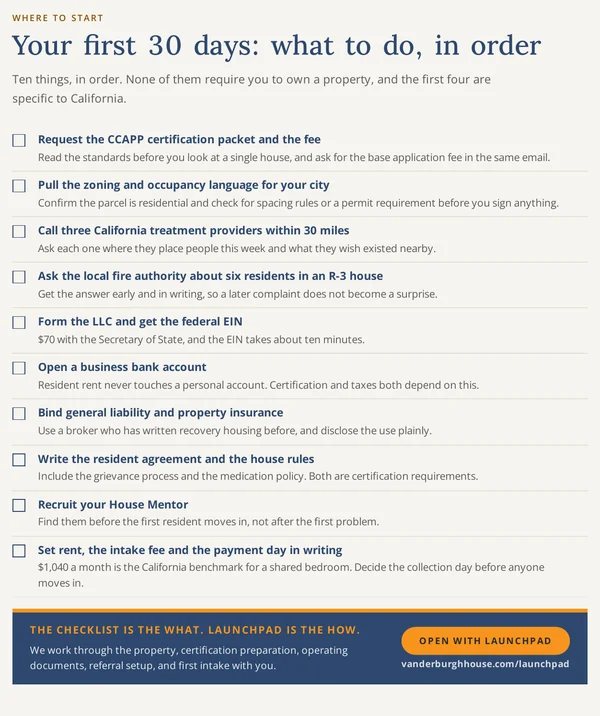
Your Santa Clarita Sober House Startup Checklist
Every item is covered above, and none of them is optional in Santa Clarita.
The guides below cover the operating side every house meets after opening.
How VSL Helps You Open a Sober House in Santa Clarita
Vanderburgh Sober Living charters independently operated recovery homes into a cooperative network, where the operator keeps ownership of the business and gains the brand, the operating standards and the startup and certification support of the Chartered Operator community. That support lands where this page kept returning: structuring the household, writing the documents a certifier will grade, and reaching a county referral pipeline before the mortgage starts.
Two routes in. The Launchpad program is self-paced for someone working the steps above alone. The Mastery program is done with you, with coaching through the property decision, the documents and the certification application.
Start your sober house
Pick the path that fits where you are in the process.
Download the free guidePath to Purposeful Recovery Housing, by Dr. Hunter T. Foote.Explore the Mastery ProgramHands-on startup, certification, and operating support.See how starting with VSL worksThe opportunity, the community, and what a Charter includes.Prefer to talk now? Call (844) 762-3747, weekdays 8a to 5p.
Educational only; not legal, financial, or medical advice. Fees, rents, and rules change, and the Santa Clarita adjustments above are estimates built on the California reference model. Confirm current requirements with Santa Clarita, Los Angeles County, and qualified professionals before you sign or spend.
Research & Sources
- Foote, H. T. (2026). Vanderburgh Sober Living Operating Climate Index, 2026 Edition. Vanderburgh Sober Living. https://www.vanderburghhouse.com/research/operating-climate-index-2026/
- California Health and Safety Code § 11834.01. Licensure of alcoholism or drug abuse recovery or treatment facilities. https://leginfo.legislature.ca.gov/faces/codes_displaySection.xhtml?lawCode=HSC§ionNum=11834.01
- California Department of Health Care Services. (2026). Licensing and certification complaints. https://www.dhcs.ca.gov/individuals/licensing-and-certification-complaints/
- California Health and Safety Code § 1566.3. Residential facilities serving six or fewer persons. https://leginfo.legislature.ca.gov/faces/codes_displaySection.xhtml?lawCode=HSC§ionNum=1566.3
- Los Angeles County Department of Public Health, Substance Abuse Prevention and Control. Recovery Bridge Housing. https://publichealth.lacounty.gov/sapc/providers/special-programs/homeless.htm
- National Alliance for Recovery Residences. (2018). NARR standard, version 3.0. https://narronline.org/wp-content/uploads/2018/11/NARR_Standard_V.3.0_release_11-2018.pdf
- Los Angeles County. (2026, June 25). Drug-related overdose deaths in LA County continue to fall. https://lacounty.gov/2026/06/25/drug-related-overdose-deaths-in-la-county-continue-to-fall/
- Los Angeles County Department of Public Health, Substance Abuse Prevention and Control. (2026). Report on drug overdoses in Los Angeles County. https://publichealth.lacounty.gov/sapc/MDU/SpecialReport/Report-on-Drug-Overdoses-in-Los-Angeles-County.pdf
- California Association of Realtors. (2026, September 16). California existing home sales and price report, August 2026. https://www.car.org/aboutus/mediacenter/newsreleases/2026releases/august2026sales
- U.S. Census Bureau. (2026). QuickFacts: Santa Clarita city, California. https://www.census.gov/quickfacts/fact/table/santaclaritacitycalifornia/PST045224
- California Consortium of Addiction Programs and Professionals. CCAPP Recovery Residences. https://ccapprecoveryresidences.org/
- California Department of Health Care Services. (2026). SUD recovery treatment facilities [Data set]. California Health and Human Services Open Data Portal. https://data.chhs.ca.gov/dataset/sud-recovery-treatment-facilities
- Los Angeles Superior Court. North Valley District, Santa Clarita Courthouse. Los Angeles County locator. https://locator.lacounty.gov/lac/Location/3176795/los-angeles-county-superior-court—north-valley-district—santa-clarita
- Los Angeles County Department of Public Health, Substance Abuse Prevention and Control. Criminal justice programs and initiatives. https://publichealth.lacounty.gov/sapc/providers/programs-and-initiatives/criminal-justice.htm
- Los Angeles Homeless Services Authority. (2026). 2026 Greater Los Angeles Homeless Count: Service Planning Area 2 data summary. https://www.lahsa.org/documents?id=10080-hc26-spa-2-data-summary
- Los Angeles Homeless Services Authority. Accessing the Coordinated Entry System. https://www.lahsa.org/ces/home/accessingces/
- Santa Clarita Valley Central Office of Alcoholics Anonymous. Meetings and services. https://aascv.org/
- Los Angeles County Department of Health Services. (2026). Office of Diversion and Reentry clinical programs dashboard. https://file.lacounty.gov/SDSInter/dhs/1119711_ClinicalProgramsDashboard.pdf
- City of Santa Clarita. Mapping Your City property lookup. https://santaclarita.gov/myc
- Santa Clarita Municipal Code ch. 17.33. Urban residential zones. City of Santa Clarita Unified Development Code. https://ecode360.com/48595305
- City of Santa Clarita Planning Division. Contact us. https://santaclarita.gov/planning/contact-us/
- California Secretary of State. Business entities fee schedule. https://bpd.cdn.sos.ca.gov/pdf/be-fee-schedule-062018.pdf
- California Franchise Tax Board. Limited liability company. https://www.ftb.ca.gov/file/business/types/limited-liability-company/index.html
- City of Santa Clarita Economic Development Division. Frequently asked questions. https://econdev.santaclarita.gov/faq/
- Santa Clarita Municipal Code § 17.11.020. Definitions. City of Santa Clarita Unified Development Code. https://ecode360.com/48594086
- Los Angeles County Code § 22.14.060. Definitions: F. https://library.municode.com/ca/los_angeles_county/codes/code_of_ordinances?nodeId=TIT22PLZO_DIV2DE_CH22.14DE_22.14.060F
- U.S. Department of Housing and Urban Development. (2026). FY2027 Small Area Fair Market Rents [Data set]. https://www.huduser.gov/portal/datasets/fmr/fmr2027/FY27_safmrs.xlsx
- Santa Clarita Municipal Code § 18.01.010. Adoption of the California Building and Residential Codes. https://ecode360.com/48607727
- Santa Clarita Municipal Code § 22.01.010. Adoption of the County of Los Angeles Fire Code. https://ecode360.com/48607939
- California Health and Safety Code § 13113.7. Smoke alarm requirements. https://leginfo.legislature.ca.gov/faces/codes_displaySection.xhtml?lawCode=HSC§ionNum=13113.7
- California Health and Safety Code § 17926. Carbon monoxide device requirements. https://leginfo.legislature.ca.gov/faces/codes_displaySection.xhtml?lawCode=HSC§ionNum=17926
- City of Santa Clarita. City Clerk. https://santaclarita.gov/city-clerk/
- City of Santa Clarita Building and Safety Division. Permit Center. https://santaclarita.gov/building-safety/permit-center/
- California Consortium of Addiction Programs and Professionals. Start a recovery residence. https://ccapprecoveryresidences.org/start-recovery-residence/
- California Consortium of Addiction Programs and Professionals. (2023). Recovery residence inspection checklist. https://ccapprecoveryresidences.org/wp-content/uploads/2023/02/CCAPP-Recovery-Residence-Inspection-Checklist.pdf
- California Department of Insurance. Homeowners premium study. https://www.insurance.ca.gov/0400-news/0200-studies-reports/0250-homeowners-study/
- California Health and Safety Code § 11853.5. Liability insurance for recovery residences under government contract. https://leginfo.legislature.ca.gov/faces/codes_displaySection.xhtml?lawCode=HSC§ionNum=11853.5
- National Alliance for Recovery Residences. Affiliate: California Consortium of Addiction Programs and Professionals. https://narronline.org/affiliate/california-consortium-of-addiction-programs-and-professionals/
- Los Angeles County Department of Public Health, Substance Abuse Prevention and Control. How to become a provider. https://publichealth.lacounty.gov/sapc/providers/how-to-become-a-provider.htm
- Los Angeles County Department of Regional Planning. (2012). Santa Clarita Valley Area Plan. https://planning.lacounty.gov/wp-content/uploads/2022/10/Santa-Clarita-Valley-Area-Plan.pdf
- City of Santa Clarita. (2022). 2021-2029 Housing Element. California Department of Housing and Community Development. https://www.hcd.ca.gov/housing-elements/docs/santa-clarita-6th-adopted051122.pdf
- Metrolink. Stations. https://metrolinktrains.com/rider-info/general-info/stations/
- Santa Clarita Transit. Routes and schedules. https://santaclaritatransit.com/routes-schedules/
- City of Santa Clarita. (2025). Old Town Newhall Specific Plan. https://filecenter.santa-clarita.com/Planning/OldTownNewhallSpecificPlanUpdate/2025%20OTNSP%20FINAL.pdf
- Metrolink. Santa Clarita station. https://metrolinktrains.com/rider-info/general-info/stations/santa-clarita/
- California Health and Safety Code § 11834.02. Definitions. https://leginfo.legislature.ca.gov/faces/codes_displaySection.xhtml?lawCode=HSC§ionNum=11834.02
- California Health and Safety Code § 1505. Exemptions from community care facility licensure. https://leginfo.legislature.ca.gov/faces/codes_displaySection.xhtml?lawCode=HSC§ionNum=1505
- California Building Standards Commission. (2025). California Building Standards Code, Title 24. California Department of General Services. https://www.dgs.ca.gov/BSC/Codes
- California Health and Safety Code § 13143.6. Fire and life safety standards for care facilities. https://leginfo.legislature.ca.gov/faces/codes_displaySection.xhtml?lawCode=HSC§ionNum=13143.6
- Santa Clarita Municipal Code § 17.42.010. Residential use types. City of Santa Clarita Unified Development Code. https://ecode360.com/48595809
- Los Angeles County Fire Department. Fire Prevention Division. https://fire.lacounty.gov/fire-prevention/
- Los Angeles County Code ch. 22.18. Residential zones. https://library.municode.com/ca/los_angeles_county/codes/code_of_ordinances?nodeId=TIT22PLZO_DIV3ZO_CH22.18REZO
- California Health and Safety Code § 11834.23. Local regulation of recovery facilities serving six or fewer. https://leginfo.legislature.ca.gov/faces/codes_displaySection.xhtml?lawCode=HSC§ionNum=11834.23
- Santa Clarita Municipal Code § 17.23.180. Requests for reasonable accommodations. City of Santa Clarita Unified Development Code. https://ecode360.com/48594580
- City of Edmonds v. Oxford House, Inc., 514 U.S. 725 (1995). https://www.law.cornell.edu/supct/html/94-23.ZO.html
- The Ohio House, LLC v. City of Costa Mesa, No. 22-56181 (9th Cir. Apr. 24, 2025). https://cdn.ca9.uscourts.gov/datastore/opinions/2025/04/24/22-56181.pdf
- California Office of the Attorney General. (2026, June 3). Attorney General Bonta and the Newsom Administration issue legal alert reaffirming fair housing protections. https://oag.ca.gov/news/press-releases/attorney-general-bonta-newsom-administration-issue-legal-alert-reaffirming
- Los Angeles County Code § 22.14.180. Definitions: R. https://library.municode.com/ca/los_angeles_county/codes/code_of_ordinances?nodeId=TIT22PLZO_DIV2DE_CH22.14DE_22.14.180R
- Office of the State Fire Marshal. Information bulletin: Residential automatic fire sprinkler systems. California Department of Forestry and Fire Protection. https://34c031f8-c9fd-4018-8c5a-4159cdff6b0d-cdn-endpoint.azureedge.net/-/media/osfm-website/resources/information-bulletins/resautosprinklersbulletin.pdf
- City of Santa Clarita Building and Safety Division. Building codes and design criteria. https://santaclarita.gov/building-safety/building-codes-design-criteria/
- Freddie Mac. (2026). Primary Mortgage Market Survey. https://www.freddiemac.com/pmms
- Missouri Economic Research and Information Center. (2026). Cost of living data series. https://meric.mo.gov/data/cost-living-data-series
- City of Santa Clarita. Homelessness. https://www.santaclarita.gov/residents/homelessness/
- California Constitution, article XIII A, § 1. Maximum ad valorem tax on real property. https://leginfo.legislature.ca.gov/faces/codes_displaySection.xhtml?lawCode=CONS§ionNum=SEC.%201.&article=XIII%20A
- Los Angeles County Department of Mental Health. Service Area 2. https://dmh.lacounty.gov/about/service-areas/service-area-2/
- Los Angeles County Department of Mental Health. ACCESS help line. https://dmh.lacounty.gov/our-services/disaster-services/access-hotline/
- Los Angeles County Department of Health Services. Office of Diversion and Reentry housing. https://dhs.lacounty.gov/office-of-diversion-and-reentry/our-services/office-of-diversion-and-reentry/odr-housing-2/
- Los Angeles County Probation Department. Adult Field Services Bureau, Valencia sub-office. Los Angeles County locator. https://locator.lacounty.gov/lac/Location/3177432/los-angeles-county-probation-department—adult-field-services-bureau—valencia-sub-office
- Henry Mayo Newhall Hospital. Behavioral Health Unit. https://www.henrymayo.com/medical-services/behavioral-health-unit/
- Action Family Counseling. Santa Clarita programs. https://www.actionfamily.org/
- National Council on Alcoholism and Drug Dependence, San Fernando Valley. Programs. https://ncadd-sfv.org/
- Bridge to Home. Santa Clarita Valley emergency and interim shelter. https://btohome.org/
- U.S. Department of Veterans Affairs. VA Greater Los Angeles Healthcare System locations. https://www.va.gov/greater-los-angeles-health-care/locations/
- Stepping Stones Alano Club. Meetings. https://steppingstonesalanoclub.org/