
Opening a sober living home in Fremont means satisfying three layers of rule, and in this city the zoning layer is the one that has already been settled in an operator’s favor. California does not license sober living homes at all: the Department of Health Care Services states that it does not license, certify, or investigate complaints against sober living or transitional living homes. Fremont, uniquely among large Bay Area cities, amended its zoning ordinance in December 2023 to permit residential care facilities by right in every residential district with no size cap, no spacing rule, and no conditional use permit. Alameda County controls the money, screening residents into recovery residences through a published county helpline. Demand is documented: 309 opioid-related overdose deaths countywide in 2023, a rate up 65 percent in a single year, against 20 licensed residential treatment facilities and 659 beds for a county of 1.64 million people.
What follows is specific to Fremont: the code sections that classify the house, the ordinance that removed the permit trigger, the fire sprinkler thresholds that decide whether a renovation pencils, the city departments an operator actually visits, local lease and purchase anchors, and the Alameda County desks that fill beds. Statewide rules, the CCAPP certification process, and the full startup and revenue model belong to the California guide; shared state figures are restated here against local property costs, never recalculated.
Before you read onHow to Open a Sober Living Home in CaliforniaThis post covers one piece of the process. The complete California guide walks through every step, from planning to your first resident.→Watch: How to Start a Sober Living Home in California
The video walks through the statewide sequence: the line between housing and treatment that keeps a home outside DHCS licensure, what CCAPP certification asks for, how zoning review works in California, and how to plan a startup budget. Everything after it on this page applies that sequence to Fremont, where the zoning answer is unusually clean and the building itself is the constraint.
The California book covers the same ground in print, with the checklists and templates an operator needs on day one.
Is Fremont a Good Place to Open a Sober Living Home?
Yes, on the regulatory side, and that is not a close call: Fremont is one of the easiest large California cities in which to site a recovery residence, because the city removed its own permit trigger in 2023 and has never adopted a sober living ordinance. The caveats are financial, not legal. Alameda County median home prices sit above $1.2 million, Fremont’s local fire code pulls a full sprinkler retrofit into renovations that most cities would wave through, and the county funds recovery residences out of block grant dollars rather than Medi-Cal, which caps how many beds it buys.
Recovery Housing Demand in Alameda County
Residents reach a Fremont home through four channels, and only one of them is the county helpline that most first-time operators fixate on.
- Treatment discharge: Alameda County has 20 licensed residential facilities and 659 beds, and every one of them discharges people who need somewhere structured to land. Cronin House in Hayward alone runs 52 beds.
- The justice system: Alameda County Drug Court and Reentry Court both list free sober housing among participant benefits, and the Probation Department buys transitional and sober living beds directly under AB 109.
- The homelessness response: Fremont counted 852 unhoused residents in January 2026, and three coordinated-entry access points sit inside city limits.
- The recovery community: East Bay Intergroup covers 19 cities and roughly 890 weekly AA meetings, including a standing Fremont fellowship. Sponsors and meeting secretaries place more people than any agency does.
These are the figures a lender, a landlord, or a county contract officer asks about before anything else.
| Indicator | Fremont figure | Why it matters to an operator |
|---|---|---|
| Opioid overdose deaths, Alameda County (2023) | 309 deaths, an age-adjusted rate of 21.82 per 100,000, up 65 percent over 2022 | The sharpest one-year rise the county has recorded. It is the figure that opens a conversation with a county contract officer. |
| Overdose hospital burden, Alameda County (2023) | 229 hospitalizations and 764 emergency department visits | Every one of those discharges is a referral decision made by a hospital social worker who needs a bed that answers the phone. |
| Licensed residential treatment capacity, Alameda County | 20 licensed residential facilities, 659 beds | Thin capacity for 1.64 million residents. Sober living absorbs the step-down that residential treatment cannot hold. |
| People counted homeless in Fremont (January 2026) | 852, up from 807 in 2024 while the county total fell 13 percent | Fremont moved the wrong way while the county improved. A Fremont-sited home is filling a gap the county data already flags. |
| Share reporting a substance use disorder, Alameda County count (2024) | 28.5 percent named a substance use disorder as a disabling condition | Roughly one in four people in the county’s homeless system is a candidate for a recovery residence rather than permanent housing. |
| Adults under Alameda County Probation supervision (June 2022) | 5,105 adults, including 401 on post-release community supervision | Probation is a paying referral source. The figure is dated because it is the most recent the department publishes in narrative form. |
| BART service in Fremont | Fremont station and Warm Springs/South Fremont, with average weekday ridership of 2,479 and 1,482 in July 2026, up 14.5 and 19.4 percent year over year | Two stations inside city limits. Residents without a car can hold a job in Oakland, San Jose, or Milpitas from a Fremont address. |
| The public payer for recovery beds | Alameda County Behavioral Health, through its Recovery Residence Programs line | The county, not the state, decides which homes receive publicly funded placements. That relationship is the business. |
VSL’s Operating Climate Index rates California 8 of 10 on its composite Operating Climate Score and classifies the state as moderately regulated, with a Market Strength score of 10 and a Fire and Building Feasibility score of 5 (Foote, 2026, Operating Climate Index). Fremont is a concentrated version of both readings. The market is as strong as California markets get, with two BART stations, a 226,442-person city inside a 1.64 million-person county, and no local ordinance standing in the way. The feasibility drag is equally concentrated: Fremont’s amended fire code reaches further into ordinary renovations than the state code does.
Fremont is the rare California city where zoning is the easy part. The 2023 code amendment removed the conditional use permit that used to attach at seven residents, so the binding constraints here are the purchase price and the sprinkler retrofit thresholds in the local fire code, not the planning counter.
Most people ask whether they are allowed to open a recovery home. The better first question is whether the need and the money are there. This answers both, for your state.
- How many people need a bed, and how few beds exist
- Who actually pays the rent, and which programs are real
- What it costs to open on the purchase path and the lease path
How to Open a Sober House in Fremont: Step-by-Step
The statewide sequence lives in the California guide. This version is ordered for Fremont, and the order differs for one reason: the zoning review that consumes months in cities with a sober living ordinance takes an afternoon here, so the risk moves downstream to the building. Step 1 is fast, and steps 3 and 4 are where Fremont deals fail, because the fire code reaches renovations and the permit history of the bedrooms decides what the fire inspector finds. Budget four to six months from first address to first resident, and see the timeline after the last step.
Ten steps, in the order a Fremont operator meets them.
Step 1. Run the Address Through ZoningCheck Before You Sign Anything
Fremont publishes ZoningCheck, an online tool that reports whether a proposed use is allowed at a chosen address, alongside a parcel-level zoning district viewer. Confirm the parcel sits in R-1, R-2, R-3, or R-G. Table 18.90.080 of the Fremont zoning ordinance permits residential care facilities outright in all four, with no footnote capping the number of residents. If the address turns out to be in unincorporated Alameda County rather than the city, the answer changes: the county makes the same use conditional in its R-1 district.
There is no block-level check to run, because Fremont has none to run. FMC 18.190.465, added by Ordinance 07-2023, states that a residential care facility is a residential use subject only to the restrictions that apply to other dwellings of the same type in the same district. There is no spacing rule, no concentration cap, and no requirement to disclose or count an existing recovery home nearby. Call the Planning Division at 510-494-4440 and get the reading in writing anyway, because a landlord or lender will ask for it.
California guideCalifornia Zoning, Fair Housing, and Land Use Laws for Sober LivingWhere sober homes can operate in California and the legal protections that apply.→Step 2. Form the Entity and Pull the Fremont Business Tax Certificate
The entity signs the lease or holds title, not the operator personally. A California LLC costs $70 to file Articles of Organization and $20 for the initial Statement of Information, and the Franchise Tax Board adds an $800 annual minimum franchise tax due the fifteenth day of the fourth month of the taxable year. A nonprofit files Articles of Incorporation for $30 plus the same $20 statement. Year one runs $890 for an LLC. Get the EIN and open the operating account before a single resident pays rent, so the first deposit is not sitting in a personal account.
Fremont requires a business tax certificate from the Revenue Division before a business commences, home-based businesses and nonprofits included. FMC 5.05.230 sets a $30 annual registration tax, and the city adds a $4 state-mandated fee. Ask the Revenue Division how they classify the operation: FMC 5.05.310 exempts anyone renting or managing four or fewer residential dwelling units from the gross-receipts levy on rental property, and a single house is one dwelling unit, but a home characterized as a service business under FMC 5.05.250 would owe $1.00 per $1,000 of gross receipts instead. Renewal is annual and delinquency runs from 5:00 p.m. on the last business day of February for annual taxpayers.
California guideHow to Form a Legal Entity for a Sober Living Business in CaliforniaLLC, nonprofit, or both: how California operators structure the business and the property.→Step 3. Choose a Property That Passes the Household Test and the Budget
A Fremont house has to read as a household, and the code makes that easier than most. FMC 18.25.1060 defines family to include two or more people who have made social, economic, and psychological commitments to each other and constitute a bona fide single housekeeping unit, then adds expressly that family includes the residents of residential care facilities and group homes for people with disabilities. The practical test is whether the house operates as one household rather than a set of separately rented rooms.
- One lease or one ownership interest covering the whole house, never room-by-room rental agreements.
- One kitchen, shared and used in common, which is what FMC 18.25.980 requires of a dwelling unit.
- Shared household responsibilities, meals, chores, and a weekly house meeting that produces a record.
- No locks on individual bedroom doors, which is the detail that turns a house into a boardinghouse in a code officer’s reading.
- Four or more bedrooms and at least two full bathrooms, because the bed count drives every number in the model below.
Two anchors set the budget. On the lease path, the HUD fair market rent for the Oakland-Fremont HUD Metro FMR Area is $3,592 for a three-bedroom and $4,250 for a four-bedroom, effective October 1, 2026. On the purchase path, the median price of an existing single-family home in Alameda County was $1,285,000 in August 2026, up 1.3 percent year over year. Those two figures drive the cost table and the pro forma further down, and nothing else about the state model changes for Fremont.
California guideSober Living Startup Costs in CaliforniaEvery one-time cost to open, on the lease path and the purchase path, with the California figures behind each line.→Step 4. Settle the Permit History, Then the Fire and Building Review
Fremont adopted the 2025 California Fire Code with local amendments in September 2025, and the amendments matter more here than the base code does. Fremont Fire Code 903.2.8 requires an automatic sprinkler system throughout all buildings with a Group R fire area, deleting the state’s story and unit thresholds. Section 903.2.23 pulls a whole-building sprinkler retrofit into any addition that takes the house past 5,000 square feet or increases floor area by 50 percent. Smoke alarms in every sleeping room and carbon monoxide alarms are California Residential Code R314 and R315 requirements for every dwelling regardless of who lives in it, and CCAPP inspects against them as well.
The occupancy trap in Fremont is inverted, and it catches people. FMC 15.10.110 amends the building code so that for single-family homes the final signed building permit acts as the certificate of occupancy, meaning the city will not hand over a separate certificate for a house. CCAPP asks applicants for written occupancy confirmation from the local building official, so plan to request the permit history and final inspection record from Building and Safety at 510-494-4460 instead. If a previous owner added bedrooms without a permit, that shows up here, and resolving it means a retroactive permit and inspection before anything else proceeds. Settle it before the fire inspection, not after. The fire and building section below carries the citations.
Step 5. Write the Governing Documents CCAPP Will Ask For
CCAPP reviews twelve written policies at application, and writing them after opening means writing them under pressure with residents already in the house. Prepare the mission and vision statement, the resident financial agreement, house rules, the weekly schedule, resident rights, the grievance procedure, the confidentiality policy, the medication policy, the infectious disease control policy, the code of ethics, the house mentor contract, and the good neighbor policy. Add the one most templates skip: a written neighbor-relations plan naming who answers a neighbor’s call, what they say, and how fast they call back. Fremont has no complaint-driven registry to trigger, which means the only thing standing between a neighborhood objection and a city council agenda item is how the house handles the first phone call.
Keep readingHouse Rules in Sober HousesThe rules that keep a recovery home safe, structured, and worth living in.→Step 6. Quote Insurance on the Specific Address
Quote insurance on the specific address before signing, because carrier appetite in the East Bay varies by construction type, roof age, and whether the parcel sits in Fremont’s wildland-urban interface area. The city designated additional very high fire hazard severity zones beyond the state recommendation in July 2025, and a property inside that boundary changes both the premium and the construction standard. Ask the carrier for general liability, property, professional liability, and abuse and molestation coverage, confirm the policy contemplates a recovery residence rather than a single-family rental, and bind before the lease commences or escrow closes. This is one of the lines the state cost model leaves unpriced because it cannot be quoted generically.
Step 7. Recruit and Sign the Live-In House Mentor
The house mentor lives in the home, holds the structure, and is the single feature that makes a NARR Level II residence work rather than a group rental. Recruit locally through East Bay Intergroup meetings, the Fremont fellowship, alumni of Alameda County residential programs, and Narcotics Anonymous in the Mission Peak sub-area covering Fremont, Newark, and Union City. Put the arrangement in writing before move-in: duties, the rent offset, grounds for ending it, and who covers when the mentor travels. Move the mentor in before the first resident so the structure exists on day one, and carry the unpaid mentor bed as a real line, because it reappears as a $1,040 monthly deduction in the pro forma.
Step 8. Apply for CCAPP Certification
Certification is voluntary in California law and close to mandatory in Alameda County practice. The county built its recovery residence standards on the certification requirements of the body that became CCAPP and used those standards as bidding requirements in its procurement, per its own Drug Medi-Cal Organized Delivery System plan. An operator seeking county-funded placements should expect to meet them. The sequence is short here because the California certification guide owns the detail.
- Request the application from CCAPP and assemble the twelve required policies, proof of entity, current liability insurance, written property authority, and the signed house mentor agreement.
- Submit the signed agreements with the non-refundable application fee, which CCAPP quotes on request rather than publishing.
- Clear document review inside CCAPP’s published 30-day processing window and host the on-site peer inspection against its checklist.
- Receive the certificate and keep it current through the annual peer site visit.
Step 9. Open the Referral Doors Before You Open the House
Alameda County Behavioral Health controls publicly funded placements through the Substance Use Access and Referral Helpline on (844) 682-7215, whose published levels of care list recovery residences alongside outpatient, residential, and withdrawal management. Discharge planners, however, do not consult a directory when a bed is needed on a Friday afternoon; they call the three homes whose mentors they already know. Introduce yourself to Cronin House in Hayward, Second Chance in Newark, the Drug Court and Reentry Court coordinators at 510-263-4342, and the Fremont housing resource centers run by Abode and BACS, six to eight weeks before the doors open. Bring the certification status, the house rules, the intake criteria, and a phone number that a human answers.
Step 10. Open, Then Hold Occupancy
The California reference model turns cash-flow positive at 39 percent occupancy, about five of fourteen beds, on the priced purchase stack. In Fremont the property lines push that threshold materially higher, so the first quarter is not a profit period, it is a referral-building period. Fill two or three beds a month rather than chasing a full house in week three, because one bad admission early costs more than an empty bed does. Hold the weekly house meeting from the first week, track occupancy daily, and send a short monthly note to every referral partner naming open beds and who fits them.
Keep readingHow Sober Houses Fill Beds and Stay FullProven occupancy strategies from established recovery housing operators.→Phases overlap. The figures below assume a lease path with no permit history to unwind.
| Phase | Weeks (estimated) | What gets done |
|---|---|---|
| Address and zoning confirmation | Weeks 1–2 | Run ZoningCheck, confirm the parcel is inside city limits and in a residential district, and get the Planning Division reading in writing. |
| Entity, EIN, business tax certificate | Weeks 2–4 | File with the Secretary of State, obtain the EIN, open the account, and register with the Fremont Revenue Division before commencing. |
| Property secured | Weeks 3–12 | Negotiate the lease or close escrow. Purchase adds four to eight weeks and a sprinkler question if renovation is planned. |
| Permit history and life safety | Weeks 6–14 | Pull the permit record from Building and Safety, resolve unpermitted bedrooms, install alarms, and request the fire walkthrough. |
| Documents, insurance, house mentor | Weeks 10–16 | Write the twelve policies and the neighbor-relations plan, bind coverage, and move the mentor in. |
| CCAPP application and inspection | Weeks 14–22 | Submit, clear the 30-day review, and host the peer site visit. |
| Referral outreach and opening | Weeks 18–26 | Meet the county desks and discharge planners, then admit the first residents at two to three a month. |
Timelines are estimated. In Fremont the two things that add months are an unpermitted bedroom in the property’s history, which requires a retroactive permit and inspection, and any renovation that crosses the Fremont Fire Code 903.2.23 threshold and pulls a whole-building sprinkler retrofit into the project.
Best Neighborhoods for a Sober Living Home in Fremont
Fremont was assembled in 1956 from five separate townships, and the city still reads that way. A workable address here passes four tests, and the geography makes two of them harder than they look.
- Household scale: The house needs four or more bedrooms and a shared kitchen, which in Fremont means the 1950s and 1960s tract stock west of Mission Boulevard rather than the newer condominium and townhouse product near the BART stations.
- Transit without a car: Residents who cannot drive need to reach work and meetings. That means a walkable or short-bus distance to Fremont BART or Warm Springs/South Fremont BART.
- Private restrictions: Fremont’s zoning is permissive, but recorded CC&Rs and homeowner associations are not city rules and are not bound by FMC 18.190.465. Pull the title report before the lease.
- Fire hazard designation: The eastern hill edge sits inside the city’s designated very high fire hazard severity zone, which changes the construction standard, the insurance premium, and the renovation path.
Seven districts follow. Housing character comes from the Fremont General Plan and the city’s own district pages, transit from BART and AC Transit, and the fire hazard designation from the ordinance adopting the city’s fire hazard severity zone map.
| Area | Housing stock and transit | Siting notes for a sober living home |
|---|---|---|
| Centerville (94536) | One of the five original townships, designated a Town Center in the General Plan with a walkable historic commercial core. Post-war single-family stock. Served by the Fremont/Centerville Capitol Corridor and ACE station and AC Transit Line 210 and Line 211 to Fremont BART. | Advantage: the deepest supply of ordinary four-bedroom houses at Fremont’s lower price band, with rail and bus without a car. Risk: Town Center commercial frontage brings more foot traffic and more neighbors watching than a cul-de-sac does. |
| Irvington (94538) | Original township and Town Center; mixed post-war and 1960s stock. Currently the only large Fremont district with no BART station, though the Irvington BART station at Washington and Osgood is roughly 90 percent designed with construction starting mid-2026 and opening scheduled for late 2031. AC Transit Line 210 runs Washington Boulevard. | Advantage: today’s prices reflect no BART, and a station opens in 2031. Risk: a five-year construction window on Washington Boulevard, and bus-only transit for residents in the meantime. |
| Glenmoor (94536) | Roughly 1,900 single-story ranch homes on large lots, built across 32 tracts between 1951 and 1966 as a self-contained community with its own shopping center, schools, and parks. Short bus ride to Fremont BART. | Advantage: the single most consistent stock of large single-level houses in the city, which suits residents with mobility limits. Risk: a mandatory homeowners association with CC&Rs recorded against every deed, plus city design guidelines. Fremont’s permissive zoning does not override a private covenant. |
| Warm Springs (94539) | Original township, now the Fremont Innovation District: roughly 850 acres planned for more than 20,000 jobs and 4,000 new housing units, anchored on Warm Springs/South Fremont BART, whose ridership rose 19.4 percent year over year. Line 239 runs Grimmer Boulevard to the station. | Advantage: the strongest job access in the city for residents rebuilding employment, on the fastest-growing station. Risk: heavy industrial adjacency including the Tesla plant and its approved expansion, and new stock skewing to multifamily rather than large houses. |
| Mission San Jose (94539) | Original township on the hill edge. The General Plan holds hillside residential below 8.7 units per net acre with a 20,000-square-foot minimum lot outside established subdivisions, and the district carries its own adopted design guidelines. | Advantage: the largest houses in Fremont. Risk: the highest prices in the city, adopted design guidelines adding a review layer, and the hill edge falling inside the very high fire hazard severity zone, which triggers the wildland-urban interface construction standard on alterations. |
| Niles (94536) | Original township with a historic commercial district. Covered by a Historical Overlay District, under which any exterior alteration, addition, landscaping, lighting, or paving change requires historical architectural review and approval. | Advantage: genuine neighborhood cohesion and a walkable center, which helps residents build a routine. Risk: historical review on every exterior change is a real schedule cost when a fire inspection asks for an exterior alteration. |
| Ardenwood and Northgate (94555) | West of I-880 beside Coyote Hills Regional Park. The Ardenwood district was rezoned in 2016 from a 1980s business park into a modern employment district. Residential stock is 1970s and 1980s tract housing. AC Transit Line 251 connects toward Fremont BART. | Advantage: quiet residential blocks with employment within walking distance and quick Dumbarton access to the Peninsula. Risk: the furthest district from BART, so residents without a car depend entirely on the bus. |
Three house-level features decide it anywhere in Fremont.
- Square footage under 5,000 with no planned addition: Crossing 5,000 square feet, or adding 50 percent to the floor area, triggers a whole-building sprinkler retrofit under Fremont Fire Code 903.2.23. That single threshold decides whether a renovation is a $40,000 project or a $140,000 one.
- A fully permitted bedroom count: Fremont issues no separate certificate of occupancy for a single-family house, so the permit record is the only proof the bedrooms are legal. An unpermitted conversion surfaces at the worst moment.
- Two full bathrooms and off-street parking: FMC 18.190.465 bars the city from demanding parking beyond what other residential uses provide, so parking is a neighbor-relations question rather than a code question, and it is the complaint that reaches a council member first.
Neighboring cities in the same county run under their own codes and reach different answers. Newark, Union City, and Hayward each have their own zoning ordinance, and unincorporated Alameda County requires a conditional use permit for the same use that Fremont permits by right, per its R-1 district regulations. Confirm which jurisdiction the parcel is in before running any zoning check, because an address with a Fremont mailing address is not always inside the city.
- ✓Room-by-room requirements for a Level II home
- ✓Zoning and occupancy questions to ask before you tour
- ✓The red flags that should end a showing early
Who Regulates Sober Living Homes in Fremont?
No single agency regulates sober living homes in Fremont, which is why operators get contradictory answers depending on who they call. The state licenses treatment, not housing; the city controls zoning, building, fire, and business registration; the county controls the money and the referrals; and a private nonprofit, CCAPP, controls certification. The state agency says so itself: DHCS states plainly that it does not license, certify, or investigate complaints against sober living/transitional living homes.
A sober living home is a shared residence where people in recovery live together under house rules, pay their own rent, and receive no treatment on site. That last clause is what keeps the home outside state licensure: DHCS licenses a facility under Health and Safety Code 11834.01 only when it provides one or more treatment services on a 24-hour residential basis. Fremont’s code reaches the same conclusion from the other direction, defining family in FMC 18.25.1060 to include the residents of residential care facilities and group homes for people with disabilities, so the household is the household regardless of who lives in it.
| Layer | Agency | What it controls for a sober living home |
|---|---|---|
| State licensing | California Department of Health Care Services (DHCS) | Licenses residential treatment facilities under Health and Safety Code 11834.01, not sober living homes. Detoxification, individual or group counseling, educational sessions on addiction, recovery or treatment planning, and incidental medical services provided on a 24-hour residential basis are what cross the line. Operating unlicensed after notice costs $2,000 per day plus a five-year bar on applying for a license. |
| State certification (voluntary) | California Consortium of Addiction Programs and Professionals (CCAPP) | The NARR affiliate for California. Certifies recovery residences at NARR Levels I through IV against a published standard. No statute requires it, and Alameda County procurement built its bidding requirements on it. |
| City zoning | Fremont Planning Division | Permits residential care facilities by right in R-1, R-2, R-3, and R-G under Table 18.90.080, with FMC 18.190.465 barring any restriction not applied to other dwellings of the same type. No spacing rule, no occupancy cap, no conditional use permit, no parking surcharge. |
| City building | Fremont Building and Safety Division | Administers the 2025 California Residential Code and the 2025 California Building Code as amended. Under FMC 15.10.110 a single-family home’s final signed building permit acts as its certificate of occupancy, and a change of occupancy requires inspection, application, and fee. |
| City fire | Fremont Fire Department, Fire Prevention Bureau | Enforces the 2025 California Fire Code as amended by FMC Chapter 15.35, including the local sprinkler amendments at 903.2.8, 903.2.23, and 903.2.27. Its published programs cover safety inspections, business self-inspections, vegetation management, and Community Care Licensing clearances for state-licensed facilities. |
| City business registration | Fremont Revenue Division | Requires a business tax certificate before commencing, at $30 per year plus a $4 state-mandated fee, home-based businesses and nonprofits included. |
| County zoning outside city limits | Alameda County Community Development Agency, Planning Department | Makes a medical or residential care facility a conditional use in the county R-1 district, which is stricter than Fremont. This applies only to unincorporated parcels, not to addresses inside Fremont. |
| County funding and referrals | Alameda County Behavioral Health (ACBH) | Runs the Substance Use Access and Referral Helpline on (844) 682-7215, whose levels of care include recovery residences, and funds a Recovery Residence Programs line from block grant rather than Drug Medi-Cal dollars, per its own DMC-ODS plan. |
The short version for an operator.
- State license: Not required, and not available, so long as no treatment service is delivered in the house.
- City license: No use permit and no land-use approval. A $30 business tax certificate plus a $4 state fee, and that is the whole city permission.
- Certification: Voluntary under California law, and effectively expected by Alameda County for publicly funded placements.
- Referrals: Controlled by the county, not the state, through the ACBH helpline, the collaborative courts, and Probation’s contracted bed list.
Zoning is the easy layer in Fremont, which inverts the usual advice. The layers that actually constrain an operator here are the fire code, because the local sprinkler amendments reach ordinary renovations, and the county, because it decides which homes receive funded placements. The next section covers what the city does and does not have on its books, since that is the question every operator arrives with.
Fremont Zoning Laws for Sober Living Homes
Fremont has no sober living ordinance, no spacing requirement, no resident cap, and no registration scheme for recovery residences. A full-text search of all 59 chapters of Title 18 on September 17, 2026 returned no occurrence of “sober,” “recovery residence,” or any equivalent, and the city’s ordinance table shows no sober-living-specific ordinance in the 2021 through 2026 range. What governs instead is the general residential care facility treatment the city adopted in December 2023, which is more permissive than state law requires.
How the Fremont Municipal Code Treats a Sober Living Home
Title 18 carries no sober living use category and no standalone group home definition. The classification therefore runs through three definitions and one use table, all of them favorable.
- Family, FMC 18.25.1060: “Two or more persons living together who have made social, economic, and psychological commitments to each other and who constitute a bona fide single housekeeping unit. ‘Family’ includes the residents of residential care facilities and group homes for people with disabilities.” Added by Ordinance 07-2023.
- Residential care facilities, FMC 18.25.2408: “Any family home, group care facility, or similar facility that is maintained and operated to provide 24-hour nonmedical care of persons in need of personal services, supervision, or assistance essential for sustaining the activities of daily living.” The definition carries no numeric size threshold.
- Boardinghouse or rooming house, FMC 18.25.340: “A dwelling or part thereof where meals and/or lodging are provided for compensation.” This is the category to stay out of, and it is prohibited outright in R-1.
- Permitted zones, Table 18.90.080: Residential care facilities are permitted by right in R-1, R-2, R-3, and R-G, with no footnote capping residents at six. The six-person footnote in the same table applies to rooming and boardinghouses, supportive housing, and transitional housing instead. Table 18.45.060-1 also permits them in C-O, C-N, MX, TC-P, and TC-T.
A Fremont house is analyzed as a household when it runs as one: one lease, one kitchen, shared responsibilities, no room-by-room agreements. It is exposed when it looks like lodging for compensation, which is the boardinghouse definition and is not permitted in R-1 at all. The city has put its own position on the record. The November 14, 2023 staff report for file PLN2023-00213 states that the code amendments “correct, clarify, or include uses such as emergency shelters, residential care facilities, and low-barrier navigation centers as permitted uses in any residential, mixed use, or commercial district that allows for mixed-use residential.” A city writing down that it permits the use is the strongest citation available on this page.
One Fremont rule cuts the other way and operators need to read it before relying on the accommodation process. FMC 18.265.050 states that persons currently using or addicted to controlled substances are not considered disabled and no accommodation shall be granted for them. That tracks federal law, which excludes current illegal drug use from protection, and it does not reach people in recovery who are not currently using. It does mean a Fremont accommodation application should be framed around residents in recovery, never around active use.
What the Six-or-Fewer Rule Does and Does Not Do
Every California operator has heard that a home with six or fewer residents is automatically protected. The rule is real, it is carried by two statutes, and neither statute covers an unlicensed sober living home.
- Health and Safety Code 1566.3: A residential facility serving six or fewer persons is a residential use of property, and its residents and operators are a family for zoning purposes. It applies to facilities licensed by the Department of Social Services.
- Health and Safety Code 11834.23: An alcohol or other drug recovery or treatment facility serving six or fewer persons is a residential use of property. It applies to facilities licensed by DHCS.
- Unlicensed homes: A sober living home delivers no treatment and therefore holds no license, which is exactly why DHCS states it does not license or investigate them. Both statutes turn on licensure, so neither reaches an unlicensed recovery residence directly. They are persuasive by analogy, not controlling.
The protection comes from disability law instead. Residents in recovery from substance use disorder are protected under the federal Fair Housing Act, and California reaches further: Government Code 12955(l) makes it unlawful to discriminate through land use practices, decisions, and authorizations, including denials of use permits; Government Code 12955.8 sets the proof standards for intent and effect claims; and Government Code 65008 voids any city land use action that denies residence because of a characteristic listed in the fair housing statute. An operator refused something should be reading the reasonable accommodation chapter and the fair housing rules together, not the six-or-fewer rule.
Keep readingThe Federal Fair Housing Act and Sober Living: Everything You Need to KnowThe federal protections every operator, neighbor, and local official should understand.→Ordinance 07-2023: The Amendment That Removed Fremont’s Permit Trigger
Fremont’s one relevant regulatory action is generic, and it moved decisively in an operator’s favor. The City Council adopted Ordinance 07-2023 on December 5, 2023 on the consent calendar, after a November 14, 2023 public hearing, under file PLN2023-00213. Its title reads in part: amending various chapters of Fremont Municipal Code Title 17 and Title 18 to comply with state law and implement programs of the city’s 2023-2031 Housing Element. The amendments took effect January 4, 2024. Three things happened.
- It repealed FMC 18.25.2410, the “residential care facilities, special” category, which had been the conditional use permit trigger at seven or more residents.
- It added FMC 18.190.465, which makes a residential care facility a residential use of property subject only to the restrictions and standards that apply to other residential dwellings of the same type in the same zoning district, and permitted and processed in the same manner.
- It amended the family definition in FMC 18.25.1060 to include the residents of residential care facilities and group homes for people with disabilities.
What did not change is as important. Fremont did not adopt a sober living ordinance, a registry, a spacing rule, or a complaint process, and nothing in Ordinance 07-2023 binds an operator to a permit today. The city has amended Title 18 since, most recently by Ordinance 02-2026 on May 5, 2026, without disturbing the residential care facility treatment. Why the permissive model holds up matters, because cities that go the other way get tested in court.
- City of Edmonds v. Oxford House, Inc., 514 U.S. 725 (1995): A zoning code’s family-definition rule capping unrelated occupants is not an exempt maximum occupancy restriction under the Fair Housing Act, so a group recovery home may challenge it.
- Pacific Shores Properties, LLC v. City of Newport Beach, 730 F.3d 1142 (9th Cir. 2013): An ordinance targeting group homes for people recovering from addiction can be intentionally discriminatory under the Fair Housing Act, the ADA, and California’s fair employment and housing law, and plaintiffs need not produce a similarly situated comparator.
- SoCal Recovery, LLC v. City of Costa Mesa, 56 F.4th 802 (9th Cir. 2023): Sober living operators may establish that their residents are handicapped under the Fair Housing Act through aggregate evidence rather than individualized proof.
- The Ohio House, LLC v. City of Costa Mesa, No. 22-56181 (9th Cir. 2024): The Ninth Circuit upheld a city permit and separation-distance ordinance for sober living homes after a jury verdict for the city, the one recent decision running the other way.
- Legal Alert of June 3, 2026 from the California Attorney General, HCD, and the Civil Rights Department: Issued to every California city and county, it warns that localities may not rely on the Ohio House decision to adopt restrictive group-home zoning, states that California courts are the final arbiters of California law, and notes that noncompliance can jeopardize housing element certification. HCD has enforced this before, ordering Encinitas to repeal its 2020 group home ordinance.
What this means for a Fremont operator today, in order.
- Proceed on the current code. There is no permit to apply for and no threshold to stay under, so a seven-bed or ten-bed house in an R-1 needs no city land use approval.
- Save the record. Download the current text of FMC 18.190.465 and Table 18.90.080 and keep them with the lease file, because a landlord, lender, or insurer will ask what authority permits the use.
- Watch the ordinance table rather than the rumor mill. Fremont amends Title 18 roughly annually, and the city’s own ordinance table is where a change would appear first.
- Treat neighbor relations as the risk. With no ordinance to enforce, a complaint has nowhere to go except a council member’s inbox, which is how ordinances get proposed in the first place.
Unincorporated Alameda County: The Conditional Use Test Outside City Limits
Parcels in unincorporated Alameda County, including addresses with Fremont, Hayward, or Castro Valley mailing addresses that sit outside city boundaries, run under the county zoning ordinance instead, and the county is stricter.
- The county R-1 district: Permits one single-family residence, crops, orchards, and gardens, and lists a medical or residential care facility as a conditional use rather than a permitted one.
- The county’s licensed category: The county defines a medical or residential care facility by reference to licensure by the State Department of Social Services, Community Care Licensing Division. An unlicensed sober living home does not sit inside that definition, which leaves its classification to be argued rather than read off the table.
- The practical instruction: Confirm the jurisdiction before anything else. Run the address through ZoningCheck; if the tool reports the parcel is not in the city, the Fremont analysis on this page does not apply and a conditional use permit application is the likely path.
How your home gets classified, where Fair Housing applies, and what to do if the city says no.
Fremont Fire and Building Code Rules for Sober Living Homes
A single-family house run as a sober living home stays in Group R-3 under the California Building Code, which is the classification that keeps it out of institutional territory. Three things decide what Fremont’s building and fire departments ask for.
- The client-count line: CBC 310.4 places residential care and assisted living facilities with six or fewer persons receiving care in Group R-3, and CBC 310.5 moves licensed facilities with more than six and up to sixteen occupants into Group R-4. A sober living home provides no care and holds no license, so it is not a care facility being counted; it remains a dwelling in R-3. Fremont’s own zoning treatment, which sets no resident cap, does not change the building code question.
- Certificate of occupancy: FMC 15.10.110 amends CBC 111 so that for single-family homes, townhomes, and U occupancies the final signed building permit acts as the certificate of occupancy. The converted-house trap is the reverse of most cities: there is no certificate to produce, so the permit record is the only evidence the bedrooms are legal, and CBC 111.1.1 requires inspection, application, and fee before any change of occupancy is certified.
- The fire department’s scope: The Fire Prevention Bureau runs a safety inspection program, business self-inspections, weed and vegetation management, fire safety education, and Community Care Licensing clearances. That last program exists for state-licensed facilities. An unlicensed sober living home falls outside it, which means no inspector is scheduled to visit and the operator has to request the walkthrough.
Alarms are where first-time operators fall short of both the code and the CCAPP inspection, usually because nobody told them the requirements attach to the dwelling rather than to the use. Everything below applies to every house in Fremont regardless of who lives in it.
| Requirement | What the rule says | Authority |
|---|---|---|
| Automatic sprinklers, Group R | An automatic sprinkler system is required throughout all buildings with a Group R fire area. Fremont deletes the state code’s story and unit thresholds. | Fremont Fire Code 903.2.8, FMC Ch. 15.35, Ord. 11-2025 |
| Sprinklers triggered by an addition | Sprinklers throughout the entire building if the existing house plus the addition exceeds 5,000 square feet, or the addition increases floor area by 50 percent. Limited exception for additions under 500 square feet, or under 1,000 square feet with an approved hardwired fire alarm, where cumulative area stays at or below 5,000 square feet. | Fremont Fire Code 903.2.23 |
| Sprinklers triggered by alteration | Alterations cumulatively exceeding 50 percent of existing gross floor area within a ten-year window beginning January 1, 2017 trigger full-building sprinklers in R-1, R-2, R-2.1, and R-4. | Fremont Fire Code 903.2.27 |
| Smoke alarms | Required in each sleeping room, outside each separate sleeping area in the immediate vicinity of the bedrooms, and on each story. Interconnected, with the power source the code specifies. | California Residential Code R314, 2025 edition |
| Carbon monoxide alarms | Required in any dwelling unit with a fossil-fuel burning heater or appliance, a fireplace, or an attached garage. The statutory deadline for single-family dwellings passed on July 1, 2011, so this is enforceable today, not prospective. | California Residential Code R315 and Health and Safety Code 17926 |
| Emergency escape and rescue openings | Required in every sleeping room and basement. This is the provision that catches converted garages, attics, and basements marketed as bedrooms. | California Residential Code R310 |
| Wildland-urban interface construction | Inside the city’s designated very high fire hazard severity zone, alterations trigger the wildland-urban interface standard: Class A roof, one-hour fire-resistive exterior walls, enclosed under-floor utilities, defensible space, and a fire protection plan. | FMC Ch. 15.66, Ord. 12-2025, with the city fire hazard zone map |
| Fire extinguishers and documentation | Not a Fremont code mandate for a single-family dwelling, but part of the standard CCAPP inspects against, alongside written evacuation procedures and naloxone on site with trained staff. | CCAPP recovery residence standard |
Nobody prompts a single-family house in Fremont to comply, and that is the whole problem. No certificate of occupancy is issued, no Community Care Licensing clearance applies, and no annual inspection is scheduled, so the burden falls entirely on the operator to request the walkthrough from the Fire Prevention Bureau at 510-494-4200 and to pull the permit record from Building and Safety. Do the occupancy math before that visit rather than after: how many people the house can hold turns on bedroom count, egress, and bathroom capacity, and determining maximum occupancy is a calculation to finish while the layout can still change.
Alarms, egress, extinguishers, and the documentation an inspector expects on file.
Get the checklist freeNo cost, no obligation. Unsubscribe in one click.How Much Does It Cost to Open a Sober House in Fremont?
The California reference model prices the lease path at $52,572 to $55,830 and the purchase path at $210,937 for a 14-bed home, before the lines that can only be quoted locally: insurance on a specific address, and any renovation the building itself demands. Fremont changes two inputs and leaves the rest alone. The lease anchor rises because Bay Area rents are higher than the statewide model, and the purchase anchor rises sharply because Alameda County prices run well above the statewide median. Entity costs, furnishings, supplies, deposits, marketing, and the operating reserve hold at the state figures.
| Line item | Fremont figure | Source |
|---|---|---|
| Entity formation, year one | $890 (LLC filing $70, Statement of Information $20, Franchise Tax Board minimum $800) | California Secretary of State fee schedule and Franchise Tax Board |
| Fremont business tax certificate | $34 per year ($30 registration tax plus a $4 state-mandated fee) | FMC 5.05.230 and the Fremont Revenue Division |
| State license | $0. No license exists for a sober living home. A licensed residential treatment facility would instead fall under the DHCS licensing scheme entirely. | California Department of Health Care Services |
| CCAPP certification fee | Quoted on request and non-refundable; CCAPP does not publish it. Published fees are a $100 cancellation fee and a $100 reinspection fee. | CCAPP recovery residences |
| Lease anchor, two to three months upfront | $8,500 to $12,750, on a four-bedroom fair market rent of $4,250 per month (three-bedroom: $3,592) | HUD FY2027 Fair Market Rent schedule, Oakland-Fremont HMFA, effective October 1, 2026 |
| Purchase anchor, 20 percent down | $277,560 estimated, on a $1,387,800 adjusted purchase price (Alameda County median of $1,285,000 with the state model’s 1.08 recovery-housing premium applied) | California Association of Realtors, August 2026 |
| Annual property tax rate | 1.1681 percent of assessed value for Fremont tax rate area 12-001, being the 1 percent Proposition 13 base plus school, college, hospital, BART, park, water, and city levies | Alameda County property tax rates, FY2025-26 and the Alameda County Auditor-Controller |
| Furnishings, supplies, deposits, marketing, reserve | Unchanged from the state model: $26,220 furniture and setup, $3,934 supplies and linens, $843 utility deposits, $702 marketing and launch, and a three-month operating reserve of $13,467 on the lease path or $17,865 on the purchase path | Restated from the California startup cost model rather than repriced. See the guide below for how each line is built. |
Two adjustments turn the statewide model into a Fremont budget.
- Purchase path: Swap the state model’s $158,695 down payment for $277,560 and the purchase-path total moves from $210,937 to roughly $329,800, estimated. That figure still excludes insurance on the specific address, any sprinkler retrofit the building triggers, and any retroactive permit needed to legalize an existing bedroom.
- Lease path: It moves far less. Two to three months upfront on the $4,250 four-bedroom fair market rent is $8,500 to $12,750 against the state model’s $6,516 to $9,774, so the Fremont lease path lands near $54,600 to $58,800, estimated. Use $4,250 as the figure to test a landlord’s quote against: a quote well above it needs a reason, and one well below it needs a look at the property.
Local offsets exist, but none of them reduce what it costs to open.
- Alameda County recovery residence contracts: ACBH funds a Recovery Residence Programs line, but its own DMC-ODS plan states that Drug Medi-Cal funds cannot be used for recovery residences, so the county pays from substance abuse block grant dollars freed up when Medi-Cal began covering residential treatment. Capacity is contracted through procurement, not available on demand.
- Probation-purchased beds: The Probation Department contracts directly for transitional and sober living beds under AB 109, with named providers and bed counts on its active programs list. This is revenue for an operating home, awarded to established providers.
Neither of these is a grant, and neither arrives before opening. Both are contracts for beds in a home that already exists, is already certified, and already has a track record. Plan the startup on capital the operator controls, and treat county money as revenue that may follow in year two, never as a funding source for year one.
California guideCalifornia Recovery Housing Funding: Why It Rarely Works the Way Operators ExpectBlock grants, opioid settlement dollars, Medicaid, and county contracts: what reaches a sober living home and what does not.→Is a Sober Living Home Profitable in Fremont?
Yes, but on a longer horizon than most of California, and only if the property is bought right or leased rather than purchased. The California reference model runs a 14-bed home at $1,040 per bed per month, $10,959 total monthly revenue after the house mentor bed, a scholarship allowance, and an 18 percent vacancy assumption, against $5,955 in monthly operating costs, for $5,004 net operating income, a 45.7 percent margin, and breakeven at 39 percent occupancy. Fremont changes exactly two inputs: the mortgage and the property tax.
That score is a statewide reading, and Fremont sharpens both sides of it. The revenue side holds up unusually well, because two BART stations, permissive zoning, and a county that funds recovery residences support both occupancy and rate. The capital side is worse than the state average, because Alameda County’s median sale price runs roughly 43 percent above the statewide median. The table restates the California model and scales only the property lines.
| Line | California reference model ([N] beds) | Fremont adjustment (estimated) |
|---|---|---|
| Beds | 14 | Unchanged |
| Rent per bed | $1,040 per month, or $240 per week | Unchanged |
| Total monthly revenue | $10,959, after the house mentor bed, the scholarship allowance, an 18 percent vacancy allowance, intake fees and laundry | Unchanged |
| Mortgage principal and interest | $4,079 on a $634,781 loan at 6.66 percent over 30 years | $7,135 estimated, on a $1,110,240 loan at the same rate and term, after 20 percent down on a $1,387,800 adjusted purchase price |
| Real estate taxes | $496 per month | $1,351 per month estimated, at the 1.1681 percent Fremont tax rate area 12-001 rate applied to the adjusted purchase price |
| All other operating expenses | $1,380 per month combined: insurance $149, electricity $265, water and sewer $228, natural gas $100, internet and TV $83, drug screens $128, house supplies $175, repairs $150, administrative $67, print marketing $35 | Unchanged |
| Total monthly operating costs | $5,955 | $9,866 estimated |
| Net operating income, before owner’s labor | $5,004 per month | $1,093 per month estimated |
| Net margin | 45.7 percent | 10.0 percent estimated |
| Breakeven occupancy | 39 percent, about 5 of 14 beds | About 63 percent estimated, roughly 9 of 14 beds |
The adjustment holds every revenue line and every non-property expense constant and moves only the mortgage and the property tax, using Fremont’s own tax rate area and the Alameda County median sale price. It is an estimate for planning, not a quote, and no lender has priced it. On those assumptions a purchased Fremont home runs at roughly a 10 percent margin against 45.7 percent on the state model, and needs nine of fourteen beds filled rather than five. Three local factors move that margin more than the mortgage rate does.
- Lease versus purchase: The lease path barely moves in Fremont while the purchase path nearly doubles. Leasing a four-bedroom at the $4,250 fair market rent substitutes a $4,250 line for the combined $8,486 of mortgage and tax, which is the single largest lever available and it is available on day one.
- Occupancy discipline: At a 63 percent breakeven, two empty beds are the difference between profit and loss. The county helpline, the collaborative courts, and hospital discharge planners are what keep that from happening, which is why referral relationships are worth more here than a rate increase.
- The sprinkler threshold: A renovation that crosses Fremont Fire Code 903.2.23 adds a whole-building sprinkler retrofit that no operating month recovers. Buying a house that needs no addition is worth more than negotiating the purchase price down.
No real property matches a reference model. Running an actual Fremont address against real numbers takes a few minutes and is the only way to know how far off the model is.
Will your property pencil out?
Get a custom projection for your California property, then compare it with typical returns.
Get my projectionFree calculator with your property’s numbers.See California profitabilityRealistic revenue, operating costs, and margins in California.How to Get Residents for a Sober Living Home in Fremont
Alameda County controls publicly funded placements and a handful of nonprofit providers, hospitals, and courts fill the rest. Three public doors matter most.
- The Substance Use Access and Referral Helpline, (844) 682-7215: The county’s front door for adults 18 and over living in Alameda County, open weekdays 8 a.m. to 6 p.m. Callers get a clinical phone screening of about fifteen minutes, and the published levels of care it places into include recovery residences alongside outpatient, residential, withdrawal management, and opioid treatment. Cherry Hill runs 24-hour withdrawal management on (866) 866-7496.
- ACBH Recovery Residence Programs: The county’s funded sober living line under its substance use continuum of care, reachable on (510) 618-3452. Its own DMC-ODS plan places the recovery residence as the step-down from ASAM 3.1 and 3.5 residential treatment, or as a direct placement where 24-hour residential care is not medically necessary, with residents expected to stay engaged in outpatient care and submit to random testing.
- Certification: The county built its recovery residence standards on the certification requirements of the body that became CCAPP and used them as bidding requirements in its procurement. That stops short of a blanket rule that certification is required for any referral, but an operator pursuing county-funded placements should assume the standard applies.
Sixteen organizations follow. Public agencies lead the list because they are the ones that place people at volume and on a schedule, while nonprofits and hospitals produce a steadier trickle of individual referrals.
| Organization | Type | How residents reach you |
|---|---|---|
| ACBH Substance Use Access and Referral Helpline | County access line | A clinical phone screening places callers directly into a recovery residence level of care. The single highest-volume public door. |
| ACBH Recovery Residence Programs | County behavioral health | Contracted beds. This is where an operator pursues a county agreement, on (510) 618-3452. |
| Alameda County Coordinated Entry | Homeless system triage | Assessment at a regional access point, then matching through Home Stretch to a housing placement. |
| Fremont housing resource centers | City-listed access points | Three Fremont addresses: the City Family Resource Center on Liberty Street, the Abode center on Papazian Way for single adults, and the BACS Wellness Center on Grimmer Boulevard. |
| Alameda County Drug Court | Collaborative court | Participants are placed into free sober housing as a listed program benefit. Contact the collaborative courts on 510-263-4342. |
| Alameda County Reentry Court | Collaborative court | Same housing benefit for people on parole, post-release community supervision, and felony probation, ordered by the judge. |
| Alameda County Probation, AB 109 contracted programs | County probation | Probation officers place supervised clients into contracted sober living beds. The active programs list names providers and bed counts. |
| Alameda County Public Defender, Collaborative Courts | Public defense | Defense attorneys steer clients into the court tracks that fund housing, so the relationship starts before sentencing. |
| Alameda County Public Health, harm reduction and syringe services | County public health | Outreach workers make first contact and hand off warm to treatment and housing. |
| Alameda County Social Services, Fremont office | County benefits | CalWORKs, CalFresh, and General Assistance recipients often pay program fees from benefits, and caseworkers refer. |
| Fremont Police Mobile Evaluation Team | City crisis response | An officer paired with a licensed clinician on 510-790-6914, referring field crisis contacts to county behavioral health and local providers. |
| Washington Hospital, Fremont, emergency department | District hospital | Emergency department social workers discharge-plan overdose and withdrawal patients who need somewhere structured that night. |
| Kaiser Permanente Fremont, behavioral health | Health system | Addiction medicine and behavioral health clinicians refer patients who need stable housing to hold a treatment plan. |
| Horizon Treatment Services, Cronin House | Residential treatment, Hayward | A 52-bed licensed residential program at 2575 Depot Road on 510-346-7845. Discharge planners step clients down into sober living. |
| Second Chance Inc. | Outpatient and court programs | Offices in Newark at 6330 Thornton Avenue on 510-792-4357 and in Hayward. Outpatient and court-referred clients needing housing. |
| Bay Area Community Health | Federally qualified health center | Fremont clinic at 40910 Fremont Boulevard. Behavioral health patients referred out to housing. |
| Abode Services | Housing nonprofit, Fremont headquarters | Runs the Fremont access point for single adults and provides housing navigation and rapid rehousing. |
| VA Palo Alto Health Care System, homeless veteran care | Federal | HUD-VASH case managers and VA residential substance use programs place veterans stepping down from treatment. |
The fellowships place more people than any of these, and neither refers formally. East Bay Intergroup covers 19 cities and roughly 890 weekly meetings, including a standing Fremont fellowship, on a 24-hour line at 510-839-8900 in English and 510-502-8560 in Spanish. Narcotics Anonymous in Alameda County runs a 24-hour helpline on 510-444-4673, with the Mission Peak sub-area covering Fremont, Newark, and Union City. No secretary will send a resident to a house nobody in the rooms has heard of, which is why the mentor being a known face at local meetings matters more than any marketing budget.
If you found this page looking for a bed rather than a business plan, the next section is for you.
Take the next step
Apply, browse homes, or search the national directory.
Apply onlineGet a call back within 24 hours.View VSL homesSee Chartered recovery homes and find the right fit.Search the national directoryCertified sober houses anywhere in the US.Or call (844) 762-3747, weekdays 8a to 5p.
Common Mistakes When Opening a Sober House in Fremont
These are the errors that show up in Fremont homes struggling through year one, and each of them happens at a specific point in the sequence above.
- Assuming the county rules apply inside the city: Unincorporated Alameda County makes a residential care facility a conditional use; Fremont permits it by right. Operators who read county guidance, or hire a consultant who does, budget months and legal fees for a permit that does not exist here. Run ZoningCheck at step 1 and confirm the jurisdiction first.
- Buying a house that needs an addition: Fremont Fire Code 903.2.23 pulls a whole-building sprinkler retrofit into any addition that takes the house past 5,000 square feet or adds 50 percent to the floor area. A buyer who plans to add two bedrooms to reach fourteen beds has quietly added a six-figure line the state cost model never mentions.
- Trusting the statewide purchase figure: The California model assumes a $734,700 property and a $158,695 down payment. Alameda County’s median is $1,285,000, so the Fremont down payment lands near $277,560 and the margin falls from 45.7 percent to roughly 10 percent. Operators who budget from the state number are short by more than $100,000 before they start.
- Treating county funding as a startup source: ACBH funds recovery residences from block grant dollars, not Drug Medi-Cal, and contracts through procurement to established providers. It is revenue for an operating, certified home in year two, not capital for opening in year one.
- Skipping the permit record: Fremont issues no certificate of occupancy for a single-family house, so nothing forces the question until the CCAPP inspector asks for written occupancy confirmation. An unpermitted bedroom discovered at that point means a retroactive permit, an inspection, and a stalled certification with residents already paying rent.
- Leaving neighbor relations to chance: Fremont has no sober living ordinance, which cuts both ways. There is no complaint process to survive, and equally no process that absorbs a complaint before it reaches a council member. A written neighbor-relations plan and a phone number someone answers is the cheapest insurance on this list.
The California book walks the whole sequence in print, and the Blueprint carries the templates, policies, and financial models an operator would otherwise build from scratch.
The book gives you the map to open a home. When you’re ready to launch, certify, and sustain, the Blueprint is the full playbook covering funding, legal, insurance, and operations.
Frequently Asked Questions About Opening a Sober House in Fremont
Do you need a license to open a sober living home in Fremont, CA?
No. California does not license sober living homes, and the Department of Health Care Services states it does not license, certify, or investigate complaints against them. A license is only required if the house delivers treatment on a 24-hour residential basis, such as detoxification, counseling sessions, or treatment planning. Fremont adds no city license either, only a $30 business tax certificate plus a $4 state fee.
Can a sober living home operate in a single-family neighborhood in Fremont?
Yes, by right. Table 18.90.080 of the Fremont Municipal Code permits residential care facilities in R-1, R-2, R-3, and R-G with no conditional use permit. FMC 18.190.465, added by Ordinance 07-2023, bars the city from applying any restriction that does not apply to other dwellings of the same type in the same district.
Is there a resident cap for sober living homes in Fremont?
No. Fremont repealed its special residential care facility category in December 2023, which had been the conditional use permit trigger at seven or more residents. The current code sets no resident cap for residential care facilities. Practical limits come from bedroom count, egress, and bathroom capacity rather than from a number in the zoning ordinance.
Does Fremont require sprinklers in a sober living home?
It depends on what you build, not on who lives there. Fremont Fire Code 903.2.8 requires sprinklers throughout all buildings with a Group R fire area, and 903.2.23 pulls a whole-building retrofit into any addition taking the house past 5,000 square feet or adding 50 percent to the floor area. An existing house occupied as-is with no addition is a different question from one being expanded.
Is CCAPP certification required to open a sober house in Fremont?
Not by law. CCAPP certification is voluntary in California. In practice Alameda County built its recovery residence standards on CCAPP’s requirements and used them as bidding requirements in its procurement, so an operator seeking county-funded placements should expect to meet the standard even though no statute compels it.
How much does it cost to open a sober living home in Fremont?
On the lease path, roughly $54,600 to $58,800 estimated, driven by two to three months upfront on the $4,250 four-bedroom fair market rent. On the purchase path, roughly $329,800 estimated, because a 20 percent down payment on Alameda County’s $1,285,000 median sale price runs about $277,560. Neither figure includes insurance on a specific address or any sprinkler retrofit the building triggers.
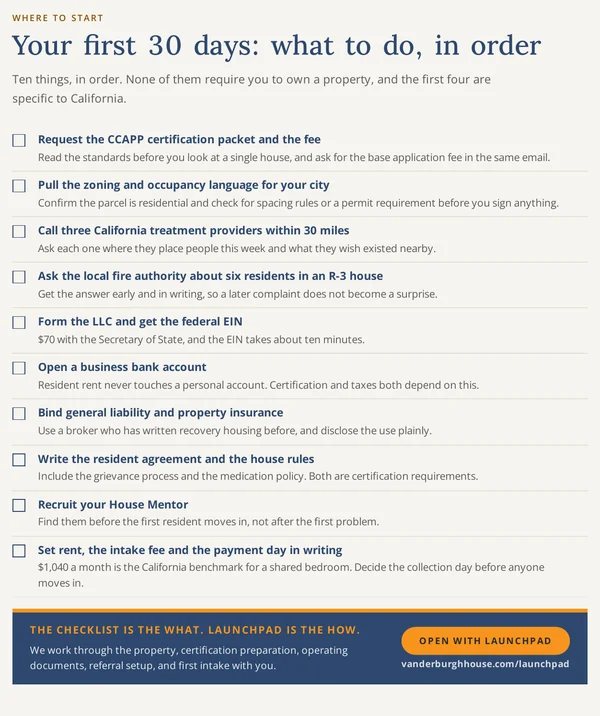
Your Fremont Sober House Startup Checklist
Every item below is covered somewhere above, and none of them is optional in Fremont. Work them in order, because several are cheaper to fix before money moves than after.
Four evergreen guides cover the operating questions that come after the doors open.
How VSL Helps You Open a Sober House in Fremont
Vanderburgh Sober Living charters independently operated recovery homes across more than fourteen states, and most Chartered Operators opened their first house with no prior experience in recovery housing. The help is aimed at exactly the points this page kept returning to: reading a Fremont address against the code before money moves, pulling a permit record and knowing what an unpermitted bedroom costs to fix, pricing a Bay Area purchase honestly against a lease, writing the twelve policies and the neighbor-relations plan CCAPP and a council member will both want to see, and walking into the county helpline and the collaborative courts with something they can refer to.
There are two routes. The Launchpad program is self-guided, for an operator who wants the sequence, the templates, and the financial model and intends to run the process themselves. The Mastery program is done with you, with structured coaching through zoning, property selection, certification, and the first ninety days of occupancy. If you have a specific Fremont address in hand, or you are weighing whether to lease in Centerville or buy in Warm Springs, that is a conversation worth having before you sign anything. Tell us about the property and someone will walk through it with you.
Start your sober house
Pick the path that fits where you are in the process.
Download the free guidePath to Purposeful Recovery Housing, by Dr. Hunter T. Foote.Explore the Mastery ProgramHands-on startup, certification, and operating support.See how starting with VSL worksThe opportunity, the community, and what a Charter includes.Prefer to talk now? Call (844) 762-3747, weekdays 8a to 5p.
Educational only; not legal, financial, or medical advice. Fees, rents, and rules change, and the Fremont adjustments above are estimates built on the California reference model. Confirm current requirements with Fremont, Alameda County, and qualified professionals before you sign or spend.
Research & Sources
- Foote, H. T. (2026). Vanderburgh Sober Living Operating Climate Index, 2026 Edition. Vanderburgh Sober Living. https://www.vanderburghhouse.com/research/operating-climate-index-2026/
- City of Fremont. (2026). Fremont Municipal Code Chapter 18.25: Definitions. Code Publishing. https://www.codepublishing.com/CA/Fremont/html/Fremont18/Fremont1825.html
- City of Fremont. (2026). Fremont Municipal Code Chapter 18.90: Residential District Regulations. Code Publishing. https://www.codepublishing.com/CA/Fremont/html/Fremont18/Fremont1890.html
- City of Fremont. (2026). Fremont Municipal Code Chapter 18.190: Special Use Regulations, Section 18.190.465 Residential Care Facilities. Code Publishing. https://www.codepublishing.com/CA/Fremont/html/Fremont18/Fremont18190.html
- City of Fremont. (2026). Fremont Municipal Code Chapter 18.265: Reasonable Accommodations for Persons with Disabilities. Code Publishing. https://www.codepublishing.com/CA/Fremont/html/Fremont18/Fremont18265.html
- City of Fremont. (2026). Fremont Municipal Code Chapter 18.45: Commercial and Town Center District Regulations. Code Publishing. https://www.codepublishing.com/CA/Fremont/html/Fremont18/Fremont1845.html
- City of Fremont. (2026). Fremont Municipal Code Chapter 18.135: Historical Overlay District. Code Publishing. https://www.codepublishing.com/CA/Fremont/html/Fremont18/Fremont18135.html
- City of Fremont. (2026). Fremont Municipal Code Chapter 15.10: Building Code. Code Publishing. https://www.codepublishing.com/CA/Fremont/html/Fremont15/Fremont1510.html
- City of Fremont. (2026). Fremont Municipal Code Chapter 15.35: Fire Code. Code Publishing. https://www.codepublishing.com/CA/Fremont/html/Fremont15/Fremont1535.html
- City of Fremont. (2026). Fremont Municipal Code Chapter 15.47: Residential Building Code. Code Publishing. https://www.codepublishing.com/CA/Fremont/html/Fremont15/Fremont1547.html
- City of Fremont. (2025). Fremont Municipal Code Chapter 15.65: Wildland-Urban Interface Fire Area. Code Publishing. https://www.codepublishing.com/CA/Fremont/html/Fremont15/Fremont1565.html
- City of Fremont. (2025). Fremont Municipal Code Chapter 15.66: Wildland-Urban Interface Code. Code Publishing. https://www.codepublishing.com/CA/Fremont/html/Fremont15/Fremont1566.html
- City of Fremont. (2026). Fremont Municipal Code Chapter 5.05: Business Taxes. Code Publishing. https://www.codepublishing.com/CA/Fremont/html/Fremont05/Fremont0505.html
- City of Fremont. (2026). Fremont Municipal Code Ordinance Table. Code Publishing. https://www.codepublishing.com/CA/Fremont/html/FremontOT.html
- City of Fremont. (2023). City Council meeting of December 5, 2023: Second reading and adoption of Ordinance 07-2023 (PLN2023-00213). https://fremontcityca.iqm2.com/Citizens/Detail_Meeting.aspx?ID=1921
- City of Fremont. (2023). City Council meeting of November 14, 2023: 2023 code updates, Housing Element program implementation (PLN2023-00213). https://fremontcityca.iqm2.com/Citizens/Detail_Meeting.aspx?ID=1919
- City of Fremont. (2023). Staff report ID 5030: 2023 code updates, Housing Element program implementation. https://fremontcityca.iqm2.com/Citizens/FileOpen.aspx?Type=30&ID=13209&MeetingID=1919
- City of Fremont. (2026). Housing Element 2023-2031. Community Development Department. https://www.fremont.gov/government/departments/community-development/planning-building-permit-services/plans-maps-guidelines/general-plan/housing-element
- City of Fremont. (2011). General Plan Chapter 2: Land Use Element. https://www.fremont.gov/home/showpublisheddocument/801/637750630860000000
- City of Fremont. (2026). Our story: the five townships. https://www.fremont.gov/about/our-story
- City of Fremont. (2026). Warm Springs Innovation District. Economic Development Department. https://www.fremont.gov/government/departments/economic-development/local-economy-overview/employment-hubs/warm-springs
- City of Fremont. (2026). Ardenwood employment hub. Economic Development Department. https://www.fremont.gov/government/departments/economic-development/local-economy-overview/employment-hubs/ardenwood
- City of Fremont. (2026). Irvington BART Station Project. Public Works Department. https://www.fremont.gov/government/departments/public-works/public-works-projects/irvington-bart-station-project
- City of Fremont. (2026). Zoning: ZoningCheck and zoning district maps. Planning and Building Permit Services. https://www.fremont.gov/government/departments/community-development/planning-building-permit-services/plans-maps-guidelines/zoning
- City of Fremont. (2026). Find My Zoning District parcel viewer. Fremont Enterprise GIS. https://egis.fremont.gov/gisapps/fremont/index.html?viewer=Public.gvh
- City of Fremont. (2026). Planning Division. https://www.fremont.gov/government/departments/planning
- City of Fremont. (2026). Building and Safety Division. https://www.fremont.gov/government/departments/building-safety
- City of Fremont. (2026). Fire Prevention Bureau. Fremont Fire Department. https://www.fremont.gov/government/departments/fire/fire-divisions/fire-prevention-bureau/prevention
- City of Fremont. (2026). Business tax information. Finance Department, Revenue Division. https://www.fremont.gov/government/departments/finance/revenue/business-tax
- City of Fremont. (2025). Local Responsibility Area Fire Hazard Severity Zones map. https://experience.arcgis.com/experience/abe71a98e5fd4b86b1031f4a0555ac41/
- City of Fremont. (2026, May 21). Fremont releases preliminary 2026 Point-in-Time count results. https://www.fremont.gov/Home/Components/News/News/1784
- City of Fremont. (2026). Housing Resource Center and access point services. Homeless Response. https://www.fremont.gov/residents/homeless-response/homeless-services/housing-resource-center-access-point-services
- Fremont Police Department. (2026). Mobile Evaluation Team. https://www.fremontpolice.gov/about-us/patrol-division/mobile-evaluation-team-met
- Alameda County Community Development Agency. (2026). R-1 district zoning regulations. Planning Department. https://www.acgov.org/cda/planning/ordinance/documents/R-1_DistrictZoningRegulations.pdf
- Alameda County Behavioral Health. (2026). Substance Use Access and Referral Helpline. Alameda County Health. https://health.alamedacountyca.gov/details-alameda-county-substance-use-access-referral-helpline/
- Alameda County Behavioral Health. (2026). Recovery Residence Programs. Alameda County Health. https://health.alamedacountyca.gov/program/recovery-residence-programs/
- Alameda County Behavioral Health Care Services. (n.d.). Drug Medi-Cal Organized Delivery System implementation plan. https://bhcsproviders.acgov.org/providers/SUD/docs/medi-cal/DMC_ODS_plan.pdf
- Alameda County Health. (2026). Coordinated Entry System. https://health.alamedacountyca.gov/unit/coordinated-entry/
- Alameda County Health. (2026). Harm reduction and syringe service programs. https://health.alamedacountyca.gov/harm-reduction-and-syringe-service-programs/
- Alameda County Health Care Services Agency. (2025). Board of Supervisors agenda item: behavioral health overdose data, May 13, 2025. https://www.acgov.org/board/bos_calendar/documents/DocsAgendaReg_05_13_25/HEALTH%20CARE%20SERVICES/Regular%20Calendar/BHCS_GSA_385900.pdf
- Alameda County Public Health Department. (2025). Board of Supervisors agenda item: AB 1037 public health substance use disorder report, September 15, 2025. https://www.acgov.org/board/bos_calendar/documents/DocsAgendaReg_9_15_25/PAL/AB_1037_Public_Health_SUD.pdf
- Alameda County Continuum of Care. (2024). 2024 Point-in-Time homelessness report. https://homelessness.acgov.org/homelessness-assets/docs/infographic/Alameda%20County%202024%20PIT%20Homelessness%20Report%20-%20FINAL%20.pdf
- Alameda County Probation Department. (2022). State of the Alameda County Probation Department. https://probation.acgov.org/probation-assets/files/about-us/State%20of%20the%20Alameda%20County%20Probation%20Department.pdf
- Alameda County Probation Department. (2024). Active contracted programs, August 2024. https://alamedacountyca.gov/probation/documents/ActivePrograms_August2024.pdf
- Superior Court of California, County of Alameda. (2026). Drug Court. Collaborative Courts Division. https://www.alameda.courts.ca.gov/divisions/collaborative-courts/drug-court
- Superior Court of California, County of Alameda. (2026). Reentry Court. Collaborative Courts Division. https://www.alameda.courts.ca.gov/divisions/collaborative-courts/reentry-court
- Alameda County Public Defender. (2026). Collaborative Courts. https://publicdefender.acgov.org/CollaborativeCourts.page
- Alameda County Social Services Agency. (2026). Fremont office. https://socialservices.alamedacountyca.gov/ex/contact-us/offices/fremont-office
- Alameda County Auditor-Controller. (2026). Property tax frequently asked questions. https://auditor.alamedacountyca.gov/tax-faqs/
- County of Alameda. (2025). Property tax rates, fiscal year 2025-26. Alameda County Open Data. https://data.acgov.org/datasets/8a6a0187bf3148b5a180c4bf6aad8f01_0/about
- California Department of Health Care Services. (2026). Licensing and certification complaints. https://www.dhcs.ca.gov/individuals/licensing-and-certification-complaints/
- California Health and Safety Code section 11834.01. (2026). California Legislative Information. https://leginfo.legislature.ca.gov/faces/codes_displaySection.xhtml?lawCode=HSC§ionNum=11834.01.
- California Health and Safety Code section 11834.23. (2026). California Legislative Information. https://leginfo.legislature.ca.gov/faces/codes_displaySection.xhtml?lawCode=HSC§ionNum=11834.23.
- California Health and Safety Code section 11834.31. (2026). California Legislative Information. https://leginfo.legislature.ca.gov/faces/codes_displaySection.xhtml?lawCode=HSC§ionNum=11834.31.
- California Health and Safety Code section 1566.3. (2026). California Legislative Information. https://leginfo.legislature.ca.gov/faces/codes_displaySection.xhtml?lawCode=HSC§ionNum=1566.3.
- California Health and Safety Code section 17926. (2026). California Legislative Information. https://leginfo.legislature.ca.gov/faces/codes_displaySection.xhtml?lawCode=HSC§ionNum=17926.
- California Government Code section 12955. (2026). California Legislative Information. https://leginfo.legislature.ca.gov/faces/codes_displaySection.xhtml?lawCode=GOV§ionNum=12955.
- California Government Code section 12955.8. (2026). California Legislative Information. https://leginfo.legislature.ca.gov/faces/codes_displaySection.xhtml?lawCode=GOV§ionNum=12955.8.
- California Government Code section 65008. (2026). California Legislative Information. https://leginfo.legislature.ca.gov/faces/codes_displaySection.xhtml?lawCode=GOV§ionNum=65008.
- International Code Council. (2025). 2025 California Building Code, Chapter 3: Occupancy Classification and Use. https://codes.iccsafe.org/content/CABC2025P1/chapter-3-occupancy-classification-and-use
- International Code Council. (2025). 2025 California Residential Code, Part III: Building Planning and Construction. https://codes.iccsafe.org/content/CARC2025P1/part-iii-building-planning-and-construction
- California Secretary of State. (2018). Business Programs Division fee schedule. https://bpd.cdn.sos.ca.gov/pdf/be-fee-schedule-062018.pdf
- California Franchise Tax Board. (2026). Limited liability company. https://www.ftb.ca.gov/file/business/types/limited-liability-company/index.html
- California Attorney General, Department of Housing and Community Development, and Civil Rights Department. (2026, June 3). Legal alert regarding Ohio House v. City of Costa Mesa. https://oag.ca.gov/system/files/attachments/press-docs/Legal%20Alert%20re%20Ohio%20House%20v.%20City%20of%20Costa%20Mesa%20-%20Final.pdf
- California Department of Housing and Community Development. (2021, March 25). Notice of violation to the City of Encinitas regarding group homes. https://www.hcd.ca.gov/community-development/housing-element/docs/sdiencinitas-nov-grouphomes-03252021.pdf
- City of Edmonds v. Oxford House, Inc., 514 U.S. 725 (1995). Justia. https://supreme.justia.com/cases/federal/us/514/725/
- Pacific Shores Properties, LLC v. City of Newport Beach, 730 F.3d 1142 (9th Cir. 2013). Justia. https://law.justia.com/cases/federal/appellate-courts/ca9/11-55460/11-55460-2014-03-04.html
- SoCal Recovery, LLC v. City of Costa Mesa, 56 F.4th 802 (9th Cir. 2023). Justia. https://law.justia.com/cases/federal/appellate-courts/ca9/20-55820/20-55820-2023-01-03.html
- The Ohio House, LLC v. City of Costa Mesa, No. 22-56181 (9th Cir. 2024). Justia. https://law.justia.com/cases/federal/appellate-courts/ca9/22-56181/22-56181-2024-12-04.html
- U.S. Department of Housing and Urban Development. (2026). FY2027 Fair Market Rent schedule. Office of Policy Development and Research. https://www.huduser.gov/portal/datasets/fmr/fmr2027/FY2027_FMR_Schedule.pdf
- U.S. Department of Housing and Urban Development. (2026, September 1). Fair market rents for the Housing Choice Voucher Program, fiscal year 2027. Federal Register. https://www.federalregister.gov/documents/2026/09/01/2026-17891/fair-market-rents-for-the-housing-choice-voucher-program-moderate-rehabilitation-single-room
- U.S. Census Bureau. (2026). QuickFacts: Fremont city, California. https://www.census.gov/quickfacts/fact/table/fremontcitycalifornia/PST045224
- U.S. Census Bureau. (2026). QuickFacts: Alameda County, California. https://www.census.gov/quickfacts/fact/table/alamedacountycalifornia/PST045224
- California Association of Realtors. (2026, September 16). August 2026 home sales and price report. https://www.car.org/en/aboutus/mediacenter/newsreleases/2026releases/august2026sales
- California Health and Human Services Agency. (2026). Substance use disorder recovery treatment facilities dataset. https://data.chhs.ca.gov/dataset/sud-recovery-treatment-facilities
- Bay Area Rapid Transit. (2026). Fremont station. https://www.bart.gov/stations/FRMT
- Bay Area Rapid Transit. (2026). Warm Springs/South Fremont station. https://www.bart.gov/stations/warm
- Bay Area Rapid Transit. (2026). Monthly ridership snapshot, July 2026. https://www.bart.gov/sites/default/files/2026-08/202607%20Monthly%20Ridership%20Snapshot.pdf
- AC Transit. (2026). Line 210 schedule and route. https://www.actransit.org/bus-lines-schedules/210
- AC Transit. (2026). Line 211 schedule and route. https://www.actransit.org/bus-lines-schedules/211
- AC Transit. (2026). Line 239 schedule and route. https://www.actransit.org/bus-lines-schedules/239
- AC Transit. (2026). Line 251 schedule and route. https://www.actransit.org/bus-lines-schedules/251
- Capitol Corridor Joint Powers Authority. (2026). Fremont/Centerville station. https://www.capitolcorridor.org/stations/fremontcenterville/
- Glenmoor Gardens Homeowners Association. (2026). About Glenmoor. https://www.glenmoorgardens.org/info.php?pnum=95d82228ff3800
- California Consortium of Addiction Programs and Professionals. (2026). Certified recovery residence directory. https://ccapprecoveryresidences.org/search/
- East Bay Intergroup of Alcoholics Anonymous. (2026). Meetings and 24-hour helpline. https://eastbayaa.org/
- Narcotics Anonymous, Alameda County Area. (2026). Helpline and meeting information. https://www.naalamedacounty.org/