Opening a sober living home in Oakland means working inside three sets of rules at once, and only one of them is a real obstacle. California does not license sober living homes, so a peer-based house that provides no treatment falls outside state licensure entirely. Oakland does not regulate them separately either: a home with no state license and no on-site care reads as an ordinary household under the Oakland Planning Code, permitted by right in every residential zone in the city. Alameda County controls the money, and it counted 309 opioid overdose deaths in 2023, a 60 percent rise over the year before, against 401 licensed residential treatment beds across the whole county.
What follows is Oakland-specific: how the city code classifies a recovery home, the 300-foot separation rule that catches the homes people assume are safest, the 2023 ordinance that rewrote residential care siting, the city desks that issue what you need, Oakland and Alameda County prices, and the agencies that fill beds here. Statewide rules, the CCAPP certification process, and the full cost model belong to the California guide below. The shared figures on this page are restated from that model and adjusted only on the lines Oakland actually changes, never recalculated.
Before you read onHow to Open a Sober Living Home in CaliforniaThis post covers one piece of the process. The complete California guide walks through every step, from planning to your first resident.→Watch: How to Start a Sober Living Home in California
The video walks the statewide sequence: the line between housing and treatment that decides whether a license applies, what CCAPP certification involves, how zoning review works, and what opening costs. Oakland sits inside all of it. The rest of this page applies those steps to one city code, one county funding system, and one set of referral partners.
The California book covers the same ground in print, with the checklists and templates an operator needs on day one.
Is Oakland a Good Place to Open a Sober Living Home?
Yes on demand, and the constraint here is capital rather than permission. Oakland has serious unmet need, a county that pays for recovery residence beds, and a city code that lets an unlicensed home open by right in any residential zone. The obstacle is price: Alameda County’s median sale price of $1,285,000 in August 2026 puts the purchase path out of reach for most first-time operators and makes the lease path the realistic entry.
Recovery Housing Demand in Alameda County
Residents reach an Oakland sober living home through four pipelines, and each behaves differently here.
- County-funded treatment discharge: Alameda County runs Recovery Residence as a named level in its substance use continuum, so beds are screened and placed through one central line rather than negotiated house by house.
- The courts and probation: Alameda County Drug Court at the Wiley W. Manuel Courthouse in Oakland lists temporary sober housing and housing case management among its program benefits, and AB 109 probation officers place clients into contracted beds.
- The homelessness response: The county’s 2024 point-in-time count found 9,450 people unhoused, 28.5 percent of whom reported a substance use disorder, and more than 40 percent of Alameda County overdose deaths in 2023 were among people experiencing homelessness.
- The recovery community itself: Meeting secretaries, sponsors, and alumni of the county’s residential programs move more residents into sober living than any formal referral agreement does.
Five figures do most of the work when a lender or a referral partner asks whether the market is real.
| Indicator | Oakland figure | Why it matters to an operator |
|---|---|---|
| Opioid overdose deaths, Alameda County | 309 in 2023, up 60 percent over 2022, an age-adjusted rate of 21.29 per 100,000, driven by fentanyl | A rising, fentanyl-driven death rate is what county funders point to when they expand bed contracts, and it is the number to open a referral conversation with. |
| Licensed residential treatment capacity | 401 beds across 15 facilities countywide, of which 8 licensed residential facilities with 127 beds sit inside Oakland | Every one of those beds discharges someone who needs somewhere to go next, and the county publishes no comparable count of sober living beds to receive them. |
| Unhoused population reporting a substance use disorder | 9,450 people counted in 2024, 6,343 of them unsheltered, with 28.5 percent reporting a substance use disorder | That is roughly 2,700 people county housing navigators are actively trying to place, and coordinated entry is the door they come through. |
| Opioid settlement dollars committed to beds | $740,105 in 2024 contract augmentations to three recovery residence providers, out of a settlement of up to $80 million of which $31.7 million has been received | The county is buying recovery residence capacity with settlement money and names bed expansion as an implementation activity, so new capacity is wanted. |
| Transit reach | Eight BART stations inside the city plus the Tempo 1T bus rapid transit line on International Boulevard, and 40,004,716 AC Transit riders in FY2024-25 | Residents without cars reach work, meetings, and probation appointments on transit, and a house off the network loses people to missed appointments. |
California ranks 4 of 50 for overall operating climate with a composite Operating Climate Score of 8, and scores 10 for market strength and 10 for operator funding access, while its Return on Capital Score is 2 (Foote, 2026). Oakland is a concentrated version of that split. The county money, the referral machinery, and the unmet need are all here at scale, and so is the price of the asset they sit on.
Oakland is one of the few California cities where an unlicensed sober living home faces no separation rule, no conditional use permit, and no local registration, while a state-licensed six-bed care facility next door still has to sit 300 feet from the nearest one. The safer-looking path carries the restriction. The peer-run house does not.
Most people ask whether they are allowed to open a recovery home. The better first question is whether the need and the money are there. This answers both, for your state.
- How many people need a bed, and how few beds exist
- Who actually pays the rent, and which programs are real
- What it costs to open on the purchase path and the lease path
How to Open a Sober House in Oakland: Step-by-Step
The statewide sequence lives in the California guide. This version is ordered for Oakland, where the property decision comes before the paperwork, because price is the binding constraint here and the wrong address can cost more than every permit combined. Expect four to seven months from first search to first resident, most of it spent finding a house with enough bedrooms at a price the model supports.
Ten steps, in the order an Oakland operator actually meets them.
Step 1. Confirm the Zoning and the Classification Before You Sign
Run the address through the City of Oakland interactive zoning map, which returns the base zone, height area, General Plan designation, historic status, and impact fee zone for any parcel. Residential zones in Oakland are RH-1 through RH-4, RD, RM-1 through RM-4, and RU-1 through RU-5, and a household in a one-family dwelling is permitted by right in all of them. Confirm the parcel is inside Oakland city limits, because unincorporated Alameda County parcels fall under a different code with a stricter care-facility definition.
Then get it in writing. Oakland offers a paid written zoning verification for a specific project, and it is worth the fee because the one soft spot in the code is the undefined phrase institutional living arrangement. If a planner ever reads your house as a Residential Care Residential Activity rather than a household, the 300-foot separation rule attaches and a nearby licensed care facility can foreclose the site.
California guideCalifornia Zoning, Fair Housing, and Land Use Laws for Sober LivingWhere sober homes can operate in California and the legal protections that apply.→Step 2. Form the Entity and Register the Business With Oakland
The entity signs the lease or holds title, never the person. California charges $70 for Articles of Organization and $20 for the initial Statement of Information, and the $800 minimum annual franchise tax is due by the fifteenth day of the fourth month after formation, so year one runs $890 in state filing costs. Get the EIN and open the bank account before the first resident pays rent.
Oakland then requires its own business tax registration within 30 days of the start date, at $95 for the registration itself. Residential rental falls in Class O at $13.95 per $1,000 of gross rental receipts, a flat rate that Measure T’s progressive tiers do not touch, and the Rent Adjustment Program fee application is filed alongside it. It renews annually.
California guideHow to Form a Legal Entity for a Sober Living Business in CaliforniaLLC, nonprofit, or both: how California operators structure the business and the property.→Step 3. Find a House That Reads as a Household
Oakland defines a family as a group living together as a single housekeeping unit, bearing the character of a generic family through shared household activities and expenses. A recovery home passes that test by how it actually runs, not by what it is called, and the operational details below are what a planner or a neighbor would look at.
- Residents share the whole house rather than renting locked individual rooms, because Oakland’s dwelling unit definition tips into rooming units at more than four paying guests.
- One lease or membership agreement covers the household, with shared responsibility for chores, meals, and house expenses.
- No on-site clinical services, no paid caregiving staff, and no 24-hour supervision, all of which would move the home toward a category that requires a state license.
- Length of stay is open-ended rather than a fixed program term, which is what keeps the house permanent residential rather than transitional or semi-transient.
Two anchors set the budget. A four-bedroom in this metro carries a fiscal year 2027 fair market rent of $4,250 effective October 1, 2026, and the Alameda County median sale price was $1,285,000 in August 2026. Those two numbers drive the cost table further down this page.
California guideSober Living Startup Costs in CaliforniaEvery one-time cost to open, on the lease path and the purchase path, with the California figures behind each line.→Step 4. Settle Alarms, Occupancy, and the Certificate Before Anyone Moves In
Smoke alarms are required in every dwelling intended for human occupancy under Health and Safety Code section 13113.7, and a carbon monoxide device is required in any unit with a fossil-fuel appliance, fireplace, or attached garage under section 17926. A CCAPP inspector checks the same hardware plus egress, extinguishers, and the documentation behind them, so the two inspections reward the same preparation.
The trap is the certificate of occupancy on a converted house. Unpermitted bedrooms, a garage conversion, or a prior care-facility use all surface when someone pulls records, and resolving them is the seller’s or landlord’s problem only if you raise it before signing. The fire and building section below carries the code citations and the occupancy classification thresholds.
Step 5. Write the Governing Documents Before You Open
CCAPP reviews written policies at application, and writing them after opening means writing them under pressure with a resident already in crisis. Draft the house rules, the resident agreement, the grievance and appeal procedure, the medication storage and self-administration policy, the relapse and discharge policy, and the signed code of ethics for every owner.
Add the one most templates skip: a neighbor relations plan naming who answers a neighbor’s call, what they say, and how a complaint gets resolved without the city hearing about it first. In a city with no sober living ordinance, the fastest way to get one proposed is a block that cannot reach anybody.
Keep readingHouse Rules in Sober HousesThe rules that keep a recovery home safe, structured, and worth living in.→Step 6. Quote Insurance for the Specific Address
General liability is one of the lines the California cost model leaves unpriced, because no authoritative source publishes it, so a quote for your address is the only real number. CCAPP expects general liability of at least $100,000 per occurrence and professional liability of $1,000,000 per occurrence with a $2,000,000 aggregate. Tell the carrier plainly that the house is peer-run recovery housing with no clinical services, and bind coverage before the first resident moves in.
Where the address sits changes this line more in Oakland than almost anywhere else in the state. A house in the East Oakland hills falls inside the City’s Wildfire District, where roughly 26,000 parcels are inspected a year, and property coverage in a mapped very high fire hazard zone is both more expensive and harder to place than the $1,788 statewide average the cost model carries. Get the hazard layer answer before the insurance quote, not after.
Step 7. Recruit and Move In the House Mentor
A live-in house mentor is what makes a NARR Level II home work: someone in stable recovery who lives in the house, holds the routine, and handles the first hour of a problem. In Alameda County the realistic recruiting pool is the alumni of the residential programs that discharge into sober living, which means Cherry Hill Detoxification Services in San Leandro, Options Recovery Services, CURA in Fremont, Magnolia Women’s Recovery Programs in Oakland, and the meeting communities around the address you are opening in.
Put the arrangement in writing, covering the unpaid or reduced bed, the expectations, and how it ends. Move the mentor in before the first resident arrives, and remember the mentor bed is the first deduction in the pro forma further down this page.
Step 8. Apply for CCAPP Certification
Certification is voluntary in California law and close to a practical requirement for a home that wants county and court referrals, because CCAPP’s registry is the screen discharge planners consult. It is the state’s only NARR affiliate. The sequence is short here because the California certification guide carries the detail.
- Submit the application with the governing documents, insurance certificates, and the signed code of ethics, and pay the application fee CCAPP quotes on request rather than publishes.
- Host the announced site visit, at which the inspector walks the house against the NARR standards and the documentation you prepared in step 5.
- Close any corrections and hold certification through annual renewal and peer inspections, watching the $100 late-cancellation and $100 reinspection fees that are the only published amounts.
Step 9. Open the Referral Relationships Before You Open the Doors
Alameda County controls publicly funded placement through one screening line, and discharge planners send people where they already know a bed exists. Call the partners in the table further down while the house is still being furnished, invite three of them to tour it, and list with the county helpline and the CCAPP registry the week you certify.
Those weeks are cheap before the mortgage or the lease starts and expensive after. A house that opens with two referral relationships already warm fills months faster than one that opens cold.
Step 10. Open, Then Hold Occupancy
The California reference model breaks even near 5 of 14 beds on the priced stack, and the Oakland purchase path moves that to roughly 9. Admit deliberately rather than filling every bed in the first month, because one bad early placement resets the culture of a new house.
Run the weekly house meeting from week one, track occupancy daily, and send referral partners a short monthly note saying how many beds are open. Setting rent at a number the county’s funded rate and the local market both support is what keeps those beds turning.
Keep readingHow Sober Houses Fill Beds and Stay FullProven occupancy strategies from established recovery housing operators.→Phases overlap in practice, and the property search is what sets the pace.
| Phase | Weeks (estimated) | What gets done |
|---|---|---|
| Property search and zoning verification | 6 to 16 weeks | Run addresses through the zoning map, order written zoning verification on the finalists, and confirm the certificate of occupancy and permit history. |
| Entity, registration, and insurance | 2 to 4 weeks | File the LLC, register with Oakland within 30 days of the start date, obtain the EIN, and bind general liability. |
| Property close or lease signing | 4 to 8 weeks | Close escrow or sign the lease, take possession, and schedule any corrective work the inspection surfaced. |
| Setup, documents, and mentor | 4 to 6 weeks | Furnish the house, install and test alarms, finish the governing documents, and move the house mentor in. |
| CCAPP application and site visit | 8 to 16 weeks | Submit the application, wait for scheduling, host the site visit, and close corrections. |
| Referral outreach and lease-up | Ongoing from week one | Call partners, host tours, list with the county helpline and the CCAPP registry, and admit residents deliberately. |
Timelines are estimated. What adds months in Oakland is the property search rather than the permitting: finding a four-or-more-bedroom house at a price the model supports takes longer here than anywhere else in the sequence, and a written zoning verification adds a few weeks that are worth spending.
Best Neighborhoods for a Sober Living Home in Oakland
A workable Oakland address passes four tests, and the city’s housing stock makes the first one the hard part.
- Bedrooms: Only 11.3 percent of Oakland’s 191,713 housing units have four or more bedrooms, so the areas with large older houses matter more here than in most cities.
- Transit: A house within walking distance of a BART station or a frequent AC Transit line keeps residents at work, meetings, and court dates without a car.
- Providers: Proximity to the treatment programs, courts, and county offices that discharge people is what turns a referral relationship into steady placements.
- Hazard: Much of the Oakland hills sits in a Very High Fire Hazard Severity Zone with landslide zones alongside it, which raises insurance and adds construction obligations.
Six areas follow, with bedroom and structure shares computed from American Community Survey tables B25041, B25024, and B25034 aggregated to the City of Oakland’s own planning areas, zoning shares from the City GIS base zone layer, and transit from BART and AC Transit.
| Area | Housing stock and transit | Siting notes for a sober living home |
|---|---|---|
| Glenview and Redwood Heights | The best large-house yield outside the hills: 17.0 percent of units have four or more bedrooms and 35.6 percent have three, 70.4 percent are single-unit detached, and 55.1 percent were built before 1940. Predominantly RD zoning. Nearest station is Fruitvale BART, with AC Transit lines 57, 18, 54, and 62 crossing it. | Advantage: the deepest supply of four-bedroom bungalows in a by-right RD zone, and every tract sits in the lowest displacement quintiles on the City’s Priority Neighborhoods layer. Risk: no BART station inside the area, so transit depends on bus connections, and prices track the quality of the stock. |
| Central and East Oakland (Elmhurst, Melrose, Seminary, Eastmont, Havenscourt) | 34,080 units with 11.0 percent at four or more bedrooms and 30.2 percent at three, 57.0 percent single-unit detached, and 40.6 percent of the land RD-zoned. Served by Coliseum and Fruitvale BART, the Tempo 1T bus rapid transit line on International Boulevard with 46 stations and roughly 10-minute headways, and line 40 through Eastmont Transit Center. | Advantage: the lowest entry prices in the city on detached stock, on the only BRT corridor in the East Bay, inside the East Oakland Neighborhoods Initiative planning area. Risk: eight of its 22 tracts are in the highest displacement quintile and the Housing Element equity analysis places two of Oakland’s four racially and ethnically concentrated areas of poverty along International Boulevard near the Coliseum, so community consultation matters more here, not less. |
| East Oakland Hills (Millsmont, Sequoyah, Oak Knoll) | The second-highest large-house share in the city: 24.9 percent of units have four or more bedrooms, 37.4 percent have three, and 73.5 percent are single-unit detached, mostly postwar. Zoning runs RH-1 through RH-4 alongside RD and open space. No BART station; AC Transit lines 54 and 18 only. | Advantage: the large, newer houses the model assumes, on quiet low-density streets. Risk: much of it falls inside the mapped Very High Fire Hazard Severity Zone and landslide hazard zones, which raises insurance, brings annual vegetation inspection obligations, and leaves residents without a car dependent on two bus lines. |
| West Oakland (Prescott, McClymonds, Hoover and Foster, Clawson) | The oldest stock in Oakland at 45.0 percent built before 1940, with 11.1 percent of units at four or more bedrooms but only 21.3 percent single-unit detached, because the Victorian stock is largely row and attached. The residential core is RM-2 inside a surround that is 42.1 percent IG industrial. West Oakland BART sits in the middle, with AC Transit lines 62 and 14 originating at Mandela Parkway and 7th Street. | Advantage: a BART station one stop from downtown San Francisco, an RM-2 core, and large Victorians that convert well. Risk: the West Oakland Specific Plan exists specifically to resolve conflicting land uses, a separate truck management plan governs the freight routes through it, and four of its tracts are in the highest displacement quintile. |
| Eastlake, San Antonio, and Fruitvale | 39,666 units but only 6.9 percent at four or more bedrooms, with RM-2 and RM-3 covering 45.5 percent of the land. Pockets run larger: one San Antonio tract reaches 16.0 percent at four or more bedrooms and 70.9 percent detached. Fruitvale and Lake Merritt BART, Tempo 1T, and AC Transit lines 51A, 62, 14, and 54. | Advantage: the densest transit and service access in the city, inside the Lake Merritt Station Area Plan area, near the county offices and clinics residents use. Risk: multifamily zoning means large detached houses are scarce and expensive, and a multi-unit building raises rent-adjustment and registration questions a single-family house avoids. |
| North Oakland and Adams Point (Temescal, Bushrod, Longfellow) | The largest area by unit count at 46,902, with 6.9 percent at four or more bedrooms overall but sharp pockets, including one tract at 40.0 percent four-plus bedrooms and 84.4 percent detached. Zoning is RM-2 and RM-4 heavy with RD at the edges. MacArthur, Rockridge, and 19th Street BART, with AC Transit lines 6, 51A, 57, and 18. | Advantage: three BART stations, the lowest displacement quintiles in the city, and proximity to the Pill Hill hospital cluster that discharges patients. Risk: the highest acquisition prices in the city outside the hills, and RM-2 and RM-4 dominance means most parcels are multi-unit rather than the large single-family house the model assumes. |
Across every one of those areas, the same house features decide whether a property works.
- Four or more bedrooms: The California reference model runs 14 beds, and Oakland’s stock makes that hard, so a house with four or five real bedrooms plus a convertible room is the realistic target.
- More than one full bathroom: One bathroom caps a house at a bed count that will not cover an Oakland mortgage or lease.
- A permitted floor plan: Converted garages and added bedrooms without permits are common in the older stock and surface at the worst possible moment, so pull the permit history before the offer.
- Off-street parking and a real common room: Parking keeps the block quiet, and a common room is where a house meeting actually happens rather than being a line in a policy.
Other Alameda County cities run under their own codes and reach different answers, so a search that crosses the city line restarts the zoning work. Fremont is the nearest of those with its own guide, and Berkeley, Hayward, San Leandro, and Alameda each apply their own zoning ordinance.
- ✓Room-by-room requirements for a Level II home
- ✓Zoning and occupancy questions to ask before you tour
- ✓The red flags that should end a showing early
Who Regulates Sober Living Homes in Oakland?
No single agency regulates sober living homes in Oakland. The state licenses treatment, the state’s NARR affiliate certifies housing voluntarily, the city controls zoning, building, fire, and business registration, the county controls the money and the referrals, and federal fair housing law sits over all of it. California’s housing department states the position plainly: recovery residences do not require licenses from DHCS because they do not provide alcoholism or drug addiction recovery and treatment services.
A sober living home is a shared residence where people in recovery live together under house rules, pay their own rent, and receive no treatment on site. That definition is what keeps the home outside licensure, because DHCS licenses the service rather than the building, and it is also what keeps it outside Oakland’s Residential Care category, which reaches only facilities that require a state license or are state licensed and provide 24-hour primarily nonmedical care and supervision. Crossing that line in either direction changes which rules apply.
| Layer | Agency | What it controls for a sober living home |
|---|---|---|
| State licensing | California Department of Health Care Services (DHCS) | Licenses alcohol and other drug recovery and treatment facilities under Health and Safety Code section 11834.01. Providing detoxification, individual or group counseling sessions, education, or recovery planning on site makes a license mandatory, and operating an unlicensed treatment facility is enforceable by DHCS. A house offering none of those services is not licensable, which is the whole of the housing versus treatment line. |
| Voluntary certification | California Consortium of Addiction Programs and Professionals (CCAPP) | The state’s only NARR affiliate, certifying recovery residences against 10 core principles and 31 standards across four levels of support. Certification is voluntary and confers no legal authority, but its registry is the screen counties, courts, and discharge planners consult. |
| City zoning | Oakland Planning and Building Department | Classifies the home under the Planning Code. A household with no state license and no on-site care is a Permanent Residential Activity, permitted by right in RH-1 through RH-4, RD, RM-1 through RM-4, and RU-1 through RU-5. Written zoning verification is available through the City’s project zoning information service. |
| City building and fire | Oakland Planning and Building Department and Oakland Fire Department | Oakland adopted the 2025 California Building Standards Code effective January 1, 2026 with local amendments in OMC chapters 15.04 and 15.06, and adopted the 2025 California Fire Code as OMC chapter 15.12 on December 16, 2025. The Fire Prevention Bureau reaches the department at (510) 238-3462. |
| City business registration | Oakland Business Tax Office | Requires registration within 30 days of the start date at $95, with residential rental taxed in Class O at $13.95 per $1,000 of gross rental receipts. This is a tax registration, not a license to operate a recovery home. |
| County zoning outside city limits | Alameda County Community Development Agency | Applies its own ordinance in unincorporated areas, where a medical or residential care facility expressly includes group living quarters housing persons placed by an authorized agency for rehabilitation purposes, and a boarding house is any place lodging four or more persons. Both definitions are broader than Oakland’s. |
| County funding and referrals | Alameda County Behavioral Health (ACBH) | Runs the Substance Use Access and Referral Helpline at (844) 682-7215, which screens residents and places them into Recovery Residence beds, and contracts with providers using opioid settlement and realignment dollars. The county is the gatekeeper for publicly funded referrals, not the state. |
| Federal fair housing | U.S. Department of Housing and Urban Development and U.S. Department of Justice | People in recovery from substance use disorder are protected as people with disabilities under 42 U.S.C. 3602(h), which expressly excludes current illegal drug use. The 2016 joint statement on state and local land use laws sets the six-element reasonable accommodation test. |
The short version for an operator opening in Oakland.
- State license: Not required for a peer-based home with no treatment on site, and mandatory the moment counseling, detoxification, or recovery planning is provided there.
- City license: None exists for a sober living home in Oakland, though business tax registration and the Rent Adjustment Program fee application both apply.
- Certification: Voluntary in law through CCAPP, and close to a practical requirement for a home that wants county or court referrals.
- Referrals: Controlled by Alameda County Behavioral Health through one screening helpline, with the courts and probation the second largest channel.
Licensing and registration are the easy parts in Oakland, and both are settled in an afternoon. Zoning is the layer worth real attention, because the classification your house lands in decides whether a separation rule applies at all.
Oakland Zoning Laws for Sober Living Homes
Oakland has no sober living ordinance, no registration scheme, no moratorium, and no spacing rule aimed at recovery housing. A search of the city’s legislative database on September 17, 2026 returned no matter whose title contains sober living or recovery residence in the system’s entire history, and the only sober-related file is a 2003 planning appeal. What Oakland does have is a residential care classification with a 300-foot separation rule attached, and the question that decides everything is whether your house lands inside it.
How the Oakland Planning Code Classifies a Sober Living Home
The Planning Code carries no group home or sober living use category. It classifies activities instead, and four definitions decide where a recovery home sits.
- Residential Care Residential Activities (OMC 17.10.112): Include all Residential Care Facilities that require a state license or are state licensed for seven or more residents which provide 24-hour primarily nonmedical care and supervision. Both halves of that gate have to close before the category applies.
- Permanent Residential Activities (OMC 17.10.110): Cover occupancy of living accommodations on a 30-day-or-longer basis, excluding institutional living arrangements other than state-licensed residential care facilities for six or fewer residents. An unlicensed peer-run house lands here.
- Family and single housekeeping unit (OMC 17.09.040): A family is one person or a group living together as a single housekeeping unit, defined as people living together as a relatively permanent household bearing the character of a generic family, sharing household activities and expenses. There is no cap on unrelated adults anywhere in the Planning Code.
- Dwelling unit and rooming unit (OMC 17.09.040): A dwelling unit accommodates a family plus not more than four boarders, roomers, or lodgers, and rooms accommodating more than four paying guests in a one-family dwelling become rooming units. Renting locked individual rooms is what pushes a house across that line.
- Where each is allowed: Permanent Residential is permitted by right in RH-1 through RH-4, RD, RM-1 through RM-4, and RU-1 through RU-5. Rooming House facilities are prohibited outright in the RH and RD zones and permitted in the RM and RU zones.
On the text, an unlicensed sober living home is clearly outside Residential Care and clearly inside Permanent Residential, because it neither requires nor holds a state license and provides no 24-hour care or supervision. That means by-right siting in every residential zone in Oakland with no conditional use permit and no separation requirement. One soft spot remains: both 17.10.110 and 17.10.100 exclude institutional living arrangements, a phrase the Planning Code nowhere defines, which leaves a narrow opening a zoning administrator could press.
Pay for written zoning verification on the specific address before you sign anything. It costs a fee and a few weeks, and it converts the one undefined phrase in the code from your risk into the City’s written position.
What the Six-or-Fewer Rule Does and Does Not Do in Oakland
Operators arrive believing California protects any home of six or fewer residents. The protection is real, and every statute that carries it is written for licensed facilities rather than for peer-run houses. Three statutes get quoted, and Oakland’s own code language turns on the second pair.
- Health and Safety Code section 11834.23: The statute operators quote most often. It confers residential-use status, bars classification as a boarding house or rooming house, and reaches alcoholism or drug abuse recovery facilities that are both DHCS-licensed and serving six or fewer residents. A peer-based home holds no such license, so it should not plan around this section.
- Health and Safety Code section 1566.3 and section 1568.0831: The community care statutes, which provide that a residential facility serving six or fewer persons is a residential use whose residents and operators are considered a family, and that no conditional use permit, zoning variance, or other zoning clearance shall be required of one. These are the statutes behind Oakland’s own carve-out language, because the Planning Code’s term is state-licensed Residential Care Facility.
- Unlicensed homes: Every one of those sections turns on a state license, and California’s housing department confirms recovery residences are not DHCS-licensed because they provide no recovery or treatment services. None of them reaches a peer-run sober living home, which is why the HCD group home advisory treats licensed facilities and recovery residences as separate categories.
- The Oakland twist: Section 1568.0831 bars any zoning clearance for a licensed facility serving six or fewer, and OMC 17.10.112 still applies the 300-foot separation requirement to exactly those facilities. A licensed six-bed home in Oakland sits at the point where the two rules meet.
An unlicensed home’s protection comes from somewhere else. People in recovery from substance use disorder are people with disabilities under 42 U.S.C. 3602(h), which excludes current illegal use, so a house rule requiring sobriety is a legal asset rather than a liability.
That disability status is what makes a reasonable accommodation request available. It is also why house rules, admissions criteria, and resident testimony matter: the Ninth Circuit held in SoCal Recovery, LLC v. City of Costa Mesa (2023) that an operator need not prove each individual resident is disabled.
Keep readingThe Federal Fair Housing Act and Sober Living: Everything You Need to KnowThe federal protections every operator, neighbor, and local official should understand.→Ordinance 13763 and Oakland’s 300-Foot Separation Rule
The live action is Ordinance 13763 C.M.S., Council File 23-0536, introduced June 21, 2023, passed by the City Council on October 3, 2023 and effective October 30, 2023 as part of the Oakland 2045 General Plan Phase 1 package. It amended the Planning Code to facilitate special housing types including residential care facilities, transitional and supportive housing, rooming units, and emergency shelters, implementing Housing Element actions 3.7.8, 4.3.3, and 3.7.6. The staff report describes the effect plainly.
- It allows residential care facilities of seven or more, and unlicensed care facilities not required to be licensed by the state, in all zones allowing residential uses, permitted similarly to other residential uses of the same form in the zone.
- It removes the discretionary conditional use permit those facilities previously needed in residential zones, which is why the additional use permit criteria in OMC 17.103.010.A now bite only in the handful of commercial and district zones where residential care remains conditionally permitted.
- It allows foster family homes and facilities for the elderly within 300 feet of another residential care facility, pursuant to Health and Safety Code section 1520.5, without disturbing the separation rule for anyone else.
What did not change on that date is the separation rule itself. OMC 17.103.010.B.1 still provides that no Residential Care Residential Activity shall be located closer than 300 feet from any other Residential Care Residential Activity, except for foster family homes and facilities for the elderly. More pointedly, 17.10.112 provides that state-licensed residential care facilities for six or fewer residents are treated as Permanent Residential Activities except with regard to the 300-foot separation requirement. A six-bed licensed facility keeps every other protection and still carries the spacing rule, which sits in visible tension with section 1568.0831’s bar on any zoning clearance for those same facilities.
- City of Edmonds v. Oxford House, Inc., 514 U.S. 725 (1995): Held that a family definition capping unrelated adults is not an exempt maximum occupancy restriction under the Fair Housing Act, so such caps are fully open to challenge. Oakland has no such cap, which removes the most common local obstacle before it starts.
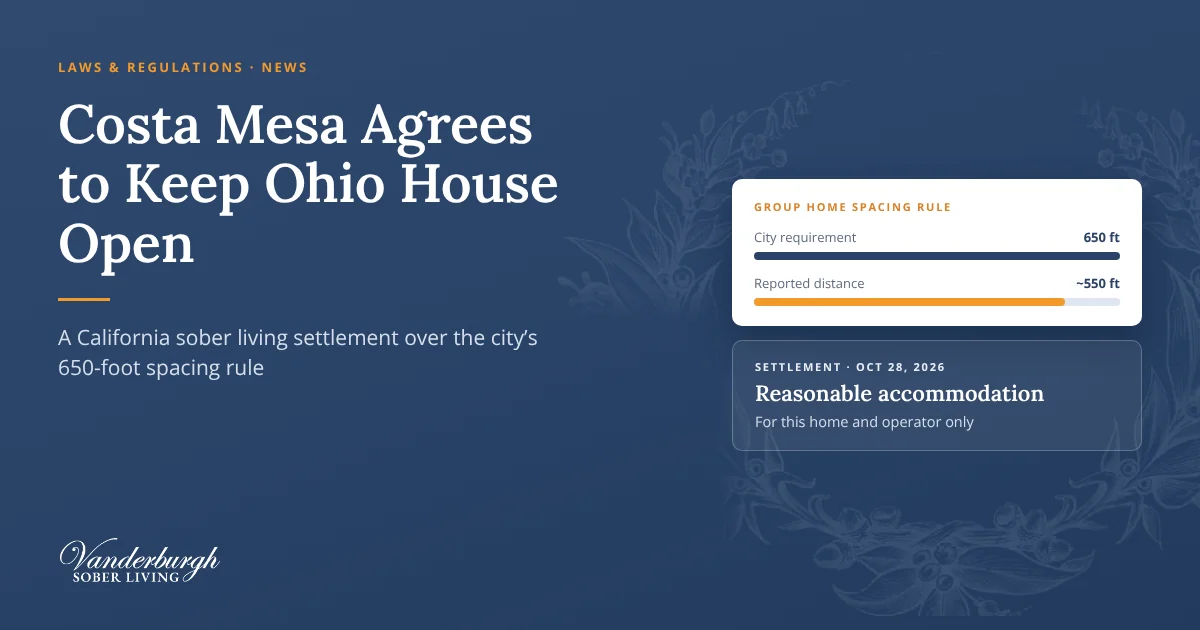
- The Ohio House, LLC v. City of Costa Mesa (9th Cir. 2024): Upheld a permit requirement and a 650-foot separation rule for sober living homes where the scheme gave disabled-serving homes pathways unavailable to other group-living uses. A separation rule is not automatically unlawful, which is the reason to stay outside the classification that triggers Oakland’s.
- Pacific Shores Properties, LLC v. City of Newport Beach, 730 F.3d 1142 (9th Cir. 2013): Held that an ordinance facially aimed at group homes for people recovering from addiction is judged on discriminatory intent and needs no comparator, and that permit costs and lost business are compensable injury.
- HUD and DOJ joint statement on state and local land use laws (November 2016): Sets the six-element reasonable accommodation test and calls out blanket spacing rules applied only to group homes, and notes a request need not be in writing or cite the Fair Housing Act.
Three moves follow from that file for anyone opening in Oakland today.
- Keep the house outside Residential Care by running it as a household with no state license, no on-site care, and no 24-hour supervision, and document that in the resident agreement and house rules.
- Order written zoning verification on the address before signing, so the classification is the City’s position rather than your reading of it.
- If the City ever does apply the 300-foot rule, OMC chapter 17.131 expressly lists distance separation requirements as a Category B reasonable accommodation request, decided by the Planning Director within 30 days of a complete application, with the materials kept confidential.
Unincorporated Alameda County: A Broader Definition Outside the City Line
The unincorporated county covers Castro Valley, San Lorenzo, Ashland, Cherryland, Fairview, Sunol, and the Fairmont area, and none of it is governed by the Oakland Planning Code. Alameda County’s zoning definitions are broader than Oakland’s in two ways that matter.
- Medical or residential care facility: Means a residential care home as licensed by the State Department of Social Services, Community Care Licensing Division, and the term also includes group living quarters housing persons placed by an authorized agency for rehabilitation purposes. That second clause reaches homes Oakland’s definition does not.
- Boarding house: Means a place where four or more persons are provided with lodging or meals or both, and the term includes a lodging house or rooming house. The threshold is four persons rather than Oakland’s four paying guests within a one-family dwelling.
- What follows: Confirm which jurisdiction a parcel sits in before touring it, because an address with an Oakland mailing address is not necessarily inside Oakland city limits, and the county answer can be different on the same street.
How your home gets classified, where Fair Housing applies, and what to do if the city says no.
Oakland Fire and Building Code Rules for Sober Living Homes
A single-family house in Oakland running as an unlicensed sober living home stays Group R-3 under the 2025 California Building Code, which is the same classification it carried as a family home. Three lines decide whether that holds.
- The occupant count: Group R-3 covers nontransient congregate living facilities with 16 or fewer occupants, and more than 16 moves the building to Group R-2 under the 2025 California Building Code chapter 3. A 14-bed house sits under that ceiling with room to spare.
- Licensed care: California does not use Group I-1 and routes licensed 24-hour care into R-3.1 at six or fewer clients and R-4 above that. A house that takes a license also takes a new occupancy group and the construction obligations that come with it.
- The certificate of occupancy: A converted garage, an unpermitted bedroom, or a prior care-facility use all attach to the building rather than to the owner, and they surface when records are pulled. Resolve them with the One-Stop Permit Center before the first inspection, not after.
Alarms are where first-time operators fall short of both the code and the CCAPP site visit, and the rules below apply to every dwelling in Oakland regardless of who lives in it.
| Requirement | What the rule says | Authority |
|---|---|---|
| Smoke alarms | Required in every dwelling intended for human occupancy, including one- and two-unit dwellings and lodging houses. New work, alterations, and additions pull the house up to current placement and interconnection requirements. | Health and Safety Code 13113.7; California Residential Code R314 |
| Carbon monoxide alarms | Required in any dwelling unit with a fossil-fuel appliance, a fireplace, or an attached garage. The statutory deadlines have long passed, so a house without one is already out of compliance. | Health and Safety Code 17926; California Residential Code R315 |
| Fire sprinklers | Required in new one- and two-family dwellings. An existing non-sprinklered house is not forced to retrofit, and adding residents while the building stays Group R-3 does not by itself trigger sprinklers. A change of occupancy to R-2, R-4, or R-2.1 does. | California Residential Code R313.2 and OSFM Information Bulletin 17-001; California Building Code 903.2.8 |
| Code edition in force | Oakland adopted the 2025 California Building Standards Code effective January 1, 2026, with local amendments in OMC chapters 15.04 and 15.06, and adopted the 2025 California Fire Code as OMC chapter 15.12 by emergency ordinance on December 16, 2025. | City of Oakland building code adoption; Council File 26-0287 |
| State fire clearance | Required of a prospective licensee of a community care facility or residential care facility for the elderly, from the local fire enforcing agency or the State Fire Marshal. An unlicensed sober living home is not a licensed facility and does not trigger it. | Health and Safety Code 13235 |
| Wildland interface construction | Oakland inspects roughly 26,000 parcels a year in its Wildfire District, and new buildings in a Very High Fire Hazard Severity Zone carry the ignition-resistant construction requirements of California Building Code chapter 7A. Check the hazard layer before buying in the hills. | Oakland Wildfire District inspections; CAL FIRE hazard severity zone maps |
| Inspection and permits | The Oakland Fire Prevention Bureau inspects against the California Fire Code and the local amendments in chapter 15.12, with walk-in hours at the One-Stop Permit Center and virtual engineer consultations. Confirm whether your address sits on the department’s annual inspection list. | Oakland Fire Prevention Bureau, (510) 238-3462 |
| CCAPP standards | Egress, extinguishers, tested alarms, and the written documentation behind them are inspected against the NARR standards CCAPP applies. These are certification standards rather than code mandates, and an inspector will still expect them on file. | CCAPP recovery residence certification |
Nobody prompts a single-family house in Oakland to comply. No annual inspection arrives, no license renewal forces the question, and the burden sits entirely with the operator until something goes wrong or a certification inspector asks. Work out how many beds the house can actually hold before the inspection rather than after, because bedroom size, egress, and bathroom count decide it and every one of those is expensive to change once residents have moved in.
Alarms, egress, extinguishers, and the documentation an inspector expects on file.
Get the checklist freeNo cost, no obligation. Unsubscribe in one click.How Much Does It Cost to Open a Sober House in Oakland?
The California reference model prices a 14-bed home at $52,572 to $55,830 on the lease path and $210,937 on the purchase path, and neither is an all-in total, because general liability insurance, the CCAPP application fee, and any code upgrades a building official requires have no authoritative published price. Oakland changes exactly three of those inputs: the purchase anchor, the lease anchor, and the operating reserve that follows from them. Entity fees, furnishings, supplies, utility deposits, and marketing hold at the statewide figures.
| Line item | Oakland figure | Source |
|---|---|---|
| Entity, first-year state costs | $890, being $70 for Articles of Organization, $20 for the initial Statement of Information, and the $800 minimum franchise tax | California Secretary of State fee schedule; Franchise Tax Board |
| Oakland business tax registration | $95, being an $88 registration fee, $4 state disability access fee, and $3 recordation and technology fee, due within 30 days of the start date | City of Oakland business tax FAQs |
| Oakland business tax, annual | $13.95 per $1,000 of gross rental receipts in Class O, a flat rate. On the reference model’s net rent income of $122,808 a year that is roughly $1,713, estimated | City of Oakland business tax rate schedule |
| State license | $0, because a peer-based home with no treatment on site is not licensable. A licensed treatment facility carries a separate DHCS fee schedule entirely | California HCD group home technical advisory |
| CCAPP certification | Application fee not published and quoted on request, plus a $100 site-visit cancellation fee and a $100 reinspection fee where they apply | CCAPP recovery residence certification |
| Lease anchor, four-bedroom | $4,250 a month, the fiscal year 2027 fair market rent for the Oakland-Fremont HUD metro area effective October 1, 2026, against $3,592 for a three-bedroom | HUD FY2027 fair market rent schedule |
| Lease upfront, two to three months | $8,500 to $12,750, estimated, at the four-bedroom fair market rent | HUD FY2027 fair market rent schedule |
| Purchase anchor | $1,285,000, the Alameda County median sale price for an existing single-family home in August 2026, against a statewide median of $901,420 | California Association of Realtors, August 2026 sales and price report |
| Down payment at 20 percent | $257,000, estimated, against $158,695 in the statewide model | California Association of Realtors applied to the state model’s 20 percent assumption |
| Property tax, annual | $16,421, estimated, at the 1.2779 percent rate for tax rate area 17-001, the modal City of Oakland rate for fiscal year 2025-26 | Alameda County property tax rates; Alameda County Auditor-Controller |
| Operating reserve, three months | $28,062 on the purchase path and $16,443 on the lease path, both estimated, against $17,865 and $13,467 statewide | Derived from the state model’s monthly stack with the Oakland mortgage, tax, and rent lines substituted |
| Furnishings, supplies, deposits, and marketing | $31,699 combined, unchanged: $26,220 furniture and setup, $3,934 supplies and linens, $843 utility deposits, and $702 marketing and launch | Restated from the California startup cost model, which scales these lines by the statewide cost-of-living index |
Two adjustments turn the statewide model into an Oakland budget.
- Purchase path: Swapping the model’s $158,695 down payment for Oakland’s $257,000 and the reserve for $28,062 lifts the priced subtotal from $210,937 to roughly $319,439, estimated. That figure still excludes general liability, the CCAPP application fee, and any code or safety upgrade the building official requires.
- Lease path: The lease anchor moves from $3,258 to $4,250 a month, lifting the priced subtotal from $52,572 to $55,830 statewide to roughly $57,532 to $61,782 in Oakland, estimated. The $4,250 fair market rent is the figure to test a landlord’s quote against, and the gap between the two paths here is more than a quarter of a million dollars.
Alameda County does put real money into recovery residences, and none of it arrives before a house opens.
- Opioid settlement contract augmentations: The county added $740,105 across three recovery residence and residential treatment contractors in May 2024, drawn from a settlement of up to $80 million. These are augmentations to existing county contracts rather than an open grant program.
- Recovery residence bed contracts: ACBH contracts with providers to hold beds, and the board’s February 2026 fiscal update names recovery residence and residential treatment bed expansion as a funded implementation activity. Access runs through county contracting, which favors established providers.
- CalAIM Housing Community Supports: The county’s housing benefit works through 24 contracted community organizations and pays deposits and transition navigation for Medi-Cal members. It funds the resident’s move rather than the operator’s startup.
None of that is startup capital. Every one of those channels pays for a bed once a resident is in it or flows through a contract that takes a year or more to secure, so a budget that assumes county money at opening is a budget that runs out. Plan the opening on your own capital and treat county contracts as a year-two revenue question.
California guideCalifornia Recovery Housing Funding: Why It Rarely Works the Way Operators ExpectBlock grants, opioid settlement dollars, Medicaid, and county contracts: what reaches a sober living home and what does not.→Is a Sober Living Home Profitable in Oakland?
Yes on the lease path, and only with strong occupancy on the purchase path. The California reference model runs a 14-bed home at $1,040 per bed to $10,959 in total monthly revenue against $5,955 in priced monthly operating expenses, leaving $5,004 in net operating income before the owner’s labor, a 45.7 percent net margin, with break-even near 5 of 14 beds. Oakland changes two lines in that stack and nothing else: the mortgage and the property tax.
That score is a statewide reading, and Oakland sharpens both halves of it. Demand here is above the state average on every indicator in the table near the top of this page, and the asset is more expensive than the statewide median the model assumes, so the return on capital is thinner in Oakland than the statewide 2 suggests. The table below restates the California model and scales only the property lines.
| Line | California reference model (14 beds) | Oakland adjustment (estimated) |
|---|---|---|
| Bed count | 14 | Unchanged |
| Rent per bed, monthly | $1,040 | Unchanged |
| Potential rent at full occupancy | $14,560 | Unchanged |
| Less house mentor bed | ($1,040) | Unchanged |
| Less membership and scholarship allowance | ($1,040) | Unchanged |
| Less vacancy allowance at 18 percent | ($2,246) | Unchanged |
| Net rent income | $10,234 | Unchanged |
| Plus intake fee and laundry income | $725 | Unchanged |
| Total revenue | $10,959 | Unchanged |
| Mortgage principal and interest | $4,079 on a $634,781 loan | $6,606, estimated, on a $1,028,000 loan after 20 percent down on the $1,285,000 Alameda County median sale price, at the same 6.66 percent 30-year Freddie Mac survey rate the model uses |
| Real estate taxes | $496 | $1,368, estimated, at the 1.2779 percent rate for tax rate area 17-001, the modal City of Oakland rate |
| Property insurance | $149 | Unchanged |
| Utilities, screens, supplies, maintenance, admin, and marketing | $1,231 | Unchanged |
| Total priced monthly operating expenses | $5,955 | $9,354, estimated |
| Net operating income, before owner’s labor | $5,004 | $1,605, estimated |
| Net margin | 45.7 percent | 14.6 percent, estimated |
| Break-even occupancy | Near 5 of 14 beds | Near 9 of 14 beds, estimated |
That adjustment holds revenue, per-bed price, vacancy, and every non-property expense constant, and it is an estimate rather than a quote. The resulting margin is 14.6 percent on the purchase path, against 45.7 percent statewide, and the house needs nine of its fourteen beds filled before it covers its own costs. At eight beds it is still roughly $309 a month short.
- The lease path: Leasing at the $4,250 four-bedroom fair market rent instead of carrying an Oakland mortgage removes the single line that destroys this model, and it is the reason most first-time operators here lease first and buy later.
- County-funded beds: Alameda County pays for recovery residence placements through one screening line, and a contracted bed is worth more to the margin than any expense a new operator can cut.
- Occupancy discipline: The gap between five and nine break-even beds means an Oakland house cannot absorb a slow quarter the way the statewide model can, which puts referral relationships ahead of cost control.
- Bed count: The model assumes 14 beds, and only 11.3 percent of Oakland housing units have four or more bedrooms, so a house that reaches 10 beds rather than 14 changes the answer before any of the above applies.
No real property matches the model, and finding out how far off yours sits takes a few minutes.
Will your property pencil out?
Get a custom projection for your California property, then compare it with typical returns.
Get my projectionFree calculator with your property’s numbers.See California profitabilityRealistic revenue, operating costs, and margins in California.How to Get Residents for a Sober Living Home in Oakland
Alameda County Behavioral Health controls publicly funded placement in Oakland through a single screening line, and the courts, probation, and the homelessness system fill most of the rest. Three doors matter more than any marketing a new operator can do.
- The Substance Use Access and Referral Helpline, (844) 682-7215: Screens Alameda County adults by phone in about 15 minutes, weekdays 8am to 6pm, and its staff provide ongoing care navigation for people admitted into residential treatment or recovery residence services. This is the county’s front door and the number every discharge planner uses.
- ACBH Recovery Residence programs: The county names Recovery Residence as its own level in the substance use continuum of care, defined as sober living homes while in outpatient treatment provided off-site. Beds are held under county contracts with providers, and the county augmented three of those contracts by $740,105 in opioid settlement money in 2024.
- Certification and county contracting: Alameda County’s stated requirement for bidders on recovery residence and residential contracts is DHCS Drug Medi-Cal certification, not CCAPP certification. CCAPP certification still matters here, because its registry is the screen courts and discharge planners consult, and because it is the standard NARR applies, but it is not what the county contract asks for.
Twelve organizations follow, public agencies first, because in Alameda County the public system places more people into sober living than the private one does.
| Organization | Type | How residents reach you |
|---|---|---|
| Alameda County Substance Use Access and Referral Helpline | County public payer | Call (844) 682-7215. Staff screen the caller, then place them into a county recovery residence bed and stay with the case afterwards. This is the single county front door. |
| Alameda County Behavioral Health, Recovery Residence programs | County public payer | The program line that funds and holds the beds the helpline places into, and the office a new operator asks about contracting. |
| Alameda County Superior Court Drug Court | Court | Defense counsel requests a Drug Court date at the Wiley W. Manuel Courthouse. Accepted participants receive temporary sober housing and housing case management as a program benefit. |
| Alameda County Superior Court Reentry Court | Court | Post-release participants are case-managed into treatment and housing as a condition of the calendar. |
| Alameda County Superior Court Veterans Treatment Court | Court | Justice-involved veterans are linked to VA and county treatment and housing in place of custody. |
| Alameda County Probation, Reentry and Public Safety Realignment | County probation | AB 109 and post-release supervision officers refer clients into residential and recovery residence beds funded by AB 109 and Proposition 47. |
| Alameda County Health, Housing and Homelessness Services | County continuum of care lead | Residents reach coordinated entry through 2-1-1 or a housing resource center access point, which assesses them and refers to interim or permanent housing. |
| Alameda County Housing Community Supports | Medi-Cal housing benefit | Twenty-four contracted community organizations provide housing transition navigation and deposits for Medi-Cal members, and the navigator places the member. |
| VA Northern California Homeless Veteran Care | Federal agency | Veterans access HUD-VASH, Grant and Per Diem, and residential treatment through the homeless veteran care line, with the Oakland Vet Center handling readjustment counseling and warm handoffs. |
| Wilma Chan Highland Hospital, Alameda Health System | Public hospital | Emergency department and inpatient discharge planners refer to Cherry Hill detox and to the county helpline for post-acute recovery residence placement. |
| Alameda County Social Services Agency | County benefits | Medi-Cal, CalFresh, and General Assistance eligibility, which is what makes a resident payable in a county-funded bed. |
| Options Recovery Services | Nonprofit provider | Operates sober living housing directly under a county recovery residence contract, and refers clients stepping down from its own outpatient services. |
| Center Point, Inc. | Nonprofit provider | Runs residential services and operates the Alameda Helpline contact line, discharging clients into sober living. |
| Horizon Services, Inc. | Nonprofit provider | Operates Cherry Hill Detoxification Services in San Leandro, 32 licensed beds and the most common on-ramp to a sober living bed in the county. |
| Magnolia Women’s Recovery Programs | Nonprofit provider | Women’s residential treatment with 20 licensed beds in Oakland, referring to recovery residences at discharge. |
| Bonita House | Nonprofit provider | Residential treatment and housing for people with co-occurring disorders, referring to sober living at discharge. |
| Building Opportunities for Self-Sufficiency | Nonprofit provider | A Housing Community Supports contractor that also runs a pre-trial program placing justice-involved clients into housing. |
| Bay Area Community Services | Nonprofit provider | Runs housing solutions and residential programs in Oakland and places clients into interim and permanent housing under county contracts. |
| La Familia Counseling Service | Nonprofit provider | Diversion and reentry case managers place justice-involved clients into housing, and the agency is an opioid settlement capital grantee. |
The recovery fellowships move people too, and neither refers formally. The East Bay Intergroup of Alcoholics Anonymous maintains a 24-hour line and a meeting directory covering Oakland and the rest of the East Bay, and the Northern California Region of Narcotics Anonymous runs a regional helpline. Meeting secretaries and sponsors are how a great many people find a house, so being known in the rooms near your address does more than any listing.
If you came here looking for a bed rather than a business plan, the next step is short.
Take the next step
Apply, browse homes, or search the national directory.
Apply onlineGet a call back within 24 hours.View VSL homesSee Chartered recovery homes and find the right fit.Search the national directoryCertified sober houses anywhere in the US.Or call (844) 762-3747, weekdays 8a to 5p.
Common Mistakes When Opening a Sober House in Oakland
These are the errors that show up in Oakland homes that struggle in year one, and every one of them ties back to something earlier on this page.
- Signing before the classification is in writing: The Planning Code’s undefined phrase institutional living arrangement is the one place an Oakland house is exposed, and a written zoning verification settles it for a fee. Operators who skip it find out what a planner thinks after the lease is signed.
- Assuming a license makes the house safer: Taking a state license moves the building into a new occupancy group, brings construction obligations, and attaches Oakland’s 300-foot separation rule even at six or fewer residents. The unlicensed peer-run house is the less regulated path here, not the riskier one.
- Planning around the statewide purchase figure: The California model’s $158,695 down payment becomes $257,000 in Alameda County, and the reserve rises with it. A budget built on the statewide number is short by roughly $108,000 before the first resident arrives.
- Buying in the hills without checking the hazard layers: The East Oakland hills hold the city’s second-highest share of four-bedroom houses and sit inside mapped very high fire hazard and landslide zones, which raise insurance, bring annual vegetation inspection, and leave residents dependent on two bus lines.
- Opening cold on referrals: Alameda County places publicly funded residents through one screening line, and a house nobody at that line has heard of waits. The calls, the tours, and the registry listing belong in the weeks before the mortgage starts.
- Skipping the neighbors: Oakland has no sober living ordinance and no complaint machinery aimed at recovery housing, which is a condition worth protecting. A block that cannot reach anybody at the house is how a city that has never regulated this starts.
The California book and the Blueprint carry the templates, checklists, and worked numbers behind every step above.
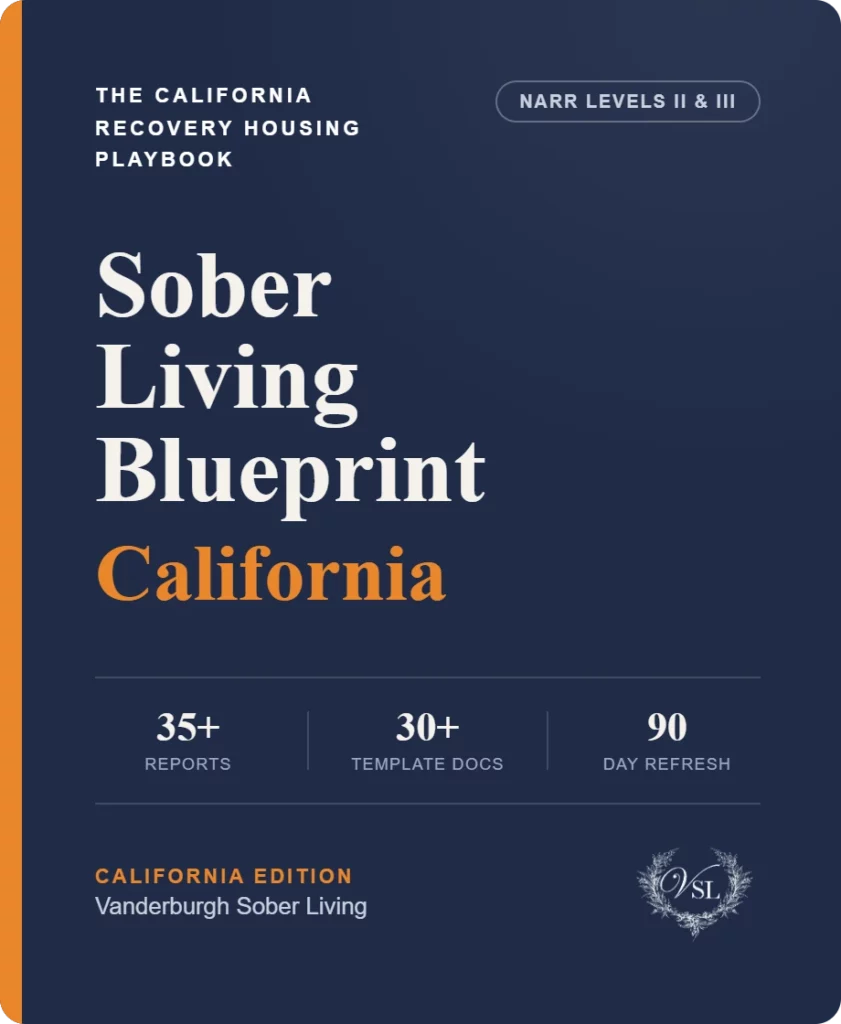
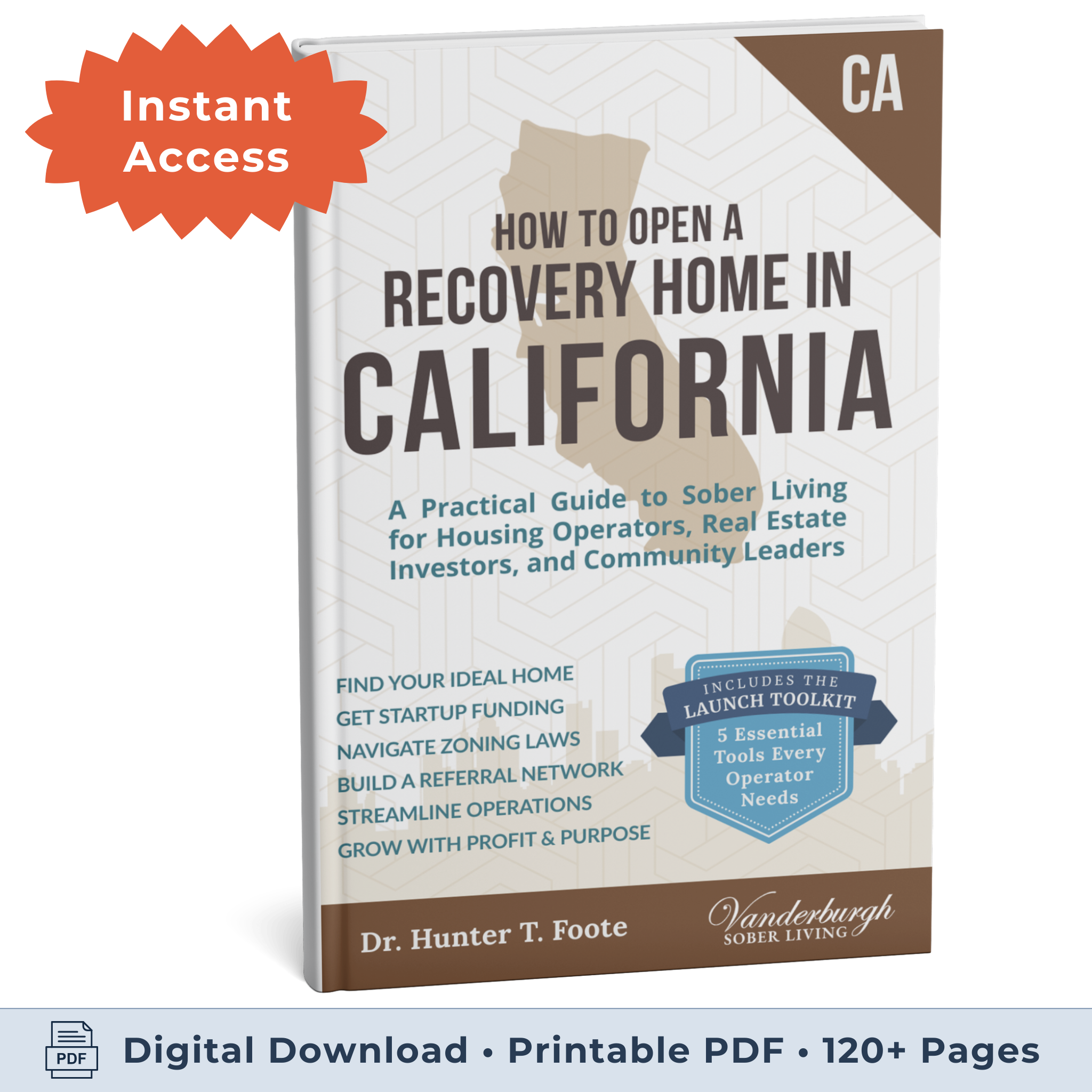
The book gives you the map to open a home. When you’re ready to launch, certify, and sustain, the Blueprint is the full playbook covering funding, legal, insurance, and operations.
Frequently Asked Questions About Opening a Sober House in Oakland
Do you need a license to open a sober living home in Oakland?
No. California does not license sober living homes, and Oakland issues no license of its own for one. A peer-based home that provides no treatment on site falls outside DHCS licensure, and providing counseling, detoxification, or recovery planning at the house is what would make a license mandatory. Business tax registration with the City still applies.
Can a sober living home operate in an Oakland single-family neighborhood?
Yes. An unlicensed sober living home run as a household is a Permanent Residential Activity under Oakland Planning Code 17.10.110, permitted by right in RH-1 through RH-4, RD, RM-1 through RM-4, and RU-1 through RU-5, with no conditional use permit. The code caps neither unrelated adults nor household size, though renting more than four locked individual rooms turns the house into rooming units.
Does Oakland’s 300-foot separation rule apply to a sober living home?
Only to state-licensed facilities. Oakland Planning Code 17.103.010.B.1 bars a Residential Care Residential Activity within 300 feet of another, and 17.10.112 reaches only facilities that require or hold a state license and provide 24-hour primarily nonmedical care. An unlicensed peer-run home meets neither condition, so the rule does not reach it, while a state-licensed facility for six or fewer residents still carries it.
How much does it cost to open a sober house in Oakland?
Roughly $57,532 to $61,782 on the lease path and about $319,439 on the purchase path for a 14-bed home, both estimated by adjusting the California reference model’s property lines. The difference is the down payment: 20 percent of Alameda County’s $1,285,000 median sale price is $257,000. None of those figures includes general liability insurance, the CCAPP application fee, or code upgrades, which have no published price.
Is CCAPP certification required to get referrals in Alameda County?
Not as a county contracting requirement. Alameda County’s stated requirement for bidders on recovery residence contracts is DHCS Drug Medi-Cal certification. CCAPP certification still matters in practice, because CCAPP is California’s only NARR affiliate and its registry is the screen courts, discharge planners, and referral partners consult.
Is a sober living home profitable in Oakland?
On the lease path, yes. On the purchase path the California model’s $5,004 monthly net operating income falls to an estimated $1,605 once the Oakland mortgage and property tax replace the statewide figures, a 14.6 percent margin, with break-even moving from near 5 of 14 beds to near 9. Leasing at the $4,250 four-bedroom fair market rent removes the line that does the damage.
Where do residents come from in Oakland?
Mostly through Alameda County Behavioral Health’s Substance Use Access and Referral Helpline at (844) 682-7215, which screens callers and places them into county recovery residence beds. Drug Court at the Wiley W. Manuel Courthouse, AB 109 probation, coordinated entry through 2-1-1, and discharges from the county’s 401 licensed residential treatment beds fill most of the rest.
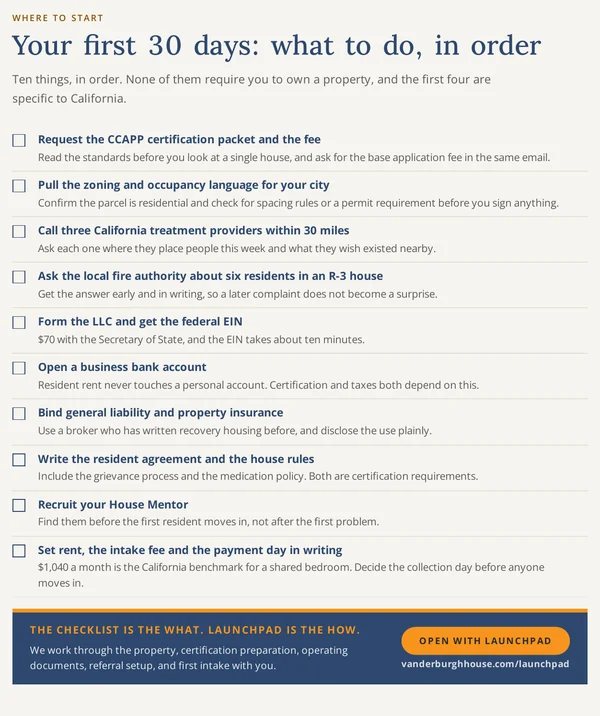
Your Oakland Sober House Startup Checklist
Every item below is covered somewhere on this page, and none of them is optional in Oakland. Work them in order, because the early ones decide whether the later ones are worth doing.
These four cover the ground every operator meets in the first year, whichever city they open in.
How VSL Helps You Open a Sober House in Oakland
Vanderburgh Sober Living charters independently operated recovery homes into a cooperative network, and many of its Chartered Operators opened their first house with no prior experience in the field. The points where this page gets difficult are the points VSL was built around: reading a city code that never mentions sober living, deciding between leasing and buying in a market where the two paths differ by a quarter of a million dollars, writing governing documents a certifying body will accept, and getting known by a county referral system before the first month’s rent comes due.
Two routes exist. The self-guided Launchpad program works through the startup sequence at your own pace with the templates and worked numbers included, and the Mastery Program adds hands-on support through startup, certification, and the first year of operating. If you have a specific Oakland address in hand, or you are weighing a $4,250 lease against a $1,285,000 purchase, that is a conversation worth having before you sign. Reach us through the VSL contact form.
Start your sober house
Pick the path that fits where you are in the process.
Download the free guidePath to Purposeful Recovery Housing, by Dr. Hunter T. Foote.Explore the Mastery ProgramHands-on startup, certification, and operating support.See how starting with VSL worksThe opportunity, the community, and what a Charter includes.Prefer to talk now? Call (844) 762-3747, weekdays 8a to 5p.
Educational only; not legal, financial, or medical advice. Fees, rents, and rules change, and the Oakland adjustments above are estimates built on the California reference model. Confirm current requirements with Oakland, Alameda County, and qualified professionals before you sign or spend.
Research & Sources
- Foote, H. T. (2026). Vanderburgh Sober Living Operating Climate Index, 2026 Edition. Vanderburgh Sober Living. https://www.vanderburghhouse.com/research/operating-climate-index-2026/
- Alameda County Auditor-Controller Agency. (2026). Property tax frequently asked questions. https://auditor.alamedacountyca.gov/tax-faqs/
- Alameda County Behavioral Health. (2026). Alameda County Substance Use Access and Referral Helpline. Alameda County Health. https://health.alamedacountyca.gov/details-alameda-county-substance-use-access-referral-helpline/
- Alameda County Behavioral Health. (2026). Recovery residence programs. Alameda County Health. https://health.alamedacountyca.gov/program/recovery-residence-programs/
- Alameda County Behavioral Health. (2026). Substance use continuum of care. Alameda County Health. https://health.alamedacountyca.gov/program/alameda-county-substance-use-access-referral-helpline/
- Alameda County Behavioral Health Care Services. (2018). Request for proposal 18-01, substance use disorder services, addendum 3. https://bhcsproviders.acgov.org/docs/RFP/2018/18-01_SUD_Serv_Addendum_3.pdf
- Alameda County Board of Supervisors. (2024, May 14). Health care services regular calendar: Recovery residence and residential treatment contract augmentations. http://www.acgov.org/board/bos_calendar/documents/DocsAgendaReg_05_14_24/HEALTH%20CARE%20SERVICES/Regular%20Calendar/BHCS_367068.pdf
- Alameda County Board of Supervisors. (2025, September 15). AB 1037 public health and substance use disorder legislative analysis. http://www.acgov.org/board/bos_calendar/documents/DocsAgendaReg_9_15_25/PAL/AB_1037_Public_Health_SUD.pdf
- Alameda County Board of Supervisors. (2026, February 26). Alameda County Behavioral Health Department opioid settlement fiscal update. http://www.acgov.org/board/bos_calendar/documents/DocsAgendaReg_2_26_26/GENERAL%20ADMINISTRATION/Regular%20Calendar/Item_1_ACBHD_Opportunites_Collab_unincorporated.pdf
- Alameda County Health. (2024). Alameda County 2024 point-in-time homelessness report. Housing and Homelessness Services. https://homelessness.acgov.org/homelessness-assets/docs/infographic/Alameda%20County%202024%20PIT%20Homelessness%20Report%20-%20FINAL%20.pdf
- Alameda County Health. (2026). Housing and homelessness services. https://homelessness.acgov.org/about.page
- Alameda County Health. (2026). Housing community supports. https://health.alamedacountyca.gov/program/housing-community-supports/
- Alameda County Probation Department. (2026). Reentry and public safety realignment. https://probation.acgov.org/adult-field-services/reentry-and-public-safety-realignment.page
- Alameda County Social Services Agency. (2026). Health and food services. https://www.alamedacountysocialservices.org/our-services/Health-and-Food/index
- Alameda County Superior Court. (2026). Collaborative courts. https://www.alameda.courts.ca.gov/divisions/collaborative-courts
- Alameda County Superior Court. (2026). Drug court. https://www.alameda.courts.ca.gov/divisions/collaborative-courts/drug-court
- Alameda County Superior Court. (2026). Reentry court. https://www.alameda.courts.ca.gov/divisions/collaborative-courts/reentry-court
- Alameda County Superior Court. (2026). Veterans treatment court. https://www.alameda.courts.ca.gov/divisions/collaborative-courts/veterans-treatment-court
- Alameda County Tax Collector. (2026). Property tax rates 2025. Alameda County Open Data. https://data.acgov.org/datasets/8a6a0187bf3148b5a180c4bf6aad8f01_0/about
- Alameda County. (2026). Code of ordinances title 17, chapter 17.04: Definitions. https://library.municode.com/ca/alameda_county/codes/code_of_ordinances?nodeId=TIT17ZO_CH17.04DE
- Alameda Health System. (2026). Wilma Chan Highland Hospital. https://www.alamedahealthsystem.org/locations/highland-hospital/
- AC Transit. (2025). Ridership, buses, and service. https://www.actransit.org/ridership
- AC Transit. (2026). Tempo bus rapid transit project. https://www.actransit.org/tempo/project
- Bay Area Community Services. (2026). Housing solutions. https://bayareacs.org/housing-solutions/
- Bay Area Rapid Transit. (2026). Monthly ridership snapshot, July 2026. https://www.bart.gov/sites/default/files/2026-08/202607%20Monthly%20Ridership%20Snapshot.pdf
- Bay Area Rapid Transit. (2026). Stations. https://www.bart.gov/stations
- Bonita House. (2026). Residential treatment. https://bonitahouse.org/residential-treatment/
- Building Opportunities for Self-Sufficiency. (2026). Housing and community supports. https://www.self-sufficiency.org/housing-and-community-supports
- California Association of Realtors. (2026, September 16). August 2026 home sales and price report. https://www.car.org/en/aboutus/mediacenter/newsreleases/2026releases/august2026sales
- California Association of Realtors. (2026). County sales and price activity. https://www.car.org/marketdata/data/countysalesactivity
- California Consortium of Addiction Programs and Professionals. (2026). Start a recovery residence. https://ccapprecoveryresidences.org/start-recovery-residence/
- California Department of General Services. (2026). California building standards code, 2025 edition. Building Standards Commission. https://www.dgs.ca.gov/bsc/codes
- California Department of General Services. (2025). 2025 part 2 chapter 3: Occupancy classification and use. Building Standards Commission. https://www.dgs.ca.gov/BSC/Resources/2025-Title-24-California-Code-Changes/2025-Part-2-Chapter-3-Occupancy-Classification-and-Use
- California Department of Health Care Services. (2026). Substance use disorder recovery treatment facilities dataset. DHCS GIS Data Hub. https://gis.dhcs.ca.gov/datasets/CADHCS::sud-recovery-treatment-facilities
- California Department of Housing and Community Development. (2022). Group home technical advisory. https://www.hcd.ca.gov/sites/default/files/docs/planning-and-community/group-home-technical-advisory-2022.pdf
- California Franchise Tax Board. (2026). Limited liability company. https://www.ftb.ca.gov/file/business/types/limited-liability-company/index.html
- California Health and Safety Code section 1566.3. (2015). https://leginfo.legislature.ca.gov/faces/codes_displaySection.xhtml?lawCode=HSC§ionNum=1566.3
- California Health and Safety Code section 11834.23. https://leginfo.legislature.ca.gov/faces/codes_displaySection.xhtml?lawCode=HSC§ionNum=11834.23
- California Health and Safety Code section 1568.0831. (2015). https://leginfo.legislature.ca.gov/faces/codes_displaySection.xhtml?lawCode=HSC§ionNum=1568.0831
- California Health and Safety Code section 13113.7. https://law.justia.com/codes/california/code-hsc/division-12/part-2/chapter-1/article-1/section-13113-7/
- California Health and Safety Code section 13235. https://codes.findlaw.com/ca/health-and-safety-code/hsc-sect-13235/
- California Health and Safety Code section 17926. https://codes.findlaw.com/ca/health-and-safety-code/hsc-sect-17926/
- California Office of the State Fire Marshal. (2025). Fire hazard severity zone maps. CAL FIRE. https://osfm.fire.ca.gov/what-we-do/community-wildfire-preparedness-and-mitigation/fire-hazard-severity-zones/fire-hazard-severity-zones-maps
- California Office of the State Fire Marshal. (2017). Information bulletin 17-001: Residential fire sprinkler requirements. https://www.hcd.ca.gov/policy-research/docs/fire-marshal-ib.pdf
- California Secretary of State. (2018). Business entities fee schedule. https://bpd.cdn.sos.ca.gov/pdf/be-fee-schedule-062018.pdf
- Center Point, Inc. (2026). Alameda helpline. https://www.cpinc.org/services/other-services/alameda-helpline/
- Center Point, Inc. (2026). Residential services. https://www.cpinc.org/residential-services/
- City of Edmonds v. Oxford House, Inc., 514 U.S. 725 (1995). https://supreme.justia.com/cases/federal/us/514/725/
- City of Oakland. (2023). General plan update phase 1 planning code amendments. Planning and Building Department. https://www.oaklandca.gov/Planning-Building/General-Plan-Neighborhood-Plans/City-of-Oakland-Current-General-Plan-Elements/General-Plan-Update-Phase-1-Planning-Code-Amendments
- City of Oakland. (2023). Housing element racial equity impact analysis. https://www.oaklandca.gov/files/assets/city/v/1/planning-amp-building/documents/sp/gp/housing-element/housing-element-reia-1.6.23_final.pdf
- City of Oakland. (2023). Zoning update committee staff report, case GP21002 and ZA23002. https://www.oaklandca.gov/files/assets/city/v/1/public-meetings/zoning-update-committee/2023/gp21002-general-plan-update-final-staff-report-zuc-031523signed.pdf
- City of Oakland. (2023). 2023-2031 adopted housing element. https://www.oaklandca.gov/Planning-Building/General-Plan-Neighborhood-Plans/City-of-Oakland-Current-General-Plan-Elements/Housing-Element/2023-2031-Adopted-Housing-Element
- City of Oakland. (2026). Business tax applications. https://www.oaklandca.gov/services/business-tax-applications-1
- City of Oakland. (2026). Business tax frequently asked questions. https://cao-94612.s3.amazonaws.com/documents/Business-Tax-FAQs.pdf
- City of Oakland. (2026). Fire code and inspections. Oakland Fire Department. https://www.oaklandca.gov/Public-Safety-Streets/Fire/Fire-Code-Inspections
- City of Oakland. (2026). Fire prevention bureau permitting services. https://www.oaklandca.gov/Public-Safety-Streets/Fire/Fire-Prevention-Bureau-Permitting-Services
- City of Oakland. (2026). Interactive zoning map. Oakland GIS. https://gismaps.oaklandca.gov/portal/apps/experiencebuilder/experience/?id=a2ab7ee345ba4d1681700bf60681d364
- City of Oakland. (2026). Neighborhood and citywide plans. https://www.oaklandca.gov/Planning-Building/General-Plan-Neighborhood-Plans/Neighborhood-and-Citywide-Plans
- City of Oakland. (2026). Oakland adoption of the 2025 California building codes. https://www.oaklandca.gov/Planning-Building/Building-Construction-Permits-Inspections/Building-Codes/Oakland-Adoption-of-2025-California-Building-Codes
- City of Oakland. (2026). One-stop permit center. https://www.oaklandca.gov/Planning-Building/Permit-Process-Overview/One-Stop-Permit-Center-In-Person-Online-Services
- City of Oakland. (2026). Planning and zoning controls map service. Oakland GIS. https://gismaps.oaklandca.gov/server/rest/services/Planning_and_Zoning_Controls/MapServer
- City of Oakland. (2026). Priority neighborhoods map service. Oakland GIS. https://gismaps.oaklandca.gov/server/rest/services/Priority_Neighborhoods/MapServer
- City of Oakland. (2026). Progressive business tax rate schedule. https://cao-94612.s3.us-west-2.amazonaws.com/documents/Progressive-Tax-Rate-Schedule.pdf
- City of Oakland. (2026). Request zoning information for your project. https://www.oaklandca.gov/services/request-zoning-information-2
- City of Oakland. (2026). Wildfire district inspections. https://www.oaklandca.gov/Public-Safety-Streets/Fire/Wildfire-District-Inspections
- City of Oakland. (2026, January 1). Ordinance adopting the 2025 California fire code, council file 26-0287. https://oakland.legistar.com/LegislationDetail.aspx?GUID=7FC0D1DB-57B0-4406-BD6E-0BE154DDE9A0&ID=7767663
- City of Oakland. (2023, October 3). Ordinance 13763 C.M.S., council file 23-0536. Oakland Legistar. https://webapi.legistar.com/v1/oakland/matters?$filter=MatterFile%20eq%20%2723-0536%27
- EveryOne Home. (2024). Alameda County continuum of care point-in-time count. https://everyonehome.org/main/continuum-of-care/point-in-time-count-2024/
- Freddie Mac. (2026). Primary mortgage market survey. https://www.freddiemac.com/pmms
- Horizon Services, Inc. (2026). Programs. https://www.horizonservices.org/programs/
- La Familia Counseling Service. (2026). Diversion and reentry. https://livelafamilia.org/services/diversion-reentry/
- Magnolia Women’s Recovery Programs. (2026). Get help. https://www.magnoliarecovery.org/get-help
- Oakland Municipal Code chapter 5.04: Business taxes generally. https://library.municode.com/ca/oakland/codes/code_of_ordinances?nodeId=TIT5BUTAPERE_CH5.04BUTAGE
- Oakland Planning Code chapter 17.103: Special regulations for certain use classifications. https://library.municode.com/ca/oakland/codes/planning_code?nodeId=TIT17PL_CH17.103SPREFICEUSCL_ARTIREAC_17.103.010RECAEMSHREAC
- Oakland Planning Code chapter 17.131: Reasonable accommodations policy and procedures. https://library.municode.com/ca/oakland/codes/planning_code?nodeId=TIT17PL_CH17.131REACPOPR
- Oakland Planning Code section 17.09.040: Definitions. https://library.municode.com/ca/oakland/codes/planning_code?nodeId=TIT17PL_CH17.09DE_17.09.040DE
- Oakland Planning Code section 17.10.100: General definitions, residential activities. https://library.municode.com/ca/oakland/codes/planning_code?nodeId=TIT17PL_CH17.10USCL_PT1REACTY_17.10.100GEDEREAC
- Oakland Planning Code section 17.10.110: Permanent residential activities. https://library.municode.com/ca/oakland/codes/planning_code?nodeId=TIT17PL_CH17.10USCL_PT1REACTY_17.10.110PEREAC
- Oakland Planning Code section 17.10.112: Residential care residential activities. https://library.municode.com/ca/oakland/codes/planning_code?nodeId=TIT17PL_CH17.10USCL_PT1REACTY_17.10.112RECAREAC
- Oakland Planning Code section 17.13.030: RH zones, permitted and conditionally permitted activities. https://library.municode.com/ca/oakland/codes/planning_code?nodeId=TIT17PL_CH17.13RHHIREZORE_17.13.030PECOPEAC
- Oakland Planning Code section 17.15.030: RD zone, permitted and conditionally permitted activities. https://library.municode.com/ca/oakland/codes/planning_code?nodeId=TIT17PL_CH17.15RDDEUNREZORE_17.15.030PECOPEAC
- Oakland Planning Code section 17.17.030: RM zones, permitted and conditionally permitted activities. https://library.municode.com/ca/oakland/codes/planning_code?nodeId=TIT17PL_CH17.17RMMIHOTYREZORE_17.17.030PECOPEAC
- Oakland Planning Code section 17.19.030: RU zones, permitted and conditionally permitted activities. https://library.municode.com/ca/oakland/codes/planning_code?nodeId=TIT17PL_CH17.19RUURREZORE_17.19.030PECOPEAC
- Options Recovery Services. (2026). Sober living housing. https://optionsrecovery.org/what-we-do/sober-living-housing-2/
- Pacific Shores Properties, LLC v. City of Newport Beach, 730 F.3d 1142 (9th Cir. 2013). https://cdn.ca9.uscourts.gov/datastore/opinions/2013/09/20/11-55460.pdf
- SoCal Recovery, LLC v. City of Costa Mesa, 56 F.4th 802 (9th Cir. 2023). https://cdn.ca9.uscourts.gov/datastore/opinions/2023/01/03/20-55820.pdf
- The Ohio House, LLC v. City of Costa Mesa, No. 22-56181 (9th Cir. Dec. 4, 2024). https://cdn.ca9.uscourts.gov/datastore/opinions/2024/12/04/22-56181.pdf
- U.S. Census Bureau. (2026). ACS 5-year estimates table B25024: Units in structure, Oakland city, California. https://data.census.gov/api/access/data/table?id=ACSDT5Y2023.B25024&g=1600000US0653000
- U.S. Census Bureau. (2026). ACS 5-year estimates table B25034: Year structure built, Oakland city, California. https://data.census.gov/api/access/data/table?id=ACSDT5Y2023.B25034&g=1600000US0653000
- U.S. Census Bureau. (2026). ACS 5-year estimates table B25041: Bedrooms, Oakland city, California. https://data.census.gov/api/access/data/table?id=ACSDT5Y2023.B25041&g=1600000US0653000
- U.S. Census Bureau. (2026). QuickFacts: Alameda County, California. https://www.census.gov/quickfacts/fact/table/alamedacountycalifornia/PST045225
- U.S. Census Bureau. (2026). QuickFacts: Oakland city, California. https://www.census.gov/quickfacts/fact/table/oaklandcitycalifornia/PST045225
- U.S. Department of Housing and Urban Development. (2026). Fiscal year 2027 fair market rent schedule. HUD User. https://www.huduser.gov/portal/datasets/fmr/fmr2027/FY2027_FMR_Schedule.pdf
- U.S. Department of Housing and Urban Development. (2026, September 1). Fair market rents for the housing choice voucher program, fiscal year 2027. Federal Register. https://www.federalregister.gov/documents/2026/09/01/2026-17891/fair-market-rents-for-the-housing-choice-voucher-program-moderate-rehabilitation-single-room
- U.S. Department of Justice and U.S. Department of Housing and Urban Development. (2016). Joint statement on state and local land use laws and practices and the application of the Fair Housing Act. https://www.justice.gov/opa/file/909906/dl
- U.S. Department of Veterans Affairs. (2026). Homeless veteran care. VA Northern California Health Care System. https://www.va.gov/northern-california-health-care/health-services/homeless-veteran-care/
- U.S. Department of Veterans Affairs. (2026). Oakland Vet Center. https://www.va.gov/oakland-vet-center/
- 42 U.S.C. section 3602(h): Definitions, handicap. https://www.govinfo.gov/link/uscode/42/3602