

Sober living zoning in Washington, DC comes down to one sentence in the District’s zoning definitions: a household may include up to six people who are not related, living together as a single housekeeping unit. A sober living home that fits inside that sentence is, in zoning terms, an ordinary household in an ordinary house. It can open on a residential street without a special permit, a public hearing, or a vote from the neighbors.
The harder questions start above six residents, or when someone at the District Department of Buildings, a neighbor, or an Advisory Neighborhood Commission decides a sober house is something other than a home. For those moments the District has a written reasonable accommodation process with a 45-day decision clock, a local human rights law that protects people in recovery, and a court record that has gone against the District more than once. What follows covers each layer, in the order an operator meets them.
Before you read onHow to Open a Sober Living Home in Washington, DCThis post covers one piece of the process. The complete Washington, DC guide walks through every step, from planning to your first resident.→Can You Open a Sober Living Home in a Residential Neighborhood in Washington, DC?
Yes. A sober living home with six or fewer unrelated residents fits the definition of a household at 11-B DCMR § 100.2, so it is a residential use permitted wherever a house is permitted. Above six residents, the realistic routes are a reasonable accommodation under 14 DCMR § 111 or relief from the Board of Zoning Adjustment.
The Zoning Regulations of 2016 do not list “sober living” or “recovery residence” as a use. That silence works in an operator’s favor. The residential use category at 11-B DCMR § 200.2 covers any use “offering habitation on a continuous basis of at least thirty (30) days,” established by a tenancy of at least one month. A sober house where residents sign monthly or longer occupancy agreements and share the home as one unit sits squarely inside that category.
Two things the District code does not do are worth knowing before any conversation with a neighbor. It does not require a sober living home to register with a zoning office, and it does not impose spacing between sober homes that stay within the household definition. The spacing rules that exist attach to licensed community residence facilities above six persons, covered below.
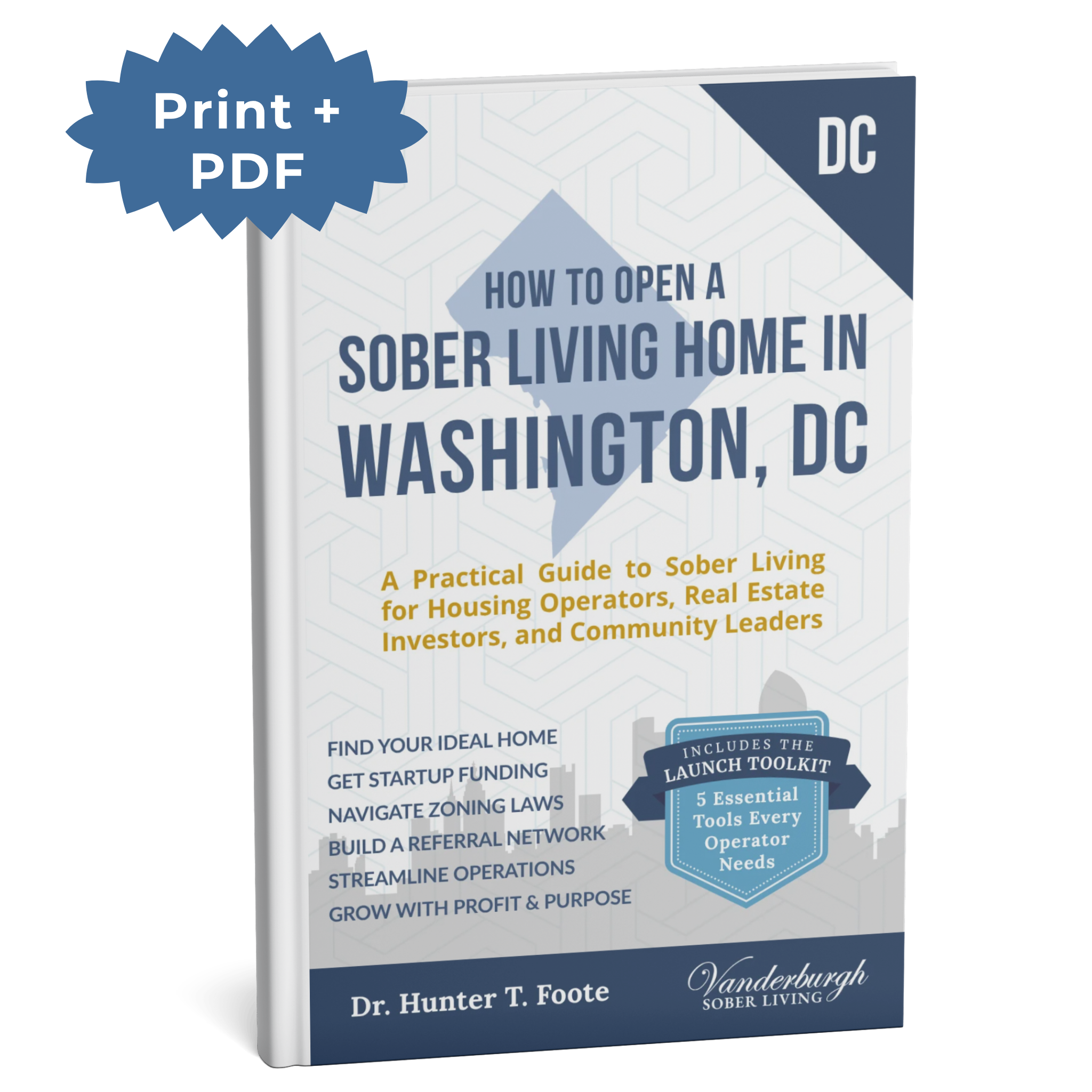
The District-specific playbook covering zoning, licensing, and setup from start to finish.
How Fair Housing Law Protects Washington, DC Sober Living
Two overlapping laws protect people in recovery who live in a District sober house: the federal Fair Housing Act (FHA) and the DC Human Rights Act (DCHRA). Both treat a person in recovery from a substance use disorder as a person with a disability, and both require reasonable accommodation.
Under federal law, the FHA bars making housing unavailable because of a handicap at 42 U.S.C. § 3604(f), and the definition of handicap at 42 U.S.C. § 3602(h) excludes only current illegal use of a controlled substance. The 2016 HUD and DOJ Joint Statement on land use laws says plainly that people in recovery are persons with disabilities under the Act and that a “sober home” is a group home for that purpose. The full federal picture is in the Fair Housing Act explainer, so this section stays on what the District adds.
The District’s own layer is the DC Human Rights Act, D.C. Code § 2-1401.01 et seq. Four provisions matter most to an operator:
- Housing protections: D.C. Code § 2-1402.21(d) makes it unlawful to deny a dwelling because of the disability of anyone intending to live there, and defines discrimination to include “a refusal to make reasonable accommodations in rules, policies, practices, or services.”
- Broad disability definition: D.C. Code § 2-1401.02(5A) defines disability as an impairment that substantially limits a major life activity, a record of one, or being regarded as having one.
- District government is covered: D.C. Code § 2-1402.73 makes it unlawful for a District agency to limit or refuse a service or benefit on the basis of disability, which reaches permitting and zoning decisions.
- Extra protected traits: The DC Office of Human Rights (OHR) lists 20 protected traits in housing, well beyond the seven in federal law, including source of income and place of residence.
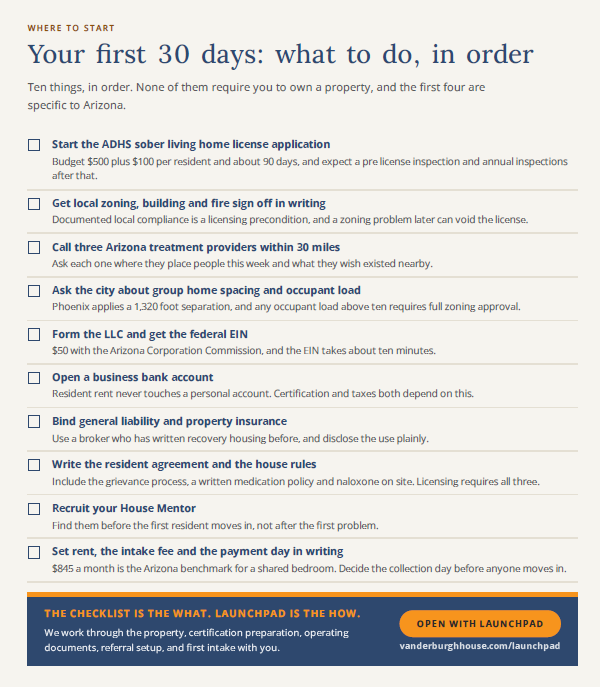
Most people ask whether they are allowed to open a recovery home. The better first question is whether the need and the money are there. This answers both, for your state.
- How many people need a bed, and how few beds exist
- Who actually pays the rent, and which programs are real
- What it costs to open on the purchase path and the lease path
The Washington, DC Case Every Operator Should Know
Samaritan Inns, Inc. v. District of Columbia
The District’s leading recovery housing case was decided by the U.S. Court of Appeals for the D.C. Circuit. It involved a residence for people in recovery, a stop-work order, and findings of intentional discrimination that the District chose not to contest. Samaritan Inns was a tax-exempt charity providing below-market rental housing to people who had completed substance use treatment, held steady jobs, and stayed sober. In 1992 it bought a building in an R-5 zone in Ward 4 to run as a boarding house for residents in recovery. In October 1993 the Zoning Administrator issued a stop-work order without explanation, and a District official then purported to revoke the building and demolition permits without the required hearing. The stop-work order stayed in place until January 1994.
The trial court found the District’s actions were motivated by discriminatory intent, had a discriminatory effect, and coerced the organization, in violation of the FHA’s §§ 3604 and 3617. On appeal the D.C. Circuit noted that “the District does not contest the district court’s finding that it violated the Act.” The appeal was about money: the court reversed part of the compensatory award and sent it back for recalculation and affirmed punitive damages against two District officials personally.
What it means for operators today:
- People in recovery are protected: A recovery residence’s residents counted as persons with a handicap under the FHA, and the court treated that as settled.
- Process abuses are discrimination: Stop-work orders and permit revocations issued without a legitimate basis were part of the violation, not just the final denial.
- Officials can be personally liable: Punitive damages against individual officials were upheld.
The Department of Justice later sued the District over its handling of group homes. In United States v. District of Columbia, No. 04-0619 (D.D.C. Mar. 14, 2008), the court declared that the District refused to make reasonable accommodations on November 28, 2001 and October 11, 2002 for a youth home operated by Boys Town, and enjoined the District from refusing reasonable accommodations going forward. The court also held that the District’s own rule, 14 DCMR § 111, “plainly grants” the authority to waive zoning requirements as an accommodation. It rejected the broader claim that nine zoning provisions were facially discriminatory, requiring case-by-case proof instead.
The case concerned youth residential care homes, not adult sober living, so it is authority on how the District must process accommodation requests rather than on sober homes directly. The 2009 settlement agreement required Fair Housing Act training for Zoning Commission and Board of Zoning Adjustment members, a designated Fair Housing Compliance Officer, and written procedures for the Board to follow when a case before it suggests a reasonable accommodation may be needed.
Where Washington, DC Sober Living Homes Can Operate
The District is one zoning jurisdiction. There are no towns or counties with their own codes, so the household definition reads the same in Anacostia as in Chevy Chase. What varies by address is the zone (R, RF, RA, MU), whether the property sits in a historic district, and which Advisory Neighborhood Commission covers it.
The household definition at 11-B DCMR § 100.2 has four parts, and two of them can describe a sober living home:
- Related family: One family related by blood, marriage, adoption, or foster agreement.
- Unrelated group: Not more than six persons who are not so related, living together as a single housekeeping unit. This is the paragraph most sober houses rely on.
- Religious community: Up to 15 members.
- Disability residence: A residential facility housing up to six persons with disabilities and two caregivers, with “disability” defined to exclude current illegal use of a controlled substance.
The fourth paragraph is worth a close read. Residents in recovery who are not currently using fit the definition of disability it adopts. Whether a live-in house mentor counts as a “caregiver” is a fair question to put to the Zoning Administrator in writing before relying on it.
Above six, the code’s matter-of-right routes at 11-U DCMR § 202.1(h) belong to the community residence facility, which the zoning definitions tie to a license under D.C. Code § 44-501 et seq. The Substance Abusers Home definition similarly requires certification under 22-A DCMR Chapter 63, which certifies substance use disorder treatment and recovery providers, not sober homes.
The table shows each route and its cap, as of November 23, 2026.
| Municipality | Zoning posture | Unrelated-occupancy cap | Governing instrument | As of |
|---|---|---|---|---|
| Household, unrelated persons | A sober house run as one housekeeping unit. Spacing test: none. | 6 | 11-B DCMR § 100.2 | Nov 23, 2026 |
| Household, disability residence | Residents with disabilities plus caregivers. Spacing test: none. | 6 plus 2 caregivers | 11-B DCMR § 100.2 | Nov 23, 2026 |
| Community residence facility, R zones | Licensed facility under D.C. Code § 44-501. Spacing test: none. | 1 to 6, excluding staff | 11-U DCMR § 202.1(h) | Nov 23, 2026 |
| Community residence facility, R-Use Group A | Licensed facility. Spacing test: no 8+ person facility within 1,000 feet. | 7 to 8, excluding staff | 11-U DCMR § 202.1(h)(1) | Nov 23, 2026 |
| Community residence facility, R-Use Groups B and C | Licensed facility. Spacing test: no 8+ person facility within 500 feet. | 7 to 8, excluding staff | 11-U DCMR § 202.1(h)(2) | Nov 23, 2026 |
| Reasonable accommodation | A sober house needing more than 6. Spacing test: set by the decision. | Set by the decision | 14 DCMR § 111 | Nov 23, 2026 |
The Zoning Commission last rewrote these uses in Z.C. Order No. 19-31, effective October 21, 2022, which restored the community residence facility and substance abusers home definitions that the 2016 rewrite had dropped. The community-based institutional facility category now covers only court-ordered monitored care or people assigned to or detained in a facility, and expressly excludes community residence facilities and substance abusers’ homes. A voluntary sober house, where residents choose to live and pay rent, is not that use.
Zoning and fair housing, answered
Know where sober homes can operate, and the federal protections that back you up.
Read the Washington, DC licensing guideWhether a peer-run recovery home needs a license in Washington, DC, and what lodging rules apply.Understand your Fair Housing rightsHow the federal Fair Housing Act protects sober living homes.Get zoning support in the LaunchpadIncludes an FHA zoning exemption request template and one-on-one strategy.Permitted by Right vs. Special Use Permits
In District terms, “by right” is “matter of right,” and the conditional permit most cities call a special use permit is a “special exception” granted by the Board of Zoning Adjustment (BZA). A sober living home within the six-person household is a matter-of-right residential use. Anything else needs either an accommodation or BZA action.
To check a specific address, work through these steps in order:
- Find the parcel’s zoning district. Look up the lot on the DC Office of Zoning map, which shows the zone and any overlay. See whether the address is in a historic district, which affects exterior permits but not who lives inside.
- Read how the code defines “family” or household. The household definition at 11-B DCMR § 100.2 allows not more than six unrelated persons living as a single housekeeping unit.
- Check whether group residential use is allowed by right. Note whether the zone allows the structure you plan to use (detached, semi-detached, rowhouse, or flat).
- Look for special or conditional use permit triggers. The DOB Office of Zoning Administration issues zoning compliance letters online, typically within three business days.
- Confirm any spacing, density, or occupancy limits. Compare your planned bed count with the six-person household cap before you sign.
If your plan is six or fewer residents:You are a household, and the inquiry ends with ordinary building and business requirements.
If your plan is seven or more:Decide early between a reasonable accommodation request and a BZA application. The accommodation route is usually the better fit for a sober home, because it asks for a change to a rule rather than a ruling that the use is acceptable to the neighborhood.
| Factor | Permitted by right | Special / conditional use permit |
|---|---|---|
| When it applies | Household of six or fewer unrelated residents | Uses or dimensions the code does not allow outright |
| Advance approval | None beyond ordinary building permits | BZA order required |
| Public hearing | No | Yes, with notice to the Advisory Neighborhood Commission |
| Who decides | Department of Buildings, by applying the code | The BZA, a five-member quasi-judicial body |
| Fair housing exposure | Low | Higher, because neighbors can participate |
How to Request a Reasonable Accommodation
A reasonable accommodation asks the District to change how a rule applies so that people with disabilities have an equal opportunity to use and enjoy a home. In the District it is a written process with a deadline, set out in 14 DCMR § 111, and the Department of Buildings publishes a Fair Housing Act Request for Reasonable Accommodation form that routes to the Zoning Administrator.
The rule requires the request to be in writing and to include specific information. Build it in this order:
- Put the request in writing. Give the name and address of the person requesting the accommodation and of the dwelling owner, as § 111.4(a) and (b) require. Give the address of the dwelling where the accommodation is needed.
- Send it to the right official. Use the Department of Buildings Fair Housing Act Request for Reasonable Accommodation form, which routes to the Zoning Administrator.
- Tie the request to the disability. Explain why the accommodation is necessary for residents with disabilities to use and enjoy the home. For a sober house, that usually means the therapeutic and financial role of a larger peer group in recovery.
- Ask for something specific and necessary. State the specific regulation you need relief from, for example the six-person limit in the household definition at 11-B DCMR § 100.2. If the request concerns occupancy, give the anticipated number of residents and any staff, which § 111.4(f) requires.
- Request a written decision and keep records. Label any confidential information “CONFIDENTIAL,” and the District must keep it in a separate file under § 111.5. The Director must issue a written decision within 45 days, paused only while the District waits for information it requested in writing. A decision not issued in time is deemed granted under § 111.12. A denial must explain its findings on whether the request would fundamentally alter a District policy or impose an undue financial or administrative burden. The decision is final, with no further administrative appeal under § 111.13.
Send the request by a method that proves delivery, and keep a copy of every page. A broader walkthrough of requesting reasonable accommodation covers the federal standard the District applies.
The District-specific playbook covering zoning, licensing, and setup from start to finish.
Washington, DC Lodging-House and Sprinkler Triggers to Watch
Sober living homes in many states run larger than six beds, and in the District any house above six crosses the zoning household cap well before any building or fire code threshold. The building code, the 2017 District of Columbia Building Code at 12-A DCMR, is more permissive than the zoning code on resident count. These are the occupancy triggers that apply:
- Zoning household cap: Six unrelated residents under 11-B DCMR § 100.2. This is the number that decides how many beds a District house can run without an accommodation.
- Single-family certificate of completion: 12-A DCMR § 110.4.2 treats congregate living facilities with six or fewer residents as one-family dwellings for this certificate. Above six, plan on working through the certificate of occupancy process with the Department of Buildings.
- Group R-3 classification: Under 12-A DCMR § 310.5, nontransient congregate living facilities with 16 or fewer occupants are Group R-3, the same class as ordinary houses.
- Group R-4 classification: Under 12-A DCMR § 310.6, a building moves to R-4 when more than six but not more than 16 persons reside in a supervised environment and receive custodial care. A sober house where residents manage their own medication and daily lives does not provide custodial care.
- Sprinklers: 12-A DCMR § 903.2.8 requires an automatic sprinkler system throughout buildings with a Group R fire area, and permits the lighter residential system under Section 903.3.1.3 in Group R-3. Whether converting an existing house triggers a retrofit depends on the scope of work and any change of occupancy, which Department of Buildings plan review settles.
So an eight-to-16-bed sober house in the District stays in the R-3 building class as long as it provides no custodial care. Its two real levers are the zoning cap, which an accommodation can change, and the sprinkler question, which the permit scope decides. Sober living fire safety and determining maximum occupancy go deeper on both.
Washington, DC guideSober Living Startup Costs in Washington, DCOne-time costs to open, including any sprinkler or fire-code retrofit a larger home may need.→Which Local Bodies Review a Washington, DC Sober Home
Because the District is both city and state, every review sits with one of its own agencies. Each checks something different:
- Department of Buildings (DOB), Office of Zoning Administration: Applies the zoning code to permits and certificates of occupancy, issues zoning compliance letters, and receives reasonable accommodation requests, as the DOB zoning services page describes.
- Board of Zoning Adjustment (BZA): Grants variances and special exceptions and hears appeals of the Zoning Administrator’s decisions.
- Zoning Commission and Office of Zoning: Write and amend the zoning text, as in Z.C. Order No. 19-31.
- Advisory Neighborhood Commissions (ANCs): Receive notice of zoning cases, and their written recommendations must be given “great weight” by District agencies under D.C. Code § 1-309.10. An ANC advises; it does not approve or deny.
- Historic Preservation Office: Reviews building permits for historic property, which covers exterior work, not who lives in the home.
- Department of Licensing and Consumer Protection (DLCP): Issues the basic business license for renting rooms. Whether a sober house needs one, and which kind, is the subject of the licensing guide for the District.
- Fire and EMS Department (FEMS): Offers residential fire safety inspections by appointment.
What none of these offices does is certify a sober home. The District has no National Alliance for Recovery Residences (NARR) state affiliate and no sober home certification program. The National Alliance for Recovery Residences (NARR) standards still describe good practice. Many operators also join a charter network. A charter is a voluntary membership agreement between a home and a private network whose standards it agrees to follow; it is not government permission or a third-party certification. Oxford House charters homes that are democratically self-run and financially self-supporting, with no paid staff in the house. Vanderburgh Sober Living charters independently operated homes into a cooperative network, where the operator keeps ownership and gains the brand, the operating standards, and the support of the Chartered Operator community.
Washington, DC guideDo You Need a License to Open a Sober Living Home in Washington, DC?What Washington, DC actually requires, and how homes show they meet a standard without a District certifier.→How to Handle Neighborhood or Municipal Pushback
Opposition in the District usually reaches an operator through one of three channels: an ANC meeting, a complaint to DOB, or a neighbor’s letter. A calm, documented response, in this order, keeps each step on the record:
- Stay calm and document everything. Explain in writing that the home is six or fewer residents living as one housekeeping unit under 11-B DCMR § 100.2, and attach your zoning compliance letter if you have one. Offer to attend the commission’s public meeting, describe your sober house rules, and share a contact for neighbors. Speaking first means the commission’s record includes your account.
- Get the specific rule or objection in writing. If DOB issues a notice or stop-work order, request the specific code basis in writing and respond to that basis. Samaritan Inns turned on an order issued without one.
- Submit a reasonable accommodation request. If an official says the home is not allowed, file a 14 DCMR § 111 reasonable accommodation request so the District must decide on the record within 45 days.
- Escalate to the state fair-housing or human-rights agency. Complaints under the DCHRA go to the DC Office of Human Rights within one year of the act or its discovery, under D.C. Code § 2-1403.04. OHR handles cases against private parties and District agencies, and every case goes to mediation first, according to its complaint process page.
- File a complaint with HUD FHEO. A federal complaint goes to the HUD Office of Fair Housing and Equal Opportunity (FHEO) within one year of the discriminatory practice, under 42 U.S.C. § 3610.
- Bring in a fair-housing attorney. Do this when a denial is final, when a stop-work order stays in place, or when you are weighing a lawsuit. A private action under the DCHRA must be filed within two years under D.C. Code § 2-1403.16.
Choosing a Defensible Location in Washington, DC
A defensible location is one where the zoning answer is simple and the house supports the household you plan to run. In the District, these factors matter most:
- Residential zoning: An R, RF, or RA zone where a house of your type is permitted, confirmed on the zoning map.
- Occupancy fit: Bedrooms and floor area that work for your bed count, with a clear plan for whether you will stay at six or request an accommodation.
- No custodial care: An operating model in which residents self-manage medication and daily life, keeping the building in Group R-3.
- Transit access: Walking distance to Metrorail or a frequent bus line, since many residents in recovery do not drive.
- Room to grow: Your realistic bed count and whether a seventh or eighth bed will need relief, settled before you sign the lease or close.
Rent control is a separate question for any District rental. The DC rent control and sober living post covers how the Rental Housing Act applies.
Classification, Fair Housing protection, reasonable accommodation, and handling a city that says no.
Tell us where to send it and it lands in your inbox in about a minute.
Washington, DC Zoning and Fair Housing at a Glance
The table summarizes each layer of law that applies to a District sober house, as of November 23, 2026.
| Layer | Rule | What It Means |
|---|---|---|
| Federal | Fair Housing Act, 42 U.S.C. § 3604(f) | People in recovery are protected, and the District must make reasonable accommodations. |
| State | DC Human Rights Act, D.C. Code § 2-1402.21 | Adds District enforcement through OHR and covers District agencies too. |
| State zoning preemption | No preemption statute found as of November 23, 2026 | The District writes its own zoning, so there is no separate state law limiting it; the household definition and federal law set the rules. |
| Local | Household definition, 11-B DCMR § 100.2 | Six unrelated residents can live together as a household anywhere a house is allowed. |
| District accommodation | 14 DCMR § 111 | A written request gets a decision in 45 days, or it is deemed granted. |
| District building code | 12-A DCMR §§ 310.5, 310.6 | A sober house without custodial care stays in the ordinary house class up to 16 occupants. |
| Deed restrictions | No District statute voiding covenants against recovery residences found as of November 23, 2026 | Private restrictions are tested against the FHA and the DCHRA’s ban on discriminatory terms in property transactions. |
Sober Living Guides Every Operator Needs
These evergreen guides apply in every state and cover what pairs with getting your zoning right: choosing a defensible property, the standards you operate to, the coverage you carry, and the referrals that keep the home full.
Frequently Asked Questions About Sober Living Zoning in Washington, DC
Can a sober living home open in a residential zone in Washington, DC?
Yes. A sober living home with six or fewer unrelated residents living as one housekeeping unit is a household under 11-B DCMR § 100.2, which makes it a matter-of-right residential use. It needs no special exception, no public hearing, and no zoning registration. Larger homes need a reasonable accommodation or relief from the Board of Zoning Adjustment.
Do I need a special exception from the BZA to open a sober house?
Not at six or fewer residents. The Board of Zoning Adjustment grants special exceptions and variances for uses the code does not allow outright, as the Office of Zoning describes. A home within the household definition is allowed outright. Above six, a 14 DCMR § 111 reasonable accommodation request is usually the better fit than a special exception.
Can the District require a sober home to register or be licensed?
The zoning code contains no registration requirement for a sober home that fits the household definition, as of November 23, 2026. The District also has no sober home certification program. Business licensing for room rentals is a separate question handled by the Department of Licensing and Consumer Protection, covered in the District licensing guide.
How many unrelated people can live in a sober house in DC?
Six. The household definition at 11-B DCMR § 100.2 allows not more than six unrelated persons living as a single housekeeping unit, or six persons with disabilities plus two caregivers. To house more, an operator can request a reasonable accommodation under 14 DCMR § 111, which requires the anticipated resident count in the request.
Can a historic district or an HOA block a sober living home?
A historic district reviews exterior work through the Historic Preservation Office, not who lives in the house. HOA covenants are tested against the Fair Housing Act and the DC Human Rights Act, which bars discriminatory terms in property transactions under D.C. Code § 2-1402.21. The site’s guide to HOAs and sober living explains the federal standard.
What happens if neighbors complain or an ANC opposes the home?
A home within the household definition needs no hearing, so an ANC’s view on it is advisory. ANCs receive great weight in District decisions under D.C. Code § 1-309.10, which makes early outreach worthwhile. If complaints lead to a denial or stop-work order, file a 14 DCMR § 111 request and, where needed, a complaint with OHR or HUD.
Open a Washington, DC Sober Living Home with Confidence
The District gives a sober living home a clear starting point: six residents, one household, no permit to ask for. Above that, the 14 DCMR § 111 process gives operators a written route with a deadline, and the DC Human Rights Act and the Fair Housing Act stand behind it. Choose the address, count the beds, and put every request in writing.
Disclaimer: The information provided in this article and all articles in the Laws & Regulations category is presented for informational purposes only and is not intended as legal advice. Laws and regulations regarding recovery housing vary by state and locality, and their interpretation can change over time. This content is meant to discuss general legal and regulatory topics related to sober living and recovery housing. For specific legal guidance, please consult a qualified attorney or legal professional.
Research & Sources
- District of Columbia Office of Documents and Administrative Issuances. (2026). 11-B DCMR § 100.2, Definitions (effective October 16, 2026). https://www.dcregs.dc.gov/Common/DCMR/SectionList.aspx?SectionNumber=11-B100
- District of Columbia Office of Documents and Administrative Issuances. (2023). 11-B DCMR § 200, Use categories. https://www.dcregs.dc.gov/Common/DCMR/SectionList.aspx?SectionNumber=11-B200
- District of Columbia Office of Documents and Administrative Issuances. (2023). 11-U DCMR § 202, Matter-of-right uses: R-use groups A, B, and C (effective August 25, 2023). https://www.dcregs.dc.gov/Common/DCMR/SectionList.aspx?SectionNumber=11-U202
- District of Columbia Zoning Commission. (2022). Notice of final rulemaking and Z.C. Order No. 19-31: Text amendments to Subtitles B, H, K, & U (community based residential uses). 69 DCR 012886. https://dcregs.dc.gov/Common/NoticeDetail.aspx?NoticeId=N127650
- District of Columbia Office of Documents and Administrative Issuances. (1998). 14 DCMR § 111, Procedures regarding requests for reasonable accommodation under the Fair Housing Act. https://www.dcregs.dc.gov/Common/DCMR/SectionList.aspx?SectionNumber=14-111
- District of Columbia Department of Buildings. (n.d.). Fair Housing Act request for reasonable accommodation [Form]. https://dob.dc.gov/sites/default/files/dc/sites/dob/Reasonable%20Accomodation%20Form.pdf
- District of Columbia Department of Buildings. (2026). Zoning services. https://dob.dc.gov/page/zoning-services
- District of Columbia Department of Buildings. (2020). 2017 District of Columbia building code (12-A DCMR), Part 1. https://dob.dc.gov/sites/default/files/dc/sites/dob/publication/attachments/2017%20District%20of%20Columbia%20Building%20Code_Part%201.pdf
- Council of the District of Columbia. (2026). D.C. Code § 2-1401.01, Intent of Council. https://code.dccouncil.gov/us/dc/council/code/sections/2-1401.01
- Council of the District of Columbia. (2026). D.C. Code § 2-1401.02, Definitions. https://code.dccouncil.gov/us/dc/council/code/sections/2-1401.02
- Council of the District of Columbia. (2026). D.C. Code § 2-1402.21, Prohibitions (housing). https://code.dccouncil.gov/us/dc/council/code/sections/2-1402.21
- Council of the District of Columbia. (2026). D.C. Code § 2-1402.73, Application to the District government. https://code.dccouncil.gov/us/dc/council/code/sections/2-1402.73
- Council of the District of Columbia. (2026). D.C. Code § 2-1403.04, Filing and withdrawal of complaints; mediation. https://code.dccouncil.gov/us/dc/council/code/sections/2-1403.04
- Council of the District of Columbia. (2026). D.C. Code § 2-1403.16, Private cause of action. https://code.dccouncil.gov/us/dc/council/code/sections/2-1403.16
- Council of the District of Columbia. (2026). D.C. Code § 1-309.10, Advisory Neighborhood Commissions: Duties and responsibilities; great weight. https://code.dccouncil.gov/us/dc/council/code/sections/1-309.10
- Samaritan Inns, Inc. v. District of Columbia, 114 F.3d 1227 (D.C. Cir. 1997). https://law.justia.com/cases/federal/appellate-courts/F3/114/1227/493684/
- United States v. District of Columbia, No. 04-0619 (JR) (D.D.C. Mar. 14, 2008) (order and memorandum opinion). https://www.justice.gov/crt/about/hce/documents/ddc_order_opin_dj_gen_inj_03-14-08.pdf
- U.S. Department of Justice. (2009). Settlement agreement, United States v. District of Columbia, No. 04-0619 (JR). https://www.justice.gov/crt/about/hce/documents/ddc_settle_5-1-09.pdf
- 42 U.S.C. § 3602 (2023). https://www.govinfo.gov/content/pkg/USCODE-2023-title42/html/USCODE-2023-title42-chap45-subchapI-sec3602.htm
- 42 U.S.C. § 3604 (2023). https://www.govinfo.gov/content/pkg/USCODE-2023-title42/html/USCODE-2023-title42-chap45-subchapI-sec3604.htm
- 42 U.S.C. § 3610 (2023). https://www.govinfo.gov/content/pkg/USCODE-2023-title42/html/USCODE-2023-title42-chap45-subchapI-sec3610.htm
- U.S. Department of Housing and Urban Development. (2026). File a fair housing complaint. https://www.hud.gov/fairhousing/fileacomplaint
- DC Office of Human Rights. (2026). OHR’s fair housing resources. https://ohr.dc.gov/page/ohrs-fair-housing-resources
- DC Office of Human Rights. (2026). File a discrimination complaint. https://ohr.dc.gov/service/file-discrimination-complaint
- DC Office of Human Rights. (2026). Complaint process and timeline. https://ohr.dc.gov/page/complaint-process-timeline
- DC Office of Zoning. (2026). About the Board of Zoning Adjustment. https://dcoz.dc.gov/page/about-board-zoning-adjustment
- DC Office of Zoning. (2026). DC zoning map. https://maps.dcoz.dc.gov/
- District of Columbia Office of Documents and Administrative Issuances. (2026). 22-A DCMR Chapter 63, Certification standards for substance use disorder treatment and recovery providers. https://www.dcregs.dc.gov/Common/DCMR/RuleList.aspx?ChapterNum=22-A63
- DC Office of Planning. (2026). Building permits for historic property. https://planning.dc.gov/page/building-permits-historic-property
- DC Fire and EMS Department. (2026). Fire prevention inspection. https://fems.dc.gov/service/fire-prevention-inspection
- U.S. Department of Housing and Urban Development & U.S. Department of Justice. (2016). Joint statement: State and local land use laws and practices and the application of the Fair Housing Act. https://www.justice.gov/crt/page/file/909956/download
- Justia. (n.d.). Fair housing laws: 50-state survey. https://www.justia.com/
