

Choosing a legal entity for a sober living business in Washington, DC is the step that turns a plan into a company that can sign a lease, open a bank account and carry insurance in its own name. In the District, that step runs through one office: the Corporations Division of the Department of Licensing and Consumer Protection (DLCP), which files every LLC, corporation and nonprofit corporation formed here. There is no county or state layer above it.
The decision underneath the filing is the one most operators wrestle with: an LLC, a corporation or a nonprofit. Each one changes how you are taxed by the Office of Tax and Revenue (OTR), whether you can take grant money, and how you get paid. The sections below compare the three for recovery housing specifically, walk through the District’s actual filing steps and fees, and explain why many operators keep the property in a separate company from the sober living home itself.
Before you read onHow to Open a Sober Living Home in Washington, DCThis post covers one piece of the process. The complete Washington, DC guide walks through every step, from planning to your first resident.→Why Washington, DC Sober Living Businesses Need a Legal Entity
A sober living home collects rent from residents, signs a lease or a deed, hires a house mentor and carries liability for what happens on the property. Running all of that under your own name puts your personal savings and home in the line of any claim. In the District, an entity does several specific jobs:
- Liability protection: A properly maintained LLC or corporation keeps a claim against the sober living home from reaching your personal assets, provided business and personal money stay separate.
- Holding the lease or the deed: Landlords and title companies expect a registered entity, and the District’s registry lets anyone confirm it is in good standing through the search tools on DLCP’s BOSS portal.
- The license chain: DLCP’s Basic Business License steps start with corporate registration, then OTR tax registration and a Clean Hands check, before the license application itself.
- Grant eligibility: The District’s Department of Behavioral Health (DBH) states in its recovery residence grant RFA that individual persons are not eligible to apply or receive funding under any DBH RFA. Only an organization can.
- A two-entity structure: Many operators run the sober living home through one company and hold the building in another, connected by a written lease (covered in its own section below).
- The series option: The District’s LLC statute permits a series of members, managers or interests under D.C. Code § 29-802.06, with liabilities kept separate for each series as long as records and assets are kept separately.
Which Legal Entity Is Best for a Sober Living Home in Washington, DC?
For most independent operators in Washington, DC, a domestic LLC is the best fit: it costs $99 to form with DLCP, protects personal assets, and lets profits pass through to the owners. A nonprofit corporation makes sense when DBH grants, donations and a mission-driven board are central to the plan, and the founder accepts a salary instead of profits.
That answer holds for the typical case, where one or two founders lease or buy a house, fill it with residents paying weekly or monthly rent, and want to keep what the home earns. An LLC gives them the $99 certificate of organization, a simple operating agreement and flexible federal tax treatment.
The nonprofit path is a different business, not a cheaper version of the same one. It trades ownership for access to grants and tax exemption, and it brings a board, annual IRS reporting and limits on how money leaves the organization. A for-profit corporation rarely wins for a single sober living home in the District. It pays the same franchise tax rate as an LLC and adds formalities without adding grant access.
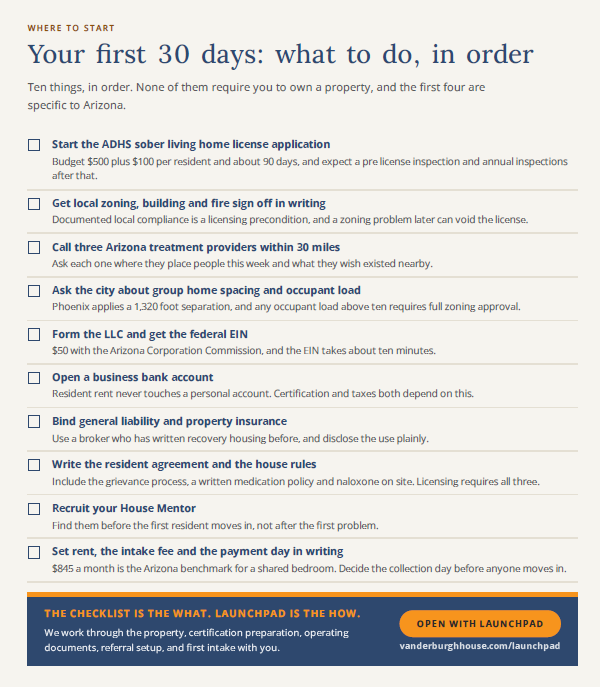
Most people ask whether they are allowed to open a recovery home. The better first question is whether the need and the money are there. This answers both, for your state.
- How many people need a bed, and how few beds exist
- Who actually pays the rent, and which programs are real
- What it costs to open on the purchase path and the lease path
LLC vs. Corporation vs. Nonprofit for Sober Living
The table below compares the three structures on the factors that matter most to a District operator. Fees come from DLCP’s own schedules and tax rates from the D.C. Code, each linked in the sections that follow.
| Factor | LLC | Corporation | Nonprofit |
|---|---|---|---|
| DLCP formation fee | $99 certificate of organization | $99 articles of incorporation (authorized capital up to $100,000) | $80 articles of incorporation |
| Biennial report | $300 every two years | $300 every two years | $80 every two years |
| Liability protection | Yes, for members | Yes, for shareholders | Yes, for directors and members |
| District income tax | Unincorporated business franchise tax, 8.25%, $250 minimum | Corporation franchise tax, 8.25%, $250 minimum | Exempt once OTR approves, after the IRS grants 501(c)(3) status |
| Federal tax | Pass-through by default | Taxed at the entity level unless an S election is made | Exempt under 501(c)(3) once approved |
| Funding access | Limited | Limited | Strongest: DBH, foundations and tax-deductible gifts |
| Founder compensation | Profit distributions | Salary and dividends | Reasonable salary only, no profit distributions |
| Governance & filing burden | Low: operating agreement | Moderate: bylaws, board, minutes | Highest: independent board, IRS Form 990 each year |
| Best fit | Independent operators who want to own the business | Operators planning outside investment in shares | Mission-led groups built around grants and donations |
A few District-specific points sit behind those rows. Both franchise taxes are set at 8.25% for unincorporated businesses under D.C. Code § 47-1808.03 and 8.25% for corporations under D.C. Code § 47-1807.02. Each carries a $250 minimum tax, rising to $1,000 if District gross receipts exceed $1 million.
The District taxes an LLC at the entity level even when the IRS treats it as pass-through. OTR’s Form D-30 instructions define a trade or business in the District to include the rental or leasing of real property. An unincorporated business with gross income of $12,000 or less is not subject to the tax, but a full sober living home will clear that line quickly.
Support for every stage
Pick the level of support that fits where you are.
Just getting startedSee how starting with VSL works and what a Charter includes.LaunchpadGuided pre-launch program: strategy, Academy training, weekly coaching, and templates.MasteryHands-on startup, certification, and operating support.Questions first? Call (844) 762-3747, weekdays 8a to 5p.
For-Profit or Nonprofit: How the Choice Shapes Funding and Operations
The for-profit versus nonprofit question is really a question about where the money comes from. Resident rent is the core revenue of a sober living home under either model. The difference is what the entity can add on top and what it gives up to get it.
To qualify under section 501(c)(3), the IRS’s exemption requirements for 501(c)(3) organizations require several things:
- Exempt purpose: The organization must be organized and operated exclusively for exempt purposes, such as charitable work.
- No private inurement: None of its net earnings may inure to any private shareholder or individual, so there are no profit distributions to founders.
- No private benefit: It may not be organized or operated for the benefit of private interests, and excess benefit transactions with insiders can trigger an excise tax.
- An application: Recognition requires IRS Form 1023, with a $600 user fee, or Form 1023-EZ at $275 for organizations that pass the 1023-EZ eligibility worksheet.
- Annual reporting: Exempt organizations file a Form 990-series return with the IRS every year.
What that status unlocks in the District is concrete:
- DBH recovery housing grants: DBH’s 2022 State Opioid Response recovery residence RFA offered up to three awards from a $750,000 total. It asked nonprofits for an IRS determination letter and recent Form 990, and also required a business license, a Certificate of Clean Hands and a board of directors.
- District tax exemption: OTR grants exemption from District income and franchise tax to charitable corporations under D.C. Code § 47-1802.01. The organization applies on Form FR-164 through MyTax.DC.gov.
- Tax-deductible donations: Donors and foundations can give to a 501(c)(3) and deduct the gift, which is rarely possible with an LLC.
The same RFA cites federal rules (45 CFR Chapter 75) that can reduce awards to for-profit commercial entities based on program income. Grant money is possible for a for-profit, but it is harder to win.
The nonprofit path has a cost. A nonprofit founder can draw a reasonable salary for real work, but cannot take the surplus the way an LLC member can. The board, not the founder, controls the organization.
Washington, DC guideHow Recovery Housing Funding Works in Washington, DCGrants, settlement dollars, and the nonprofit funding angle behind the for-profit-or-nonprofit choice.→How to Form an LLC for a Sober Living Business in Washington, DC: Step by Step
Forming a District LLC takes about a week if the paperwork is clean. Everything below runs through DLCP’s BOSS portal (formerly CorpOnline), the IRS and OTR, in this order:
- Run a name availability search. Search the District’s registry in BOSS, the portal DLCP replaced CorpOnline with. The name must be distinguishable from existing entities. If you are not ready to file, reserve it for $50.
- Appoint a registered agent. D.C. Code § 29-104.02 requires every domestic filing entity to designate and maintain a registered agent in the District. Under D.C. Code § 29-104.03, the agent’s address must be a street address in the District. A member with a District address can serve, or you can hire a commercial agent.
- File your formation documents. Submit form DLC-1 in BOSS under the Uniform Limited Liability Company Act of 2010 with the $99 filing fee. DLCP processes online filings within five business days. Expedited service costs $50 for three-day processing or $100 for next-business-day processing.
- Create an operating agreement. The District does not file it, but banks, landlords and lenders will ask for it. It should name the members and managers, set how money comes in and goes out, and if you use the series option, define each series.
- Get your EIN from the IRS. Apply on the IRS’s online EIN application, which is free and issues the number immediately once approved (IRS Form SS-4 is the paper version).
- Register for District taxes with OTR. File the FR-500 New Business Registration on MyTax.DC.gov. An LLC attaches its articles of organization, and every listed officer must provide a Social Security number or ITIN.
- Get the Basic Business License. A house that rents rooms generally falls under DLCP’s One Family Rental activity, which covers “individual rooms.” It costs $159 for a two-year license or $318 for four years, after a Clean Hands check and an inspection. Do you need a license to open a sober living home in Washington, DC? covers whether anything beyond this license applies. Forming a nonprofit runs the same route with three changes. File form DNP-1 articles of incorporation under the Nonprofit Corporation Act of 2010 for $80, seat a board and adopt bylaws. Then apply to the IRS on Form 1023 or 1023-EZ, and only after the IRS letter arrives, request District exemption from OTR.
- ✓Every document a carrier or broker asks for
- ✓Coverages a Level II home is expected to hold
- ✓Wording that gets applications kicked back
Tell us where to send it and it lands in your inbox in about a minute.
What It Costs to Form and Maintain an Entity
Every fee below comes from DLCP’s LLC fee schedule, business corporation fee schedule and nonprofit corporation fee schedule, plus OTR and the IRS where noted.
| Item | Cost | What it means |
|---|---|---|
| LLC formation filing fee | $99 | One-time DLCP filing fee for a domestic LLC (certificate of organization) |
| Business corporation articles | $99 to $1,650 | $99 for authorized capital up to $100,000; the fee rises in steps above that |
| Nonprofit articles of incorporation | $80 | One-time DLCP filing fee for a domestic nonprofit corporation |
| Name reservation | $50 (LLC or corporation), $40 (nonprofit) | Optional; holds a name before you file |
| Optional: expedited processing | $50 (3-day) or $100 (next business day) | Optional; standard online processing is five business days |
| Biennial report, for-profit | $300 every two years | Due April 1 of the year after formation, then every second April 1 |
| Biennial report, nonprofit | $80 every two years | Same April 1 schedule |
| Late biennial report | $100 for-profit, $50 nonprofit | Added when the report is filed after April 1 of the year due |
| Reinstatement after dissolution | $300 (LLC), $80 (nonprofit) | The cost of letting the entity lapse |
| Registered agent (annual) | $0 if a member with a District street address serves | A commercial agent is optional and priced by the provider |
| District franchise tax | 8.25% of taxable income, $250 minimum | Applies to LLCs and corporations; $1,000 minimum above $1 million in District gross receipts |
| IRS Form 1023 or 1023-EZ | $600 or $275 | Nonprofit path only |
| EIN (IRS) | Free | Free from the IRS |
| Typical first-year (for-profit LLC) | $649 | Formation fee + first biennial report + minimum franchise tax, with a member serving as registered agent at no cost. |
The biennial report is DLCP’s version of an annual report. Under D.C. Code § 29-102.11, the first report is due April 1 of the year after the entity forms, and every second April 1 after that. The report must name every person who owns more than 10% of the entity or controls its decisions, and leaving that information out leads to administrative dissolution.
The $250 minimum comes from D.C. Code § 47-1808.03(b) and applies once gross income passes $12,000, even in a year with a loss. The $159 Basic Business License is a licensing cost, not an entity cost, so it sits outside the total. Per-unit rental housing fees such as the $21.50 Rental Accommodations Fee listed on DLCP’s license and corporate filing fee summary are also separate. Full opening budgets are covered in the startup costs guide for the District, Sober living startup costs in Washington, DC.
Should the Property Be in a Separate LLC?
Many experienced operators split the business in two. One company owns the building, and a second company runs the sober living home and leases the building from the first. If a claim arises from operations, the property company is a separate legal person, and the building is harder to reach.
That separation only works if both companies behave like separate businesses. Each needs its own bank account and its own books, and the lease between them should set a real rent that the operating company actually pays. VSL explains the mechanics in more depth in a post on whether to form a separate LLC for the sober living property.
In the District, the second company costs another $99 to form and another $300 every two years. DLCP’s business registration FAQs note that a company holding real estate generally must register only if that real estate is income-producing, and a property leased to an operator is. The D-30 instructions let a single-member LLC treated as a disregarded entity be listed on Schedule K of its owner’s D-30 or D-20 rather than filing separately.
The landlord owns the real estate risk, and your company signs the lease, holds the security deposit and carries the liability policy. A second entity adds cost without protecting much.
It also makes a future sale or refinance cleaner. A District series LLC under § 29-802.06 is an alternative for owners with several houses, provided each series keeps separate records and assets.
Confirm either choice with an attorney and an accountant, because lenders, title insurers and the tax treatment all have a say.
After Formation: EIN, Bank Account, and Insurance
Once DLCP approves the filing, a few moves protect what you just built before the first resident moves in:
- EIN in hand: Use it, not your Social Security number, on the bank account, the lease and the OTR registration.
- Business bank account: Deposit every rent payment into the company’s account and pay every house expense from it. Mixing personal and business funds is the fastest way to lose liability protection.
- Insurance: Carry general liability and property coverage written for recovery housing; DBH’s 2022 RFA asked applicants for proof of commercial, general liability and professional liability coverage. VSL covers policy types in its guide to sober house insurance.
- Calendar the deadlines: Put April 1 of next year on the calendar for the first biennial report, and April 15 for the District franchise tax return.
- Standards: Decide what operating standards the sober living home will follow. Washington, DC has no affiliate of the National Alliance for Recovery Residences (NARR) and no District program that certifies sober homes, as we found as of November 2026.
The fifth item matters because grant funders still ask about standards. DBH’s 2022 RFA asked applicants to establish residences meeting NARR Level III or IV standards, even without a District certifier. That is where a charter can help. A charter is a voluntary membership agreement between a home and a private network whose standards the home agrees to follow. It is not government permission or a third-party certification. Oxford House charters homes that are democratically self-run and financially self-supporting, with no paid staff in the house. Vanderburgh Sober Living charters independently operated homes into a cooperative network, where the operator keeps ownership of the business and gains the brand, the operating standards and the support of the Chartered Operator community. Either way, the charter is held by your entity, which is one more reason to form it first.
Where the house sits matters as much as how it is owned. The District’s household definition and fair housing protections are covered in Washington, DC zoning, fair housing, and land use laws for sober living.
Washington, DC guideDo You Need a License to Open a Sober Living Home in Washington, DC?What Washington, DC actually requires once the entity is formed, and how homes show they meet a standard without a District certifier.→Washington, DC Entity Formation at a Glance
The table below gathers the District’s formation facts in one place, each sourced in the sections above.
| Item | Detail | What it means |
|---|---|---|
| Filing office | DLCP Corporations Division | Files every LLC, corporation and nonprofit in the District |
| Filing portal | BOSS (boss.dc.gov), formerly CorpOnline | Formation, biennial reports, name search and good standing certificates |
| LLC filing fee | $99 | Certificate of organization, form DLC-1 |
| Corporation filing fee | $99 and up | $99 for authorized capital up to $100,000 |
| Nonprofit filing fee | $80 | Articles of incorporation, form DNP-1 |
| Registered agent required | Required, with a District street address | D.C. Code § 29-104.02 and § 29-104.03 |
| Ongoing report | Biennial report, $300 for-profit, $80 nonprofit | Due April 1 of the year after formation, then every two years |
| District income tax | 8.25% franchise tax, $250 minimum | Applies to LLCs and corporations above $12,000 gross income |
| Typical processing time | Five business days online | $50 for three-day, $100 for next-business-day |
| Nonprofit exemption | IRS 501(c)(3) first, then OTR Form FR-164 | District exemption follows the federal letter |
| Business license | Basic Business License, One Family Rental $159 for two years | Issued after corporate registration, OTR registration and Clean Hands |
Sober Living Guides Every Operator Needs
These evergreen guides apply in every state and cover what sits around the entity you form: the property it holds, the insurance it carries, the financing it enables, and the standards the home certifies to.
Frequently Asked Questions About Sober Living Business Entities
Should a sober living home in Washington, DC be an LLC or a nonprofit?
Most independent operators choose an LLC, which costs $99 to form with DLCP and lets owners keep profits. A nonprofit fits groups that plan to rely on DBH grants and donations and accept board control. Both pay the same resident-rent economics; the difference is funding access, tax exemption and who controls the money.
How much does it cost to form an LLC in Washington, DC?
DLCP charges $99 to file an LLC certificate of organization, and $300 every two years for the biennial report. The District also levies an 8.25% unincorporated business franchise tax with a $250 minimum once gross income passes $12,000. A typical first-year total for a for-profit LLC is about $649, excluding the business license.
Can one LLC own several sober living homes in the District?
Yes. One LLC can hold several leases or properties, but a claim at one house could reach the assets of all of them. The District allows a series LLC under D.C. Code § 29-802.06, where each series has separate liability if records and assets are kept separately. Many owners use one property LLC per building instead.
Can the founder of a nonprofit sober living home get paid?
Yes, a nonprofit founder can earn a reasonable salary for real work, approved by an independent board. What a founder cannot do is take the surplus. IRS rules bar a 501(c)(3)’s net earnings from benefiting any private individual, and excess payments to insiders can trigger federal excise taxes on the person who received them.
Do I need my entity before applying for grants or a business license?
Yes. DLCP’s Basic Business License process starts with corporate registration, then OTR tax registration and a Clean Hands check. DBH also states that individual persons cannot apply for or receive funding under any DBH RFA. Form the entity, get the EIN and register with OTR before either application.
When is the District biennial report due?
The first biennial report is due April 1 of the year after the entity forms, and every second April 1 after that. For-profit entities pay $300 and nonprofits $80. A late report adds $100 or $50, and a report missing the required ownership information can lead to administrative dissolution.
How VSL Helps You Launch a Sober Living Business in Washington, DC
Forming the entity is a short step, and it is easier to get right when someone has done it before. Vanderburgh Sober Living works with operators from entity formation through the first full house, through the Mastery Program for hands-on coaching and the Launchpad course for operators who prefer to learn at their own pace. To talk about your plans for the District, contact the VSL team.
The District-specific playbook covering zoning, licensing, and setup from start to finish.
This article is general information, not legal or tax advice. Entity selection, tax elections, and property structuring carry consequences specific to your situation, so confirm your plan with a qualified Washington, DC attorney or accountant before you file.
Research & Sources
- District of Columbia Department of Licensing and Consumer Protection. (n.d.). Corporations Division: Business registration FAQs. https://dlcp.dc.gov/page/corporations-division-business-registration-faqs
- District of Columbia Department of Licensing and Consumer Protection. (n.d.). Steps to obtaining a basic business license. https://dlcp.dc.gov/page/steps-obtaining-basic-business-license-0
- District of Columbia Department of Behavioral Health. (2022, August 29). District of Columbia Opioid Response 3 (DCOR3): Recovery residences with intensive case management [RFA DCRR082622]. https://dbh.dc.gov/release/district-columbia-opioid-response-3-dcor3-recovery-residences-intensive-case-management
- Code of the District of Columbia. § 29-802.06. Series of members, managers, or interests of limited liability company. https://code.dccouncil.gov/us/dc/council/code/sections/29-802.06
- District of Columbia Department of Licensing and Consumer Protection. (n.d.). Corporations Division fees: Limited liability company. https://dlcp.dc.gov/page/corporations-division-fees-limited-liability-company
- Code of the District of Columbia. § 47-1808.03. Tax on unincorporated businesses: Levy and rates. https://code.dccouncil.gov/us/dc/council/code/sections/47-1808.03
- Code of the District of Columbia. § 47-1807.02. Tax on corporations: Levy and rates. https://code.dccouncil.gov/us/dc/council/code/sections/47-1807.02
- District of Columbia Office of Tax and Revenue. (2026). 2025 D-30 unincorporated business franchise tax return instructions. https://otr.cfo.dc.gov/sites/default/files/dc/sites/otr/publication/attachments/2025_D30_Book_Final_wLinks_02232026.pdf
- Internal Revenue Service. (n.d.). Exemption requirements: 501(c)(3) organizations. https://www.irs.gov/charities-non-profits/charitable-organizations/exemption-requirements-501c3-organizations
- Internal Revenue Service. (2026). Form 1023 and 1023-EZ: Amount of user fee. https://www.irs.gov/charities-non-profits/form-1023-and-1023-ez-amount-of-user-fee
- Code of the District of Columbia. § 47-1802.01. Exempt organizations: In general. https://code.dccouncil.gov/us/dc/council/code/sections/47-1802.01
- Code of the District of Columbia. § 29-104.02. Entities required to designate and maintain registered agent. https://code.dccouncil.gov/us/dc/council/code/sections/29-104.02
- Code of the District of Columbia. § 29-104.03. Addresses in filings. https://code.dccouncil.gov/us/dc/council/code/sections/29-104.03
- Code of the District of Columbia. § 29-801.01. Short title (Uniform Limited Liability Company Act of 2010). https://code.dccouncil.gov/us/dc/council/code/sections/29-801.01
- Internal Revenue Service. (n.d.). Apply for an employer identification number (EIN) online. https://www.irs.gov/businesses/small-businesses-self-employed/apply-for-an-employer-identification-number-ein-online
- District of Columbia Office of Tax and Revenue. (n.d.). New business registration. https://otr.cfo.dc.gov/page/new-business-registration
- District of Columbia Department of Licensing and Consumer Protection. (n.d.). Housing business. https://dlcp.dc.gov/page/housing-business
- Code of the District of Columbia. § 29-401.01. Short title (Nonprofit Corporation Act of 2010). https://code.dccouncil.gov/us/dc/council/code/sections/29-401.01
- District of Columbia Department of Licensing and Consumer Protection. (n.d.). Corporations Division fees: Business corporation. https://dlcp.dc.gov/page/corporations-division-fees-business-corporation
- District of Columbia Department of Licensing and Consumer Protection. (n.d.). Corporations Division fees: Nonprofit corporation. https://dlcp.dc.gov/page/corporations-division-fees-nonprofit-corporation
- Code of the District of Columbia. § 29-102.11. Biennial report for Mayor. https://code.dccouncil.gov/us/dc/council/code/sections/29-102.11
- District of Columbia Department of Licensing and Consumer Protection. (n.d.). DLCP license and corporate filing fees. https://dlcp.dc.gov/page/dlcp-license-corporate-filing-fees
