

Whether a sober living home in Washington, DC can turn a profit comes down to one number more than any other: what the property costs you each month. The District caps an ordinary household at six unrelated people, so a DC sober house earns from a handful of beds while paying for housing at some of the highest prices in the country. That combination makes the District unusual among the markets VSL models.
What follows is a full estimated pro forma for a six-bed DC sober house, built from HUD, Census, Office of Tax and Revenue and utility figures for the District itself. It runs the same house four ways (leased, bought at the citywide median, bought east of the Anacostia River, and already owned), shows the occupancy each needs to break even, and compares the result with renting the same house to a single household.
Before you read onHow to Open a Sober Living Home in Washington, DCThis post covers one piece of the process. The complete Washington, DC guide walks through every step, from planning to your first resident.→Is It Profitable to Operate a Recovery Home in Washington, DC?
A six-bed sober living home in Washington, DC is reliably profitable mainly when the property is already owned. On estimated figures, an owned house nets about $2,135 a month before the owner’s labor, a house bought in ZIP code 20019 runs about $350 short, and a leased house loses about $2,040 a month.
The reason is arithmetic, not demand. Under the zoning definition of a household at 11-B DCMR § 100.2, no more than six unrelated people may live together as a single housekeeping unit without further zoning relief. One of those six beds goes to a live-in house mentor, so a DC operator collects rent from five beds at most. Meanwhile, the Census Bureau’s 2024 American Community Survey puts the District’s median owner-occupied home value at $737,100, which turns into a mortgage payment larger than five beds of rent can cover.
The national figures for all 50 states show whether sober living homes are profitable in every state, and they make a useful benchmark for Washington, DC. Against that benchmark the District stands out: in most states the modeled house carries more beds and costs less to buy, so the same model shows a comfortable margin. In the District, the margin depends almost entirely on the property path you choose, which is why the rest of this page runs four of them side by side.
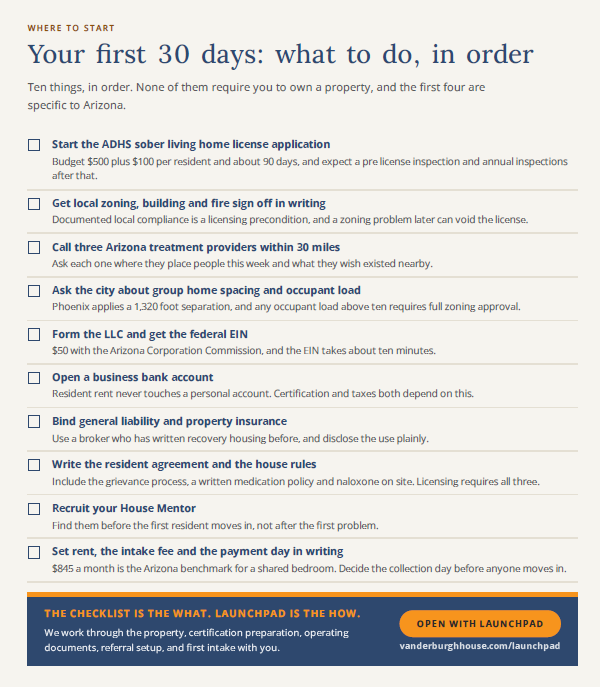
Most people ask whether they are allowed to open a recovery home. The better first question is whether the need and the money are there. This answers both, for your state.
- How many people need a bed, and how few beds exist
- Who actually pays the rent, and which programs are real
- What it costs to open on the purchase path and the lease path
Typical Revenue Per Bed
Revenue in this model starts from a modeled per-bed rent tied to what the District’s renters already pay. The 2024 ACS five-year estimate puts DC’s median gross rent at $1,954 a month, and VSL’s pro forma converts that into an estimated sober living rate of $230 a week, or about $995 a month per bed.
These are the revenue inputs the model uses for a six-bed house:
- Rent per bed: About $995 a month, estimated from the District’s median gross rent.
- Beds: Six, the most a single household may hold under the zoning definition without a reasonable accommodation.
- House mentor bed: One bed’s rent ($995) is given up, because the house mentor lives on site rent-free and is not paid a wage or stipend.
- Vacancy allowance: 18% of potential rent, the model’s standard assumption for beds that sit empty between residents.
- Intake fees: About $250 a month, scaled down from the model’s 14-bed base to six beds.
- Laundry income: About $75 a month, scaled the same way.
The per-bed figure is a starting point, not a ceiling. Rent levels across the District vary as widely as home values do: the ACS median gross rent in ZIP code 20019 east of the river is $1,222, well under the citywide figure. Setting sober living rent pricing from the neighborhood rather than the city average keeps the rate believable to residents and referral partners.
Certification is not a revenue lever in DC the way it is in many states. There is no NARR affiliate for the District, and the Department of Behavioral Health’s certification rules in 22-A DCMR Chapter 63 cover substance use disorder treatment and recovery support providers, not sober homes. Referral flow here comes from relationships and a documented standard of operation rather than from a District credential.
Operating Costs
Before any rent or mortgage, a six-bed DC sober house carries about $1,294 a month in estimated operating costs. The utility lines start from District averages and add the model’s 65% uplift for a fuller house; the business lines use DC’s own filing and license fees.
| Monthly Operating Cost | Amount | DC Basis |
|---|---|---|
| Electricity | $187 | EIA average DC residential bill, $113.23 a month (2024), plus 65% |
| Heating (natural gas) | $65 | EIA RECS 2020 DC average of $475 a year per gas-using household, plus 65% |
| Water and sewer | $257 | DC Water FY2027 average residential bill of $155.88 a month, plus 65% |
| General liability insurance | $350 | Model base premium, indexed to DC’s per-bed rent level |
| Internet | $80 | Model estimate |
| Drug testing | $55 | Model estimate, scaled to six beds |
| Repairs and maintenance | $150 | Model estimate |
| House supplies | $75 | Model estimate, scaled to six beds |
| Marketing | $35 | Model base, indexed to DC’s per-bed rent level |
| Business filings and license | $40 | $300 LLC biennial report, $159 two-year One Family Rental license and the $250 minimum franchise tax, spread monthly |
| Total Monthly Operating Costs | $1,294 |
The business-filing line includes the District’s unincorporated business franchise tax minimum of $250 a year, which applies once gross receipts pass $12,000. Tax on any actual profit, at the 8.25% rate, sits below the line in this model because it depends on what the house earns.
Property cost then comes on top, and it depends on the path:
- Lease, three-bedroom basis: $4,971 a month. HUD FY2027 fair market rent of $3,107 for the Washington-Arlington-Alexandria metro area, plus the model’s 60% recovery-housing lease premium.
- Lease, four-bedroom basis: $5,853 a month. HUD FY2027 four-bedroom fair market rent of $3,658, plus the same 60% premium.
- Purchase at the citywide median: $5,153 a month. $4,357 mortgage, $564 property tax, $232 property insurance.
- Purchase in ZIP code 20019: $3,281 a month. $2,700 mortgage, $349 property tax, $232 property insurance.
- Already owned, no mortgage: $796 a month. $564 property tax, $232 property insurance.
Property tax in every purchase scenario uses the Office of Tax and Revenue’s Class 1 residential rate of $0.85 per $100 of assessed value, applied to the purchase price. An investor-owned sober house does not qualify for the homestead deduction that lowers bills for owner-occupants, so the model applies no deduction. Property insurance starts from the 2023 average HO-3 homeowners premium for DC, $1,545 a year as compiled from NAIC data by the Insurance Information Institute, and adds the model’s 80% uplift for a group residential use, a figure worth checking against real quotes for sober house insurance.
One-time costs such as deposits, furnishings and the down payment are separate from this monthly picture; they are itemized in sober living startup costs in Washington, DC.
The model follows VSL’s standard Level II pro forma: per-bed rent is modeled from the District’s ACS median gross rent; one bed is deducted for the house mentor; 18% of potential rent is deducted for vacancy; intake and laundry income and per-resident supplies are scaled to six beds; utilities are District averages with a 65% uplift; property insurance carries an 80% uplift; purchases add an 8% premium to the median value, finance 80% over 30 years at 7.28% (the Freddie Mac weekly average for November 19, 2026), and pay DC’s Class 1 property tax on the adjusted price. The lease path prices the house at HUD’s FY2027 three-bedroom fair market rent plus a 60% recovery-housing lease premium, with the four-bedroom equivalent shown as the upper bound. Results exclude the owner’s own labor and income tax on profit.
Methodology: the pro forma multiplies rent per bed by the bed count to reach potential rent at full occupancy, subtracts the house mentor bed and this state’s vacancy allowance to reach net rent, adds intake and other income for total revenue, then subtracts the monthly operating costs in the table above. The bottom line is Net Operating Income before the owner’s own labor. Every figure is an estimated model, not audited results.
A Sample Pro Forma for a Washington, DC Sober House
AssumptionsThe table below runs the full estimated model for the same six-bed house under four property paths. Revenue is identical in every column; only the property cost changes.
The purchase columns rest on two Census anchors. The citywide column uses the $737,100 ACS median value, adjusted to $796,068, which means a $159,214 down payment and a $636,854 loan.
Both loans are modeled over 30 years at the Freddie Mac 30-year fixed average of 7.28% for the week of November 19, 2026. The ZIP 20019 column uses that area’s $456,800 ACS median value, adjusted to $493,344, with a $98,669 down payment.
| Line Item | Lease (Three-Bedroom Basis) | Buy at Citywide Median | Buy in ZIP 20019 | Already Owned |
|---|---|---|---|---|
| Potential rent (6 beds × $995) | $5,970 | $5,970 | $5,970 | $5,970 |
| Less: house mentor bed | −$995 | −$995 | −$995 | −$995 |
| Less: vacancy allowance (18%) | −$1,075 | −$1,075 | −$1,075 | −$1,075 |
| Net rent | $3,900 | $3,900 | $3,900 | $3,900 |
| Plus: intake fees | $250 | $250 | $250 | $250 |
| Plus: laundry | $75 | $75 | $75 | $75 |
| Total revenue | $4,225 | $4,225 | $4,225 | $4,225 |
| Less: operating expenses | −$1,294 | −$1,294 | −$1,294 | −$1,294 |
| Less: property cost | −$4,971 | −$5,153 | −$3,281 | −$796 |
| Net Operating Income, Before Owner’s Labor | −$2,040 | −$2,222 | −$350 | $2,135 |
The bottom line is net operating income before the owner’s labor. It does not pay anyone to run the house. An owner who wants to be fully absentee would pay a part-time operator roughly $600 to $1,200 or more a month, depending on the size of the house, out of that figure. In the District that cost would erase most of the margin even in the owned column. An owner who does not want to run the house can Lease Out Your Property to a VSL-chartered operator instead.
Will your property pencil out?
Get a custom projection for your Washington, DC property, then compare it with typical returns.
Get my projectionFree calculator with your property’s numbers.See Washington, DC startup costsWhat it costs to open a sober living home in Washington, DC.What the Margin Really Looks Like
Only one of the four columns produces a clear margin. When the house is already owned, the estimated net is about 51% of revenue, or roughly $356 per bed per month, before the owner’s labor. That is the case of a District homeowner or investor converting a property that is paid off, and it is the strongest economic case for sober living in DC.
The ZIP 20019 purchase runs about $350 a month below zero, so it depends on doing better than the model. A per-bed rate about $90 above the modeled $995, or a lower purchase price or interest rate, moves it positive; a slow fill or one surprise repair moves it further negative. The lease and the citywide-median purchase both lose money every month on these inputs. On a four-bedroom lease basis of $5,853 the deficit grows to about $2,922 a month. A lease priced at HUD’s four-bedroom fair market rent of $3,658 with no recovery-housing premium would trim the loss to about $727 a month, but that is a below-market best case most landlords will not offer for sober living use.
For an owner-operator, the owned-house margin is a real but modest second income for real work: screening, house meetings, drug testing, referral calls and repairs. For an absentee owner, the part-time operator’s pay of $600 to $1,200 or more a month comes out of that same margin, which in the District leaves little. That is why many DC owners weigh the lease vs. operate choice before they furnish a single room.
Sober Living vs. Standard Rental: Which Earns More?
In Washington, DC, a standard rental of the same house usually earns more than a six-bed sober house on these estimated figures. HUD’s FY2027 four-bedroom fair market rent for the Washington metro area is $3,658, effective October 1, 2026, and that rent comes from one household with no house mentor bed and no per-bed vacancy.
The comparison below uses the 6.9% District rental vacancy rate from the same ACS table, a standard homeowner policy and the same $150 repairs line. The sober living column uses the pro forma above.
| Model | Monthly Figure | What It Means |
|---|---|---|
| Sober living home | $2,135 | Already owned: the six-bed pro forma above, before the owner’s labor. |
| Standard long-term rental | $2,563 | Already owned: one household at HUD’s four-bedroom fair market rent of $3,658. Standard rental ahead by $428. |
| Sober living home | −$2,222 | Bought at the citywide median: the six-bed pro forma above, before the owner’s labor. |
| Standard long-term rental | −$1,794 | Bought at the citywide median: one household at the same fair market rent. Standard rental ahead by $428. |
The crossover sits close. Holding everything else equal, a six-bed DC sober house matches the owned standard rental at about $1,105 per bed per month, roughly $110 above the modeled rate. Above that, sober living pulls ahead; below it, a conventional tenant earns more with less work.
The money is not the only difference. A sober house means weekly house meetings, drug testing, resident turnover and referral relationships, and it delivers something a standard lease does not: a stable, substance-free home for people in early recovery. Owners who want the mission without the daily operation often lease to an operator who runs the house.
What would your property do?
Start with the numbers, or start the conversation.
Run a custom income projectionFree calculator: see the numbers for your specific property.Get the investor book seriesDr. Foote’s guides to buying, financing, and upfitting recovery housing.Talk to VSL about your propertyExplore leasing to a vetted operator, no operating required.Or call (844) 762-3747, weekdays 8a to 5p.
How Long Until a Washington, DC Sober House Breaks Even?
Monthly break-even depends on occupancy, and each property path needs a different level of it. Using the model’s break-even formula (potential rent less the house mentor bed and the vacancy allowance, solved for zero net income), the estimated occupancy needed across all six beds is:
- Already owned: About 46%, so the house covers its costs with fewer than three beds filled.
- Bought in ZIP 20019: About 88%, above the model’s 82% target occupancy, so the house needs better-than-modeled occupancy to cover its costs.
- Leased (three-bedroom basis): Above 100% (about 116%), so the house cannot break even at the modeled rent; the four-bedroom basis is further out, at about 131%.
- Bought at the citywide median: Above 100%, so the house cannot break even at the modeled rent no matter how full it is.
Read the same result as a rent target and it becomes a shopping tool. To break even at 82% occupancy, the leased house needs about $1,515 per bed per month on the three-bedroom basis ($1,740 on the four-bedroom basis), the ZIP 20019 purchase about $1,084, and the citywide purchase about $1,562. A landlord’s quote or a listing price can be tested against those figures before you sign.
Recovering startup capital only begins once monthly income is positive. On the owned path, the main outlay is furnishing and setup, and the monthly margin pays that back over months rather than years. On the financed paths, the down payment ($98,669 in ZIP 20019, $159,214 at the citywide median) is not recovered from operations on these inputs; any return would come from appreciation and principal paydown, which this model does not count. Expect the first few months to run below modeled occupancy while referral partners learn the house exists.
Tell us where to send it and it lands in your inbox in about a minute.
What Drives Profitability (and What Hurts It)
In the District, a few levers move the numbers far more than the rest. These are the ones a DC operator controls:
- Property cost: The single largest lever. Buying where values sit closer to the ZIP 20019 level than the citywide median, or converting a property you already own, decides whether the model can work at all.
- Occupancy: With five paying beds, each empty bed costs about a fifth of rent income. Keeping beds full matters more here than in states where a home holds 12 or 14 beds.
- Bed count: Six is the by-right ceiling. A larger house depends on zoning relief through a reasonable accommodation request, covered in Washington, DC zoning, fair housing, and land use laws for sober living, and should never be budgeted before it is granted.
- Per-bed rate: Every $100 added to the monthly rate adds roughly $390 a month to net income at 82% occupancy, which is why the crossover with a standard rental sits only about $110 above the modeled rate.
- Referral relationships: With no District certification for sober homes, steady placements come from relationships with the referral sources that serve people leaving treatment, reentry and shelter.
- Funded placements: The Department of Behavioral Health’s DCOR3 recovery residence grant offered $570,000 across up to three awards in FY2024, capped at $3,000 per resident per month, but it requires NARR Level III or IV operations with intensive care management, a different and costlier model than a Level II house.
Without a District credential, a charter is the closest thing to a recognized operating standard a DC sober house can hold. A charter is a membership agreement between a home and a private network whose standards the home agrees to run by. It is not government permission and not a third-party certification; it comes from the network rather than the District, it is voluntary, and no agency issues or revokes it. Oxford House charters homes that are democratically self-run and financially self-supporting, require immediate departure on a return to use, and operate with no paid staff in the house. Vanderburgh Sober Living charters independently operated homes into a cooperative network through charter membership, where the operator keeps ownership of the business and gains the brand, the operating standards, and the startup support of the Chartered Operator community.
The District-specific playbook covering zoning, licensing, and setup from start to finish.
Mistakes That Sink Washington, DC Sober Living Margins
Most DC sober houses that lose money do so for reasons visible before opening day. These are the ones to plan around:
- Budgeting from citywide figures: A $737,100 median value and a metro-wide fair market rent hide wide neighborhood differences. Price the specific block, not the District average.
- Planning for more than six beds: A seventh bed that depends on zoning relief you do not yet have is not revenue.
- Ignoring rent control on the lease path: Under the Rental Housing Act definitions, a “rental unit” includes a room and a “tenant” includes a lessee or sublessee, so residents renting rooms in a covered DC house hold tenant protections from the first day.
- Assuming you can raise resident rents at will: In covered units the cap for Rent Control Year 2026, May 1, 2026 through April 30, 2027, is 4.1% for most tenants and 2.1% for registered elderly or disabled tenants.
- Counting on the small landlord exemption: The exemption in D.C. Code § 42-3502.05(a)(3) requires ownership by no more than four natural persons, so a property held in an LLC cannot use it.
- Paying a house mentor: The house mentor’s free bed is the compensation. Adding a wage turns a thin margin negative.
- Underpricing to fill fast: Every $100 below the modeled rate costs about $390 a month at target occupancy.
Rent control matters most for lease-path operators, who take on residents as tenants in someone else’s building and cannot change the building’s coverage status. How the exemptions, registration rules and room-by-room coverage work is laid out in detail in rent control and sober living in Washington, DC.
Why Demand for Recovery Housing Keeps Growing
The need behind these numbers is not in question. In SAMHSA’s 2023–2024 National Survey on Drug Use and Health state estimates, 23.85% of District residents aged 12 or older met the criteria for a past-year substance use disorder, against 16.93% nationally (Table 24).
Overdose deaths show where that need is concentrated. The Office of the Chief Medical Examiner recorded 2,515 opioid-related deaths in the District from January 1, 2018 to June 30, 2024, and an average of 43 a month in 2023. The District’s Opioid Fatality Review Board 2023 annual report found that 143 of 309 DC-resident decedents it reviewed lived in Wards 7 and 8.
Those wards sit east of the Anacostia, where the ZIP 20019 values in the pro forma come from. In the District, the neighborhoods where a sober house pencils out and the neighborhoods with the most need largely overlap, which is the strongest reason the model’s best purchase case is also its most useful one.
Nonprofit vs. For-Profit: Which Structure Fits?
The ownership structure changes which costs and funding sources apply, though not the basic math of six beds. Here is how each tends to play out in the District:
- For-profit LLC: The common choice for an owner-operator. It pays DC’s 8.25% unincorporated business franchise tax on net income, with the $250 minimum already in the pro forma, and keeps whatever the house earns after that.
- Nonprofit (501(c)(3)): Opens doors to grants and donations that a for-profit cannot reach. A nonprofit can pay its founder for real work, but pay worth more than the services is an excess benefit subject to federal excise tax, so the house cannot be a personal income stream.
- Nonprofit property tax exemption: The District exempts some nonprofit-owned rental housing from property tax under D.C. Code § 47-1005.03, but only with income limits, rent limits and independent compliance monitoring. Confirm the fit before you model away the $564 property tax line.
- Grant-funded model: DBH’s recovery residence funding has gone to Level III and IV operators with care management, so a nonprofit pursuing it is building a staffed service rather than a Level II house.
Choosing and filing the structure is covered in how to form a legal entity for a sober living business in Washington, DC, and the funding programs open to each are in Washington, DC sober living funding.
Washington, DC guideHow Recovery Housing Funding Works in Washington, DCGrants, settlement dollars, and the programs that help residents pay, plus the nonprofit funding angle.→Sober Living Guides Every Operator Needs
These evergreen guides apply in every state and cover the levers behind the numbers on this page: the occupancy and referrals that drive revenue, and the financing and property decisions that set your costs.
Frequently Asked Questions About Washington, DC Sober Living Profitability
How much does a sober living home make in Washington, DC?
A six-bed DC sober house earns an estimated $4,225 a month in revenue at about $995 per bed, after a house mentor bed and 18% vacancy. Net income depends on property cost: about $2,135 a month before the owner’s labor if the house is already owned, and a loss of about $2,040 a month when the house is leased.
How many beds can a sober living home have in DC?
Six unrelated people may live together as one household under the District’s zoning definition at 11-B DCMR § 100.2, and in this model the house mentor is one of them. A larger house depends on zoning relief through a reasonable accommodation request, which an operator should secure before counting the extra beds as revenue.
Is a sober house more profitable than a regular rental in DC?
Usually not at six beds on these estimates. An owned house rented to one household at HUD’s $3,658 four-bedroom fair market rent nets about $428 a month more than the same house run as a sober home. Sober living pulls ahead once per-bed rent passes roughly $1,105 a month.
Does DC rent control apply to sober living homes?
It can. Under the Rental Housing Act, a rented room counts as a rental unit and a lessee or sublessee counts as a tenant, so residents of a covered house have tenant protections. For Rent Control Year 2026, increases in covered units are capped at 4.1% for most tenants and 2.1% for registered elderly or disabled tenants.
Can a nonprofit sober living home pay its founder in DC?
Yes, for real services at a fair value. Federal rules treat pay worth more than the services provided as an excess benefit subject to excise tax, so a 501(c)(3) cannot turn the house into a personal income stream. The District also offers a narrow property tax exemption for qualifying nonprofit-owned rental housing.
How long does it take a DC sober house to break even?
An already-owned DC sober house covers monthly costs at about 46% occupancy, so it can be cash-positive within the first months. A house bought in ZIP code 20019 needs about 88% occupancy. A leased house and a house bought at the citywide median do not break even at the modeled rent, even when every bed is full.
How VSL Helps You Build a Profitable, Compliant Sober Living Home in Washington, DC
The District rewards operators who start from real numbers: the right block, the right property path and a house kept full. Vanderburgh Sober Living works with owners and operators to test those numbers before they commit, to set up houses that run to a written standard, and to build the referral relationships a six-bed house depends on, with a house mentor living on site to hold the culture together.
Start your sober house
Pick the path that fits where you are in the process.
Download the free guidePath to Purposeful Recovery Housing, by Dr. Hunter T. Foote.Explore the Mastery ProgramHands-on startup, certification, and operating support.See how starting with VSL worksThe opportunity, the community, and what a Charter includes.Prefer to talk now? Call (844) 762-3747, weekdays 8a to 5p.
Research & Sources
- U.S. Census Bureau. (2025). American Community Survey 5-year estimates, 2020–2024: Selected housing characteristics (DP04), District of Columbia. https://data.census.gov/table/ACSDP5Y2024.DP04?g=040XX00US11
- U.S. Census Bureau. (2025). American Community Survey 5-year estimates, 2020–2024: Selected housing characteristics (DP04), ZCTA5 20019. https://data.census.gov/table/ACSDP5Y2024.DP04?g=860Z200US20019
- District of Columbia Office of Zoning. (n.d.). Title 11, Subtitle B: Definitions, § 100.2 (Household). https://dcoz.dc.gov/sites/default/files/dc/sites/dcoz/publication/attachments/Subtitle%20B_4.pdf
- National Alliance for Recovery Residences. (n.d.). NARR affiliates. https://narronline.org/affiliates/
- District of Columbia Department of Behavioral Health. (n.d.). 22-A DCMR Chapter 63: Certification standards for substance use disorder treatment and recovery providers. https://dcregs.dc.gov/Common/DCMR/RuleList.aspx?ChapterNum=22-A63
- U.S. Energy Information Administration. (2025). Table 5.A. Average monthly bill, residential, by state, 2024. https://www.eia.gov/electricity/sales_revenue_price/pdf/table_5A.pdf
- U.S. Energy Information Administration. (2023). Residential Energy Consumption Survey 2020: Annual household fuel expenditures by state. https://www.eia.gov/consumption/residential/data/2020/state/pdf/State%20expenditures.pdf
- DC Water. (2026). Approved FY 2027 and FY 2028 rates. https://www.dcwater.com/approved-rates
- District of Columbia Department of Licensing and Consumer Protection. (n.d.). Corporations Division fees: Limited liability company. https://dlcp.dc.gov/node/1621921
- District of Columbia Department of Licensing and Consumer Protection. (n.d.). Housing business license: One-family rental. https://dlcp.dc.gov/node/1618681
- District of Columbia Office of Tax and Revenue. (n.d.). DC business franchise tax rates. https://otr.cfo.dc.gov/page/dc-business-franchise-tax-rates
- U.S. Department of Housing and Urban Development. (2026). FY2027 fair market rent schedule. https://www.huduser.gov/portal/datasets/fmr/fmr2027/FY2027_FMR_Schedule.pdf
- District of Columbia Office of Tax and Revenue. (n.d.). Real property tax rates. https://otr.cfo.dc.gov/page/real-property-tax-rates
- Insurance Information Institute. (n.d.). Facts + statistics: Homeowners and renters insurance (Average premiums for homeowners and renters insurance by state, 2023; NAIC data). https://www.iii.org/fact-statistic/facts-statistics-homeowners-and-renters-insurance
- U.S. Department of Housing and Urban Development. (2026, September 1). Fair market rents for the Housing Choice Voucher Program, Moderate Rehabilitation Single Room Occupancy Program, and other programs, fiscal year 2027. Federal Register, 91, 56156. https://www.federalregister.gov/documents/2026/09/01/2026-17891/fair-market-rents-for-the-housing-choice-voucher-program-moderate-rehabilitation-single-room
- District of Columbia Department of Behavioral Health. (2024). DCOR3 grant opportunity: Recovery residences with intensive care management, RFA No. RM0 DCRR030124. https://dbh.dc.gov/sites/default/files/dc/sites/dmh/publication/attachments/RFA%20DCRR030124%20Recovery%20Residences_Final.pdf
- Council of the District of Columbia. (n.d.). D.C. Code § 42-3501.03: Definitions. https://code.dccouncil.gov/us/dc/council/code/sections/42-3501.03
- District of Columbia Office of the Tenant Advocate. (2026, February 2). RHC publishes new rent increase caps: 2.1% for elderly/disability tenants, 4.1% for other rent-controlled units. https://ota.dc.gov/release/rhc-publishes-new-rent-increase-caps-21-elderlydisability-tenants-41-other-rent-controlled
- Council of the District of Columbia. (n.d.). D.C. Code § 42-3502.05: Coverage, exemptions, and registration. https://code.dccouncil.gov/us/dc/council/code/sections/42-3502.05
- Substance Abuse and Mental Health Services Administration. (2025). 2023–2024 National Surveys on Drug Use and Health: Model-based estimated prevalence for states, Table 24. https://www.samhsa.gov/data/sites/default/files/reports/rpt56957/2024-nsduh-sae-tables-percent-csvs/2024-nsduh-sae-tables-percent.pdf
- District of Columbia Office of the Chief Medical Examiner. (2024). Opioid-related fatalities: January 1, 2018 to June 30, 2024. https://ocme.dc.gov/sites/default/files/dc/sites/ocme/Opioid-Related%20Fatalities_Sep2024.pdf
- District of Columbia Opioid Fatality Review Board. (2025). Opioid Fatality Review Board 2023 annual report. https://ocme.dc.gov/sites/default/files/dc/sites/ocme/agency_content/OFRB%202023%20Annual%20Report.pdf
- Internal Revenue Service. (n.d.). Intermediate sanctions: Excess benefit transactions. https://www.irs.gov/charities-non-profits/charitable-organizations/intermediate-sanctions-excess-benefit-transactions
- Council of the District of Columbia. (n.d.). D.C. Code § 47-1005.03: Nonprofit workforce housing properties. https://code.dccouncil.gov/us/dc/council/code/sections/47-1005.03
- Freddie Mac. (2026). 30-year fixed rate mortgage average in the United States [MORTGAGE30US]. Retrieved from FRED, Federal Reserve Bank of St. Louis. https://fred.stlouisfed.org/series/MORTGAGE30US
