

Sober living startup costs in Washington, DC run from an estimated $47,573 to open a six-bed home on a lease to an estimated $206,977 to buy one at the District’s median home value. The District’s own fees are small, $258 to $417 for the entity and the rental license, because there is no sober home license or certification to pay for. The money goes into the property: rent and deposits on one path, a down payment and recordation tax on the other.
The budget below is built line by line from District sources: HUD’s current Fair Market Rents for the Washington metro area, the Census Bureau’s median home value for DC, the Office of Tax and Revenue’s recordation tax rate, and the licensing and filing fees set by District agencies. It also counts the two lines most first-time operators leave out, year-one insurance and an operating reserve, and shows how far the purchase number moves from Ward 8 to Ward 3.
Before you read onHow to Open a Sober Living Home in Washington, DCThis post covers one piece of the process. The complete Washington, DC guide walks through every step, from planning to your first resident.→How Much Does It Cost to Start a Sober Living Home in Washington, DC?
Washington, DC startup cost snapshotOpening a six-bed sober living home in Washington, DC costs an estimated $47,573 to $54,197 if you lease the house and about $205,747 to $206,977 if you buy it at the District median. The lease range moves with bedroom count. The purchase range barely moves at all at the median, because one line, the down payment, is most of it.
Six beds is the planning number for a reason. Under the zoning definition of a household at 11-B DCMR § 100.2, no more than six unrelated persons may live together as a single housekeeping unit. Six beds is the by-right sober living home here, so every per-bed figure on this page is sized to six. A larger house depends on a reasonable accommodation request under 14 DCMR § 111, and that request carries no cost certainty you can budget against.
The national figures for all 50 states show what it costs to open a sober living home in all 50 states, and they make a useful benchmark for Washington, DC. Against that picture, the District’s lease path behaves like an expensive state and its purchase path like one of the most expensive. The difference comes from housing: the District’s cost-of-living index stands at 135.3 against a national average of 100 in the third quarter of 2026, and its housing component is 193.6.
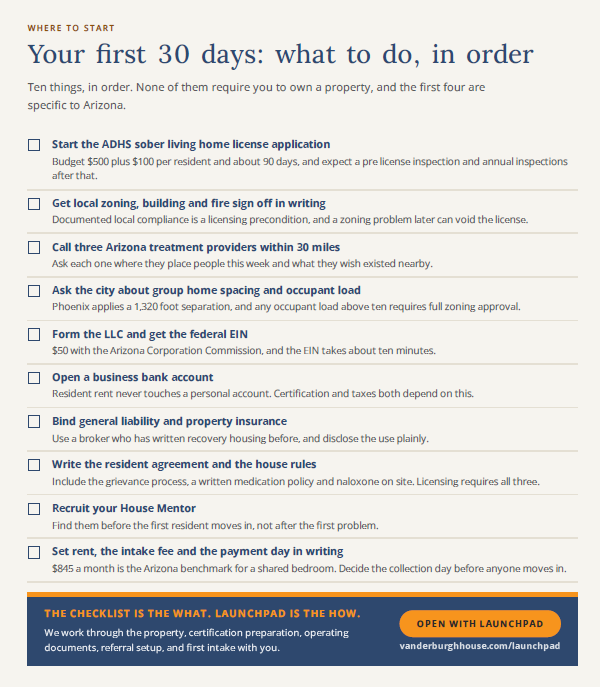
The unmet need and the bed shortfall, who pays the rent, what certification costs and what it unlocks, and the full operating model for buying versus leasing.
Get the Your State Starter Kit No cost, no obligation. Unsubscribe in one click.What Goes Into a Washington, DC Startup Budget
Every line in the table below is either a published District fee or an estimated model output built from a published District input, and the Methodology note under the table names the source and the assumption behind each one.
| Cost item | Estimated cost | What it means |
|---|---|---|
| Entity formation & state filing fee | $99 | Certificate of organization for an LLC with DLCP, on either path. |
| Basic Business License, One Family Rental | $159 | Two-year rental license; the category covers individual rooms. |
| Certificate of occupancy | $0–$83 | $0 for single-family homes in R-1A, R-1B, R-2 and R-3 zones. |
| Lease deposit or property down payment | Lease: $14,914–$17,558 Purchase: $159,214 | Lease: three months at an estimated $4,971 (three-bedroom) to $5,853 (four-bedroom) monthly lease; DC caps the deposit portion at one month’s rent. Purchase: 20% down on an estimated $796,068 purchase price. |
| Deed recordation tax, 1.45% | Lease: $0 Purchase: $11,543 | Applies to residential deeds of $400,000 or more. |
| Furniture and setup | $10,824 | Six beds at about $1,804 per bed, on either path. |
| Utility deposits | $812 | Indexed to DC cost of living. |
| Supplies and linens | $1,624 | Indexed to DC cost of living. |
| Marketing and launch | $677 | Indexed to DC cost of living. |
| Renovation and safety/code upgrades | Not included | Priced per address after an inspection, so it sits outside the total; add a contractor’s estimate before you commit. |
| Insurance (first year) | Lease: $3,550–$4,803 Purchase: $6,031–$7,178 | Liability on both paths; property coverage added on the purchase path. |
| Certification fee | $0 | No District certifying program and no NARR affiliate. |
| Operating reserve | Lease: $14,914–$17,558 Purchase: $14,764 | Three months of the lease payment, or of mortgage plus property tax. |
| Estimated all-in to open (low – high) | Lease: $47,573–$54,197 Purchase: $205,747–$206,977 | The realistic total to open a sober living home in Washington, DC, reserve included. |
Methodology & sources. Every total is an estimated model output, not a quote. The lease payment is HUD’s FY2027 Fair Market Rent for the Washington-Arlington-Alexandria, DC-VA-MD HUD Metro FMR Area ($3,107 for a three-bedroom, $3,658 for a four-bedroom), effective October 1, 2026, plus a 60% recovery-housing lease premium (a Vanderburgh Foundation estimate), times three months upfront. The purchase price is the Census Bureau’s 2020–2024 American Community Survey median value of owner-occupied DC homes, $737,100, plus an 8% recovery-housing purchase premium (a Vanderburgh Foundation estimate), with 20% down. Recordation tax is 1.45% under D.C. Code § 42-1103. The reserve uses a 30-year fixed mortgage at 7.28%, the Freddie Mac average as of November 19, 2026, plus property tax at the Class 1 rate of $0.85 per $100 of value. Furniture ($8,000), utility deposits ($600), supplies ($1,200) and marketing ($500) are Vanderburgh Foundation base estimates at a national cost-of-living index of 100, multiplied by the District’s MERIC index of 135.3, a 35.3% District uplift. Insurance uses a Vanderburgh Foundation base of $3,250 for general liability and $300 for contents on the lease path; the purchase path adds the 2023 NAIC average District homeowners premium of $1,545 with an 80% sober living property uplift ($2,781). The high end of each insurance range applies the 35.3% District uplift to the Vanderburgh Foundation bases. Renovation and code upgrades sit outside the total because they are priced per address after an inspection.
A few lines need the District context behind them.
- Entity formation: A domestic LLC files a certificate of organization with the Department of Licensing and Consumer Protection (DLCP) for $99, with a $300 biennial report after that. A nonprofit corporation files for $80 instead. Which entity fits, and what the District’s franchise tax adds in year two, is laid out in how to form a legal entity for a sober living business in Washington, DC.
- Rental license: DLCP’s Housing Business license costs $159 for two years or $318 for four in the One Family Rental category, whose definition includes “individual rooms.” It requires Clean Hands certification and a Basic Business License inspection.
- Certificate of occupancy: The Department of Buildings (DOB) exempts single-family residences in the R-1A, R-1B, R-2 and R-3 zones, and townhomes count as single-family homes. Outside those zones, DOB’s building permit fee schedule sets a certificate of occupancy for 5,000 square feet or less at a $42 base fee plus a $33 filing fee and a 10% enhancement, about $83.
- Certification: The certification line is $0 because there is nothing to buy. The District has no National Alliance for Recovery Residences (NARR) affiliate, and we found no District certification program for sober living homes as of November 2026. The Department of Behavioral Health (DBH) certifies substance use treatment and recovery support providers under 22-A DCMR Chapter 63, which is a different credential. The closest thing the District has to a recognized standard is a charter: a voluntary membership agreement between a home and a private network whose standards it agrees to run by, issued by the network rather than any government. Oxford House charters homes that are democratically self-run and financially self-supporting, with no paid staff in the house. Vanderburgh Sober Living charters independently operated homes into a cooperative network, where the operator keeps ownership of the business and gains the brand, the operating standards and the startup support of the Chartered Operator community. Neither is a District credential.
- Furniture per bed: At about $1,804 per bed across six beds, the furnishing line is an estimate, not a quote. Bunk beds, used case goods and phased purchasing all move it.
Lease vs. Buy: How the Startup Number Changes
Leasing a six-bed house in Washington, DC takes an estimated $158,174 less cash to open than buying one at the District median, and the monthly payments on the two paths are close.
The filter we use before we ever call an agent: what makes a property work as a Level II home, the zoning and occupancy questions to ask before you tour, and the red flags that should end a showing in five minutes.
Tell us where to send it and it lands in your inbox in about a minute.
| Factor | Leasing | Buying |
|---|---|---|
| Upfront cash | $47,573–$54,197 (estimated) | $205,747–$206,977 at the District median (estimated) |
| Monthly cost | $4,971 (three-bedroom) to $5,853 (four-bedroom) | $4,921 ($4,357 principal and interest plus $564 property tax) |
| Rent increases | Capped at 4.1% for Rent Control Year 2026 if the house is rent-stabilized | None; property tax and insurance still rise |
| Control over the property | Set by the lease and the landlord’s consent | Full |
| Equity | None | Builds with each payment |
| Main risk | Landlord non-renewal or sale | Concentrated capital in one address |
That near-parity on the monthly line is the District’s distinctive feature. At an estimated $4,921 a month for mortgage and tax against a $4,971 lease on a three-bedroom, the decision in Washington is almost entirely about upfront cash and control, not about the monthly carry.
Two District rules shape the lease path specifically:
- The security deposit cap: The DC Office of the Tenant Advocate’s Tenant Bill of Rights states that a security deposit “may not exceed the amount of 1 month’s rent” and must be held in an interest-bearing account. The model’s three months upfront is first month, last month and one month of deposit, so a landlord asking for two months of deposit on a residential lease is asking for more than the cap allows. A landlord who treats the master lease as commercial may argue different terms, so settle that in writing before signing.
- Rent control on the house you lease: The Rental Housing Act exempts buildings permitted after December 31, 1975 and small landlords (no more than four natural persons owning four or fewer rental units). An older house owned by an LLC or a larger landlord is usually rent-stabilized, which caps your annual increase at 4.1% for Rent Control Year 2026, May 1, 2026 through April 30, 2027. That predictability is worth something in a budget.
Rent control also reaches your side of the house. The Act’s definition of a rental unit includes a room, so an operator letting rooms becomes a housing provider and must register within 30 days. An LLC operator cannot claim the small landlord exemption. The full picture for operators is in rent control and sober living in Washington, DC.
The purchase number depends heavily on the ward. Using the same method at each ward’s 2020–2024 ACS median home value, the cash to open moves by a factor of more than two:
- Ward 8 ($441,300 ACS median): Estimated purchase price $476,604, down payment $95,321, recordation tax $6,911, total cash to open $131,297.
- Ward 7 ($492,000 ACS median): Estimated purchase price $531,360, down payment $106,272, recordation tax $7,705, total cash to open $144,058.
- District median ($737,100): Estimated purchase price $796,068, down payment $159,214, recordation tax $11,543, total cash to open $205,747.
- Ward 3 ($1,171,500 ACS median): Estimated purchase price $1,265,220, down payment $253,044, recordation tax $18,346, total cash to open $315,081.
Each total uses the low end of insurance and no certificate of occupancy fee, with a three-month reserve recalculated for that ward’s mortgage and tax. If you plan to buy, the sober house financing options decide how much of that cash you actually need on day one.
If you lease
- Expect three months upfront: first month, last month and a deposit capped at one month’s rent.
- Get the landlord’s written consent to sober living use.
- Register as a housing provider within 30 days of letting rooms.
If you buy
- Budget 1.45% recordation tax on a residential deed of $400,000 or more.
- Expect a monthly carry close to the lease: an estimated $4,921 for mortgage and tax at the District median.
- Price the ward first: an estimated $131,297 to open in Ward 8 against $315,081 in Ward 3.
Washington, DC Fire Code, Sprinklers, and the Bed-Count Cliff
The District’s building rules are what turn a six-bed plan into a fixed budget and a seventh bed into an open-ended one. The 2017 DC Construction Codes, based on the 2015 International Codes and in effect since May 29, 2020, set the thresholds below.
- The six-person cliff: At six or fewer unrelated residents, the home is a household under 11-B DCMR § 100.2 and stays a single-family dwelling. A seventh resident takes the home out of that definition, into community residence facility rules and spacing tests that the zoning analysis covers, or into a reasonable accommodation request.
- Occupancy classification: The 2017 DC Building Code places nontransient congregate living with 16 or fewer occupants in Group R-3 (§ 310.5) and reserves Group R-4 (§ 310.6) for seven to 16 people who receive custodial care. A sober living home whose residents manage their own care does not fit R-4.
- Sprinklers: Section 903.2.8 requires an automatic sprinkler system throughout buildings with a Group R fire area, and § 903.2.8.1 permits the lighter residential (NFPA 13D) system in Group R-3. Whether a conversion triggers a retrofit depends on the scope of work, so get a written answer from DOB before you sign.
Two more District rules apply to the house itself, whatever its bed count:
- Smoke and carbon monoxide alarms: The owner of every occupied dwelling unit must install smoke and carbon monoxide detectors under D.C. Code § 6-751.02. On the lease path, put that duty in the lease.
- Lead paint: Any dwelling built before 1978 “shall be maintained free of lead-based paint hazards” under D.C. Code § 8-231.02, and the District may refuse licenses or permits tied to a property in violation. Most of the city’s rowhouse stock falls on the wrong side of that date.
Floor area is the other quiet limit on beds. Work out determining maximum occupancy for each bedroom before you furnish, because a house that can only hold five legally changes every per-bed figure above.
Know your rights before you spendThe Federal Fair Housing Act and Sober Living: Everything You Need to KnowPeople in recovery are a protected class; understand these protections before you accept a costly local requirement.→The Costs First-Time Operators Underbudget
The lines that sink a first budget in Washington are rarely the fees; they are the costs that only appear once a specific house is in front of you.
- Insurance: A standard homeowners policy does not fit a sober living home. The table carries an estimated $3,550 to $7,178 for year one, and real quotes depend on the address, the carrier and the number of beds. Sober house insurance is worth quoting before you sign a lease or go under contract.
- The operating reserve: Beds fill over weeks, not days. Three months of housing payments, $14,764 to $17,558 in the model, is the cushion that keeps a slow first quarter from becoming a crisis.
- Code and safety upgrades: Interconnected alarms, egress windows in basement bedrooms and a second bathroom are priced per house. They sit outside the model’s total, so add a contractor’s estimate before you commit.
- Lead work: In a pre-1978 house, any renovation that disturbs paint needs District-certified contractors, which raises the cost of the same job.
- Recordation tax: At 1.45% of the price on any residential deed of $400,000 or more, it adds $11,543 at the District median, and buyers coming from states with low transfer taxes tend to miss it.
- Rental registration and licensing time: The Basic Business License inspection, Clean Hands certification and rental registration take weeks, and a lease or mortgage payment runs the whole time.
The District-specific playbook covering zoning, licensing, and setup from start to finish.
How to Lower Your Startup Costs
Most of the savings in Washington come from the property decision, not from cutting fees that are already small.
- Lease before you buy: The lease path opens for roughly a quarter of the purchase path’s cash, with a similar monthly payment.
- Buy east of the river, if you buy: The Ward 8 purchase path opens for an estimated $131,297 against $315,081 in Ward 3, for the same six beds.
- Choose the house that needs no upgrades: A house that already has hardwired alarms, conforming basement egress and two bathrooms can save more than any furnishing shortcut.
- Phase the furnishing: Furnish the bedrooms you will fill in the first month and add the rest as occupancy builds.
- Structure the lease well: A triple-net vs. gross lease decision moves costs between you and the landlord, so price it before you sign.
- Avoid false economies: Underinsuring, skipping the rental license or overfilling the house past six all cost more later than they save now.
Your Washington, DC Startup Checklist
Washington, DC Funding That Offsets the Upfront Outlay
Most District funding for recovery housing pays for operations after an award, but one recent round paid for startup directly.
- The DBH startup round: DBH’s RFA RM0 DCRR071026, released July 10, 2026, offered up to $70,000 per award for a one-month base period, including up to $40,000 in start-up funds for a 10-bed residence, with option years of up to $430,000 each.
- Eligibility: Applicants had to be District community-based organizations with at least one year of residential experience serving people with opioid or stimulant use disorder, and the homes had to meet NARR Level III or IV standards.
- Status: That round closed on August 7, 2026.
A first-time operator will usually not qualify for that kind of award, so budget to open on your own capital or financing and treat District grants as a year-two possibility. The programs, their eligibility rules and their timing are covered in depth in Washington, DC sober living funding, and what the house earns once it is open is modeled in whether it is profitable to operate a sober living home in Washington, DC.
Washington, DC guideHow Recovery Housing Funding Works in Washington, DCGrants, settlement dollars, and the programs that help offset what it costs to open.→Sober Living Guides Every Operator Needs
These evergreen guides apply in every state and go deeper on the pieces behind your startup budget: the standards your home certifies to, the property you choose, the insurance you carry, and the referral partners who keep the beds full.
Frequently Asked Questions About Sober Living Startup Costs
What is the minimum to open a sober living home in Washington, DC?
The lowest realistic estimate is about $47,573, for a leased three-bedroom house with six beds. That covers three months of rent upfront, $99 to form an LLC, a $159 rental license, furnishing, year-one liability insurance and a three-month operating reserve. Dropping the reserve to save cash is the most common mistake first-time operators make.
Can I start a sober living home in DC by leasing instead of buying?
Yes. Leasing is the lower-cash path in Washington, opening for an estimated $47,573 to $54,197 against about $205,747 to buy at the District median. The monthly payments are similar on both paths. Get the landlord’s written consent to sober living use, and confirm the lease respects DC’s one-month security deposit cap.
Does Washington, DC charge a sober living license or certification fee?
No. We found no District license or certification program for sober living homes as of November 2026, and the District has no NARR affiliate. You still pay DLCP $99 to form an LLC and $159 for a two-year One Family Rental business license, plus a certificate of occupancy fee in some zones.
How many beds can a DC sober living home have?
Six is the by-right number. The District’s zoning definition of a household allows no more than six unrelated persons living as a single housekeeping unit. A larger house requires a reasonable accommodation request or a different zoning route, so every startup figure on this page is sized to six beds.
Do DC grants cover sober living startup costs?
Occasionally. DBH’s July 2026 recovery residence funding round included up to $40,000 in start-up funds per award, but it required a year of residential experience and NARR Level III or IV standards, and it has closed. Most first-time operators open on their own capital and pursue District funding later.
Plan Your Washington, DC Startup Budget With VSL
The estimates above are built from District figures, but your house will have its own rent, its own repairs and its own insurance quote. The Sober Living Calculator lets you replace each model input with your own numbers and see the lease-versus-buy result for the property in front of you.
If you would rather plan the opening with people who have done it, contact Vanderburgh Sober Living to talk through your budget.
Start your sober house
Pick the path that fits where you are in the process.
Download the free guidePath to Purposeful Recovery Housing, by Dr. Hunter T. Foote.Explore the Mastery ProgramHands-on startup, certification, and operating support.See how starting with VSL worksThe opportunity, the community, and what a Charter includes.Prefer to talk now? Call (844) 762-3747, weekdays 8a to 5p.
Research & Sources
- Department of Buildings. (n.d.). Building permit fee schedule. Government of the District of Columbia. https://dob.dc.gov/node/1620346
- Department of Buildings. (n.d.). DC construction codes. Government of the District of Columbia. https://dob.dc.gov/page/dc-construction-codes
- Department of Buildings. (n.d.). Get a certificate of occupancy. Government of the District of Columbia. https://dob.dc.gov/service/get-certificate-occupancy
- Department of Buildings. (2020). 2017 District of Columbia building code, Part 1. Government of the District of Columbia. https://dob.dc.gov/sites/default/files/dc/sites/dob/publication/attachments/2017%20District%20of%20Columbia%20Building%20Code_Part%201.pdf
- Department of Behavioral Health. (2026). Request for application RM0 DCRR071026: Recovery residences with intensive care management and peer navigator support. Government of the District of Columbia. https://dbh.dc.gov/sites/default/files/dc/sites/dmh/publication/attachments/RFA%20_RM0%20DCRR071026.pdf
- Department of Licensing and Consumer Protection. (n.d.). Corporations Division fees: Limited liability company. Government of the District of Columbia. https://dlcp.dc.gov/node/1621921
- Department of Licensing and Consumer Protection. (n.d.). Housing business. Government of the District of Columbia. https://dlcp.dc.gov/node/1618681
- District of Columbia. (n.d.). D.C. Code § 6-751.02: Smoke detector and carbon monoxide detector installation. Council of the District of Columbia. https://code.dccouncil.gov/us/dc/council/code/sections/6-751.02
- District of Columbia. (n.d.). D.C. Code § 8-231.02: Lead-based paint hazards prohibited. Council of the District of Columbia. https://code.dccouncil.gov/us/dc/council/code/sections/8-231.02
- District of Columbia. (n.d.). D.C. Code § 42-1103: Recordation tax rates. Council of the District of Columbia. https://code.dccouncil.gov/us/dc/council/code/sections/42-1103
- District of Columbia. (n.d.). D.C. Code § 42-3501.03: Definitions. Council of the District of Columbia. https://code.dccouncil.gov/us/dc/council/code/sections/42-3501.03
- District of Columbia. (n.d.). D.C. Code § 42-3502.05: Coverage and exemptions. Council of the District of Columbia. https://code.dccouncil.gov/us/dc/council/code/sections/42-3502.05
- District of Columbia. (n.d.). 14 DCMR § 111: Procedures regarding requests for reasonable accommodation under the Fair Housing Act. D.C. Office of Documents and Administrative Issuances. https://www.dcregs.dc.gov/Common/DCMR/SectionList.aspx?SectionNumber=14-111
- District of Columbia Office of Planning. (2026). ACS 5-year housing characteristics of DC, 2020–2024 (Table DP04) [Data set]. U.S. Census Bureau data. https://maps2.dcgis.dc.gov/dcgis/rest/services/DCGIS_DATA/Demographic_WebMercator/MapServer/43
- District of Columbia Office of Planning. (2026). ACS 5-year housing characteristics of DC wards, 2020–2024 (Table DP04) [Data set]. U.S. Census Bureau data. https://maps2.dcgis.dc.gov/dcgis/rest/services/DCGIS_DATA/Demographic_WebMercator/MapServer/45
- Federal Reserve Bank of St. Louis. (2026). 30-year fixed rate mortgage average in the United States (MORTGAGE30US) [Data set]. Freddie Mac Primary Mortgage Market Survey. https://fred.stlouisfed.org/series/MORTGAGE30US
- Insurance Information Institute. (n.d.). Facts + statistics: Homeowners and renters insurance (NAIC average premiums by state, 2023). https://www.iii.org/fact-statistic/facts-statistics-homeowners-and-renters-insurance
- Missouri Economic Research and Information Center. (2026). Cost of living data series, third quarter 2026. https://meric.mo.gov/data/cost-living-data-series
- Office of Tax and Revenue. (n.d.). Real property tax rates. Government of the District of Columbia. https://otr.cfo.dc.gov/page/real-property-tax-rates
- Office of the Tenant Advocate. (n.d.). District of Columbia tenant bill of rights. Government of the District of Columbia. https://apia.dc.gov/sites/default/files/dc/sites/apia/publication/attachments/261018445-Bill-of-Rights.pdf
- Office of the Tenant Advocate. (2026, February 2). Rent Control Year 2026 rent increase caps. Government of the District of Columbia. https://ota.dc.gov/node/1816006
- U.S. Department of Housing and Urban Development. (2026). FY2027 Fair Market Rents [Data set]. https://www.huduser.gov/portal/datasets/fmr/fmr2027/FY27_FMRs.xlsx
- U.S. Department of Housing and Urban Development. (2026, September 1). Fair market rents for the Housing Choice Voucher Program, Moderate Rehabilitation Single Room Occupancy Program, and other programs fiscal year 2027. Federal Register. https://www.federalregister.gov/documents/2026/09/01/2026-17891/fair-market-rents-for-the-housing-choice-voucher-program-moderate-rehabilitation-single-room
- Zoning Commission for the District of Columbia. (2018). Title 11 DCMR, Subtitle B: Definitions, rules of measurement, and use categories (§ 100.2, “Household”). DC Office of Zoning. https://dcoz.dc.gov/sites/default/files/dc/sites/dcoz/publication/attachments/Subtitle%20B_4.pdf
