

Sober living funding in Washington, DC looks generous from a distance. The District’s Department of Behavioral Health runs federal opioid response money, a federal block grant and a local opioid settlement fund, and it writes the words “recovery housing” into its plans. Many aspiring operators read that and picture a grant covering the lease, the house mentor’s stipend and the second house.
The money is real, and some of it does reach recovery homes. It arrives through a small number of competitive awards, each written for an organization that already runs residential services, already meets a national standard and can report to a government funder every month. Knowing which dollars exist, and which doors they actually come through, is what keeps a new operator from building a budget around a grant that was never designed for them.
Before you read onHow to Open a Sober Living Home in Washington, DCThis post covers one piece of the process. The complete Washington, DC guide walks through every step, from planning to your first resident.→How Does Recovery Housing Funding Work in Washington, DC?
In Washington, DC, sober living funding flows mainly through the Department of Behavioral Health (DBH) as competitive grants to established community organizations, paid from federal State Opioid Response, block grant and opioid settlement dollars. Awards are few, time-limited and tied to NARR standards and reporting. Resident fees, not grants, carry a typical sober living home.
The District is a single government with no counties beneath it, so almost every public dollar for recovery housing passes through one agency. DBH describes itself in its grant solicitations as the District’s single state agency for substance use services, with authority to make grants under D.C. Official Code § 7-1141.06(7) and 22-A DCMR Chapter 44. Here is how that money behaves in practice:
- One gatekeeper: DBH issues the requests for applications (RFAs), scores them and signs the grant agreements, whether the dollars started as federal grants or settlement payments.
- Organizations, not people: Every DBH solicitation states that individuals are not eligible for DBH grant funding, so an operator needs an entity, a federal UEI number and registration in SAM before applying.
- Experience first: The 2026 recovery residence RFA requires at least one year of experience providing residential services to people with opioid or stimulant use disorder; the 2026 peer-led housing RFA requires two.
- Standards attached: District recovery housing grants require NARR-standard operation, at Level III or IV for the case-managed model and Level I or II for the peer-led model.
- Short clocks: Awards run in budget periods of one to 12 months, renewed year by year for up to four option years, and always “contingent upon the continued availability of funds.”
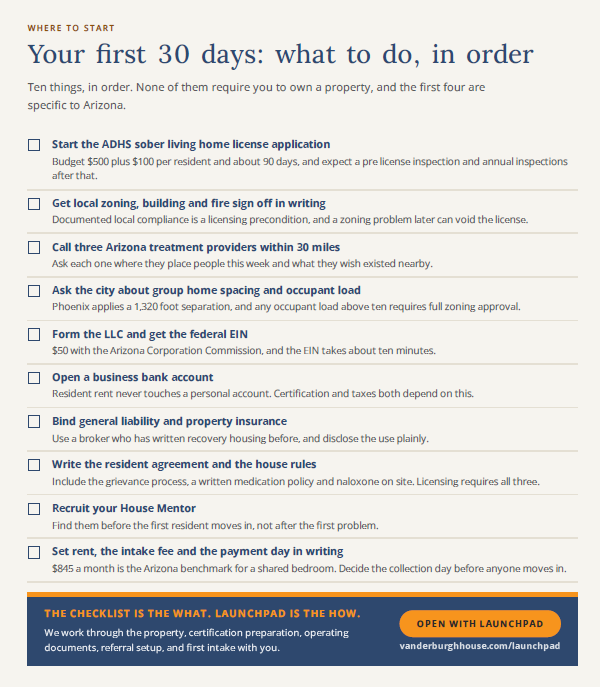
Fourteen pages: the bed shortfall, who pays the rent, and what it costs to open. Built from your state‘s own numbers.
Are There Grants to Open a Sober Living Home in Washington, DC?
Yes, but not for most new operators. DBH’s July 2026 recovery residence RFA included up to $40,000 in start-up costs per award, alongside a $3,000 per resident monthly ceiling. Only five awards were offered, and applicants needed a year of residential experience, a District location and NARR Level III or IV operations.
That yes is narrower than it sounds. DBH’s July 10, 2026 recovery residence RFA (RM0 DCRR071026) made $350,000 available across up to five awards for a one-month base year running August 25 to September 29, 2026, with option years of up to $430,000 per award after that. Applications were due August 7, 2026. Grant money in the District is built this way for three structural reasons:
- Sober living homes are housing businesses: A sober living home earns its income from residents who pay rent, so it does not fit a funding stream designed to buy services.
- Public dollars buy system capacity: The District’s grants are written to add beds, case management and peer support to a recovery system, and they flow to entities with the fiscal controls to report on them.
- Every award is time-limited and outcome-tied: The same RFA requires a sustainability plan for continuing the residence after the grant ends, which tells you DBH expects the house to outlive the award.
Resident Fees Still Fund Most Sober Living Homes
Resident fees are the only revenue a sober living home controls. They arrive every week or month, they rise and fall with occupancy, and they do not depend on a solicitation being released on time. A grant arrives once a year at best, with conditions, a reporting calendar and an end date.
The District’s own grant rules point the same way. The 2026 recovery residence RFA asks every applicant for a program income and financial disclosure, and it warns that federal rules for for-profit entities “may require a reduction of approved grant awards based upon program income earned.” Rent you collect can shrink the award, not stack on top of it.
The operators who last in Washington price their homes to stand on resident fees alone at realistic occupancy. Getting sober living rent pricing right, and keeping beds full once the house opens, decides more about survival than any single award. Funding then becomes what it should be: a supplement that adds a case manager, a second house or a safety upgrade to a model that already works.
Washington, DC guideIs It Profitable to Operate a Recovery Home in Washington, DC?Realistic revenue, operating costs, and the resident-fee margins that keep a home running.→Which Washington, DC Programs Fund Recovery Housing?
Six public funding streams touch recovery housing in the District, and only two of them ever reach a sober living home’s own budget directly.
| Program | What It Primarily Funds | Who Typically Receives It |
|---|---|---|
| DBH recovery residence grants (DCOR, RFA RM0 DCRR071026, 2026) | NARR Level III or IV residences with intensive care management, peer support after discharge and start-up costs; up to $3,000 per resident per month | Up to five District community-based organizations with at least one year of residential experience |
| DBH Peer-Led Recovery Housing (RFA RM0 PLRH073126, FY2027) | Up to three months of rental assistance per resident in NARR Level I or II peer-led homes, plus peer recovery support; one $525,000 award | One District nonprofit or community-based organization with two years of experience |
| State Opioid Response (SOR) grant | The federal source behind both DBH recovery housing RFAs; prevention, treatment and recovery support | DBH, which subgrants to providers ($25,166,719 for FY2025) |
| Substance Use Prevention, Treatment, and Recovery Services Block Grant (SUPTRS, historically SABG) | Treatment, prevention and a small recovery support line | DBH, which contracts with certified providers |
| Opioid Abatement Fund (settlement dollars) | Prevention, treatment, harm reduction, peer workforce and some transitional housing | Nonprofits selected through DBH Office of Opioid Abatement competitions |
| DC Medicaid (1115 demonstration and Housing Supportive Services) | Recovery coaching and peer support services; housing search and tenancy support for people matched to supportive housing | Enrolled Medicaid providers, not housing operators; no rent or room and board |
Methodology & sources. Rows one and two come from DBH’s Peer-Led Recovery Housing RFA RM0 PLRH073126 and the DCRR071026 RFA linked above. The SOR figure is from SAMHSA’s FY2025 State Opioid Response allocation announcement of September 22, 2025. The block grant, settlement and Medicaid rows are sourced in the subsections below. Status as of November 2026.
Support for every stage
Pick the level of support that fits where you are.
Just getting startedSee how the sober living opportunity works and what starting with VSL looks like.LaunchpadGuided pre-launch program: one-on-one strategy, Academy training, weekly coaching, and templates.MasteryHands-on startup, certification, and operating support inside the Chartered Operator community.Questions first? Call (844) 762-3747, weekdays 8a to 5p.
Direct Operating Support
Direct operating support is the money operators hope for: rent, payroll and utilities. In Washington it exists only inside DBH’s two recovery housing competitions, and each one is narrow.
- The DCOR recovery residence grants: The 2026 RFA offered five targeted competitions (men returning from incarceration, women returning from incarceration, returning citizens aged 55 and older, a women-only home and a men-only home). Each award covers a 10-bed residence at up to $3,000 per resident per month, with option-year budgets of $360,000 for beds, $50,000 for outreach to residents after they leave and $20,000 for non-Medicaid recovery support. Each home needs a live-in resident monitor and a care manager.
- The earlier round shows the pattern: DBH’s March 2024 RFA (RM0 DCRR030124) offered $570,000 across up to three awards, capped at $180,000 each for April 1 to September 29, 2024, funded by the SOR 3 grant. The total pot shrank in 2026 while the number of targeted awards grew.
- Peer-Led Recovery Housing: This RFA, released July 31, 2026, funds one grantee for October 1, 2026 to September 29, 2027, and directs that 25% of the budget go to rental assistance of up to three months per resident. It is the closest the District comes to paying a resident’s rent in a sober living home, and it is routed through one organization.
- No federal revolving loan fund: Federal law lets states and the District run a revolving loan fund of $4,000 loans for recovery homes, repaid within two years, under 42 U.S.C. § 300x-25. In its draft FY2026–2027 block grant environmental factors, DBH answered “No” to operating one and “No” to a need to start one. The Oxford House-style start-up loan many operators read about elsewhere is not on offer here.
Indirect Support
Indirect support is where most District dollars land. It pays for services around a resident and for placement relationships, which shapes who fills your beds without ever crossing your books.
- Medicaid recovery support services: DC Medicaid covers “non-clinical services and supports designed to support and maintain ongoing recovery from SUD,” delivered by certified recovery coaches and certified peer specialists, under STC 24 of the District’s Behavioral Health Transformation 1115 demonstration. The same terms state that room and board are not allowable costs for residential treatment providers. CMS extended the demonstration through December 31, 2026 in a letter dated November 17, 2025.
- Housing Supportive Services: The District’s Medicaid Housing Supportive Services benefit pays providers a per member per month rate of $755.21 for helping a person find and keep housing. Eligibility is limited to Medicaid adults who are chronically homeless or at risk of it and matched to permanent supportive housing. It funds a case manager, not a sober living home’s rent.
- Reentry placement: Four of the five 2026 DCOR competitions target returning citizens, so reentry is where DBH is concentrating recovery housing money. The Mayor’s Office on Returning Citizen Affairs (MORCA) told the Council in its FY2026 oversight responses that it has received no new housing vouchers since FY2024 and called the barrier budgetary. Recovery housing for reentry works in the District through referral relationships, not a MORCA subsidy.
Infrastructure and Capital Support
Capital money in the District buys buildings and builds systems. It does not run a six-bed sober living home, and none of it is set aside for recovery housing.
The Opioid Abatement Fund is the most flexible pot. Under D.C. Official Code § 7-3221, it is a special fund administered by DBH that may pay for awards and grants for prevention, recovery, treatment and harm reduction, and for the “infrastructure” those services require. DBH’s Office of Opioid Abatement reports that the District will receive more than $80 million over 18 years and had received $38,305,806.15 as of September 30, 2026. It has awarded about $28 million so far, with spending of $1,140,114.31 in FY2024 and $13,295,449.08 in FY2025.
Some of that reaches recovery housing, always through established nonprofits. The Office’s grantee expenditure dataset lists three FY2026 Strategic Impact Grant transitional housing awards of $750,000, $489,474.93 and $259,872.81, about $1.5 million in total. Each went to an organization already running sober or transitional beds with case management.
The District’s housing finance tools sit further away still. The Housing Production Trust Fund, administered by the Department of Housing and Community Development (DHCD), provides gap financing for affordable housing, with at least 50% of spending serving households below 30% of area median income and rental covenants that typically last 40 years. As of November 2026, we found no DHCD or DC Housing Finance Agency program set aside for recovery housing. An operator reaches that money only as a partner in a larger affordable housing development.
Why Eligibility Often Depends on Certification and Partnerships
Partnerships count as much as paperwork. The peer-led RFA requires partnerships with at least one DBH-certified substance use treatment provider, one mental health provider and one community or faith-based organization. The case-managed RFA expects grantees to recruit residents through District treatment and care management partners.
Sober living homes are voluntarily certified, not licensed as treatment, and that standing is set by the National Alliance for Recovery Residences (NARR) and, in most states, its state affiliate. The District has no NARR affiliate and no District certification for sober living homes, so DBH writes the standard into each grant instead. The 2024 and 2026 recovery residence RFAs require applicants to establish and document a “Level III or IV self-sustaining Recovery Residence” under NARR standards, covering administration, operations and physical environment. The 2026 peer-led RFA requires homes maintained to Level I or II standards.
That makes documentation your credential. Policies, house rules, resident agreements, incident logs, good-neighbor records and inspection notes are the evidence a DBH reviewer scores, and the NARR levels of care decide which competition you can enter. A house built to Level II with peer leadership fits a different RFA from a Level III house with paid care managers.
Without a District credential, the nearest thing to a recognized standard for a new house is a charter. A charter is a membership agreement between a home and a private network whose standards the home agrees to run by. It is not government permission and not a third-party certification; it comes from the network rather than the District, is voluntary, and no agency issues or revokes it. What it carries is a rulebook, a name and accountability to the organization behind it.
- Oxford House: Charters homes that are democratically self-run and financially self-supporting, require a resident to leave immediately on a return to use, and operate with no paid staff in the house.
- Vanderburgh Sober Living: Charters independently operated homes into a cooperative network, where the operator keeps ownership of the business and gains the brand, the operating standards, and the startup and certification support of the Chartered Operator community.
A charter does not satisfy a DBH grant condition on its own, and it is not a District credential. It does give a new operator written standards and a track record to build from.
Why Funding Is Competitive and Temporary
DBH funding windows are short. The 2026 recovery residence RFA gave applicants four weeks from its July 10 release to its August 7 deadline, and DBH’s peer-led RFA states it was posted on a compressed schedule so the award could start with FY2027.
Awards are scarce. Five recovery residence awards and one peer-led award were on offer in 2026, against a District recovery system that DBH says placed 526 people in SOR-funded recovery housing in FY2025, according to the peer-led RFA’s background section.
Every award ends. Base periods ran one month in the 2026 recovery residence round and six months in 2024, and every option year depends on “the continued availability of funds and recipient performance.”
The federal source itself is on a clock. SAMHSA announced the District’s FY2025 State Opioid Response money as annual continuation funding, which is why each DBH solicitation reserves the right to amend or rescind the opportunity.
Reporting does not stop. The peer-led RFA requires monthly data through DBH’s Substance Use Performance Reporting Tool, both 2026 RFAs require NARR evidence, and grantees must not supplant other funding for the same work.
Reshaping a house’s budget around one award cycle is a real risk. If the grant ends and resident fees cannot carry the home, the operator is left with staff, a lease and residents the budget no longer supports. That is why funding belongs on top of a model, never underneath it.
How Strong Washington, DC Operators Use Funding Strategically
District funding works for operators who could open and run without it. The strong ones treat a DBH solicitation the way a business treats a contract opportunity, not a rescue, and they bring these things to the table:
- Stable occupancy: A house that stays full on resident fees shows a reviewer the model works before a dollar is added.
- A year or more of records: Both 2026 recovery housing RFAs require prior residential experience, so the operating history you build now is your future eligibility.
- NARR-ready documentation: Policies and logs written to the level you intend to apply at, kept current rather than assembled the week of the deadline.
- Existing referral relationships: Treatment providers, case managers and reentry partners, the referral sources that already send residents, so your recruitment plan is real when an RFA asks for one within two weeks of award.
- Reporting capacity: Someone who can produce monthly outcome data and a budget narrative without pulling the house mentor off the floor.
- A specific objective: A second house for a target population, a women-only home or a safety upgrade, matched to a named competition rather than general operating support.
Each of those is an asset whether or not a grant ever arrives, which is the test of a sound funding strategy. The profitability picture for a District home should be settled before any application is drafted.
A Practical Way to Evaluate Any Funding Opportunity
Before spending a month on an application, run every opportunity, District or private, through five questions:
- What is it designed to accomplish? A program built to expand treatment capacity or reentry services will score applicants on those outcomes, not on whether your house needs money.
- Who is the intended recipient? If the eligibility section asks for years of residential experience, a nonprofit structure or a care management team you do not have, the answer is already no.
- What obligations come with it? Count the reporting, the staffing ratios, the NARR level and any reduction for program income before counting the dollars.
- What happens when it ends? If the house cannot carry its staff and residents on resident fees after the final option year, the award is a liability with a delay.
- Does it improve occupancy stability? The best opportunities bring referral partners and residents along with the money.
For the rare opportunity that passes all five, sober living grants follow an application process worth learning before you write. For operators organized as nonprofits, nonprofit fundraising from foundations and donors is often a steadier supplement than government cycles.
The funding paths that actually close, and what a lender wants from a first-time operator.
No cost, no obligation. Unsubscribe in one click.Tell us where to send it and it lands in your inbox in about a minute.
Sober Living Guides Every Operator Needs
These evergreen guides apply in every state and cover the fundamentals behind the money on this page: the capital you raise, the beds you fill, and the referral partners who keep resident fees flowing.
Frequently Asked Questions About Recovery Housing Funding
Are there grants to open a sober house in Washington, DC?
Yes, but they are narrow. DBH’s July 2026 recovery residence RFA included up to $40,000 in start-up costs per award, with five awards available. Applicants had to be District community-based organizations with a year of residential experience operating to NARR Level III or IV standards, so most new operators will not qualify in their first year.
Does DC Medicaid pay for sober living?
No. DC Medicaid pays for recovery coaching and peer support delivered by certified recovery coaches and peer specialists under the District’s 1115 demonstration, extended through December 31, 2026, and those terms exclude room and board. Housing Supportive Services pays providers to help eligible people find and keep housing, not a sober living home’s rent.
What are DC’s opioid settlement funds used for?
The District’s Opioid Abatement Fund, administered by DBH under D.C. Official Code § 7-3221, pays for prevention, treatment, recovery, harm reduction and related infrastructure. DBH reported $38,305,806.15 received by September 30, 2026. Some FY2026 awards funded transitional housing, all through established nonprofits selected in competitive rounds.
Can a new sober living home in DC get an Oxford House-style loan?
Not from the District today. Federal law at 42 U.S.C. § 300x-25 lets a state or the District run a revolving fund of loans up to $4,000 for recovery homes. In its draft FY2026–2027 block grant plan, DBH answered that it does not operate one and did not identify a need to start one.
Is NARR certification required to receive funding in DC?
The District has no NARR affiliate, so certification is not available. DBH instead requires grantees to operate to NARR standards: Level III or IV for its 2026 recovery residence grants and Level I or II for its peer-led housing grant. Applicants document compliance with policies, records and evidence of good-neighbor practices.
Plan Your Washington, DC Funding Strategy With VSL
The District funds recovery housing on purpose, in small competitive rounds, for organizations that already run homes well. Build a sober living home that succeeds on resident fees first, document it to a NARR level from the day it opens, and the next DBH solicitation becomes an opportunity rather than a lifeline. To plan your District model with people who have opened homes across the country, contact Vanderburgh Sober Living.
Research & Sources
- District of Columbia Department of Behavioral Health. (2026, July 10). Request for application No. DCRR071026: District of Columbia Opioid Response (DCOR) grant opportunity: Recovery residences with intensive care management and peer navigator support for individuals with opioid and/or stimulant use disorder. https://dbh.dc.gov/sites/default/files/dc/sites/dmh/publication/attachments/RFA%20_RM0%20DCRR071026.pdf
- District of Columbia Department of Behavioral Health. (2024, March 1). Request for application RM0 DCRR030124: Recovery residences with intensive care management for individuals with opioid and/or stimulant use disorder. https://dbh.dc.gov/sites/default/files/dc/sites/dmh/publication/attachments/RFA%20DCRR030124%20Recovery%20Residences_Final.pdf
- Substance Abuse and Mental Health Services Administration. (2025, September 22). HHS provides more than $1.5 billion in State and Tribal Opioid Response grants. https://www.samhsa.gov/newsroom/press-announcements/20250922/hhs-state-tribal-opioid-response-grants-2025
- District of Columbia Department of Behavioral Health. (2026, July 31). Request for application No. PLRH073126: Peer-led recovery housing. https://dbh.dc.gov/sites/default/files/dc/sites/dmh/publication/attachments/RFA%20_RM0%20PLRH073126%20FINAL_.pdf
- Legal Information Institute. (n.d.). 42 U.S. Code § 300x-25: Group homes for recovering substance abusers. Cornell Law School. https://www.law.cornell.edu/uscode/text/42/300x-25
- District of Columbia Department of Behavioral Health. (2025). FY2026–2027 combined block grant plan: Environmental factors (draft). https://dbh.dc.gov/sites/default/files/dc/sites/dmh/page_content/attachments/FY26-27%20Combined%20Block%20Grant%20Plan_DC%20Environmental%20Factors_Draft.pdf
- Centers for Medicare & Medicaid Services. (2024, November 22). District of Columbia Behavioral Health Transformation section 1115 demonstration: Temporary extension approval and special terms and conditions. https://www.medicaid.gov/medicaid/section-1115-demonstrations/downloads/dc-behavioral-health-transformation-extn-apprvl.pdf
- Centers for Medicare & Medicaid Services. (2025, November 17). District of Columbia Behavioral Health Transformation section 1115 demonstration: Temporary extension approval. https://www.medicaid.gov/medicaid/section-1115-demonstrations/downloads/dc-behavioral-health-transformation-temp-ext-appvl-11172025.pdf
- District of Columbia Department of Human Services. (n.d.). Covered services: Housing navigation, housing stabilization. https://dhs.dc.gov/page/covered-services-%C2%A0housing-navigation-housing-stabilization%C2%A0
- District of Columbia Department of Human Services. (n.d.). Individual eligibility: Housing Supportive Services. https://dhs.dc.gov/page/individual-eligibility%C2%A0
- Mayor’s Office on Returning Citizen Affairs. (2026, March). FY2026 performance oversight pre-hearing responses to the Committee on Housing. Council of the District of Columbia. https://dccouncil.gov/wp-content/uploads/2026/03/FINAL-MORCA-Pre-Hearing-Questions-FY26-Committee-on-Housing.pdf
- Council of the District of Columbia. (n.d.). D.C. Official Code § 7-3221: Opioid Abatement Fund. https://code.dccouncil.gov/us/dc/council/code/sections/7-3221
- District of Columbia Department of Behavioral Health. (2026). Office of Opioid Abatement. https://dbh.dc.gov/page/office-opioid-abatement
- District of Columbia Department of Behavioral Health, Office of Opioid Abatement. (2026). Stakeholder grantee update report, FY2024–FY2026 [Data set]. https://dbh.dc.gov/sites/default/files/dc/sites/dmh/documents/Stakeholder_Grantee_Update_Report_2026_2025_2024.xlsx
- District of Columbia Department of Housing and Community Development. (n.d.). Housing Production Trust Fund. https://dhcd.dc.gov/page/housing-production-trust-fund
