

A sober living home license in Washington, DC is something many first-time operators assume they will need, because the District licenses almost everything else that houses people: group homes, assisted living, mental health residences and treatment programs. Some online roundups say the District licenses recovery housing; others say there are no rules at all. Neither is right.
The District is a single government with no county layer, so one Council and a handful of agencies decide what a peer-run sober house must hold. The answer turns on what the house does, how many people live there and how it is rented. Below are the governing statutes and rules, the lines that would pull a house into licensure, and the business and housing paperwork every operator in the District still files.
Before you read onHow to Open a Sober Living Home in Washington, DCThis post covers one piece of the process. The complete Washington, DC guide walks through every step, from planning to your first resident.→Do You Need a License to Open a Sober Living Home in Washington, DC?
No. As of November 2026, Washington, DC has no license, registration or certification for a peer-run sober living home that provides no treatment. The District does require the paperwork any residential landlord needs: a Basic Business License from DLCP (One Family Rental, $159 for two years), rental registration with DHCD, and housing that meets District codes.
That answer comes from reading the District’s three relevant licensing schemes against what a sober house actually does. The Department of Behavioral Health (DBH) certifies substance use disorder programs under 22-A DCMR Chapter 63, and § 6300.5 requires certification for anyone who operates “a program that offers or proposes to offer non-hospital SUD treatment services.” A house that rents rooms to people in recovery and delivers no treatment is not that program.
DBH separately licenses mental health community residence facilities under 22-A DCMR Chapter 38, but only those giving 24-hour supervised care to adults with a principal diagnosis of mental illness. DC Health licenses community residence facilities under the Health-Care and Community Residence Facility, Hospice and Home Care Licensure Act, D.C. Code § 44-501 et seq., which reaches sheltered-care settings. A self-governing rental house falls outside all three, with limits explained in the threshold sections below.
How your home gets classified, where Fair Housing applies, and what to do if the city says no.
Tell us where to send it and it lands in your inbox in about a minute.
Washington, DC Sober Living Licensing at a Glance
The table summarizes every rule this page covers, with the source for each, so the rest of the post can be read as the detail behind each row.
| Item | Detail | What it means |
|---|---|---|
| State license required | None found as of November 2026 | A peer-run house with no treatment needs no health or behavioral health license |
| Registry or certification mandate | None for recovery residences | No District list to join and no inspection to schedule for the recovery use itself |
| Administering agency | DBH, 22-A DCMR § 6300.5 | Applies only if you offer non-hospital SUD treatment services |
| Governing statute | DC Health, D.C. Code § 44-502 | Applies to sheltered-care settings and is the zoning route to seven or eight residents |
| Mental health residence license | DBH, 22-A DCMR § 3801.1 | Applies only to 24-hour supervised care for adults with mental illness |
| Business license | DLCP One Family Rental BBL, $159 (2 years) or $318 (4 years) | Required to rent a house or its individual rooms |
| Rental registration | DHCD, after the BBL issues (D.C. Code § 42-3502.05) | A registration statement or claim of exemption for the rental |
| Thresholds that trigger licensure | 6 unrelated persons (11-B DCMR § 100.2) | The practical bed limit for an unlicensed house |
| Express statutory mention | None for sober homes; “halfway house” appears in D.C. Code § 38-3201 (school notice) | Applies to the Mayor’s siting of facilities, not to private rentals |
| Voluntary certification body | No NARR affiliate in the District | No local certification exists to pursue |
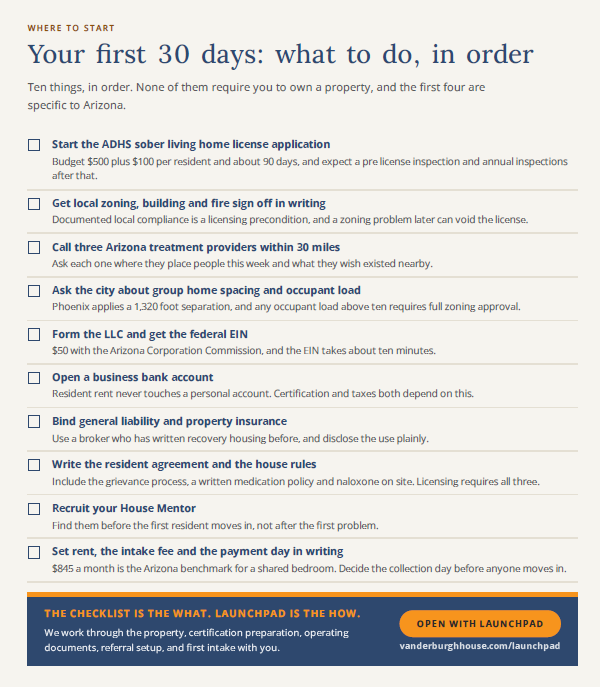
Most people ask whether they are allowed to open a recovery home. The better first question is whether the need and the money are there. This answers both, for your state.
- How many people need a bed, and how few beds exist
- Who actually pays the rent, and which programs are real
- What it costs to open on the purchase path and the lease path
How Washington, DC Regulates Sober Living Homes
The District regulates the building, the business and the number of people in the household, not the recovery use. No agency holds a roster of sober homes, and we found no provision of the D.C. Code that names “sober living” or “recovery residence” as of November 2026, after a full-text search of the Code’s published titles.
Behavioral health authority sits with DBH. The Department of Behavioral Health Establishment Act, D.C. Code § 7-1141.06, makes DBH the single state agency for substance use services and directs it to set “certification standards” for prevention, treatment and recovery support services. DBH used that authority to write Chapter 63, which certifies providers by ASAM level of care, from outpatient through residential treatment and withdrawal management, plus a non-clinical tier called Level R: Recovery Support Services (§ 6338).
Chapter 63 does contain one housing service. Section 6350, Environmental Stability, is a certified recovery support service that “includes recovery housing for up to six (6) months.” It is limited to a single parent with a child or children, requires the resident to be enrolled in other certified recovery support services, and needs DBH prior authorization. It is a funded service a certified provider may add, not a license that an ordinary sober house must hold.
Everything else is ordinary landlord law. The Department of Licensing and Consumer Protection (DLCP) issues the business license, the Department of Buildings (DOB) controls occupancy and construction, Fire and EMS (FEMS) enforces the fire code, and the Office of Zoning sets how many unrelated people may share a dwelling.
License vs. Certification vs. Registration: What Each Term Means
These three words get used interchangeably in online advice, and in the District they point to three very different things.
License
- What it is: Government permission to operate, enforced by law, where operating without it is unlawful.
- Does the District require one for a sober home: No. Licenses exist for community residence facilities (§ 44-502) and mental health residences, and both turn on care or supervision a peer-run home does not provide.
- What it unlocks: The legal right to run a care setting, plus annual inspections and renewal fees.
Certification
- What it is: A credential confirming that an operator meets a published standard, issued by an agency or an accredited body.
- Does the District require one for a sober home: No. DBH certification under Chapter 63 is for treatment and recovery support programs, and the District has no state affiliate of the National Alliance for Recovery Residences (NARR) to certify houses. NARR’s affiliate directory lists no District affiliate as of November 2026.
- What it unlocks: For DBH-certified programs, eligibility to deliver and bill District-funded services.
Registration
- What it is: A mandatory listing on a government roster, short of full licensure.
- Does the District require one for a sober home: No. The District has no registry for recovery residences, so there is no District list to join and no inspection to schedule for the recovery use itself.
- What operators do register: The rental. One Family Rental licensees register with the Department of Housing and Community Development (DHCD) after DLCP issues the Basic Business License (D.C. Code § 42-3502.05).
Operators also hear a fourth term, charter, which is neither a license nor a certification.
- What it is: A membership agreement between a home and a private network whose standards the home agrees to run by.
- What it is not: It is not government permission and not a third-party audit. No District agency issues or revokes it, and it is entirely voluntary.
- Who issues it: The network. Oxford House charters homes that are democratically self-run and financially self-supporting, require immediate departure on a return to use, and have no paid staff in the house. Vanderburgh Sober Living charters independently operated homes into a cooperative network, where the operator keeps ownership of the business and gains the brand, the operating standards, and the startup and certification support of the Chartered Operator community.
- What it unlocks: A rulebook, a recognized name and accountability to an organization. With no District license and no NARR affiliate, a charter is the closest thing the District offers to a recognized standard, and it is not a District credential.
| Credential | Required? | Administering body |
|---|---|---|
| License (sober home) | No | None exists |
| License (community residence facility) | Only for sheltered-care settings | DC Health |
| Certification (SUD program) | Only for treatment or recovery support programs | DBH |
| Certification (recovery residence) | No | No District certifier |
| Registration | No recovery residence registry; rental registration required | DHCD (rental registration) |
| Charter | No (voluntary) | Oxford House; Vanderburgh Sober Living |
When a Sober Living Home Crosses Into Licensed Treatment
A sober house stays outside DBH’s scheme by not offering clinical services, and the line is drawn by what is delivered on the premises. These are the conditions that would require DBH certification under Chapter 63:
- Offering treatment: Counseling, therapy, diagnostic assessment or withdrawal management delivered by the house triggers the certification requirement in § 6300.5.
- Running a residential program: A residential treatment program must also hold a Certificate of Need from the State Health Planning and Development Agency under § 6325.2.
- Billing recovery support services: Providing Level R recovery support services for DBH funding requires certification, a recovery program manager and a DBH-approved curriculum (§ 6338.9 and § 6338.10).
- Accreditation for certified providers: Since October 1, 2023, every certified SUD provider must hold CARF, COA or Joint Commission accreditation under § 6351.1.
Residents can still attend treatment elsewhere while they live with you. Rides to an outpatient program, house meetings and peer accountability do not make a house a treatment program. Keep the house agreement explicit that no treatment is delivered on site, and keep any clinical partner’s services at the partner’s own address.
The Care and Supervision Line: Community Residence Facilities
The license that matters most for District operators to understand is not DBH’s. It is DC Health’s community residence facility license, because the statute’s definition is broad.
D.C. Code § 44-501(a)(3) defines a community residence facility as one “that provides a sheltered living environment for individuals who desire or need such an environment because of their physical, mental, familial, social, or other circumstances.” Section 44-502 makes operating one without a license unlawful, and § 44-501(b) gives the Mayor the final say on whether a particular operation falls in the category. DC Health’s operating rules sit in 22-B DCMR Chapter 34, which covers residence directors, admission and discharge policies, dietary services and medication storage, and includes a section headed “Halfway Houses.”
That section is a halfway house subtype within the District’s community residence facility rules (22-B DCMR § 3440), so a sober house that drifts into community residence facility territory would be regulated as one. That is one reason Vanderburgh Sober Living never uses the term “halfway house” for its homes.
Those rules describe a care setting run by staff. A sober house where tenants rent rooms, buy and cook their own food, manage their own medication and govern themselves is run as a rental. The further a model moves toward providing care, the closer it gets to the license:
- Meals and medication: Serving meals or handling residents’ medication looks like the dietary and medication services Chapter 34 regulates.
- Staff supervision: A paid on-site director responsible for residents’ welfare looks like the residence director role in § 3400.
- Seven or more residents: Zoning sends any house above six unrelated persons toward the community residence facility category, covered in the occupancy section below.
If your model includes any of these, ask DC Health’s Intermediate Care Facilities Division, which licenses community residence facilities, for a written determination before you sign a lease. The penalty exposure under § 44-509 includes injunctions brought by the Attorney General, so the question is worth settling on paper first.
What’s Changed in Washington, DC Sober Living Law
The District has never passed a recovery residence statute. The milestones below are the rule changes that shaped today’s answer, with no guaranteed timeline for what comes next.
February 24, 1984: The Health-Care and Community Residence Facility Licensure Act (D.C. Law 5-48) took effect, creating the community residence facility license.
September 4, 2015: DBH published Chapter 63 certification standards for SUD treatment and recovery providers at 62 DCR 12056, including Environmental Stability (§ 6350).
May 1, 2018: Mental health community residence facility rules took effect in 22-A DCMR Chapter 38, replacing the repealed 22-B DCMR Chapter 38.
October 9, 2020: DBH amended Chapter 63 at 67 DCR 011585, the version of § 6338 and § 6350 in force today.
August 29, 2022: DBH released a recovery residence funding opportunity, RFA DCRR082622, asking grantees to run houses to NARR Level III or IV standards. It is a grant condition, not a license.
October 21, 2022: Zoning Commission Order No. 19-31 took effect, restoring community residence facilities to the residential use lists (69 DCR 012886).
October 1, 2023: National accreditation became mandatory for every DBH-certified SUD provider under § 6351.1.
Nationally, the District’s position is the common one. The Operating Climate Index observes a mandatory operating license for sober homes in three of the 50 states it scores and none in 45 (Foote, 2026). The Index does not score the District.
Washington, DC’s Occupancy and Building-Safety Thresholds
Bed count, not program type, is what pulls a District sober home into extra paperwork. These are the thresholds:
- Six unrelated residents: The zoning household is capped at six unrelated persons living as a single housekeeping unit under 11-B DCMR § 100.2. A house at six or fewer is a dwelling, with no special zoning approval.
- Seven or eight residents: Community residence facility routes for 7 to 8 persons need a DC Health license (11-U DCMR § 202.1(h)), and the Community-Based Institutional Facility category in 11-B DCMR § 200.2 excludes them. An unlicensed house has no matter-of-right path above six.
- Custodial care: The 2017 DC Building Code classifies more than six but not more than 16 persons receiving custodial care as Group R-4 (§ 310.6). Custodial care includes help with cooking or taking medication, so those services change the building’s classification.
- Certificate of occupancy: DOB states that single-family residences in the R-1A, R-1B, R-2 and R-3 zones are exempt from the certificate of occupancy requirement. Building Code § 110.4.2 treats congregate living with six or fewer residents as a one-family dwelling.
- Fire inspection: FEMS inspects single-family homes only on request or complaint, but runs annual license-renewal inspections for rooming houses and community residence facilities.
The full zoning picture, including reasonable accommodation requests to exceed six, sits in the District’s zoning, fair housing and land use rules for sober living.
Washington, DC guideWashington, DC Zoning, Fair Housing, and Land Use Laws for Sober LivingWhere sober homes can operate in Washington, DC and the legal protections that apply.→What’s Still Required Without a License
No sober home license does not mean no paperwork. Every operator renting rooms in the District still owes this compliance floor:
- A legal entity: Form an LLC or nonprofit before you sign anything; DLCP charges $99 to form a domestic LLC, as set out in the guide to forming a legal entity for a sober living business in Washington, DC.
- A Basic Business License: D.C. Code § 47-2851.02 requires one for each business location. DLCP’s One Family Rental activity covers single-family homes and “individual rooms,” at $159 for two years or $318 for four, after tax registration, Clean Hands certification and an inspection.
- The right license category: DLCP’s Lodging category lists Rooming House and Boarding House at $99 for two years and requires a certificate of occupancy. Confirm with DLCP which category fits your configuration before you apply.
- Rental registration: One Family Rental licensees register with the Department of Housing and Community Development after DLCP issues the license, and DLCP lists a $21.50 Rental Accommodations Fee per unit per year. Rent stabilization questions are covered in the post on rent control and sober living in Washington, DC.
- Smoke and carbon monoxide alarms: D.C. Code § 6-751.02 makes the owner of every occupied dwelling unit responsible for installing both under the Construction Codes.
- Insurance: General liability and property coverage written for a shared residence, explained in this guide to insurance for your sober house.
- Fair housing compliance: Residents in recovery are protected by the federal Fair Housing Act and the DC Human Rights Act, which protect the house from discriminatory treatment and bind the operator too.
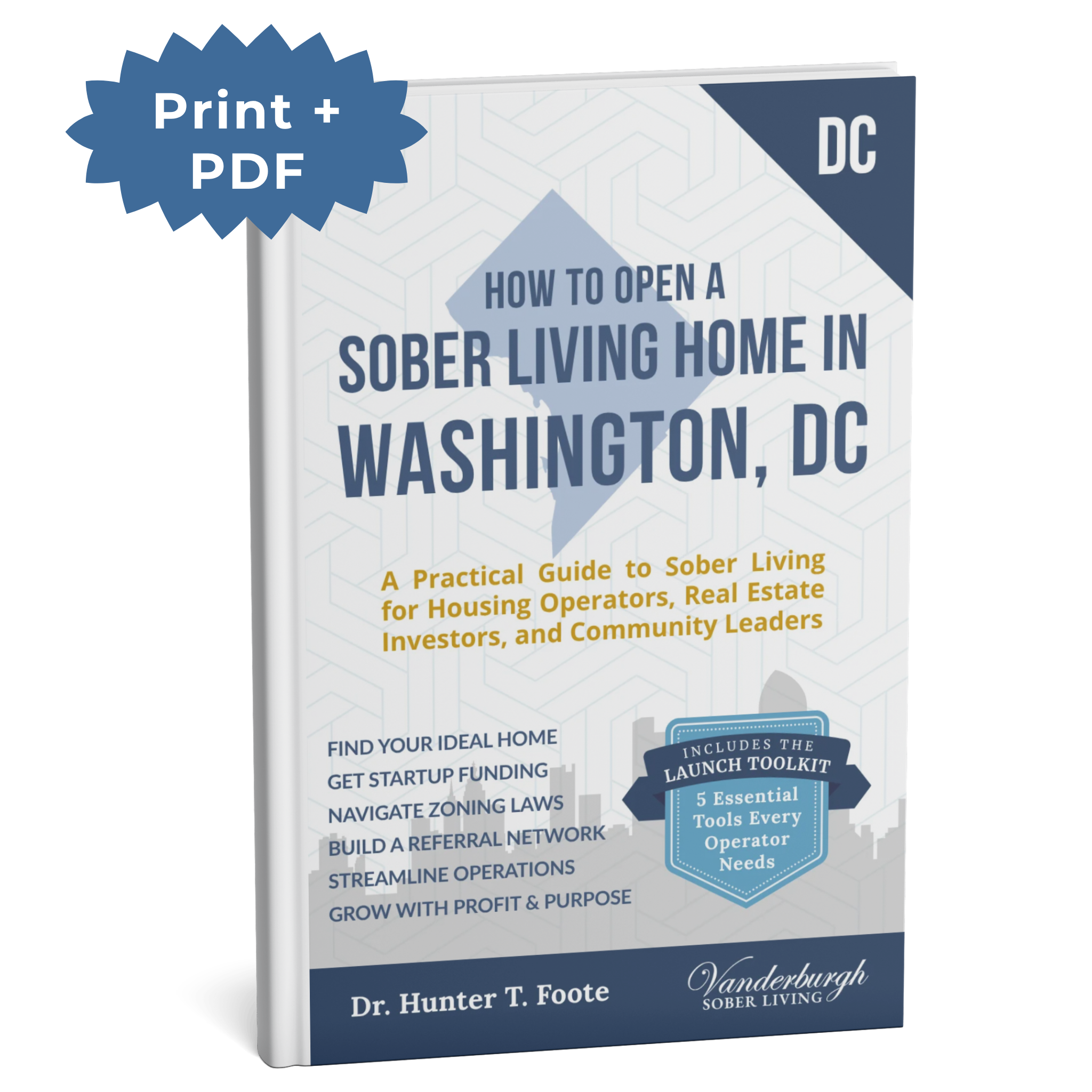
The District-specific playbook covering zoning, licensing, and setup from start to finish.
How Voluntary NARR Standards Work Without a District Certifier
In most states, the credibility standard for a sober home is certification by the state’s NARR affiliate. The District has no affiliate and no District-run certification program, so no local certificate exists to pursue.
What does exist is the standard itself. The National Alliance for Recovery Residences publishes the levels of support that DBH wrote into its 2022 recovery residence grant. Running a house to NARR standards, documented in your policies, is the practical substitute for a certificate, and it matches what District funders have asked for.
Operator guideHow to Certify a Sober House: An Overview of NARR-Affiliate CertificationHow NARR-affiliate certification works in states that have an affiliate, and what its standards ask of a home.→What Skipping NARR Standards Costs You
Because no certification is available, an uncertified District home is not at a disadvantage against certified neighbors. The real cost falls on operators who cannot show their standards on paper.
Referral partners in the District, including treatment programs and case managers, decide where to send people based on what they can verify. A written house agreement, a documented drug-testing policy, house rules and a live-in house mentor carry the weight a certificate would elsewhere. DBH’s recovery residence grant asked applicants to show compliance with NARR standards, so documented standards are also what keeps grant eligibility open.
Steps to Open a Washington, DC Sober House Legally
These steps put the paperwork in the order the District checks it:
- Form the entity: File the LLC or nonprofit with DLCP and get an EIN before you sign a lease or a contract.
- Pick a property that fits six: Confirm the zone and the household cap before you offer, using the zoning guide linked above.
- Define the model in writing: Rental house, peer governance, no treatment, no custodial care. If the plan includes meals, medication help or more than six residents, get DC Health’s determination first.
- License the business: Register with OTR, obtain Clean Hands certification and apply for the One Family Rental Basic Business License through DLCP.
- Register the rental: File with DHCD after the license issues and pay the per-unit fees.
- Make the house safe: Install interconnected smoke alarms and carbon monoxide alarms, check egress in every bedroom and bind insurance.
- Open to residents: Sign house agreements that state plainly that no treatment is provided on site, and track your opening budget against sober living startup costs in Washington, DC.
Support for every stage
Pick the level of support that fits where you are.
Just getting startedSee how the sober living opportunity works and what starting with VSL looks like. LaunchpadGuided pre-launch program: one-on-one strategy, Academy training, weekly coaching, and templates. MasteryHands-on startup, certification, and operating support inside the Chartered Operator community.Questions first? Call (844) 762-3747, weekdays 8a to 5p.
Sober Living Guides Every Operator Needs
These evergreen guides apply in every state and cover what matters once you know the licensing picture: the standards you certify to, the fair-housing protections behind you, the property you choose, and the referrals that certification unlocks.
Frequently Asked Questions About Sober Living Licensing in Washington, DC
Do you need a license to open a sober living home in Washington, DC?
No. As of November 2026, the District has no license, registration or certification for a peer-run sober home that provides no treatment. You still need a DLCP Basic Business License to rent rooms, rental registration with DHCD, and a house that meets District building, fire and zoning rules, including the six-person household cap.
How much does the required business license cost?
DLCP’s One Family Rental Basic Business License costs $159 for two years or $318 for four. Before applying you register with the Office of Tax and Revenue and obtain Clean Hands certification. DLCP also lists a $21.50 per-unit annual Rental Accommodations Fee, and forming an LLC adds a $99 filing fee.
Is an unlicensed sober house legal in the District?
Yes, if it is a rental with six or fewer unrelated residents and no treatment or custodial care. The house still needs its Basic Business License and rental registration. Adding treatment requires DBH certification, while adding meals, medication help or more residents can bring DC Health’s community residence facility license into play.
Does DBH certify sober living homes?
No. DBH certifies substance use disorder treatment and recovery support programs under 22-A DCMR Chapter 63. Its one housing service, Environmental Stability, serves single parents with children and requires DBH prior authorization. A private sober home that bills no District services does not need DBH certification to operate.
Can a Washington, DC sober home have more than six residents?
Not as an unlicensed house by right. Zoning caps a household at six unrelated persons, and the routes to seven or eight belong to licensed community residence facilities. An operator can request a reasonable accommodation under fair housing law, but should plan the business around six beds until that request is granted.
Your Next Step Toward Opening Legally in Washington, DC
Washington, DC leaves peer-run recovery housing unlicensed and holds it to the rules every landlord follows. Stay a rental, cap the house at six, keep treatment and custodial care off the premises, and the District asks for a business license, a registration and a safe building. If you want help building a house that meets those rules from the first lease, contact Vanderburgh Sober Living.
Research & Sources
- Foote, H. T. (2026). Vanderburgh Sober Living Operating Climate Index, 2026 Edition. Vanderburgh Sober Living. https://www.vanderburghhouse.com/research/operating-climate-index-2026/
- District of Columbia Office of Documents and Administrative Issuances. (n.d.). 22-A DCMR Chapter 63: Certification standards for substance use disorder treatment and recovery providers. https://dcregs.dc.gov/Common/DCMR/RuleList.aspx?ChapterNum=22-A63
- District of Columbia Office of Documents and Administrative Issuances. (2024). 22-A DCMR § 6300: General provisions. https://dcregs.dc.gov/Common/DCMR/SectionList.aspx?SectionNumber=22-A6300
- District of Columbia Office of Documents and Administrative Issuances. (2018). 22-A DCMR Chapter 38: Mental health community residence facilities. https://dcregs.dc.gov/Common/DCMR/RuleList.aspx?ChapterNum=22-A38
- Council of the District of Columbia. (n.d.). D.C. Code § 44-501: Definitions. https://code.dccouncil.gov/us/dc/council/code/sections/44-501
- Council of the District of Columbia. (n.d.). D.C. Code § 44-502: License requirements. https://code.dccouncil.gov/us/dc/council/code/sections/44-502
- District of Columbia Department of Licensing and Consumer Protection. (n.d.). Housing business. https://dlcp.dc.gov/page/housing-business
- Council of the District of Columbia. (n.d.). D.C. Code § 42-3502.05: Registration and coverage. https://code.dccouncil.gov/us/dc/council/code/sections/42-3502.05
- District of Columbia Office of Documents and Administrative Issuances. (2026). 11-B DCMR § 100: Definitions. https://www.dcregs.dc.gov/Common/DCMR/SectionList.aspx?SectionNumber=11-B100
- Council of the District of Columbia. (n.d.). D.C. Code § 38-3201: Mayor to provide notice to Board when locating certain facilities near schools. https://code.dccouncil.gov/us/dc/council/code/sections/38-3201
- National Alliance for Recovery Residences. (n.d.). Affiliates. https://narronline.org/affiliates/
- Council of the District of Columbia. (n.d.). D.C. Code § 7-1141.06: Department of Behavioral Health duties. https://code.dccouncil.gov/us/dc/council/code/sections/7-1141.06
- District of Columbia Office of Documents and Administrative Issuances. (2020). 22-A DCMR § 6338: Level of Care-R: Recovery support services. https://dcregs.dc.gov/Common/DCMR/SectionList.aspx?SectionNumber=22-A6338
- District of Columbia Office of Documents and Administrative Issuances. (2020). 22-A DCMR § 6350: Environmental stability, supported housing. https://dcregs.dc.gov/Common/DCMR/SectionList.aspx?SectionNumber=22-A6350
- District of Columbia Office of Documents and Administrative Issuances. (n.d.). 22-B DCMR Chapter 34: Community residence facilities. https://dcregs.dc.gov/Common/DCMR/RuleList.aspx?ChapterNum=22-B34
- DC Health. (n.d.). Intermediate Care Facilities Division. https://dchealth.dc.gov/node/174652
- Council of the District of Columbia. (n.d.). D.C. Code § 44-509: Penalties; enforcement. https://code.dccouncil.gov/us/dc/council/code/sections/44-509
- District of Columbia Office of Documents and Administrative Issuances. (n.d.). 22-B DCMR Chapter 38: Community residence facilities for mentally ill persons [repealed]. https://dcregs.dc.gov/Common/DCMR/RuleList.aspx?ChapterNum=22-B38
- District of Columbia Department of Behavioral Health. (2022). District of Columbia Opioid Response 3 (DCOR3): Recovery residences with intensive case management (RFA DCRR082622). https://dbh.dc.gov/release/district-columbia-opioid-response-3-dcor3-recovery-residences-intensive-case-management
- District of Columbia Zoning Commission. (2022). Notice of final rulemaking, Z.C. Order No. 19-31, 69 DCR 012886. https://dcregs.dc.gov/Common/NoticeDetail.aspx?NoticeId=N127650
- District of Columbia Office of Documents and Administrative Issuances. (n.d.). 11-U DCMR § 202: Matter-of-right uses (R). https://www.dcregs.dc.gov/Common/DCMR/SectionList.aspx?SectionNumber=11-U202
- District of Columbia Office of Documents and Administrative Issuances. (n.d.). 11-B DCMR § 200: Use categories. https://www.dcregs.dc.gov/Common/DCMR/SectionList.aspx?SectionNumber=11-B200
- District of Columbia Department of Buildings. (2017). 2017 District of Columbia Building Code, Part 1. https://dob.dc.gov/sites/default/files/dc/sites/dob/publication/attachments/2017%20District%20of%20Columbia%20Building%20Code_Part%201.pdf
- District of Columbia Department of Buildings. (n.d.). Certificate of occupancy. https://dob.dc.gov/service/get-certificate-occupancy
- DC Fire and EMS Department. (n.d.). Office of the Fire Marshal. https://fems.dc.gov/page/office-fire-marshal
- Council of the District of Columbia. (n.d.). D.C. Code § 47-2851.02: Basic business license required. https://code.dccouncil.gov/us/dc/council/code/sections/47-2851.02
- District of Columbia Department of Licensing and Consumer Protection. (n.d.). Lodging business. https://dlcp.dc.gov/lodgingbusiness
- District of Columbia Department of Licensing and Consumer Protection. (n.d.). DLCP license and corporate filing fees. https://dlcp.dc.gov/page/dlcp-license-corporate-filing-fees
- Council of the District of Columbia. (n.d.). D.C. Code § 6-751.02: Duty of owner to install detectors. https://code.dccouncil.gov/us/dc/council/code/sections/6-751.02
