The Texas Recovery Oriented Housing Network (TROHN) is the organization a Texas operator actually deals with when a sober living home pursues certification. TROHN is the Texas affiliate of the National Alliance for Recovery Residences, and it carries three jobs on that affiliate’s behalf: it certifies recovery residences against national standards, it publishes the statewide directory of certified homes, and it administers the grievance process that certified operators answer to. Understanding who TROHN is, what authority stands behind it, and what it charges tells you most of what you need to know before you decide whether certification belongs in your first-year plan. These Texas rules sit inside the national framework that governs how to certify a sober house through a NARR affiliate.
This post profiles the organization rather than walking through its application. It covers TROHN’s founding status, its governance and fiscal agent, the statutory position Texas gave it in 2023, the standards and levels it certifies against, its published fee, its directory, and the reasons a Texas operator signs up. It also covers Oxford House, Inc., the one other body the state may approve, because the choice between the two is a real fork for some operators and a false choice for most.
Looking for a sober house in Texas?
Sober House Directory lists recovery residences across Texas, with location, house rules, pricing and contact details so you can reach a house manager directly. If TROHN certification matters to you, ask the house manager whether the home currently holds it.
See sober houses in Texas on Sober House Directory →
In another state? See who certifies recovery residences in each state.
What Is the Texas Recovery Oriented Housing Network (TROHN)?
TROHN is the Texas affiliate of the National Alliance for Recovery Residences and the only NARR-approved body certifying recovery residences in Texas. It certifies homes against NARR Standard 3.0, publishes the statewide directory of certified residences, and administers the grievance process that certified operators answer to. It is a certifying body, not a regulator.
TROHN’s own account of its role names those three responsibilities and stops there: certifying recovery housing that meets national standards, maintaining a public directory of certified residences, and administering a grievance process. Nothing it issues is a permit, and nothing it withholds closes a home. What it can do is certify, list, and hear complaints about the homes it has certified.
That distinction matters because Texas does not require a license to operate a non-clinical sober living home. The chapter of Texas law that governs recovery housing is titled “Voluntary Accreditation of Recovery Housing,” and licensure attaches only when a home crosses into treatment, which Health and Safety Code Chapter 464, Subchapter A reserves for licensed chemical dependency treatment facilities. Texas therefore scores 8 on the Vanderburgh Sober Living Operating Climate Index and is classified as lightly regulated with no mandatory operating license (Foote, 2026). TROHN certification is the credential that fills the space a license would otherwise occupy.
Four facts about the organization settle most of what an operator needs to know before an application starts.
- Certifying body, not a state agency. TROHN certifies to national standards and hears grievances, while the Health and Human Services Commission holds the statutory authority behind the scheme.
- Founding NARR affiliate. TROHN describes itself as a founding state affiliate, which means Texas was at the table when the national levels of support, the standards, and the code of ethics were drafted.
- Fiscal agent. TROHN operates under a fiscal agent, RecoveryPeople, which carries advocacy, workforce development, and provider services, so the certifying function is staffed through a partner organization rather than a standalone bureaucracy.
- Statewide coverage with a mandatory site visit. TROHN covers the entire state, from El Paso to Beaumont and Amarillo to South Texas, and every certification includes a physical visit to every property in the application.
Capacity is the part of that arrangement that shows up in your timeline. A thin staff and a mandatory onsite review are the two facts that explain why certification in Texas takes months rather than weeks. The practical consequence is to apply before you need the credential rather than after a funder asks for it.
| Item | Detail |
|---|---|
| Organization | Texas Recovery Oriented Housing Network (TROHN), the NARR state affiliate for Texas |
| Role in Texas | Certifies recovery residences, publishes the certified directory, administers grievances |
| Fiscal agent | RecoveryPeople |
| Director | Jason Pullin |
| Correspondence | Post office box in Elgin, Texas |
| Standard applied | NARR Standard 3.0, released November 2018 |
| Certification fee | $1,000 base plus $15 per bed, charged at application submission |
| Recertification | Every 24 months at the same price, per TROHN’s published FAQ |
| Eligibility gate | At least 50 percent occupied for a minimum of 60 days before a home is considered |
| Required training | Recovery Housing Administrator Curriculum, 16 hours 15 minutes |
| Certified homes | 81, with 23 newly certified in fiscal year 2024, per Texas Tribune reporting in March 2025 |
| Public directory | Find Recovery Housing, searchable across all 254 Texas counties |
| Statutory authority | Health and Safety Code Chapter 469 and 26 Texas Administrative Code Chapter 571 |
The History of TROHN
TROHN describes itself as a founding state affiliate of NARR, and NARR’s affiliate roster repeats that language in its Texas listing. Founding status is worth a sentence for a reason: it means Texas was in the room when the national levels of support, the standards, and the code of ethics were being written. TROHN has been certifying against those documents rather than reacting to them.
Its site carries a copyright line running from 2009, which puts the organization’s working history well ahead of the Texas statute that later recognized it. For most of that run, certification in Texas carried no statutory consequence at all. What changed in 2023 was not TROHN’s standards but the weight the state attached to them.
One point of vocabulary keeps tripping operators up. NARR charters its state affiliates, and TROHN is one of those chartered affiliates, which is a relationship between a national body and a state body. It has nothing to do with the charter a single home might hold with a private network, a separate sense of the word covered in the questions below.
Is TROHN Certification Required, and Is It Legitimate?
Certification is voluntary in Texas, and the rules say so affirmatively rather than by silence. 26 Texas Administrative Code Section 571.4(a) provides that a recovery house “is encouraged to seek and maintain accreditation but is not required to be accredited to operate in the state of Texas.” A certification and a license are different instruments. A certification is a private credential measured against national standards, and a license is state permission to deliver a regulated service, which Texas does not issue for non-clinical recovery housing.
The legitimacy question has a statutory answer. House Bill 299, passed by the 88th Legislature in 2023, added Chapter 469 to the Health and Safety Code and defined a recovery house as a shared living environment centered on peer support, free from alcohol and drug use, that connects residents to community supports, and the chapter took effect September 1, 2023. Under Section 469.002, the commission “may approve only the National Alliance for Recovery Residences or the Oxford House Incorporated” as an accrediting organization. NARR exercises that approval in Texas through TROHN, which is why the certification market in Texas has exactly two doors.
Four other provisions of Chapter 469 shape what a TROHN certification means day to day.
- Funding gate. Section 469.009 makes a recovery house that is not accredited under the chapter “ineligible for and may not receive state money,” effective September 1, 2025. This is the enforcement lever.
- Responsible party. Section 469.004 requires every accredited recovery house other than an Oxford House to designate at least one responsible party who completes the accrediting organization’s training on the standards, and to report a change in who holds the role before the 30th business day.
- Advertising. Section 469.007 bars a recovery house from claiming it is accredited unless it is, and bars false or misleading advertising about the house. Certification is what makes the claim lawful.
- Enforcement ladder. Section 469.008 lets the accrediting organization suspend a certification for up to six months while it audits, then either impose a corrective action plan or revoke.
The commission also collects the numbers. Section 469.005 requires an annual report on total accredited houses, new accreditations, reaccreditation issues, and revocations with reasons, and the approved accrediting organization supplies that data. Your compliance standing with TROHN is visible to the state, not only to TROHN. The implementing rules sit in 26 Texas Administrative Code Chapter 571, five subchapters covering general provisions, minimum standards, accrediting-organization requirements, prohibited actions, and enforcement.
Texas guideDo You Need a License to Open a Sober Living Home in Texas?What Texas actually requires, and where voluntary certification fits instead.→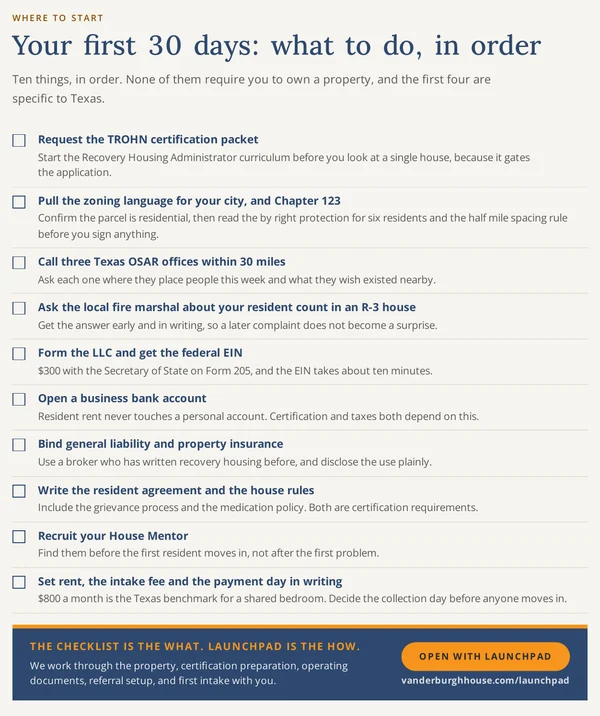
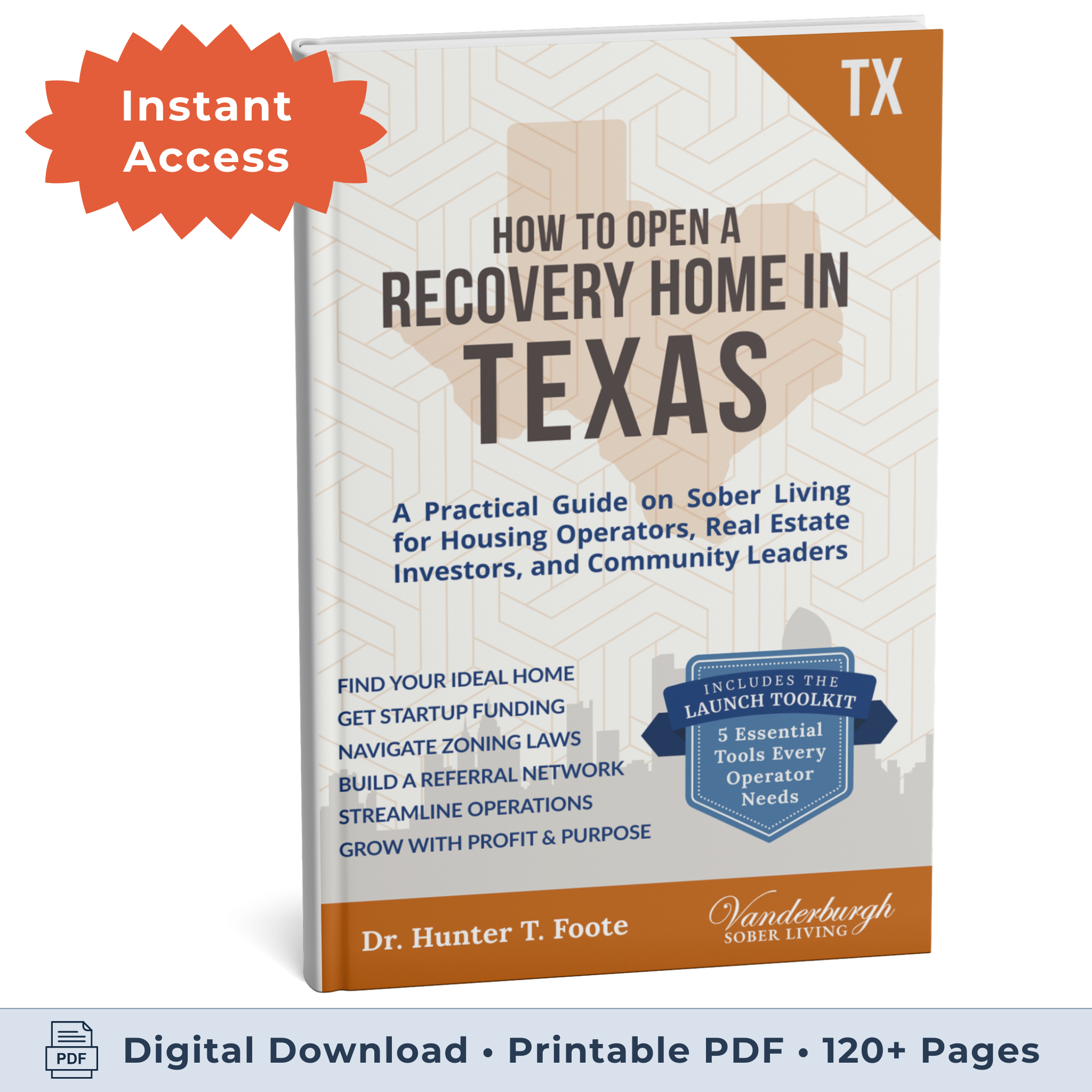
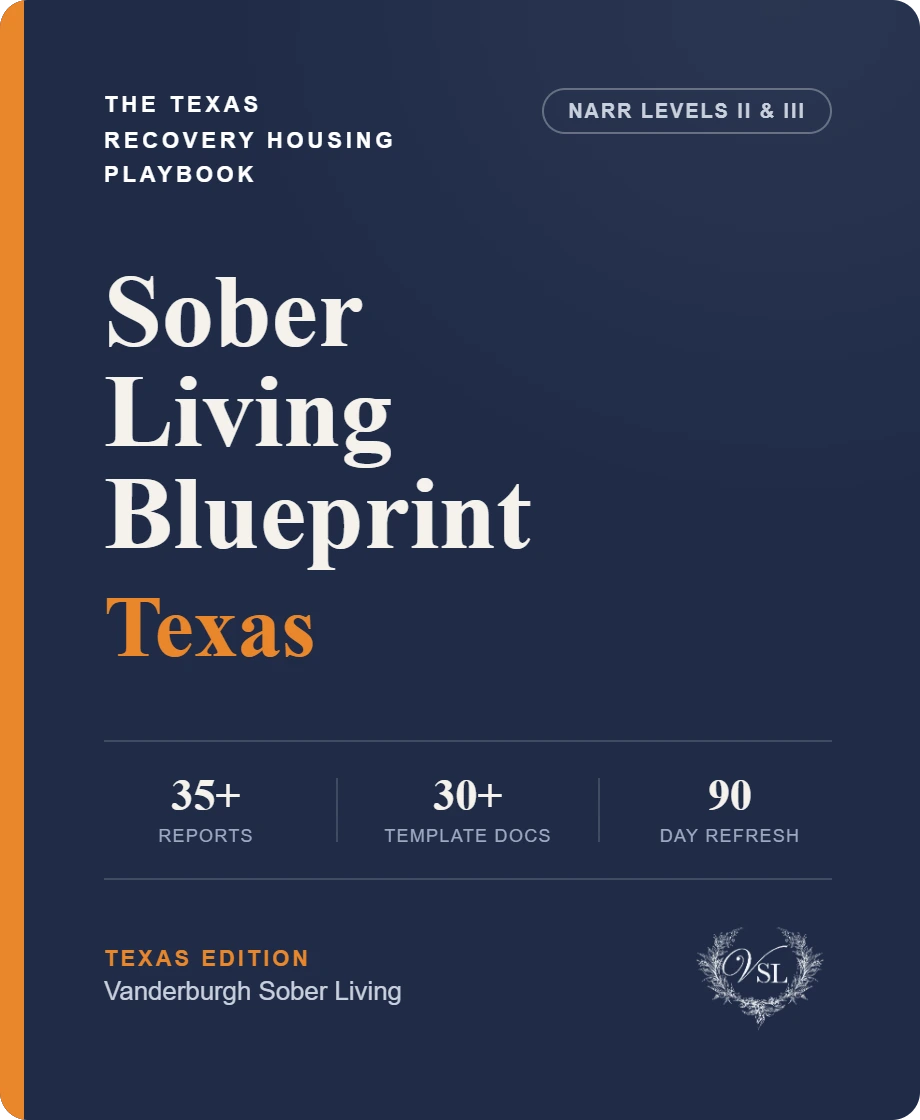
Fourteen pages: the bed shortfall, who pays the rent, and what it costs to open. Built from your state‘s own numbers.
What NARR Level II Certification Means in Texas
Most independent Texas sober living homes certify at NARR Level II, the monitored level, where a house mentor or a senior resident provides oversight and no clinical staff work inside the house. The level a home holds is not something an operator picks off a menu. TROHN determines the level of support during certification, based on staffing, governance, and the intensity of the recovery support services on offer.
The four levels differ by governance and staffing, and Level II sits between the fully peer-run house and the supervised one.
- Level I. Peer-run and democratically governed with no paid staff in the house, the pattern self-supporting Texas houses follow, including the Oxford House model.
- Level II. Monitored, with a house mentor or senior resident providing oversight, which is where most independent Texas sober living homes land.
- Level III. Supervised, with credentialed staff and structured programming and life skills, for homes running a formal curriculum.
- Level IV. Service provider, clinically supervised with credentialed staff, for residences attached to treatment continuity.
One boundary travels with every level a Texas home can hold. Texas requires that the minimum standards the commission adopts prohibit an accredited recovery house from providing personal care services as defined by Health and Safety Code Section 247.002, which keeps a certified home firmly on the non-clinical side of the line and caps what a Level II house can offer before it becomes something the state does license.
Keep readingUnderstanding the NARR Levels of CareHow the four levels of recovery housing differ in structure, staffing, and support.→The Standards TROHN Homes Are Measured Against
TROHN certifies against NARR Standard 3.0, released in November 2018 and developed with providers, researchers, and other stakeholders. Standard 3.0 organizes the social model into four domains, ten principles, and 31 standards, and it scales those standards across NARR’s four levels of support. Build your policies against that document specifically, because it is the document a reviewer reads your binder against.
Four requirements inside the standard do most of the work in a TROHN review.
- Domains and principles. The four domains and ten principles carry 31 standards, and each one has to show up in a written policy rather than in house habit.
- Insurance. Coverage is required, not optional. NARR Standard 3.0 Section 2.b is adopted by reference at 26 Texas Administrative Code Section 571.11, so an uninsured home cannot satisfy the Texas minimum standards.
- Medication-assisted treatment. NARR’s guidance for state policy makers holds that operators cannot lawfully deny admission solely because an applicant uses physician-prescribed medication, so a blanket no-MAT house policy puts certification at risk.
- Written governance. The Recovery Residence Self-Assessment forces the policy set, the resident agreement, the staffing plan, and the house rules into writing, which is where most first-time operators are weakest.
TROHN publishes one certification package at $1,000 base plus $15 per bed, charged at application submission. Certification runs five steps: the Recovery Housing Administrator Curriculum, then the online application and Recovery Residence Self-Assessment, the document review against the standard, the virtual interview, and the onsite review of all properties. A 10-bed home pays $1,150 and a 14-bed home pays $1,210, and recertification comes every 24 months at the same price. Budget the fee in full rather than counting on an offset, and note that eligibility starts only once a home has been at least 50 percent occupied for a minimum of 60 days.
Texas guideHow to Certify a Sober Living Home with Texas Recovery Oriented Housing Network in TexasThe step-by-step Texas Recovery Oriented Housing Network application, costs, timelines, and inspection checklist.→How Many Sober Living Homes Does TROHN Certify?
Reporting by The Texas Tribune counted 81 TROHN-certified homes, 23 of them newly certified in fiscal year 2024, against an advocate estimate of 600 to 700 recovery homes operating in Texas in a given year. Certification is the exception in Texas, not the norm. For an operator that thin roster reads two ways at once: the credential is a real differentiator in front of funders, courts, and treatment discharge planners rather than a box everyone has already ticked, and TROHN’s small staff is the bottleneck between you and a listing.
The listing is the practical payoff. TROHN’s Find Recovery Housing directory lets a person searching for a bed filter by city or county across all 254 Texas counties, by gender, and by population focus including medication-assisted treatment, veterans, reentry, LGBT residents, and parents with children. TROHN also publishes an operator directory and a supporter directory. A certified home with a carefully completed directory profile is discoverable to exactly the people who make placements.
Where TROHN Fits in Texas’s Recovery Ecosystem
Section 469.002 leaves Texas with exactly two doors, and the state has a long working relationship with the other one. HHSC partners with Oxford House, Inc., Be Well Texas, and UT Health Science Center at Houston to provide level 1 through level 3 recovery residences statewide, and the commission provides move-in stipends for residents leaving HHSC-funded treatment into an Oxford House. The same Texas Tribune reporting that counted TROHN’s certified homes counted 326 chartered Oxford Houses in Texas, and an Oxford House contract with the state reported at roughly $1.6 million a year.
TROHN’s own footprint in state policy runs through its fiscal agent. RecoveryPeople carries the advocacy, workforce development, and provider services side of the work, which is how a certifying body with a small staff keeps a voice in Texas recovery housing policy. House Bill 299 gave that voice statutory weight in 2023 by naming NARR, and therefore TROHN, as one of only two organizations the commission may approve.
Reputation is the last piece, and it is quiet. We found no public enforcement action, lawsuit, or controversy involving TROHN in Texas court records, HHSC materials, or state reporting as of September 2026. What the record does show is that the choice between the two accreditors is a model choice rather than a paperwork choice. If you intend to own and operate a business with staff, set rent, and control admissions, the Oxford House route is closed to you by design and TROHN is your path, while Oxford House requirements and training materials show how different a truly self-governing house has to be.
Support for every stage
Pick the level of support that fits where you are.
Just getting startedSee how the sober living opportunity works and what starting with VSL looks like.LaunchpadGuided pre-launch program: one-on-one strategy, Academy training, weekly coaching, and templates.MasteryHands-on startup, certification, and operating support inside the Chartered Operator community.Questions first? Call (844) 762-3747, weekdays 8a to 5p.
How to Reach TROHN
TROHN runs on a small footprint, so there is one route in for most questions. Correspondence goes to the organization’s post office box in Elgin, Texas, and its director, Jason Pullin, is the named contact on NARR’s Texas affiliate listing. Operators reach the same office for certification, for the course catalog, and for grievances.
Two things make that first contact more productive. Know your bed count, because the fee is priced per bed, and know your occupancy history, because eligibility starts only after a home has run at least half full for 60 days. If the question is a complaint about a home that is already certified rather than an application, TROHN’s grievance process is the route, and it reaches certified residences only.
Every step between signing the lease and taking your first resident, in order.
Sober Living Guides Every Operator Needs
These evergreen guides apply in every state and cover what a certification connects to: the standards behind it, the referrals it unlocks, the occupancy it supports, and the coverage a certified home carries.
Frequently Asked Questions About TROHN
Is TROHN certification required to operate a sober living home in Texas?
No. 26 Texas Administrative Code Section 571.4(a) provides that a recovery house is encouraged to seek and maintain accreditation but is not required to be accredited to operate in Texas. Certification becomes practically necessary when you want state money, because Section 469.009 has barred unaccredited recovery houses from receiving it since September 1, 2025.
How much does TROHN certification cost, and how often do homes recertify?
TROHN publishes one certification package at $1,000 base plus $15 per bed, charged at application submission. A 10-bed home pays $1,150 and a 14-bed home pays $1,210. Recertification comes every 24 months at the same price, and a home has to be at least 50 percent occupied for a minimum of 60 days before TROHN considers it.
Is an Oxford House charter the same as a TROHN certification?
No. A charter is a membership agreement with a private network, not government permission and not third-party certification. Oxford House charters homes that are democratically self-run, financially self-supporting, and free of paid staff inside the house. Vanderburgh Sober Living charters independently owned homes into a cooperative network of Chartered Operators. TROHN certification is a standards audit against NARR Standard 3.0.
The Bottom Line on TROHN Certification in Texas
The Texas Recovery Oriented Housing Network is a small, long-established certifying body with a real statutory position: the Texas affiliate of NARR, one of only two accreditors the commission may approve, certifying against NARR Standard 3.0 for $1,000 base plus $15 per bed on a 24-month cycle. Certification unlocks state money, makes the accredited claim lawful, and puts a home in the directory that referral partners search.
What it does not do is build the operating discipline underneath, which is the work that decides whether the beds stay full. If you are weighing whether TROHN certification fits your Texas plan this year or next, tell us about your home and where you are in the process and we will help you sequence it.
Research & Sources
- Foote, H. T. (2026). Vanderburgh Sober Living Operating Climate Index, 2026 Edition. Vanderburgh Sober Living. https://www.vanderburghhouse.com/research/operating-climate-index-2026/
- Texas Recovery Oriented Housing Network. (n.d.). Certification packages and pricing. https://trohn.org/pricing/
- Texas Recovery Oriented Housing Network. (n.d.). Certification process and eligibility. https://trohn.org/certification/
- Texas Recovery Oriented Housing Network. (n.d.). Frequently asked questions. https://trohn.org/faq/
- Texas Recovery Oriented Housing Network. (n.d.). Find recovery housing directory. https://trohn.org/find/
- Texas Recovery Oriented Housing Network. (n.d.). Grievance process. https://trohn.org/grievance/
- National Alliance for Recovery Residences. (n.d.). Texas Recovery Oriented Housing Network affiliate listing. https://narronline.org/affiliate/texas-recovery-oriented-housing-network/
- National Alliance for Recovery Residences. (2018). NARR standard, version 3.0. https://narronline.org/wp-content/uploads/2018/11/NARR_Standard_V.3.0_release_11-2018.pdf
- National Alliance for Recovery Residences. (2018). MAT-capable recovery residences: A guide for state policy makers. https://narronline.org/wp-content/uploads/2024/05/NARR-MAT-Capable-Recovery-Residences-Guide-for-State-Policy-Makers-2018.pdf
- Texas Health and Human Services Commission. (n.d.). Adult substance use recovery residences. https://www.hhs.texas.gov/services/mental-health-substance-use/adult-substance-use/adult-substance-use-recovery-residences
- Texas Health and Human Services Commission. (n.d.). Adult substance use: Oxford House. https://www.hhs.texas.gov/services/mental-health-substance-use/adult-substance-use/adult-substance-use-oxford-house
- Texas Legislature. (2023). House Bill 299 bill analysis, 88th Legislature. https://capitol.texas.gov/tlodocs/88R/analysis/html/HB00299E.htm
- Texas Health and Safety Code. (2023). Chapter 469, Voluntary accreditation of recovery housing. https://statutes.capitol.texas.gov/Docs/HS/htm/HS.469.htm
- Texas Health and Safety Code. Chapter 464, Subchapter A, Chemical dependency treatment facility licensure. https://statutes.capitol.texas.gov/Docs/HS/htm/HS.464.htm
- Texas Health and Safety Code. Chapter 247, Assisted living facilities (Section 247.002 definitions). https://statutes.capitol.texas.gov/Docs/HS/htm/HS.247.htm
- Cornell Legal Information Institute. (n.d.). 26 Texas Administrative Code Chapter 571, Voluntary recovery housing accreditation. https://www.law.cornell.edu/regulations/texas/title-26/part-1/chapter-571
- The Texas Tribune. (2025, March 7). Texas substance use recovery homes aren’t getting accredited. https://www.texastribune.org/2025/03/07/texas-recovery-homes-accreditation/