Sober living startup costs in Texas run from about $36,309 to open a leased house to roughly $112,744 to open one you buy, and the gap between those two numbers is almost entirely the down payment. Texas is one of the cheaper states in the country to enter, and that is not an accident of the housing market alone. Texas earns a Startup Burden Score of 8 in the 2026 Operating Climate Index, which reflects a state with no mandatory operating license for recovery housing, a statutory bar on cities forcing sprinklers into ordinary houses, and a certification fee that stays in four figures for a mid-sized home (Foote, 2026).
The budget below is built line by line from Texas figures: the Secretary of State’s actual filing fee, HUD’s published Fair Market Rents for the Texas metros, Census housing data, and the Texas Recovery Oriented Housing Network’s own published certification price. Every line is labeled, every modeled range is marked as an estimate, and the two entry paths are priced separately so a reader can see which one they can actually afford. The national figures for all 50 states show what it costs to open a sober living home in every state, including Texas.
Before you read onHow to Open a Sober Living Home in TexasThis post covers one piece of the process. The complete Texas guide walks through every step, from planning to your first resident.→How Much Does It Cost to Start a Sober Living Home in Texas?
Texas startup cost snapshotOpening a 14-bed sober living home in Texas costs an estimated $36,309 to $39,334 on the lease path and $86,954 to $112,744 on the purchase path, with the property down payment as the single largest driver on the buy side. Both figures include year-one insurance and a working capital reserve carried through lease-up, the two lines first-time operators leave out most often.
What moves a Texas budget inside that range is mostly geography and entry path. The FY2026 Fair Market Rents published by the U.S. Department of Housing and Urban Development put a four-bedroom house at $3,091 in the Dallas HUD Metro FMR Area, $2,639 in Houston, $2,760 in Austin, $2,132 in San Antonio, and $1,998 in El Paso, so three months upfront on a lease ranges from roughly $5,994 in El Paso to $9,273 in Dallas, against the statewide model in the table below, three months at $3,128, or $9,384. The fixed lines, entity formation, furnishings, certification, and startup supplies, barely move between metros. That is why the honest answer to the cost question in Texas is a range and not a number.
The unmet need and the bed shortfall, who pays the rent, what certification costs and what it unlocks, and the full operating model for buying versus leasing.
Get the Your State Starter Kit No cost, no obligation. Unsubscribe in one click.What Goes Into a Texas Startup Budget
Every line below is a real Texas cost with a named source or an explicit estimate label, sized for a 14-bed home. Read the two path figures as alternatives, not additions: an operator pays the lease amount or the purchase amount, never both.
| Cost item | Estimated cost | What it means |
|---|---|---|
| Entity formation & state filing fee | $300 to $325, either path | Texas charges $300 for an LLC or for-profit corporation certificate of formation, $25 for a nonprofit, and $25 for an assumed name certificate |
| Lease deposit or property down payment | Lease $9,384 Purchase $56,760 to $73,000 | Three months upfront on the lease, covering first month, last month, and a security deposit, or 20 percent down on the purchase |
| Closing and acquisition costs | Purchase only, $5,676 to $10,950 | Estimated at 2 to 3 percent of the purchase price; a leased house carries none of this |
| Furniture and setup | $7,208, either path | Beds, dressers, common-area furniture, and kitchen equipment, scaled to the Texas cost of living |
| Supplies and linens | $1,081, either path | Opening stock of bedding, towels, kitchen goods, and cleaning supplies |
| Utility deposits | $541, either path | Electric, water, gas, and internet deposits at account opening |
| Renovation and safety/code upgrades | $500 to $3,500, either path | Interconnected smoke and carbon monoxide alarms, compliant bedroom egress, handrails, and extinguishers |
| Insurance (first year) | Lease $3,250 Purchase $5,850 | General liability only on a lease; add an owner’s property policy once you hold title |
| Certification fee | $1,210, either path | TROHN charges $1,000 base plus $15 per bed at application submission, which is $1,210 at 14 beds |
| Marketing and launch | $451, either path | Website, directory listings, and referral outreach materials |
| Operating reserve | Lease $12,384 Purchase $7,377 to $8,628 | Three months of carrying cost held back as working capital while the beds fill |
| Estimated all-in to open (low – high) | Lease $36,309 to $39,334 Purchase $86,954 to $112,744 | The realistic total to open a certified home in Texas, reserve included. |
Methodology & sources. Sourced figures and modeled estimates are separated here so a reader can rebuild this table in a spreadsheet and swap in their own inputs. The Texas Secretary of State fee schedule sets the certificate of formation at $300 for a Texas LLC or for-profit corporation, $25 for a nonprofit corporation, and $25 for an assumed name certificate, and choosing between those structures is the work covered in forming a legal entity for a sober living business in Texas. On the lease path, the model applies a disclosed 60 percent recovery-housing rent premium to the statewide average three-bedroom Fair Market Rent of $1,955, weighted by population, from the FY2025 schedule published by the U.S. Department of Housing and Urban Development, giving an estimated $3,128 per month; the reserve is three months of that rent plus about $1,000 of other carrying cost. On the purchase path, the low end takes 20 percent of the $283,800 median value of an owner-occupied Texas home in the same Census five-year estimates, and the high end applies a disclosed 8 percent recovery-housing premium to mid-2026 statewide median sale prices, giving an estimated adjusted purchase price of $365,000 and a $73,000 down payment, because recovery homes need more bedrooms, more bathrooms, and more parking than a median house. Payments are modeled on a 30-year amortization at 6.66 percent, the Freddie Mac Primary Mortgage Market Survey weekly average 30-year fixed rate published by the Federal Reserve Bank of St. Louis for the week ending August 27, 2026, producing an estimated $1,459 monthly payment on the low purchase model and $1,876 on the high one. The Texas Recovery Oriented Housing Network publishes its basic certification package at $1,000 plus $15 per bed, which is $1,210 for a 14-bed home, and older, lower per-bed figures still circulate but are out of date. Insurance, furnishings, supplies, deposits, marketing, safety upgrades, and the reserve are Vanderburgh Foundation estimates scaled to the Texas cost of living, with the purchase-path insurance line applying a disclosed 80 percent uplift to the $3,250 general liability estimate to account for an owner’s property coverage on a multi-resident home. Each path total is the arithmetic sum of every line above it, insurance and reserve included.
Lease vs. Buy: How the Startup Number Changes
The choice between leasing and buying changes the opening cash requirement by roughly $56,000 to $74,000 in Texas, and it changes almost nothing else about the operating model. Both paths run the same house, the same beds, and the same certification standard.
The filter we use before we ever call an agent: what makes a property work as a Level II home, the zoning and occupancy questions to ask before you tour, and the red flags that should end a showing in five minutes.
Get the guide free →| Factor | Leasing | Buying |
|---|---|---|
| Upfront cash | $36,309 to $39,334 | $86,954 to $112,744 |
| Monthly cost | $3,128 estimated rent | $1,459 to $1,876 estimated principal and interest |
| Control over the property | Lease term governs; a landlord can decline renewal or sell | Controlled by you |
| Equity | None | Yes, plus appreciation |
| Property tax and major repairs | Landlord’s obligation | Yours, including a Texas recovery-housing assessed premium |
| Insurance burden | General liability only | General liability plus property, and windstorm where applicable |
| Speed to open | Weeks | Months, plus the financing timeline |
| Main risk | Lease non-renewal or a sale that ends a house that is running well | Capital tied up in one property before the model is proven |
If you lease
- Leasing is the right first move for most Texas operators, because it converts a $73,000 problem into a $9,000 problem.
- Resident fee income proves itself before capital is committed to real estate in a specific neighborhood.
- The trade is real: a landlord who sells or declines renewal can end a house that is running well, and no equity accrues in the meantime.
If you buy
- The purchase path carries the lower monthly housing cost at Texas prices, and that inversion is the actual argument for buying.
- Owning is what turns a Texas recovery home into a durable business rather than a lease-dependent one.
- Buying is the stronger play once one house is stabilized and the operator has a track record a lender or a mission-based Texas CDFI can underwrite.
Texas Fire Code, Sprinklers, and the Bed-Count Cliff
Texas is unusually friendly on the single largest code-driven capital cost in recovery housing, which is fire sprinklers. The state preempts cities on the question for ordinary houses, and the practical result is that most sober living homes in Texas never face a sprinkler retrofit at all.
- Sprinklers in one- and two-family dwellings are off the table. Texas Occupations Code Section 1301.551(i), operative since January 1, 2009, states that a municipality “may not enact an ordinance, bylaw, order, building code, or rule requiring the installation of a multipurpose residential fire protection sprinkler system or any other fire sprinkler protection system in a new or existing one- or two-family dwelling.” A home operating as a true one- or two-family dwelling cannot be forced to install one.
- The protection depends on staying in residential occupancy. The preemption is written for one- and two-family dwellings. A home reclassified into an institutional occupancy class, which generally happens when a house provides personal or custodial care, loses the shelter and inherits sprinkler, alarm, and egress requirements that can run into five figures.
- Not providing care is what keeps you in the cheap class. Texas certified recovery houses are defined around peer support rather than personal care services under Health and Safety Code Chapter 469, Voluntary Accreditation of Recovery Housing, added by HB 299 in the 88th Legislature in 2023, and the implementing rule at 26 Texas Administrative Code Section 571.4(a) states that a recovery house “is encouraged to seek and maintain accreditation but is not required to be accredited to operate in the state of Texas.” Keeping a home non-clinical is a code strategy as much as a program philosophy.
- The Chapter 123 community-home lane is a parallel track with its own bed ceiling, not the recovery-home lane. Human Resources Code Chapter 123 makes a qualifying community home a use by right in any residentially zoned district under Section 123.003, caps it at six residents with disabilities plus two supervisors under Section 123.006, and bars a second such home within half a mile under Section 123.008. That lane is generally unavailable to a for-profit peer-support home: Section 123.004 limits qualifying operators to listed public providers, licensed assisted living facilities, and entities subject to the Texas Nonprofit Corporation Law, Section 123.005 requires the home to furnish care, habilitation services, and supervision, and Section 469.003(10) makes a Chapter 123 community home ineligible for recovery-house accreditation, so the two lanes are mutually exclusive. Federal Fair Housing Act reasonable accommodation is the protection a Texas recovery home actually relies on, and the zoning route a larger home takes is covered in Texas zoning, fair housing, and land use laws for sober living.
- Enforcement is local, so the real budget number is local. Texas has no statewide residential building code the state itself enforces; the adopted code and its amendments come from the city, and unincorporated county areas often apply very little review. Two houses 20 miles apart can carry different upgrade bills.
What that leaves in a Texas budget is the ordinary alarm and egress work rather than a sprinkler system.
- Interconnected smoke alarms. Hardwired and interconnected coverage in every sleeping area and on every level is the most common upgrade an older Texas house needs.
- Carbon monoxide alarms. Required coverage where fuel-burning appliances or an attached garage are present.
- Compliant egress from sleeping rooms. A basement or converted bedroom may need a window enlarged to meet the adopted code.
- Handrails, guards, and extinguishers. Small line items that a fire marshal will look for on a walkthrough.
The $500 to $3,500 estimate in the table reflects the spread between a recently built house that already complies and an older house that needs alarm wiring and a window enlarged.
Know your rights before you spendThe Federal Fair Housing Act and Sober Living: Everything You Need to KnowPeople in recovery are a protected class; understand these protections before you accept a costly local requirement.→The Costs First-Time Operators Underbudget
Five lines account for most of the gap between a first budget and the real one, and they are in the table above precisely because they get left out.
- Year-one insurance. A general liability policy written for a house with 14 unrelated adults costs more than a landlord policy, and the estimated $3,250 to $5,850 range assumes an operator who discloses the use accurately. Understating occupancy to win a lower premium is the fastest way to have a claim denied.
- Windstorm and hail in the coastal counties. Standard Texas home policies frequently exclude windstorm and hail along the coast, and the Texas Department of Insurance explains that coastal property owners often buy separate windstorm coverage. A Galveston or Corpus Christi house carries an insurance line a Lubbock house does not.
- The working capital reserve. No house fills on day one. Three months of carrying cost, an estimated $7,377 to $12,384 depending on path, is the difference between a slow lease-up and a closed house.
- The certification waiting period. TROHN will not consider a home for accreditation until it has been at least 50 percent occupied for a minimum of 60 days. That gate means an operator carries an uncertified, partly filled house for two months minimum, and it is a cash-flow fact before it is a paperwork fact.
- The administrator training time. Completing the Recovery Housing Administrator Curriculum is a prerequisite to reaching TROHN’s application platform, and the TROHN course catalog lists it at 16 hours and 15 minutes. That is two working days someone has to spend before certification can begin.
- Property tax, for buyers. Texas funds local government heavily through property tax, and a recovery home carries a modest assessed premium over a comparable single-family house in the pro forma modeling. Buyers should pull the actual county rate rather than a state average and test it against their own bed count in the Sober Living Calculator.
How to Lower Your Startup Costs
Most of the savings available to a Texas operator come from sequencing rather than from cutting corners. The tactics below reduce the opening cash requirement without weakening the house.
- Lease the first house. This is the single biggest lever, worth an estimated $56,000 to $74,000 in avoided down payment and closing costs. Buy the second house with the first house’s track record.
- Phase the furnishings. Furnish and open the bedrooms you can fill in the first 60 days, then add the rest from the resident fee income. That defers a meaningful share of the $7,208 furniture line.
- Buy the house that already complies. A house with hardwired interconnected alarms, compliant bedroom egress, and adequate parking can drop the safety-upgrade line to near its floor. Screen for compliance during the property search, not after the lease is signed.
- Structure as a nonprofit where the mission fits. The $25 nonprofit certificate of formation is a rounding error next to the eligibility it opens for HUD pass-through and state grant money that for-profit operators cannot access.
- Partner rather than borrow. A property owner who contributes the house in exchange for a share of the operation removes the acquisition line entirely, and Texas CDFIs underwrite operators that conventional lenders decline.
- Certify on schedule, not late. Certification is $1,210, and the 60-day occupancy gate means a delayed start pushes back access to state-funded referrals by months. The document set and the review sequence are mapped in how to certify a sober living home in Texas with TROHN.
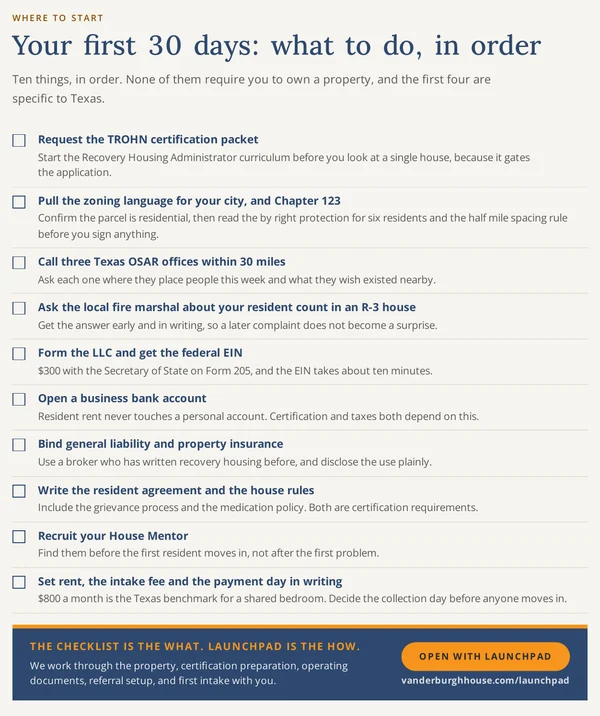
The checklist below puts those tactics in the order a Texas launch actually runs, because each item gates the next.
Keep readingHow to Certify a Sober House: An Overview of NARR Affiliate CertificationWhat certification involves, what it costs, and how the process works in every state.→Your Texas Startup Checklist
Texas Funding That Offsets the Upfront Outlay
Texas does not hand out startup grants to for-profit sober living operators, but it does route real money to certified homes once they are open, which changes the size of the reserve a new operator has to carry.
- The state funding gate. Health and Safety Code Section 469.009 bars an unaccredited recovery house from receiving state money as of September 1, 2025, so certification is the switch that turns funding access on.
- The HHSC recovery residence network. On the other side of that switch sits the Texas Health and Human Services Commission recovery residence network, which routes referrals and support to accredited homes.
- Opioid settlement dollars. The Texas Opioid Abatement Fund Council recovery housing grant puts settlement money behind recovery housing capacity rather than behind private acquisition.
- Structure and lender fit. Nonprofit status widens eligibility further, and mission-based Texas lenders cover the acquisition side when conventional underwriting will not.
The practical effect on a startup budget is indirect but substantial. Subsidized residents shorten lease-up, and a shorter lease-up means a smaller working capital reserve, which is the line most likely to sink an underfunded first house.
Texas guideHow Recovery Housing Funding Works in TexasGrants, settlement dollars, and the programs that help offset what it costs to open.→Sober Living Guides Every Operator Needs
These evergreen guides apply in every state and go deeper on the pieces behind your startup budget: the standards your home certifies to, the property you choose, the insurance you carry, and the referral partners who keep the beds full.
Frequently Asked Questions About Sober Living Startup Costs
What is the minimum to open a sober living home in Texas?
About $36,309 on the lease path for a 14-bed home, including year-one general liability insurance and a three-month working capital reserve. A smaller house in a lower-cost metro such as El Paso or Wichita Falls can open for less, mostly because the lease deposit and reserve scale with rent.
Can I start by leasing instead of buying?
Yes, and most first-time Texas operators should. Leasing removes the down payment and closing costs, which together account for an estimated $62,000 to $84,000 of the purchase path, and it lets you test demand in a specific neighborhood before committing capital to real estate there.
How long before resident fees cover the costs?
Budget three months. At 14 beds and an estimated $800 per bed per month, a house needs roughly a third of its beds filled to cover a leased property’s carrying cost, and TROHN’s 60-day occupancy gate means you are operating at partial capacity for at least two months regardless.
Do grants cover Texas startup costs?
Rarely for startup itself. Texas channels opioid settlement and Health and Human Services Commission money to homes that are already open and accredited, so grants offset operating costs and shorten lease-up rather than funding acquisition or furnishings.
Is certification worth $1,210?
Yes, because state money is gated on it. An unaccredited Texas recovery house cannot receive state funds, which closes off subsidized referrals from the largest payer in the state. The fee is roughly one month of one bed’s revenue.
Plan Your Texas Startup Budget With VSL
Texas gives a new operator a favorable entry: no mandatory operating license, a statutory shield against municipal sprinkler mandates, a certification fee that stays in four figures, and housing costs well under the national picture. The two numbers that decide the plan are the entry path and the reserve, and both are worth modeling with your own metro’s rent and your own bed count rather than a statewide average.
If you want a second set of eyes on the budget before you sign a lease or make an offer, tell us about your Texas project and we will walk the numbers with you.
Start your sober house
Pick the path that fits where you are in the process.
Download the free guidePath to Purposeful Recovery Housing, by Dr. Hunter T. Foote.Explore the Mastery ProgramHands-on startup, certification, and operating support.See how starting with VSL worksThe opportunity, the community, and what a Charter includes.Prefer to talk now? Call (844) 762-3747, weekdays 8a to 5p.
Research & Sources
- Foote, H. T. (2026). Vanderburgh Sober Living Operating Climate Index, 2026 Edition. Vanderburgh Sober Living. https://www.vanderburghhouse.com/research/operating-climate-index-2026/
- Texas Recovery Oriented Housing Network. (2026). Certification packages and pricing. https://trohn.org/pricing/
- Texas Recovery Oriented Housing Network. (2026). Become certified. https://trohn.org/certification/
- Texas Recovery Oriented Housing Network. (2026). Recovery Housing Administrator Curriculum course catalog. https://trohn.org/edu/
- Texas Secretary of State. (2026). Corporations section filing fee schedule. https://direct.sos.state.tx.us/help/help-corp.asp?pg=fee
- U.S. Department of Housing and Urban Development, Office of Policy Development and Research. (2025). Fair market rents, fiscal year 2026. https://www.huduser.gov/portal/datasets/fmr.html
- Federal Reserve Bank of St. Louis. (2026). 30-year fixed rate mortgage average in the United States (MORTGAGE30US). https://fred.stlouisfed.org/series/MORTGAGE30US
- Texas Legislature. (2009). Texas Occupations Code Chapter 1301, Plumbing License Law, Section 1301.551. https://statutes.capitol.texas.gov/Docs/OC/htm/OC.1301.htm
- Texas Legislature. (2023). Texas Health and Safety Code Chapter 469, Voluntary Accreditation of Recovery Housing. https://statutes.capitol.texas.gov/Docs/HS/htm/HS.469.htm
- Texas Legislature. (2023). Texas Human Resources Code Chapter 123, Community Homes for Disabled Persons. https://statutes.capitol.texas.gov/Docs/HR/htm/HR.123.htm
- Texas Health and Human Services Commission. (2024). 26 Texas Administrative Code Chapter 571, Voluntary Recovery Housing Accreditation. https://www.law.cornell.edu/regulations/texas/title-26/part-1/chapter-571
- Texas Department of Insurance. (2025). What is windstorm insurance? https://www.tdi.texas.gov/tips/what-is-windstorm-insurance.html
- Texas Health and Human Services Commission. (2026). Adult substance use recovery residences. https://www.hhs.texas.gov/services/mental-health-substance-use/adult-substance-use/adult-substance-use-recovery-residences
- Texas Comptroller of Public Accounts, Opioid Abatement Fund Council. (2026). Recovery housing grant. https://comptroller.texas.gov/programs/opioid-council/grants/housing.php