Recovery housing funding in Texas is real, growing, and almost never shaped the way a new operator pictures it. Most people who open a sober living home here arrive with a mental image of a grant that covers rent for a few empty beds, pays a house mentor, or funds the second house. What Texas actually built is a system that moves large sums through state agencies, universities, regional councils, and contracted networks, and that treats an independent home as a downstream participant rather than a direct recipient.
That distinction decides whether your first year is spent filling beds or writing applications that were never scored with you in mind. The money exists, and some of it does reach homes. The problem is usually the expectation attached to it, so this piece names the programs, says who each one actually pays, and works back from there to a funding strategy a single-house operator can use.
Before you read onHow to Open a Sober Living Home in TexasThis post covers one piece of the process. The complete Texas guide walks through every step, from planning to your first resident.→How Does Recovery Housing Funding Work in Texas?
Recovery housing funding in Texas flows from opioid settlement dollars, federal block grants, and federal opioid response money into state agencies, universities, and regional grantees, which then contract with certified providers. Resident subsidies and referrals reach homes; direct operating grants for an independent home almost never do. Certification is the eligibility gate on every public dollar.
Once you see the money as a pipeline with several stages, the behavior of each program becomes predictable. Three features repeat across nearly every Texas funding stream.
- The recipient is an organization with reporting capacity. The Substance Use Prevention, Treatment, and Recovery Services Block Grant goes to states, not providers, and Texas receives it through the Health and Human Services Commission as the single state agency. State Opioid Response grants work the same way, reaching states and territories that then subcontract.
- The money is attached to residents more often than to buildings. The Health and Human Services Commission (HHSC) contracts with three named partners for its own recovery residence network, and those partners subsidize stays inside already certified homes.
- Certification is the switch, not the application. Health and Safety Code §469.009 makes an unaccredited recovery house “ineligible for and may not receive state money,” effective September 1, 2025. Nothing upstream matters until a home clears that line.
Texas scores 8 for resident funding access and 7 for operator funding access on the Vanderburgh Sober Living Operating Climate Index (Foote, 2026), and the gap between those two numbers is the whole story of this page. Residents in Texas have unusually good access to subsidy. Operators have a narrower path, and it runs through partnership rather than through a grant portal.
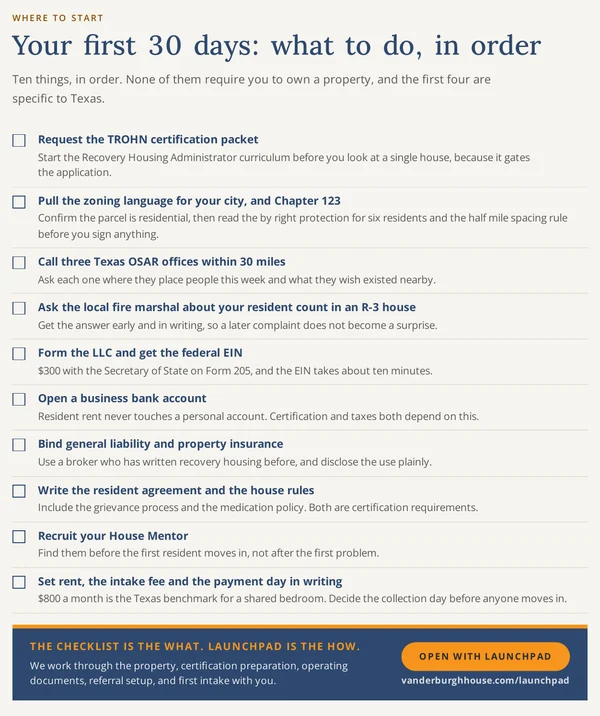
Fourteen pages: the bed shortfall, who pays the rent, and what it costs to open. Built from your state‘s own numbers.
Are There Grants to Open a Sober Living Home in Texas?
No, not in the way most operators expect. Texas issues no startup grant to a private operator opening a sober living home. Public dollars fund system capacity through agencies, universities, regional grantees, and contracted networks. A new home reaches that money indirectly, by becoming certified and then filling subsidized and state-referred beds.
The reason is structural rather than political. A sober living home is a housing business with a recovery environment, so its operating income is resident-paid by design, and Texas law is explicit that a certified recovery house may not provide personal care services under §469.002. Public funding, meanwhile, is built to expand treatment and recovery capacity across a whole state, which pushes it toward recipients that can absorb reporting, audit, and reimbursement mechanics.
- Award size does not scale down. The Opioid Abatement Fund Council’s Recovery Housing Grant went to a single recipient, UTHealth Houston, for up to $25 million in December 2025, to expand Level 2 and Level 3 capacity statewide.
- Eligibility language names entities, not owners.Emergency Solutions Grants administered by the Texas Department of Housing and Community Affairs (TDHCA) subgrant to units of local government and 501(c)(3) nonprofits.
- Reimbursement assumes a balance sheet. Settlement grants pay on a reimbursement basis, which means the grantee spends first and recovers later.
- Loans
- Payment plans
- Employer aid
- Campaigns
- Voc Rehab
- VA (soon)
- Open
A realistic first-year budget therefore looks like a property, a furnishing budget, working capital through the lease-up period, and certification costs, all funded privately. The full one-time picture is what you actually have to put on the table before any public dollar is in play.
Texas guideSober Living Startup Costs in TexasThe one-time cost to open, and where a small amount of outside funding can offset it.→Resident Fees Still Fund Most Sober Living Homes
Resident fees are the only revenue line in a recovery home that behaves predictably, and every durable Texas operation is priced so that fees alone carry the house.
A house that covers its mortgage or lease, utilities, insurance, staffing, and reserves out of weekly resident fees at a realistic occupancy rate has a business. A house that needs a voucher cohort or a grant cycle to break even has a bet. The difference shows up in the second year, when a subsidy program shifts its target population or a settlement round closes and the beds that were full on someone else’s dollar go quiet.
The practical target is a fee structure that clears expenses at ordinary occupancy rather than at full occupancy, with subsidized and state-referred residents treated as a stabilizer on top of that base. The operating math behind that target, including the margin an occupied bed actually produces in Texas, decides whether that base holds.
Texas guideIs It Profitable to Operate a Recovery Home in Texas?Realistic revenue, operating costs, and the resident-fee margins that keep a home running.→Which Texas Programs Fund Recovery Housing?
Texas has more named funding streams touching recovery housing than most states, and each one pays for something specific. The table maps every real program to what it funds and who receives it, which is the fastest way to see where an independent home sits.
| Program | What It Primarily Funds | Who Typically Receives It |
|---|---|---|
| Opioid Abatement Trust Fund, Recovery Housing Grant | Statewide expansion of Level 2 and Level 3 capacity, accreditation support, underserved populations | A single statewide grantee (UTHealth Houston, up to $25 million, December 2025) |
| Opioid Abatement Trust Fund, CORE | One-year regional projects in four categories including recovery support services | Regional entities across the 20 Regional Healthcare Partnership regions; $21.2 million across 109 awards in September 2025, maximum $250,000 or 20% of a region’s funds |
| Opioid Abatement Trust Fund, LTCORE | Multi-year treatment, coordination of care, and recovery support services | Regional organizations; $48.9 million across 65 awards approved June 16, 2026, individual awards up to $750,000 |
| Texas Targeted Opioid Response (State Opioid Response) | Treatment expansion plus recovery supports including housing access, employment, and peer support | HHSC, which subcontracts to universities and providers |
| Substance Use Block Grant | The state treatment and recovery system, including the required group-home revolving loan fund | HHSC as the single state agency, then its contracted providers |
| HHSC recovery residence network | Subsidized resident stays in certified Level 1, 2, and 3 homes | Oxford House, Be Well Texas, and Project HOMES, and the certified homes in their networks |
| Emergency Solutions Grants (TDHCA) | Rapid re-housing and homelessness prevention, including rent and deposits | Units of local government and 501(c)(3) nonprofits |
| Fund for Veterans’ Assistance (Texas Veterans Commission) | Housing stabilization, homelessness prevention, and case management for veterans | Local governments, nonprofits, and veterans service organizations, not individuals |
| Group-home revolving loan fund | Start-up loans for a new self-run peer group home, capped at $4,000 and repaid by residents within two years | Residents of a newly forming Oxford House-model home |
| SBA 504 and conventional lending | Purchase and renovation of the property itself | The operator’s own business entity |
Methodology & sources. Program rows and dollar figures come from the Texas Comptroller’s Opioid Abatement Fund Council pages for the Recovery Housing Grant, CORE, and LTCORE; HHSC’s pages for the recovery residence network and the Texas Targeted Opioid Response; SAMHSA’s block grant page; TDHCA; the Texas Veterans Commission; 42 U.S.C. §300x-25; and the U.S. Small Business Administration.
Where the settlement money comes from is worth understanding, because it is the fastest-growing pot and the one operators ask about most. Of the money Texas receives under the statewide opioid settlement agreements, 85% goes into the Opioid Abatement Trust Fund and 15% into the Opioid Abatement Account, and within the trust fund another 15% is distributed to counties and municipalities. The Opioid Abatement Fund Council awards the regional and statewide grants from that trust fund, which is why almost every settlement dollar an operator hears about arrives with a regional grantee’s name on it.
Support for every stage
Pick the level of support that fits where you are.
Just getting startedSee how the sober living opportunity works and what starting with VSL looks like.LaunchpadGuided pre-launch program: one-on-one strategy, Academy training, weekly coaching, and templates.MasteryHands-on startup, certification, and operating support inside the Chartered Operator community.Questions first? Call (844) 762-3747, weekdays 8a to 5p.
Direct Operating Support
Direct operating support means money that pays rent, payroll, insurance, or utilities, and it is the rarest category in Texas.
- No state program issues a general operating grant to a privately owned sober living home.
- The closest thing to a start-up cushion is the group-home revolving loan fund that federal law requires every state to maintain as a condition of the block grant. Loans are capped at $4,000, are repaid by the residents in monthly installments within two years, and exist specifically for a group of six or more people in recovery forming a self-run house under 42 U.S.C. §300x-25. In practice that mechanism belongs to the Oxford House model, which is self-run, self-supporting, and staffed by no one, and it covers a first month and deposit rather than an operating budget.
- Oxford House is also the dominant non-NARR pathway in Texas, holding a state contract reported at roughly $1.6 million a year by The Texas Tribune, which is one reason a large share of Texas beds already sit inside a network rather than in independent homes.
Indirect Support
Indirect support is where the money an independent operator can actually reach lives. It arrives as an occupied bed rather than as a check with your name on it.
- Resident subsidies through the state network. Be Well Texas voucher values are reported at $6,800 for a Level 3 stay and $4,500 for a Level 2 stay, covering roughly three to four months, for emerging adults ages 18 to 25, with residents able to co-pay to extend a stay. Project HOMES, run by UTHealth Houston, covers residents using medications for opioid use disorder, and Oxford House covers the self-run Level 1 population.
- State-funded referrals. The Outreach, Screening, Assessment and Referral network is the state’s front door to substance use services, present across the Texas health and human services regions, with current Texas residency as the only eligibility requirement. Specialty court coordinators and the Texas Department of Criminal Justice substance abuse continuum place people leaving in-prison treatment into aftercare and then into housing.
- Rent paid through a partner organization. A nonprofit with an Emergency Solutions Grant subaward can pay a resident’s rent and deposit through rapid re-housing, and a veterans service organization holding a Fund for Veterans’ Assistance grant can do the same for a veteran resident.
- Medicaid pays for services, not for a bed. Texas Medicaid reimburses clinical and peer services delivered to a person, and room and board in a recovery residence is not a covered benefit. We found no Texas Medicaid housing-support benefit that pays a recovery residence’s rent as of September 2026.
Infrastructure and Capital Support
Infrastructure money buys, builds, and renovates property, and in Texas it is reached by partnering rather than by applying alone.
The settlement grants that carry real capital weight are awarded to regional and statewide entities, which means an operator’s route to them is a subaward, a memorandum of understanding, or a service contract with the entity holding the grant. The Recovery Housing Grant is the clearest current example: one grantee, a statewide mandate to increase Level 2 and Level 3 capacity, and a rollout that reaches homes through relationships rather than through an open portal. For the property itself, ordinary business finance does more work than any public program, whether that is an SBA 504 loan structured with a certified development company or one of the mission lenders and capital programs listed by the Office of the Texas Governor’s small business financing resource. How the property is held and whether the operating entity is for-profit or a 501(c)(3) changes which of these doors opens, which is the practical reason to settle how to form a legal entity for a sober living business in Texas before chasing any funding at all.
Recovery Housing Grant, CORE, and LTCORE money is awarded to regional and statewide entities, so an operator reaches it through a subaward, a memorandum of understanding, or a service contract. Watching the grantee announcements and the annual CORE and LTCORE rounds is a better use of an operator’s time than searching for a grant that pays a mortgage.
Owner-occupied purchase and renovation run through conventional lending or an SBA 504 structure with a certified development company, alongside the statewide mission lenders and capital programs. This is the path that actually buys Texas property, and it turns on the entity and the balance sheet rather than on a funding round.
Why Eligibility Often Depends on Certification and Partnerships
Eligibility in Texas is a question of standing rather than a question of need, and one statute settles it. Health and Safety Code §469.009 bars an unaccredited recovery house from receiving state money as of September 1, 2025. Nothing about how good the house is or how badly a region needs beds moves that line.
The same chapter limits who may accredit, and HHSC may approve only the National Alliance for Recovery Residences or Oxford House, Inc. That produces two lanes and no third option: a home certified by the Texas Recovery Oriented Housing Network is inside the funding system, an Oxford House-chartered home is inside it by the other door, and an uncertified home is outside it. Certification is also what makes the marketing claim lawful, because §469.007 prohibits a recovery house from communicating that it is accredited unless it actually is, so the credential does double duty as a funding key and as permission to say the word.
Sober living homes are voluntarily certified, not licensed as treatment, and that standing is set by the National Alliance for Recovery Residences (NARR) and its Texas affiliate. The cost is modest against what it unlocks: TROHN’s certification package is priced at $1,000 plus $15 per bed and Texas homes recertify every 24 months at the same price, with document review against the NARR standard, a virtual interview to set the level of support, and an onsite review of every property. A home must also be at least 50% occupied for a minimum of 60 days before TROHN will consider it, so the sequence matters more than the fee, and that sequence is laid out step by step in how to certify a sober living home in Texas with TROHN.
Why Funding Is Competitive and Temporary
Every public funding stream in Texas recovery housing carries an end date, a report, and a set of other applicants. CORE awards are one-time projects of under a year, capped at $250,000 or 20% of a region’s available funds. LTCORE runs multi-year, with individual awards reaching $750,000, and both are disbursed against spending already incurred. A round closes, a new round opens with revised priorities, and a home that reshaped its budget around the last cycle discovers that the population or the region emphasis has moved.
Resident subsidies behave the same way. A Be Well Texas voucher is scoped to emerging adults and covers a few months, and Project HOMES is scoped to residents using medications for opioid use disorder. Both are excellent revenue when your house serves that population and your beds are certified. Neither is a reason to build a fee structure that cannot stand without them.
The reporting side is the part operators underestimate. Grant money brings documentation, invoicing, and audit exposure, and a subaward from a statewide grantee brings the grantee’s compliance requirements on top of the state’s. That work is worth doing when the money funds something specific. It is a poor trade when the money is being used to patch a fee structure that was set too low.
How Strong Texas Operators Use Funding Strategically
Operators who use Texas funding well share a pattern. They build a home that works on resident fees, get certified, build referral relationships, and only then look at what is on offer, which is also the order in which a home becomes a credible partner when a grantee or a referrer needs beds.
- Certification already in place: Standing under Health and Safety Code Chapter 469 is the precondition, not the project, so the credential is earned before the opportunity appears.
- Clean policies and resident agreements: Written house rules, fee schedules, and grievance procedures are what a partner organization reviews before it sends a subsidized resident.
- A documented admission process: A written intake that is capable of supporting residents on medications for opioid use disorder is what makes a home usable by the state network partners.
- A track record of stable occupancy: Demonstrated occupancy on resident fees shows the home does not need the money, which is exactly why it tends to get it.
- Reporting capacity: Bookkeeping, invoicing, and documentation good enough to survive a subaward audit keep a relationship alive past its first cycle.
Free technical assistance is available while you build that record. The Fletcher Group’s Texas recovery housing resources are published at no cost to operators, and TROHN’s certified housing directory is where referrers look first.
A Practical Way to Evaluate Any Funding Opportunity
Once a home is fundable, the remaining question is whether a given opportunity is worth the months it will take. Six questions settle that before you write anything.
- What is this program designed to accomplish: Read the strategy category, not the headline. A recovery support services category funds services, and a capacity category funds capacity.
- Who is the intended recipient: If the eligibility language names units of local government, nonprofits, or regional entities, a for-profit operator’s route is a subaward, not an application.
- What obligations come attached: Reimbursement basis, reporting cadence, audit exposure, and any requirement about who you must admit.
- What happens when it ends: Model the house at ordinary occupancy with the funding removed. If that model fails, the funding is masking a pricing problem.
- Does it improve occupancy stability: Subsidies and referrals that keep certified beds full are worth more over five years than a one-time award, because they compound with reputation.
- Is the relationship worth more than the dollars: A service agreement with a regional grantee or a network partner often outlasts the grant that created it.
The funding paths that actually close, and what a lender wants from a first-time operator.
Get the playbook freeNo cost, no obligation. Unsubscribe in one click.Sober Living Guides Every Operator Needs
These evergreen guides apply in every state and cover the fundamentals behind the money on this page: the capital you raise, the beds you fill, and the referral partners who keep resident fees flowing.
Frequently Asked Questions About Recovery Housing Funding
Are there grants to open a sober living home in Texas?
No state grant funds a private operator opening a home. Texas routes public dollars to agencies, universities, and regional grantees, which then contract with certified providers. The Opioid Abatement Fund Council’s Recovery Housing Grant went to one statewide recipient for up to $25 million, not to individual homes.
Does Texas Medicaid pay for sober living?
Texas Medicaid reimburses clinical and peer services delivered to a person, not room and board in a recovery residence. We found no Texas Medicaid housing-support benefit paying recovery residence rent as of September 2026. Resident subsidies come instead through HHSC’s recovery residence network partners.
What are Texas opioid settlement funds used for in recovery housing?
The Opioid Abatement Fund Council awards trust fund money for treatment, prevention, recovery support services, and workforce development. Its CORE round paid $21.2 million across 109 regional awards in September 2025, capped at $250,000 each, and awards go to organizations rather than to homes.
Can a new home get a start-up loan from the state?
The block grant requires Texas to maintain a revolving loan fund for group homes, but 42 U.S.C. §300x-25 caps a loan at $4,000, repaid by residents within two years. It funds a first month and deposit for a self-run peer house, not an operating budget for a staffed home.
Is certification required to receive funding in Texas?
Yes. Health and Safety Code §469.009 makes an unaccredited recovery house ineligible for state money as of September 1, 2025, and the chapter recognizes only the National Alliance for Recovery Residences, through its Texas affiliate, and Oxford House as accreditors. Certification precedes every public dollar and every state-funded referral.
Plan Your Texas Funding Strategy With VSL
The Texas operators who eventually benefit from public funding are the ones who never needed it to open. They price resident fees to carry the house, certify early because the statute makes certification the gate on every state dollar, and treat vouchers, referrals, and settlement subawards as a stabilizer on a business that already works. If you are weighing a Texas home and want a sober read on how the funding picture fits your specific plan, talk with our team.
Research & Sources
- Foote, H. T. (2026). Vanderburgh Sober Living Operating Climate Index, 2026 Edition. Vanderburgh Sober Living. https://www.vanderburghhouse.com/research/operating-climate-index-2026/
- Texas Legislature. (2023). Health and Safety Code Chapter 469, Voluntary Accreditation of Recovery Housing. https://statutes.capitol.texas.gov/Docs/HS/htm/HS.469.htm
- Texas Health and Human Services Commission. (2026). Adult Substance Use Recovery Residences. https://www.hhs.texas.gov/services/mental-health-substance-use/adult-substance-use/adult-substance-use-recovery-residences
- Texas Health and Human Services Commission. (2026). Texas Targeted Opioid Response. https://www.hhs.texas.gov/services/mental-health-substance-use/adult-substance-use/texas-targeted-opioid-response
- Texas Health and Human Services Commission. (2026). Outreach, Screening, Assessment and Referral. https://www.hhs.texas.gov/services/mental-health-substance-use/mental-health-substance-use-resources/outreach-screening-assessment-referral
- Substance Abuse and Mental Health Services Administration. (2026). Substance Use Prevention, Treatment, and Recovery Services Block Grant (SUPTRS/SABG). https://www.samhsa.gov/grants/block-grants/subg
- Substance Abuse and Mental Health Services Administration. (2024). State Opioid Response Grants. https://www.samhsa.gov/grants/grant-announcements/ti-24-008
- Texas Comptroller of Public Accounts. (2026). About the Opioid Settlements. https://comptroller.texas.gov/programs/opioid-council/settlements/index.php
- Texas Comptroller of Public Accounts. (2025). Opioid Abatement Fund Council Recovery Housing Grant. https://comptroller.texas.gov/programs/opioid-council/grants/housing.php
- Texas Comptroller of Public Accounts. (2025). CORE Grant. https://comptroller.texas.gov/programs/opioid-council/grants/core.php
- Texas Comptroller of Public Accounts. (2026). Long-term CORE Grant. https://comptroller.texas.gov/programs/opioid-council/grants/ltcore.php
- Texas Department of Housing and Community Affairs. (2026). Emergency Solutions Grants Program. https://www.tdhca.texas.gov/programs/emergency-solutions-grants-esg-program
- Texas Veterans Commission. (2026). Grants for Grantseekers. https://tvc.texas.gov/grants/grantseekers/
- Texas Department of Criminal Justice. (2026). Substance Abuse Treatment. https://www.tdcj.texas.gov/divisions/rrd/substance_abuse.html
- Office of the Law Revision Counsel. (2024). 42 U.S.C. §300x-25, Group homes for recovering substance abusers. https://www.govinfo.gov/link/uscode/42/300x-25
- U.S. Small Business Administration. (2026). 504 Loans. https://www.sba.gov/funding-programs/loans/504-loans
- Office of the Texas Governor. (2026). Financing and Capital for Small Businesses. https://gov.texas.gov/business/page/financing-and-capital
- Texas Recovery Oriented Housing Network. (2026). Certification Packages and Pricing. https://trohn.org/pricing/
- Texas Recovery Oriented Housing Network. (2026). Frequently Asked Questions. https://trohn.org/faq/
- Texas Recovery Oriented Housing Network. (2026). Find Recovery Housing. https://trohn.org/find/
- Be Well Texas, UT Health San Antonio. (2023). Be Well Texas offers recovery home subsidies to young adults with substance use disorder. https://bewelltexas.org/be-well-texas-offers-recovery-home-subsidies-to-young-adults-with-substance-use-disorder/
- Oxford House, Inc. (2026). Oxford Houses of Texas. https://www.oxfordhousetx.org/
- Fletcher Group. (2026). Texas Recovery Housing Resources. https://www.fletchergroup.org/texas-resources/
- The Texas Tribune. (2025, March 7). Obstacles slow Texas’ effort to improve conditions at substance abuse recovery homes. https://www.texastribune.org/2025/03/07/texas-recovery-homes-accreditation/