Forming a legal entity for a sober living business in Texas is the step that turns an intention into a company: a name the state recognizes, a bank account that belongs to the business, and a wall between the home’s obligations and your personal savings. Texas keeps the mechanics cheap and fast, with a $300 certificate of formation for a limited liability company and no annual report fee. The Texas filing steps come after a bigger decision: choosing a nonprofit or for-profit structure for a sober living home.
The choice carries more weight here than in most states, though, because the entity you file shapes which public money you can touch, which zoning lane you can stand in, and how a certifying body reads your paperwork. Getting it right on the first filing is cheaper than restructuring after a grant application forces the question.
Before you read onHow to Open a Sober Living Home in TexasThis post covers one piece of the process. The complete Texas guide walks through every step, from planning to your first resident.→Why Texas Sober Living Businesses Need a Legal Entity
Operating a recovery home in your own name means every lease, every resident agreement, and every contractor invoice runs through you personally. An entity moves that exposure onto the business and gives you the paperwork that landlords, banks, insurers, and referral partners expect to see before they say yes.
- Personal liability protection: A limited liability company or corporation separates business debts and claims from your house, your car, and your savings, as long as you keep the finances fully separate.
- Lease and property capacity: An entity can sign the lease or hold title, which matters when a property owner wants a business tenant rather than an individual roommate arrangement.
- Banking and payments: Banks open business accounts and merchant processing for entities with a federal employer identification number, not for informal arrangements.
- Insurance eligibility: General liability and property carriers underwrite named insureds, and sober house insurance is written to the entity that operates the home.
- Credibility with certifying bodies and referral partners: The Texas Recovery Oriented Housing Network (TROHN), the state affiliate of the National Alliance for Recovery Residences (NARR), reviews your policies, your property profile, and your organizational documents during accreditation, and county and court referral sources want a contracting party.
- The two-entity structure: Many operators run the home through one entity and hold the real estate in a second, connected by a written lease, so a claim against operations does not reach the building.
- The series LLC option: Texas permits a series LLC, and the Comptroller lists series LLCs among the entities subject to franchise tax, so the structure separates assets internally while still reporting as one taxable entity.
Most people ask whether they are allowed to open a recovery home. The better first question is whether the need and the money are there. This answers both, for your state.
- How many people need a bed, and how few beds exist
- Who actually pays the rent, and which programs are real
- What it costs to open on the purchase path and the lease path
Which Legal Entity Is Best for a Sober Living Home in Texas?
For most independent Texas operators, a limited liability company fits best: it costs $300 to form, carries no annual report fee, and owes no franchise tax below $2,650,000 in annualized revenue. Choose a Texas nonprofit corporation with 501(c)(3) recognition instead when grants, donations, and state contracts drive the model.
The reason the LLC wins so often is that a sober living home’s revenue is resident fees, and resident fees are ordinary business income. You do not need tax exemption to collect rent, and you do need liability separation and a clean set of books. The $300 filing fee on Form 205 buys both, and Texas asks for no annual report from an LLC at all.
The nonprofit case is real, though, and it is not sentimental. Texas Health and Safety Code Section 469.009 has provided since September 1, 2025 that a recovery house not accredited under Chapter 469 “is ineligible for and may not receive state money.” That gate applies to your accreditation status rather than your tax status, so an LLC that gets certified clears it. What tax status changes is the next layer: much of the pass-through federal money that reaches Texas recovery housing, including Emergency Solutions Grants and most foundation grantmaking, is written for 501(c)(3) subrecipients. If your plan depends on those dollars rather than on resident fees, file the nonprofit.
One boundary applies to every structure. Vanderburgh Sober Living homes provide housing and peer support, not clinical treatment, and keeping treatment out of the house is what keeps a recovery residence outside the chemical dependency treatment facility licensing scheme in Health and Safety Code Chapter 464. Whether Texas requires anything else of you is settled separately, and the licensing question owns that answer.
LLC vs. Corporation vs. Nonprofit for Sober Living
The three structures diverge on six things that actually change how a recovery home operates: what it costs to start, who controls it, how you get paid, what you owe the state, what funding opens up, and how much governance you carry.
| Factor | LLC | Corporation | Nonprofit |
|---|---|---|---|
| Liability protection | Yes, for members | Yes, for shareholders | Yes, for directors and officers |
| Taxation | Pass-through federally, and subject to Texas franchise tax with no tax due below $2,650,000 | Corporate tax, or an S election, at the same franchise tax threshold | Exempt only after the IRS grants 501(c)(3) recognition, then a separate Comptroller application |
| Funding access | Limited; most grants exclude for-profits | Limited | Broad; eligible for most foundation and pass-through funding |
| Founder compensation | Distributions and guaranteed payments | Salary and dividends | Reasonable salary only, never profit distributions |
| Governance & filing burden | Light; no director minimum, member or manager managed | Moderate; at least one director, bylaws, board, minutes | Heaviest; at least three directors, conflict-of-interest policy, annual Form 990 |
| Best fit | Owner-operated homes funded by resident fees | Multi-investor ventures raising equity | Mission-led homes funded by grants and contracts |
The filing documents differ as much as the structures do. An LLC files Form 205 for $300, a for-profit corporation files Form 201 for $300, and a nonprofit corporation files Form 202 for $25, all on the same Secretary of State fee schedule. Ownership is the deeper split: members hold membership interests in an LLC and shareholders hold stock in a corporation, while a nonprofit corporation is owned by no one and its assets are dedicated to the purpose.
Support for every stage
Pick the level of support that fits where you are.
Just getting startedSee how starting with VSL works and what a Charter includes.LaunchpadGuided pre-launch program: strategy, Academy training, weekly coaching, and templates.MasteryHands-on startup, certification, and operating support.Questions first? Call (844) 762-3747, weekdays 8a to 5p.
For-Profit or Nonprofit: How the Choice Shapes Funding and Operations
The honest version of this decision is that 501(c)(3) status is a funding strategy with a governance price attached. You give up ownership of the assets and you take on a board, and in exchange you become eligible for money a for-profit operator cannot apply for.
What 501(c)(3) recognition requires:
- A charitable purpose in the certificate of formation: The purpose clause and a dissolution clause dedicating assets to exempt purposes have to be in the document you file, not added later.
- A real board: A Texas nonprofit corporation needs at least three directors, and the IRS reads an independent board as evidence the organization is not run for private benefit.
- No private inurement: Founders and insiders cannot receive profits. Reasonable compensation for actual work is permitted, and documenting how the board set it is part of the job.
- A federal application: Form 1023 carries a $600 user fee and Form 1023-EZ carries $275, and the streamlined version is available only to smaller organizations that meet the eligibility test.
- Annual reporting: The Form 990 series is due every year, and it is a public document that funders read.
- A separate Texas exemption step: Filing a nonprofit certificate of formation does not exempt the corporation from state tax. A recognized 501(c)(3) submits Form AP-204 with its IRS determination letter to obtain Texas franchise and sales tax exemption.
What it unlocks:
- Pass-through federal housing money: Texas subgrants HUD Emergency Solutions Grants funds to private nonprofits, which is how rapid re-housing and prevention dollars reach resident rent.
- Deductible donations: Individual and business giving becomes tax deductible, which changes what a local fundraising campaign can raise. Building that muscle is what nonprofit fundraising is for.
- Foundation and settlement grantmaking: Most private foundations and many opioid abatement subawards restrict eligibility to tax-exempt organizations.
- A parallel statutory zoning lane: Texas Human Resources Code Chapter 123 is a track for care-providing community homes rather than the default protection for a peer-supported recovery home, and the entity rules are why. Section 123.004 limits who may operate a community home to a listed public provider, a licensed assisted living facility, or an entity subject to the Texas Nonprofit Corporation Law, so a for-profit LLC is not on that list, and Section 123.006 caps the by-right placement at six residents with disabilities plus two supervisors. Health and Safety Code Section 469.003(10) then makes a Chapter 123 community home ineligible for recovery house accreditation, which puts the two lanes in opposition. The actual protection for a Texas recovery home is federal reasonable accommodation under the Fair Housing Act, and whether a given home meets the chapter’s community home definition is a separate question that most peer-run homes argue on fair housing grounds instead.
One more thing Texas makes easy: there is no general charitable solicitation registration. The Office of the Attorney General states that most charities are not required to register with the state, with registration reserved for law enforcement, public safety, and veterans solicitations.
Structures can also coexist. Vanderburgh Sober Living is a network of Chartered homes whose operators own their own businesses, most of them for-profit, while the charitable side of the work is carried by the Vanderburgh Foundation, a 501(c)(3). Charter membership is a private network agreement rather than a tax status, and it does not replace either filing.
Texas guideHow Recovery Housing Funding Works in TexasGrants, settlement dollars, and the nonprofit funding angle behind the for-profit-or-nonprofit choice.→How to Form an LLC for a Sober Living Business in Texas: Step by Step
Texas runs entity formation through the Secretary of State’s Corporations Section, and tax registration through the Comptroller of Public Accounts. The order below is the one that avoids rework.
- Run a name availability search. Check availability against existing Texas entities and reserve the name if you are not ready to file. Names that suggest clinical treatment invite questions you do not want, so pick something that reads as housing.
- Appoint a registered agent. Business Organizations Code Section 5.201 requires every filing entity to continuously maintain a registered agent and a registered office street address in Texas where process can be served personally. A post office box or answering service does not satisfy it. You may serve as your own agent if you are a Texas resident, and the agent must consent to the appointment.
- File your formation documents. Submit Form 205 with the $300 filing fee, naming the entity, the registered agent and office, whether the company is member managed or manager managed, the governing persons, the organizer, and the effective date. The Secretary of State encourages electronic filing through SOSDirect or SOSUpload, where credit card payments carry a statutory 2.7% convenience fee. Texas Express adds expedited handling at $50 for two to three business days, $500 for next business day, or $750 for same day when the document arrives by noon. If the house will market under a name other than the entity’s legal name, file Form 503 with the Secretary of State for $25; House Bill 3609 removed the county clerk filing for registered entities effective September 1, 2019, so the state filing is the whole obligation.
- Create an operating agreement. Texas calls it a company agreement, does not file it, and does not require you to have one, and you want one anyway. It sets ownership percentages, capital contributions, management authority, how a member exits, and who signs leases. Banks and lenders ask for it.
- Get your EIN from the IRS. Apply directly with the IRS, which issues an employer identification number free and in minutes online, limited to one per responsible party per day. Nobody should ever charge you for this.
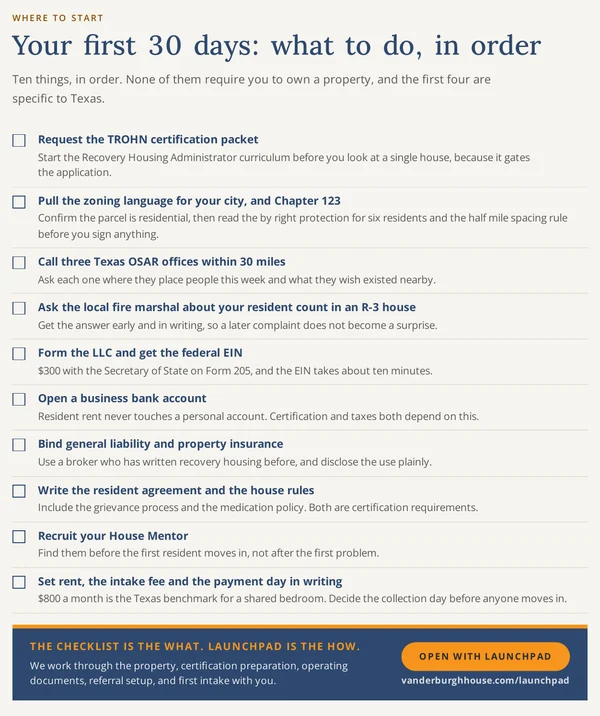
- Register for state taxes and local business licenses. An LLC is a taxable entity for franchise tax purposes from formation, so set up Webfile and calendar the May 15 report date. A sales and use tax permit is free and is required only if you sell tangible personal property or taxable services, and residential rent for a recovery home is neither, so most operators skip it unless they add retail, vending, or taxable services. If you hire, a for-profit employer becomes liable for Texas unemployment tax after paying $1,500 or more in gross wages in a calendar quarter, or employing at least one person in 20 different calendar weeks, a 501(c)(3) employer becomes liable at four employees across 20 weeks, and you register with the Texas Workforce Commission once you cross the line and carry workers’ compensation or document that you are a non-subscriber. Cities set their own requirements, from a certificate of occupancy to a boarding home permit in the larger metros, so confirm them with the city before you sign a lease. Take the nonprofit fork if that is your path: file Form 202 for $25 with the charitable purpose and dissolution clauses and at least three initial directors, adopt bylaws and a conflict-of-interest policy, hold an organizing meeting, get the EIN, file Form 1023 or 1023-EZ, and then submit Form AP-204 to the Comptroller once the determination letter arrives.
- ✓Every document a carrier or broker asks for
- ✓Coverages a Level II home is expected to hold
- ✓Wording that gets applications kicked back
What It Costs to Form and Maintain an Entity
Texas is one of the least expensive states to form in and one of the least expensive to keep, because there is no annual report fee at all. The recurring cost that matters is franchise tax, and most single-home operators sit well under the threshold where any tax is owed.
| Item | Cost | What it means |
|---|---|---|
| LLC formation filing fee | $300 | One-time filing fee on Form 205 with the Secretary of State, and the same $300 applies to a for-profit corporation on Form 201 |
| Annual report / franchise tax | $0 | Texas charges no LLC or corporate annual report fee, and no franchise tax is due below the $2,650,000 no tax due threshold for report years 2026 and 2027; above it the rate is 0.75% of taxable margin, or 0.375% for retail and wholesale. The Public Information Report, Form 05-102 is still required at no fee, due May 15 each year |
| Registered agent (annual) | $0 | Free if you serve as your own registered agent, which Section 5.201 permits for a Texas resident with a Texas street address |
| EIN (IRS) | Free | Free from the IRS, issued online in minutes, one per responsible party per day |
| Optional: DBA, expedited processing | $25 to $750 | Form 503 assumed name certificate is $25 at the state level only, and Texas Express expedited handling adds $50 for two to three business days, $500 for next business day, or $750 for same day; card payments carry a statutory 2.7% convenience fee |
| Typical first-year (for-profit LLC) | $300 | Formation fee + first annual report/franchise-tax payment + a typical registered-agent cost. |
Should the Property Be in a Separate LLC?
If you own the building, a property-holding LLC usually owns the real estate and leases it to your operating entity. If you lease the building, one operating entity is enough. Whether a separate LLC for the sober living property is worth the upkeep usually turns on the equity in the building, and it is a question for your attorney and your accountant.
In Texas, the split carries a few state-specific costs and steps:
- Filing cost: A second Texas LLC adds another $300 certificate of formation.
- Franchise tax: Each entity keeps its own franchise tax account and files its own Public Information Report, and a real estate holding entity stays on the Comptroller’s taxable entity list.
- Timing: Lenders sometimes require title in a specific entity, so settle the structure before closing rather than after.
After Formation: EIN, Bank Account, and Insurance
The liability shield you just paid for only works if the business behaves like a business. These are the moves that make the separation real.
- Get the EIN first: Everything downstream, from the bank account to payroll to the certification application, asks for it.
- Open a dedicated business bank account: Bring the stamped certificate of formation, the company agreement, and the EIN letter. Never run resident payments through a personal account.
- Bind insurance in the entity’s name: General liability and property coverage appropriate to a residential recovery setting, with the entity as named insured and the landlord as additional insured where the lease requires it.
- Set up clean books and a rent ledger: Separate accounting is both the audit trail for franchise tax and the evidence that the entity is not an alter ego of its owner.
- Put the entity on every document: Leases, resident agreements, vendor contracts, and the sign on the door all name the company, not you.
- Calendar the recurring dates: May 15 for the franchise tax report and Public Information Report, plus renewal dates for insurance and accreditation.
With the entity standing, the next moves are accreditation and the numbers. TROHN certification runs $1,000 plus $15 per bed for a term of 24 months, and how to certify a sober living home in Texas with TROHN walks the five-step process the network actually uses. On the economics, whether it is profitable to operate a recovery home in Texas works through rent, occupancy, and the operating lines that decide it.
Texas guideDo You Need a License to Open a Sober Living Home in Texas?What Texas actually requires once the entity is formed, and where certification fits instead.→Texas Entity Formation at a Glance
Everything an operator needs to file in Texas, in one place.
| Item | Detail | What it means |
|---|---|---|
| Filing office | Texas Secretary of State, Corporations Section | All formation documents go here |
| LLC filing fee | Form 205, $300 | The default choice for owner-operated homes |
| Nonprofit filing fee | Form 202, $25 | Requires at least three directors, and state-law nonprofit status is not tax exemption |
| Registered agent required | Yes, continuously | Section 5.201 demands a Texas street address, not a post office box |
| Annual report / franchise tax | No annual report fee; no franchise tax due below $2,650,000 | Report years 2026 and 2027, and the Public Information Report, Form 05-102 is still due May 15 |
| Filing portal | SOSDirect and SOSUpload | Electronic filing is encouraged, cards carry a 2.7% convenience fee, and expedited handling runs $50, $500, or $750 |
Sober Living Guides Every Operator Needs
These evergreen guides apply in every state and cover what sits around the entity you form: the property it holds, the insurance it carries, the financing it enables, and the standards the home certifies to.
Frequently Asked Questions About Sober Living Business Entities
Do I need an LLC to open a sober living home in Texas?
No law requires it. Texas does not license recovery housing, so you can operate as a sole proprietor. Almost every operator forms an entity anyway, because a $300 certificate of formation buys liability separation, a business bank account, insurance in the company’s name, and a contracting party landlords and referral sources accept.
How much does it cost to form an LLC for a sober living business in Texas?
The certificate of formation is $300, filed with the Texas Secretary of State. There is no annual report fee, the EIN is free, and no franchise tax is owed below $2,650,000 in annualized revenue for report years 2026 and 2027. Serving as your own registered agent keeps first-year cost at $300.
Can one LLC hold multiple sober living homes?
Yes. A single entity can operate several homes, and many operators do exactly that. Once the portfolio grows or the homes are owned rather than leased, separating them into a series LLC or separate holding entities limits how far a claim against one property can travel. Each Texas entity files its own franchise tax report.
Do nonprofit sober living founders get paid?
Yes, as salary rather than profit. A 501(c)(3) can pay reasonable compensation for actual work performed, documented by the board. What it cannot do is distribute surplus to founders, directors, or insiders. That prohibition on private inurement is the structural trade for grant eligibility and deductible donations.
Does the entity have to exist before TROHN certification?
Practically, yes. The accreditation review examines your policies, procedures, and organizational documents, and the home must be at least 50% occupied for 60 days before it is considered. Both mean the business is already operating, with leases, insurance, and resident agreements signed by an entity.
Is a nonprofit corporation automatically tax exempt in Texas?
No. Filing Form 202 creates a nonprofit corporation under state law, nothing more. Federal exemption requires an IRS determination on Form 1023 or 1023-EZ, and Texas franchise and sales tax exemption requires a separate application to the Comptroller on Form AP-204 with that determination letter attached.
How VSL Helps You Launch a Sober Living Business in Texas
Texas gives operators one of the cheapest and fastest formation processes in the country: $300 and a Form 205 for an LLC, $25 for a nonprofit corporation, no annual report, and no franchise tax until revenue clears $2,650,000. The decision that deserves your attention is not the paperwork but the model, because 501(c)(3) recognition opens grant and pass-through funding that a for-profit cannot reach, and it costs you ownership, a board, and an annual Form 990. Texas rates as the fourth most favorable state in the country for recovery housing operators, with an Operating Climate Score of 8 and a Legal Climate sub-score of 8 (Foote, 2026), and the light entity burden is part of why.
If you want help choosing a structure and standing up a certified home in Texas, talk with the Vanderburgh Sober Living team about what your plan needs.

This article is general information, not legal or tax advice. Entity selection, tax elections, and property structuring carry consequences specific to your situation, so confirm your plan with a qualified Texas attorney or accountant before you file.
Research & Sources
- Foote, H. T. (2026). Vanderburgh Sober Living Operating Climate Index, 2026 Edition. Vanderburgh Sober Living. https://www.vanderburghhouse.com/research/operating-climate-index-2026/
- Texas Secretary of State. (n.d.). Form 205: Certificate of formation, limited liability company. https://www.sos.state.tx.us/corp/forms/205_boc.pdf
- Texas Secretary of State. (n.d.). Form 201: Certificate of formation, for-profit corporation. https://www.sos.state.tx.us/corp/forms/201_boc.pdf
- Texas Secretary of State. (n.d.). Form 202: Certificate of formation, nonprofit corporation. https://www.sos.state.tx.us/corp/forms/202_boc.pdf
- Texas Secretary of State. (n.d.). Form 806: Filing fee schedule. https://www.sos.state.tx.us/corp/forms/806_boc.pdf
- Texas Secretary of State. (n.d.). Name filings frequently asked questions. https://www.sos.state.tx.us/corp/namefilingsfaqs.shtml
- Texas Secretary of State. (n.d.). Filing options. https://www.sos.state.tx.us/corp/options.shtml
- Texas Secretary of State. (n.d.). Texas Express expedited business filings. https://www.sos.state.tx.us/express.shtml
- Texas Secretary of State. (n.d.). Business services: Corporations Section. https://www.sos.state.tx.us/corp/index.shtml
- Texas Business Organizations Code, Chapter 5, § 5.201 (Registered agent and registered office). https://statutes.capitol.texas.gov/Docs/BO/htm/BO.5.htm
- Texas Comptroller of Public Accounts. (n.d.). Franchise tax. https://comptroller.texas.gov/taxes/franchise/
- Texas Comptroller of Public Accounts. (n.d.). Requirements for reporting and paying franchise tax. https://comptroller.texas.gov/taxes/franchise/filing-requirements.php
- Texas Comptroller of Public Accounts. (n.d.). Public Information Report and Ownership Information Report filing requirements. https://comptroller.texas.gov/taxes/franchise/pir-oir-filing-req.php
- Texas Comptroller of Public Accounts. (n.d.). Franchise tax frequently asked questions: Taxable entities. https://comptroller.texas.gov/taxes/franchise/faq/taxable-entities.php
- Texas Comptroller of Public Accounts. (n.d.). Sales and use tax permit frequently asked questions. https://comptroller.texas.gov/taxes/sales/faq/permit.php
- Texas Comptroller of Public Accounts. (n.d.). 501(c)(3), (4), (8), (10) or (19) exemptions. https://comptroller.texas.gov/taxes/exempt/501(c)-exemptions-1.php
- Texas Health and Safety Code, Chapter 469 (Voluntary accreditation of recovery housing). https://statutes.capitol.texas.gov/Docs/HS/htm/HS.469.htm
- Texas Human Resources Code, Chapter 123 (Community homes for disabled persons). https://statutes.capitol.texas.gov/Docs/HR/htm/HR.123.htm
- Texas Workforce Commission. (n.d.). Thresholds for coverage under employment-related laws. https://efte.twc.texas.gov/thresholds_for_coverage.html
- Office of the Attorney General of Texas. (n.d.). Charitable trusts: Registration and filings. https://www.texasattorneygeneral.gov/divisions/charitable-trusts/registration-and-filings
- Texas Recovery Oriented Housing Network. (n.d.). Certification packages and pricing. https://trohn.org/pricing/
- Internal Revenue Service. (n.d.). Get an employer identification number. https://www.irs.gov/businesses/small-businesses-self-employed/get-an-employer-identification-number
- Internal Revenue Service. (n.d.). Form 1023 and 1023-EZ: Amount of user fee. https://www.irs.gov/charities-non-profits/form-1023-and-1023-ez-amount-of-user-fee