Opening a sober living home in Virginia Beach means clearing three separate gates, and only one of them is the state. Virginia does not license recovery housing, but since 2025 it is a Class 1 misdemeanor to operate a recovery residence without certification from the Department of Behavioral Health and Developmental Services, and no Virginia court may release a person to an uncertified home (Va. Code § 37.2-431.1). The city is the harder gate: the Virginia Beach City Zoning Ordinance caps a “family” at four unrelated people (CZO § 111), so a five-bed home is a “Group home” needing a conditional use permit in every residential district (CZO § 501), and that permit is reviewed against the Oceana noise-zone rules that mark residential use incompatible across a wide band of the city. The need is real: Virginia Beach recorded 48 fatal overdoses in 2025 (Virginia Department of Health) and counted 325 people experiencing homelessness in its 2026 point-in-time count (Department of Housing and Neighborhood Preservation).
What follows is the Virginia Beach layer. The code definitions that decide how your house is classified, the conditional use permit and the Oceana overlay that sits on top of it, the city desks you file with, the local rent and purchase anchors, and the agencies that actually send residents. Statewide rules, the DBHDS certification process, and the full startup and revenue models live in the Virginia guide, and the figures from those pages are restated here and adjusted only where Virginia Beach actually changes them, never recalculated.
Before you read onHow to Open a Sober Living Home in VirginiaThis post covers one piece of the process. The complete Virginia guide walks through every step, from planning to your first resident.→Watch: How to Start a Sober Living Home in Virginia
The video walks the Virginia sequence from the outside in: the line between housing and treatment that keeps a recovery residence out of clinical licensure, what DBHDS certification requires and why it is no longer optional, how zoning review works, and how to plan the money. Everything below applies that sequence to one city, where the zoning step is the one that decides whether the plan survives.
The Virginia book covers the same ground in print, with the checklists and templates an operator needs on day one.
Is Virginia Beach a Good Place to Open a Sober Living Home?
Yes, with one condition that rules out a large share of the map. Virginia Beach has the demand, the household income, the referral infrastructure and the housing stock to support a certified recovery home, and Virginia scores 7 of 10 on the Vanderburgh Sober Living Operating Climate Index (Foote, 2026). The condition is the address. A home above four unrelated residents needs a conditional use permit here, and that permit runs into the Oceana noise-zone policy, which treats residential use as incompatible across the parts of the city closest to the base. Pick the parcel before you pick anything else.
Recovery Housing Demand in Virginia Beach
Demand in Virginia Beach arrives through four doors, and each one behaves differently for a new operator. Understanding which door sends people and on what terms is what separates a home that fills in eight weeks from one that sits half empty for a year.
- Treatment discharge: Sentara Virginia Beach General and Virginia Beach Psychiatric Center discharge people who need somewhere structured to land, and the city’s own Pathways Center runs the outpatient and medication programs that feed the same need.
- The courts and the jail: The Virginia Beach Adult Recovery Court requires Phase I participants to live in provided or approved housing, and the Sheriff’s Office Road to Hope reentry programs release people who need a bed on day one.
- The homelessness response: Virginia Beach runs its own continuum of care rather than sitting inside a regional one, so coordinated entry through the Housing Resource Center is a single, local front door.
- The recovery community: Meetings, sponsors and alumni networks move more residents between homes than any formal referral channel, and they are the slowest to build and the cheapest to keep.
Four numbers come up in every conversation with a lender, a landlord or a referral partner here. These are the current ones, each linked to the body that publishes it.
| Indicator | Virginia Beach figure | Why it matters to an operator |
|---|---|---|
| Fatal overdoses, 2025 | 48, down from a peak of 129 in 2023 (Virginia Department of Health, Office of the Chief Medical Examiner) | Falling overdose deaths do not mean falling demand for beds. They track a treatment system that is keeping more people alive and therefore needs somewhere to send them next. |
| People experiencing homelessness, 2026 | 325, of whom 86% were sheltered (Virginia Beach Department of Housing and Neighborhood Preservation) | A small, mostly sheltered count means coordinated entry is manageable and worth registering with, rather than an overwhelmed system that will never call you back. |
| Median household income | $92,968 (Census Bureau QuickFacts) | Private-pay capacity here is real. A meaningful share of residents and families can cover a bed without a public payer, which matters because Virginia Beach has no public payer for recovery beds. |
| Median gross rent | $1,714 (Census Bureau QuickFacts) | One household pays about $1,714 for a house that can support fourteen residents paying by the bed. That spread is the whole business case, and it is what a skeptical landlord needs walked through. |
| Metro population | 1,797,213 across the Virginia Beach-Chesapeake-Norfolk, VA-NC metro (Census Bureau population estimates) | Referral partners think regionally even though codes are municipal. A Virginia Beach home draws from Norfolk and Chesapeake, and you will compete with operators in both. |
| Transit | 72 Hampton Roads Transit bus routes and 10.01 million FY2026 boardings, with no light rail inside the city (Hampton Roads Transit) | Residents without cars depend entirely on the bus here. The Tide light rail stops at the city line, so a house off a frequent bus corridor will lose residents to job access. |
VSL’s Operating Climate Index scores Virginia 7 of 10 and ranks it 20th nationally, classifying it as moderately regulated (Foote, 2026). The composite hides a split that Virginia Beach makes sharper than anywhere else in the state. Virginia rates 9 for certification value, the highest of its six sub-indices, because a mandatory credential that courts and community services boards rely on turns certification into a referral pipeline rather than a plaque. It rates 5 for legal climate, its lowest, and Virginia Beach is much of the reason: a four-person household cap, conditional use review in every residential district, and a military noise overlay that no other Virginia city carries at this scale.
A home with four or fewer unrelated residents fits the Virginia Beach definition of a family and needs no conditional use permit. The fifth resident changes the legal posture of the whole project. Decide which side of that line you are on before you sign anything.
Most people ask whether they are allowed to open a recovery home. The better first question is whether the need and the money are there. This answers both, for your state.
- How many people need a bed, and how few beds exist
- Who actually pays the rent, and which programs are real
- What it costs to open on the purchase path and the lease path
How to Open a Sober House in Virginia Beach: Step-by-Step
The Virginia sequence lives in the state guide. This version is reordered for Virginia Beach, and the reason is the conditional use permit. In most cities the zoning question is a check you run before you buy. Here it is a public hearing before the Planning Commission and City Council, scheduled on the city’s calendar rather than yours, and it is reviewed against the Oceana compatibility tables. That pushes the address decision to the front and everything else behind it. Expect six to ten months from first search to first resident on the purchase path, and four to seven on the lease path.
Ten steps, in the order a Virginia Beach operator actually meets them.
Step 1. Check the parcel on zoning and the Oceana overlay
Open VBMap, the city’s public parcel viewer, and pull the address twice. First for its zoning district, because “Group homes” is a conditional use in all ten residential districts under CZO § 501 and permitted by right in none. Second for its AICUZ noise zone and accident potential zone, published as city GIS layers (Noise Zone Outline). Virginia Beach is an independent city, so there is no county code to fall back on and no unincorporated area: if the parcel has a Virginia Beach address, the city ordinance governs it.
Then look at what is already around it. Virginia Beach has no spacing rule and no cap on recovery homes per block, but a conditional use permit is decided at a public hearing after notice to neighbors, and an existing home nearby changes the room you walk into. Talk to the civic league before the hearing rather than at it.
Virginia guideVirginia Zoning, Fair Housing, and Land Use Laws for Sober LivingWhere sober homes can operate in Virginia and the legal protections that apply.→Step 2. Form the entity and register the business
The lease and the utilities go in the entity’s name, not yours. Articles of organization for a Virginia LLC cost $100 with the State Corporation Commission, and the annual registration fee is $50, due in the month the LLC was organized (SCC). Year one is therefore $150 in state filings before anything local. Get the EIN and open the business bank account before the first resident pays rent, because commingling is the first thing a certification reviewer and a lender both notice.
Virginia Beach also requires a business license before you begin operating, issued by the Commissioner of the Revenue and renewed by March 1 each year. The fee schedule is flat at the small end: $25 on gross receipts up to $25,000, $40 up to $100,000, and $50 up to $200,000, moving to a rate per $100 of gross receipts above that. The city determines your classification, so ask for it in writing rather than assuming the general services rate applies.
Virginia guideHow to Form a Legal Entity for a Sober Living Business in VirginiaLLC, nonprofit, or both: how Virginia operators structure the business and the property.→Step 3. Match the property to the household test
Virginia Beach defines a family as one person living alone, people related by blood, marriage, adoption or approved foster care, or a group of no more than four unrelated people including any on-premises employee (CZO § 111). There is no local exemption that reaches a recovery residence, so the property decision and the resident count decide each other.
- Four unrelated residents or fewer, and the house is a family under the ordinance with no permit required. Five or more, and it is a Group home needing a conditional use permit.
- Bedrooms must carry at least 70 square feet, and at least 50 square feet per occupant where more than one person sleeps in the room (Va. Code § 36-105.4). DBHDS certification incorporates that floor directly (12VAC35-260-20), so it is a certification requirement as well as a building one.
Two local numbers set the budget. On the lease path, the HUD fair market rent for the Virginia Beach-Norfolk-Newport News HUD Metro FMR Area is $2,376 for a three-bedroom and $2,797 for a four-bedroom in FY2026, effective October 1, 2025 (HUD). On the purchase path, the median sale price in Virginia Beach city was $425,000 in July 2026 (Virginia REALTORS). Those two figures drive the cost table below and the only two lines of the state revenue model that Virginia Beach changes.
Virginia guideSober Living Startup Costs in VirginiaEvery one-time cost to open, on the lease path and the purchase path, with the Virginia figures behind each line.→Step 4. Settle occupancy classification and the certificate
A recovery residence where residents are independent and receive no custodial care stays an ordinary dwelling under the Virginia Uniform Statewide Building Code, which means smoke alarms, carbon monoxide alarms and egress to the standard every house in the city meets. What changes the picture is care. Once a home houses more than five people who receive assistance with daily living tasks in a supervised setting, it classifies as Group R-4 (13VAC5-63-210), and sprinklers follow (13VAC5-63-240).
The trap is the house itself. A certificate of occupancy is required before occupancy or a change of occupancy (13VAC5-63-160), and converted garages, finished attics and basement bedrooms added without permits are common in Virginia Beach housing stock from the 1960s and 1970s. Those rooms are the ones you were planning to put beds in. Resolve them with Permits and Inspections before the certification inspection, not after. The citations are in the fire and building section below.
Step 5. Write the governing documents
VARR reviews your written policies at application, not after you open, and writing them under deadline produces documents nobody follows. Draft the resident agreement, the house rules, the fee and refund schedule, the grievance procedure, the medication storage policy, and the discharge and re-entry policy before you take an application. Add the one most templates leave out: a neighbor relations plan naming who answers the phone when a neighbor calls, what that person says, and how fast they call back. In a city where your permit was granted at a public hearing, that document is not optional.
Keep readingHouse Rules in Sober HousesThe rules that keep a recovery home safe, structured, and worth living in.→Step 6. Quote insurance on the specific address
Insurance is priced on the address, the occupancy and the resident count, and it is one of the lines the state cost model leaves open because no honest number exists until a carrier looks at your house. Ask for general liability and property together, disclose the group residential use rather than describing it as a rental, and ask directly whether the carrier writes recovery housing at all. Bind coverage before the lease or closing, not before the first resident.
Step 7. Recruit and house the house mentor
The live-in house mentor is what makes a NARR Level II home a Level II home. They hold the structure, run the house meeting, handle the two in the morning problems, and give referral partners a person to call. Recruit through Virginia Beach recovery meetings and the alumni networks of the treatment providers you plan to take referrals from. Put the arrangement in writing, including the free or reduced bed, and move them in before the first resident arrives. That bed shows up as an unpaid bed in the revenue model, and it is the cheapest line on the page.
Step 8. Apply for DBHDS certification
Certification is not optional in Virginia and has not been since 2025. Operating a recovery residence without it is a Class 1 misdemeanor, and no Virginia court and no Commonwealth agency may refer or release a person to an uncertified home (Va. Code § 37.2-431.1). DBHDS recognises VARR and Oxford House as accrediting bodies and runs a conditional certification for homes still completing accreditation (DBHDS). The state guide carries the full process; the short version is three stages.
- Accredit with VARR, which charges $750 a year plus $10 per accredited bed, and passes on a policy review and a site inspection.
- Apply to DBHDS for certification, or for conditional certification if accreditation is still in progress.
- Get listed on the DBHDS certification list, which is what courts, community services boards and probation officers check before they send anyone.
Step 9. Open the referral relationships early
No single agency controls referrals in Virginia Beach, because no agency pays for recovery beds here. That makes outreach a relationship exercise rather than a contracting one. Discharge planners send people to homes they have seen and to house mentors they can reach, and they build that list months before they need it. Call the partners in the table below while the house is still being painted, invite three of them to walk through it, get listed with the VARR directory the moment certification lands, and register with coordinated entry through the Housing Resource Center. Those weeks cost nothing. The same weeks after closing cost a mortgage payment each.
Step 10. Open, then hold occupancy
The Virginia reference model runs 14 beds at $865 a month and 82% occupancy, and that occupancy assumption is the entire margin. The first quarter is not for profit; it is for proving to three or four referral partners that you answer the phone and manage a discharge well. Admit deliberately rather than filling every bed in a month, because one bad early placement costs you a partner. Run the house meeting weekly, track occupancy daily, and send a short monthly note to every referral partner whether or not you have vacancies.
Keep readingHow Sober Houses Fill Beds and Stay FullProven occupancy strategies from established recovery housing operators.→A realistic Virginia Beach schedule, assuming a conditional use permit is needed.
| Phase | Weeks (estimated) | What gets done |
|---|---|---|
| Parcel search and zoning check | 2 to 6 | Shortlist addresses, pull each on VBMap for zoning district and Oceana noise zone, and eliminate anything in a 70-75 or greater than 75 dB DNL band. |
| Conditional use permit | 12 to 20 | Pre-application meeting with Zoning Administration, application, staff review, Planning Commission hearing, then City Council. Neighbor notice goes out in this window. |
| Entity, property and repairs | 4 to 10 | LLC and business license, close or sign the lease, resolve unpermitted rooms with Permits and Inspections, furnish, install alarms. |
| Accreditation and certification | 8 to 16 | VARR policy review and site inspection, then the DBHDS certification application or conditional certification. |
| Referral outreach and opening | 4 to 8 | Tours for referral partners, VARR directory listing, coordinated entry registration, then admissions at a controlled pace. |
Timelines are estimated. The conditional use permit is what stretches a Virginia Beach timeline, because the Planning Commission and City Council meet on a fixed calendar and a deferral costs a full cycle. A home held to four unrelated residents skips that phase entirely and can open in roughly half the time.
Best Neighborhoods for a Sober Living Home in Virginia Beach
A workable Virginia Beach address passes four tests, and the first one is unique to this city.
- The Oceana test: The parcel sits outside the 70-75 and greater than 75 dB DNL noise zones and outside any accident potential zone. Inside them, CZO Table 1 marks every residential use incompatible, and a conditional use permit is a discretionary application reviewed against that table.
- The household test: Either the home holds to four unrelated residents and needs no permit, or the house and the block can support the public hearing that a fifth resident triggers.
- The bus test: A frequent Hampton Roads Transit corridor within walking distance, because there is no rail in Virginia Beach and residents in early recovery rarely have cars.
- The house test: Four or more legally permitted bedrooms meeting the 70 square foot floor, more than one full bathroom, and no unpermitted conversions carrying the bed count.
Six areas follow. Housing and land use descriptions come from the city’s Comprehensive Plan and Strategic Growth Area plans, transit from Hampton Roads Transit, and every noise zone below was sampled directly against the city’s published AICUZ noise zone layer at a grid of points across the area. Sampling characterises an area, not a parcel. Pull your own address on VBMap before you offer on it.
| Area | Housing stock and transit | Siting notes for a sober living home |
|---|---|---|
| Kempsville | Established single-family subdivisions built out largely between the 1960s and 1980s, with the four-bedroom stock this use needs. Sits on Kempsville Road, Providence Road and Indian River Road near I-64, served by Hampton Roads Transit routes 24 and 25. | Every sampled point fell outside the Oceana noise zones and accident potential zones, which makes it the cleanest conditional use permit posture in the city. The risk is that these are organised, long-tenured neighborhoods with active civic leagues, and the permit is decided at a public hearing. |
| Bayside | Mature post-war through 1970s housing toward the Chesapeake Bay and the Lynnhaven. Shore Drive, Independence Boulevard and Northampton Boulevard, with routes 22, 29 and 35 and the Newtown Road light rail station just over the Norfolk line. | Clear of the noise footprint at every sampled point, and the only Virginia Beach area with practical access to the Tide. The risk is flood exposure near the water, which drives insurance and can complicate a lender. |
| Pembroke and Town Center | Predominantly commercial and multifamily rather than single-family, with newer mid-rise residential built through the Town Center redevelopment on an older commercial base (Pembroke Strategic Growth Area). The transit hub of the city, at Independence and Virginia Beach Boulevard. | Clear of the noise zones and the best transit access in Virginia Beach. The risk is the housing stock itself: large single-family homes with four or more bedrooms are scarce, so this is a strong location for a small home and a poor one for a fourteen-bed model. |
| Princess Anne and Courthouse | Lower-density residential mixed with institutional and open space around the Municipal Center, the community college and Sentara Princess Anne (Princess Anne Commons and Transition Area). Princess Anne Road and Dam Neck Road, route 25. | Walking distance to the courthouse, the Recovery Court docket and the city’s human services campus, which is a genuine referral advantage. The risk is that most sampled points fell inside the 65-70 dB DNL band, where noise attenuation applies to residential construction and a conditional use permit still draws Oceana review. |
| Hilltop | Mixed older single-family and commercial along First Colonial Road and Laskin Road, immediately north of Naval Air Station Oceana. | Avoid. Eleven of sixteen sampled points fell in the greater than 75 dB DNL zone, and the area carries APZ-1, APZ-2 and Clear Zone designations. Table 1 and Table 2 mark every residential use incompatible there, and CZO § 1804 makes it council policy not to approve a discretionary application for an incompatible use. |
| Great Neck | Established single-family from the 1960s through the 1980s along Great Neck Road and the Lynnhaven River, with larger waterfront stock to the north. Routes 26 and 29. | The northern end near the Bay sampled clear and holds good large-home stock. The southern end did not: sampled points returned 65, 70 and greater than 75 dB DNL readings plus APZ-1 and APZ-2. This is the area where checking the specific parcel matters most, because two streets can sit on opposite sides of the line. |
Beyond location, four features decide whether a Virginia Beach house works as a recovery home.
- Permitted bedrooms: Four or more bedrooms that appear on the permit record and meet the 70 square foot floor. A converted garage that never went through Permits and Inspections does not count toward your bed model.
- Bathroom ratio: At least one full bathroom for every four residents. This is the single most common cause of house conflict and the thing residents mention first when they leave.
- Parking and the street: Off-street parking for the house mentor and staff, because street parking complaints are what turn a neutral neighbor into a hearing objector.
- A real common room: A space that seats everyone at once for the house meeting. A home without one runs its meetings in the kitchen and stops running them by month three.
Virginia Beach is an independent city, so its ordinance stops at the city line and no county code sits underneath it. Norfolk, Chesapeake and Suffolk each run their own zoning ordinances with their own household definitions and their own permit paths, and none of them carries the Oceana overlay at Virginia Beach’s scale. An address a few minutes away can sit under a different rulebook, which is worth knowing before you narrow the search to one city.
- ✓Room-by-room requirements for a Level II home
- ✓Zoning and occupancy questions to ask before you tour
- ✓The red flags that should end a showing early
Who Regulates Sober Living Homes in Virginia Beach?
No single agency regulates sober living homes in Virginia Beach, which is why operators get contradictory answers depending on who they call. Six bodies each control one piece: DBHDS certifies the home and can prosecute an uncertified one, Virginia Beach zoning decides whether the use is allowed at the address, the Oceana overlay decides whether a permit will be granted there, Permits and Inspections controls the certificate of occupancy, the Fire Department inspects on request or complaint, and the Commissioner of the Revenue issues the business license. Virginia does not license recovery housing at all; it certifies it, and the difference is the most misread point in the state.
A sober living home is a shared residence where people in recovery live under house rules, pay their own rent, and receive no clinical treatment on site. Virginia writes that distinction into statute: a recovery residence is housing that is free of alcohol and illicit drugs for people with substance use disorders “that does not include clinical treatment services” (Va. Code § 37.2-431.1). Adding treatment on site crosses the home into licensed clinical territory and a different regulator. Virginia Beach does not define a recovery residence anywhere in its own code, which is precisely why the generic “Group homes” category ends up carrying it.
| Layer | Agency | What it controls for a sober living home |
|---|---|---|
| State certification | Virginia Department of Behavioral Health and Developmental Services (DBHDS) | Certifies recovery residences and maintains the certification list. Operating without certification is a Class 1 misdemeanor, and no court or Commonwealth agency may refer a person to an uncertified home (Va. Code § 37.2-431.1; 12VAC35-260). Adding clinical services on site moves the home into licensed treatment under a separate scheme. |
| Private accreditation | Virginia Association of Recovery Residences (VARR) and Oxford House | The two bodies DBHDS recognises as accrediting entities. Accreditation is the route to certification and carries the NARR standards and the site inspection (DBHDS). |
| City zoning | Virginia Beach Planning and Community Development, Zoning Administration | Decides whether the use is permitted at the address. Four unrelated residents or fewer is a family (CZO § 111); five or more is a Group home requiring a conditional use permit in every residential district (CZO § 501). Reachable at (757) 385-8074 (Zoning Administration). |
| Military compatibility overlay | Air Installations Compatible Use Zones (AICUZ) Overlay, NAS Oceana | Applies to every discretionary development application, conditional use permits included, on a parcel inside an accident potential zone or a 65 dB DNL or greater noise zone (CZO § 1803). Table 1 marks all residential uses incompatible at 70-75 and above 75 dB DNL, and § 1804 makes it council policy not to approve an incompatible application. |
| City building and fire | Permits and Inspections, and the Virginia Beach Fire Department Fire Prevention Bureau | Permits and Inspections enforces the Virginia Uniform Statewide Building Code and issues the certificate of occupancy (Permits and Inspections). The Fire Prevention Bureau does not routinely inspect private dwellings and acts on request or complaint, at (757) 385-4228 (Fire Prevention). |
| City business licensing | Virginia Beach Commissioner of the Revenue | Issues the business license required before you begin operating, renewed by March 1 each year, with flat fees from $25 to $50 below $200,000 in gross receipts (Commissioner of the Revenue). |
The four answers operators most often get wrong here.
- State license: Not required. Virginia does not license non-clinical recovery housing.
- City license: Required. Virginia Beach requires a business license before you operate (Commissioner of the Revenue).
- Certification: Mandatory. DBHDS certification is a legal condition of operating, not a credential you add later (Va. Code § 37.2-431.1).
- Referrals: Certification-gated. Courts and Commonwealth agencies are barred from sending anyone to an uncertified home, so the credential is the referral pipeline.
Certification is the part Virginia makes clear. Pay the fees, pass the inspection, meet the standards, and the credential is attainable on a known timetable. Zoning is the part that decides whether the project happens at all, and in Virginia Beach it is two constraints stacked on each other.
Virginia Beach Zoning Laws for Sober Living Homes
Virginia Beach has no sober living ordinance, no spacing rule, no density cap, and no registration scheme aimed at recovery homes. It does not define a recovery residence, a sober living home, or a halfway house anywhere in its zoning ordinance. What governs instead is the generic definition of a family, the conditional use requirement attached to “Group homes,” and the Oceana compatibility overlay, and together those three do more work than most cities’ dedicated ordinances.
How the Virginia Beach City Zoning Ordinance Classifies a Sober Living Home
The ordinance carries a use called “Group homes” but never defines it, and it carries no supplemental standards section for it the way it does for senior housing, single room occupancy and short-term rentals. Classification therefore runs entirely through the definition of a family in CZO § 111.
- Family: An individual living alone, people related by blood, marriage, adoption or approved foster care, or “a group of not more than four (4) persons (including on premise employees) who need not be related” (CZO § 111).
- The eight-person carve-out: The ordinance does treat a group of up to eight people as a family where they have mental illness, intellectual disability or developmental disabilities and live with staff in a DBHDS-licensed facility, but it adds that those terms “shall not include current illegal use of or addiction to a controlled substance” (CZO § 111(b)(3)). That clause is why the carve-out does not reach a recovery residence.
- Residential districts: “Group homes” is listed as a conditional use, marked C, in all ten residential districts from R-40 through R-2.5, and as a permitted use in none, while a single-family dwelling is permitted by right in nine of the ten (CZO § 501).
The line is the fifth unrelated resident. At four or fewer, the home is a family occupying a single-family dwelling, permitted by right, with nothing to apply for. At five or more, it is a Group home requiring a conditional use permit granted after notice and a public hearing before the Planning Commission and City Council. Virginia Beach processes Group home permits as an ordinary category rather than an exceptional one, and has done so for years, which is useful context when a neighbor argues the use is unprecedented.
Because “Group homes” is undefined in the ordinance, the classification conversation happens with a zoning official rather than in the code. Ask Zoning Administration for a written determination on your specific address and resident count before you make an offer, and keep it.
What the Eight-or-Fewer Rule Does and Does Not Do
The rule operators quote most often in Virginia is that a residential facility for eight or fewer people must be treated as a single family. It is real, it is in the state code, and it does not reach a sober living home.
- Va. Code § 15.2-2291(A): Requires zoning ordinances to treat a residential facility housing no more than eight people with mental illness, intellectual disability or developmental disabilities, with staff, as residential occupancy by a single family, and bars conditions more restrictive than those on a related household. It then excludes “current illegal use of or addiction to a controlled substance” from those terms (§ 15.2-2291).
- Va. Code § 15.2-2291(B): Extends the same treatment to facilities for eight or fewer aged, infirm or disabled people licensed by the Department of Social Services (§ 15.2-2291). Both subsections turn on a licensing authority, and a recovery residence has none.
- Recovery residences: Fall outside both. Virginia Beach copied the statutory exclusion verbatim into its own family definition at CZO § 111(b)(3), so the same words that create the carve-out are the words that remove recovery housing from it. A search of Title 15.2, Chapter 22, Article 7 returns no zoning statute addressing recovery residences at all.
Protection comes from disability law rather than from the eight-person rule. People in recovery from substance use disorder are protected under the federal Fair Housing Act, and the HUD and DOJ joint statement on land use sets out how that reaches zoning decisions. The operative duty is reasonable accommodation: a city must consider waiving or modifying a rule where doing so is necessary to give people with disabilities equal opportunity to use housing. Sober living zoning and requesting reasonable accommodation are the two mechanics worth understanding before a hearing rather than after a denial.
Keep readingThe Federal Fair Housing Act and Sober Living: Everything You Need to KnowThe federal protections every operator, neighbor, and local official should understand.→No Local Sober Living Ordinance: What a September 2026 Search Found
A search on September 19, 2026 of the Virginia Beach Code of Ordinances, the City Clerk’s eDocs agenda archive, the city website and the Planning and Community Development document store found no ordinance, moratorium, zoning text amendment or enforcement action specific to sober living homes or recovery residences. One qualification belongs with that finding: the eDocs archive does not offer full-text search to the public, so the absence reflects what is publicly searchable rather than a certified negative. What the search did surface is that Virginia Beach handles Group home conditional use permits as routine business, including a 2021 permit for an eight-bed group home in the Centerville District.
- No definition of a recovery residence or sober living home anywhere in the zoning ordinance.
- No supplemental standards section for group homes, unlike senior housing, single room occupancy and short-term rentals.
- No spacing, density or registration requirement aimed at recovery housing.
The absence of a local ordinance is not the absence of local rules, and an operator who reads it that way will be surprised at the hearing. The four-person family cap binds today, the conditional use requirement binds today, and the Oceana overlay binds today. Virginia Beach is also the rare city with reported federal case law about its own recovery housing.
- Oxford House, Inc. v. City of Virginia Beach, 825 F. Supp. 1251 (E.D. Va. 1993): Zoning inspectors cited four Oxford Houses for exceeding the four-unrelated-persons cap in § 111, and the court dismissed the Fair Housing Act claims as unripe because the operators had never applied for the conditional use permit § 501 provides (E.D. Va.). The practical lesson is that you apply first and litigate second, not the reverse.
- Bryant Woods Inn, Inc. v. Howard County, 124 F.3d 597 (4th Cir. 1997): The governing Fourth Circuit standard for reasonable accommodation in group home zoning: the accommodation must be both necessary and reasonable, and the operator carries the burden of showing it (4th Cir.).
- HUD and DOJ, Joint Statement on State and Local Land Use Laws: Warns that land use rules singling out housing for people with disabilities, or applied to block it, can violate the Fair Housing Act, and sets out the reasonable accommodation obligation that applies to a permit decision (Department of Justice).
Three moves follow from all of that.
- Pull the parcel on VBMap for zoning district and Oceana noise zone before you make an offer, and put a zoning contingency in the contract.
- Ask Zoning Administration for a written determination on the address and the resident count, and apply for the conditional use permit if you need one rather than opening and waiting to be cited.
- Build the neighbor relationship before the hearing notice arrives. The permit is discretionary, the hearing is public, and the civic league will be there.
How your home gets classified, where Fair Housing applies, and what to do if the city says no.
Virginia Beach Fire and Building Code Rules for Sober Living Homes
A Virginia Beach recovery home where residents are independent stays an ordinary dwelling under the Virginia Uniform Statewide Building Code, built and maintained to the same standard as any house on the street. Virginia writes the building code once at the state level and localities enforce rather than tighten it (Va. Code § 36-98), which means the building rules here are the Virginia rules. Three things decide what Permits and Inspections and the Fire Department actually ask of you.
- Custodial care, not head count: Group R-4 covers homes with more than five but not more than sixteen residents who live there on a 24-hour basis in a supervised environment and receive custodial care, defined as help with cooking, medication, bathing, toileting and other daily living tasks (13VAC5-63-210; 13VAC5-63-200). A home where residents cook, self-administer and come and go independently does not meet that test at any bed count. Start providing that assistance and the classification changes, and R-4 carries a sprinkler requirement (13VAC5-63-240).
- The certificate of occupancy: No building may be occupied, and no occupancy may change, without a certificate (13VAC5-63-160). The trap in Virginia Beach is the mid-century housing stock: converted garages, enclosed porches and finished attic rooms that were never permitted. Those are the rooms operators plan beds into, and they will not survive a certification inspection.
- The fire inspection: The Virginia Statewide Fire Prevention Code is a maintenance code enforced after occupancy (13VAC5-51). The Virginia Beach Fire Prevention Bureau inspects businesses, lodging and assembly occupancies on a routine cycle and does not routinely inspect private dwellings, acting instead on request or complaint (Fire Prevention). You can request an inspection at (757) 385-4228.
Because nobody schedules an inspection of a single-family house, the life-safety gap in a recovery home is usually discovered by the accreditation inspector rather than by the city. These are the requirements that apply whether or not an inspector ever knocks.
| Requirement | What the rule says | Authority |
|---|---|---|
| Bedroom floor area | At least 70 square feet per bedroom, and at least 50 square feet per occupant where a room sleeps more than one person. | Va. Code § 36-105.4, incorporated into certification by 12VAC35-260-20 |
| Smoke and carbon monoxide alarms | The alarm provisions of the Virginia Construction Code apply to the dwelling as built and to any alteration, and working alarms in every sleeping area are what an accreditation inspector checks first. | 13VAC5-63 |
| Sprinklers | Not required for an ordinary dwelling. Required throughout a Group R fire area once the home classifies as R-4, which is the practical cost of adding custodial care. | 13VAC5-63-240, § 903.2.8 |
| Certificate of occupancy | Required before occupancy and before any change of occupancy classification, which is what a move from dwelling to R-4 would be. | 13VAC5-63-160, § 116 |
| Fire code maintenance | Egress kept clear, extinguishers serviced, alarms maintained. Enforced on complaint or request in a private dwelling rather than on a schedule. | Virginia Statewide Fire Prevention Code and VBFD Fire Prevention |
Nobody in Virginia Beach will make you comply with any of this on a single-family house. The burden sits with the operator, and it comes due at the VARR site inspection, at the first insurance claim, and at the first complaint from a neighbor who has been to a Planning Commission hearing. Work out determining maximum occupancy from the permitted bedrooms and the square footage floor before the inspection rather than after, because discovering the house holds ten beds and not fourteen after closing changes the entire model.
Alarms, egress, extinguishers, and the documentation an inspector expects on file.
Get the checklist freeNo cost, no obligation. Unsubscribe in one click.How Much Does It Cost to Open a Sober House in Virginia Beach?
The Virginia reference figures are the floor. Opening on the lease path runs about $38,910 before the first resident, and the purchase path about $131,478, with the gap driven almost entirely by a 20% down payment on the state median sale price. Virginia Beach changes two inputs and leaves the rest alone. Its median sale price runs below the Virginia median, which makes the purchase path slightly cheaper here. Its fair market rent runs above the state lease assumption, which makes the lease path slightly dearer. Insurance stays unpriced until a carrier looks at the address. Nothing else in the state model moves.
| Line item | Virginia Beach figure | Source |
|---|---|---|
| LLC formation, year one | $150 ($100 articles of organization plus the $50 annual registration fee) | Virginia SCC and SCC annual registration |
| Virginia Beach business license | $25 to $50 in the first years, on gross receipts below $200,000 | Commissioner of the Revenue |
| State license | $0. Virginia does not license non-clinical recovery housing | Va. Code § 37.2-431.1 |
| VARR accreditation, annual | $890 at 14 beds ($750 flat plus $10 per accredited bed) | VARR |
| Lease anchor, four-bedroom | $2,797 a month, FY2026 fair market rent effective October 1, 2025 | HUD fair market rents |
| Purchase anchor | $425,000 median sale price, July 2026, putting 20% down at $85,000 | Virginia REALTORS |
| Furnishings, alarms and reserve | Carried at the Virginia figures. Virginia Beach does not change what a bed, a smoke alarm or three months of reserve costs | The Virginia startup-costs model, restated |
| Everything else | Restated from the Virginia model rather than repriced here | The Virginia startup-costs model, restated |
Two adjustments turn the Virginia budget into a Virginia Beach one.
- Purchase path: Swap the state model’s $89,640 down payment for $85,000, the 20% figure on the Virginia Beach median of $425,000, and the purchase path lands at roughly $126,838, estimated. That excludes closing costs, any repairs to bring unpermitted rooms into compliance, and insurance, which has no quotable figure until a carrier sees the house.
- Lease path: The lease path moves the other way. HUD puts the four-bedroom fair market rent here at $2,797, above the roughly $2,526 the Virginia model assumes for a comparable property, so test any landlord quote against $2,797 rather than against the statewide number and expect to pay a premium above it for a group residential use.
There are no local offsets, and an operator should plan on that rather than around it.
- Opioid Abatement Authority awards: Virginia Beach has received $2,457,137 from the Virginia Opioid Abatement Authority since 2023, across a mobile SUD services van, youth prevention, a recovery high school, a police deflection program and juvenile detention services (OAA awards by locality). Not one award funds recovery housing, and the FY2026 renewals of $425,210 do not either (FY2026 recommendations).
- The city State Opioid Response program: Funds medication for opioid use disorder, peer support and transportation for uninsured Virginia Beach residents, not beds (Virginia Beach SOR).
Read that plainly: Virginia Beach has no recovery housing voucher, no per-diem bed rate and no local grant a new operator can apply for. Every bed in your model is private pay or paid by the resident from wages, family or benefits. Underwrite the house on that basis. An operator who builds a pro forma assuming a public payer will appear is building on money that does not exist in this city.
Virginia guideVirginia Recovery Housing Funding: Why It Rarely Works the Way Operators ExpectBlock grants, opioid settlement dollars, Medicaid, and county contracts: what reaches a sober living home and what does not.→Is a Sober Living Home Profitable in Virginia Beach?
Yes, on the same condition as everywhere else in Virginia: occupancy. The Virginia reference model runs 14 beds at $865 a month and 82% occupancy, producing about $8,800 in monthly revenue against about $4,202 in monthly operating costs and leaving roughly $4,598 in net operating income before the owner’s own labor. Virginia Beach changes exactly two lines of that model, the mortgage and the real estate tax, and they move in opposite directions.
That statewide reading cuts both ways here. Virginia Beach buys in below the Virginia median, which improves the capital side, and pays a higher effective property tax, which takes some of it back. The table below restates the Virginia model and scales only the two property lines. Revenue, rent per bed, occupancy and every other operating cost are the state figures, unchanged.
| Line | Virginia reference model (14 beds) | Virginia Beach adjustment (estimated) |
|---|---|---|
| Beds | 14 | Unchanged |
| Rent per bed, monthly | $865 | Unchanged |
| Occupancy | 82% | Unchanged |
| Monthly revenue | $8,800 | Unchanged |
| Mortgage payment | $2,304 | $2,185, estimated, on 80% of the $425,000 Virginia Beach median at the same 6.66% 30-year rate the state model uses (Virginia REALTORS) |
| Real estate tax | $258 | $344, estimated, at the Virginia Beach FY2027 rate of $0.97 per $100 of assessed value applied to $425,000 (Real Estate Assessor) |
| All other operating costs | $1,640 | Unchanged |
| Net operating income, monthly | $4,598 | $4,631, estimated |
That adjustment holds every figure but the mortgage and the property tax constant, and both adjusted numbers are estimates rather than quotes. Net the two against each other and the Virginia Beach home lands about $33 a month ahead of the state model, near enough to identical, at a working margin of roughly 53% before the owner’s own labor. The mortgage is not what decides this business.
- Occupancy: One empty bed costs $865 a month. Four points of occupancy move the bottom line further than the entire difference between the Virginia Beach mortgage and the state model’s.
- The absence of a public payer: With no Virginia Beach bed rate and no voucher, every bed is private pay. That makes the referral relationships in the next section a revenue line rather than a marketing activity.
- The permit path: Months spent in conditional use review are months of carrying costs against no revenue. Choosing a parcel clear of the Oceana zones, or holding to four residents, is a financial decision before it is a legal one.
Your property will not be the model property, and the gap between them is worth an afternoon rather than a guess.
Will your property pencil out?
Get a custom projection for your Virginia property, then compare it with typical returns.
Get my projectionFree calculator with your property’s numbers.See Virginia profitabilityRealistic revenue, operating costs, and margins in Virginia.How to Get Residents for a Sober Living Home in Virginia Beach
Nobody controls publicly funded referrals in Virginia Beach, because there is no public money for recovery beds here. What exists instead is a set of public doors that screen people and send them somewhere, and the home they send them to is the one they know. Three doors matter most.
- Virginia Beach Department of Human Services, (757) 385-0511: Same-day adult behavioral health assessment for the city’s community services board, routing people into outpatient care, medication treatment, case management and residential supports (Behavioral Health). The Pathways Center at (757) 385-6950 is the substance use front door (Recovery and Treatment Services).
- Regional Housing Crisis Hotline, (757) 227-5932: Coordinated entry for the BEACH Continuum of Care, with walk-in triage at the Housing Resource Center at 104 N. Witchduck Road (coordinated entry). It places people into shelter and rehousing, and it does not pay a recovery residence rate. Register anyway, because it is where housing-insecure people in the city are screened.
- DBHDS certification: The gate on all of it. Because no Virginia court and no Commonwealth agency may send a person to an uncertified recovery residence (Va. Code § 37.2-431.1), certification is not a marketing credential in Virginia Beach. It is the difference between being on a referral list and being legally unreachable.
Twelve organizations, public agencies first, because they are the ones whose staff turn over least and whose referrals arrive most consistently. Each row says how a resident actually reaches you from that door, not what the organization does in general.
| Organization | Type | How residents reach you |
|---|---|---|
| Virginia Beach Department of Human Services | City community services board | Same-day assessment at (757) 385-0511 routes people into care; case managers place the ones who need structured housing. |
| The Pathways Center | Outpatient and medication treatment | Residents step down from intensive outpatient or start medication treatment and need somewhere stable to live while they do it. |
| Virginia Beach Adult Recovery Court | Recovery court | Phase I participants must live in provided or approved housing. The coordinator at (757) 385-6338 keeps the list of homes that qualify. |
| VBDHS Adult Correctional Services | Jail-based treatment and discharge planning | Runs the substance use curriculum inside the correctional center and plans releases, at (757) 385-2131. |
| Virginia Beach Community Corrections and Pretrial | Local probation and pretrial | Supervises people on local probation with treatment-compliance conditions and needs addresses that hold, at (757) 385-4689. |
| Virginia Beach Sheriff’s Office, Road to Hope | Reentry | A 20-week recovery program and a three-month reentry program release people who need a bed the day they walk out. |
| VADOC Probation and Parole District 23 | State probation and parole | Officers approve residences for people under state supervision and refer to homes that report reliably, at (757) 821-7575. |
| VBDHS Residential Services and PATH | Housing and street outreach | Transitional and permanent supportive housing plus PATH outreach, reaching people who need a structured step, at (757) 385-4024. |
| Housing Resource Center, BEACH Continuum of Care | Coordinated entry | Walk-in triage and the housing crisis hotline screen people and refer them on, at (757) 385-5167. |
| Hampton VA Health Care System | Veterans health care | Housing navigation and addiction treatment for veterans across Hampton Roads, including HUD-VASH placements that need structured options. |
| Sentara Virginia Beach General Hospital | Hospital behavioral health | Inpatient and intensive outpatient discharges are the fastest referrals in the city and the least forgiving of a slow phone answer. |
| Judeo-Christian Outreach Center | Shelter and rehousing nonprofit | Operates the city’s year-round single-adult shelter and works directly with detox and human services, at (757) 491-2846. |
The fellowships fill beds that no agency ever touches. The Tidewater Intergroup of Alcoholics Anonymous publishes the local meeting schedule and staffs a 24-hour line, and Tidewater Area Narcotics Anonymous does the same across Hampton Roads. Neither refers formally, and neither will endorse a home. Meeting secretaries, sponsors and the people who have been sober in this city for fifteen years are still how most residents find a house, and that network takes a year to earn and a single bad discharge to lose.
If you came here looking for a place to live rather than a business to run, that part is simpler.
Take the next step
Apply, browse homes, or search the national directory.
Apply onlineGet a call back within 24 hours.View VSL homesSee Chartered recovery homes and find the right fit.Search the national directoryCertified sober houses anywhere in the US.Or call (844) 762-3747, weekdays 8a to 5p.
Common Mistakes When Opening a Sober House in Virginia Beach
These are the errors that show up in Virginia Beach homes that struggle through year one, and all five happen in the first ninety days, before a single resident moves in.
- Buying before pulling the parcel on the Oceana layer: Table 1 marks residential use incompatible at 70-75 and above 75 dB DNL, and a conditional use permit is a discretionary application reviewed against it. An operator who closes on a Hilltop or London Bridge house and then applies has bought a property they cannot legally fill above four beds.
- Taking the fifth resident without the permit: Four unrelated residents is a family under CZO § 111. The fifth makes it a Group home requiring a conditional use permit, and Oxford House v. City of Virginia Beach is the reported case of exactly that enforcement, in this city, against recovery homes.
- Quoting the eight-or-fewer rule: Va. Code § 15.2-2291 excludes addiction to a controlled substance by its own terms, and Virginia Beach copied that exclusion into § 111(b)(3). Arriving at a hearing citing a statute that names your residents as the exception is worse than arriving without one.
- Underwriting against public money: Virginia Beach has taken $2.46 million in opioid abatement awards and put none of it into recovery housing, and the city SOR program funds medication rather than beds. A pro forma with a public payer line in it does not survive contact with this city.
- Treating certification as a later step: Operating uncertified is a Class 1 misdemeanor, and courts and Commonwealth agencies are barred from referring anyone to an uncertified home. Certification is not the finishing touch here. It is the condition on which the referral pipeline exists at all.
The Virginia book and the Blueprint carry the templates, the checklists and the full startup sequence in print.

The book gives you the map to open a home. When you’re ready to launch, certify, and sustain, the Blueprint is the full playbook covering funding, legal, insurance, and operations.
Frequently Asked Questions About Opening a Sober House in Virginia Beach
Do you need a license to open a sober living home in Virginia Beach?
No. Virginia does not license non-clinical recovery housing. It certifies it. Certification by the Department of Behavioral Health and Developmental Services is mandatory, and operating a recovery residence without it is a Class 1 misdemeanor under Va. Code § 37.2-431.1. You also need a Virginia Beach business license from the Commissioner of the Revenue before you begin operating, and a conditional use permit if the home houses five or more unrelated residents.
How many unrelated people can live together in a Virginia Beach house?
Four. The Virginia Beach City Zoning Ordinance defines a family as a group of not more than four unrelated persons, including any on-premises employee, in CZO § 111. At four or fewer the home is a family in a single-family dwelling and needs no permit. At five or more it becomes a Group home, which CZO § 501 lists as a conditional use in all ten residential districts and a permitted use in none.
Does the eight-person group home rule protect a sober living home in Virginia?
No. Va. Code § 15.2-2291 requires zoning ordinances to treat a residential facility for eight or fewer people with mental illness, intellectual disability or developmental disabilities as a single family, but the statute expressly excludes current illegal use of or addiction to a controlled substance. Virginia Beach copied that exclusion into its own family definition. Protection for a recovery residence comes from disability status under the federal Fair Housing Act and the reasonable accommodation duty instead.
How does NAS Oceana affect where a sober living home can open in Virginia Beach?
Substantially, and it is the constraint that surprises operators most. CZO § 1803 applies the AICUZ overlay to every discretionary development application, conditional use permits included, on a parcel inside an accident potential zone or a noise zone of 65 dB DNL or greater. Table 1 marks all residential uses incompatible at 70-75 and above 75 dB DNL, and § 1804 makes it city council policy not to approve an application for an incompatible use. Check the parcel on VBMap before you offer on it.
Is there funding for recovery housing in Virginia Beach?
Not for beds. Virginia Beach has received $2,457,137 from the Virginia Opioid Abatement Authority since 2023, and none of those awards fund recovery housing. The city State Opioid Response program pays for medication for opioid use disorder, peer support and transportation rather than housing. There is no Virginia Beach voucher and no per-diem bed rate, so a new home should be underwritten as private pay.
Is a sober living home profitable in Virginia Beach?
It can be, and occupancy decides it rather than the property. The Virginia reference model runs 14 beds at $865 a month and 82% occupancy for about $8,800 in monthly revenue against roughly $4,202 in operating costs. Virginia Beach changes two lines: a lower mortgage on the city’s $425,000 median sale price and a higher real estate tax at $0.97 per $100. Net, the estimated Virginia Beach margin lands within about $33 a month of the state model.
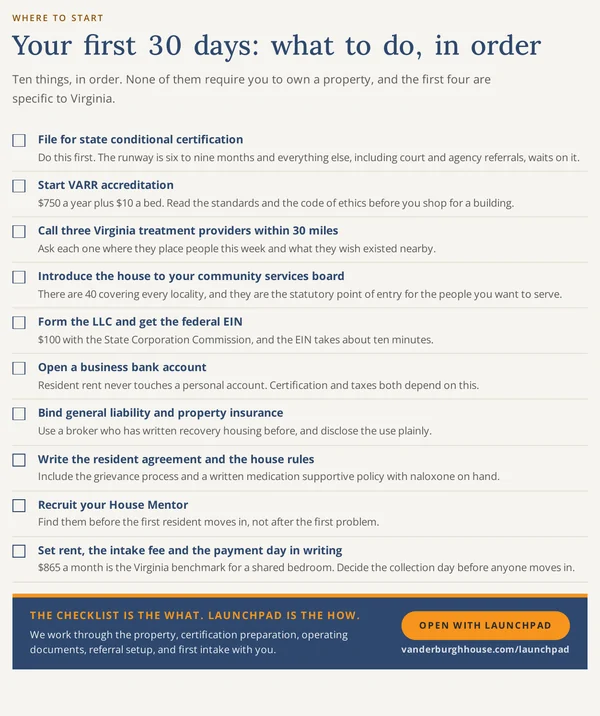
Your Virginia Beach Sober House Startup Checklist
Every item below is covered somewhere on this page, and none of them is optional in Virginia Beach. Work them in order, because several of them are cheap before you sign and expensive afterwards.
Four guides cover the operating questions that come after the doors open.
How VSL Helps You Open a Sober House in Virginia Beach
Vanderburgh Sober Living charters independently owned recovery homes into a cooperative network across more than a dozen states, and most Chartered Operators opened their first home with no prior experience in housing. The help is aimed at the points this page kept returning to: choosing a parcel that survives the Oceana overlay and the conditional use path, deciding whether to hold at four residents or apply, getting through VARR accreditation and DBHDS certification without a false start, and building the referral relationships that are the only thing filling beds in a city with no public payer.
There are two routes in. The Launchpad is self-paced and covers the startup sequence for people who want to work through it themselves. The Mastery Program is done with you, pairing the same material with direct support through zoning, certification and the first admissions. If you have a specific Virginia Beach address in hand, or you are weighing a lease against a purchase here, that is a conversation worth having before the offer rather than after, and you can start it through the contact form.
Start your sober house
Pick the path that fits where you are in the process.
Download the free guidePath to Purposeful Recovery Housing, by Dr. Hunter T. Foote.Explore the Mastery ProgramHands-on startup, certification, and operating support.See how starting with VSL worksThe opportunity, the community, and what a Charter includes.Prefer to talk now? Call (844) 762-3747, weekdays 8a to 5p.
Educational only; not legal, financial, or medical advice. Fees, rents, and rules change, and the Virginia Beach adjustments above are estimates built on the Virginia reference model. Confirm current requirements with the City of Virginia Beach, the Commonwealth of Virginia, and qualified professionals before you sign or spend.
Research & Sources
- Foote, H. T. (2026). Vanderburgh Sober Living Operating Climate Index, 2026 Edition. Vanderburgh Sober Living. https://www.vanderburghhouse.com/research/operating-climate-index-2026/
- Virginia General Assembly. (2026). Code of Virginia § 37.2-431.1: Recovery residences. Virginia Law Library. https://law.lis.virginia.gov/vacode/title37.2/chapter4/section37.2-431.1/
- Virginia General Assembly. (2026). Code of Virginia § 15.2-2291: Contracts for certain residential facilities. Virginia Law Library. https://law.lis.virginia.gov/vacode/title15.2/chapter22/section15.2-2291/
- Virginia General Assembly. (2026). Code of Virginia § 36-105.4: Minimum room sizes. Virginia Law Library. https://law.lis.virginia.gov/vacode/title36/chapter6/section36-105.4/
- Virginia General Assembly. (2026). Code of Virginia § 36-98: Uniform Statewide Building Code supersedes local codes. Virginia Law Library. https://law.lis.virginia.gov/vacode/title36/chapter6/section36-98/
- Virginia Board of Behavioral Health and Developmental Services. (2026). 12VAC35-260: Certified recovery residences. Virginia Administrative Code. https://law.lis.virginia.gov/admincodefull/title12/agency35/chapter260/
- Virginia Board of Housing and Community Development. (2024). 13VAC5-63-210: Use and occupancy classification. Virginia Administrative Code. https://law.lis.virginia.gov/admincode/title13/agency5/chapter63/section210/
- Virginia Board of Housing and Community Development. (2024). 13VAC5-63-200: Definitions. Virginia Administrative Code. https://law.lis.virginia.gov/admincode/title13/agency5/chapter63/section200/
- Virginia Board of Housing and Community Development. (2024). 13VAC5-63-240: Fire protection systems. Virginia Administrative Code. https://law.lis.virginia.gov/admincode/title13/agency5/chapter63/section240/
- Virginia Board of Housing and Community Development. (2024). 13VAC5-63-160: Certificates of occupancy. Virginia Administrative Code. https://law.lis.virginia.gov/admincode/title13/agency5/chapter63/section160/
- Virginia Department of Housing and Community Development. (2024). Statewide Fire Prevention Code (13VAC5-51). https://www.dhcd.virginia.gov/statewide-fire-prevention-code
- City of Virginia Beach. (2020). City Zoning Ordinance § 111: Definitions. Code of Ordinances. https://library.municode.com/va/virginia_beach/codes/code_of_ordinances?nodeId=CO_APXAZOOR_ART1GEPR
- City of Virginia Beach. (2019). City Zoning Ordinance § 501: Use regulations, residential districts. Code of Ordinances. https://library.municode.com/va/virginia_beach/codes/code_of_ordinances?nodeId=CO_APXAZOOR_ART5REDI_S501USRE
- City of Virginia Beach. (2026). City Zoning Ordinance Article 18: Special regulations in Air Installations Compatible Use Zones. Code of Ordinances. https://library.municode.com/va/virginia_beach/codes/code_of_ordinances?nodeId=CO_APXAZOOR_ART18SPREAIINCOUSZOAI
- Oxford House, Inc. v. City of Virginia Beach, 825 F. Supp. 1251 (E.D. Va. 1993). https://law.justia.com/cases/federal/district-courts/FSupp/825/1251/1412622/
- Bryant Woods Inn, Inc. v. Howard County, 124 F.3d 597 (4th Cir. 1997). https://law.justia.com/cases/federal/appellate-courts/F3/124/597/620814/
- U.S. Department of Housing and Urban Development & U.S. Department of Justice. Joint statement on state and local land use laws and practices and the application of the Fair Housing Act. https://www.justice.gov/crt/joint-statement-department-housing-and-urban-development-and-department-justice-state-and-local
- Virginia Department of Behavioral Health and Developmental Services. (2026). Information for providers about recovery residences. https://dbhds.virginia.gov/information-for-providers-about-recovery-residences/
- Virginia Association of Recovery Residences. (2026). Accredited residences. https://varronline.org/accredited-residences-2/
- Oxford House Virginia. (2026). Vacancies. https://oxfordvacancies.com/
- U.S. Census Bureau. (2026). QuickFacts: Virginia Beach city, Virginia. https://www.census.gov/quickfacts/fact/table/virginiabeachcityvirginia/PST045225
- U.S. Census Bureau. (2026). Metropolitan and micropolitan statistical area population totals, 2020-2025. https://www2.census.gov/programs-surveys/popest/datasets/2020-2025/metro/totals/cbsa-est2025-alldata.csv
- Virginia Department of Health, Office of the Chief Medical Examiner. (2026). Fatal drug overdose data by locality. https://www.vdh.virginia.gov/medical-examiner/forensic-epidemiology/
- City of Virginia Beach Department of Housing and Neighborhood Preservation. (2026). Point-in-time count. https://housing.virginiabeach.gov/ending-homelessness/point-in-time-count
- Virginia REALTORS. (2026). Median sales prices by county and city, monthly. Research and data. https://virginiarealtors.org/research/data/
- U.S. Department of Housing and Urban Development. (2025). Fair market rents, FY2026. Office of Policy Development and Research. https://www.huduser.gov/portal/datasets/fmr.html
- City of Virginia Beach Real Estate Assessor. (2026). Tax rates, FY2027. https://assessor.virginiabeach.gov/tax-rates
- City of Virginia Beach Commissioner of the Revenue. (2026). Business tax rates and important dates. https://cor.virginiabeach.gov/businesses/tax-rates-important-dates-deadlines
- City of Virginia Beach Commissioner of the Revenue. (2026). Application process for a City of Virginia Beach business license. https://s3.us-east-1.amazonaws.com/virginia-beach-departments-docs/cor/Businesses/License/How-to-Start-a-Business-English.pdf
- Virginia State Corporation Commission. (2026). Virginia limited liability companies: forms and fees. https://www.scc.virginia.gov/businesses/forms-and-fees/virginia-limited-liability-companies/
- Virginia State Corporation Commission. (2026). Annual registration fees. https://www.scc.virginia.gov/businesses/business-faqs/annual-registration-fees/
- City of Virginia Beach. (2026). VBMap parcel and property viewer. https://experience.arcgis.com/experience/27209ad3cbef405ab9317f49f47826b3
- City of Virginia Beach Planning and Community Development. (2026). Air Installation Compatible Use Zone (AICUZ). https://planning.virginiabeach.gov/zoning/air-installation-compatible-use-zone-aicuz
- City of Virginia Beach. (2026). Noise Zone Outline (AICUZ) geographic dataset. VBgov open data. https://gis.data.vbgov.com/datasets/d8cf882a417d45b5bc9b2a41bbc3a242_0/about
- City of Virginia Beach Planning and Community Development. (2026). Zoning Administration. https://planning.virginiabeach.gov/zoning
- City of Virginia Beach Planning and Community Development. (2026). Permits and Inspections. https://planning.virginiabeach.gov/divisions-offices/permits-inspections
- Virginia Beach Fire Department. (2026). Fire prevention inspections. https://fire.virginiabeach.gov/fire-prevention/inspections
- City of Virginia Beach Department of Human Services. (2026). Behavioral health. https://hs.virginiabeach.gov/behavioral-health
- City of Virginia Beach Department of Human Services. (2026). Outpatient recovery and treatment services: The Pathways Center. https://hs.virginiabeach.gov/behavioral-health/outpatient-recovery-treatment-services
- City of Virginia Beach Department of Human Services. (2026). Adult correctional services. https://hs.virginiabeach.gov/behavioral-health/adult-correctional-services
- Supreme Court of Virginia, Office of the Executive Secretary. (2026). Virginia recovery court directory. https://www.vacourts.gov/static/courtadmin/aoc/djs/programs/sds/programs/rc/general_info/rc_directory.pdf
- Virginia Beach Sheriff’s Office. (2026). Road to Hope. https://vbso.net/road-to-hope
- City of Virginia Beach Department of Housing and Neighborhood Preservation. (2026). Continuum of care. https://housing.virginiabeach.gov/ending-homelessness/continuum-of-care
- Virginia Opioid Abatement Authority. (2026). List of awards by city and county. https://www.oaa.virginia.gov/media/governorvirginiagov/oaa/pdf/List-of-OAA-awards-by-city-and-county.pdf
- Hampton Roads Transit. (2026). Modes of service. https://gohrt.com/modes/