Starting a sober living home in Virginia in 2026 means working inside a rule the Commonwealth wrote down and then put teeth behind. A recovery residence here has to be certified by the Department of Behavioral Health and Developmental Services (DBHDS) to operate, a prohibition on the books since July 1, 2022, and since July 1, 2025 operating without that certification has been a Class 1 misdemeanor. Certification runs through accreditation with the Virginia Association of Recovery Residences (VARR) or Oxford House, which makes the credential the entry ticket rather than a competitive advantage. Each step below applies the national roadmap for how to start a sober living home to the rules in Virginia.
That does not make Virginia a hard state to operate in. The Operating Climate Index ranks Virginia 20th of 50 with a composite score of 7, classifies the state as moderately regulated, and records no mandatory operating license for recovery housing (Foote, 2026). Virginia scores 9 for certification value, the strongest sub-index in its profile, which is the same point in numbers: the credential here is cheap, clear, and worth holding.
The rest of the work is familiar to anyone who has opened a recovery home elsewhere: form the entity, clear local zoning, buy or lease the right property, write the policies, place the insurance, staff the house, build referral relationships, and fund the first several months of operation. What follows covers each of those steps with the Virginia specifics attached, including the certification mandate, how zoning and fair housing actually work here, opioid settlement money, and what an eight to 14 bed home actually costs to open here.
Quick Answers
Do you need a license to open a sober living home in Virginia?
No. Virginia does not license non-clinical recovery housing, but it does require state certification to operate one.
A sober living home that provides alcohol-free and drug-free housing without clinical treatment is not a licensed behavioral health provider under Virginia law. The moment a home delivers clinical services on site, it crosses into DBHDS provider licensing under 12VAC35-105 and becomes a different kind of business entirely.
Is VARR certification required in Virginia?
Yes. Va. Code § 37.2-431.1 has barred operating an uncertified recovery residence since July 1, 2022, and since July 1, 2025 a violation has been a Class 1 misdemeanor.
The “no person shall operate” prohibition entered the statute through 2022 Acts cc. 732 and 755, and 2025 Acts c. 608 added the criminal penalty along with the conditional certification bridge. Certification is granted on the strength of accreditation from a recognized credentialing entity, which in practice means VARR or Oxford House.
What are the biggest early risks?
Losing the conditional certification runway, and assuming a state zoning shield that does not exist.
DBHDS issues a conditional certification for six months, extendable once by 90 days, for a maximum of nine months while a home completes accreditation. Separately, Virginia’s group-home zoning statute reaches only licensed facilities and excludes addiction, so local land use is handled through federal and state fair housing accommodation rather than a state parity rule.
How long does it take to open a sober living home in Virginia?
Plan on four to nine months from entity formation to a fully certified, filled house.
Entity filing takes days, property acquisition or a signed lease takes 30 to 90 days, policy drafting and the VARR on-site inspection take another 60 to 120 days, and beds fill over the following two to three months. Operators who file for conditional certification early run those tracks in parallel instead of in sequence.
Is a sober living home profitable in Virginia?
A 14-bed home in Virginia can generate roughly $8,800 in monthly revenue at an assumed 18% vacancy rate, against operating expenses in the $4,200 range including a mortgage.
Those are estimated figures from VSL’s own pro forma for a purchased property at the state median. Rent per bed models to about $865 a month, which sits sensibly against Virginia’s median gross rent of $1,579 for a whole housing unit. A leased property changes both the expense line and the capital requirement.
Watch: How to Open a Sober House in Virginia
Before working through the steps below, it helps to see the whole sequence laid out at once. Dr. Hunter T. Foote walks through the Virginia path from the operator’s side, in the order the work actually happens.
The recap is short. Virginia does not license non-clinical recovery housing, but it does require certification to operate one, and that certification runs through accreditation. Zoning is handled through fair housing accommodation rather than a state parity rule. Costs are moderate by national standards, and the state’s public money is deep but intermediated. Everything after this section is the detail behind those four points.
- ✓Policies and house agreements to have signed
- ✓Inspections, insurance, and intake paperwork
- ✓What the first week actually requires
Do You Need a License to Open a Sober House in Virginia?
Virginia draws its line between housing and treatment cleanly, and the whole regulatory picture follows from where a home sits on that line. Va. Code § 37.2-431.1 defines a recovery residence as a housing facility providing alcohol-free and illicit-drug-free housing to people with substance use disorders and co-occurring mental illness, one “that does not include clinical treatment services.” A home that stays on the housing side of that definition is not a licensed provider. A home that adds counseling, clinical assessment, or medication administration on site becomes a licensed behavioral health provider and is regulated accordingly.
What replaced licensure here is certification, and it carries real weight. The Department of Behavioral Health and Developmental Services states plainly that the 2025 General Assembly changes now require recovery residences to be certified in order to remain active and legally operate. Certification is not something an operator earns directly from the state on their own paperwork. DBHDS certifies homes that hold accreditation from a recognized credentialing entity, and Virginia recognizes two: VARR, the state’s NARR affiliate, and Oxford House for self-governed peer homes.
Two features of the statute matter more than operators expect. First, § 37.2-431.1(F) bars DBHDS and every agency of the Commonwealth from referring anyone to a home that is not certified, and bars courts from referring or releasing a person to one. In a state with 59 recovery courts and 40 community services boards acting as the statutory point of entry, that provision alone decides whether a home fills. Second, the statute prohibits requiring a resident to use clinical services in which the home or its owner holds a financial interest, which forecloses the referral arrangements that have caused trouble in other states.
Compliance points worth setting up before you take the first resident:
- Stay non-clinical: No on-site counseling, assessment, or medication administration. Residents self-manage their own prescriptions, including medication for opioid use disorder, as adults.
- File for conditional certification on day one: Six months, plus a single 90-day extension, is the entire runway.
- Disclose the credentialing entity: Homes must tell prospective residents who accredits them and, for a NARR-accredited home, the level of support provided.
- Keep the advertising accurate: Representing a home as certified before DBHDS certifies it is a criminal violation, not a marketing dispute.
Step-by-Step: Starting a Sober Living Home in Virginia
Nine steps take an operator from an idea to a certified home with residents in it. Each one has a Virginia-specific wrinkle.
Step 1. Form the Right Business Entity
Virginia entities are filed with the State Corporation Commission rather than a secretary of state. An LLC is formed by filing Articles of Organization for $100, and the ongoing obligation is a $50 annual registration fee with no annual report requirement.
A stock corporation files Articles of Incorporation at $25 plus a share-based fee, and a nonstock nonprofit corporation files for $75. Most single-home operators use an LLC and add a nonprofit only when they intend to raise charitable dollars, which also triggers charitable solicitation registration with the Virginia Department of Agriculture and Consumer Services. Choose the entity around how you intend to fund the home, not around tax preference alone. Settlement and grant money in Virginia flows through localities and accredited operators rather than to individuals, and some of it favors nonprofit applicants.
| Structure | Formation cost | Annual cost | Best for |
|---|---|---|---|
| Limited liability company | $100 Articles of Organization | $50 annual registration fee, no annual report | Most single-home operators |
| Stock corporation | $25 Articles of Incorporation plus a share-based fee | Annual registration fee | Operators who need a stock corporate structure |
| Nonstock nonprofit corporation | $75 Articles of Incorporation | Annual registration fee | Operators who intend to raise charitable dollars |
Step 2. Review Zoning and Fair Housing Rules
Operators arrive expecting a state zoning shield tied to certification, and Virginia does not have one. Va. Code § 15.2-2291 does give a residential facility housing eight or fewer people with disabilities the same treatment as a single-family dwelling, but it reaches only facilities licensed by DBHDS and expressly excludes addiction to a controlled substance. A certified recovery residence is neither licensed nor within that definition. As of September 2, 2026, a review of § 15.2-2291, the surrounding zoning article in Title 15.2 Chapter 22, § 37.2-431.1, and 2026 Acts cc. 1000 and 1079 found no enacted zoning parity provision for certified recovery residences.
Protection comes instead from fair housing law, and it is stronger than operators assume. People in recovery from substance use disorder are protected under the Fair Housing Act, and the Fourth Circuit’s decision in United States v. Southern Management Corp. governs how that protection applies across Virginia. State law runs parallel: Va. Code § 36-96.3 carries the accommodation duty, and § 36-96.3:2 codifies the interactive process a locality has to engage in when a request is made.
Virginia’s own history reinforces the point that process matters. Oxford House, Inc. v. City of Virginia Beach, 825 F. Supp. 1251 (E.D. Va. 1993), turned partly on whether the operator had used available local procedures. Requesting reasonable accommodation in writing, early, and with counsel is what protects the home.
Step 3. Choose a Property for a Sober House
Virginia’s median home sale price is $415,000, and the average housing unit here runs about 1,986 square feet. A purchase budget should be built on what houses actually close at, which is what that median reports. Most operators are looking for a four to six bedroom single-family house with generous common space, two or more full bathrooms, and parking that will not become the neighbors’ argument at a zoning hearing.
Occupancy classification follows use, not the sign on the door. A home whose residents are self-preserving and receive no custodial care sits in the ordinary dwelling lane under the Virginia Uniform Statewide Building Code, which means interconnected smoke and carbon monoxide alarms rather than a sprinkler system.
Applying IRC vs. IBC correctly is the single most valuable code conversation an operator can have with a local official, and holding the house at eight or fewer residents keeps it comfortably inside the ordinary dwelling classification. Determining maximum occupancy before you make an offer keeps the pro forma honest.
Step 4. Create House Rules, Intake Forms, and Resident Policies
VARR accreditation is documentary before it is physical, and the policy binder is where most first-time applicants lose weeks. Write the intake and screening policy, the sober house rules and behavioral expectations, the grievance procedure, the medication and MAT policy, the drug testing protocol, the fee and refund schedule, and the discharge policy before you schedule an inspection.
Virginia adds one structural advantage here. Under Va. Code § 55.1-1201, occupancy in a recovery residence is not a residential tenancy under the Virginia Residential Landlord and Tenant Act. Residents are not tenants and operators are not landlords, which makes a clear written discharge policy both possible and necessary. Write the process you will actually follow, apply it uniformly, and document every step.
Step 5. Secure Insurance for a Sober Living Home
VARR verifies appropriate insurance coverage during accreditation and provides a certificate template, so this cannot wait until after the inspection. A typical Virginia recovery home carries general liability, property coverage on the building and contents, professional or abuse and molestation liability, auto coverage if the house transports residents, and workers’ compensation once anyone is on payroll. A sober living property prices above an ordinary homeowners policy because of occupancy and use, so a standard homeowners quote is not a usable planning number.
Getting sober house insurance placed correctly is one of the two budget lines that consistently surprises new operators. Start the conversation with a carrier that has written recovery housing before, and get quotes before you close on a property.
Step 6. Hire and Train Staff or House Leadership
Virginia does not set a staffing quota for recovery residences by statute. What it does instead is certify homes that hold accreditation, and the accreditation standards carry the operational expectations. 12VAC35-260 conditions certification on holding a credential from a recognized entity and on meeting minimum square footage per bed and sleeping room, and the VARR accreditation process requires written policies and procedures covering intake, resident rights, grievances, and peer leadership roles before an on-site inspection is scheduled. Staffing follows from those documents, not from a headcount rule. In VSL homes the person who carries that responsibility is the house mentor, someone in established recovery who lives in the home, holds the culture, and handles daily operations.
That is not the same as clinical staffing, and it should not be described that way. A Level 2 monitored home does not require around-the-clock clinical presence. Recruit from the recovery community, use Virginia’s peer workforce pipeline through the certified peer recovery specialist credential, and pay attention to how house mentors are selected and supported.
Step 7. Build Resident Referral Networks
Virginia has an unusually reachable referral spine, and certification is the key to all of it. Virginia’s 40 community services boards are the primary point of entry into the public behavioral health system, and the Virginia recovery courts run 59 specialized dockets that § 37.2-431.1(F) limits to certified homes.
Add the Department of Corrections reentry offices, hospital emergency departments and behavioral health units at the large systems, and a dense layer of recovery community organizations including the McShin Foundation in Richmond and SAARA of Virginia. Each of those relationships is built one conversation at a time, and none of them open to an uncertified home.
Competition is real and measurable. Of the 408 residences on the DBHDS list of certified recovery residences as of August 7, 2026, 187 are Oxford Houses, which are self-governed, unstaffed, and priced low by design. Differentiate on structure, staffing, and outcomes rather than on price.
Cultivating referral sources deliberately is what separates a home that fills from one that does not, and keeping beds full is the discipline that protects the margin.
Step 8. Get Certified Through Virginia Association of Recovery Residences
VARR accredits to NARR Standard 3.0 and the social model, and its accreditation is the step that unlocks DBHDS certification. The VARR accreditation process runs eight steps: submit the online application, review the NARR standards and the VARR code of ethics and compliance agreement, verify legal entity status and insurance and property owner permission, submit policies and procedures, pass an on-site inspection, and sign the compliance agreement and assurances.
The fee structure is one of the cheapest state credentials in the country: $750 a year per organization regardless of how many homes you run, plus $10 per accredited bed. A 14-bed home pays $890 in the first year. Re-accreditation is annual and must be started within 60 days before the certificate expires, with a 90-day lapse period after that before accreditation is revoked.
If you are still deciding between the two recognized pathways, understanding the Virginia Association of Recovery Residences (VARR) as an organization is the place to start. The broader logic of NARR certification explains why states build their rules on it.
Level of support matters for pricing, staffing, and referrals, and the NARR levels of care explain what each one commits a home to. Most VSL homes in Virginia operate at Level 2.
Three dated developments define the Virginia operating environment right now, and each one changes an operator’s calendar.
- July 1, 2022: the operate prohibition took effect. 2022 Acts cc. 732 and 755 added the “no person shall operate” language to § 37.2-431.1, alongside the credentialing entity disclosure requirement and the landlord-tenant carve-out.
- July 1, 2025: the criminal penalty and the conditional bridge took effect. 2025 Acts c. 608 made a violation a Class 1 misdemeanor and created the six-month conditional certification with a single three-month extension.
- July 1, 2026: anti-brokering and renewal rules took effect. 2026 Acts cc. 1000 and 1079 barred conditioning residence on using clinical services in which the home holds a financial interest, and tightened renewal requirements. The implementing regulation, 12VAC35-260, carries the standards, the conditional structure, and the enumerated sanctions, including suspension of indigent bed funding.
One more trend is worth watching rather than acting on. Virginia’s fatal drug overdoses fell 37% in 2024 compared with 2023, and preliminary 2025 data suggests the decline continued. That is good news for Virginia and a signal for operators to underwrite occupancy conservatively rather than assuming demand grows on its own.
Step 9. Budget Startup Costs and Explore Virginia Funding
Virginia’s public money is deep and intermediated. The Commonwealth expects more than $1.1 billion in opioid settlement payments through 2041, and the Virginia Opioid Abatement Authority directs 55% of it, with 30% going directly to cities and counties and 15% to the state. That money is won through a partnership with a locality rather than an open operator grant program. Alongside it, the Appropriation Act provides $1,950,000 each year in grants to VARR-member recovery residences certified by DBHDS for recovery support services. That is the closest thing Virginia has to an indigent bed subsidy, and it reaches accredited, certified homes only.
Two traps are worth naming. Federal State Opioid Response dollars, administered by DBHDS through the community services boards, build recovery housing capacity but cannot pay a resident’s rent. And settlement money is anti-supplantation gated, so it cannot replace funding a locality already provides. How recovery housing funding works in Virginia rarely matches what operators assume when they first read the headline numbers.
What Does It Cost to Start a Sober Living Home?
The first real decision is lease or buy, and it changes the capital requirement by more than a factor of three. Leasing a home in Virginia at a recovery-housing lease rate takes roughly $10,838 upfront for first month, last month, and security, and all-in lease-path startup runs about $45,428 once furniture, certification, deposits, supplies, launch marketing, and an operating reserve are funded. Buying at the state median with a 20% down payment brings the all-in figure to about $131,478, most of the difference being the down payment itself.
Whichever route you take, the property side of the deal is covered in our recovery housing real estate section: what to look for when buying a sober house, how sober house loans are underwritten, and what a landlord expects on a long term lease.
Neither path is unusually expensive by national standards. The Operating Climate Index scores Virginia 7 for startup burden and 6 for return on capital, and rates fire and building feasibility at 8, which reflects how rarely a Virginia recovery home is pushed out of the ordinary dwelling code lane (Foote, 2026).
The second decision is the size of the reserve. Beds do not fill on day one, and a home that opens with no operating cushion makes bad decisions about who to admit. Three to six months of operating expenses is the standard, and in Virginia that means budgeting for a mortgage or lease payment, utilities at a higher usage level than a single-family household, insurance, drug screens, and supplies while occupancy ramps. The lease side of the model is anchored to HUD’s fair market rents, which average $2,258 for a three-bedroom unit statewide (FY2025, population-weighted), marked up 60% for recovery housing.
Virginia Cost Anchors for a 14-Bed Model
| Cost category | Estimated range |
|---|---|
| Property, purchase at the state median sale price | $415,000 |
| Lease deposits, first month, last month, and security | $10,838 |
| HUD three-bedroom fair market rent, monthly | $2,258 |
| VARR year-one certification, $750 plus $10 per bed at 14 beds | $890 |
| LLC formation, SCC filing fee | $100 |
| Estimated total | $45,428 lease path; $131,478 purchase path |
Metro competition varies more than price does. Northern Virginia carries the highest acquisition cost and the most organized neighborhood opposition. Richmond has the deepest recovery community organization layer and strong referral density. Hampton Roads, including Virginia Beach and Norfolk, has established recovery housing supply and a large veteran population. Roanoke and the Shenandoah Valley are mid-cost with documented zoning fights. Far southwest Virginia is the clearest underserved market in the Commonwealth.
Virginia City Guides
Local rules, referral relationships, and property costs differ enough by market that the city guides carry the detail this page cannot.
Sober Living Guides Every Operator Needs
These evergreen guides apply in every state and cover the fundamentals every recovery housing operator should know.
About the Book: How to Open in Virginia
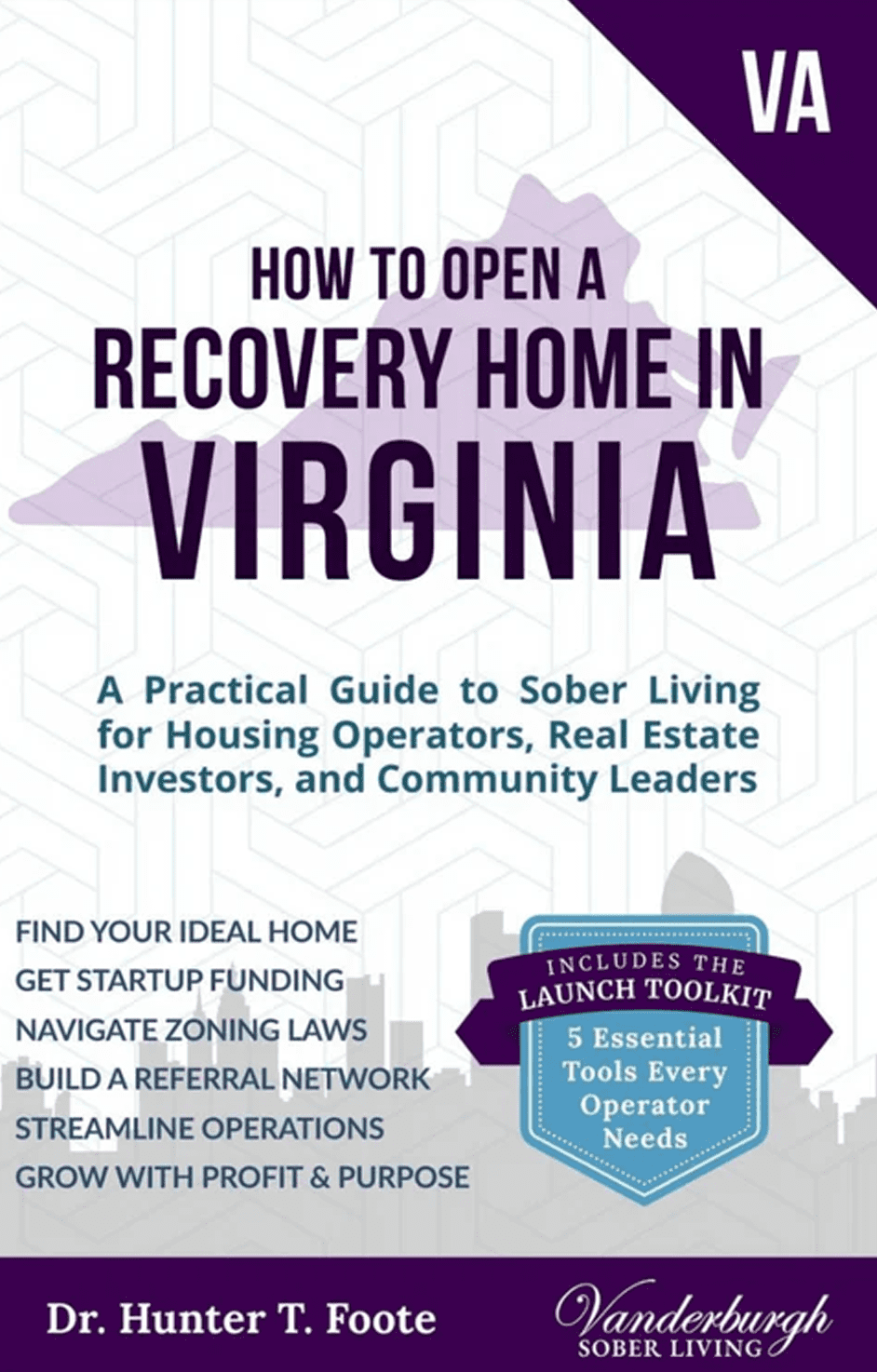
How to Open a Recovery Home in Virginia collects the certification workflow, the policy templates, the pro forma, and the local zoning research into a single volume written for this state.
Operators who want structured support alongside it work through the Mastery Program with a Chartered Operator cohort. The book is written by Dr. Hunter T. Foote, whose Operating Climate Index ranks Virginia 20th of 50 with a composite score of 7.
Everything we’ve learned about opening a certified home, written for Virginia.
Start a Sober Living Home With VSL
Virginia rewards operators who treat certification as the first step rather than the last one. A home that files for conditional certification early, holds at eight or fewer residents, earns VARR accreditation inside the runway, and builds relationships with its community services board and recovery court will be referrable, fundable, and full. The regulatory picture is clear enough to plan around, and the settlement funding behind it runs for another 15 years.
If you are ready to open a sober living home in Virginia and want people who have done it before working alongside you, tell us about your plans and we will help you map the first 90 days.
Learn How Sober Living Works
Understand how sober living works and whether operating is right for you before you commit.
Evaluate Your Property
See whether your property will pencil out with a custom Virginia financial projection.
Build a Virginia Home With VSL
Get hands-on startup, certification, and operating support and join the VSL Chartered Operator community.
Research & Sources
Research material and primary sources referenced in this guide:
- Foote, H. T. (2026). Vanderburgh Sober Living Operating Climate Index, 2026 Edition. Vanderburgh Sober Living.
- Code of Virginia. (2026). § 37.2-431.1. Recovery residences; penalty. Virginia Legislative Information System.
- Virginia Administrative Code. (2026). 12VAC35-260. Regulations for Certified Recovery Residences.
- Virginia Department of Behavioral Health and Developmental Services. (2026). Information for providers about recovery residences.
- Virginia Department of Behavioral Health and Developmental Services. (2026, August 7). Recovery residences: certified recovery residences list.
- Virginia Department of Behavioral Health and Developmental Services. (2026). STEP-VA: system transformation excellence and performance.
- Virginia Association of Recovery Residences. (2026). Accreditation overview.
- Code of Virginia. (2026). § 15.2-2291. Zoning provisions for certain residential facilities.
- Code of Virginia. (2026). § 36-96.3. Unlawful discriminatory housing practices (Virginia Fair Housing Law, Title 36 Ch. 5.1).
- Code of Virginia. (2022). § 55.1-1201. Applicability of the Virginia Residential Landlord and Tenant Act.
- Virginia Administrative Code. (2026). 13VAC5-63. Virginia Uniform Statewide Building Code.
- Oxford House, Inc. v. City of Virginia Beach, 825 F. Supp. 1251 (E.D. Va. 1993).
- Supreme Court of Virginia, Office of the Executive Secretary. (2026). Virginia recovery courts.
- Virginia General Assembly. (2025). Appropriation Act, Item 296 (Department of Behavioral Health and Developmental Services).
- Virginia State Corporation Commission. (2026). Virginia limited liability companies: forms and fees.
- Virginia State Corporation Commission. (2026). Annual registration fees.
- Virginia Opioid Abatement Authority. (2025). About the Authority.
- Virginia Opioid Abatement Authority. (2025, August 4). Opioid Abatement Authority announces grant awards to state agencies [Press release].
- Virginia Department of Health. (2026, August 31). Virginia Department of Health highlights overdose prevention and treatment efforts.
- U.S. Census Bureau. (2024). American Community Survey 5-year estimates, Table DP05: demographic and housing estimates, Virginia.
- U.S. Census Bureau. (2024). American Community Survey 5-year estimates, Table DP04: selected housing characteristics, Virginia.
- Zillow. (2026). Virginia home values: median sale price.
- U.S. Department of Housing and Urban Development, Office of Policy Development and Research. (2026). Fair market rents.
- U.S. Energy Information Administration. (2020). Residential Energy Consumption Survey: square footage of U.S. homes by state.
- U.S. Census Bureau. (2026). State population totals and components of change: 2020–2025, Vintage 2025 (July 1, 2025 estimates).
Pick Your Path
Find the next step that fits where you are right now.
Just getting startedLearn how sober living works and browse Virginia resources.Already have a propertyEvaluate readiness and run a custom projection.Ready to go deeperGet hands-on startup, certification, and operating support.
Will Your Property Pencil Out?
Get a custom financial projection for your Virginia sober living property, then compare it with single-family and multifamily returns.