

Whether you need a license to open a sober living home in Ohio has a two-part answer, and most of the pages you will find online give you only the first half. Ohio does not license peer-run recovery housing. It does, since January 1, 2025, make certification a legal condition of operating one, with criminal and injunctive enforcement behind it. Those two facts sit together in the Ohio Revised Code, and an operator who reads one without the other will either overbuild for a license that does not exist or open a home that cannot lawfully take a single referral. That gap is why the conflicting advice persists. State-by-state roundups read the licensure column, see “no license required,” and stop. Ohio moved the requirement out of the licensure chapter and into a certification-and-registry scheme instead. The obligation is real, the penalty is a criminal one, and the credential that satisfies it costs about a thousand dollars over two years.
The Ohio answer sits within the national picture of whether you need a license to open a sober living home, which differs widely from state to state.
Before you read onHow to Open a Sober Living Home in OhioThis post covers one piece of the process. The complete Ohio guide walks through every step, from planning to your first resident.→Do You Need a License to Open a Sober Living Home in Ohio?
No. Ohio does not require a state license for a peer-run sober living home. Under R.C. 340.034(A), a recovery housing residence is monitored by the Ohio Department of Behavioral Health but is not subject to residential facility licensure. Since January 1, 2025, though, certification and registry listing are legally required to operate.
The exemption is written into the statute in plain terms. R.C. 340.034(A) provides that a recovery housing residence complies with the department’s monitoring requirements under sections 5119.39 to 5119.396 “but the residence is not subject to residential facility licensure by the department under section 5119.34 of the Revised Code.” Section 5119.34 is the license that covers residential facilities providing accommodation, supervision, personal care, and mental health services. A home offering housing and peer support does not fall inside it.
What replaced licensure is a certification mandate. R.C. 5119.392(A) states that beginning January 1, 2025, no person or government entity shall operate a recovery housing residence unless it is certified by the department or accredited by an approved organization, or is in operation not more than eighteen months and actively engaged in efforts to obtain that certification or accreditation. Violating that division is a misdemeanor of the first degree under R.C. 5119.99, and R.C. 5119.392(B) lets the director of behavioral health ask the attorney general to petition the court of common pleas for an order enjoining the operation.
So the honest answer for an Ohio operator is: no license, but no lawful uncertified home either.
How your home gets classified, where Fair Housing applies, and what to do if the city says no.
Ohio Sober Living Licensing at a Glance
The table below summarizes what Ohio actually requires, what administers it, and what each item means for a home opening this year.
| Item | Detail | What it means |
|---|---|---|
| State operating license required | No | A peer-run home is exempt from residential facility licensure under R.C. 340.034(A) |
| Certification or accreditation required | Yes, since January 1, 2025 | Operating without it violates R.C. 5119.392(A) |
| Penalty for operating uncertified | Misdemeanor of the first degree, plus injunction | Set by R.C. 5119.99; injunction authority in R.C. 5119.392(B) |
| Statewide registry | Required listing | R.C. 5119.394 directs the department to establish and maintain it |
| Registration filing | Within 30 days of first occupancy | R.C. 5119.391 prescribes the operator’s registration form |
| Advertising restriction | Cannot market as recovery housing or a sober living home unless registered | R.C. 5119.395(A), also an M1 under R.C. 5119.99 |
| Referral restriction | Clinical providers may not refer to unlisted homes | R.C. 5119.396, effective January 1, 2025 |
| Administering agency | Ohio Department of Behavioral Health (DBH), formerly OhioMHAS | Maintains the statewide registry |
| Certifying body | Ohio Recovery Housing (ORH) | Certifies NARR Levels I through III; Oxford House charters are also accepted. DBH is building a state program under Executive Order 2026-03D, not yet in place |
| Certification cost | $800 application plus $250 per house for two years | ORH fee schedule: $1,050 for one home, payable as two annual $525 installments |
| Express statutory mention | Yes, extensively | “Recovery housing” is defined at R.C. 340.01 and “sober living home” appears verbatim in R.C. 5119.395 |
| Clinical treatment threshold | Separate track | On-site clinical services move a home into licensure under R.C. 5119.34 or provider certification under R.C. 5119.36 |
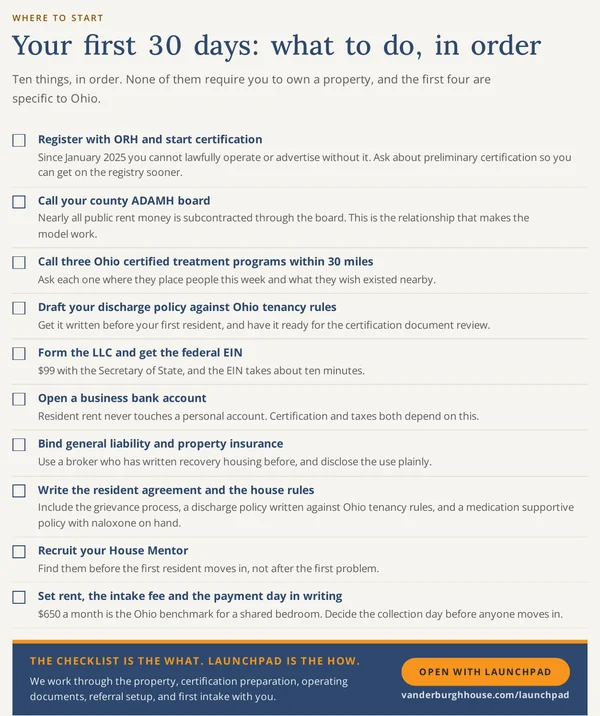
Most people ask whether they are allowed to open a recovery home. The better first question is whether the need and the money are there. This answers both, for your state.
- How many people need a bed, and how few beds exist
- Who actually pays the rent, and which programs are real
- What it costs to open on the purchase path and the lease path
How Ohio Regulates Sober Living Homes
Ohio is unusual in giving recovery housing an explicit statutory identity rather than leaving it to be inferred from landlord-tenant law. R.C. 340.01 defines recovery housing as housing for individuals recovering from drug or alcohol addiction that provides an alcohol-free and drug-free living environment, peer support, assistance with obtaining addiction services, and other recovery assistance. That definition sits inside Chapter 340, the chapter that governs the county alcohol, drug addiction, and mental health services boards, which is also where the state’s public rent money originates.
The agency is the Ohio Department of Behavioral Health (DBH), the successor name for what operators still call the Ohio Department of Mental Health and Addiction Services (OhioMHAS). DBH does not today inspect or certify recovery homes directly, though an August 2026 executive order set that change in motion. It recognizes accrediting organizations, maintains the statutory registry, and enforces the operating, advertising, and referral prohibitions. The substantive standards a home is measured against are the National Alliance for Recovery Residences (NARR) standards applied by Ohio Recovery Housing, not a promulgated administrative rule. R.C. 5119.397 gives the director discretionary authority to adopt implementing rules, phrased as “may adopt,” and we found no adopted recovery housing chapter of the Ohio Administrative Code under it as of September 2026.
The current scheme was enacted by House Bill 33, the fiscal year 2024 to 2025 budget bill, effective October 3, 2023, and amended by House Bill 96, effective September 30, 2025. The operating, advertising, and referral prohibitions were written with a delayed trigger date of January 1, 2025, which is why an Ohio home that opened in 2023 and one opening now face different histories but identical obligations. Two things make this regime workable rather than punishing. The certification that satisfies it is among the least expensive in the country because DBH subsidizes a large share of the review cost. And the same credential that keeps a home lawful is what puts it in front of the referral and funding channels, so the compliance spend and the census spend are the same spend. VSL’s Operating Climate Index scores Ohio 7 for legal climate and classifies the state as moderately regulated, with an overall Operating Climate Score of 9 (Foote, 2026).
License vs. Certification vs. Registration: What Each Term Means
These three words are used interchangeably in conversation and mean three different things in Ohio law. Each has its own issuer, its own trigger, and its own consequence for getting it wrong.
License
A license is state permission to operate a regulated facility, issued by a government agency after review against binding rules. Ohio does not require one for a peer-run sober living home: R.C. 340.034(A) exempts recovery housing residences from residential facility licensure. The track DBH does administer sits at R.C. 5119.34 and covers residential facilities that provide accommodation with supervision, personal care, or mental health services.
What a license unlocks is the lawful provision of the licensed service itself. A home that adds clinical treatment needs this track and cannot substitute certification for it.
Certification
Certification is a quality review against published standards, conducted by a non-governmental accrediting body. Ohio requires it, functionally and legally: R.C. 5119.392(A) makes operating without certification or accreditation an offense. Ohio Recovery Housing, the state’s NARR affiliate, administers it for Levels I through III, and DBH also accepts an Oxford House charter as equivalent accreditation. DBH has announced a state-run certification program of its own, which is not yet operating.
What certification unlocks is lawful operation, registry listing, the right to advertise, referral eligibility, and access to recovery housing funding. A charter belongs in this row rather than a row of its own. A charter is a membership agreement between a home and a private network whose standards the home agrees to run by. It is not government permission and it is not a third-party audit; it comes from the network rather than the state, no agency issues or revokes it, and it is entirely voluntary. Oxford House charters homes that are democratically self-run and financially self-supporting, require a resident to leave immediately on a return to use, and operate with no paid staff in the house. Vanderburgh Sober Living offers charter membership to independently operated homes joining a cooperative network, where the operator keeps ownership of the business and gains the brand, the operating standards, and the startup and certification support of the Chartered Operator community. Ohio is one of the few states where a charter does regulatory work: DBH treats an Oxford House charter as accreditation for registry purposes.
Registration
Registration is an informational filing with the state, followed by inclusion on a public list. Ohio requires it. R.C. 5119.391 requires the operator to file a prescribed registration form with DBH within thirty days after the first resident occupies the residence. DBH administers the filing, maintains the registry under R.C. 5119.394, and publishes it at rhsearch.mha.ohio.gov.
What registration unlocks is visibility to referral sources and eligibility to receive referrals at all. A home is listed only if it is accredited, or if it has been operating eighteen months or less and is actively pursuing accreditation.
The full application sequence, the document review clocks, and the on-site visit are covered separately in the Ohio certification process, and the certifying body itself is profiled in Ohio Recovery Housing.
| Credential | Required in Ohio | Administering body |
|---|---|---|
| License | No, for peer-run housing; yes for on-site clinical treatment | Ohio Department of Behavioral Health |
| Certification or accreditation | Yes, to operate | Ohio Recovery Housing; Oxford House, Inc. for chartered homes |
| Charter | No | Oxford House and Vanderburgh Sober Living, as private networks |
| Registration and registry listing | Yes | Ohio Department of Behavioral Health |
When a Sober Living Home Crosses Into Licensed Treatment
The exemption in R.C. 340.034 is an exemption for housing, not for services. A home crosses out of it and into the treatment track when it starts doing any of the following:
- Delivers clinical addiction or mental health services on site. Those services require certification of the provider under R.C. 5119.36, which now also requires national accreditation for the certifiable services and supports where such accreditation exists.
- Provides accommodation together with supervision, personal care services, and mental health services. That combination is the Class One definition of a residential facility under R.C. 5119.34, and operating one without a valid license carries a $500 fine for a first offense and $1,000 for each subsequent offense.
- Operates at NARR Level IV. Ohio Recovery Housing certifies Levels I through III only. A Level IV home with clinical services on site is regulated as a treatment setting, not as recovery housing, and no certification substitutes for that. Where a home sits on the NARR levels of care scale decides its entire regulatory track.
- Represents itself as certified when it is not. R.C. 5119.36(O) separately prohibits representing that a provider’s certifiable services and supports are certified when they are not.
The practical line for a new operator is clean: house people, support people, connect people to treatment elsewhere, and stay in the housing lane. Bring a counselor onto the payroll to deliver sessions inside the house and the regulatory posture changes entirely.
What’s Changed in Ohio Sober Living Law
Ohio’s scheme is three years old and still moving. These are the dated milestones an operator should know.
House Bill 33 takes effect. The budget bill enacts R.C. 5119.391 through 5119.397, creating the registration form, the statewide registry, the operating prohibition, the advertising prohibition, and the referral prohibition.
The prohibitions bite. R.C. 5119.392, R.C. 5119.395, and R.C. 5119.396 all carry this trigger date. From this day forward, operating, advertising, and receiving clinical referrals all depend on certification and registry status.
ORH’s current fee schedule takes effect. The $800 application fee plus $250 per house replaces the prior structure, covering a two-year certification period.
House Bill 96 amendments take effect. The current versions of R.C. 340.034, 5119.391, 5119.392, 5119.394, 5119.395, 5119.397, and 5119.99 all date from this amendment.
House Bill 58 passes the Ohio House, 92 to 0. Introduced February 4, 2025 by Representatives Justin Pizzulli and Dontavius Jarrells, HB 58 would create a certificate-of-need process for recovery housing, require state certification of residences, give county boards inspection and complaint authority, and create an Ohio Recovery Housing Task Force. Its long title would repeal R.C. 5119.391, 5119.395, and 5119.397.
HB 58 is referred to the Senate Addiction and Community Revitalization Committee. As of September 2026 it has not been reported by that committee, has not passed the Senate, and is not law. There is no published schedule for when the committee will act, and the outcome remains open.
Executive Order 2026-03D moves certification toward the state. Governor DeWine signed an executive order giving DBH authority to create a statewide certification program for recovery housing operators, backed by emergency rules. The paragraphs below cover what this does and does not change.
Governor DeWine signed Executive Order 2026-03D on August 10, 2026, announcing that DBH would assume recovery housing certification and oversight and stand up a statewide certification program. The stated reason is scale and quality: DBH reports that 356 recovery houses were operating in 2022 and more than 1,700 operate today, with the order aimed at unsafe conditions and at bad actors, particularly in southern Ohio. The order took effect through emergency rules rather than new legislation. Nothing about the operator’s obligation changed. There is still no state license, certification is still mandatory, and today that certification still comes from Ohio Recovery Housing or an Oxford House charter.
Here is the part that matters for anyone deciding what to do this month. The handover is announced, not completed. No statute changed: R.C. 5119.392 and R.C. 5119.394 still show an effective date of September 30, 2025, from House Bill 96, and the existing statute already allowed DBH to certify homes directly and to treat an outside organization’s accreditation as equivalent, so the executive order is operating inside the law that was already there. DBH still recognizes the existing accreditations, and the department’s statewide registry page states today that DBH recognizes Ohio Recovery Housing’s accreditation and Oxford House Inc.’s charter as appropriate accreditations for recovery housing certification. There is also no DBH certification to apply for yet: Ohio Recovery Housing is still certifying homes and still publishing its fee schedule, and we found no published DBH application pathway and no published transition deadline for homes already certified as of September 2026.
The emergency rules have a shelf life. An Ohio emergency rule becomes invalid at the end of the one hundred twentieth day it is in effect under R.C. 119.03(G), which puts the lapse date at December 9, 2026, and the governor has asked that permanent rules be codified through the standard rule review process before then. December 9, 2026 is the date to watch. Whatever permanent rules are filed in place of the emergency rules will decide whether ORH certification continues to satisfy the requirement, whether certified homes have to re-credential with DBH, and on what schedule. Until those rules are adopted, the practical instruction for an operator has not moved: get certified through Ohio Recovery Housing or hold an Oxford House charter, file the registration form, and stay on the registry.
Keep this separate from HB 58. The executive order is in effect now and works inside existing statute. HB 58 is a bill that would rewrite the statute itself, and it is still sitting in a Senate committee. They point in a similar direction, but only one of them is currently operative, and neither has changed the answer to the question in this post’s title. If HB 58 is enacted in something like its House-passed form, the Ohio answer to the licensing question changes materially: state certification plus a needs-based approval to establish or expand a home would replace the current private-affiliate certification route. Until then, the law described on this page is the law in force.
Ohio’s Occupancy and Building-Safety Thresholds
Nothing above is triggered by headcount. Ohio’s building and fire codes are, and they are where a peer-run home most often runs into a requirement it did not expect. The codes are statewide and model-code-based: the 2024 Ohio Building Code at OAC 4101:1, based on the 2021 International Building Code and effective March 1, 2024, and the Ohio Fire Code at OAC 1301:7-7, administered by the State Fire Marshal and based on the 2021 International Fire Code.
- There is no recovery housing occupancy classification. Homes are classified by actual use, care level, length of stay, and resident count. We found no separate recovery housing occupancy category in the Ohio Building Code as of September 2026.
- Five or fewer occupants in a care posture sits in Group R-3. Under OAC 4101:1-3-01, a residential care facility with five or fewer occupants excluding staff is Group R-3 or may comply with the Residential Code of Ohio. This is the ordinary dwelling box, and it is where most peer-run homes want to be.
- Self-preservation is the test that keeps a home in R-3. Where occupants are capable of responding to an emergency without physical assistance from staff, the building is classified R-3 regardless of the services offered around it.
- More than five, up to sixteen, in a care posture is Group R-4. R-4 expressly covers group homes and residential board-and-care settings. It must meet R-3 construction requirements or comply with the Residential Code of Ohio where the building has an automatic sprinkler system installed under Section 903.2.8.
- Custodial or supervised care can push further. Care for occupants not capable of self-preservation can move a building into Group I-1, I-2, or I-4, with substantially heavier construction and fire protection obligations.
- The building official makes the call. The authority having jurisdiction decides the occupancy classification, and a change of use or a jump above the five-occupant care threshold can trigger a change-of-occupancy determination and commercial plan review.
Local land use is a separate question from all of this, and it is the one that generates the most conflict. Ohio sober living zoning laws cover the municipal side, including how the Fair Housing Act constrains what a city can do to a recovery home.
Ohio guideOhio Zoning, Fair Housing, and Land Use Laws for Sober LivingWhere sober homes can operate in Ohio and the legal protections that apply.→What’s Still Required Without a License
No license does not mean no compliance. The floor an Ohio home stands on has several parts, and none of them is optional.
- A legal entity. Ohio charges $99 to file Articles of Organization with the Secretary of State and requires no annual report, which makes formation one of the cheapest steps in the whole build. The choice between an LLC, a corporation, and a nonprofit is worked through in forming a legal entity for a sober living business in Ohio.
- The registration filing. R.C. 5119.391 requires the form within thirty days after first occupancy, independent of certification status.
- Building and fire code compliance. Smoke and carbon monoxide alarms, egress, and extinguishers follow occupancy classification and the local authority having jurisdiction. Certification review also checks fire and life-safety conditions, so this obligation reaches a home through two channels.
- Local business registration and any municipal permits. These are whatever a residential rental in the jurisdiction requires.
- Insurance. We found no Ohio statutory minimum coverage requirement for recovery housing and no published ORH coverage amount as of September 2026, but general liability and property coverage are what makes a lease signable and a board subcontract possible. Getting sober house insurance right early is cheaper than fixing it after a claim.
- Fair housing obligations. People in recovery are a protected class under the federal Fair Housing Act, the ADA, and Ohio’s own fair housing law at R.C. 4112.02. Blanket exclusions of residents receiving medication for opioid use disorder are legally exposed, and Ohio’s own statute at R.C. 340.034(F) expressly permits residents to receive medication-assisted treatment.
Tenancy discipline sits underneath all of it. Ohio applies its landlord-tenant law at Chapter 5321 and eviction procedure at Chapter 1923 to recovery home residents. There is no fast self-help removal, and R.C. 340.034(E) bars limiting a resident’s stay to an arbitrary or fixed length of time.
How Voluntary Ohio Recovery Housing Certification Works Here
Ohio Recovery Housing is the state’s NARR affiliate and the body whose certification satisfies R.C. 5119.392 for Levels I through III. The credential is not expensive by national standards, because DBH subsidizes much of the review cost: $800 for the application plus $250 per house across a two-year certification period, so a single home is $1,050, payable as two annual installments of $525. A second verification visit, where one is needed, is $375 plus $75 per property.
What that buys is not just legal cover. Registry listing is what makes a home visible and eligible to the clinical referral sources that fill beds, and it is the precondition for the recovery housing dollars that flow through the county boards. Of roughly 582 known recovery residences at NARR Levels I through III in Ohio, 268 were certified by Ohio Recovery Housing, which is a useful signal of how much of the market has completed the transition and how much has not.
Ohio guideHow to Certify a Sober Living Home with Ohio Recovery Housing in OhioThe step-by-step ORH application, costs, timelines, and inspection checklist.→What Skipping Ohio Recovery Housing Certification Costs You
In most states this is a business argument. In Ohio it is a legal one first. Operating without certification or accreditation, outside the eighteen-month active-pursuit window, violates R.C. 5119.392(A) and is a misdemeanor of the first degree under R.C. 5119.99. The director of behavioral health may ask the attorney general to petition the court of common pleas to enjoin the operation. Advertising or representing a residence as recovery housing, a sober living home, or other alcohol-free and drug-free housing for people in recovery, without registry listing, is a separate M1 offense under R.C. 5119.395(A) with the same injunction mechanism.
The commercial cost follows from the legal one. Community addiction services providers and community mental health services providers are prohibited under R.C. 5119.396 from referring anyone to a home that is not on the registry on the date the referral is made, and they must keep records of the referrals they do make, which means the prohibition is auditable rather than aspirational. A home that is not listed is invisible to hospital discharge planners, treatment providers, and the county boards that hold the rent money. There is a cure path, and it is deliberately generous. A home that has been operating eighteen months or less and is actively engaged in efforts to obtain certification satisfies R.C. 5119.392(A)(2) while it works, and ORH offers a preliminary certification for homes too new to meet the full occupancy history. Starting the application before opening is the way to be lawful on day one rather than betting on the grace window.
Steps to Open an Ohio Sober House Legally
The sequence below is the shortest lawful path from decision to first resident.
- Form the entity and get an EIN. File Articles of Organization with the Ohio Secretary of State for $99 and open a business bank account before you sign anything.
- Secure a property that fits R-3. Confirm the occupancy classification with the local building official before committing, and plan census around the five-occupant care-facility line rather than discovering it later.
- Meet building and fire code and local requirements. Alarms, egress, extinguishers, and any municipal rental registration.
- Apply to Ohio Recovery Housing before you open. Preliminary certification exists so that a new home can be on the registry lawfully from the start.
- File the R.C. 5119.391 registration form with DBH. The form is due within thirty days after your first resident moves in.
- Confirm your listing at rhsearch.mha.ohio.gov. Then begin marketing and building referral relationships, which you may lawfully do once you are listed.
- Approach your county ADAMH board. Public recovery housing money in Ohio reaches operators by subcontract with the board, and board relationships are built before the money moves, not after.
Support for every stage
Pick the level of support that fits where you are.
Just getting startedSee how the sober living opportunity works and what starting with VSL looks like. LaunchpadGuided pre-launch program: one-on-one strategy, Academy training, weekly coaching, and templates. MasteryHands-on startup, certification, and operating support inside the Chartered Operator community.Questions first? Call (844) 762-3747, weekdays 8a to 5p.
Sober Living Guides Every Operator Needs
These evergreen guides apply in every state and cover what matters once you know the licensing picture: the standards you certify to, the fair-housing protections behind you, the property you choose, and the referrals that certification unlocks.
Frequently Asked Questions About Sober Living Licensing in Ohio
Do you need a license to open a sober living home in Ohio?
No. R.C. 340.034(A) exempts recovery housing residences from residential facility licensure by the Ohio Department of Behavioral Health. Certification or accreditation is required instead, and since January 1, 2025 operating without it violates R.C. 5119.392(A) and is a first-degree misdemeanor under R.C. 5119.99.
Is an uncertified sober living home legal in Ohio?
Only within a narrow window. A home operating eighteen months or less that is actively engaged in efforts to obtain certification satisfies R.C. 5119.392(A)(2). Outside that window, operating an uncertified recovery housing residence is a first-degree misdemeanor, and the director may seek a court order enjoining the operation.
What does certification cost in Ohio?
Ohio Recovery Housing charges an $800 application fee plus $250 per house for a two-year certification period, so a single home costs $1,050, payable as two annual installments of $525. A second verification visit, where required, adds $375 plus $75 per property. DBH subsidizes much of the review cost.
Can I advertise my home as sober living before I am certified?
No. R.C. 5119.395(A) prohibits advertising or representing any residence as recovery housing, a sober living home, or other alcohol-free and drug-free housing for people in recovery unless it is on the statewide registry or regulated by the Department of Rehabilitation and Correction. That violation is also a first-degree misdemeanor.
What is the difference between the ORH certification and the DBH registry?
Certification is the quality review Ohio Recovery Housing conducts against NARR standards. The registry is the state list DBH maintains under R.C. 5119.394. Certification is what qualifies a home for the registry; the registry listing is what makes referrals and advertising lawful.
Does the August 2026 executive order mean I now need a state certification?
Not yet. Executive Order 2026-03D, signed August 10, 2026, authorizes DBH to build a statewide certification program, and it took effect through emergency rules rather than new legislation. DBH still recognizes Ohio Recovery Housing accreditation and Oxford House charters, and there is no DBH certification to apply for today.
When do the emergency rules expire?
An Ohio emergency rule becomes invalid at the end of its one hundred twentieth day under R.C. 119.03(G), which puts the lapse date at December 9, 2026. Permanent rules are expected to replace them through the standard rule review process. What those rules say will determine any re-credentialing schedule for certified homes.
Will HB 58 change any of this?
It would if enacted. HB 58 passed the Ohio House 92 to 0 on February 25, 2026 and would add a certificate-of-need process and state certification while repealing several current sections. It was referred to the Senate Addiction and Community Revitalization Committee on March 4, 2026 and has not passed the Senate.
Does a Level IV home need a license in Ohio?
Effectively yes, on a different track. ORH certifies NARR Levels I through III only. A home providing clinical services on site is regulated as a treatment setting, which means provider certification under R.C. 5119.36 or residential facility licensure under R.C. 5119.34 rather than recovery housing certification.
Your Next Step Toward Opening Legally in Ohio
Ohio asks less of a sober living operator than most states and enforces what it does ask more seriously than most. There is no license to chase, no facility inspection regime to survive, and no state-run approval queue. There is a certification that costs about $1,050 over two years and, since January 1, 2025, decides whether the home can lawfully operate, advertise, or take a referral at all. Who issues that certification is changing, and December 9, 2026 is the date to watch, but the obligation itself has not moved. Start the application before you open rather than after, and the whole scheme works in your favor. If you want a second read on where your Ohio plan sits against the statute, talk with our team.
Research & Sources
- Foote, H. T. (2026). Vanderburgh Sober Living Operating Climate Index, 2026 Edition. Vanderburgh Sober Living. https://www.vanderburghhouse.com/research/operating-climate-index-2026/
- Ohio Revised Code § 340.034, Recovery housing (eff. Sept. 30, 2025). Ohio Laws & Administrative Rules. https://codes.ohio.gov/ohio-revised-code/section-340.034
- Ohio Revised Code § 5119.392, Operation of recovery housing residence (eff. Sept. 30, 2025). Ohio Laws & Administrative Rules. https://codes.ohio.gov/ohio-revised-code/section-5119.392
- Ohio Revised Code § 5119.99, Penalties. Ohio Laws & Administrative Rules. https://codes.ohio.gov/ohio-revised-code/section-5119.99
- Ohio Revised Code § 5119.395, Advertising prohibition; and § 5119.396, Referral restrictions. Ohio Laws & Administrative Rules. https://codes.ohio.gov/ohio-revised-code/section-5119.395
- Ohio Department of Behavioral Health. Statewide Registry of Recovery Housing Residences. https://dbh.ohio.gov/supporting-providers/housing-providers/recovery-housing-residences/statewide-registry
- Ohio Recovery Housing. Certification Fees. https://www.ohiorecoveryhousing.org/fees
- Office of the Governor of Ohio. (2026, August 10). Governor DeWine signs executive order, announces DBH to assume recovery housing certification and oversight (Executive Order 2026-03D). https://governor.ohio.gov/wps/portal/gov/governor/media/news-and-media/governor-dewine-signs-executive-order-announces-dbh-to-assume-recovery-housing-certification-and-oversight
- Ohio Revised Code § 119.03(G), Emergency rules. Ohio Laws & Administrative Rules. https://codes.ohio.gov/ohio-revised-code/section-119.03
- Ohio Senate. House Bill 58, 136th General Assembly status. https://ohiosenate.gov/legislation/136/hb58
- Ohio Board of Building Standards. Building Codes and Interpretations (2024 Ohio Building Code, OAC 4101:1). https://com.ohio.gov/divisions-and-programs/industrial-compliance/boards/board-of-building-standards/building-codes-and-interpretations