Sober living startup costs in Ohio land between roughly $22,510 and $194,289, a modeled range built line by line below from the Ohio REALTORS statewide median sale price of $285,000 for June 2026 and the Freddie Mac Primary Mortgage Market Survey 30-year fixed rate, and the spread is not padding. It is the difference between signing a lease in Toledo and closing on a seven-bedroom house in Columbus. Ohio is unusually kind to a new operator on the regulatory side: the state does not license peer recovery housing, the certification that has been effectively mandatory since January 1, 2025 under Ohio Revised Code 5119.392 costs about $1,050 for a single home over two years on Ohio Recovery Housing’s published fee schedule, and a self-preserving peer home stays in the ordinary residential code box under Ohio Administrative Code 4101:1-3-01. What actually drives the number is real estate, insurance, and the cash you hold back to survive the first ninety days.
The budget below prices every line an Ohio operator pays before the first resident moves in, using current Ohio filing fees, Ohio Recovery Housing’s published fee schedule, Ohio median sale prices by metro, and today’s mortgage rate. Where a figure is modeled rather than published, it says so once. The national figures for all 50 states show what it costs to open a sober living home in every state, including Ohio.
Before you read onHow to Open a Sober Living Home in OhioThis post covers one piece of the process. The complete Ohio guide walks through every step, from planning to your first resident.→How Much Does It Cost to Start a Sober Living Home in Ohio?
Ohio startup cost snapshotStarting a sober living home in Ohio costs about $51,631 on a typical leased launch and about $121,169 on a typical purchase, with a realistic floor near $22,510 and a ceiling near $194,289, all four modeled from the statewide median sale price and the itemized lines below. The single largest variable is the down payment. Certification, insurance, and furnishing together come to about $24,214 on the typical purchase path, well under half the down payment.
Two things pull an Ohio budget up or down. The first is metro. The statewide median sale price reached $285,000 in June 2026, up 3.6% from $275,000 a year earlier, but Toledo, Cleveland, and Akron transact at around half that, and a 20% down payment in those markets falls under $32,000. The second is condition. A house that already has enough bedrooms at code-legal size, working egress, and a second bathroom needs cosmetic work. A house that needs a bedroom carved out of a basement needs permits, a licensed contractor, and a building official’s sign-off.
Ohio scores 8 for fire and building feasibility in VSL’s Operating Climate Index, which rates the sub-index at 0.15 of the composite, and it carries a Startup Burden Score of 10, the top of the published scale. Startup Burden is a modeled context measure published alongside the index rather than an input to the composite score, and it reads on how much cash a first home demands relative to other states. Ohio rates well on both counts because the code path for a self-preserving peer home is the ordinary residential one and because median prices sit below the national median. Neither score is a forecast of what your specific house will cost.
The unmet need and the bed shortfall, who pays the rent, what certification costs and what it unlocks, and the full operating model for buying versus leasing.
Get the Your State Starter Kit No cost, no obligation. Unsubscribe in one click.What Goes Into an Ohio Startup Budget
Every line below is a one-time or first-year cost paid before or during launch. The purchase-path table is the fuller version; the lease path drops the down payment and closing costs and carries lighter insurance.
| Cost item | Low | Typical | High | What it means |
|---|---|---|---|---|
| Entity formation and state filing fees | $99 | $599 | $2,299 | Ohio Articles of Organization are $99; expedite adds $100; the nonprofit route adds an IRS user fee |
| Down payment (20%) | $27,605 | $61,560 | $65,642 | Toledo at the low end, statewide median typical, Columbus at the high end |
| Closing costs and lender fees (2.5%) | $3,451 | $7,695 | $8,205 | Title, origination, appraisal, transfer tax, prepaids |
| Renovation and code compliance | $3,000 | $12,000 | $45,000 | Bedroom conversions, egress, second bath, water heater capacity |
| Life-safety hardware | $600 | $1,800 | $5,000 | Smoke alarms in every sleeping room, CO alarms, extinguishers |
| Furnishing, beds, and household setup | $7,386 | $18,673 | $33,443 | Fourteen bed sets and dressers, linens at two to three sets per bed, common area seating and dining for fourteen, three full-size refrigerators, two washer and dryer pairs, kitchen goods at scale |
| Utility deposits and account setup | $380 | $695 | $1,500 | Gas, electric, water and sewer, internet |
| Insurance binder and year-one premium | $2,700 | $4,491 | $7,500 | Dwelling coverage plus general liability at recovery-residence rates |
| Ohio Recovery Housing certification, year one | $525 | $1,050 | $1,500 | $800 application plus $250 per house over two years |
| Background checks and screening setup | $100 | $250 | $600 | BCI and FBI WebCheck through a private vendor |
| Marketing, signage, and launch | $250 | $456 | $2,000 | Listing photos, site page, referral outreach materials |
| Software and systems, year one | $0 | $900 | $3,600 | Resident management, drug-screen logging, accounting |
| Operating reserve | $6,000 | $11,000 | $18,000 | Roughly three months of carrying costs for a fourteen-bed home while beds fill |
| Estimated all-in to open | $52,096 | $121,169 | $194,289 | The realistic total to open a certified home in Ohio, reserve included. |
Methodology & sources. Entity formation uses the $99 filing fee on Ohio Secretary of State Form 610, Articles of Organization, plus the $100 two-business-day expedite option on the same form and, at the high end, counsel and the IRS user fee of $600 for Form 1023 or $275 for Form 1023-EZ. Purchase prices apply an 8% recovery-housing acquisition premium over each market’s median, an estimate reflecting the extra bedroom count and code-ready condition a fourteen-bed home needs, which in practice means six to eight legal bedrooms, two or three full baths, and water heater and egress capacity for fourteen residents. The premium stays at 8% at fourteen beds rather than rising, because a six- to eight-bedroom house still transacts inside the ordinary single-family market in every Ohio metro modeled here rather than in a separate property class, and because the shared living space a peer home needs scales with bedroom count far more slowly than price does. The typical column builds on the Ohio REALTORS statewide median sale price of $285,000 for June 2026, published July 16, 2026, giving an adjusted price of $307,800 and a 20% down payment of $61,560; the financed balance of $246,240 carries a payment of about $1,591 a month at a 30-year fixed rate of 6.71%, the Freddie Mac Primary Mortgage Market Survey average as of September 3, 2026. Closing costs are modeled at 2.5% of the adjusted price. Certification fees are the published Ohio Recovery Housing schedule: an $800 application fee plus $250 per house covering two years, payable as two annual installments of $525, with a second onsite verification visit billed at $375 plus $75 per property if one is required. Insurance builds from the Insurance Information Institute’s Ohio average homeowners premium with an 80% recovery-residence uplift on the dwelling policy plus a general liability policy at roughly $225 a month. Furnishing is a Vanderburgh Foundation modeled estimate rather than a sourced figure, built component by component for a fourteen-resident house and priced at Ohio retail. The typical column of $18,673 covers fourteen bed frames at $145 and fourteen mattresses at $239 with protectors at $28, fourteen dressers at $119, forty-two linen sets at $58 so every bed has three, $2,100 of common area seating and $1,150 of dining seating for fourteen, three full-size refrigerators at $749 each because the one-per-five-residents standard cited above requires three at fourteen residents, two washers at $549 and two dryers at $529 for laundry capacity at that headcount, and $1,150 of kitchen goods sized for fourteen. The low column of $7,386 assumes secondhand frames, dressers, and common area furniture, new budget mattresses, two linen sets per bed, and a house where one refrigerator and one laundry pair already convey. The high column of $33,443 prices everything new at a better grade. Utility deposits are modeled the same way and scaled to a six- to eight-bedroom property: $695 typical across gas, electric, water and sewer, and internet, $380 where credit history waives most deposits, and $1,500 where none are waived. Marketing and the reserve are Vanderburgh Foundation estimates scaled to Ohio cost of living. Background check pricing comes from private WebCheck vendors listed by the Ohio Attorney General, which set their own fees.
One line deserves its own sentence: the entity. Ohio charges the same $99 whether you form a for-profit LLC or a nonprofit corporation, so the fee is never the reason to choose one over the other. The tax posture, the liability wall, and whether you can hold the real estate in a separate company are the reasons, and those are worked through in how to form a legal entity for a sober living business in Ohio.
Lease vs. Buy: How the Startup Number Changes
Leasing cuts the cash you need to open by roughly 60% in Ohio. It also gives away the equity, the control over renovations, and the protection against a landlord who decides in year three that recovery housing is not what he signed up for.
The filter we use before we ever call an agent: what makes a property work as a Level II home, the zoning and occupancy questions to ask before you tour, and the red flags that should end a showing in five minutes.
Get the guide free →| Factor | Leasing | Buying |
|---|---|---|
| Cash to open, low | $22,510 | $52,096 |
| Cash to open, typical | $51,631 | $121,169 |
| Cash to open, high | $102,642 | $194,289 |
| Property cost at signing | $7,008 typical, first month plus last month plus security | $69,255 typical, down payment plus closing |
| Renovation control | Landlord approval for anything structural | Yours, subject to the building official |
| Insurance you carry | Liability and contents, roughly $3,200 year one | Dwelling and liability, roughly $4,491 year one |
| Equity built | None | Principal paydown plus appreciation |
| Biggest risk | Non-renewal or a sale mid-lease | Carrying the mortgage through a vacancy stretch |
The lease figure comes from a modeled monthly rent of $2,336, built from HUD’s FY2025 three-bedroom Fair Market Rent for Ohio, a $1,460 statewide average weighted by population, plus a 60% recovery-housing lease premium, an estimate reflecting that a fourteen-bed home is a six- to eight-bedroom property rather than a median rental and that operator tenancies price above household tenancies. The premium holds at 60% across the whole six- to eight-bedroom range because Ohio landlords price large single-family rentals off the whole house rather than per bedroom, so an added bedroom moves rent far less than the step from a median rental to a large house does. Three months upfront brings the lease path to $7,008 at signing. Your own metro, bed count, and rent are worth running through the Sober Living Calculator before you commit to either path.
If you lease
- About $22,510 to open at the low end and about $51,631 on a typical Ohio lease, against $7,008 due at signing for first month, last month, and security.
- No down payment and no closing costs, the two lines that dominate the purchase path.
- Liability and contents coverage of roughly $3,200 in year one rather than a dwelling policy.
- Landlord approval for anything structural, and exposure to non-renewal or a sale mid-lease.
- No equity: the rent buys occupancy and an operating history, not an asset.
If you buy
- About $52,096 to open at the low end and about $121,169 on a typical Ohio purchase, with $69,255 due at closing on the statewide median.
- A 20% down payment that runs from $27,605 in Toledo to $65,642 in Columbus, which is the single largest variable in the whole budget.
- Dwelling and liability coverage of roughly $4,491 in year one.
- Renovation control is yours, subject to the building official rather than a landlord.
- Equity through principal paydown and appreciation, against the risk of carrying the mortgage through a vacancy stretch.
Purchase cash varies more by metro than by anything else you control:
| Metro | Median sale price (source, as of) | With 8% premium | 20% down | Closing at 2.5% | Cash to acquire |
|---|---|---|---|---|---|
| Toledo | $127,800 (Zillow, June 30, 2026) | $138,024 | $27,605 | $3,451 | $31,056 |
| Cleveland | $137,500 (Zillow, June 30, 2026) | $148,500 | $29,700 | $3,713 | $33,413 |
| Akron | $145,648 (Redfin, June 2026) | $157,300 | $31,460 | $3,933 | $35,393 |
| Dayton | $158,117 (Zillow, June 30, 2026) | $170,766 | $34,153 | $4,269 | $38,422 |
| Ohio statewide | $285,000 (Ohio REALTORS, June 2026) | $307,800 | $61,560 | $7,695 | $69,255 |
| Cincinnati | $299,750 (Redfin, July 2026) | $323,730 | $64,746 | $8,093 | $72,839 |
| Columbus | $303,898 (Redfin, July 2026) | $328,210 | $65,642 | $8,205 | $73,847 |
Two operators can run identical homes and be more than $40,000 apart on day one purely on the county line they bought in. That is worth weighing before you fall in love with a listing, and it is the reason how to finance the purchase of a sober living home property matters as much as the price itself.
Ohio guideIs It Profitable to Operate a Recovery Home in Ohio?Once the doors open: realistic revenue, operating costs, and margins for Ohio operators.→Ohio Fire Code, Sprinklers, and the Bed-Count Cliff
Ohio’s code cliff is not a bed count on its own. It is care posture first, and resident count only once care is in the picture. The counts in the rule below govern persons receiving care in a care facility, so a fourteen-bed peer home that provides no care and houses self-preserving adults is not measured against them at all. Ohio Administrative Code 4101:1-3-01, the occupancy classification rule under the Ohio Building Code, sets the lines:
- Group R-3, the ordinary dwelling box. A care facility with an independent exit serving five or fewer persons receiving care is classified Group R-3. Where occupants are capable of self-preservation and can respond to an emergency without physical staff assistance, the residential classification holds. A peer-run recovery home with ambulatory residents and no care being delivered is an ordinary dwelling under this classification rather than a care facility, which is why a fourteen-resident peer home sits here and not in the five-or-fewer care band. This is the box worth protecting.
- Compliance with the Residential Code of Ohio. A dwelling serving as a care facility for an aggregate of five or fewer persons may comply with the Residential Code of Ohio. The rule adds an automatic sprinkler condition where occupants are not capable of self-preservation.
- Group R-4, the expensive side. More than five but not more than sixteen persons, excluding staff, who reside in a supervised residential environment and receive care fall into Group R-4. A fourteen-bed home falls inside that headcount band, so the whole question is the second half of the test: R-4 reaches the house only if it is a supervised residential environment where residents receive care, and a peer home that supervises nobody and delivers no care does not meet it. R-4 must meet Group R-3 construction requirements except as otherwise provided, or comply with the Residential Code of Ohio where the building is protected by an automatic sprinkler system installed per Section 903.2.8 as adopted in Ohio Administrative Code 4101:1-3-01.
- Institutional classifications. Adding custodial care, clinical services, or supervision that defeats self-preservation can push a home toward Group I-1, which carries substantially heavier fire protection and construction requirements and a full commercial plan review.
The practical consequence is that a peer home with self-preserving residents and no on-site care stays on the residential path at fourteen beds just as it does at eight, which means no sprinkler retrofit, no commercial plan review, and no State Fire Marshal involvement beyond ordinary local inspection. The Home Fire Sprinkler Coalition puts new-construction sprinkler cost near $1.35 per sprinklered square foot; retrofitting a finished house runs several times that once walls, ceilings, and water service are opened up, and a six- to eight-bedroom Ohio home can reasonably be modeled at $8,000 to $25,000. That is the number that turns a $12,000 renovation into a $45,000 one, which is why understanding sober living fire safety belongs in the budgeting stage rather than after closing.
Separately from the building code, Ohio Recovery Housing verifies physical-environment standards during its dwelling review, and the ORH certification measures carry their own small costs:
- Smoke detectors in each sleeping room. Hardware that belongs in the life-safety line rather than in the renovation line.
- Carbon monoxide detectors in homes with gas appliances. Required wherever the house burns gas for heat, hot water, or cooking.
- Fire extinguishers. Checked at the dwelling review along with the alarms.
- Bedrooms of at least 70 square feet for the first person and 50 square feet for each additional person. The standard that decides how many beds a room can legally hold, and the reason bedroom size drives renovation cost. See the ORH certification measures.
- At least one full-size refrigerator per five residents. Three refrigerators at fourteen residents, which is why the furnishing line carries three.
ORH reviewers are not building or fire code inspectors, so a passing dwelling review is not a substitute for the local building official’s determination. Both matter, and both cost money. Sizing the house correctly before you buy is the cheapest version of this problem, which is what determining maximum occupancy is for.
Know your rights before you spendThe Federal Fair Housing Act and Sober Living: Everything You Need to KnowPeople in recovery are a protected class; understand these protections before you accept a costly local requirement.→The Costs First-Time Operators Underbudget
The lines below are where Ohio budgets break, in rough order of how often they do it.
- The operating reserve. Nothing else on this list gets skipped as reliably. A new home does not fill in a week. For the fourteen-bed owned home priced in this budget, the monthly stack is $1,591 of mortgage on the financed balance at the Freddie Mac survey rate, $702 of utilities at fourteen-resident occupancy (heating $231, electricity $223, water and sewer $172, internet and TV $76), $374 of insurance (general liability $225, property $149), $264 of real estate taxes, and $473 of operating lines (house supplies $175, repairs $150, urine drug screens $128, print marketing $20). Carrying costs for a fourteen-bed home therefore land at $3,404 a month, the same expense table published in the Ohio profitability breakdown rather than a parallel set of numbers. Three months of that is $10,212, and the budget carries an $11,000 reserve, a hair over three months, so a slow ramp does not end the business. That money sits in the bank on opening day and cannot be spent on furniture.
- Insurance at recovery-residence rates. Operators price a homeowners policy, get a comfortable number, and then discover the carrier will not write the risk once the use is disclosed. The dwelling policy prices roughly 80% above a standard Ohio owner-occupied premium, the uplift disclosed in the methodology note above, and general liability at a modeled $225 a month is a separate policy that is not optional. Getting the coverage structure right early is the point of sober house insurance.
- Bedroom conversions that trigger permits. Adding a bedroom in a basement is the most common Ohio renovation and the one most likely to require egress work, ceiling height verification, and a permit. Budget $1,500 to $5,000 per converted room and assume a plan review timeline, not a weekend.
- Beds and mattresses at real quantity. A fourteen-bed home is fourteen bed frames, fourteen mattresses, fourteen sets of linens, and enough dresser space that residents are not living out of bags. Operators who plan for density often look at bunk beds for recovery and still find the furnishing line runs past $18,000 once fourteen bed sets, three refrigerators, and laundry capacity for fourteen are all in it.
- The second installment of the certification fee. Ohio Recovery Housing’s fee schedule bills $525 up front and $525 one year after the onsite visit. The second payment arrives in a month when nothing else feels due, and it is not optional if you intend to stay certified.
- Property tax at recovery-housing values. Ohio’s median annual real estate tax on an owner-occupied home is about $2,937, and a home bought above the median pays above that, which is why the stack above carries $264 a month. It is an operating cost, not a startup cost, but it hits the reserve calculation.
How to Lower Your Startup Costs
Every tactic here is real, and none of them involve skipping something the state or ORH requires, and none of them depend on Ohio recovery housing grant money.
- Lease the first house. The lease path opens for about 43% of the purchase path’s cash. Buy the second house with the operating history the first one gave you.
- Buy in a market where the down payment is the low number. Toledo, Cleveland, Akron, and Dayton put a code-appropriate multi-bedroom house within reach at a down payment under $35,000.
- Buy a house that is already the right shape. Paying $15,000 more for a home with seven legal bedrooms, two or three baths, and working egress beats paying $30,000 to create them.
- Stay in the residential code box. Keeping residents self-preserving and clinical services out of the house is the difference between an ordinary residential inspection and a commercial plan review with a sprinkler system attached.
- Phase the furnishing. Furnish the bedrooms you will fill in the first sixty days, then the rest from revenue. The ORH certification measures set standards for the beds and living space residents actually occupy, and none of them require a fully furnished empty house.
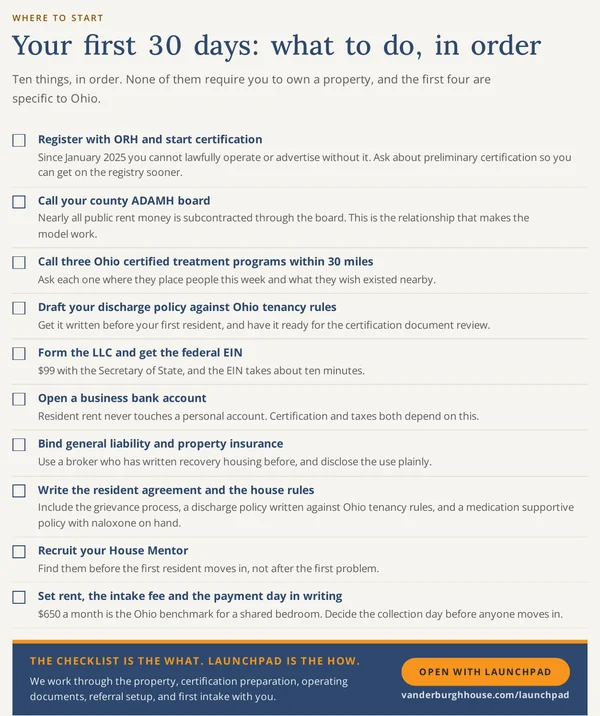
- Apply for preliminary certification early. ORH allows preliminary certification for a property that is ready for residents but has not yet hit the occupancy threshold, which lets referral relationships start forming while you are still filling beds. The steps are laid out in the process for certifying a sober living home or recovery housing program in Ohio.
- Fill beds faster instead of cutting the budget. The reserve exists to cover slow occupancy. Shortening the ramp is worth more than any line item you could trim, which is the argument for treating keeping beds full as a launch discipline rather than a later problem.
Do not economize here: skipping ORH certification, underinsuring, or opening without a reserve. Since January 1, 2025, Ohio Revised Code 5119.392(A) has prohibited operating an uncertified recovery residence, R.C. 5119.392(B) lets the attorney general or a prosecutor seek an injunction against a violator, and R.C. 5119.99 makes a violation of R.C. 5119.392(A) or R.C. 5119.395(A) a first-degree misdemeanor. Certification is also the gate to the statewide registry, to clinical referrals, and to the county funding described below. A $1,050 credential is not the place to save money.
Keep readingHow to Certify a Sober House: An Overview of NARR Affiliate CertificationWhat certification involves, what it costs, and how the process works in every state.→Your Ohio Startup Checklist
Ohio Funding That Offsets the Upfront Outlay
Ohio has a real, dedicated public rent stack, which is unusual. What it does not have is a grant that writes you a check for a down payment. The money that reaches recovery housing in Ohio moves through county Alcohol, Drug Addiction and Mental Health boards by subcontract, not directly to operators or residents, and the acquisition side is financed rather than granted, which is what financing the purchase of a sober living home property covers.
- The Recovery Supports Block Grant. A $19,500,000 annual earmark inside the Ohio Department of Behavioral Health’s Continuum of Care Services line item (ALI 336421) rather than an appropriation of its own, which the enacted House Bill 96 budget funds at $104,080,000 in each of fiscal years 2026 and 2027. Allowable uses include peer support, operational expenses, and minor facility improvements at class two and class three residential facilities and at recovery housing residences.
- The HUD Recovery Housing Program subsidy. Its PY 2025 allocation of $1,322,915 splits into $66,145 for administration and $1,256,770 for rental subsidies, assisting a resident for up to two years.
- State Opioid and Stimulant Response dollars and OneOhio settlement grants. Both reach operators through the same county board relationships. The mechanics, the eligibility, and the realistic timeline are covered in the Ohio recovery housing funding guide.
All of it is resident-rent and operations money that arrives after you open, and all of it is gated behind ORH certification and a board relationship. Budget acquisition and setup as your own capital.
Two other pressures belong on a 2026 budget. Ohio House Bill 58, which would require state certification of recovery residences and add local board inspection duties, passed the House and sits in Senate committee as of September 2026; if enacted it would raise entry costs. And once the home is open, whether the model carries its own costs is a separate question, answered with Ohio operating numbers in the Ohio profitability analysis.
Ohio guideHow Recovery Housing Funding Works in OhioGrants, settlement dollars, and the programs that help offset what it costs to open.→Sober Living Guides Every Operator Needs
These evergreen guides apply in every state and go deeper on the pieces behind your startup budget: the standards your home certifies to, the property you choose, the insurance you carry, and the referral partners who keep the beds full.
Frequently Asked Questions About Sober Living Startup Costs
What is the minimum to open a sober living home in Ohio?
About $22,510 on a leased house in a low-cost Ohio market, modeled on the three-bedroom Fair Market Rent plus the disclosed lease premium. That covers the $99 entity filing on the Ohio Secretary of State’s business filing forms, two months of rent upfront, basic life-safety hardware, secondhand furnishing, utility deposits, liability insurance, the first $525 certification installment, and a modeled $6,000 reserve.
Can I start by leasing instead of buying?
Yes, and most first-time Ohio operators should. Leasing removes the down payment and closing costs, the two largest lines, and drops the typical all-in figure from about $121,169 to about $51,631, both modeled from the Ohio REALTORS statewide median sale price and the rent input above. You give up equity and renovation control in exchange for a much shorter runway to opening.
How long before resident fees cover costs?
The pro forma published in the Ohio profitability analysis puts modeled break-even occupancy for a certified peer home near 47%, about seven of the fourteen beds this budget also assumes, against the same $3,404 monthly stack priced above. The reserve exists to bridge the ramp, which commonly runs sixty to ninety days from the first move-in.
Do grants cover Ohio startup costs?
Rarely. Ohio’s dedicated recovery housing money is resident-rent and operations funding routed through county boards by subcontract, and it reaches an operator only after certification and after the doors are open. Budget acquisition and setup as your own capital.
Is ORH certification worth $1,050?
It is the cheapest required cost in the budget and the one that unlocks the most, at $800 plus $250 per house across two years. Since January 2025 it has been the legal condition of operating and advertising as recovery housing under R.C. 5119.392, enforced as a first-degree misdemeanor under R.C. 5119.99, and it is the condition of receiving clinical referrals and the gate to every public rent dollar in the state.
What does a comfortable Ohio launch cost instead of a lean one?
Around $121,169 buying, or roughly $51,631 leasing with a fuller reserve and new rather than secondhand furnishing, on the same median sale price and rent inputs. The comfortable version is mostly a larger reserve and better insurance, not nicer furniture.
Plan Your Ohio Startup Budget With VSL
Ohio rewards operators who budget realistically: a cheap credential, a residential code path, and a funded rent market on the other side of opening. The two numbers that decide whether your launch works are the down payment or lease deposit and the reserve, and both are worth modeling with your own metro, bed count, and rent in the Sober Living Calculator before you commit.
If you want a second set of eyes on your Ohio budget before you sign anything, reach out to the Vanderburgh Sober Living team and we will work through it with you.
Start your sober house
Pick the path that fits where you are in the process.
Download the free guidePath to Purposeful Recovery Housing, by Dr. Hunter T. Foote.Explore the Mastery ProgramHands-on startup, certification, and operating support.See how starting with VSL worksThe opportunity, the community, and what a Charter includes.Prefer to talk now? Call (844) 762-3747, weekdays 8a to 5p.
Research & Sources
- Foote, H. T. (2026). Vanderburgh Sober Living Operating Climate Index, 2026 Edition. Vanderburgh Sober Living. https://www.vanderburghhouse.com/research/operating-climate-index-2026/
- Ohio Secretary of State. Articles of Organization for a Domestic Limited Liability Company (Form 610). https://www.ohiosos.gov/assets/610.pdf
- Ohio Recovery Housing. Certification Fees. https://www.ohiorecoveryhousing.org/fees
- Ohio Administrative Code 4101:1-3-01, Occupancy classification and use, Ohio Board of Building Standards. https://codes.ohio.gov/assets/laws/administrative-code/rules/4101/1/4101$1-3-01_eff_10_15_25.pdf
- Ohio REALTORS. (2026, July 16). Ohio’s Housing Market Strengthens in June (statewide median sale price, June 2026). https://www.ohiorealtors.org/blog/2371/ohios-housing-market-strengthens-in-june/
- Freddie Mac. Primary Mortgage Market Survey, week of September 3, 2026. https://www.freddiemac.com/pmms
- U.S. Census Bureau. American Community Survey 2024 5-Year Estimates, Table DP04. https://data.census.gov/table/ACSDP5Y2024.DP04
- U.S. Department of Housing and Urban Development, Office of Policy Development and Research. (2024). FY2025 Fair Market Rents. https://www.huduser.gov/portal/datasets/fmr.html
- Ohio Housing Finance Agency. FY2026 Ohio Housing Needs Assessment: Homeownership. https://ohiohome.org/research/homeownership-25.aspx
- Ohio Revised Code 5119.392, Certification of recovery housing residences. https://codes.ohio.gov/ohio-revised-code/section-5119.392
- Insurance Information Institute. Facts + Statistics: Homeowners and Renters Insurance. https://www.iii.org/fact-statistic/facts-statistics-homeowners-and-renters-insurance
- Home Fire Sprinkler Coalition. Fire Sprinkler Answers. https://homefiresprinkler.org/fire-sprinkler-answers/
- Internal Revenue Service. Form 1023 and 1023-EZ: Amount of User Fee. https://www.irs.gov/charities-non-profits/form-1023-and-1023-ez-amount-of-user-fee
- Ohio Legislature. House Bill 58, 136th General Assembly. https://www.legislature.ohio.gov/legislation/136/hb58
- Ohio Legislative Service Commission. Greenbook: LBO Analysis of Enacted Budget, Department of Behavioral Health (H.B. 96, 136th General Assembly). https://www.lsc.ohio.gov/assets/legislation/136/hb96/en0/files/hb96-mha-greenbook-as-enacted-136th-general-assembly.pdf
- Ohio Revised Code 5119.99, Penalties. https://codes.ohio.gov/ohio-revised-code/section-5119.99
- Ohio Department of Development. Draft PY 2025 Recovery Housing Program Substantial Amendment. https://dam.assets.ohio.gov/image/upload/v1770742251/development.ohio.gov/community/coummunityresources/Draft_PY25_RHP_Substantial_Amendment.docx.pdf
- Ohio Recovery Housing. ORH Certification Measures. https://www.ohiorecoveryhousing.org/orhmeasures