Recovery housing funding in Ohio is unusual, because it actually exists. Most states hand operators a list of federal acronyms and nothing behind them. Ohio has a dedicated public rent-subsidy stack, a purpose-built recovery housing loan product, a repairs fund that pays for the work needed to pass certification, and a settlement foundation that has already written checks for recovery beds. The misconception is not that the money is imaginary. It is that operators picture themselves applying for it, receiving it, and using it to cover rent, payroll, and expansion.
That is not how any of it moves. Nearly every public dollar that touches an Ohio recovery residence passes through one of roughly 50 county Alcohol, Drug Addiction and Mental Health boards and lands as a subcontract, not a grant. An operator who spends three months writing applications to the state has spent three months on the wrong desk. The reframe below is the whole post: the money is real, the eligibility rules are strict, the disbursing point is local, and the funding follows a home that is already running well rather than one that needs funding to start.
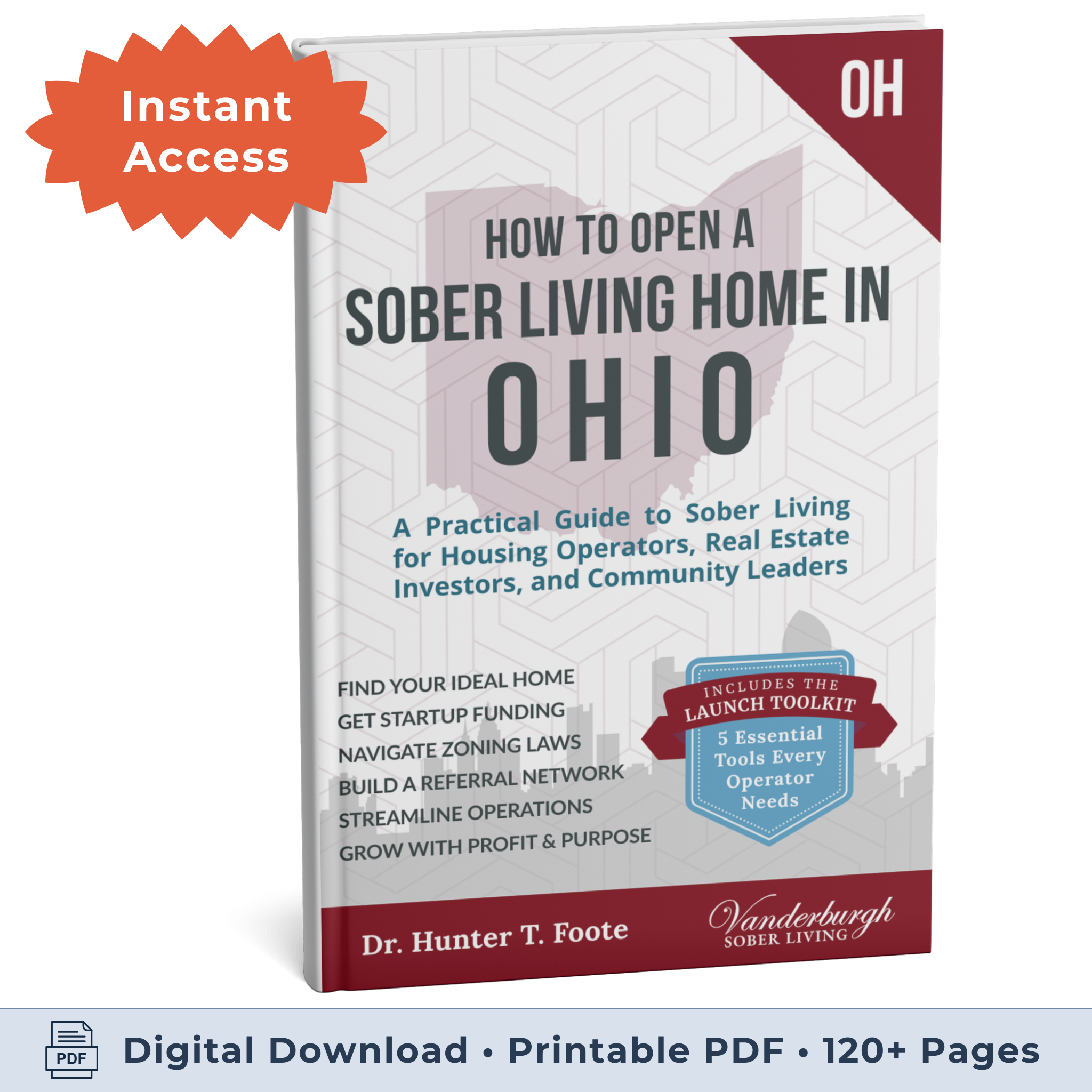
Before you read onHow to Open a Sober Living Home in OhioThis post covers one piece of the process. The complete Ohio guide walks through every step, from planning to your first resident.→How Does Recovery Housing Funding Work in Ohio?
Ohio funds recovery housing through county ADAMH boards, not through direct operator grants. State and federal rent dollars flow from the Ohio Department of Behavioral Health and the Ohio Department of Development to a county board, which subcontracts with certified residences on the statewide registry. Operators access money by holding certification and a board relationship, never by applying to the state.
Once you accept that the county board is the disbursing point, the rest of the system becomes readable. Ohio’s architecture works like this:
- Certification is the gate. Since January 1, 2025, only residences certified by Ohio Recovery Housing or chartered by Oxford House, and listed on the state registry, can lawfully operate, advertise, or receive provider referrals under R.C. 5119.392, 5119.395, and 5119.396.
- The board is the payer. County ADAMH boards are empowered by R.C. 340.01 to plan, fund, and manage community behavioral health services, and they hold the subcontracts that pay for recovery housing beds.
- Rent subsidies are paid to homes, not to residents. The Program Year 2025 Recovery Housing Program action plan amendment states plainly that awards go to ADAMH boards, which contract with certified residences, and that no payments are made directly to an individual.
- Subsidies are time-limited. The same plan caps subsidy payments at two years if permanent housing is not secured.
- The body that issues certification is in motion, but the gate has not moved. On August 10, 2026, Governor DeWine signed Executive Order 2026-03D, giving the Ohio Department of Behavioral Health authority to create a statewide certification program for recovery housing operators. DBH still recognizes Ohio Recovery Housing accreditation and an Oxford House charter as qualifying accreditations for the statewide registry.
Vanderburgh Sober Living’s Operating Climate Index scores Ohio 10 for resident funding access and 10 for operator funding access, the top of both sub-index scales (Foote, 2026). Those are among the highest funding-access scores in the country, and they describe availability, not ease. The dollars exist. The route to them is narrow.
Fourteen pages: the bed shortfall, who pays the rent, and what it costs to open. Built from your state‘s own numbers.
Are There Grants to Open a Sober Living Home in Ohio?
No, not in the way most operators expect. Ohio has no grant that hands a new operator money to open and run a home. What exists is an Ohio Recovery Housing repairs fund that reimburses up to $10,000 per property toward certification, settlement grants that fund organizations with track records, and rent subsidies paid to certified homes through county boards after they are already operating.
The mechanism behind that verdict is structural, not political. A sober living home is a housing business with a recovery environment around it. It is not a licensed treatment provider, so it does not bill a payer for care. Public behavioral health dollars are built to buy system capacity: treatment slots, peer support, care coordination, placement. They move through entities that can absorb reporting obligations, and they are tied to outcomes and end dates. A first-time operator with no residents, no certification, and no board contract does not match any of those design assumptions. Three consequences follow, and they are worth budgeting around:
- Timing: Money arrives after the home works, not before. Certification requires the home to be open. Subsidies require certification. Board contracts require both.
- Recipient: The intended grantee is usually an organization, not a startup. OneOhio requires applicants to have been registered with the Ohio Secretary of State for two consecutive years under their current EIN, per the foundation’s grant process page.
- Purpose: Most awards buy beds or capacity, not operating margin. Rent subsidy replaces a resident’s payment; it does not add profit on top of a full house.
- Loans
- Payment plans
- Employer aid
- Campaigns
- Voc Rehab
- VA (soon)
- Open
The startup budget therefore has to close without grant money in it. Sober living startup costs in Ohio are worth pricing line by line, and the one meaningful offset available at that stage is the repairs fund described below.
Ohio guideSober Living Startup Costs in OhioThe one-time cost to open, and where a small amount of outside funding can offset it.→Resident Fees Still Fund Most Sober Living Homes
Resident fees are the only revenue in the model that is predictable, recurring, and under the operator’s control. They arrive monthly, they scale with occupancy, and no one can end them with a budget vote. Every funding stream in this post arrives in cycles, carries conditions, and expires.
That is why disciplined operators price rent to fully support the home on private pay alone, then treat every subsidized bed as an improvement to an already-solvent model rather than a load-bearing beam. Setting sober living rent pricing against real local comparables is the single most consequential financial decision an Ohio operator makes, and it matters more than any grant application. The full operating math, including where margin actually comes from in this state, determines whether it is profitable to run a sober living home in Ohio.
There is a practical reason beyond prudence. A home that can prove stable occupancy and clean books is the home a county board wants to subcontract with. Financial independence is not just insurance against losing a grant. It is what qualifies you for one.
Ohio guideIs It Profitable to Operate a Recovery Home in Ohio?Realistic revenue, operating costs, and the resident-fee margins that keep a home running.→Which Ohio Programs Fund Recovery Housing?
Ohio’s real programs sort into three groups: rent money that follows a resident, capital that improves or acquires property, and technical support that makes a home eligible for the first two.
| Program | What It Primarily Funds | Who Typically Receives It |
|---|---|---|
| HUD Recovery Housing Program (RHP) | Rental subsidies for low-income people in recovery, capped at two years per person | County ADAMH boards, which subcontract with certified residences |
| Recovery Supports Block Grant, a $19,500,000 earmark within Continuum of Care Services (ALI 336421) | Peer support, operational expenses, and minor facility improvements at class two and class three residential facilities and at recovery housing residences | ADAMH boards, allocated locally |
| State Opioid and Stimulant Response (SOS 4.0) | Treatment, recovery supports, and recovery housing operations and rent subsidies | ADAMH boards and community providers, by RFA |
| OneOhio Recovery Foundation regional grants | Program expansion, capacity, and recovery housing projects | Established nonprofits and public entities, via 19 regional boards |
| Local government opioid settlement share (30% of Ohio’s total) | Locally determined approved purposes, including recovery support | Counties, cities, villages, and townships |
| ORH Recovery House Repairs Fund | Physical repairs identified during certification review, up to $10,000 per property | Operators in the funded regions, reimbursed after certification |
| Ohio Capital Finance Corporation Recovery Housing Loan | Predevelopment, construction, and bridge financing (repayable) | Recovery housing developers and mission-driven organizations |
| OHFA Housing Development Assistance Program and Ohio Housing Trust Fund gap financing | Development and preservation of affordable housing units | Affordable-housing developers, typically multi-unit |
| Oxford House revolving loan fund (42 U.S.C. 300x-25) | First month’s rent and security deposit to start a new house, up to $4,000, repayable | Groups of residents forming an Oxford House, not the operator |
Methodology & sources. RHP allocation, fund split, flow of funds, and the two-year limit come from the Ohio Department of Development PY 2025 RHP action plan amendment and the PY 2024 annual performance report. Block grant and line-item figures come from the Legislative Service Commission greenbook for the enacted HB 96 budget. Settlement figures come from the OneOhio Recovery Foundation grant awards page. Repairs fund terms come from Ohio Recovery Housing. Loan terms come from Ohio Capital Finance Corporation and the Oxford House loan conditions from 42 U.S.C. 300x-25. Ohio Medicaid covers treatment services under OAC 5160-27-09 but not room and board, and we found no Ohio Medicaid pathway paying recovery housing rent as of September 2026.
The three subsections below take those groups in turn: the money operators hope will support operations, the money that reaches a home as occupancy, and the money that builds or repairs property.
Support for every stage
Pick the level of support that fits where you are.
Just getting startedSee how the sober living opportunity works and what starting with VSL looks like.LaunchpadGuided pre-launch program: one-on-one strategy, Academy training, weekly coaching, and templates.MasteryHands-on startup, certification, and operating support inside the Chartered Operator community.Questions first? Call (844) 762-3747, weekdays 8a to 5p.
Direct Operating Support
This is the money operators hope for, and Ohio has more of it than most states, though almost none of it is paid on an application an operator files alone.
- HUD Recovery Housing Program. Ohio’s PY 2025 allocation is $1,322,915, split as $66,145 for administration (5%) and $1,256,770 for rental subsidies. The technical assistance carve-out that existed in earlier years was eliminated in PY 2025 and shifted into subsidies. Eligibility runs to people in recovery at or below 50% of area median income, in a residence certified by Ohio Recovery Housing or chartered by Oxford House and listed on the state registry.
- Board-level awards are modest and uneven. Development runs a request for application open to all 50 ADAMH boards and splits a single statewide allocation among those that apply, so what reaches any one county is a fraction of a total that is small to begin with. Across prior program years the program has housed 1,038 people, 363 of whom moved on to permanent housing.
- Recovery Supports Block Grant. Following the enacted HB 96 budget, recovery housing operating support sits inside Continuum of Care Services (ALI 336421), which the Legislative Service Commission greenbook for the enacted HB 96 budget shows funded at $104,080,000 in each of fiscal years 2026 and 2027, down from $105,687,039 in fiscal year 2024 and $104,605,007 in fiscal year 2025. Within that line item sits a Recovery Supports Block Grant earmark of $19,500,000 in each of those two years. Read the structure carefully before you build a budget on it: the $19,500,000 is an earmark inside a larger line item, not a standalone appropriation and not a sum dedicated to recovery housing. Its allowable uses cover peer support, operational expenses, and minor facility improvements at class two and class three residential facilities and at recovery housing residences, so recovery housing is one permitted use competing for a share of that $19,500,000.
- The Oxford House revolving loan fund. It is the only true startup cushion in the stack, and it belongs to the residents rather than to an owner. Federal law under 42 U.S.C. 300x-25 conditions the block grant on a fund of not less than $100,000, loans not exceeding $4,000, and repayment within two years. It applies to the Oxford House model only.
Indirect Support
The larger dollars in Ohio never appear on an operator’s bank statement as a grant. They arrive as occupancy.
- County board contracts. With 582 known Level I through Level III residences statewide and only 268 certified in the PY 2024 annual performance report linked above, a certified home is competing in a much smaller pool for board placements than the raw home count suggests.
- Justice and reentry placement. Specialized dockets and Ohio Department of Rehabilitation and Correction reentry programs place residents whose housing is often funded or mandated. These are among the most reliable referral sources in the state.
- Medicaid does not pay rent. Ohio Medicaid covers substance use disorder treatment services under OAC 5160-27-09, including peer recovery services delivered inside residential treatment. Room and board in a recovery residence is not a covered benefit, and we found no Ohio Medicaid pathway paying recovery housing rent as of September 2026. Treat any pitch that promises Medicaid rent reimbursement for a sober living home as a misreading of the rule.
- Veteran and disability income. Supportive Services for Veteran Families and SOAR-obtained SSI or SSDI turn otherwise unfunded residents into paying ones without the operator applying for anything.
Infrastructure and Capital Support
Capital money builds and repairs. It does not run a home, and confusing the two is the most common budgeting error in this category.
The ORH Recovery House Repairs Fund is the highest-leverage first stop for a new Ohio operator, because it pays for the exact defects that stand between a home and certification. It reimburses up to $10,000 per property with a $30,000 organizational cap, is funded by OneOhio dollars for specific regions, is awarded first come, first served until depleted, and pays only after certification is obtained. Repairs started before approval disqualify the application, which is where most operators lose it.
For acquisition and rehabilitation, the Ohio Capital Finance Corporation Recovery Housing Loan is a rare purpose-built product. It came out of a $1,525,000 CDFI Fund award and provides short-term, low-interest predevelopment, construction, and bridge financing designed to complement state program funding that can cover up to 75% of permanent financing. It is debt, and it is underwritten. That distinction matters more than the interest rate: a lender wants an entity, a pro forma, and proof of revenue, which is why the shape of your legal entity for a sober living business in Ohio is a funding decision, not just a paperwork decision.
OneOhio settlement money reaches homes two ways: through the foundation’s 19 regional boards, and through the 30% share paid directly to counties, cities, villages, and townships. Cycle 1 awarded more than $45,400,000 across 245 projects, including recovery housing. Cycle 2 made roughly $45,000,000 available, and the foundation’s grant process page, linked above, set the funding inquiry window at January 14 to February 11, 2026, with awards announced on a rolling basis. The local 30% share is the door most operators overlook, and it has the shortest line.
Why Eligibility Often Depends on Certification and Partnerships
Eligibility here has almost nothing to do with need and almost everything to do with standing. Every rent stream in the stack requires a residence certified by Ohio Recovery Housing or chartered by Oxford House, and listed on the state registry. Without that, a home cannot lawfully take a provider referral, let alone a subcontract.
What is in motion is the body that issues the credential, not the requirement itself. Executive Order 2026-03D, signed August 10, 2026, gives the Ohio Department of Behavioral Health authority to create a statewide certification program and to investigate complaints and enforce compliance directly, per the department’s announcement. The state’s stated reason was growth, from 356 homes in 2022 to more than 1,700 by August 2026, with uncertified operation and poor conditions concentrated in southern Ohio. For an operator today, the practical position is unchanged. No statute was amended: R.C. 5119.392 and R.C. 5119.394 both still carry their September 30, 2025 effective date, and existing law already allowed the department either to certify directly or to accept an outside accreditation as equivalent. Rules adopted on an emergency basis under R.C. 119.03 become invalid at the end of the 120th day they are in effect unless adopted through ordinary procedure, so the standing framework is what governs a certification decision made this fall.
Sober living homes are voluntarily certified, not licensed as treatment, and that standing is set by the National Alliance for Recovery Residences (NARR) and its Ohio affiliate. Ohio Recovery Housing certification is what satisfies the gate right now, and it is what the registry still recognizes, so the direction of travel toward stricter, state-run standards raises the value of certifying early rather than waiting to see what replaces it. How to certify a sober living home in Ohio walks the process itself. The second half of eligibility is relational: there is no statewide switchboard, only roughly 50 boards with their own priorities, levy resources, and contracting habits, and the operator who introduces themselves before they need money, shows up with occupancy data and a certification timeline, and asks which braided streams that board actually deploys locally is the one who gets a call when a subcontract opens.
Why Funding Is Competitive and Temporary
Ohio just demonstrated this at the state level. The dedicated recovery housing general revenue line item, 336424, carried $2,609,619 in fiscal year 2024 and $3,713,467 in fiscal year 2025, and the enacted budget cut it to zero in both fiscal year 2026 and fiscal year 2027, a 100 percent reduction, with support folded into the Recovery Supports Block Grant earmark inside Continuum of Care Services instead. Nothing about that was a judgment on recovery housing. It was a routine consolidation, but an operator who had built a rent roll around that line item spent the summer rebuilding it.
Applications take months. Awards are not guaranteed, and reporting obligations attach, with end dates the norm rather than the exception. A two-year subsidy cap per resident is written into the RHP plan, which means even a successful placement has a clock on it.
Reshaping a budget around one cycle converts a housing business into a grant-dependent one. That is the risk, and it is why every experienced Ohio operator treats funding as a supplement to a working model rather than the foundation of a new one.
How Strong Ohio Operators Use Funding Strategically
Funding compounds on top of a durable model. It cannot substitute for one. Operators who consistently win subcontracts and awards in Ohio tend to share the same profile:
- Certified early: Often before opening, using preliminary certification so the home is registry-listed and lawfully referable from day one.
- Occupancy already stable on private pay: Keeping beds full is the evidence a board is actually evaluating.
- Documentation a board can audit: Resident agreements, house policies, incident logs, and clean financials.
- A named board contact: A working referral relationship that predates the funding request.
- A specific objective for the money: Certification repairs, a second property, or a safety upgrade, rather than general operating relief.
- Capacity to report: Every dollar in this stack comes with an accounting obligation attached.
None of those are grant-writing skills. They are operating disciplines, and they are what a county board is weighing before it writes a subcontract.
A Practical Way to Evaluate Any Funding Opportunity
Before you spend a month on an application, run it through five questions. If you cannot answer them from the program’s own published materials, that is your answer.
- What is this program designed to accomplish: Rent subsidy, capacity building, and capital improvement are three different products. Applying to the wrong one is the most common wasted month.
- Who is the intended recipient: If the eligible applicant is a county board or a two-year-old registered nonprofit, your path runs through a partner, not a portal.
- What obligations come attached: Reporting cadence, audit exposure, resident eligibility verification, and length-of-stay limits all carry real administrative cost.
- What happens when it ends: If the home cannot cover its own expenses on the day the award expires, the award has created a liability rather than an asset.
- Does it improve occupancy stability: The strongest opportunities in Ohio are the ones that make beds easier to fill and easier to keep filled. Grants to open a sober living home covers the application mechanics for the rare case where a genuine operating grant is on the table.
The funding paths that actually close, and what a lender wants from a first-time operator.
Get the playbook free No cost, no obligation. Unsubscribe in one click.Sober Living Guides Every Operator Needs
These evergreen guides apply in every state and cover the fundamentals behind the money on this page: the capital you raise, the beds you fill, and the referral partners who keep resident fees flowing.
Frequently Asked Questions About Recovery Housing Funding
Are there grants to open a sober living home in Ohio?
Not for opening. Ohio’s rent subsidies require an operating, certified home, and OneOhio requires two consecutive years of Secretary of State registration. The Ohio Recovery Housing Recovery House Repairs Fund, whose published terms are linked above, is the closest thing available to a startup grant, reimbursing up to $10,000 per property for repairs identified during certification review.
Does Ohio Medicaid pay for sober living?
No. Ohio Medicaid covers substance use disorder treatment services under OAC 5160-27-09, linked above, including peer recovery services inside residential treatment settings. Room and board in a recovery residence is not a covered benefit, and we found no Ohio Medicaid pathway paying recovery housing rent as of September 2026.
How much rent subsidy can one resident receive?
Ohio publishes no flat per-resident or monthly dollar cap in its Recovery Housing Program action plan. The stated limit is duration: subsidy payments will not exceed two years if permanent housing is not secured. Actual amounts are set in each ADAMH board’s subcontract with the residence.
Can a new home get an Oxford House loan?
Only within the Oxford House model. 42 U.S.C. 300x-25, linked above, conditions the state’s block grant on a revolving loan fund of at least $100,000, with loans capped at $4,000 and repaid by residents within two years. It covers first month’s rent and a security deposit for a resident group, not an owner’s acquisition or operating costs.
Is certification required to receive funding in Ohio?
Yes. Recovery Housing Program subsidies flow only to residences certified by Ohio Recovery Housing or chartered by Oxford House and listed on the statewide registry. Since January 1, 2025, uncertified operation, advertising, and provider referrals are also barred by R.C. 5119.392, linked above.
Plan Your Ohio Funding Strategy With VSL
Ohio gives operators something most states do not: a dedicated public rent stack, a repairs fund that pays for the certification you already need, and a lender that built a product for this asset. It gives none of it to a home that is not certified, not registry-listed, and not known to its county board. Build the model so it works on resident fees alone, get certified early, meet your board before you need them, and let the funding land on top of a business that was already going to survive without it. If you want help mapping the certification, entity, and board sequence for your county, start a conversation with our team.
Research & Sources
- Foote, H. T. (2026). Vanderburgh Sober Living Operating Climate Index, 2026 Edition. Vanderburgh Sober Living. https://www.vanderburghhouse.com/research/operating-climate-index-2026/
- Ohio Department of Development. (2026). Draft Program Year 2025 Ohio Recovery Housing Program Action Plan Amendment. https://dam.assets.ohio.gov/image/upload/v1770742251/development.ohio.gov/community/coummunityresources/Draft_PY25_RHP_Substantial_Amendment.docx.pdf
- Ohio Department of Development. (2025). Draft PY 2024 Recovery Housing Program Annual Performance Report. https://dam.assets.ohio.gov/image/upload/v1760466684/development.ohio.gov/community/coummunityresources/Draft_PY_2024_Recovery_Housing_Program_Annual_Performance_Report.pdf
- Ohio Legislative Service Commission. (2025). Greenbook: LBO Analysis of Enacted Budget, Department of Mental Health and Addiction Services (HB 96, 136th General Assembly). https://www.lsc.ohio.gov/assets/legislation/136/hb96/en0/files/hb96-mha-greenbook-as-enacted-136th-general-assembly.pdf
- Office of Governor Mike DeWine. (2026, August 10). Governor DeWine Signs Executive Order, Announces DBH to Assume Recovery Housing Certification and Oversight. https://governor.ohio.gov/wps/portal/gov/governor/media/news-and-media/governor-dewine-signs-executive-order-announces-dbh-to-assume-recovery-housing-certification-and-oversight
- Ohio Department of Behavioral Health. (2026, August 10). Governor DeWine Signs Executive Order, Announces DBH to Assume Recovery Housing Certification and Oversight. https://dbh.ohio.gov/about-us/media-center/news/pr08.10.26
- Ohio Department of Behavioral Health. (n.d.). Recovery Housing Statewide Registry. https://dbh.ohio.gov/supporting-providers/housing-providers/recovery-housing-residences/statewide-registry
- Ohio Revised Code § 119.03. Adoption of rules; emergency rules. https://codes.ohio.gov/ohio-revised-code/section-119.03
- Ohio Revised Code § 5119.392. Recovery housing residence certification and prohibitions. https://codes.ohio.gov/ohio-revised-code/section-5119.392
- Ohio Revised Code § 340.01. Board of alcohol, drug addiction, and mental health services. https://codes.ohio.gov/ohio-revised-code/section-340.01
- OneOhio Recovery Foundation. (2026). Grant Awards. https://www.oneohiofoundation.com/grantawards
- Ohio Recovery Housing. (2026). Recovery House Repairs Fund. https://www.ohiorecoveryhousing.org/repairs-fund
- Ohio Capital Finance Corporation. (2026). Lending. https://www.occh.org/lending/
- 42 U.S.C. § 300x-25. Requirement of group homes for recovering substance abusers. https://www.govinfo.gov/app/details/USCODE-2023-title42/USCODE-2023-title42-chap6A-subchapXVII-partB-subpart2-sec300x-25
- Ohio Administrative Code 5160-27-09. Substance use disorder services. https://codes.ohio.gov/ohio-administrative-code/rule-5160-27-09
- Ohio Department of Development. (n.d.). Recovery Housing Program. https://dam.assets.ohio.gov/image/upload/v1789073543/development.ohio.gov/community/coummunityresources/Draft_PY26_RHP_Substantial_Amendment.pdf
- OneOhio Recovery Foundation. (2026). Regional Grant Cycle 2. https://www.oneohiofoundation.com/regionalgrantcycle2
- U.S. Department of Veterans Affairs. (n.d.). Supportive Services for Veteran Families. https://www.va.gov/homeless/ssvf/
- Substance Abuse and Mental Health Services Administration. (n.d.). SOAR. https://www.samhsa.gov