Aspiring operators researching a license to open a sober living home in Illinois run into two flatly contradictory answers within an afternoon. One says Illinois requires nothing at all and a peer-run home can open tomorrow. The other says Illinois licenses “recovery homes” and warns of an Attorney General referral. Both statements are describing something real, and neither is the whole picture. The Illinois answer sits within the national picture of whether you need a license to open a sober living home, which differs widely from state to state.
Illinois runs two tracks at once, and which track you are on depends on what you tell the public you are, not on how good your house rules are. Getting that distinction right before you sign a lease is worth more than any other hour of research you will do this month.
Before you read onHow to Open a Sober Living Home in IllinoisThis post covers one piece of the process. The complete Illinois guide walks through every step, from planning to your first resident.→Do You Need a License to Open a Sober Living Home in Illinois?
No. Illinois does not license ordinary, non-clinical, peer-run sober living homes or Oxford Houses. State rule and the state’s own registry define both as non-licensed and lawful. A separate, optional Recovery Home intervention license exists for staffed, structured homes that want state referrals and contract dollars.
The Illinois Department of Human Services draws the line itself. On its Recovery Residence Registry, IDHS defines a “Recovery Home” as a “facility licensed by DBHR,” an “Oxford House” as a “non-licensed, independent, supportive sober living environment,” and a “Sober Living Home” as a “non-licensed, alcohol and drug-free living environment.” Two of those three categories are expressly non-licensed, and the state names them that way on its own page.
What sits on the other track is a real license with real conditions. 77 Ill. Adm. Code 2060.540 sets the standards a licensed Recovery Home must meet, and they are staffing-heavy: a credentialed full-time operator, an on-site manager, peer-led groups a minimum of five days a week, an individual recovery plan for every resident, and a reserve equal to two months of operating expenses. That is a different business from a peer-run house, and Illinois prices it accordingly in effort rather than in fees.
So the honest answer has two halves. You need no state license to run a genuine peer-run sober living home in Illinois. You need the Recovery Home license the moment you hold your home out as the staffed, structured service the rule defines, or the moment you want the state referral and contract money that only licensed homes can receive.
How your home gets classified, where Fair Housing applies, and what to do if the city says no.
Illinois Sober Living Licensing at a Glance
The table below is the short version of everything this page covers, with the governing authority for each row.
| Item | Detail | What it means |
|---|---|---|
| State license required | No for a peer-run home; yes only for the optional DBHR “Recovery Home” intervention license | A non-clinical, peer-run home or Oxford House operates unlicensed and lawfully; the license exists for staffed, structured homes and carries no application fee under 77 Ill. Adm. Code 2060.220 |
| Registry or certification mandate | None; the Recovery Residence Registry is voluntary | 20 ILCS 301/55-40 creates a free registry open to licensed and non-licensed residences alike, with a required disclaimer that listed residences are not regulated by the Department |
| Administering agency | IDHS Division of Behavioral Health and Recovery (DBHR), formerly the Division of Substance Use Prevention and Recovery (SUPR) | One division since July 1, 2025 |
| Governing statute | 20 ILCS 301, Substance Use Disorder Act; 77 Ill. Adm. Code Part 2060 | The prior Part was repealed and a new Part adopted April 2, 2025 at 49 Ill. Reg. 5290 |
| Thresholds that trigger licensure | Delivering, or holding yourself out as delivering, the structured Recovery Home service | Unlicensed holding-out draws a cease-and-desist letter and a 10-day window to document that no license is required, before any referral to the State’s Attorney or Attorney General |
| Express statutory mention | 20 ILCS 301/55-40 | Names recovery residences and creates the registry, and states that listed residences “are not regulated by the Department” |
| Voluntary certification body | Illinois Association of Extended Care (IAEC), the state’s sole NARR affiliate | Certification is credibility and referral standing, not state permission; Illinois scores 6 out of 10 on the Vanderburgh Sober Living Operating Climate Index, ranked 36 of 50 and classified Moderately Regulated |
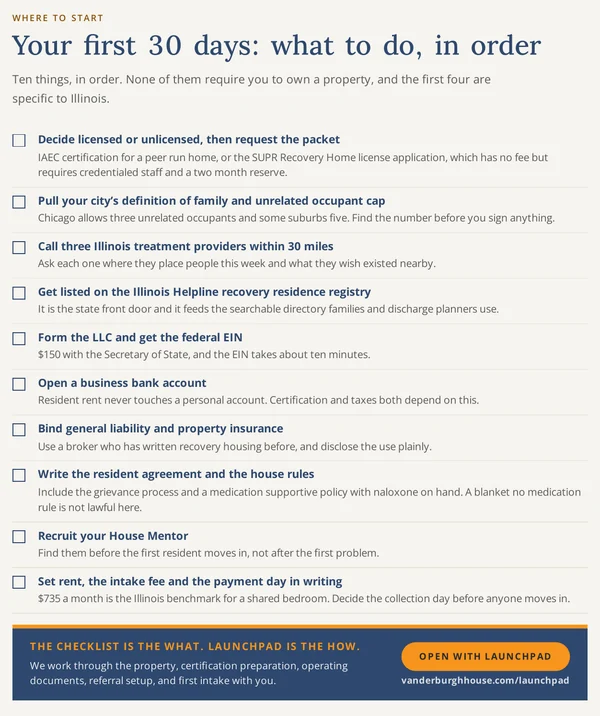
Most people ask whether they are allowed to open a recovery home. The better first question is whether the need and the money are there. This answers both, for your state.
- How many people need a bed, and how few beds exist
- Who actually pays the rent, and which programs are real
- What it costs to open on the purchase path and the lease path
How Illinois Regulates Sober Living Homes
Illinois regulates the service, not the housing. The governing statute is the Substance Use Disorder Act at 20 ILCS 301, which authorizes IDHS to license substance use treatment and intervention services. The implementing rule is Part 2060, whose prior version was repealed and replaced by a new Part adopted April 2, 2025.
That rewrite matters for anyone reading older material. The recovery home standards used to live at Section 2060.509. They now live at Section 2060.540, and the operator and manager credentialing that the old section carried internally moved to Section 2060.320(i). Section 2060.509 no longer appears in the Part, so a summary that cites it is describing a repealed rule. The other point older summaries get wrong is the division’s name. IDHS merged the Division of Substance Use Prevention and Recovery into the Division of Behavioral Health and Recovery effective July 1, 2025. Rules and grant notices still carry the SUPR name in places, and it refers to the same license.
Crucially, the Recovery Home license is an intervention license, not a treatment license. Illinois treats a licensed recovery home as recovery-oriented supportive housing with peer-led services, which is why the rule asks for peer groups and recovery plans rather than clinical staff and medical records. A home that starts delivering clinical treatment is in a different licensing conversation entirely. Alongside the license sits something that is not a license at all. 20 ILCS 301/55-40, added by Public Act 100-1062, directs IDHS to maintain an online registry of recovery residences, encourages operators to seek national accreditation, and requires the Department to publish a disclaimer that listed residences “are not regulated by the Department.” That is an Illinois statute expressly naming recovery residences and expressly declining to regulate them. It is the clearest statutory confirmation available that the state’s baseline for sober living homes is permission-free.
License vs. Certification vs. Registration: What Each Term Means
Illinois operators encounter more instruments than most states use, and conflating them costs money. Here is what each one actually is, who issues it, and what it buys you.
License
A license is government permission to deliver a defined service. In Illinois the only license that touches recovery housing is the DBHR Recovery Home intervention license under 77 Ill. Adm. Code 2060.540. It is issued by a state agency, it can be denied, conditioned, or revoked by that agency, and it is required only for the structured Recovery Home service.
It is what unlocks state referrals and contract dollars. It is not required for an ordinary sober living home.
Certification
Certification is a private, third-party audit against a published standard. In Illinois that is the Illinois Association of Extended Care (IAEC), the state’s sole NARR affiliate, which certifies homes against the NARR standard and inspects them annually. Certification is voluntary, it is issued by a nonprofit rather than the state, and it carries credibility with referral partners.
It is not state permission, and it is not a substitute for the license where the license is actually required. Illinois operators also meet a fourth, closely related instrument: the charter, a membership agreement with a private network such as Oxford House or Vanderburgh Sober Living. A charter is likewise not government permission and not a third-party audit; it is a rulebook, a name, and accountability to the network behind it, and neither Oxford House’s requirements nor Vanderburgh Sober Living’s charter membership is a state credential. The two certifying bodies active in the state are compared in this IAEC certification overview.
Registration
Registration is a listing, not a credential. The Recovery Residence Registry created by 20 ILCS 301/55-40 is open to licensed recovery homes, Oxford Houses, and sober living homes alike, and the statute requires a disclaimer stating that listed residences are not regulated by the Department.
Registering costs nothing, puts a home in front of people searching for recovery housing, and confers no legal status whatsoever.
In Illinois, the license is optional and reserved for staffed Recovery Homes administered by DBHR; certification is voluntary through IAEC; and registration is a free, voluntary listing under 20 ILCS 301/55-40. None of the three is mandatory for an ordinary peer-run home.
| Credential | Required? | Administering body |
|---|---|---|
| License | Only for the structured Recovery Home service | IDHS Division of Behavioral Health and Recovery |
| Certification | No, voluntary | Illinois Association of Extended Care (IAEC) |
| Registration | No, voluntary | IDHS, under 20 ILCS 301/55-40 |
When a Sober Living Home Crosses Into Licensed Treatment
Illinois does not draw the line at bed count, rent level, or whether you call yourself a sober house. It draws the line at whether you are delivering, or telling the public you deliver, the licensable service. Under 77 Ill. Adm. Code 2060.210, when DBHR finds an unlicensed organization providing a licensable service, it issues a letter ordering the organization to cease and desist, the organization has 10 calendar days to submit written documentation showing that no license is required or that it is properly authorized, and only if the activity continues past that window is the matter referred to the State’s Attorney or the Office of the Attorney General.
- Marketing the staffed, structured service: Advertising scheduled peer groups, assigned recovery plans, and on-duty staff describes the licensed Recovery Home service, whether or not you use the phrase.
- Using “Recovery Home” as your public label: In Illinois that term signals state licensure to referral partners and regulators, because that is how the rule defines it.
- Taking state referrals or contract dollars: DCFS, IDOC, and DBHR-contracted placements route to licensed homes, and accepting them presumes the license.
- Delivering clinical or treatment services on site: That moves past intervention into treatment licensure, a separate and heavier category under Part 2060.
A truly peer-run home, an Oxford House, or an IAEC-certified private-pay home that describes itself accurately is nowhere near this line. The risk is created by the description, not by the housing, and it is almost always self-inflicted through marketing copy written before anyone read the rule.
What’s Changed in Illinois Sober Living Law
Illinois’ recovery housing rules moved recently enough that a 2023 article can mislead you. Four dated milestones matter.
The registry takes effect. Public Act 100-1062 added what is now 20 ILCS 301/55-40, directing IDHS to build an online recovery residence registry, encouraging operators to seek national accreditation, and requiring a published disclaimer that listed residences are not regulated by the Department.
Part 2060 is rewritten. The prior Part was repealed and a new 77 Ill. Adm. Code Part 2060 adopted at 49 Ill. Reg. 5290. Recovery home standards moved from Section 2060.509 to Section 2060.540, and operator credentialing moved to Section 2060.320(i).
SUPR becomes DBHR. IDHS merged the Division of Substance Use Prevention and Recovery into the Division of Behavioral Health and Recovery. The license and the registry did not change; the division’s name did.
HB1843 stalls. House Bill 1843 would bar municipal zoning that contradicts the Fair Housing Act and the ADA and would protect community-integrated living arrangements from unrelated-occupant caps. It passed the House 77 to 35 on April 10, 2025 and was re-referred to Senate Assignments on June 1, 2026. It is not law, and there is no guaranteed timeline for a Senate revival.
Illinois’s Occupancy and Building-Safety Thresholds
A second set of thresholds has nothing to do with licensure and catches operators who assumed the license question was the only one. These are occupancy and code triggers, and they apply to licensed and unlicensed homes alike.
- The 16-resident line: NFPA 101 treats small lodging or rooming houses of 16 or fewer occupants more lightly than hotel and dormitory occupancies of 17 or more. Illinois adopts the 2015 edition of NFPA 101 through the State Fire Marshal at 41 Ill. Adm. Code 100. The exact chapter applied to a given home is the authority having jurisdiction’s call, so confirm it locally before you plan a census above 16.
- Custodial care changes the classification: A home whose residents are ambulatory and self-preserving is treated as an ordinary dwelling. Providing hands-on personal care can push a home into a board-and-care or institutional classification with heavier alarm, egress, and sprinkler expectations.
- A statewide code floor since 2025: Public Act 103-0510 amended the Capital Development Board Act to require municipalities and counties to adopt codes at least as stringent as the IBC, IEBC, and IRC, effective January 1, 2025, as the Capital Development Board sets out. Local building departments still enforce and still make the occupancy call.
- Chicago runs its own code: The city is excluded from the state fire code framework and enforces its own building and fire code, so a Chicago property answers to a different rulebook than a property in most of the rest of the state.
- Licensed homes carry one extra filing: The Life Safety Inspection attestation under Section 2060.310(a)(2) is a licensure condition, filed at initial licensure and renewal, rather than something the local authority asks for on its own.
Local land use is the other half of this, and it is where Illinois operators spend the most time. Municipal “family” definitions capping unrelated occupants are the constraint that most often reaches a recovery home, and the remedy is a documented reasonable accommodation request rather than a zoning fight. The mechanics of that sit with the Illinois zoning guide below.
Illinois guideIllinois Zoning, Fair Housing, and Land Use Laws for Sober LivingWhere sober homes can operate in Illinois and the legal protections that apply.→What’s Still Required Without a License
No state license does not mean no obligations. The compliance floor below applies to every Illinois sober living home, licensed or not.
- A legal entity: Form the LLC or corporation, register with the Secretary of State, and keep the operating agreement and the property in the right names.
- Local business registration: Many Illinois municipalities require a general business registration or license for any business operating in the jurisdiction, independent of use.
- Building and fire code compliance: The property should comply with the applicable local building and fire codes for its classification, as enforced by the local building department and the fire authority.
- Occupancy rules: The local definition of “family” and any unrelated-occupant cap, subject to the reasonable-accommodation obligations described below.
- Fair housing obligations: People in recovery from substance use disorder are a protected class under the federal Fair Housing Act and the ADA, and Illinois layers the Illinois Human Rights Act on top. The Illinois Department of Human Rights enforces the state law, and its guidance treats a zoning variance request from a community residence as a request for reasonable accommodation. The federal baseline is set out in the DOJ and HUD joint statement on group homes and local land use.
- Insurance: General liability and property coverage appropriate to congregate residential use, plus whatever a lender or landlord requires.
- Written house rules and a resident agreement: Not a legal requirement, but the document that makes discharge, fees, and expectations defensible.
Two of those deserve their own reading. Entity choice for an Illinois operator is covered in forming a legal entity, and the protections and duties that come with disability status are set out in the Fair Housing Act explainer.
How Voluntary Illinois Association of Extended Care Certification Works Here
The Illinois Association of Extended Care (IAEC) is the state’s sole affiliate of the National Alliance for Recovery Residences, and it certifies recovery residences against the NARR standard with an annual inspection. Certification in Illinois is voluntary for every category of home, including unlicensed ones, and IAEC publishes its membership and inspection fee schedule, which puts a first-year single-site certification at roughly $600.
What certification buys in Illinois is credibility and referral standing rather than legal permission. It signals to clinicians, courts, and families that an independent body has inspected the home against a published standard. What it does not do is substitute for the Recovery Home license where a home is in fact delivering the licensable service, and it is not what opens state contract funding. Sequencing matters: certify because it makes you a better and more referable home, and license separately if and when the licensed lane is where you want to operate.
Illinois guideHow to Certify a Sober Living Home with Illinois Association of Extended Care in IllinoisThe step-by-step IAEC application, costs, timelines, and inspection checklist.→What Skipping Illinois Association of Extended Care Certification Costs You
Skipping both is a legitimate choice in Illinois, and plenty of good homes make it. The cost is opportunity rather than penalty. An uncertified, unlicensed home is invisible to the referral partners who screen for a credential, is harder to place with insurers who ask what standard you run to, and is ineligible for state contract dollars and the DCFS and IDOC placement channels that route to licensed recovery homes only. Building a private-pay census without any of that is possible, and it means your referral sources have to be built by hand.
The enforcement exposure is narrower than the internet suggests, and it is entirely within your control. Under Section 2060.210 the trigger is delivering or holding out the licensable service without the license, and the process starts with a letter and a 10-day window to document that no license is required. An operator who describes the home accurately, does not advertise staffed structured programming, and does not take licensed-home referrals is not in that conversation at all.
Steps to Open an Illinois Sober House Legally
The sequence below assumes the unlicensed, IAEC-certified private-pay model, which is where most first-time Illinois operators should start.
- Decide your lane. Peer-run and unlicensed, or staffed and licensed under Section 2060.540. This decision drives your staffing budget, your marketing language, and your revenue model, and reversing it later is expensive.
- Form the entity. Register the LLC or corporation with the Illinois Secretary of State before you sign anything.
- Secure a compliant property. Confirm the occupancy classification and the local unrelated-occupant cap with the building department before closing or signing, and plan the census against the 16-resident NFPA 101 line.
- Meet local codes and register locally. Building, fire, and any municipal business registration, with a documented reasonable accommodation request ready if a “family” definition is raised.
- List on the Recovery Residence Registry. Free, open to non-licensed homes, and the state’s own referral surface.
- Certify with IAEC. Voluntary, annual, and the credential referral partners recognize.
- Apply for the Recovery Home license only if the licensed lane is your model. No application fee, but budget for two credentialed roles, five-day-a-week programming, and a two-month reserve first.
Support for every stage
Pick the level of support that fits where you are.
Just getting startedSee how the sober living opportunity works and what starting with VSL looks like.LaunchpadGuided pre-launch program: one-on-one strategy, Academy training, weekly coaching, and templates.MasteryHands-on startup, certification, and operating support inside the Chartered Operator community.Questions first? Call (844) 762-3747, weekdays 8a to 5p.
Sober Living Guides Every Operator Needs
These evergreen guides apply in every state and cover what matters once you know the licensing picture: the standards you certify to, the fair-housing protections behind you, the property you choose, and the referrals that certification unlocks.
Frequently Asked Questions About Sober Living Licensing in Illinois
Is it legal to run a sober living home in Illinois without a license?
Yes. IDHS defines both sober living homes and Oxford Houses as non-licensed living environments on its Recovery Residence Registry, and 20 ILCS 301/55-40 requires a published disclaimer that listed recovery residences are not regulated by the Department. Licensure attaches only to the structured Recovery Home service defined in Part 2060.
How much does an Illinois Recovery Home license cost?
Nothing to apply. 77 Ill. Adm. Code 2060.220 states that no application fee is required, with narrow exceptions at Sections 2060.260 and 2060.265 covering ownership changes and relocation or cessation of services. The real cost is compliance: two credentialed roles, five-day-a-week peer groups, and a two-month operating reserve.
What is the difference between a recovery home and a sober living home in Illinois?
In Illinois the terms are not interchangeable. “Recovery Home” is a defined, DBHR-licensed service with staffing and programming standards under Section 2060.540. “Sober living home” is IDHS’s term for a non-licensed alcohol and drug-free living environment. Using the licensed term for an unlicensed home invites an enforcement letter.
Do I have to register my sober living home with the state of Illinois?
No. The Recovery Residence Registry created by 20 ILCS 301/55-40 is voluntary and open to licensed and non-licensed residences alike. Listing costs nothing, puts the home in front of people searching for recovery housing, and confers no legal status or state endorsement.
What happens if I operate a recovery home in Illinois without a license?
Under 77 Ill. Adm. Code 2060.210, DBHR issues a cease-and-desist letter when an unlicensed organization delivers a licensable service. The organization has 10 calendar days to document that no license is required. Only continued activity after that window is referred to the State’s Attorney or the Attorney General.
Is IAEC certification required in Illinois?
No. Certification through the Illinois Association of Extended Care is voluntary for every category of home, including unlicensed ones. It carries referral credibility and NARR standing at roughly $600 in the first year, and it is not a substitute for the Recovery Home license where a home in fact delivers the licensable service.
Your Next Step Toward Opening Legally in Illinois
Illinois gives operators a real choice rather than a hurdle. A peer-run, accurately described sober living home needs no state license and can be open as soon as the property and the entity are ready, while the Recovery Home license waits for operators who want the staffing, the programming, and the state referral channels that come with it. The mistake that costs money is not picking the wrong lane, it is describing yourself as being in one lane while operating in the other. If you want help deciding which lane fits your property, your capital, and your timeline, reach out to the Vanderburgh Sober Living team and we will walk through it with you.
Research & Sources
- Foote, H. T. (2026). Vanderburgh Sober Living Operating Climate Index, 2026 Edition. Vanderburgh Sober Living. https://www.vanderburghhouse.com/research/operating-climate-index-2026/
- Illinois Department of Human Services. (n.d.). Recovery Residence Registry. https://www.dhs.state.il.us/page.aspx?item=115597
- Illinois Department of Human Services. (n.d.). Recovery Residence Frequently Asked Questions. https://www.dhs.state.il.us/page.aspx?item=117273
- Illinois General Assembly. (2025). Ill. Admin. Code tit. 77, § 2060.540 (Recovery Homes). https://www.ilga.gov/commission/jcar/admincode/077/077020600E05400R.html
- Illinois General Assembly. (2025). Ill. Admin. Code tit. 77, § 2060.320 (Staff Qualifications). https://www.ilga.gov/commission/jcar/admincode/077/077020600C03200R.html
- Illinois General Assembly. (2025). Ill. Admin. Code tit. 77, § 2060.220 (Application Fee). https://www.ilga.gov/commission/jcar/admincode/077/077020600B02200R.html
- Illinois General Assembly. (2025). Ill. Admin. Code tit. 77, § 2060.210 (Unlicensed Practice). https://www.ilga.gov/commission/jcar/admincode/077/077020600B02100R.html
- Illinois General Assembly. (2025). Ill. Admin. Code tit. 77, Part 2060 (section list; new Part adopted April 2, 2025, 49 Ill. Reg. 5290). https://www.ilga.gov/agencies/JCAR/Sections?PartID=07702060&TitleDescription=TITLE+77%3A++PUBLIC+HEALTH
- Illinois General Assembly. (n.d.). 20 ILCS 301, Substance Use Disorder Act. https://www.ilga.gov/legislation/ilcs/ilcs5.asp?ActID=232
- Illinois General Assembly. (n.d.). 20 ILCS 301/55-40 (Recovery residences). https://www.ilga.gov/legislation/ilcs/fulltext?DocName=002003010K55-40
- Illinois Department of Human Services. (2025). MR #26.09: Division of Behavioral Health and Recovery. https://www.dhs.state.il.us/page.aspx?item=177060
- Illinois Department of Human Services. (n.d.). About the Division of Behavioral Health and Recovery. https://www.dhs.state.il.us/page.aspx?item=173565
- Illinois General Assembly. (2026). HB1843 bill status, 104th General Assembly. https://www.ilga.gov/Legislation/BillStatus?DocNum=1843&GAID=18&DocTypeID=HB&SessionID=114
- Office of the Illinois State Fire Marshal. (n.d.). Life Safety Code. https://sfm.illinois.gov/resources/life-safety-code.html
- Illinois Capital Development Board. (n.d.). Building Codes and Regulations. https://cdb.illinois.gov/business/codes/buildingcodesregulations.html
- Illinois Department of Human Rights. (n.d.). Housing Rights. https://dhr.illinois.gov/rights/housing-rights.html
- U.S. Department of Justice & U.S. Department of Housing and Urban Development. (n.d.). Joint Statement on Group Homes, Local Land Use, and the Fair Housing Act. https://www.justice.gov/crt/joint-statement-department-justice-and-department-housing-and-urban-development
- Illinois Association of Extended Care. (n.d.). IAEC. https://www.iaecrecoveryillinois.org/