Sober living zoning in Illinois almost never turns on a rule about sober living homes. It turns on a single line in a municipal code: the definition of “family,” or in Chicago’s case “household,” and how many unrelated adults that definition lets share a dwelling. Get that line right before you sign, and most Illinois operators open in an ordinary residential neighborhood with no special permission at all. Every Illinois rule sits on top of the federal sober living zoning laws that apply in all 50 states, starting with the Fair Housing Act.
Illinois gives operators something most states do not: two civil rights statutes instead of one. The federal Fair Housing Act and the Americans with Disabilities Act set the national floor, and the Illinois Human Rights Act sits on top of them with its own agency, its own complaint process, and its own guidance telling municipalities how to handle a zoning request from a community residence.
That double layer is why Illinois scores 8 for legal climate in the Vanderburgh Sober Living Operating Climate Index (Foote, 2026), even though Chicagoland occupancy caps produce real friction. This page is about using the layer you have.
Before you read onHow to Open a Sober Living Home in IllinoisThis post covers one piece of the process. The complete Illinois guide walks through every step, from planning to your first resident.→Can You Open a Sober Living Home in a Residential Neighborhood in Illinois?
Yes, in most cases. Illinois does not license or zone ordinary peer-run sober living homes as a separate use. A home where unrelated adults live together as a single housekeeping unit is residential use. The constraint you are most likely to meet is a municipal cap on unrelated occupants, and fair housing law requires the municipality to consider waiving it.
The state itself treats these homes as housing rather than as a regulated use. On its Recovery Residence Registry, the Illinois Department of Human Services (IDHS) defines a “Sober Living Home” as a “non-licensed, alcohol and drug-free living environment” and an “Oxford House” as a “non-licensed, independent, supportive sober living environment.” Only the staffed, structured “Recovery Home” service carries a state license, and that is a service license, not a zoning classification.
Zoning is then entirely local, and local codes rarely mention recovery housing by name. What they contain instead is a household or family definition written decades ago for roommates and boarding houses. The DOJ and HUD joint statement on state and local land use laws and the Fair Housing Act is explicit that a municipality may not restrict housing for people with disabilities more severely than it restricts comparable housing for anyone else.
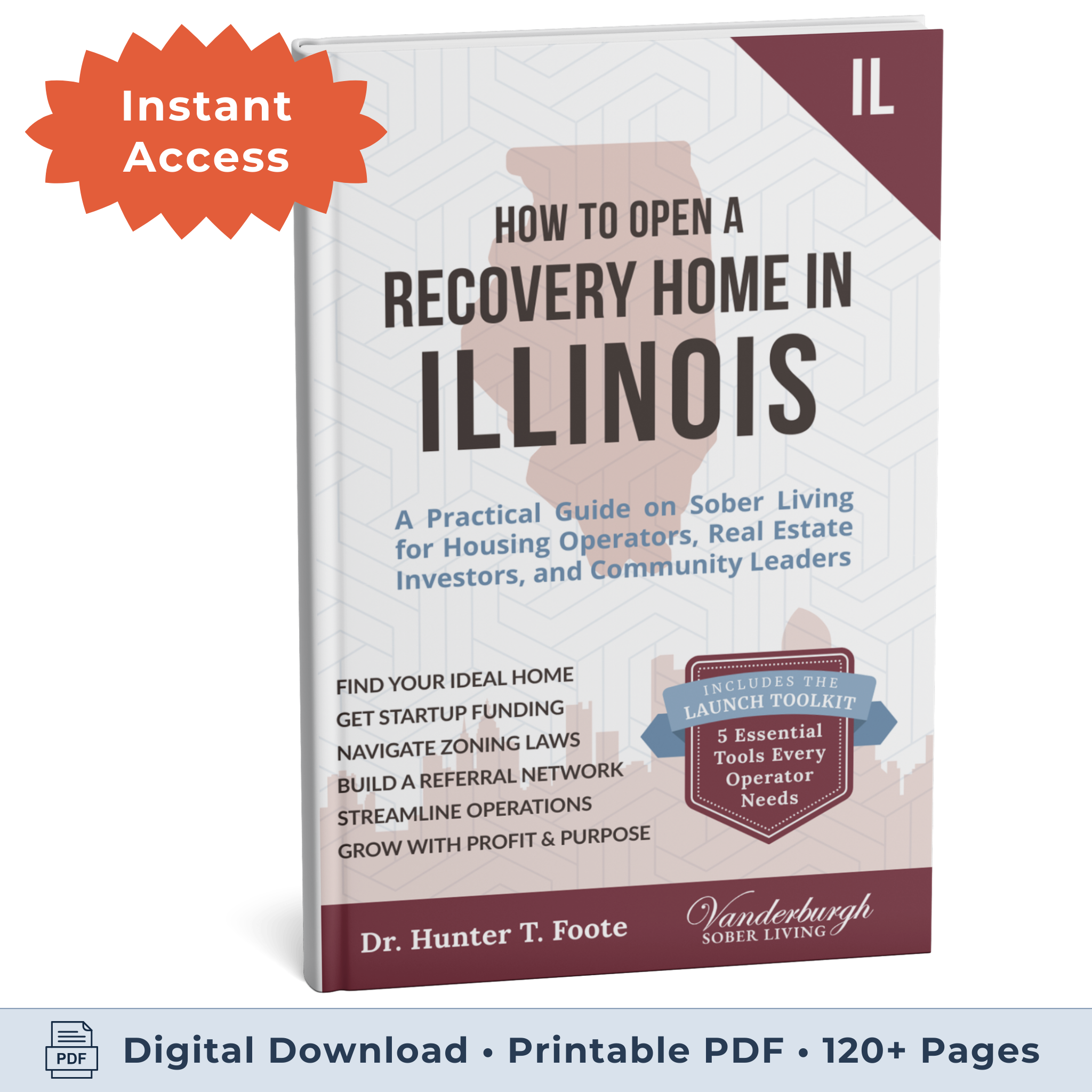
The book gives you the map to open a home in Illinois. When you are ready to launch, certify, and sustain, the Blueprint is the full playbook covering zoning, licensing, certification, funding, legal, insurance, and operations.
How Fair Housing Law Protects Illinois Sober Living
People in recovery from substance use disorder are a protected disability class, and abstinence-based homes remain lawful because people currently using illegal drugs are not covered. Three statutes carry that protection in Illinois, and they operate at the same time.
The federal layer is the Fair Housing Act and the ADA. HUD’s Office of Fair Housing and Equal Opportunity summarizes the rights and obligations those statutes create, including the duty to make reasonable accommodations in rules and policies where a person with a disability needs one for equal use and enjoyment of a dwelling. The federal doctrine in full sits with the site’s guide to the Fair Housing Act and is not repeated here.
The Illinois layer is the addition worth knowing. 775 ILCS 5/3-102.1 of the Illinois Human Rights Act independently makes disability discrimination in a real estate transaction a civil rights violation, and it requires “reasonable accommodations in rules, policies, practices, or services” where an accommodation is necessary to give a person with a disability equal opportunity to use and enjoy a dwelling. It is enforced by the Illinois Department of Human Rights (IDHR), a state agency with its own investigators.
IDHR has also told municipalities how to read their own zoning powers. Its reasonable accommodations and modifications guide states that where an organization seeks a zoning variance to open a community residence, “the municipality should treat the organization’s request for a variance as a request for a reasonable accommodation.” That single sentence changes the posture of a zoning conversation in Illinois, and it is worth quoting to a village attorney.
Keep readingThe Federal Fair Housing Act and Sober Living: Everything You Need to KnowThe federal protections every operator, neighbor, and local official should understand.→
Most people ask whether they are allowed to open a recovery home. The better first question is whether the need and the money are there. This answers both, for your state.
- How many people need a bed, and how few beds exist
- Who actually pays the rent, and which programs are real
- What it costs to open on the purchase path and the lease path
The Illinois Case Every Operator Should Know
Oxford House v. City of Peoria and Oxford House v. Village of Woodridge (both pending)
Two federal fair housing matters against Illinois municipalities are live as of September 2026, and both test the same question: whether an unrelated-occupant definition can be applied to a recovery home. Neither has produced a merits ruling, so read them as illustrations of the pattern, not as Illinois holdings. In Peoria, Oxford House, Inc. v. City of Peoria, Illinois, No. 1:23-cv-01406, was filed in the U.S. District Court for the Central District of Illinois on October 26, 2023, after the City reclassified Oxford House properties out of single-family dwelling status into a “family care facility” category. In Woodridge, a second action was filed in the U.S. District Court for the Northern District of Illinois on December 12, 2024, after the Village issued a zoning violation notice in January 2024 and denied a reasonable accommodation request in August 2024; Woodridge Zoning Code Section 9-2-2 defines a family to include a group of not more than five persons who need not be related by blood, marriage or adoption.
The precedent both matters sit on is settled: in City of Edmonds v. Oxford House, Inc., 514 U.S. 725 (1995), the U.S. Supreme Court held that a family-composition rule in a zoning code is not the kind of maximum-occupancy restriction the Fair Housing Act exempts, so it remains subject to the Act.
Three practical takeaways for an Illinois operator:
- The trigger is almost always the code, not the neighbors: Both matters began with an occupancy definition already on the books, applied after someone complained.
- The denial is what creates the claim: In each fact pattern the municipality refused or reclassified rather than engaging with an accommodation request.
- Documentation is the whole case: A dated written request and a dated written response is what turns a dispute into something an agency or a court can act on quickly.
Where Illinois Sober Living Homes Can Operate
Illinois has no statewide household definition, so the answer changes at the village line. The pattern is consistent even where the numbers are not: an unlimited number of related people may share a dwelling, while unrelated adults are capped, and many codes carry a separate, more generous category for community residences serving people with disabilities.
Chicago is the clearest example of both halves. Section 17-17-0270 of the Chicago Municipal Code defines a household as persons related by blood, marriage, legal adoption or guardianship plus not more than three additional persons, or handicapped persons plus not more than three additional persons living together as a single housekeeping unit. The three-unrelated rule is real, and so is the disability carve-out sitting directly beside it. Chicago also defines community homes for persons with disabilities in family-model and group-model sizes within its use groups.
Woodridge shows the same shape at a different number: five unrelated persons under the general family definition, and a separate community residence category for a dwelling shared by up to 12 unrelated persons living as a single housekeeping unit. When a village tells an operator “five,” the community residence definition further down the same page is frequently the better argument.
| Municipality | Zoning posture | Unrelated-occupancy cap | Governing instrument | As of |
|---|---|---|---|---|
| Chicago | Residential use; separate community home categories exist in the use groups | Unlimited related plus 3 unrelated; or handicapped persons plus 3 additional | Chicago Municipal Code § 17-17-0270 | September 2026 |
| Village of Woodridge | Residential use; community residence category available beyond the family cap | 5 unrelated under the family definition; up to 12 in a community residence | Woodridge Zoning Code § 9-2-2 | September 2026 |
| City of Peoria | Single-family status contested; “family care facility” classification applied to recovery homes | Set by the family care facility provisions rather than a flat unrelated cap | Peoria Code of Ordinances, Appendix B Zoning Ordinance | September 2026 |
| Downstate home rule municipalities | Local ordinance governs; definitions vary widely | Read the local code, commonly 3 to 5 unrelated | Municipal zoning ordinance | September 2026 |
| Unincorporated county areas | County zoning applies; often more permissive residential districts | County code definition | County zoning ordinance | September 2026 |
Zoning and fair housing, answered
Know where sober homes can operate, and the federal protections that back you up.
Read the Illinois licensing guideWhether a peer-run recovery home needs a license in Illinois, and what lodging rules apply.Understand your Fair Housing rightsHow the federal Fair Housing Act protects sober living homes.Get zoning support in the LaunchpadIncludes an FHA zoning exemption request template and one-on-one strategy.Permitted by Right vs. Special Use Permits
Most Illinois sober living homes open by right, meaning no hearing, no vote, and no discretionary approval. A special or conditional use permit becomes relevant when a municipality classifies the home as a community residence, a group home, or a care facility rather than a dwelling, and Illinois municipalities draw that classification power from the special use provisions of the Illinois Municipal Code.
Checking a specific address takes an afternoon, and it is the single highest-value hour in an Illinois acquisition.
- Find the parcel’s zoning district. Use the municipality’s zoning map or parcel viewer, and note the district code exactly.
- Read how the code defines “family” or household. Open the definitions article of the zoning ordinance and read “family,” “household,” “dwelling unit,” “community residence,” “group home,” and “care facility” in full.
- Check whether group residential use is allowed by right. Compare the unrelated-occupant number the definition allows to the bed count your property supports.
- Look for special or conditional use permit triggers. Check the permitted use table for that district and look for whether community residences are permitted, special, or absent.
- Confirm any spacing, density, or occupancy limits. Ask the zoning administrator in writing, describe the home accurately as a residential dwelling shared by adults in recovery, and ask for a written zoning determination.
If the home fits the household definitionYou are permitted by right, and the file you keep is simply the written determination.
If the count exceeds the cap, or the code pushes the home into a discretionary categoryThe next move is a reasonable accommodation request rather than a variance application, because the accommodation framework puts the burden on the municipality to justify a refusal.
| Factor | Permitted by right | Special / conditional use permit |
|---|---|---|
| When it applies | The home fits the household or family definition as written | The code classifies the use as a community residence, group home, or care facility |
| Advance approval needed | None; a building permit for any work is the only filing | Application, staff review, and a decision by the plan commission or village board |
| Public hearing | No | Usually yes, with published notice to nearby owners |
| Typical timeline | Days to weeks | Two to four months in most Illinois municipalities |
| Fair-housing risk | Low | Higher, because a discretionary vote can be influenced by opposition |
How to Request a Reasonable Accommodation
A reasonable accommodation request is a letter asking a municipality to make an exception to a rule so that people with disabilities have an equal opportunity to use and enjoy a dwelling.
In Illinois, it is the strongest tool an operator has, and IDHR’s guidance directs municipalities to treat a community residence’s variance request as exactly that. Send it early, in writing, and before a violation notice hardens into an enforcement action.
- Put the request in writing. Send it by email and by certified mail so the date is not in dispute, and identify the operating entity, the property address, and the residential nature of the use, described accurately as a home shared by adults in recovery.
- Send it to the right official. Address it to the zoning administrator or community development director, copied to the village attorney and the village manager.
- Tie the request to the disability. Explain that residents are people with disabilities under the Fair Housing Act, the ADA, and the Illinois Human Rights Act, and that shared housing at a viable size is what makes recovery housing affordable and effective for them.
- Ask for something specific and necessary. Name the ordinance section and the specific waiver you need, for example a waiver of a five-unrelated-persons limit in the family definition to permit a stated number of residents, and address parking, occupancy, house rules, and how the home functions as a single housekeeping unit. A written set of sober house rules attached as an exhibit does real work here.
- Request a written decision and keep records. Ask for a decision within a stated, reasonable period; the DOJ and HUD joint statement on group homes and local land use warns that a local government’s failure to respond, or an inordinate delay in responding, can violate the Act on its own. Offer to meet, since most Illinois municipalities resolve these at the staff level once someone explains the model, and keep every letter, email, and response, dated, in one file.
The mechanics of drafting, including what an accommodation letter looks like line by line, sit with the guide to requesting reasonable accommodation.
Illinois Lodging-House and Sprinkler Triggers to Watch
Bed count interacts with the fire and building code separately from zoning, and the two are often confused in the same phone call. A realistic Illinois sober living home runs roughly eight to 16 beds, and that range sits comfortably inside the lighter occupancy classification, which makes the municipal unrelated-occupant cap the constraint that actually decides capacity.
- The 16-resident line: A building housing 16 or fewer residents falls within the lodging or rooming house occupancy under the NFPA 101 Life Safety Code, while 17 or more moves into the heavier hotel and dormitory occupancy. The Office of the State Fire Marshal administers the Life Safety Code in Illinois, and the operative chapter for a given home is a determination for the authority having jurisdiction.
- The care threshold: A home whose residents are ambulatory and self-preserving is treated as an ordinary dwelling. Adding hands-on custodial or personal care can move a home into a board and care or institutional classification, which brings alarm, egress, and sprinkler expectations with it.
- The statewide code floor: Public Act 103-0510 amended the Capital Development Board Act to require municipalities and counties to adopt building codes at least as stringent as the international model codes, effective January 1, 2025. The Capital Development Board publishes the adopted framework, and enforcement stays with the local building department.
- Chicago is its own system: The City administers its own building code rather than the state framework, so a Chicago property is read against Chicago’s requirements.
Sizing a home to the property rather than to a threshold is the practical approach, and the method is set out in the site’s walkthrough on determining maximum occupancy. Where an older Illinois property raises alarm or sprinkler questions, the general treatment of sober living fire safety covers what those systems involve.
Illinois guideSober Living Startup Costs in IllinoisOne-time costs to open, including any sprinkler or fire-code retrofit a larger home may need.→Which Local Bodies Review an Illinois Sober Home
No single office signs off on a sober living home in Illinois. Several may touch it, and knowing which one is asking helps you answer the right question.
- The zoning administrator or community development department: Issues zoning determinations, interprets the family or household definition, and sends violation notices. This is where a reasonable accommodation request lands.
- The building department: Reviews permits for any renovation, applies the locally adopted building code, and makes the occupancy classification call for the structure.
- The plan commission or zoning board of appeals: Hears special or conditional use applications and variance requests where the code routes you there.
- The village board or city council: Takes the final vote on a discretionary approval, which is where public comment enters the record.
- The fire department or Office of the State Fire Marshal: Inspects for life safety compliance, and outside Chicago and home rule municipalities with their own codes measures against the state framework.
A licensed Recovery Home adds a state layer on top of all of this, including a Life Safety Inspection attestation filed with the state. Whether that license applies to your model at all is settled by the licensing question, and for most peer-run homes the answer is no.
Illinois guideDo You Need a License to Open a Sober Living Home in Illinois?What Illinois actually requires, and where voluntary certification fits instead.→How to Handle Neighborhood or Municipal Pushback
Opposition usually arrives as an email, a petition, or a violation notice, and it usually resolves without litigation. Work the sequence in order, and keep every step in writing.
- Stay calm and document everything. Do not stop operating on a verbal instruction. Ask for the concern in writing, with the ordinance section cited; verbal directions from a counter clerk are not enforcement.
- Get the specific rule or objection in writing. Read the cited section yourself and confirm whether the home actually falls outside the definition, or whether the code has a community residence category that already fits.
- Submit a reasonable accommodation request. This is the pivot point: it converts a zoning argument into a fair housing analysis the municipality has to work through. Meet the staff, offer a walkthrough, share the house rules, and answer parking and occupancy questions with specifics. If a hearing is scheduled, attend prepared with the accommodation request, the written correspondence, and residents or alumni willing to speak, and keep it factual and calm.
- Escalate to the state fair-housing or human-rights agency. A charge under the Illinois Human Rights Act is filed with the Illinois Department of Human Rights, and under 775 ILCS 5/7B-102 it must be filed within one year after the alleged violation was committed or terminated. Filing is free and does not require a lawyer.
- File a complaint with HUD FHEO. A federal fair housing complaint goes to HUD’s Office of Fair Housing and Equal Opportunity through its housing discrimination reporting process. Having two venues is the practical benefit of Illinois’ dual framework.
- Bring in a fair-housing attorney. Not at the first complaint, and not at the hearing notice. The moment a written accommodation request is refused, or a permit is denied on a record full of opposition, get counsel.
Choosing a Defensible Location in Illinois
A defensible location is one where the zoning answer is boring. These are the criteria worth applying before an offer, not after.
- A household definition your bed count already fits: The best zoning outcome is the one you never have to argue for.
- A residential district with community residences permitted: Codes that name the category tend to produce faster, calmer determinations.
- A property that stays an ordinary dwelling: Ambulatory, self-preserving residents and no on-site custodial care keeps the lighter occupancy classification.
- Parking that satisfies the district standard: Parking is the most common good-faith municipal objection, and it is solvable with a plan.
- Proximity to transit, work, and meetings: This is what residents need and what a hearing record responds well to.
- A written zoning determination in the file before closing: Make it a contingency.
Location work pairs with two other decisions that shape how a village sees the home. Holding the property and the operation in the right structure matters, which is the subject of forming a legal entity, and voluntary certification gives you a published standard to point at in a hearing room, which is the subject of IAEC certification.
Classification, Fair Housing protection, reasonable accommodation, and handling a city that says no.
Claim your free copyIllinois Zoning and Fair Housing at a Glance
The rules that govern an Illinois sober living home sit in four layers, and only one of them is local.
| Layer | Rule | What It Means |
|---|---|---|
| Federal | Fair Housing Act and ADA; DOJ and HUD joint statements on group homes and land use | People in recovery are protected, and a municipality has to consider waiving a rule that keeps them from living together |
| State civil rights | Illinois Human Rights Act, 775 ILCS 5/3-102.1, enforced by IDHR | A second, state-level route with its own investigators and a one-year filing window |
| State agency guidance | IDHR reasonable accommodations and modifications guide | A village should treat a community residence’s variance request as an accommodation request |
| State zoning preemption | We found no Illinois statute preempting municipal zoning of recovery residences as of September 2026. House Bill 1843 passed the House 77 to 35 on April 10, 2025 and has not passed the Senate; as amended it addresses community-integrated living arrangements | Nothing in state law currently overrides a village’s family definition, so the accommodation route is the working remedy |
| State licensing and life safety | 20 ILCS 301 and 77 Ill. Adm. Code Part 2060; NFPA 101 through the Office of the State Fire Marshal | A peer-run home is unlicensed and lawful; life safety follows occupancy and the local authority |
| Local | Municipal zoning ordinance: household or family definition, community residence category, permitted use table | This is the layer that decides your bed count, and it changes at the village line |
Illinois ranks 36 of 50 in the Vanderburgh Sober Living Operating Climate Index, with an Operating Climate Score of 6 and a Moderately Regulated classification, and scores 8 on legal climate (Foote, 2026). That split is the honest picture: a permissive legal baseline, with the work concentrated in municipal land use.
Sober Living Guides Every Operator Needs
These evergreen guides apply in every state and cover what pairs with getting your zoning right: choosing a defensible property, the standards you operate to, the coverage you carry, and the referrals that keep the home full.
Frequently Asked Questions About Sober Living Zoning in Illinois
Can a sober living home operate in a single-family residential zone in Illinois?
Generally yes. A home where unrelated adults live together as a single housekeeping unit is residential use, and people in recovery from opioid or other substance use disorder are protected under federal disability law, as the DOJ’s ADA guidance explains. The limit you will meet is the local unrelated-occupant definition.
Do I need a special use permit for a sober living home in Illinois?
Usually not. Most homes fit the household definition and open by right. A permit becomes relevant only where the code classifies the use as a community residence, group home, or care facility, and the special use process itself derives from the Illinois Municipal Code.
Can a city require a sober living home to register or get a license?
A municipality can apply generally applicable rental or occupancy registration to any dwelling. What it cannot do is impose a registration scheme only on housing for people with disabilities. At state level, listing on the recovery residence registry created by 20 ILCS 301/55-40 is voluntary, and the statute states that listed residences are not regulated by the Department.
Can an HOA or a deed restriction block a sober living home in Illinois?
Private covenants are subject to fair housing law, and an association refusing an accommodation faces the same analysis a village does under the real estate transaction provisions at 775 ILCS 5/3-102. We found no Illinois statute voiding restrictive covenants against recovery residences as of September 2026. The practical treatment is covered in HOAs and sober living.
Are there spacing or distance requirements between recovery homes in Illinois?
No statewide dispersal rule exists as of September 2026. Some municipalities apply spacing to community residences through their own ordinances, and where such a rule blocks a home for people with disabilities, it is reviewable as a request for accommodation under the IDHR guidance.
How many residents can share a sober living home in Illinois?
Two separate numbers apply. The municipal unrelated-occupant cap sets the zoning answer, from three additional persons under Chicago’s household definition to five or more elsewhere. The fire code answer turns on the 16-resident occupancy line, applied through the state fire prevention rules at 41 Ill. Adm. Code 100 and the local authority having jurisdiction.
What do I do when neighbors organize against the home?
Keep operating, keep everything in writing, and send a reasonable accommodation request if a rule is being applied against the home. If it is refused, a charge can be filed with IDHR within one year, or with HUD through the FHEO intake and investigation process, or both. Opposition alone is not a lawful basis for a denial.
Open an Illinois Sober Living Home With Confidence
Illinois gives operators a permissive legal baseline and two civil rights statutes to enforce it with, and the work sits in one place: reading the municipal household definition before you commit to a property. Where a cap does apply, a documented reasonable accommodation request is the remedy the state’s own agency tells municipalities to expect. Handled early and in writing, most of these conversations end at the staff level. If a municipal cap or a permit condition is standing between you and a property, reach out to our team and we will look at the ordinance, the property, and the accommodation request with you.
Disclaimer: The information provided in this article and all articles in the Laws & Regulations category is presented for informational purposes only and is not intended as legal advice. Laws and regulations regarding recovery housing vary by state and locality, and their interpretation can change over time. This content is meant to discuss general legal and regulatory topics related to sober living and recovery housing. For specific legal guidance, please consult a qualified attorney or legal professional.
Research & Sources
- Foote, H. T. (2026). Vanderburgh Sober Living Operating Climate Index, 2026 Edition. Vanderburgh Sober Living. https://www.vanderburghhouse.com/research/operating-climate-index-2026/
- U.S. Department of Housing and Urban Development & U.S. Department of Justice. (2016). Joint statement on state and local land use laws and practices and the application of the Fair Housing Act. https://www.justice.gov/media/867036/dl?inline
- U.S. Department of Justice & U.S. Department of Housing and Urban Development. (1999, updated 2015). Joint statement on group homes, local land use, and the Fair Housing Act. https://www.justice.gov/crt/joint-statement-department-justice-and-department-housing-and-urban-development
- U.S. Department of Housing and Urban Development, Office of Fair Housing and Equal Opportunity. Fair housing: Rights and obligations. https://www.hud.gov/stat/fheo/rights-obligations
- U.S. Department of Justice, Civil Rights Division. The ADA and opioid use disorder: Combating discrimination against people in treatment or recovery. https://www.ada.gov/resources/opioid-use-disorder/
- Illinois General Assembly. Illinois Human Rights Act, 775 ILCS 5/3-102.1 (Disability). https://www.ilga.gov/documents/legislation/ilcs/documents/077500050K3-102.1.htm
- Illinois General Assembly. Illinois Human Rights Act, 775 ILCS 5/3-102 (Civil rights violations; real estate transactions). https://www.ilga.gov/legislation/ilcs/fulltext?DocName=007500050K3-102
- Illinois General Assembly. Illinois Human Rights Act, 775 ILCS 5/7B-102 (Charge). https://www.ilga.gov/legislation/ilcs/fulltext?DocName=007500050K7B-102
- Illinois Department of Human Rights. Reasonable accommodations and modifications guide, Section 8: Issues unique to certain housing providers. https://dhr.illinois.gov/compliance/real-estate-and-housing/real-estate/reasonable-accommodations-and-modifications-guide/section-8-issues-unique-to-certain-housing-providers.html
- Illinois Department of Human Rights. Filing a charge. https://dhr.illinois.gov/filing-a-charge.html
- U.S. Department of Housing and Urban Development. Report housing discrimination. https://www.hud.gov/reporthousingdiscrimination
- U.S. Department of Housing and Urban Development, Office of Fair Housing and Equal Opportunity. Learn about FHEO’s process to report and investigate housing discrimination. https://www.hud.gov/stat/fheo/intake-investigation
- City of Edmonds v. Oxford House, Inc., 514 U.S. 725 (1995). https://www.law.cornell.edu/supremecourt/text/514/725
- Oxford House, Inc. v. City of Peoria, Illinois, No. 1:23-cv-01406 (C.D. Ill. filed Oct. 26, 2023) [docket]. https://dockets.justia.com/docket/illinois/ilcdce/1:2023cv01406/91061
- City of Chicago. Municipal Code of Chicago, Zoning Ordinance § 17-17-0270 (Household). https://codelibrary.amlegal.com/codes/chicago/latest/chicagozoning_il/0-0-0-52535
- Village of Woodridge, Illinois. Title 9, Zoning Regulations, § 9-2-2 (Definitions). https://cms9files.revize.com/woodridgeil/Document%20Center/Community%20Development/Title%209%20Zoning%20Code%20Full%20Text_Updated%2004.17.24.pdf
- City of Peoria, Illinois. Code of ordinances, Appendix B: Zoning ordinance. https://library.municode.com/il/peoria/codes/code_of_ordinances/179607?nodeId=CO_APXBZOOR
- Illinois General Assembly. Illinois Municipal Code, 65 ILCS 5/11-13-1.1 (Special uses). https://www.ilga.gov/legislation/ilcs/fulltext?DocName=006500050K11-13-1.1
- Illinois General Assembly. Substance Use Disorder Act, 20 ILCS 301/55-40 (Recovery residence registry). https://www.ilga.gov/legislation/ilcs/fulltext?DocName=002003010K55-40
- Illinois General Assembly. House Bill 1843, 104th General Assembly, bill status. https://www.ilga.gov/Legislation/BillStatus?DocNum=1843&GAID=18&DocTypeID=HB&SessionID=114
- Illinois Department of Human Services. Recovery Residence Registry. https://www.dhs.state.il.us/page.aspx?item=115597
- Office of the Illinois State Fire Marshal. Life Safety Code. https://sfm.illinois.gov/resources/life-safety-code.html
- Illinois Office of the State Fire Marshal. 41 Ill. Adm. Code 100, Fire Prevention and Safety. https://www.ilga.gov/agencies/JCAR/EntirePart?titlepart=04100100
- Illinois Capital Development Board. Building codes and regulations. https://cdb.illinois.gov/business/codes/buildingcodesregulations.html