
Opening a sober living home in Mesa means clearing three layers of rule at once, and only one of them is optional. Arizona requires a state license before the first resident moves in, because A.R.S. § 36-2062(E) prohibits any person from establishing, conducting or maintaining a sober living home without a current and valid license from the Arizona Department of Health Services. Mesa then regulates the house as a community residence, a use its zoning ordinance defines to include sober living homes by name, subject to a 1,200-foot spacing rule, a five-to-ten resident cap, and annual registration with the Planning Division. Maricopa County pays for the clinical care around the bed and not for the bed itself. The need behind all of it is measurable: 1,500 county residents died of a drug overdose in 2024, 343 people were counted unsheltered in Mesa on the night of January 26, 2026, and 34 licensed sober living homes serve a city of 513,656.
This page covers what is specific to Mesa: how the Mesa Zoning Ordinance classifies the house and why the length of a resident stay decides the permit path, the ordinance that built that framework and the state law that now constrains it, the city desks that sign off, the local lease and purchase anchors, the occupancy and sprinkler thresholds Mesa wrote itself, and the agencies that keep beds full in the East Valley. Statewide licensure, the AzRHA certification process, and the full startup and revenue models belong to the Arizona guide, and the shared figures below are restated from it rather than recalculated here.
Before you read onHow to Open a Sober Living Home in ArizonaThis post covers one piece of the process. The complete Arizona guide walks through every step, from planning to your first resident.→Watch: How to Start a Sober Living Home in Arizona
The walkthrough below covers the statewide picture: the line between housing and treatment that decides whether the state licenses you as a sober living home or as a behavioral health residential facility, what AzRHA certification adds on top of the license, how zoning review works in Arizona cities, and how to plan a startup budget. Everything after it applies those steps to Mesa, where the city adds a use classification, a spacing rule, a resident cap and a registration of its own.
The Arizona book covers the same ground in print, with the checklists and templates an operator needs on day one.
Is Mesa a Good Place to Open a Sober Living Home?
Yes, with one condition that decides almost everything else: you have to design the program around Mesa’s ten-resident cap and around the length of stay you intend to offer. Mesa has the demand, the referral infrastructure and the housing stock, and it is one of the few cities in the country whose code names sober living homes as a permitted residential use rather than leaving them to be argued about. The cost of that clarity is a real rulebook. A home that plans for fourteen beds, or for ninety-day stays in a single-family neighborhood, will meet it as a surprise.
Recovery Housing Demand in Mesa and Maricopa County
Demand in Mesa arrives through four doors, and each one behaves differently. Knowing which door fills your beds tells you what the house has to look like and who has to know your name.
- Treatment discharge: Mesa alone holds 60 licensed behavioral health residential facilities with 730 beds, and their discharge planners place people into sober housing every week. This is the steadiest pipeline and the slowest to earn.
- The courts and probation: Maricopa County Adult Probation supervised 27,556 active standard probation cases in May 2026, and both the county and the Mesa municipal courts run specialty dockets that route people into structured housing.
- The homelessness response: Mesa runs its own non-congregate shelter and, at exit, transports participants to their next destination, naming a program, group home or new residence as the destination.
- The recovery community itself: Meeting rooms, sponsors and alumni fill the beds no agency controls, and in a city this size they fill more of them than any single agency does.
These are the figures a lender, a landlord or a referral partner will ask about before they ask about anything else.
| Indicator | Mesa figure | Why it matters to an operator |
|---|---|---|
| Licensed sober living homes in Mesa | 34 homes, 358 licensed beds (ADHS, September 1, 2026) | Mesa is the second-largest sober living market in Arizona after Phoenix. It also means the 1,200-foot spacing rule has real bite, and you cannot check it yourself. |
| Overdose deaths, Maricopa County | 1,500 in 2024, or 32.1 per 100,000, a fourth straight annual decline from the 2021 peak of 1,666 | Methamphetamine was involved in 67% of those deaths and fentanyl in 59%. A Mesa house that plans only for opioid recovery is planning for the wrong majority. |
| People counted unsheltered in Mesa | 343 on January 26, 2026, within a regional count of 9,726 where 1,324 self-reported substance use | Referral volume from the homelessness system is steady, and the people it sends generally have no money on day one. Budget for the gap. |
| Licensed behavioral health residential beds in Mesa | 60 facilities, 730 beds (ADHS extract, August 1, 2024) | Every one of those beds discharges someone eventually. Introduce yourself to their case managers before you need them. |
| Adults under probation supervision, Maricopa County | 27,556 standard cases plus 1,192 on intensive supervision (May 2026) | Court-ordered placements are the fastest referrals to win and the strictest on documentation. Expect to show your house rules. |
| Light rail in Mesa | Seven stations and 1,882,610 boardings in FY 2025-26, up 13.3% year over year | Transit access in Mesa is linear. Every station sits on Main Street, so a house more than a mile off that line is a car-dependent house. |
| The public payer for a recovery bed | None. AHCCCS states that sober living homes are not eligible for reimbursement through AHCCCS or insurance | Private pay and third-party pay are the base case in Mesa. Build the pro forma on resident rent, not on a county contract. |
VSL’s Operating Climate Index rates Arizona 4 out of 10 on its composite Operating Climate Score and classifies the state as Highly Regulated, with a Market Strength score of 6 and a Legal Climate score of 8 (Foote, 2026). The composite is capped at 4 because Arizona requires a mandatory operating license, which is the single fact that most changes how a Mesa startup is sequenced. The Market Strength reading is where Mesa contributes most: a county population of 4,689,558, a dense treatment and court referral network, and rents that support a per-bed model. Resident Funding Access scores 2, and Mesa does nothing to improve that.
Mesa caps a community residence at ten residents, not including staff, under Mesa City Code § 11-31-14(A)(2). The Arizona reference model in the state guide runs fourteen beds. That gap is the most consequential thing Mesa does to the economics of a recovery home, and it has to be settled before you pick a house, not after.
Most people ask whether they are allowed to open a recovery home. The better first question is whether the need and the money are there. This answers both, for your state.
- How many people need a bed, and how few beds exist
- Who actually pays the rent, and which programs are real
- What it costs to open on the purchase path and the lease path
How to Open a Sober House in Mesa: Step-by-Step
The statewide sequence lives in the Arizona guide. This version is reordered for Mesa, and the reason is the first step below: in Mesa the length of a resident stay, not the size of the house or the number of beds, decides whether the home is permitted by right or needs a Special Use Permit. Get that decision wrong and you discover it after you have signed. Expect eight to fourteen months from decision to first resident on the purchase path, and five to nine on a lease, with the state license and the city registration running in parallel rather than in sequence.
Eleven steps, in the order a Mesa operator actually meets them.
Step 1. Decide How Long Residents Will Stay
Mesa splits community residences in two, and the dividing line is tenancy length. A Family Community Residence is a relatively permanent arrangement with no limit on length of tenancy, where the minimum stay is typically a year or longer. A Transitional Community Residence is the same house with a tenancy limit under a year, measured in weeks or months. Both are defined in Mesa City Code § 11-86-2.
That single choice sets your permit path. Under Table 11-5-2, a Family Community Residence is permitted by right in every RS and RSL district in the city, while a Transitional Community Residence in those same districts requires a Special Use Permit. A typical ninety-day to nine-month program is transitional. If you intend to run open-ended tenancies with no program end date, say so in writing in your house rules and your residency agreements before you apply, because the Planning Division will read those documents.
Step 2. Run the Zoning, Overflight and Spacing Check
Start on the city’s own mapping services and the residential district tables to confirm the parcel’s base zoning. A Transitional Community Residence is permitted by right only in RM districts, and RM acreage in Mesa is concentrated in three areas: the Central Main Street and West Main Street plan areas and the Fiesta District. Then check the airport overlays, because footnotes 13 and 14 of Table 11-5-2 bar the use outright where a property sits in Airport Overflight Area One or Two. The city states it plainly: neither type is permitted in Airport Overflight Areas One or Two.
The spacing check you cannot run yourself. Section 11-31-14(A)(1) requires a minimum distance of 1,200 feet from the closest existing community residence, assisted living home or Assisted Living Center, unless a canal, a railroad, a highway or at least ten acres of municipal open space intervenes and the Zoning Administrator approves it. Mesa keeps the community residence map inside the Planning Division and publishes no public list, so call Planning at 480-644-2385 with the address before you go to contract. With 34 licensed homes already in the city, a second house on the same block is a live risk, not a theoretical one.
Arizona guideArizona Zoning, Fair Housing, and Land Use Laws for Sober LivingWhere sober homes can operate in Arizona and the legal protections that apply.→Step 3. Form the Entity and File in Arizona
The entity signs the lease or holds the deed, never the operator personally. Articles of Organization cost $50 with the Arizona Corporation Commission, or $85 expedited, a trade name registration adds $10 and runs five years, and Arizona charges an LLC no annual report fee. One Maricopa County advantage: because your statutory agent address is in Maricopa County, the Commission publishes the required notice on its own website and you owe nothing to a newspaper. Get the EIN and the business bank account open before the first resident pays anything.
Mesa adds two business filings on top. A Mesa General Business License costs $25 to open and $25 a year to renew, and Mesa City Code § 5-5-3 requires one of anyone conducting business in the city, including at a residential location. Separately, the rent you collect is taxable: Mesa levies a 2% privilege tax on income from leasing or renting residential real property in the city under § 5-10-445, licensed and filed through the Arizona Department of Revenue with a $50 application fee and a $20 annual renewal.
Arizona guideHow to Form a Legal Entity for a Sober Living Business in ArizonaLLC, nonprofit, or both: how Arizona operators structure the business and the property.→Step 4. Find a House That Passes the Bedroom and Bathroom Tests
Arizona’s physical-plant rules, not Mesa’s, decide whether a house works, and they are specific enough to rule out most three-bedroom ranch homes at your target bed count. A.A.C. R9-12-207 requires:
- One bathroom for every five residents, each with a working toilet, a sink with running water, and a bathtub or shower with a slip-resistant surface.
- At least 60 square feet of floor space in a single-occupancy bedroom, and at least 50 square feet per resident where two or more share.
- One openable window or door to the outside in every bedroom, for use as an emergency exit, and no bedroom used as a passageway to another room.
- A kitchen, a living room accessible at all times, a dining area furnished for group meals, a working washer and dryer, a working telephone, and heating and cooling that hold the house between 70 and 84 degrees.
Two local numbers set the budget. On the lease path, the FY 2027 fair market rent for the Phoenix-Mesa-Chandler metro is $2,287 for a three-bedroom and $2,537 for a four-bedroom, effective October 1, 2026, with the FY 2026 figures of $2,452 and $2,720 in force until then. Because the metro is a mandatory small area fair market rent area, the number that matters is the one for your ZIP code, and four-bedroom small area rents across Mesa run from $2,160 in 85205 to $3,280 in 85212. On the purchase path, the Maricopa County median sale price was $474,850 in the second quarter of 2026, with Mesa ZIP-level medians from $299,900 in 85208 to $553,850 in 85213. Those two anchors drive the cost table below.
Arizona guideSober Living Startup Costs in ArizonaEvery one-time cost to open, on the lease path and the purchase path, with the Arizona figures behind each line.→Step 5. License the Home With ADHS
This is the step that has no Mesa equivalent and no way around it. A.R.S. § 36-2062 makes the license a precondition of operating, sets a one-year term, requires ADHS to print the maximum number of residents on the face of the license including any live-in manager, and requires the home to obtain and maintain current documentation from the local jurisdiction verifying compliance with local zoning, building, fire and licensing rules. The fee is a $500 base plus $100 for each resident, so a ten-resident Mesa home pays $1,500 and a fourteen-resident home would pay $1,900 (ADHS Bureau of Special Licensing).
Operating without the license is expensive and cumulative. Section 36-2063 allows up to $1,000 per violation, assessable per resident impacted, plus a further $1,000 for operating unlicensed, and each day a violation continues counts as a separate violation. ADHS reported 151 complaints about suspected unlicensed operations in 2025, 108 investigations and nine enforcement actions, so the risk is enforced rather than nominal. The local-compliance piece is an attestation on your application, not a state inspection, which means Mesa is the one checking Mesa’s rules.
Step 6. Settle the Occupancy Classification and the Sprinkler Question
Mesa wrote its own occupancy scheme, and it is the most valuable thing on this page for anyone choosing a bed count. The city’s Occupancy Confirmation Worksheet classifies a home of five or fewer residents who are all capable of self-preservation as Group R-5, a category Mesa created that does not exist in the published International Building Code, and lets it follow the residential code path with no sprinklers. Six to ten residents becomes Group R-4: Condition 1 where every resident can evacuate unaided, and Condition 2 where any resident needs limited verbal or physical assistance.
That distinction is worth five figures. Under Mesa’s amendments to the 2024 International Fire Code, R-4 Condition 1 is excepted from the sprinkler requirement, while R-4 Condition 2 is not, and Condition 2 also requires attic protection monitored off site by a third party. Mesa separately deleted the one- and two-family sprinkler mandate from its residential code, so nothing forces sprinklers into a five-resident house. Answer the worksheet accurately and early: answer it optimistically and you will be corrected at inspection, after the money is spent.
Step 7. Register the Community Residence With Mesa
Registration is mandatory, annual, and it is where the city checks everything else. Under § 11-31-14(C) you submit through the DIMES portal with a residential building application, the Community Residence Registration form, the Occupancy Confirmation Worksheet, property owner authorization, a project narrative describing operations and resident supervision, a site plan and a floor plan. If the use complies, the Planning Division issues a provisional registration, and you have 120 days to produce the license or certification to convert it to final. The fee is $250, with a $50 annual renewal.
Know the revocation cascade before you rely on the registration. If your state license, AzRHA certification or Oxford House charter is denied or revoked, the Mesa registration terminates automatically after 15 calendar days of written notice and the home must cease operation 45 calendar days from that notice. Renewal is yearly, on or before the expiration date, and the Planning Division runs the whole process at 55 N. Center Street.
Step 8. Write the House Rules and the Good Neighbor Policy
AzRHA reviews your governing documents at application, and writing them after you open means writing them under pressure, usually during the first incident. You need house rules, a residency agreement, an intake and screening policy, a grievance procedure, a discharge and readmission policy, a medication and drug-testing policy, and an emergency plan. Arizona adds specifics: A.A.C. R9-12-206 requires a written evacuation plan, an evacuation path posted in each hallway on each floor, and an evacuation drill at least every six months with records kept for twelve.
Mesa requires one document most templates skip. Section 11-31-14(B)(4) requires a good neighbor policy naming the manager, giving a phone number, and setting out how complaints are received and answered. Write it as though a neighbor will read it, because one will. If you are applying for a Special Use Permit, you will also file a citizen participation plan, and the one exception worth knowing is that a reasonable accommodation request under § 11-31-14(D) is expressly excused from that requirement.
Keep readingHouse Rules in Sober HousesThe rules that keep a recovery home safe, structured, and worth living in.→Step 9. Quote Insurance for the Address and Move the House Mentor In
Get a written quote on the specific address before you sign anything, because insurance is one of the lines the state cost model can only estimate. Tell the carrier the truth about the use: a licensed sober living home with six to ten unrelated residents is not a standard rental risk, and a policy written on the wrong description is a policy that will not pay. Ask for general liability and either contents coverage on a lease or an owner policy on a purchase, and bind before residents move in.
Arizona law puts a manager in the house, which makes the house mentor a licensing fact rather than a staffing preference: ADHS prints the resident maximum on the license including any manager living on the premises. Recruit from local alumni and meeting networks, put the arrangement in writing, and move the mentor in before the first resident arrives. That bed is not revenue, and it is the line that most often gets left out of a first pro forma. What a mentor does and does not do is also the difference between peer support and staffing that pulls a home toward licensed treatment.
Step 10. Apply for AzRHA Certification
Certification is voluntary in Arizona and close to unavoidable in Mesa, for two different reasons. Mesa § 11-31-14(A)(3) requires a community residence to hold a state license, or AzRHA certification, or a permanent Oxford House charter, so it is one of three ways to satisfy the city. More usefully, A.R.S. § 36-2064(B) lets ADHS issue a license without an initial on-site inspection, and skip the annual one, for a home certified by a certifying organization that takes no state or federal money and has had no enforcement action in the prior year. AzRHA represents more than 1,600 certified beds statewide.
- Join as a member and work through the AzRHA Quality of Care Standards and Code of Ethics.
- Submit the application with your governing documents, then schedule the Level II inspection.
- Recertify annually, which in practice means keeping the documentation current rather than rebuilding it each year.
Step 11. Open the Referral Doors, Then Open the House
Start the referral work while the house is still being furnished, because those weeks are free and the weeks after the mortgage starts are not. List with the Mercy Care crisis line at 1-800-631-1314, which triages for the whole county. Call the discharge planners at the residential programs in your ZIP code. Ask the Mesa Municipal Community Court team what they need from a housing provider, and ask the Maricopa County Regional Homeless Court what it takes to be treated as a qualified transitional program provider, since that court works through a provider’s own case manager rather than accepting self-referrals. Invite three partners to walk the house before you open it.
The Arizona model holds an 82% target occupancy, an 18% vacancy allowance on a fourteen-bed home. At Mesa’s ten-resident cap the same percentage is a smaller cushion in absolute beds, which makes admissions pace and pricing discipline matter more, not less. Run a weekly house meeting from week one, track occupancy daily, send referral partners a short monthly note whether or not you have vacancies, and hold your rate: discounting the first beds to fill them sets a number you will live with for a year.
Keep readingHow Sober Houses Fill Beds and Stay FullProven occupancy strategies from established recovery housing operators.→Here is what the sequence above looks like on a calendar.
| Phase | Weeks (estimated) | What gets done |
|---|---|---|
| Model and zoning check | 2 to 6 | Tenancy model settled in writing, base zoning and airport overlays confirmed, and Planning called for the 1,200-foot spacing check on a shortlist of addresses. |
| Entity, property and financing | 4 to 12 | Arizona filings, EIN and bank account, then an offer or lease signed subject to the zoning answer, with appraisal and inspections on a purchase. |
| Renovation, occupancy classification and inspections | 6 to 16 | Occupancy Confirmation Worksheet filed, bedroom and bathroom work permitted and built, and sprinklers only if the home lands in R-4 Condition 2. |
| State license and city registration | 6 to 12 | ADHS application with the local-compliance attestation, Mesa community residence registration and the 120-day window to convert it, plus the business and privilege tax licenses. |
| Certification, referrals and lease-up | 8 to 20 | AzRHA membership, application and Level II inspection, referral outreach to the courts and discharge planners, first admissions, and the climb to target occupancy. |
Timelines are estimated. Two things stretch a Mesa timeline more than anything else: a Special Use Permit, which sends a transitional home to the Board of Adjustment with citizen participation ahead of the hearing, and a sprinkler retrofit triggered by an R-4 Condition 2 classification. The 2026 Board of Adjustment docket shows how that runs in practice: case ADJ 26004 (Legacy Recovery Center, 2338 E. Minton St.) was introduced on December 23, 2025 and heard on January 7, 2026; ADJ 26017 (Skybridge Harmony Homes, 5848 S. Hassett) was introduced on March 25 and heard on April 1, 2026; and ADJ 26046, a reasonable accommodation request on W. Lobo Ave., was introduced on August 24 and heard on September 2, 2026. Five to seven weeks from introduction to hearing, and that clock only starts once the application is complete.
Best Neighborhoods for a Sober Living Home in Mesa
A workable Mesa address has to pass four tests, and only one of them is about the house.
- Zoning district: A transitional program is permitted by right only in RM districts, and RM acreage in Mesa is concentrated in three areas. Everywhere else in the residential table means a Special Use Permit.
- Airport overflight: Falcon Field and Phoenix-Mesa Gateway overlays bar a community residence in Overflight Areas One and Two, which removes parts of Citrus and Falcon Field and much of southeast Mesa from consideration entirely.
- Existing concentration: With 34 licensed homes in the city, the 1,200-foot rule rules out more addresses than price does, and only the Planning Division can tell you which ones.
- Organized neighbors: Mesa maps 398 homeowner associations and 316 registered neighborhoods, and the areas with RM zoning and rail access are also the areas with the most registered neighborhoods.
Seven areas follow, named as the City of Mesa names them in its General Plan and adopted sub-area plans. Housing figures come from the Census American Community Survey at ZIP code level and from the city’s own plans, and transit figures from the city’s light rail ridership dataset.
| Area | Housing stock and transit | Siting notes for a sober living home |
|---|---|---|
| Central Main Street Area Plan | About 2,400 acres, planned in 2012. Zoning runs RS-6 at 20%, RM-4 at 11% and RM-2 at 10%. Median year built 1981 in 85201 and 1979 in 85203, with four-bedroom-or-larger units at 11.2% and 24.1% of stock. Five light rail stations: Country Club, Center, Mesa Dr, Stapley and Gilbert Rd. | The only part of Mesa with RM zoning and rail walkability together, so a transitional home can be permitted by right rather than permitted by hearing. It also holds 29 registered neighborhoods and every one of Mesa’s eight local historic districts, which means design review and organized comment. |
| West Main Street Area Plan | Adopted December 2007, bounded by University Drive, Broadway Road, Country Club Drive and the Tempe line. RS-6 at 19% and RM-4 at 11%, alongside 33% light and general industrial. The city’s transit corridor plan puts the corridor at 72% multifamily and 70% renter-occupied, with corridor single-family homes averaging $390,000 against a citywide median of $432,000. Sycamore and Alma School stations. | The cheapest entry in the city that still has RM zoning and two rail stations. The industrial share is the catch: check what abuts the parcel, not just what the parcel is zoned, and expect 12 registered neighborhoods in the area. |
| Fiesta District | About 630 acres. Limited Commercial at 29%, with RM-4 at 14% plus RM-3 and RM-2. Median year built 1979 in 85202, where 15.4% of units have four or more bedrooms. No rail station; the nearest is Alma School, roughly three miles north. Banner Desert Medical Center and Mesa Community College sit inside the district. | The lowest combined opposition risk in Mesa that still has RM zoning: one mapped homeowner association and one registered neighborhood. A hospital and a community college inside walking distance help residents. No rail, so plan for bus routes and cars. |
| Citrus Sub Area | Planned in 2003 across roughly three square miles, 79% RS-35 with a minimum lot size of 35,000 square feet. 85213 carries Mesa’s second-highest four-bedroom-or-larger share at 31.1% and 85215 sits at 18.3%, median year built 1987 and 1993. No rail. | Large houses on very large lots, which is exactly what a ten-resident home wants. Two problems: Falcon Field Overflight Areas One and Two cover part of the area and bar the use outright, and 22 homeowner associations sit inside it. RS-35 also means a Special Use Permit for anything transitional. |
| Lehi Sub Area | Planned in 2006 across about a square mile and a half between McDowell Road and the Salt River, 89% RS-43 with a one-acre minimum lot and no RM zoning at all. No rail. | The only named area in Mesa with zero mapped homeowner associations and just three registered neighborhoods, which is a real advantage when neighbors are the risk. Against that: one-acre lots price out most first-time operators, the Lehi Heritage Neighborhood adds review since 2023, and every transitional home needs a Special Use Permit. |
| Desert Uplands | The largest of the sub-areas at more than 10,000 acres, zoned RS-90 and other large-lot RS districts. 85207 is 72% single-unit detached with 28.8% of units at four bedrooms or more and a median year built of 1999. Falcon Field Overflight Area Three only, which does not bar the use. | The best supply of newer large houses in Mesa that is not overflight-barred. It also has the worst neighborhood-politics profile in the city, with 30 homeowner associations and 21 registered neighborhoods, and no rail or frequent bus service. |
| Southeast Mesa (Mesa Gateway Strategic Development Plan) | The largest planned area in the city. 85212 has a median year built of 2010, is 92% single-unit detached, and has 51.2% of its units at four bedrooms or more, the largest concentration of big houses in Mesa. Residential zoning is thin: RSL-2.5 is 2% of the area against 46% light industrial. | Where the houses actually are, and mostly where you cannot use them. Phoenix-Mesa Gateway Overflight Areas One and Two bar community residences across much of the area, and 85212 carries the city’s highest small area fair market rents at $2,950 for three bedrooms and $3,280 for four. |
Wherever the address ends up, four features of the house itself decide whether it works at your bed count.
- Bathroom count: One bathroom per five residents is the binding constraint in Arizona, so a house with two full bathrooms tops out at ten residents and a house with one tops out at five.
- Bedroom dimensions: Fifty square feet per resident in a shared room and 60 in a single, measured rather than estimated, before you plan a bed count.
- Egress from every bedroom: Each bedroom needs an openable window or a door to the outside, which quietly rules out converted interior dens and most garage conversions.
- Single-story layout with direct exits: Evacuation capability is what separates R-4 Condition 1 from Condition 2, and a single-story house with direct exits makes Condition 1 easier to demonstrate and keeps sprinklers out of the budget.
The rules change at the city line, even inside the same county. Opening a sober house in Phoenix and opening one in Gilbert both run on their own zoning and use-permit schemes despite sharing Maricopa County’s referral and funding system with Mesa, and opening one in Tucson answers to Pima County and a different city code again. In unincorporated Maricopa County, Section 907 of the county zoning ordinance permits a community residence by right subject to its own standards, with the same 1,200-foot spacing but a six-to-ten resident range rather than Mesa’s five to ten.
- ✓Room-by-room requirements for a Level II home
- ✓Zoning and occupancy questions to ask before you tour
- ✓The red flags that should end a showing early
Who Regulates Sober Living Homes in Mesa?
No single agency does, and in Arizona that is unusual, because the state actually claims the job. ADHS licenses and inspects sober living homes outright, Mesa classifies and registers the house and signs off on building and fire, the Maricopa County Assessor takes the residential rental filing, AzRHA certifies voluntarily, and AHCCCS pays for the clinical services around the bed while stating in its own fraud-prevention materials that a sober living home is not eligible for reimbursement.
A sober living home is a shared residence where people in recovery live by house rules, pay their own rent, and receive no treatment on the premises. In most states that definition is what keeps a home outside licensure. Arizona is the exception: § 36-2061(7) reaches any premises that may provide verification of abstinence and that either provides alcohol-free and drug-free housing in a supervised, monitored or peer-led environment, or merely advertises or implies that it does. Only on-site medical or behavioral services push a home out of that definition and into a licensed treatment category, and a self-run, self-supported chartered Oxford House is expressly excluded. Mesa uses a different instrument for the same house, defining a community residence as a living arrangement for five to ten individuals with disabilities living as a family in a single dwelling unit, and stating that the category includes sober living homes.
| Layer | Agency | What it controls for a sober living home |
|---|---|---|
| State licensing and enforcement | Arizona Department of Health Services, Bureau of Special Licensing (ADHS) | Issues the mandatory one-year license, prints the resident maximum on it, inspects annually, and penalizes unlicensed operation at up to $1,000 per violation per day (A.R.S. §§ 36-2062, 36-2063). Rules at A.A.C. Title 9, Chapter 12. |
| State referral rules | Arizona Legislature, by statute | A.R.S. § 36-2065 directs state agencies, state and federally funded clients, licensed treatment institutions and behavioral health professionals to refer only to a licensed sober living home, and requires a state court to give first consideration to a licensed home. |
| City zoning and use permits | Mesa Development Services Department, Planning Division (DSD) | Classifies the house as a Family or Transitional Community Residence, applies the 1,200-foot spacing rule and the five-to-ten resident cap, runs annual registration, and hears Special Use Permits (§ 11-31-14, Table 11-5-2). |
| City building safety | Mesa Development Services Department, Building Permit & Plan Review | Sets the occupancy classification through the Occupancy Confirmation Worksheet and permits bedroom and bathroom work. Mesa adopted the 2024 building and residential codes by Title 4 of the city code, effective January 8, 2026. |
| City fire | Mesa Fire & Medical Department (MFMD) | Enforces the 2024 International Fire Code as amended at Title 7, which is where the R-4 Condition 2 sprinkler and third-party monitoring requirement lives. Its inspection program excludes one- and two-family dwellings, so a five-resident home sits outside it. |
| City business licensing and tax | Mesa Business Licensing and Revenue Collections, with the Arizona Department of Revenue | Requires a general business license for any business conducted in the city, including at a residential address, and levies a 2% privilege tax on residential rental income. |
| County zoning outside city limits | Maricopa County Planning & Development Department | Governs any address outside Mesa’s boundary. MCZO Section 907 permits a community residence by right subject to its standards, with the same 1,200-foot spacing, a six-to-ten resident range, a requirement that residents not be adjudicated, and licensure or certification before a certificate of occupancy. |
| Voluntary certification | Arizona Recovery Housing Association (AzRHA) | Certifies against NARR-aligned standards. It is not a licence, but it satisfies one of Mesa’s three alternatives under § 11-31-14(A)(3) and unlocks the § 36-2064(B) inspection substitution at ADHS. |
The short version for an operator in Mesa:
- State license: Required, from ADHS, before you open. This is not a state where a sober living home can operate unlicensed while it gets organized.
- City license: Required. A $25 general business license, a privilege tax license through the Department of Revenue, and the $250 community residence registration, renewed annually.
- Certification: Voluntary in law, and practically expected. It satisfies Mesa’s licensure-or-certification test and waives the ADHS inspection for a qualifying home.
- Referrals: No public payer for the bed. AHCCCS funds the clinical services around it, and the only route to per-diem bed payment runs through the H2O waiver as Enhanced Shelter or Transitional Housing.
Licensing is the part Arizona makes unambiguous: you apply, you pay, you pass, you operate. Zoning is the part that decides whether the house you already picked can hold the program you already designed, and in Mesa it is decided by a definition most operators have never read.
Mesa Zoning Laws for Sober Living Homes
Mesa has all three of the things operators usually hope a city does not have: a named use category for sober living homes, a 1,200-foot spacing rule between them, and a resident cap. All three sit in Mesa City Code § 11-31-14, Community Residences, enacted by Ordinance No. 5632 on July 8, 2021 and last amended by Ordinance No. 5858 on July 1, 2024. What Mesa does not have is the thing operators fear most, a moratorium, and it no longer has a city licensing scheme of its own.
How the Mesa Zoning Ordinance Treats a Sober Living Home
It carries the category explicitly, which is rarer than it sounds. Mesa does not use the words recovery residence or group home anywhere in its zoning ordinance, and it has no standalone rooming house definition. Sober living homes are regulated as community residences and nothing else, under three definitions in § 11-86-2 and one in Chapter 87.
- Community residence: A living arrangement for five to ten individuals with disabilities, excluding staff, living as a family in a single dwelling unit who need the mutual support of other residents. The definition states that it includes sober living homes and excludes any shelter, rooming house, boarding house or transient occupancy.
- Family Community Residence: A relatively permanent arrangement with no limit on length of tenancy, where the minimum stay is typically a year or longer.
- Transitional Community Residence: The same house with a tenancy limit of less than a year, measured in weeks or months. This is what a standard sober living program is.
- Permitted districts: Under Table 11-5-2, a Family Community Residence is permitted by right in RS, RSL and RM. A Transitional Community Residence is permitted by right only in RM, and needs a Special Use Permit in RS and RSL. Footnotes 13 and 14 bar both types from Airport Overflight Areas One and Two.
A Mesa home is analyzed as a household when it looks and behaves like one: five to ten residents living as a family, a stay measured in years rather than weeks, and no treatment on the premises. It is exposed the moment any of those slip. The city says as much in its own resident-facing materials, where it explains that a community residence is a residential use and not a business use and that neither type is permitted in the overflight areas. A house that exceeds ten residents is not a community residence at all, and the code’s boarding house definition, which covers five or more unrelated individuals paying separately for rooms, is the category waiting for a home that stops fitting.
Write your residency agreement and your house rules to match the classification you applied for. If you registered as a Family Community Residence and your own paperwork caps stays at 90 days, you have handed the city the evidence that you are running a transitional home without the Special Use Permit that requires.
What the Five-to-Ten Resident Rule Does and Does Not Do
Operators quote Mesa’s cap as though it were a fair housing ceiling, and it is not. Three separate instruments set numbers, and they do not agree with each other.
- Mesa City Code Chapter 87: Defines family as an individual, people related by blood, marriage or adoption, or a group of no more than four unrelated individuals living as a single housekeeping unit. Four is the ordinary household limit in Mesa.
- Mesa City Code § 11-31-14(A)(2): Sets a community residence at five up to a maximum of ten individuals, not including staff. A community residence is therefore an exception above the family limit, not a restriction below it, which is what the Ninth Circuit called a one-way ratchet.
- A.R.S. § 36-2062(C): Requires ADHS to identify the maximum number of residents on the licence itself, including any manager or staff living on the premises. The state count and the city count are measured differently, and the state’s is the one printed on your licence.
Where the real protection comes from is federal. People in recovery from substance use disorder are handicapped within the meaning of the Fair Housing Act, and the Ninth Circuit held as much for sober living residents specifically in SoCal Recovery, LLC v. City of Costa Mesa, 56 F.4th 802 (9th Cir. 2023), a California case rather than an Arizona one, which also allowed an operator to prove its residents’ disability collectively rather than one by one. The joint HUD and DOJ statement on state and local land use laws of November 10, 2016 is the agencies’ reading of how that applies to zoning, and their 2004 statement on reasonable accommodations sets out the interactive process. Arizona then adds a state-law duty on top, and requesting a reasonable accommodation in writing, early, is what preserves it. The general shape of sober living zoning law is the same everywhere; what changes city to city is which instrument does the work.
Keep readingThe Federal Fair Housing Act and Sober Living: Everything You Need to KnowThe federal protections every operator, neighbor, and local official should understand.→Ordinance No. 5632, Senate Bill 1308, and the Board of Adjustment Docket
The framework is Ordinance No. 5632, adopted July 8, 2021 on council file 21-0678. It repealed the old § 11-31-14, titled Group Homes for the Handicapped, in its entirety and replaced it with the Community Residences section, amending Chapters 4, 5, 6, 8, 31, 32, 58, 64, 86 and 87 alongside it. The Planning and Zoning Board recommended adoption 7 to 0 in case PZ 21065. The file is searchable in the city’s legislative record by that number. What it instructs is:
- Classify every sober living home as a community residence, split into family and transitional types by tenancy length.
- Impose 1,200-foot spacing, a five-to-ten resident cap, and a licensure, certification or Oxford House charter requirement.
- Require annual registration with the Planning Division, with a good neighbor policy and an express reasonable accommodation route through the Special Use Permit process.
What did not happen is as important. Mesa adopted no ordinance, resolution or moratorium specific to sober living homes between January 1, 2023 and September 17, 2026. A council item did come forward, file 23-0825, heard on October 2, 2023, but it was a presentation and direction-setting session and produced nothing binding. Mesa also no longer licenses these homes itself: Title 5, Chapter 21, added by Ordinance No. 5458 in July 2018, repealed itself automatically on July 1, 2019 when ADHS finalized the state rules, and the chapter now reads RESERVED. The pressure since has come from the legislature and the courts rather than from council.
- A.R.S. § 9-462.14, added by S.B. 1308, Laws 2025, Ch. 66, signed April 18, 2025: Requires a municipality with a spacing rule, or with building or fire code requirements for sober living homes, to establish a deviation procedure as a reasonable accommodation, and bars it from reclassifying a single-family home under a local building or fire code solely because the home is the subject of a licence application. Mesa’s deviation procedure is the Special Use Permit at § 11-31-14(D).
- The Ohio House, LLC v. City of Costa Mesa, 122 F.4th 1097 (9th Cir. 2024, amended 2025): Upheld a 650-foot separation requirement between sober living homes, reasoning that the ordinance read as a whole benefited group homes, and that waiving separation as an accommodation could fundamentally alter the city’s zoning scheme. This is the decision that makes Mesa’s 1,200-foot rule contestable rather than void in this circuit.
- City of Edmonds v. Oxford House, Inc., 514 U.S. 725 (1995): Held that a zoning rule defining family is not an exempt maximum occupancy restriction under the Fair Housing Act, so a city has to defend such a rule on the merits. It is why Mesa’s four-unrelated-persons family definition cannot simply be applied to a recovery home.
- HUD and DOJ joint statement on land use, November 10, 2016: Takes the position that an across-the-board spacing requirement applied to group homes that do not exceed the permitted number of unrelated residents violates the Act, because it is a condition imposed on people with disabilities and not on others. The agencies and the Ninth Circuit are not aligned on this, and that tension is the honest state of the law for a Mesa applicant.
Three moves follow from all of that, and they are worth doing in this order.
- Call the Planning Division at 480-644-2385 with your address before you go to contract, and ask them to check the internal community residence map for the 1,200-foot rule.
- Decide and document your tenancy model, then register under the type that matches it rather than the type that is easier to permit.
- If spacing, occupancy or licensure blocks you, file a reasonable accommodation request through the Special Use Permit process under § 11-31-14(D), in writing, citing A.R.S. § 9-462.14 and the federal duty. The citizen participation plan is waived for that route.
Outside the City Line: Maricopa County’s Own Standards
Addresses in unincorporated Maricopa County near Mesa, including pockets around Apache Junction and the Salt River corridor, answer to the Maricopa County Zoning Ordinance rather than to Mesa, and its definitions do not match Mesa’s.
- Family: The county allows a group of not more than five unrelated persons living together as a single housekeeping unit, one more than Mesa’s four.
- Community residence: The county sets the range at six to ten unrelated individuals with disabilities plus live-in staff, so a five-resident home that Mesa would treat as a community residence falls below the county’s floor and is analyzed as a family instead.
- Recovery community: The county has a category Mesa has no analogue for: multiple dwelling units on a single parcel or adjacent lots under unified ownership, up to three gross acres, providing drug-free and alcohol-free living. It is permitted by Special Use Permit in R-3 and R-4 and by plan of development elsewhere, and it is the only route in the region to a campus rather than a house.
How your home gets classified, where Fair Housing applies, and what to do if the city says no.
Mesa Fire and Building Code Rules for Sober Living Homes
Mesa is one of the few cities that answers this question in a published form rather than leaving it to an inspector’s judgment. The city adopted the 2024 International Building, Residential and Fire Codes on December 8, 2025, effective January 8, 2026, and it amended Chapter 3 of the building code heavily enough to create a Group R-5 occupancy that does not exist in the published code at all. Three points decide what the building and fire departments will ask you for.
- The resident count and the evacuation test: Five or fewer residents is Group R-5 and follows the residential code path. Six to ten is Group R-4, split into Condition 1 where every resident can evacuate unaided and Condition 2 where any resident needs limited verbal or physical assistance, per the city’s Occupancy Confirmation Worksheet. Above ten residents the use is not a community residence at all.
- The certificate of occupancy trap: An older Mesa house that was previously used as a care facility, or that has bedrooms added without permits, carries that history into your application. Unpermitted bedrooms have to be legalized through Development Services before the classification is settled, and a converted room has to clear egress, ceiling height and the city’s 40 pounds per square foot sleeping-room live load, which is higher than the published code’s 30.
- What the fire department does and does not touch: Mesa Fire & Medical’s inspection program covers all occupancies excluding one- and two-family dwellings and home-based businesses, on a three-year cycle for low-risk properties. A five-resident R-5 home stays outside that program; an R-4 home does not. Fire Prevention is reachable at 480-644-2622.
Alarms are where first-time operators fall short of both the code and the AzRHA inspection, usually because the two sets of requirements are different and both apply. Everything in the table below attaches to the dwelling regardless of who lives in it.
| Requirement | What the rule says | Authority |
|---|---|---|
| Sprinklers, five or fewer residents | Not required where all residents are capable of self-preservation. Required, with a smoke alarm system, where any resident is not. | Mesa amendments to the 2024 IBC, §§ 310.4.1 and 310.6; Occupancy Confirmation Worksheet |
| Sprinklers, six to ten residents | Not required for R-4 Condition 1. Required for R-4 Condition 2, with attic protection monitored off site by a third party and a current third-party fire inspection report on file. | Mesa amendments to the 2024 IFC, §§ 903.2.1 and 903.4.1 |
| One- and two-family sprinkler mandate | Deleted. Mesa struck the residential code’s one- and two-family sprinkler section in its entirety and kept the requirement only for townhouses. | Mesa amendments to the 2024 IRC, § 309; adopted at Mesa City Code Title 4, Chapter 3 |
| Smoke and carbon monoxide alarms, city | Primary power from the building wiring with battery backup, permanent and without a disconnecting switch. Battery-only is allowed only where alterations do not open walls or ceilings and no attic, crawlspace or basement offers a route for hardwiring. | Mesa amendments to the 2024 IRC, §§ R310.6 and R311.6 |
| Smoke and carbon monoxide detectors, state | A smoke detector in each resident bedroom, in each hallway and in the kitchen. A carbon monoxide detector in the same places if there is a gas line. Battery operated, or hardwired with a backup battery, and in working order. | A.A.C. R9-12-206(3) and (4) |
| Fire extinguisher | A kitchen extinguisher rated at least 1A-10-BC by Underwriters Laboratories, replaced when a disposable unit reaches the red zone, or serviced every 12 months with a dated tag if rechargeable. | A.A.C. R9-12-206(5) |
| Evacuation plan and drills | A written evacuation plan, an evacuation path posted in each hallway on each floor, a drill at least every six months, and drill records kept 12 months. | A.A.C. R9-12-206(6) to (9) |
| Naloxone and first aid | A first aid kit available, and naloxone available and accessible to the manager, staff and residents. This is a state licensing requirement, not a Mesa code requirement. | A.A.C. R9-12-206(1) and (2) |
| Local code compliance itself | An attestation on the ADHS application that the home complies with local zoning, building and fire codes. The state does not verify it for you, and § 36-2062(C) requires you to obtain and maintain the local documentation. | A.A.C. R9-12-103(A)(1)(j); A.R.S. § 36-2062(C) |
Nobody prompts a single-family home in Mesa to comply. The fire department’s inspection program excludes one- and two-family dwellings, the state takes an attestation rather than a local inspection, and the city checks the classification at registration rather than auditing the house afterwards. That leaves the operator carrying the burden, which means the honest move is to settle the bed count and the evacuation question first, because determining maximum occupancy is a calculation about bathrooms, bedroom area and exits rather than a negotiation, and doing it before the AzRHA inspection is far cheaper than doing it after. Sprinkler and alarm requirements in recovery housing follow the same pattern everywhere: the classification drives the cost, and the classification is set by facts you control at the planning stage.
Alarms, egress, extinguishers, and the documentation an inspector expects on file.
Get the checklist freeNo cost, no obligation. Unsubscribe in one click.How Much Does It Cost to Open a Sober House in Mesa?
The Arizona floor is $58,581 to $101,484 all in on the lease path and $156,841 to $228,730 on the purchase path, covering the deposit or down payment, furnishing, licensure, certification, launch costs and an operating reserve. Mesa changes four of those inputs and leaves the rest alone. It changes the lease anchor, because the metro is a small area fair market rent area and the number varies by ZIP code. It changes the purchase anchor, because Maricopa County sells above the statewide median. It adds three city fees the state model does not carry. And it changes the state licence fee, because Mesa’s ten-resident cap means you are paying per resident on ten rather than fourteen.
| Line item | Mesa figure | Source |
|---|---|---|
| Entity formation, year one | $60 to $95 | Arizona Corporation Commission fee schedule: $50 to file, $85 expedited, plus a $10 trade name. No newspaper publication cost, because the Commission publishes the notice for a Maricopa County statutory agent. |
| ADHS sober living home licence, initial | $1,500 at ten residents | $500 base plus $100 per resident, renewed annually (ADHS Bureau of Special Licensing). A fourteen-resident home would pay $1,900, which is what the statewide model assumes. |
| Mesa community residence registration | $250, then $50 a year | City of Mesa Schedule of Fees and Charges, updated for July 2026, Development Services and Planning. |
| Mesa Special Use Permit, single residence | $310 | Same fee schedule. Needed for a Transitional Community Residence in any RS or RSL district, and for a reasonable accommodation request under § 11-31-14(D). A zoning verification letter, if a lender wants one, is $240. |
| Mesa general business licence | $25, then $25 a year | City of Mesa general business licence. A $10 late fee applies after the renewal date. |
| Transaction privilege tax licence | $50 to apply, $20 a year | Arizona Department of Revenue city profile for Mesa. The ongoing cost is the tax itself: 2% of gross rental income to the city, within a combined 8.3% rate. |
| AzRHA certification | $640 | Arizona Recovery Housing Association: a $400 annual member fee, a $100 Level II inspection, and $10 per bed. |
| Lease anchor, three months upfront | $6,861 to $7,611 at metro rents | HUD FY 2027 fair market rent for Phoenix-Mesa-Chandler, $2,287 for three bedrooms and $2,537 for four, effective October 1, 2026. By ZIP code the four-bedroom small area rent runs $2,160 in 85205 to $3,280 in 85212. |
| Purchase anchor, 20% to 25% down | $94,970 to $118,713 | ARMLS second-quarter 2026 housing summary: a Maricopa County median sale price of $474,850. Mesa ZIP medians run $299,900 in 85208 to $553,850 in 85213. |
| Sprinklers, attic protection and third-party monitoring | $0, or a five-figure retrofit | Zero where the home stays at five residents or qualifies as R-4 Condition 1. Required where it lands in R-4 Condition 2, which is the single largest avoidable line in a Mesa budget. |
Two adjustments turn the statewide model into a Mesa budget.
- Purchase path: The statewide model assumes a $464,490 adjusted purchase price. Swapping in the Maricopa County median of $474,850 raises a 20% down payment to $94,970 and a 25% down payment to $118,713, which moves the all-in purchase range to roughly $158,900 to $231,300, estimated. That still excludes the sprinkler retrofit, the Special Use Permit, and the city licences above.
- Lease path: Less than most people expect. Three months upfront on a four-bedroom at the FY 2027 metro rent is $7,611 against the statewide model’s $7,406, but a landlord quoting a recovery-housing premium should be tested against the small area rent for the actual ZIP code rather than the metro average, because the spread across Mesa is more than $1,100 a month.
Local offsets exist, and they are smaller and later than operators hope.
- The AzRHA inspection substitution: Not cash, but real money: A.R.S. § 36-2064(B) lets a certified home skip the initial and annual ADHS on-site inspections, provided it takes no state or federal monies and had no enforcement action in the prior year. Taking public money forfeits it.
- The H2O waiver, as a revenue path rather than a grant: AHCCCS pays per diem for Enhanced Shelter and Transitional Housing under its Housing and Health Opportunities demonstration, capped at six months combined per member. To receive it you register with AHCCCS under an H2O provider type and contract with the programme administrator, which is Solari, Inc..
Neither of those is startup capital. The inspection substitution saves an inspection, not a fee, and it disappears the moment you accept public money. H2O pays only after a member is enrolled, placed and served, only for members who meet its homelessness and health criteria, and only for six months. Mesa has no grant, no revolving loan and no fee waiver for a sober living home, and the AHCCCS Housing Program excludes licensed residential settings from participation outright. Plan to open on your own capital.
Arizona guideArizona Recovery Housing Funding: Why It Rarely Works the Way Operators ExpectBlock grants, opioid settlement dollars, Medicaid, and county contracts: what reaches a sober living home and what does not.→Is a Sober Living Home Profitable in Mesa?
Yes, on one condition: that you price and staff for ten residents rather than fourteen. The Arizona reference model runs a fourteen-bed home at $845 a bed held at 82% occupancy, which models about $11,830 in potential rent, $8,611 in total revenue after the house mentor bed, the network membership contribution and an 18% vacancy allowance, $4,584 in monthly operating costs, and about $4,027 in monthly net operating income before the owner’s own labor. Mesa changes three of those inputs: the mortgage, the property tax, and the number of beds the city will let you license.
That score is a statewide reading, and Mesa sharpens both sides of it. On the upside, Mesa has the referral density and the rent support that the Market Strength score of 6 is describing, more of both than most of the state. On the downside, Mesa is where the regulatory cost actually lands: the ten-resident cap, the Special Use Permit for a transitional program, and the sprinkler question. The table below restates the Arizona model line for line and scales only the two property lines a Mesa address changes.
| Line | Arizona reference model (14 beds) | Mesa adjustment (estimated) |
|---|---|---|
| Potential rent at full occupancy (14 beds at $845) | $11,830 | Unchanged |
| Net rent income, after the house mentor bed, the membership contribution and an 18% vacancy allowance | $8,011 | Unchanged |
| Total revenue, including intake and laundry income | $8,611 | Unchanged |
| Mortgage, principal and interest | $2,400 | $2,650, estimated. The state line is scaled by the ratio of the Maricopa County median sale price of $474,850 to the statewide median behind the model, holding the rate and the down payment constant. |
| Real estate taxes | $165 | $318, estimated. Mesa’s combined primary and secondary rate of 8.0410 per $100 of assessed value, applied at the 10% residential rental assessment ratio. Because the rate applies to limited property value rather than market value, treat this as an upper bound. |
| All other monthly operating costs | $2,019 | Unchanged |
| Total monthly operating costs | $4,584 | $4,987, estimated |
| Net operating income, before owner’s labor | $4,027 | $3,624, estimated |
| Target occupancy | 82%, an 18% vacancy allowance | Unchanged as a percentage, and a thinner cushion in beds once the city cap applies. |
That adjustment holds every other line constant and is an estimate rather than a quote: it scales two property lines and leaves revenue, per-bed pricing and all other operating expenses exactly as the state model sets them. On that basis a Mesa home models about $3,624 a month before the owner’s labor, a 42% margin against $8,611 in revenue, down from about 47% statewide. The property lines are not what moves this the most.
- The ten-resident cap: Four fewer beds than the state model is a far larger hit than $250 of extra mortgage. Mesa decides your revenue ceiling before a lender does, and the only way past it is an occupancy accommodation under § 11-31-14(D)(3), which requires showing the extra residents are needed for therapeutic viability.
- The classification you land in: An R-4 Condition 2 sprinkler retrofit with attic protection and third-party monitoring is a one-time cost that can exceed several years of the mortgage difference. It is decided by resident count and evacuation capability, both of which you choose.
- Occupancy, still: At 82% the model already assumes an empty bed most of the time. In a city with 34 licensed competitors, holding census is an operating discipline rather than a marketing task, and it moves the bottom line more than any line in the table.
Your property will not match the model, and finding out how far off takes about ten minutes with your own purchase price, bed count and rent.
Will your property pencil out?
Get a custom projection for your Arizona property, then compare it with typical returns.
Get my projectionFree calculator with your property’s numbers.See Arizona profitabilityRealistic revenue, operating costs, and margins in Arizona.How to Get Residents for a Sober Living Home in Mesa
AHCCCS controls the money around the bed and not the bed itself, which makes Mesa a private-pay and court-referral market with a public triage layer on top. Three doors are worth knowing before you open.
- The Mercy Care crisis line, 1-800-631-1314: Mercy Care is the regional behavioral health authority for Maricopa County, and its 24-hour line is open to any Arizona resident regardless of insurance. Its mobile teams and case managers are where a person in crisis gets triaged, and where a housing referral gets made.
- Housing and Health Opportunities (H2O): The one AHCCCS path that pays for a bed. Its Enhanced Shelter and Transitional Housing interventions cover members with a serious mental illness designation who are homeless with a chronic health condition, or within 90 days either side of release from a correctional facility, capped at six months combined. It pays a per diem, not rent, and you have to register as an H2O provider type and contract with the programme administrator.
- Certification: No Arizona agency conditions a referral on AzRHA certification, and it would be wrong to claim otherwise. What is true is narrower and still useful: A.R.S. § 36-2065 restricts state-funded and court referrals to licensed homes, and licensure plus certification is what most Mesa discharge planners expect to see on a one-page leave-behind.
Thirteen organizations follow, public agencies and courts first, because in Mesa those are the ones with a mandate to place someone rather than a preference about where they go.
| Organization | Type | How residents reach you |
|---|---|---|
| Mercy Care (Maricopa regional behavioral health authority) | Public payer and crisis system | A crisis team or case manager triages an SMI or substance use member and refers to a recovery residence. |
| Solari, Inc., H2O programme administrator | State waiver administrator | Determines H2O eligibility, refers the member to a contracted provider, and converts your invoice to a claim. |
| Maricopa County Regional Homeless Court | Specialty court | You become a qualified transitional program provider; your case manager then applies on the resident’s behalf and the resident lives with you through the programme. Mesa City Court is a participating originating court. |
| Maricopa County Adult Probation | Probation and specialty courts | Drug, DUI and veterans court officers, and the Reach Out step-down from residential treatment, place probationers in an approved residence as a condition of supervision. |
| Maricopa County Criminal Mental Health Court | Specialty court | The SMI probation violation docket expedites release from custody to approved treatment, and your house is the approved placement. |
| Mesa Municipal Community Court | City court | The court team issues a substance use treatment or shelter referral as part of a participant’s plan, working with named partners including Community Bridges and Copa Health. |
| Mesa Municipal Veterans Treatment Court | City court | A judge-ordered treatment plan routes a veteran into sober housing with VA support and a volunteer veteran mentor. |
| City of Mesa Office of Homeless Solutions, Off the Streets | City shelter | Referral-only shelter with stays up to 90 days; at exit the city transports the participant to a programme, group home or new residence. Intake runs through 480-644-HOPE. |
| Maricopa Regional Continuum of Care coordinated entry | Regional coordinated entry | The Brian Garcia Welcome Center matches a single adult to an available bed through the regional homeless management information system. |
| Maricopa County Smart Justice | Reentry and workforce | Its East Valley Career Center in Mesa serves people on supervision or within 12 months of release, and its navigators refer clients who need housing alongside work. |
| VA Phoenix Health Care System, Community Resource and Referral Center | Federal health system | The walk-in center gives veterans same-day referral to transitional housing, and its Grant and Per Diem programme is the one federal source that pays a per diem for a community bed. |
| Community Bridges, Inc. | Nonprofit treatment provider | Discharge planners step clients down from detox and residential care, and CBI also operates Mesa’s Off the Streets shelter, so both routes lead to the same desk. |
| Terros Health | Nonprofit treatment provider | Residential substance use programmes discharge to a recovery residence while the client continues outpatient care or medication treatment. |
Beyond the agencies, the recovery fellowships fill the beds nobody assigns. The Phoenix-area Alcoholics Anonymous central office runs a 24-hour line and publishes the Valley meeting schedule, and Arizona Region Narcotics Anonymous does the same for NA. Neither organization refers formally or endorses a home, and neither should be described as a referral partner. What is true is that meeting secretaries, sponsors and alumni are how a large share of residents actually find a house, which is a reason to be present in the rooms rather than a reason to advertise in them.
If you came here looking for a bed rather than a business plan, the next step is short and there is someone to talk to.
Take the next step
Apply, browse homes, or search the national directory.
Apply onlineGet a call back within 24 hours.View VSL homesSee Chartered recovery homes and find the right fit.Search the national directoryCertified sober houses anywhere in the US.Or call (844) 762-3747, weekdays 8a to 5p.
Common Mistakes When Opening a Sober House in Mesa
Every one of these shows up in Mesa homes that struggle in year one, and every one of them happens in the first eight weeks, before a single resident has moved in.
- Signing before Planning checks the spacing: The 1,200-foot rule is measured against every existing community residence, assisted living home and Assisted Living Center, and Mesa keeps that map internal. With 34 licensed homes in the city, an address that fails is common. Call 480-644-2385 first.
- Registering as a Family Community Residence while running 90-day stays: The tenancy definitions in § 11-86-2 are the whole permit question. A transitional program in an RS or RSL district needs a Special Use Permit, and your own residency agreement is the document that proves which one you are.
- Planning for fourteen beds: The Arizona reference model is a fourteen-bed home. Mesa caps a community residence at ten, not including staff. Four beds is roughly a quarter of the revenue, and discovering it after a purchase is the most expensive version of this mistake.
- Answering the Occupancy Confirmation Worksheet optimistically: Claiming every resident can evacuate unaided puts you in R-4 Condition 1 with no sprinklers. If it is not accurate, the correction comes at inspection, and the retrofit comes with attic protection and third-party monitoring attached.
- Budgeting a public payer for the bed: AHCCCS states plainly that sober living homes are not eligible for reimbursement, and its housing programme excludes licensed residential settings. H2O pays a capped per diem to contracted providers only. Build the pro forma on resident rent.
- Skipping the good neighbor policy: Section 11-31-14(B)(4) requires one, with a named manager and a complaint procedure, and the Board of Adjustment reads it. A home that treats it as paperwork is a home whose first neighbor complaint becomes a hearing.
The Arizona book walks the same ground in print with the checklists and templates, and the Blueprint is the full operating playbook for anyone going further than the first house.
The book gives you the map to open a home. When you’re ready to launch, certify, and sustain, the Blueprint is the full playbook covering funding, legal, insurance, and operations.
Frequently Asked Questions About Opening a Sober House in Mesa
Do you need a license to open a sober living home in Mesa?
Yes. Arizona requires a state license from the Arizona Department of Health Services before a sober living home operates, under A.R.S. § 36-2062(E), and operating without one carries penalties of up to $1,000 per violation per day. Mesa then requires separate annual registration of the house as a community residence, plus a city business license.
Can a sober living home open in a Mesa single-family neighborhood?
It depends on how long residents stay. A Family Community Residence, meaning no tenancy limit and stays typically of a year or longer, is permitted by right in every RS and RSL district. A Transitional Community Residence, with stays limited to under a year, needs a Special Use Permit in those districts and is permitted by right only in RM.
How many residents can a Mesa sober living home have?
Five to ten, not including staff, under Mesa City Code § 11-31-14(A)(2). A home wanting more than ten must request a Special Use Permit under § 11-31-14(D)(3) and show the additional residents are needed for therapeutic viability. ADHS separately prints the resident maximum on the license, counting any live-in manager.
How far apart do sober living homes have to be in Mesa?
At least 1,200 feet from the closest existing community residence, assisted living home or Assisted Living Center, unless a canal, railroad, highway or ten acres of municipal open space intervenes and the Zoning Administrator approves. Mesa keeps the map internal, so the Planning Division has to run the check for you at 480-644-2385.
Is AzRHA certification required to operate in Mesa?
Not on its own. Mesa § 11-31-14(A)(3) accepts a state license, or AzRHA certification, or a permanent Oxford House charter, and because Arizona already requires the license, that box is normally ticked by licensure. Certification still earns the A.R.S. § 36-2064(B) waiver of the initial and annual ADHS inspections.
Will a Mesa sober living home need fire sprinklers?
Only in specific cases. A home of five or fewer residents who can all self-preserve is Group R-5 with no sprinkler requirement, and Mesa deleted the residential code’s one- and two-family sprinkler mandate. Six to ten residents is R-4: Condition 1 needs none, while Condition 2 requires sprinklers plus attic protection monitored off site.
How much does it cost to open a sober house in Mesa?
Roughly $58,600 to $101,500 on the lease path and about $158,900 to $231,300 on the purchase path, estimated, using the Maricopa County median sale price of $474,850. Mesa adds a $250 community residence registration, a $25 business license, a $50 privilege tax license, and a $310 Special Use Permit where one is needed.
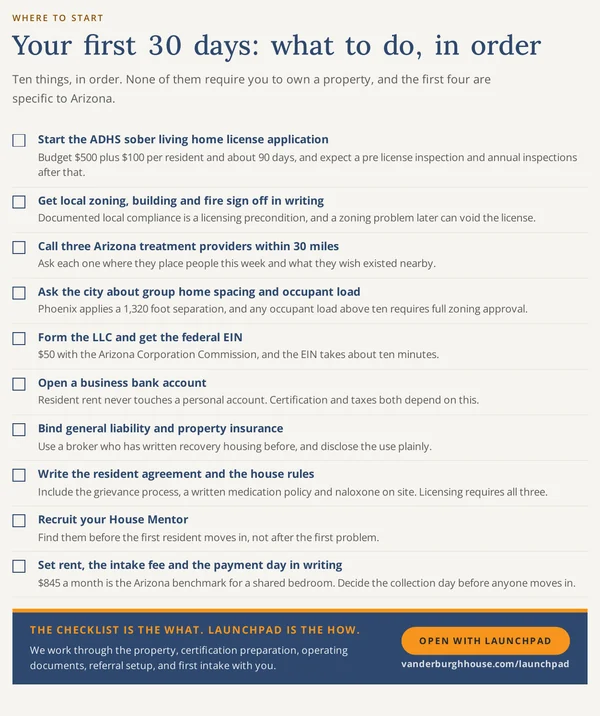
Your Mesa Sober House Startup Checklist
Every item below is covered somewhere above, and in Mesa none of them is optional. Work them in this order, because several of them gate the ones underneath.
Four guides cover the operating questions that come after the doors open.
How VSL Helps You Open a Sober House in Mesa
Vanderburgh Sober Living charters independently owned recovery homes into a cooperative network across more than a dozen states, and most of its Chartered Operators opened their first home with no prior experience in recovery housing. The help is aimed at exactly the points this page kept returning to: deciding a tenancy model before you sign, getting the spacing and overflight checks done in the right order, answering the Occupancy Confirmation Worksheet in a way that survives inspection, and pricing a ten-bed home rather than a fourteen-bed one.
There are two routes. The Launchpad program is self-paced, for operators who want the sequence and the templates and intend to do the work themselves. The Mastery program is done with you, with startup, certification and operating support from people who have taken homes through this process, and a Charter that carries the brand and the standards. If you have a specific Mesa address in hand, or you are weighing a lease in the Fiesta District against a purchase in Desert Uplands, that is a conversation worth having before you commit: tell us about the property and someone will walk through it with you.
Start your sober house
Pick the path that fits where you are in the process.
Download the free guidePath to Purposeful Recovery Housing, by Dr. Hunter T. Foote.Explore the Mastery ProgramHands-on startup, certification, and operating support.See how starting with VSL worksThe opportunity, the community, and what a Charter includes.Prefer to talk now? Call (844) 762-3747, weekdays 8a to 5p.
Educational only; not legal, financial, or medical advice. Fees, rents, and rules change, and the Mesa adjustments above are estimates built on the Arizona reference model. Confirm current requirements with Mesa, Maricopa County, and qualified professionals before you sign or spend.
Research & Sources
- Foote, H. T. (2026). Vanderburgh Sober Living Operating Climate Index, 2026 Edition. Vanderburgh Sober Living. https://www.vanderburghhouse.com/research/operating-climate-index-2026/
- Arizona State Legislature. (2026). Arizona Revised Statutes § 36-2062: Sober living homes; licensure; requirements. State of Arizona. https://www.azleg.gov/viewdocument/?docName=https://www.azleg.gov/ars/36/02062.htm
- City of Mesa. (2026). Mesa City Code § 11-86-2: Residential use classifications. Municode. https://library.municode.com/az/mesa/codes/code_of_ordinances?nodeId=COOR_TIT11ZOOR_ART8LAUSCLDE_CH86USTY_11-86-2REUSCL
- Maricopa County Department of Public Health. (2025). Overdose data. Maricopa County. https://www.maricopa.gov/6205/Overdose-Data
- Maricopa Association of Governments. (2026). 2026 Maricopa Regional Continuum of Care point-in-time count report. https://maricopacoc.org/wp-content/uploads/2026/05/2026-Maricopa-CoC-PIT-Report.pdf
- Arizona Department of Health Services. (2026). Licensed sober living homes, September 2026 [Data set]. Division of Licensing Services. https://www.azdhs.gov/documents/licensing/databases/2026/september/SOBER_LIVING_HOMES.xlsx
- U.S. Census Bureau. (2025). QuickFacts: Mesa city, Arizona. https://www.census.gov/quickfacts/fact/table/mesacityarizona/PST045224
- Arizona Department of Health Services. (2024). Licensed behavioral health residential facilities [Data set]. Division of Licensing Services. https://www.azdhs.gov/documents/licensing/databases/RESIDENTIAL_LIST.xls
- Arizona Supreme Court. (2026). Active standard probation supervision cases, May 2026. Adult Probation Services Division. https://www.azcourts.gov/Portals/0/25/Stats/StatsFY2026/Active%20SPS%20Cases%2005-2026_1.pdf
- City of Mesa. (2026). Off the Streets. Office of Homeless Solutions. https://www.mesaaz.gov/Resident-Resources/Housing/Human-Services/Office-of-Homeless-Solutions/Off-the-Streets
- City of Mesa. (2026). Light rail ridership [Data set]. Mesa Data Hub, Transit Services. https://data.mesaaz.gov/Transit-Services/Light-Rail-Ridership/pdpe-wbxu
- Arizona Health Care Cost Containment System. (2026). Four steps to review provider credibility: Elements of a credible sober living home. https://www.azahcccs.gov/Fraud/Downloads/4StepsToReviewProviderCredibility.pdf
- U.S. Census Bureau. (2025). QuickFacts: Maricopa County, Arizona. https://www.census.gov/quickfacts/fact/table/maricopacountyarizona/PST045225
- City of Mesa. (2026). Mesa City Code § 11-31-14: Community residences. Municode. https://library.municode.com/az/mesa/codes/code_of_ordinances?nodeId=COOR_TIT11ZOOR_ART4DERE_CH31STSPUSAC_11-31-14CORE
- City of Mesa. (2026). Mesa City Code Table 11-5-2: Land use, residential districts. Municode. https://library.municode.com/az/mesa/codes/code_of_ordinances?nodeId=COOR_TIT11ZOOR_ART2BAZO_CH5REDI_11-5-2LAUSRE
- City of Mesa. (2026). Mesa City Code Title 11, Chapter 5: Residential districts. Municode. https://library.municode.com/az/mesa/codes/code_of_ordinances?nodeId=COOR_TIT11ZOOR_ART2BAZO_CH5REDI
- City of Mesa. (2026). Community residences. Resident resources. https://www.mesaaz.gov/Resident-Resources/Community-Residences
- Arizona Corporation Commission. (2026). Fee schedule: Limited liability companies. https://azcc.gov/docs/default-source/corps-files/fee-schedules/fee-schedule-llcs.pdf
- Arizona Corporation Commission. (2026). Instructions: Articles of organization (L010i). https://azcc.gov/docs/default-source/corps-files/instructions/l010i-instructions-articles-of-organization.pdf
- City of Mesa. (2026). Mesa general business license. Business Services. https://www.mesaaz.gov/Business-Development/Licensing/Mesa-General-Business-License
- City of Mesa. (2026). Mesa City Code Title 5, Chapter 5: Business licenses. Municode. https://library.municode.com/az/mesa/codes/code_of_ordinances?nodeId=COOR_TIT5BURE_CH5BULI
- City of Mesa. (2026). Mesa City Code § 5-10-445: Rental, leasing and licensing of real property. Municode. https://library.municode.com/az/mesa/codes/code_of_ordinances?nodeId=COOR_TIT5BURE_CH10PREXTA_TACO_ARTIVPRTA_5-10-445RELELIUSREPR
- Arizona Department of Revenue. (2026). Model city tax code: City profile, Mesa. https://azdor.gov/model-city-tax-code/city-profile/mesa
- Arizona Secretary of State. (2019). Arizona Administrative Code Title 9, Chapter 12: Department of Health Services, Sober Living Homes. State of Arizona. https://apps.azsos.gov/public_services/Title_09/9-12.pdf
- U.S. Department of Housing and Urban Development. (2026). FY 2027 fair market rent schedule. Office of Policy Development and Research. https://www.huduser.gov/portal/datasets/fmr/fmr2027/FY2027_FMR_Schedule.pdf
- U.S. Department of Housing and Urban Development. (2025). FY 2026 fair market rent schedule. Office of Policy Development and Research. https://www.huduser.gov/portal/datasets/fmr/fmr2026/FY2026_FMR_Schedule.pdf
- U.S. Department of Housing and Urban Development. (2026). FY 2027 small area fair market rent schedule. Office of Policy Development and Research. https://www.huduser.gov/portal/datasets/fmr/fmr2027/FY2027_Small_Area_FMR_Schedule.pdf
- Arizona Regional Multiple Listing Service. (2026). Quarterly housing summary, second quarter 2026. https://armls.com/docs/Quarterly-Housing-Summary-2026-Q2.pdf
- Arizona Department of Health Services. (2026). Sober living homes: Licensing fact sheet. Bureau of Special Licensing. https://www.azdhs.gov/documents/licensing/special/sober-living-homes/sober-living-fact-sheet.pdf
- Arizona State Legislature. (2026). Arizona Revised Statutes § 36-2063: Inspections; civil penalties. State of Arizona. https://www.azleg.gov/viewdocument/?docName=https://www.azleg.gov/ars/36/02063.htm
- Arizona Department of Health Services. (2026). Licensed sober living homes: Annual report 2025. State of Arizona. https://www.azdhs.gov/documents/director/annual-report/sober-living-home/sober-living-home-reporting-2025.pdf
- City of Mesa. (2026). Occupancy confirmation worksheet: Residential care, non-treatment. Development Services. https://www.mesaaz.gov/files/assets/public/v/1/business-development/planning/occupancy-confirmation-worksheet.pdf
- City of Mesa. (2025). Amendments to the 2024 International Fire Code (Ordinance No. 5978, Resolution No. 12444, council file 25-1031, adopted December 8, 2025; codified at Mesa City Code Title 7, Chapter 2). https://legistar1.granicus.com/Mesa/attachments/893a0f62-1367-4208-a557-d189e7d78926.DOCX
- City of Mesa. (2025). Amendments to the 2024 International Residential Code (Ordinance No. 5981, Resolution No. 12451, council file 25-1015, adopted December 8, 2025; codified at Mesa City Code Title 4, Chapter 3). https://mesa.legistar.com/View.ashx?GUID=525CA71F-ADAE-4DA9-AF38-2DB0AE888F00&ID=14946666&M=F
- City of Mesa. (2026). Citywide schedule of fees and charges, updated for July 2026. Office of Management and Budget. https://www.mesaaz.gov/files/assets/public/v/14/government/omb/fees-charges/citywide-schedule-of-fees-and-charges.pdf
- City of Mesa. (2026). Community residence registration. Development Services, Planning Division. https://www.mesaaz.gov/Business-Development/Development-Services/Planning/Current-Planning/Community-Residence-Registration
- Arizona State Legislature. (2026). Arizona Revised Statutes § 36-2064: Certification; licensure; inspections. State of Arizona. https://www.azleg.gov/viewdocument/?docName=https://www.azleg.gov/ars/36/02064.htm
- Arizona Recovery Housing Association. (2026). About AzRHA: Certification and standards. https://www.myazrha.org/
- Arizona Health Care Cost Containment System. (2026). Crisis services and regional crisis lines. https://www.azahcccs.gov/BehavioralHealth/crisis.html
- City of Mesa. (2026). Mesa Municipal Community Court. Mesa Municipal Court. https://www.mesaaz.gov/Public-Safety/Court/Community-Court
- Maricopa County Superior Court. (2026). Regional Homeless Court: Case manager instructions. https://superiorcourt.maricopa.gov/departments/superior-court/homeless-court/case-manager-instructions/
- City of Mesa Board of Adjustment. (2026). Case ADJ 26004, BOA25-00843: Legacy Recovery Center transitional community residence special use permit. Mesa Legistar. https://webapi.legistar.com/v1/mesa/matters/23292
- City of Mesa Board of Adjustment. (2026). Case ADJ 26017, BOA26-00082: Skybridge Harmony Homes transitional community residence special use permit. Mesa Legistar. https://webapi.legistar.com/v1/mesa/matters/23553
- City of Mesa Board of Adjustment. (2026). Case ADJ 26046, BOA26-00528: Reasonable accommodation request. Mesa Legistar. https://webapi.legistar.com/v1/mesa/matters/24009
- City of Mesa. (2026). Neighborhood registration. Neighborhoods and Community Engagement. https://www.mesaaz.gov/Resident-Resources/Neighborhoods-Community-Engagement/Neighborhood-Registration
- City of Mesa. (2026). Long range planning and adopted sub-area plans. Development Services, Planning Division. https://www.mesaaz.gov/Business-Development/Development-Services/Planning/Long-Range-Planning
- City of Mesa. (2026). Historic preservation. Development Services, Planning Division. https://www.mesaaz.gov/Business-Development/Development-Services/Planning/Historic-Preservation
- City of Mesa. (2007). West Main Street area plan. Planning Division. https://www.mesaaz.gov/files/assets/public/v/1/business-development/planning/subareaplans/wmainfinalplan.pdf
- City of Mesa. (2024). MesaCONNECTED transit oriented development plan. Transportation Department. https://www.mesaaz.gov/files/assets/public/v/6/government/projects/mesaconnected/mesaconnected_tod_plan.pdf
- City of Mesa. (2003). Citrus sub-area plan. Planning Division. https://www.mesaaz.gov/files/assets/public/v/1/business-development/planning/subareaplans/citrus.pdf
- City of Mesa. (2006). Lehi sub-area plan. Planning Division. https://www.mesaaz.gov/files/assets/public/v/1/business-development/planning/subareaplans/lehi.pdf
- Maricopa County. (2026). Community residences and recovery communities. Planning and Development Department. https://www.maricopa.gov/6372/Community-Residences-Recovery-Communitie
- Arizona State Legislature. (2026). Arizona Revised Statutes § 36-2061: Definitions. State of Arizona. https://www.azleg.gov/viewdocument/?docName=https://www.azleg.gov/ars/36/02061.htm
- Arizona State Legislature. (2026). Arizona Revised Statutes § 36-2065: Referrals to licensed sober living homes. State of Arizona. https://www.azleg.gov/viewdocument/?docName=https://www.azleg.gov/ars/36/02065.htm
- City of Mesa. (2026). Mesa City Code Title 4: Building codes. Municode. https://library.municode.com/az/mesa/codes/code_of_ordinances?nodeId=COOR_TIT4BURE
- City of Mesa. (2026). Mesa City Code Title 7: Fire regulations. Municode. https://library.municode.com/az/mesa/codes/code_of_ordinances?nodeId=COOR_TIT7FIRE
- City of Mesa. (2026). Low-risk inspection information. Mesa Fire and Medical Department, Fire Prevention. https://www.mesaaz.gov/Public-Safety/Mesa-Fire-Medical/Fire-Prevention/Fire-Business-Services/Low-Risk-Inspection-Information
- City of Mesa. (2026). Mesa City Code Title 11, Chapter 87: Definitions. Municode. https://library.municode.com/az/mesa/codes/code_of_ordinances?nodeId=COOR_TIT11ZOOR_ART8LAUSCLDE_CH87DE
- SoCal Recovery, LLC v. City of Costa Mesa, 56 F.4th 802 (9th Cir. 2023). United States Court of Appeals for the Ninth Circuit. https://cdn.ca9.uscourts.gov/datastore/opinions/2023/01/03/20-55820.pdf
- U.S. Department of Justice & U.S. Department of Housing and Urban Development. (2016). Joint statement on state and local land use laws and practices and the application of the Fair Housing Act. https://www.justice.gov/opa/file/912366/dl
- U.S. Department of Housing and Urban Development & U.S. Department of Justice. (2004). Joint statement on reasonable accommodations under the Fair Housing Act. https://www.hud.gov/sites/documents/huddojstatement.pdf
- City of Mesa. (2021). Council file 21-0678: Ordinance No. 5632, amending Title 11 to replace group homes for the handicapped with community residences. Mesa Legistar. https://webapi.legistar.com/v1/mesa/matters/16249
- City of Mesa. (2023). Council file 23-0825: Presentation and direction on sober living homes in Mesa. Mesa Legistar. https://webapi.legistar.com/v1/mesa/matters/20246
- City of Mesa. (2026). Mesa City Code Title 5, Chapter 21: Reserved (structured sober living homes, repealed). Municode. https://library.municode.com/az/mesa/codes/code_of_ordinances?nodeId=COOR_TIT5BURE_CH21RE
- Arizona State Legislature. (2025). Senate Bill 1308, Laws 2025, Chapter 66: Sober living homes. 57th Legislature, First Regular Session. https://www.azleg.gov/legtext/57leg/1r/laws/0066.htm
- Arizona State Legislature. (2026). Arizona Revised Statutes § 9-462.14: Sober living homes; reasonable accommodation; building and fire codes. State of Arizona. https://www.azleg.gov/viewdocument/?docName=https://www.azleg.gov/ars/9/00462-14.htm
- The Ohio House, LLC v. City of Costa Mesa, 122 F.4th 1097 (9th Cir. 2024, amended 2025). United States Court of Appeals for the Ninth Circuit. https://cdn.ca9.uscourts.gov/datastore/opinions/2025/04/24/22-56181.pdf
- City of Edmonds v. Oxford House, Inc., 514 U.S. 725 (1995). Library of Congress, U.S. Reports. https://tile.loc.gov/storage-services/service/ll/usrep/usrep514/usrep514725/usrep514725.pdf
- Maricopa County. (2025). Maricopa County zoning ordinance. Planning and Development Department. https://www.maricopa.gov/DocumentCenter/View/4785/P-18—Zoning-Ordinance-PDF
- City of Mesa. (2026). Mesa building code. Development Services, Building Permit and Plan Review. https://www.mesaaz.gov/Business-Development/Development-Services/Building-Permit-Plan-Review/Mesa-Building-Code
- City of Mesa. (2025). Amendments to the 2024 International Building Code (Ordinance No. 5980, Resolution No. 12450, council file 25-1013, adopted December 8, 2025; codified at Mesa City Code Title 4, Chapter 2). https://legistar1.granicus.com/Mesa/attachments/0ee5f4a7-4122-4b0b-8088-4c977a927283.docx
- City of Mesa. (2026). Transaction privilege (TPT) tax. Business Services. https://www.mesaaz.gov/Business-Development/Transaction-Privilege-TPT-Tax
- Arizona Health Care Cost Containment System. (2026). Medical policy manual chapter 1720: Housing and health opportunities. https://www.azahcccs.gov/shared/Downloads/MedicalPolicyManual/1700/1720.pdf
- Arizona Health Care Cost Containment System. (2026). Fee-for-service provider manual chapter 29: H2O services. https://www.azahcccs.gov/PlansProviders/Downloads/FFSProviderManual/FFS_Chap29H2OServices.pdf
- Arizona Health Care Cost Containment System. (2024). AHCCCS awards H2O program administrator contract. https://www.azahcccs.gov/shared/News/GeneralNews/H2OProgramAdministratorAward.html
- Arizona Health Care Cost Containment System. (2026). AHCCCS Housing Program. https://www.azahcccs.gov/AHCCCS/Initiatives/AHP/
- Maricopa County. (2026). Tax rates, tax year 2026. Office of the Board of Supervisors. https://www.maricopa.gov/DocumentCenter/View/123385/Tax-Rate-2026-PDF
- Arizona Department of Revenue. (2024). Arizona property taxation. https://azdor.gov/sites/default/files/2023-03/PROPERTY_AZPropertyTaxation.pdf
- Maricopa County Superior Court. (2026). Adult probation specialized services. https://superiorcourt.maricopa.gov/departments/probation-offices/adult-probation/specialized-services/
- Maricopa County Superior Court. (2026). Criminal Mental Health Court. https://superiorcourt.maricopa.gov/departments/superior-court/criminal/specialized-courts/criminal-mental-health/
- City of Mesa. (2026). Veterans Treatment Court. Mesa Municipal Court. https://www.mesaaz.gov/government/court/veterans-treatment-court
- Maricopa Regional Continuum of Care. (2026). Get help: Coordinated entry access points. https://maricopacoc.org/get-help/
- Maricopa County. (2026). Smart Justice. Human Services Department. https://www.maricopa.gov/3783/Smart-Justice
- U.S. Department of Veterans Affairs. (2026). Homeless veteran care. Phoenix VA Health Care System. https://www.va.gov/phoenix-health-care/health-services/homeless-veteran-care/
- Community Bridges, Inc. (2026). Supportive housing services. https://communitybridgesinc.org/service/supportive-housing/
- Terros Health. (2026). Residential substance use treatment. https://terroshealth.org/programs-category/residential-substance-use-treatment/
- Alcoholics Anonymous, Phoenix Area Intergroup. (2026). Meetings and 24-hour helpline. https://aaphoenix.org/
- Narcotics Anonymous, Arizona Region. (2026). Meetings and regional helpline. https://www.arizona-na.org/