Gilbert is one of the few Arizona municipalities that regulates recovery residences by name, and an operator here answers to three authorities at once. Arizona licenses the home: A.R.S. § 36-2062(E) makes it unlawful to run a sober living home in the state without a current license from the Arizona Department of Health Services, and A.A.C. R9-12-103 prices that license at $500 plus $100 for every resident on the licensed maximum. The Town of Gilbert permits the use by right in every residential district, then caps it at five residents and holds it 1,200 feet from the next recovery residence or group home under Land Development Code Section 5.1.6. Maricopa County sets a different rule outside town limits, and the county is also where publicly funded residents come from, through Mercy Care, the Medicaid contractor for the county, the courts, and probation.
The need behind those rules is measurable. Maricopa County recorded 1,500 fatal overdoses in 2024, with methamphetamine involved in 67 percent of them and fentanyl in 59 percent, and the county’s 2026 point-in-time count counted 9,726 people experiencing homelessness on a single night in January 2026.
This guide is about Gilbert: how the town’s own code classifies a recovery residence, what the five-resident cap and the 1,200-foot separation do to a site search, which Gilbert desks issue what, what a house actually costs here, and which local organizations put residents in beds. Arizona’s statewide licensing scheme, the AzRHA certification process, and the full startup and revenue models belong to the Arizona guide and its spokes, and the shared figures on this page are restated from them rather than recalculated. Where a number is local, it is linked to the agency that published it.
Before you read onHow to Open a Sober Living Home in ArizonaThis post covers one piece of the process. The complete Arizona guide walks through every step, from planning to your first resident.→Watch: How to Start a Sober Living Home in Arizona
The video walks the Arizona sequence end to end: the line between housing and treatment that decides whether you need a behavioral health license at all, what ADHS requires of a licensed sober living home, how AzRHA certification fits alongside it, and how to plan a startup budget that survives contact with a real property. Everything after it on this page applies that sequence to Gilbert, where the town adds a registration, a business license, an operations and management plan, and a separation rule the state does not impose.
The Arizona book covers the same ground in print, with the checklists and templates an operator needs on day one.
Is Gilbert a Good Place to Open a Sober Living Home?
Yes, if you build for five residents rather than fourteen. Gilbert is a high-income, low-crime town of 287,285 people sitting inside a county with real and documented demand, it permits recovery residences by right in every residential district, and it charges $210 for the group home application rather than running operators through a $3,000 use permit. The constraint is scale: Section 5.1.6 caps a recovery residence at five residents excluding staff, so the fourteen-bed economics that carry the Arizona reference model are not available inside town limits, and the same mortgage has to be covered by a third as many beds.
Where Recovery Housing Demand in Gilbert Actually Comes From
Gilbert itself produces relatively few of its own residents. The town is affluent and stable, so most of the people who will fill a Gilbert bed arrive through countywide systems that happen to discharge into the East Valley.
- Courts and probation: Maricopa County Superior Court runs adult drug court and a homeless court, and county adult probation supervises more than 28,000 people. A judge or probation officer who orders structured housing is the single most reliable source of a filled bed in this county.
- Jail release: Maricopa County Correctional Health Services discharges people from the county jails with a reactivated AHCCCS enrollment and a housing plan, which is a scheduled, predictable flow rather than a walk-in.
- Treatment discharge: No hospital in Gilbert operates an inpatient psychiatric or detox unit, so step-downs come from freestanding providers such as Community Bridges and Terros Health in Mesa, Chandler, and Tempe, and from Banner Behavioral Health in Scottsdale.
- Crisis response: Gilbert Police Department has run a Crisis Response Team since October 2022, pairing crisis-trained officers with behavioral health support on calls that would otherwise end in an arrest. Those officers need somewhere to send people.
- Private pay: Gilbert has a median household income of $122,551, and families paying out of pocket for a son or daughter are a larger share of this market than they are in most Arizona cities.
The figures a lender or a referral partner asks for first are county figures, because that is the geography the data is collected in. Each one below is linked to the agency that publishes it.
| Indicator | Gilbert figure | Why it matters to an operator |
|---|---|---|
| Fatal overdoses, Maricopa County (2024) | 1,500, down from 1,554 in 2023; methamphetamine involved in 67 percent, fentanyl in 59 percent | Demand is real and slowly falling. Build the business on referral relationships rather than on the assumption that need alone fills beds. |
| People experiencing homelessness, Maricopa County (January 2026) | 9,726, of whom 4,567 were unsheltered; 1,324 self-reported substance use | The unsheltered half is the population county outreach is trying to place, and placement requires a licensed home. |
| Adults under county probation supervision | more than 28,000 | Probation is the highest-volume single referral channel in Maricopa County and it places directly into named homes. |
| Licensed behavioral health residential facilities, Maricopa County | 632 of 830 statewide, 28 of them in Gilbert (dataset run 3 February 2025) | The East Valley already has treatment capacity. What it discharges into is the gap a recovery residence fills. |
| Median gross rent, Gilbert | $2,110 per month | A recovery residence competes for the same houses as market renters, and this is the floor a landlord is comparing your offer against. |
| Housing units with four or more bedrooms, Gilbert | 43,720, or 43.6 percent of all units | Gilbert has an unusually deep supply of large houses, which is the town’s single biggest advantage for this use. |
Arizona scores 4 out of 10 on the VSL Operating Climate Index composite (Foote, 2026), which classifies the state as highly regulated and records a mandatory operating license. The state reads 6 for Market Strength and 2 for both Resident Funding Access and Operator Funding Access, and Gilbert is a sharp illustration of that split: the market is strong, the housing stock is deep, and almost none of the money that fills beds elsewhere is available here. Scores are rubric-scored against published anchored rubrics rather than measured.
Gilbert permits recovery residences by right in all nine single-family districts and all three multifamily districts, with no use permit. The cost of that permissiveness is the cap: five residents excluding staff and minor children, and 1,200 feet of separation from the next recovery residence or group home. Site selection in Gilbert is therefore a separation problem before it is a price problem.
Most people ask whether they are allowed to open a recovery home. The better first question is whether the need and the money are there. This answers both, for your state.
- How many people need a bed, and how few beds exist
- Who actually pays the rent, and which programs are real
- What it costs to open on the purchase path and the lease path
How to Open a Sober House in Gilbert: Step-by-Step
The statewide order lives in the Arizona guide. This version is sequenced for Gilbert because of a loop the state guide does not have to deal with: A.R.S. § 36-2062(C) makes local zoning, building, and fire compliance documentation a condition of the ADHS license, while Gilbert’s Section 5.1.6(C)(4)(d) requires the applicant to hand the town a copy of that same state license. Neither office will wait for the other, so the Gilbert steps run the town registration and the ADHS application in parallel and put the separation check before either of them.
Budget six to nine months from first address search to first resident. The two schedule risks specific to Gilbert are finding a compliant address inside the 1,200-foot rule and the ADHS review clock, which runs up to 90 calendar days overall under A.A.C. R9-12-106.
Ten steps, in the order a Gilbert operator actually meets them.
Step 1. Run the Separation Check Before You Offer on Anything
Open the Town of Gilbert zoning map on the town’s open data portal and confirm the parcel is inside Gilbert town limits and in a residential district. Recovery residences are permitted by right in SF-43, SF-35, SF-15, SF-10, SF-8, SF-7, SF-6, SF-D and SF-A, and in MF/L, MF/M and MF/H, with no use permit required. If the parcel turns out to be in unincorporated Maricopa County rather than Gilbert, a completely different ordinance applies and the analysis restarts.
Then check the block. Section 5.1.6(C)(2) requires 1,200 feet between recovery residences, and between a recovery residence and a group home, measured from the closest property lines, unless the two are separated by a utility right-of-way at least 300 feet wide or by a freeway, arterial street, canal, or railroad. Gilbert registers these homes, so the town knows where the existing ones are. Ask the Planning Division before you write an offer, not after, and treat a $470 zoning confirmation letter as cheap insurance on a $605,000 purchase.
Arizona guideArizona Zoning, Fair Housing, and Land Use Laws for Sober LivingWhere sober homes can operate in Arizona and the legal protections that apply.→Step 2. Form the Entity and Get the Gilbert Business License
The entity signs the lease or takes title, not you. Arizona Corporation Commission articles of organization cost $50 to file, or $85 expedited, and because Maricopa County has more than 800,000 residents, A.R.S. § 29-3201(G) exempts a Gilbert LLC from the newspaper publication requirement that catches operators in rural counties. Get the EIN and open the bank account before the first resident pays anything.
Gilbert then requires two separate filings that operators routinely conflate. A business license: every commercial and home-based business in town needs one, at $50 plus a $17 activation fee, applied for through the One Stop Shop. The group home application is the second, at $210 on the current fee schedule, and Section 5.1.6 makes it effective only once the zoning administrator verifies it and the operator holds a valid Gilbert business license. Add the state transaction privilege tax license at $12 to the state plus $2 to Gilbert.
Arizona guideHow to Form a Legal Entity for a Sober Living Business in ArizonaLLC, nonprofit, or both: how Arizona operators structure the business and the property.→Step 3. Choose a House That Works at Five Residents
Gilbert’s advantage is its housing stock and its limit is the resident cap, so the property has to earn its keep on five beds rather than ten. ADHS sets the physical minimums the house must meet, and they are specific.
- A bedroom used by one resident must be at least 60 square feet, and a shared bedroom at least 50 square feet per resident (A.A.C. R9-12-207(C)(1)(e)).
- Every bedroom needs at least one openable window or door to the outside for use as an emergency exit, and must be separated from halls and other habitable rooms by floor-to-ceiling walls.
- One bathroom is required for each five residents, with a working toilet, a sink with running water, and a bathtub or shower with a slip-resistant surface.
- The home must hold between 70 and 84 degrees Fahrenheit at all times, and must have a working washer and dryer accessible to residents.
- Every resident needs a separate adult-sized bed and individual storage, plus a lockable or otherwise secure place for medications and valuables.
Two anchors set the budget, and both are Gilbert numbers rather than state ones. On the lease path, the FY2027 HUD fair market rent for a four-bedroom in the Phoenix-Mesa-Chandler metro is $2,537 a month, but the small area fair market rents for Gilbert’s own ZIP codes run from $2,970 in 85233 to $3,800 in 85298, so the metro figure will understate a Gilbert lease by a wide margin. On the purchase path, the median single-family sale price in Gilbert was $605,000 in August 2026, against $499,990 countywide. Those two figures drive the cost table further down this page.
Arizona guideSober Living Startup Costs in ArizonaEvery one-time cost to open, on the lease path and the purchase path, with the Arizona figures behind each line.→Step 4. Settle the Certificate of Occupancy and the Bedroom Count
Gilbert runs on the 2018 International Residential Code and the 2018 International Fire Code, adopted by Ordinance No. 2739 on 7 November 2019. A single-family house occupied by five residents who live independently stays an IRC dwelling: the R-4 trip in the building code is more than five persons who also receive custodial care, and a peer-supported recovery residence provides neither treatment nor custodial care. Arizona reinforces this directly, because A.R.S. § 9-462.14(B) bars a municipality from reclassifying a single-family home under a local building or fire code solely because it is the subject of a sober living home license application.
The trap is the house, not the classification. Pull the address in the Gilbert One Stop Shop permit portal and cross-check it against the town’s open permits dataset before you close, looking for garage conversions, enclosed patios, casitas over 200 square feet, and any added bedroom without a compliant emergency escape opening. Because ADHS prints the maximum resident count on the license, a bedroom you cannot legalize is a bed you cannot license, and on a five-bed cap losing one is losing 20 percent of the revenue.
Step 5. Write the Operations and Management Plan Before You Need It
Gilbert is unusual in requiring the plan up front. Section 5.1.6(B) requires an operations and management plan at registration covering the owner and property owner details, an emergency contact, the number of persons per bedroom, the maximum occupants, a floor plan, the resident screening process, and the rules of conduct for residents and guests. ADHS asks for the same substance from a different angle: A.A.C. R9-12-201(A)(2) requires documented policies that identify a named person for neighbors to contact, require that person to respond even when the issue cannot be resolved, and set enforceable rules on parking, noise, smoking, cleanliness of the public space near the home, and loitering.
Write both while the house is empty. The document most operators skip is the one Gilbert and ADHS both effectively require, which is a neighbor relations plan that says who answers the phone and what they say. In a town that registers these homes and publishes a page inviting residents to report unlicensed ones, that plan is the difference between a complaint that ends in a conversation and one that ends at the zoning administrator’s desk.
Keep readingHouse Rules in Sober HousesThe rules that keep a recovery home safe, structured, and worth living in.→Step 6. Quote Insurance on the Specific Address
Insurance is one of the lines the Arizona startup model can only range, because it is priced on the building and the operation rather than on the state. Gilbert pushes it up at both ends: a $605,000 median sale price means a dwelling replacement cost well above the statewide assumption, and a five-resident cap means that cost is spread across a third as many beds as the state model carries. Get a quote on the actual address before you sign, and tell the carrier plainly that the home is a licensed sober living home with five residents and a live-in house mentor.
Ask what the carrier requires for the alarm and extinguisher package, whether the policy covers resident property, and how it treats a vacancy period, which on a five-bed house can arrive faster than on a fourteen-bed one. Bind coverage to start the day you take possession rather than the day the first resident moves in.
Step 7. Place a Live-In House Mentor
A house mentor is what makes a NARR Level II home a Level II home, and Gilbert’s cap makes the role unusually expensive in proportion. Section 5.1.6(C)(3) counts five residents excluding staff, and ADHS excludes the live-in manager from the fee calculation, so the mentor does not consume a licensed bed. Recruit through the East Valley recovery community, put the arrangement in writing including what the free or reduced room is worth, and move the mentor in before the first resident so the house has a culture before it has a census.
Step 8. Apply to ADHS, Then Certify with AzRHA
Licensure is mandatory in Arizona and it is the gate on everything else. A.R.S. § 36-2062(E) requires the license; A.A.C. R9-12-103 prices it at $500 plus $100 per resident on the licensed maximum, which is $1,000 at Gilbert’s five-resident cap; the license runs one year; and A.R.S. § 36-2065 reserves state and federal funding, state agency referrals, and referrals from licensed treatment providers to licensed homes only. Applications now go through the ADHS Licensing Management System rather than on paper.
AzRHA certification is voluntary in law and close to expected in practice, and it also removes a step: under A.R.S. § 36-2064, ADHS issues the license without an initial on-site inspection to a home already certified by a recognized certifying organization. The AzRHA process runs in four stages.
- Apply online with all fees paid and documents uploaded; AzRHA reviews for completeness within seven business days.
- Sit a board interview with two or three board members, with notice of the outcome within three business days.
- Host the on-site inspection, with the inspector’s report filed within three business days.
- Receive the accreditation decision, full, conditional, or denied, within seven business days of that report.
Step 9. Open the Referral Doors Before You Open the House
In Maricopa County the publicly funded pathway runs through AHCCCS and Mercy Care rather than through the town, and none of it reaches an unlicensed home. Start the relationships while the house is still being furnished: call the partners in the table further down this page, invite three of them to walk through, ask probation and the drug court team what they need to see in a placement packet, and get listed in the AzRHA directory the moment certification lands. Those weeks cost nothing while the mortgage has not started and are the most expensive weeks of the year once it has.
Step 10. Open at Five Beds and Hold Them
The Arizona reference model breaks even at roughly 48 percent occupancy across fourteen beds, which is a comfortable cushion. Gilbert does not give you that cushion: with five beds, a single empty room is 20 percent of capacity, so the discipline that matters is admissions pace and turnover rather than marketing spend. Run a weekly house meeting, track occupancy daily, and send a short monthly note to every referral partner saying how many beds are open, because a referral source that hears from you monthly sends first.
Keep readingHow Sober Houses Fill Beds and Stay FullProven occupancy strategies from established recovery housing operators.→The phases below assume a lease rather than a purchase, and an address that clears the separation rule on the first or second try.
| Phase | Weeks (estimated) | What gets done |
|---|---|---|
| Site search and separation check | 2 to 8 | Zoning map review, calls to the Planning Division on candidate blocks, and a zoning confirmation letter on the address you intend to take. |
| Entity, licenses, and lease | 2 to 4 | Articles of organization, EIN, bank account, Gilbert business license, transaction privilege tax license, and a signed lease or an accepted offer. |
| Property readiness | 3 to 6 | Permit history review, any bedroom or egress corrections, furnishing, alarms, extinguisher, and the posted evacuation path. |
| Documents and registration | 2 to 4 | Operations and management plan, house rules, neighbor relations plan, screening policy, and the Section 5.1.6 registration with Development Services. |
| ADHS licensure | Up to 13 | A.A.C. R9-12-106 allows 90 calendar days overall, 30 for administrative completeness and 60 substantive. |
| AzRHA certification | 4 to 10 | Membership, application review, board interview, on-site inspection, and the accreditation decision. |
| Referral outreach and lease-up | 4 to 12 | Partner visits, directory listings, and filling the first five beds. |
Timelines are estimated. In Gilbert the two things that add months are a separation conflict that forces a second address, which resets the entire property track, and the ADHS review clock, which can be extended by written agreement by up to a further 25 percent of the overall timeframe.
Best Neighborhoods for a Sober Living Home in Gilbert
Gilbert changes what a good address means. In most cities the tests are transit and treatment access; here the binding test is arithmetic, because a compliant parcel has to sit 1,200 feet from every other recovery residence and group home in town.
- Separation: Check the block before the house. In a town that registers these homes and permits them in every residential district, the good blocks fill up, and the older, cheaper parts of Gilbert are where the existing homes already are.
- Bedroom count at five residents: A five-bedroom house is the efficient shape here, because the cap counts residents rather than beds and a sixth bedroom earns nothing. Gilbert has 43,720 units with four or more bedrooms, so the stock exists.
- Transit, or the honest admission that there is none: Gilbert has no light rail and three bus routes that meaningfully touch it. Outside the Gilbert Road corridor, a house without a vehicle does not work.
- HOA reality: Almost every master-planned community in Gilbert has an active association with design review. An HOA cannot override the Fair Housing Act, but it can generate the complaint that starts the conversation, which is a reason to introduce yourself early rather than a reason to avoid the neighborhood.
Five areas follow, with housing and transit drawn from the Gilbert General Plan 2020, Valley Metro, and Census data at the ZIP level. Two Gilbert communities are worth ruling out at the start: Trilogy at Power Ranch is age-restricted housing for older persons, and Circle G Ranches lists from roughly $1.5 million, which no five-bed model supports.
| Area | Housing stock and transit | Siting notes for a sober living home |
|---|---|---|
| Heritage District | Gilbert’s original downtown and the subject of the 2018 Heritage District Redevelopment Plan. Single-family homes average about 2,390 square feet on median lots near 4,800 square feet, with stock ranging from early-1900s to new infill. The Gilbert Park-and-Ride at 216 N Oak St is here, and Route 136 runs the Gilbert Road corridor north to the light rail terminus in Mesa. | The only part of Gilbert with usable transit service, and the one place a resident without a car can reach a job and a meeting. The lots are small and the redevelopment plan means active rezoning around you, so confirm the parcel’s district and the separation distance carefully. |
| Val Vista Lakes | The oldest master-planned community in town, built from 1986 to 2005 across roughly 900 acres in ZIP 85234, with homes from one to six bedrooms and a professionally managed association. No fixed bus route runs inside it. | Lowest entry price per bedroom of the Gilbert master-planned communities, and the large 1990s floor plans suit a five-resident house. The association is well staffed and enforces its covenants, so the neighbor relations plan earns its keep here. |
| Morrison Ranch | Roughly 3,000 acres across seven residential sections built from 1999 to 2022, with two- to six-bedroom homes, wide parkways, and generous lots. Bus service does not enter the community. | The deepest supply of four- and five-bedroom homes at mid-market prices in Gilbert, and lots large enough that five residents’ vehicles do not spill into the street, which is the complaint that most often reaches a town. |
| Power Ranch | Eleven neighborhoods built from 2000 to 2015 in ZIP 85297, two to six bedrooms, with 200 acres of open space and 26 miles of trails. Household size in this ZIP averages 3.2 people, the highest in Gilbert. | Newer stock and layered sub-association dues raise the carrying cost, and Trilogy at Power Ranch inside the same community is age-restricted and unavailable. Check which sub-association governs the specific parcel before you offer. |
| Cooley Station | Built from 2005 to 2020 in south Gilbert between ASU Polytechnic and San Tan Village, two to six bedrooms, close to Loop 202. Route 156 terminates at ASU Polytechnic and Route 184 runs the Power Road corridor. | The best south-Gilbert option for transit, and the newest stock on the list, which usually means fewer permit-history surprises. It is also the furthest from the county services in central Phoenix that residents are referred from. |
Across all five, the same house features decide it.
- Five real bedrooms: Each at least 60 square feet for single occupancy or 50 per resident when shared, each with an openable window or door to the outside, and each separated by floor-to-ceiling walls.
- Two bathrooms: One per five residents is the ADHS minimum, but a single bathroom for five adults on a working schedule is the fastest way to lose a resident.
- Off-street parking for four or more vehicles: Parking is the first thing a neighbor counts and the first item ADHS requires the good neighbor policy to address.
- A permit history that matches the floor plan: ADHS requires a floor plan showing bedroom locations and sizes, and it prints the licensed maximum on the license, so an unpermitted bedroom costs a bed.
Neighboring East Valley cities run under their own codes and their own separation rules, so an address a mile away can sit under a different scheme entirely. Mesa, Phoenix, Chandler, Queen Creek, and Apache Junction each regulate this use separately, and unincorporated Maricopa County pockets near Gilbert follow the county ordinance rather than the town’s.
- ✓Room-by-room requirements for a Level II home
- ✓Zoning and occupancy questions to ask before you tour
- ✓The red flags that should end a showing early
Who Regulates Sober Living Homes in Gilbert?
No single agency regulates a sober living home in Gilbert. The state licenses the operation, the state’s NARR affiliate certifies the standard voluntarily, the town controls the land use and two separate registrations, and the county controls the money and most of the referrals.
A sober living home in Arizona is defined by statute rather than by custom. A.R.S. § 36-2061 describes it as premises providing alcohol-free and drug-free housing in a supervised, monitored, or peer-led environment for people in recovery, and expressly excludes premises licensed to provide on-site medical services, behavioral health services, or medication administration. That exclusion is the line that matters: the moment a home delivers treatment on site it becomes a health care institution under a different licensing scheme, and the moment it advertises itself as offering a recovery environment it falls inside this one whether or not it wants to.
| Layer | Agency | What it controls for a sober living home |
|---|---|---|
| State licensing | Arizona Department of Health Services (ADHS), Bureau of Behavioral Health Facilities Licensing | Mandatory licensure under A.R.S. § 36-2062; $500 plus $100 per resident on the licensed maximum under A.A.C. R9-12-103; one-year term; on-site inspection before licensure and at least annually, waived for a home already certified by a recognized certifying organization under § 36-2064. Operating without a license carries a civil penalty of up to $1,000 per violation, with each day a separate violation, under § 36-2063. Providing medical or behavioral health services on site moves the home into health care institution licensure instead. |
| State certification (voluntary) | Arizona Recovery Housing Association (AzRHA), the NARR affiliate for Arizona | Certifies homes against NARR quality standards for Levels I, II, and IV. Not required by law, but it waives the ADHS initial inspection and it is what referral partners look for. |
| Town zoning and registration | Gilbert Development Services, Planning Division | Permits recovery residences by right in all nine single-family and three multifamily districts; caps residents at five excluding staff and minor children; imposes the 1,200-foot separation; requires registration, an operations and management plan, and a copy of the ADHS license, under Land Development Code Section 5.1.6. |
| Town business licensing | Gilbert Development Services, Business Registration and Licensing | Requires a business license for every commercial and home-based business in Gilbert, at $50 plus a $17 activation fee. Section 5.1.6 makes a valid business license a condition of the recovery residence registration taking effect. |
| Town building code | Gilbert Development Services, Plan Review and Inspection | Enforces the 2018 International Residential and Building Codes adopted by Ordinance No. 2739, including the certificate of occupancy requirement and permits for any bedroom or egress work. |
| Town fire code | Gilbert Fire and Rescue | Enforces the 2018 International Fire Code as amended. Gilbert’s own amendment to IFC 102.5 limits the fire code’s reach into an IRC dwelling to exterior construction provisions plus administrative, operational, hazardous materials, and maintenance provisions. Its published inspection programs include a Group Home Annual Inspection. |
| County zoning (outside town limits) | Maricopa County Planning and Development | Runs a separate scheme for unincorporated areas under the Maricopa County Zoning Ordinance Section 907 and Directive DD-3500-01: community residences of six to ten residents, permitted in every district except C-O and C-S, with a 1,200-foot separation, a licensure or certification gate on the certificate of occupancy, a bar on adjudicated residents, and a one-year protection period. |
| County funding and referrals | Mercy Care, the AHCCCS complete care contractor for Maricopa County | Authorizes housing support services and coordinates the AHCCCS Housing and Health Opportunities demonstration, which is the Medicaid pathway that can pay toward a transitional bed. The county courts, probation, and jail discharge planners control most of the rest. |
The short version for an operator.
- State license: Required, and not optional in any form. Budget $1,000 a year at a five-resident maximum and expect up to 90 days for the initial review.
- Town licenses: Two of them. A $50 business license and a $210 group home application, both through Development Services, plus a registration that only takes effect once the zoning administrator verifies it.
- Certification: Voluntary by law and close to necessary in practice, at $400 membership, $100 for a Level II inspection, and $10 per bed per year.
- Referrals: County-controlled and license-gated. An unlicensed home is ineligible for state and federal funding and cannot receive a referral from a state agency or a licensed treatment provider.
Licensing is the expensive part of this list but it is not the hard part, because the rules are published and the fees are fixed. The part that decides whether a Gilbert home happens at all is the zoning, and specifically two numbers in Section 5.1.6.
Gilbert Zoning Laws for Sober Living Homes
Gilbert has a recovery residence ordinance, which most Arizona municipalities do not. Section 5.1.6 of the Land Development Code permits the use by right in every residential district with no use permit, and then attaches a five-resident cap, a 1,200-foot separation requirement, a registration, an operations and management plan, a business license condition, and a requirement to hand the town a copy of the state license. There is no moratorium, no overlay, and no discretionary hearing. The constraints are written into the code itself, which makes them predictable and also makes them hard to argue with.
How the Gilbert Land Development Code Treats a Recovery Residence
The code carries the use category by name rather than forcing a recovery residence into a group home or boarding house definition, which is what most Arizona codes do. Gilbert has no boarding house or rooming house category at all; its nearest analogues are the congregate living facility, the dormitory, and the shelter care facility, none of which apply to a five-person home.
- Recovery residence: Chapter 1, Section 2 of the Land Development Code defines it as a dwelling unit or building used to provide a stable, clean and sober environment for individuals recovering from substance abuse, where residents do not live together as a single housekeeping unit and every resident other than the live-in manager, whom the code calls the “House Manager,” and any minor children is an individual with a disability. The definition cross-references A.R.S. §§ 9-10-101, 36-425.06 and 36-401.
- Family: The same section defines a family as people related by blood, marriage or adoption living as a single housekeeping unit, or not more than five unrelated persons living as a single housekeeping unit, or a functional family of not more than five persons. That five is where Gilbert’s resident cap comes from.
- Single housekeeping unit: An interactive group jointly occupying a residential unit under a single written lease, where the household’s makeup is determined by the residents rather than by the landlord. The recovery residence definition expressly says residents do not meet this test, which is why the use has its own category.
- Group homes for the handicapped: A separate category at Section 5.1.5, for a facility licensed or authorized by a governmental authority for persons with disabilities who live as a single housekeeping unit and receive care, supervision or counseling from staff. It shares the 1,200-foot separation and the five-resident cap, but allows up to ten where a state license permits it.
- Permitted districts: Recovery residences are marked permitted by right in SF-43, SF-35, SF-15, SF-10, SF-8, SF-7, SF-6, SF-D and SF-A, and in MF/L, MF/M and MF/H. No use permit is required in any residential district, which matters because Gilbert’s use permit fee is $3,000.
Gilbert has also put its position in writing in plain language. The town publishes a Group Homes and Recovery Residences page that states homes may serve a maximum of five residents excluding staff, that Gilbert’s zoning allows them in all residential areas, and that there must be 1,200 feet between group and recovery homes. A municipality that has already published its own reading of its code is the strongest citation available on a page like this, because it removes the argument about what the code means.
Gilbert’s land use rules are not in the Code of Gilbert on Municode. The Town Clerk’s office states plainly that the Code of Gilbert does not contain land use laws and regulations, which all live in the separate Land Development Code. An operator or attorney searching Municode for a sober living ordinance will find nothing and conclude wrongly that Gilbert has no rule.
What the Five-Person Rule Does and Does Not Do
Operators arrive quoting a statewide six-or-fewer protection, and in Arizona that is two different statutes doing two different jobs, neither of which is a general license to exceed five residents in Gilbert.
- The six-or-fewer statute: A.R.S. § 36-582 treats a residential facility serving six or fewer persons as a residential use for all local zoning purposes, deems the residents and operators a family, voids any local ordinance that distinguishes such a facility from a single-family dwelling, and bars any conditional use permit or variance not required of a single-family residence. It also imposes its own 1,200-foot radius between facilities.
- The limit on § 36-582: Subsection (K) applies the article only to residential facilities licensed, operated, supported or supervised by the department in the developmental disabilities context. It is not a general sober living statute, and an operator quoting it as one will be corrected.
- The statute that actually applies: A.R.S. § 9-462.14 is the provision that reaches sober living homes. Subsection (A) requires a municipality that restricts the distance between sober living homes, or that enacts building or fire code requirements for them, to establish a procedure for granting a deviation as a reasonable accommodation under the Fair Housing Act. Subsection (B) bars a municipality from reclassifying a single-family home under a local building or fire code solely because it is the subject of a sober living home license application. It was added by SB 1308, Laws 2025, Chapter 66 in 2025.
- What this leaves: Gilbert’s five-resident cap stands as written. What does not stand is a refusal to consider an exception, because § 9-462.14(A) obliges the town to run a deviation procedure, and Section 5.1.6(D) supplies one.
The real protection comes from disability status under the federal Fair Housing Act, which reaches people in recovery from substance use disorder, and from the duty to grant a reasonable accommodation where one is necessary to afford equal opportunity to use and enjoy a dwelling. Section 5.1.6(D) lets an owner submit a written request for accommodation to the zoning administrator with the reasons it is required, and the administrator decides in consultation with the town attorney. The two pieces of Gilbert practice worth understanding before you need them are how zoning protections apply to recovery housing generally and the way the Ninth Circuit has handled separation rules.
Keep readingThe Federal Fair Housing Act and Sober Living: Everything You Need to KnowThe federal protections every operator, neighbor, and local official should understand.→Section 5.1.6, the 1,200-Foot Separation, and the Deviation Gilbert Must Offer
Gilbert’s recovery residence rule is codified rather than pending. It sits inside the Land Development Code adopted by Ordinance No. 2809 on 21 September 2021 and effective 21 October 2021, and the recovery residence section itself carries a revision date of 15 September 2023. Maricopa County moved separately: Directive DD-3500-01, “Community Residences and Recovery Communities,” was adopted 11 March 2022 and revised 11 October 2023, replacing five earlier directives and governing unincorporated areas.
A search on 21 September 2026 of the Town of Gilbert agenda portal covering council, study session, subcommittee and board meetings from 2005 forward, using the terms sober, sober living, structured sober living, recovery, recovery residence and group home, returned no separate ordinance, resolution or council item on sober living homes, and a search of the Code of Gilbert on Municode for sober living and recovery residence returned nothing. Gilbert has not published an amendment history table inside the codified Land Development Code, so the ordinance number that created Section 5.1.6 is not on the public record and would need a records request to the Town Clerk. What binds an operator today is the section as codified.
What Section 5.1.6 actually instructs is short enough to list.
- Register with the Development Services Department before beginning operations, on the town’s form.
- Hold a valid Town of Gilbert business license, which the registration is conditioned on.
- Submit an operations and management plan covering ownership, emergency contact, persons per bedroom, maximum occupants, a floor plan, resident screening, and rules of conduct for residents and guests.
- Keep to five residents, excluding staff and minor children.
- Keep 1,200 feet from the nearest other recovery residence or group home, measured property line to property line, unless separated by a qualifying right-of-way, freeway, arterial, canal or railroad.
- Provide the town a copy of the state license required under A.R.S. § 36-2064(A).
The Ninth Circuit governs Arizona, and it has looked at exactly this kind of scheme.
- Family definitions are reviewable: City of Edmonds v. Oxford House, Inc., 514 U.S. 725 (1995) held that a family-definition cap on unrelated occupants is not an exempt maximum occupancy restriction under the Fair Housing Act, so a definition like Gilbert’s five-unrelated-persons rule is reviewable under the Act rather than immune from it.
- Disability may be shown collectively: SoCal Recovery, LLC v. City of Costa Mesa, 56 F.4th 802 (9th Cir. 2023) held that sober living operators may establish that their residents are disabled on a collective basis for Fair Housing Act and ADA purposes, rather than having to prove it resident by resident.
- Separation rules have been upheld: The Ohio House, LLC v. City of Costa Mesa, No. 22-56181 (9th Cir., amended opinion 24 April 2025) upheld a city’s separation and permitting scheme for sober living homes against disparate treatment, disparate impact and reasonable accommodation claims. This is the decision that makes a 1,200-foot rule like Gilbert’s defensible as written.
- Intent still matters: Pacific Shores Properties, LLC v. City of Newport Beach, 730 F.3d 1142 (9th Cir. 2013) held that a facially neutral ordinance can still violate the Fair Housing Act on evidence of discriminatory intent, which is why how a rule is applied matters as much as how it reads.
Three concrete moves follow from all of this.
- Treat the separation check as the first spend, not the last. A $470 zoning confirmation letter on the address you intend to take is the cheapest piece of due diligence in the whole budget.
- If the separation rule blocks an address you have a strong reason to want, use Section 5.1.6(D) and submit a written accommodation request to the zoning administrator, stating why the accommodation is necessary for this house and these residents rather than in general.
- Keep every piece of correspondence with the town. If Gilbert ever applies a building or fire requirement to the house because it is a licensed sober living home, A.R.S. § 9-462.14 is the provision to put in front of them, and the paper trail is what makes it usable.
Unincorporated Maricopa County: The Community Residence Test
Parcels near Gilbert that sit outside town limits fall under the Maricopa County Zoning Ordinance rather than Section 5.1.6, and the county scheme is different rather than simply stricter. It allows more residents and fewer districts are off limits, but it gates the certificate of occupancy and re-checks the paperwork every year.
- Community residence: Chapter 2 defines it as a residential living arrangement for six to ten unrelated individuals with disabilities and live-in staff living as a single housekeeping unit in a single dwelling unit, and expressly includes sober living homes licensed by ADHS, homes certified by AzRHA, and homes holding an Oxford House charter. Section 907.2.1 permits the use in every district except C-O and C-S.
- The certificate of occupancy gate: Section 907.3.4 withholds the certificate of occupancy until the owner or operator holds or will hold the state license or certification, a provisional AzRHA certification, or a conditional Oxford House charter, and Section 907.3.5 requires the renewed document to be resubmitted within ten business days of its anniversary.
- Occupancy, staffing and residents: No more than ten unrelated individuals including live-in staff, no more than three staff per shift, and Section 907.3.3 states that residents shall not be adjudicated, which rules out a large share of the county’s court-referred population.
- The protection period: Section 907.3.1(4) gives an approved community residence a one-year protection period that blocks another one within 1,200 feet, extendable once by up to 180 days. It is the one feature of the county scheme that favors whoever moves first.
The practical instruction is to establish which jurisdiction the parcel is in before anything else, because the two schemes are incompatible. A ten-resident model built for unincorporated county land cannot be moved into Gilbert, and a five-resident Gilbert model carried into the county leaves capacity unused while still paying the county’s annual documentation burden.
How your home gets classified, where Fair Housing applies, and what to do if the city says no.
Gilbert Fire and Building Code Rules for Sober Living Homes
A five-resident sober living home in a Gilbert house stays an ordinary dwelling under the building code. Arizona has no mandatory statewide building code, so adoption is local, and Gilbert adopted the 2018 International Residential Code, International Building Code and International Fire Code by Ordinance No. 2739 on 7 November 2019. Three points decide what the building and fire departments can ask for.
- The resident count and the care test: The International Building Code moves a residence into Group R-4 only at more than five persons, excluding staff, who reside on a 24-hour basis in a supervised residential environment and receive custodial care. A Gilbert recovery residence fails both halves: it is capped at five residents, and a peer-supported home that provides no treatment provides no custodial care. It remains an IRC dwelling.
- The state bar on reclassification: A.R.S. § 9-462.14(B) provides that a municipality may not reclassify a single-family home under a local building or fire code solely because the home is the subject of a license application for a sober living home. This is the provision to cite if a plan reviewer proposes an institutional classification on the strength of the ADHS application alone.
- Sprinklers: A.R.S. § 9-807(A) bars a municipality from adopting any code that requires or forbids fire sprinklers in a single-family detached residence, and from imposing any penalty for the choice either way. A Gilbert house cannot be required to retrofit sprinklers for this use.
- How far the fire code reaches inside: Gilbert’s own amendment to IFC 102.5 provides that for structures designed and constructed under the International Residential Code, the fire code applies to exterior provisions such as premises identification, fire apparatus access and water supplies, plus administrative, operational, hazardous materials and maintenance provisions. It does not import commercial interior construction requirements into a house.
- Certificate of occupancy: Gilbert adopted the IBC and IRC whole, including the certificate of occupancy provisions at IBC 111 and IRC R110. Occupancy without one, or a change in occupancy classification without one, is a violation, and Town Code Section 10-50 escalates penalties from $250 to $1,000 after a ten-day notice period.
The requirements that will actually be inspected come from ADHS rather than from Gilbert, because the town does not run a routine single-family inspection program. Every item below applies to the dwelling regardless of who lives in it, or is a condition of the state license.
| Requirement | What the rule says | Authority |
|---|---|---|
| Smoke and carbon monoxide detectors | A smoke detector, and a carbon monoxide detector if there is a gas line in the home, installed in bedroom, hallway and kitchen areas. | A.A.C. R9-12-206(A)(3) |
| Detector condition | Battery-operated, or hard-wired with a backup battery, and in working order. | A.A.C. R9-12-206(A)(4) |
| Fire extinguisher | A kitchen unit rated at least 1A-10-BC. A disposable unit is replaced when the indicator reaches red; a rechargeable unit is serviced at least once every twelve months. | A.A.C. R9-12-206(A)(5) |
| Evacuation path and plan | An evacuation path conspicuously posted on each hallway of each floor, and a written evacuation plan available to the manager, staff and every resident. | A.A.C. R9-12-206(A)(6) and (7) |
| Evacuation drills | A drill at least once every six months, with records kept for at least twelve months after the drill date. | A.A.C. R9-12-206(A)(8) and (9) |
| First aid and naloxone | A first aid kit sufficient for the residents, and naloxone available and accessible to the manager, staff and residents. | A.A.C. R9-12-206(A)(1) and (2) |
| Bedroom egress and size | At least one openable window or door to the outside from each bedroom for use as an emergency exit; 60 square feet for single occupancy and 50 square feet per resident when shared; floor-to-ceiling separation from halls and other habitable rooms. | A.A.C. R9-12-207(C)(1) |
| Bathrooms | One bathroom for each five residents, with a flushing toilet with a seat, a sink with running water, and a bathtub or shower with a slip-resistant surface. | A.A.C. R9-12-207(A)(5) |
| Temperature | Heating and cooling that maintain the home between 70 and 84 degrees Fahrenheit at all times, unless a resident controls their own room. | A.A.C. R9-12-207(A)(6) |
| Local compliance documentation | Current documentation from the local jurisdiction verifying compliance with local zoning, building, fire and licensing ordinances, supplied at initial application and on any change to the maximum number of residents or any construction or modification. | A.R.S. § 36-2062(C) |
Nobody prompts a single-family house to comply, which is the real risk. Gilbert Fire and Rescue publishes four inspection programs, of which the relevant one is the Group Home Annual Inspection, requested at (480) 503-6728; there is no advertised voluntary residential life-safety inspection. If Gilbert declines to inspect because the property is an IRC dwelling, keep that response, because it is itself the documentation A.R.S. § 36-2062(C) asks for and it is consistent with the town’s own IFC 102.5 amendment.
Occupancy math belongs before the inspection rather than after it. Work out how maximum occupancy is actually determined against the bedroom sizes, the bathroom count and the five-resident cap while you are still deciding whether to take the house, because ADHS prints the licensed maximum on the license and every bedroom that fails R9-12-207 permanently reduces it.
Alarms, egress, extinguishers, and the documentation an inspector expects on file.
Get the checklist freeNo cost, no obligation. Unsubscribe in one click.How Much Does It Cost to Open a Sober House in Gilbert?
The Arizona reference model prices a startup at $58,581 to $101,484 on the lease path and $156,841 to $228,730 on the purchase path, before the lines that can only be quoted on a specific building: insurance, renovation, and whatever the fire and life-safety package costs in the house you actually take. Gilbert changes four of those inputs and leaves the rest alone. What moves is the lease anchor, the purchase anchor, the town fees, and the ADHS license fee, which falls because the town caps the home at five residents rather than fourteen.
| Line item | Gilbert figure | Source |
|---|---|---|
| Entity formation | $50 articles of organization, or $85 expedited. Publication costs $0 because Maricopa County is exempt. | Arizona Corporation Commission fee schedule; A.R.S. § 29-3201(G) |
| Transaction privilege tax license | $12 to the state plus $2 to Gilbert. | Arizona Department of Revenue |
| Gilbert business license | $50, plus a $17 activation fee. | Gilbert fee schedule, effective 1 July 2025 |
| Gilbert group home application | $210. | Gilbert fee schedule |
| Zoning confirmation letter (recommended) | $470. | Gilbert fee schedule |
| ADHS sober living home license | $1,000 a year at a five-resident maximum, calculated as $500 plus $100 per resident. | A.A.C. R9-12-103(A)(6) |
| AzRHA membership and Level II certification | $550 in year one: $400 membership, $100 home inspection, and $10 per bed for five beds. | AzRHA fee schedule |
| Lease anchor, four-bedroom | $2,970 to $3,800 a month depending on ZIP code, against a metro-wide fair market rent of $2,537. | HUD small area fair market rents, FY2027 |
| Purchase anchor | $605,000 median single-family sale price, August 2026. A 20 percent down payment is $121,000. | ARMLS data via Phoenix REALTORS |
| Utilities, monthly base | About $145 before consumption: $48.16 water on a three-quarter-inch meter, $62.01 sewer, $28.10 refuse, and a $6.79 environmental compliance fee, plus a $200 deposit. | Town of Gilbert utility rates, effective 1 April 2026 |
| Everything else | Furnishings, appliances, renovation, alarms, insurance, screening and software, marketing, and the operating reserve carry the Arizona reference figures unchanged. | restated from the Arizona startup model; state figures are not recalculated here |
Two adjustments turn the statewide model into a Gilbert budget.
- Purchase path: Swap the state model’s down payment for $121,000 at Gilbert’s $605,000 median, which puts the estimated Gilbert purchase-path total at roughly $185,000 to $233,000 before insurance and renovation are quoted on the building. That is an estimate built on a median rather than a quote on a house, and it excludes closing costs that scale with the higher price.
- Lease path: The lease path moves much less, because the fee changes are small and the deposit scales with rent rather than with price. What changes is the monthly number to test a landlord against: a four-bedroom quote materially above $3,800 is above the top of Gilbert’s own small area fair market rent range, and worth pushing back on.
Local offsets are thin, and it is better to say so than to plan around money that is not there.
- The Gilbert Community Action Program office: Operated by AZCEND at 132 W. Bruce Ave. in Gilbert, it administers rent and utility assistance for Gilbert residents. It pays toward an individual resident’s costs, not toward your startup. AZCEND Gilbert
- AHCCCS housing programs: The Housing and Health Opportunities demonstration can fund time-limited transitional housing services for eligible members, and the AHCCCS Housing Program subsidies are held by two housing administrators, Arizona Behavioral Health Corporation and HOM, Inc., rather than by Mercy Care. Both are revenue once you are licensed and contracted, not capital before you open.
None of these is a grant, and none of them arrives before opening. Arizona also reserves state and federal funding for licensed homes, so every dollar in this paragraph is on the far side of a license that takes up to 90 days to issue. Budget the opening from capital and treat public money as something that stabilizes a home in year two.
Arizona guideArizona Recovery Housing Funding: Why It Rarely Works the Way Operators ExpectBlock grants, opioid settlement dollars, Medicaid, and county contracts: what reaches a sober living home and what does not.→Is a Sober Living Home Profitable in Gilbert?
A sober living home can work in Gilbert, but not on the arithmetic that carries the rest of Arizona. The Arizona reference model runs fourteen beds at $845 a month each, $8,611 in monthly revenue against $4,584 in operating costs, $4,027 of net operating income before owner labor, a 47 percent net margin, and break-even at roughly 48 percent occupancy. Gilbert changes two inputs directly, the mortgage and the property tax, and changes a third by law, because the town caps the home at five residents.
That is a statewide reading, and Gilbert sharpens both halves of it. The market side is stronger here than the state average, because household incomes are high, the housing stock is deep in four- and five-bedroom homes, and private-pay families are a genuine share of demand. The capital side is worse, because Gilbert prices like the East Valley’s best suburb while permitting a third of the beds. The table below restates the Arizona model line by line and scales only the two property lines.
| Line | Arizona reference model (14 beds) | Gilbert adjustment (estimated) |
|---|---|---|
| Licensed beds | 14 | Five residents maximum under Land Development Code Section 5.1.6(C)(3), excluding staff and minor children. The fourteen-bed scale is not available inside Gilbert town limits. |
| Rent per bed | $845 per month, or $195 per week | Unchanged |
| Monthly revenue at target occupancy | $8,611 | Unchanged as the state benchmark. A Gilbert home earns against five beds rather than fourteen. |
| Mortgage principal and interest | $2,400 | About $3,376, scaling the model’s payment to Gilbert’s $605,000 August 2026 median single-family sale price at the model’s loan terms |
| Real estate taxes | $165 | About $447, from a $605,000 full cash value at the 10 percent legal class 4 assessment ratio and the 2026 Maricopa County combined rate of 8.8709 per $100 of assessed value in tax area 410600 |
| Property insurance | $153 | Unchanged |
| General liability insurance | $300 | Unchanged |
| Electricity | $264 | Unchanged |
| Natural gas | $83 | Unchanged |
| Water and sewer | $154 | Unchanged |
| Internet | $96 | Unchanged |
| ADHS license | $158 | Unchanged |
| AzRHA certification | $53 | Unchanged |
| Drug testing supplies | $128 | Unchanged |
| Repairs and maintenance | $150 | Unchanged |
| House supplies | $175 | Unchanged |
| Software and administration | $75 | Unchanged |
| Marketing | $30 | Unchanged |
| Replacement reserve | $200 | Unchanged |
| Total operating costs | $4,584 | About $5,842, estimated, holding every line except the mortgage and the property tax at the model’s figure |
| Net operating income before owner labor | $4,027 per month, a 47 percent margin | About $2,769 if the model’s revenue held. It does not: the same property cost is carried by five beds rather than fourteen, which is the central fact about operating in Gilbert. |
| Break-even occupancy | About 48 percent, roughly 7 of 14 beds | About 58 percent of the model’s bed count once the property lines are adjusted, estimated. Against a five-resident cap the question in Gilbert is the cap, not the occupancy rate. |
Everything except the mortgage and the property tax is held at the Arizona model’s figure, and both adjusted numbers are estimates built on a median sale price rather than quotes on a building. Three local factors move a Gilbert margin further than the mortgage does.
- The five-resident cap: This is the whole argument. A cap that removes nine beds removes far more contribution than a $976 swing in monthly property cost, and no amount of operational discipline recovers it. A Gilbert home is a lease-path business or a second-property business, rarely a single-house purchase.
- The purchase-versus-lease gap: Gilbert’s median sale price runs 21 percent above the county median while its small area fair market rents run above the metro figure too. Leasing transfers the price premium to a landlord and keeps the cap from compounding with a mortgage.
- Payer mix: With Resident Funding Access at 2, the beds that pay reliably in Gilbert are private-pay and court-referred rather than publicly subsidized. That favors a home that markets to families and keeps a standing relationship with probation, and it punishes one built on the assumption of a county contract.
None of this describes your property. The Gilbert numbers here are medians, and a house bought below the median, or leased at the bottom of the small area rent range, changes the picture quickly.
Will your property pencil out?
Get a custom projection for your Arizona property, then compare it with typical returns.
Get my projectionFree calculator with your property’s numbers.See Arizona profitabilityRealistic revenue, operating costs, and margins in Arizona.How to Get Residents for a Sober Living Home in Gilbert
Referrals in Maricopa County are controlled by the county and gated by the state license, not by the Town of Gilbert. A.R.S. § 36-2065 reserves state agency referrals, referrals from licensed treatment providers and licensed behavioral health professionals, and eligibility for state and federal funding to licensed sober living homes, and directs state courts to give first consideration to a licensed home. An unlicensed home in Gilbert is locked out of nearly every organized referral channel in the county.
- The county crisis line: Mercy Care at 1-800-631-1314 answers 24 hours a day for Maricopa County, operated under contract by Solari Crisis Response Network. It screens and dispatches, and the people it stabilizes overnight need a bed the next morning.
- The Medicaid housing pathway: The AHCCCS Housing and Health Opportunities demonstration covers transitional housing services, including time-limited rental assistance, for eligible AHCCCS members who are homeless or at risk, including people leaving incarceration. This is the closest thing Arizona Medicaid has to paying toward a recovery bed, and the provider manual chapter sets out the covered services.
- Who holds the subsidies: The AHCCCS Housing Program subsidies are held by two contracted housing administrators, Arizona Behavioral Health Corporation and HOM, Inc., rather than by Mercy Care. A provider agreement with them is what turns a referral into paid occupancy.
- Certification as a practical gate: AzRHA certification is not a legal prerequisite for public funding in Arizona; the ADHS license is. In practice, probation officers, hospital discharge planners and family members search the AzRHA directory of certified homes, which means an uncertified home is invisible to the people making placements even when it is fully licensed.
Fourteen organizations follow, public agencies first, because in this county the courts, probation and the jail move more people into recovery housing than any nonprofit does. Each one is a real local desk with a real route in.
| Organization | Type | How residents reach you |
|---|---|---|
| Maricopa County Adult Probation, Substance Use Treatment | County court | A probation officer orders residence in a licensed sober living home as a term of probation and places the person directly. Highest volume single channel in the county. |
| Maricopa County Adult Drug Court | County court | Participants are required to live in structured housing during the program phases, and the specialized services team assigns the bed. |
| Maricopa County Superior Court Homeless Court | County court | Case managers enroll clients who are housed and engaged in treatment, so the court pulls people toward a verifiable program address. |
| Maricopa County Attorney diversion programs | County agency | Diversion participants must document stable, substance-free housing to complete, and prosecutors and case managers refer to homes that will verify it. |
| Maricopa County Correctional Health Services | County agency | Jail discharge planners release people with AHCCCS reactivated and a housing placement, on a predictable schedule you can plan admissions around. |
| Maricopa County Department of Public Health, substance use programs | County agency | County staff and opioid-settlement-funded partners refer people leaving treatment who need a bed, and the program page names the contacts. |
| Mercy Care | Medicaid contractor | A care coordinator places a member and authorizes housing support services alongside the bed. This is the county’s complete care contractor for the central region. |
| Gilbert Police Department Crisis Response Team | Town agency | Crisis-trained officers divert mental health, overdose and substance use calls away from arrest, and need somewhere in town to send people. Reachable at [email protected]. |
| AZCEND, Gilbert Community Action Program office | Nonprofit provider | The designated community action office for Gilbert at 132 W. Bruce Ave. Staff can pay a resident’s first month or program fee and route people out of the Chandler shelter. |
| Keys to Change, Project Connect Gilbert | Nonprofit provider | Street outreach inside Gilbert enrolls unsheltered people and hands them to a housing provider the same day. |
| Community Bridges, Inc. | Nonprofit provider | Runs the East Valley crisis stabilization and detox front door in Mesa, Chandler and Tempe. Discharge from a CBI unit is the highest-volume clinical arrival path into East Valley recovery housing. |
| Terros Health | Nonprofit provider | AHCCCS-contracted integrated care with East Valley sites including Mesa. Outpatient and medication-assisted treatment teams discharge clients who need housing to complete a level of care. |
| Partners in Recovery, East Valley | Nonprofit provider | The clinical home for East Valley members with a serious mental illness designation, whose case managers hold the housing referrals. |
| Native American Connections | Nonprofit provider | AHCCCS-contracted residential and outpatient treatment for Native residents of metro Phoenix, stepping people down into recovery housing. |
| Banner Behavioral Health Hospital, Scottsdale | Hospital | The nearest inpatient psychiatric and medical detox facility to Gilbert. Neither Gilbert hospital operates an inpatient behavioral health unit, so this is where a Gilbert crisis often ends up and where the discharge planner sits. |
| Banner Gateway Medical Center and Dignity Health Mercy Gilbert Medical Center | Hospital | Gilbert’s two acute hospitals. Both are emergency department entry points rather than inpatient psychiatric units, so the referral comes from an ED social worker. |
| Phoenix VA Health Care System, homeless veteran care | Federal agency | HUD-VASH and HCHV coordinators place veterans and can pair a voucher with the bed. The VA’s southeast clinic on S. Val Vista Dr. is the Gilbert touchpoint. |
| Arizona Recovery Housing Association directory | Certifying body | Certified homes appear in the searchable registry that probation officers, discharge planners and families actually use to find a bed. |
The recovery fellowships are the other half of how beds fill, and they work differently. East Valley Intergroup of Alcoholics Anonymous in Mesa staffs a 24-hour helpline at 480-834-9033, and the East Valley Area of Narcotics Anonymous answers at 480-897-4636. Neither organization refers formally or endorses any home, but meeting secretaries, sponsors and long-time members are how a large share of residents actually hear about a house, which is a reason to show up rather than to advertise.
If you came to this page looking for a bed rather than a business plan, the options below are for you.
Take the next step
Apply, browse homes, or search the national directory.
Apply onlineGet a call back within 24 hours.View VSL homesSee Chartered recovery homes and find the right fit.Search the national directoryCertified sober houses anywhere in the US.Or call (844) 762-3747, weekdays 8a to 5p.
Common Mistakes When Opening a Sober House in Gilbert
The errors below are the ones that show up in Gilbert homes that struggle in year one, and almost all of them happen in the first ninety days, before the first resident arrives.
- Signing on a house before checking the 1,200-foot separation: Gilbert permits recovery residences in every residential district, which lulls operators into skipping the block check. Separation is measured property line to property line under Section 5.1.6(C)(2), the town knows where the registered homes are, and a conflict discovered after closing means a property you cannot use for this purpose.
- Building a pro forma at ten or fourteen beds: Section 5.1.6(C)(3) caps the home at five residents excluding staff. Every model that assumes a larger house is wrong by a factor of two or three, and a $605,000 purchase carried by five beds is a different business from the same purchase carried by fourteen.
- Searching Municode and concluding Gilbert has no rule: The Town Clerk states that the Code of Gilbert contains no land use regulations. They live in the separate Land Development Code, so an attorney who checks only Municode will advise you that Gilbert is unregulated, which is the opposite of the truth.
- Treating the state license and the town registration as one process: ADHS requires local compliance documentation under A.R.S. § 36-2062(C) while Gilbert’s Section 5.1.6(C)(4)(d) requires a copy of the state license. Running them in sequence rather than in parallel adds months, and neither office will move first on your behalf.
- Assuming a parcel near Gilbert is in Gilbert: Unincorporated Maricopa County pockets run under Section 907 of the county ordinance, which allows six to ten residents but gates the certificate of occupancy on licensure, bars adjudicated residents, and requires annual re-documentation. It is a different business, not a looser version of the same one.
- Budgeting rent from the metro fair market rent: The Phoenix-Mesa-Chandler four-bedroom fair market rent is $2,537, and every Gilbert ZIP code sits above it, up to $3,800 in 85298. A budget built on the metro figure understates the single largest monthly cost on the lease path.
- Skipping the neighbor relations plan: Gilbert requires an operations and management plan at registration, ADHS requires a documented contact who responds to neighbors even when the issue cannot be resolved, and the town publishes a page inviting residents to report unlicensed homes. Writing that plan after the first complaint means writing it under pressure and in front of an audience.
If you want the whole sequence in one place rather than section by section, the Arizona book and the Blueprint carry it with the checklists and templates already built.

The book gives you the map to open a home. When you’re ready to launch, certify, and sustain, the Blueprint is the full playbook covering funding, legal, insurance, and operations.
Frequently Asked Questions About Opening a Sober House in Gilbert
Do you need a license to open a sober living home in Gilbert, AZ?
Yes. Arizona requires a state license from the Arizona Department of Health Services for every sober living home, and A.R.S. § 36-2062(E) makes operating without one unlawful. The license costs $500 plus $100 for each resident on the licensed maximum, which is $1,000 a year at Gilbert’s five-resident cap, runs for one year, and takes up to 90 calendar days to issue. Gilbert separately requires a business license and a recovery residence registration.
How many residents can a sober living home have in Gilbert?
Five, excluding staff and minor children. Land Development Code Section 5.1.6(C)(3) sets the cap, and it applies in every residential district in town. A live-in house mentor does not count against the five, and ADHS also excludes the manager when calculating the license fee. Unincorporated Maricopa County allows six to ten residents under a different ordinance, but that scheme does not apply inside Gilbert town limits.
Can a sober living home go in a single-family neighborhood in Gilbert?
Yes, by right, with no use permit. Recovery residences are permitted in all nine of Gilbert’s single-family districts and all three multifamily districts. The condition is the 1,200-foot separation from the nearest other recovery residence or group home, measured property line to property line, unless the two are separated by a freeway, arterial street, canal, railroad, or a utility right-of-way at least 300 feet wide.
What does Gilbert charge to open a recovery residence?
The town fees are modest. A group home application is $210, a business license is $50 plus a $17 activation fee, and a zoning confirmation letter, which is optional but worth buying, is $470. Gilbert does not require a use permit for this use, which avoids the town’s $3,000 use permit fee. The state license at $1,000 a year and AzRHA certification at $550 in year one sit on top of those.
Is AzRHA certification required in Arizona?
No, but it does two things worth paying for. Under A.R.S. § 36-2064, ADHS issues a license without an initial on-site inspection to a home already certified by a recognized certifying organization, and the AzRHA directory is where probation officers, hospital discharge planners and families look for a bed. Certification costs $400 for membership, $100 for a Level II home inspection, and $10 per bed per year.
Can Gilbert make a sober living home install fire sprinklers?
No. A.R.S. § 9-807(A) bars any Arizona municipality from requiring or forbidding sprinklers in a single-family detached residence, or penalizing the choice either way. A.R.S. § 9-462.14(B) separately bars a municipality from reclassifying a single-family home under a local building or fire code solely because it is the subject of a sober living home license application. A five-resident home providing no custodial care stays an ordinary dwelling under the building code.
Where do residents come from in Gilbert?
Mostly from county systems rather than from Gilbert itself. Maricopa County adult probation supervises more than 28,000 people, drug court and homeless court place directly, and the county jail discharges into housing on a schedule. Clinically, the flow runs through East Valley providers such as Community Bridges and Terros Health, because neither Gilbert hospital operates an inpatient behavioral health unit. Private-pay families are a larger share here than in most Arizona cities.
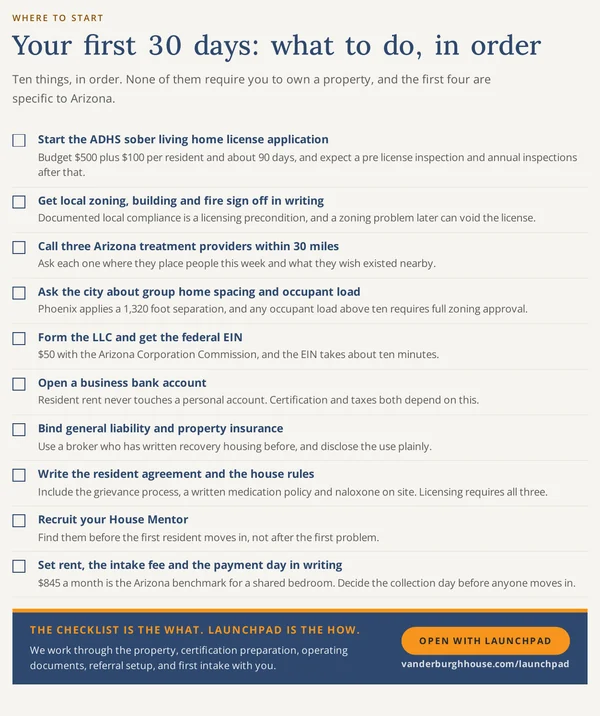
Your Gilbert Sober House Startup Checklist
Every item below is covered somewhere above, and in Gilbert none of them is optional. They run in the order an operator meets them.
Four guides worth reading alongside this one, whichever way you go.
How VSL Helps You Open a Sober House in Gilbert
Vanderburgh Sober Living charters independently owned recovery homes into a cooperative network across more than a dozen states, and the operators running them mostly opened their first house with no prior experience in recovery housing. The operator keeps ownership of the business and gains the brand, the operating standards, and the startup and certification support of the Chartered Operator community. The points this page kept returning to are the points VSL exists to help with: reading a local ordinance correctly before an offer goes in, building a pro forma around the resident cap a town actually imposes rather than a state average, writing the operations and neighbor plans that a registration and a state license both demand, and standing up referral relationships with courts and county agencies before the mortgage starts.
There are two ways in. The Launchpad Program is the self-paced route, a course that takes you from deciding whether to do this through opening the doors. The Mastery Program is done with you, with structured coaching through startup, certification and the first year of operating. If you have a specific Gilbert address in hand, or you are weighing a lease against a purchase at Gilbert’s prices, that is a conversation worth having before you commit: get in touch with the VSL team.
Start your sober house
Pick the path that fits where you are in the process.
Download the free guidePath to Purposeful Recovery Housing, by Dr. Hunter T. Foote.Explore the Mastery ProgramHands-on startup, certification, and operating support.See how starting with VSL worksThe opportunity, the community, and what a Charter includes.Prefer to talk now? Call (844) 762-3747, weekdays 8a to 5p.
Educational only; not legal, financial, or medical advice. Fees, rents, and rules change, and the Gilbert adjustments above are estimates built on the Arizona reference model. Confirm current requirements with Gilbert, Maricopa County, and qualified professionals before you sign or spend.
Research & Sources
- Foote, H. T. (2026). Vanderburgh Sober Living Operating Climate Index, 2026 Edition. Vanderburgh Sober Living. https://www.vanderburghhouse.com/research/operating-climate-index-2026/
- Arizona State Legislature. (n.d.). A.R.S. § 36-2061. Definitions. Arizona Revised Statutes. https://www.azleg.gov/ars/36/02061.htm
- Arizona State Legislature. (n.d.). A.R.S. § 36-2062. Sober living homes; licensure; rules; requirements. Arizona Revised Statutes. https://www.azleg.gov/ars/36/02062.htm
- Arizona State Legislature. (n.d.). A.R.S. § 36-2063. Fees; inspections; civil penalties. Arizona Revised Statutes. https://www.azleg.gov/ars/36/02063.htm
- Arizona State Legislature. (n.d.). A.R.S. § 36-2064. Certification; licensure without inspection. Arizona Revised Statutes. https://www.azleg.gov/ars/36/02064.htm
- Arizona State Legislature. (n.d.). A.R.S. § 36-2065. Referrals; funding eligibility. Arizona Revised Statutes. https://www.azleg.gov/ars/36/02065.htm
- Arizona State Legislature. (n.d.). A.R.S. § 36-582. Residential facilities; zoning; notice; appeal. Arizona Revised Statutes. https://www.azleg.gov/ars/36/00582.htm
- Arizona State Legislature. (n.d.). A.R.S. § 9-462.14. Sober living homes; distance and operation requirements; deviation procedure; prohibition; definition. Arizona Revised Statutes. https://www.azleg.gov/ars/9/00462-14.htm
- Arizona State Legislature. (2025). Laws 2025, Chapter 66 (S.B. 1308). Fifty-seventh Legislature, First Regular Session. https://www.azleg.gov/legtext/57leg/1r/laws/0066.htm
- Arizona State Legislature. (n.d.). A.R.S. § 9-807. Fire sprinklers; single family residences; prohibition. Arizona Revised Statutes. https://www.azleg.gov/ars/9/00807.htm
- Arizona State Legislature. (n.d.). A.R.S. § 29-3201. Formation of limited liability company; articles of organization; notice. Arizona Revised Statutes. https://www.azleg.gov/ars/29/03201.htm
- Arizona State Legislature. (n.d.). A.R.S. § 42-15004. Assessed valuation of class four property. Arizona Revised Statutes. https://www.azleg.gov/ars/42/15004.htm
- Arizona Secretary of State. (2019). Arizona Administrative Code, Title 9, Chapter 12: Department of Health Services, Sober Living Homes. https://apps.azsos.gov/public_services/Title_09/9-12.pdf
- Arizona Department of Health Services. (n.d.). Bureau of Behavioral Health Facilities Licensing: Sober living homes. https://www.azdhs.gov/licensing/bbhl-facilities/index.php
- Arizona Department of Health Services. (2024). Sober living home initial licensure application. https://www.azdhs.gov/documents/licensing/special/sober-living-homes/sober-living-complete-application.pdf
- Arizona Department of Health Services. (n.d.). Licensing Management System. https://www.azdhs.gov/licensing/license-management-system/
- Arizona Department of Health Services. (n.d.). Licensed sober living home provider search. https://hsapps.azdhs.gov/ls/sod/SearchProv.aspx?type=SLH
- Arizona Department of Health Services. (2025). ADHS licensed facilities GIS dataset (run date 3 February 2025). https://www.azdhs.gov/gis/adhs-licensed-facilities/index.php
- Arizona Recovery Housing Association. (n.d.). Providers: membership, fees and the certification process. https://www.myazrha.org/providers
- Arizona Recovery Housing Association. (n.d.). Standards and levels of support. https://www.myazrha.org/standards
- Arizona Recovery Housing Association. (n.d.). Certified recovery residence directory. https://www.myazrha.org/home-search
- National Alliance for Recovery Residences. (n.d.). Affiliate: Arizona Recovery Housing Association. https://narronline.org/affiliate/arizona-recovery-housing-association/
- Town of Gilbert. (2026). Land Development Code (adopted by Ordinance No. 2809, 21 September 2021). https://www.gilbertaz.gov/departments/development-services/planning/land-development-code
- Town of Gilbert. (n.d.). Group homes and recovery residences. Development Services, Planning Division. https://www.gilbertaz.gov/departments/development-services/planning/group-homes-and-recovery-residences
- Town of Gilbert. (n.d.). Planning Division. Development Services. https://www.gilbertaz.gov/departments/development-services/planning
- Town of Gilbert. (n.d.). Business registration and licensing. Development Services. https://www.gilbertaz.gov/departments/development-services/business-registration-and-licensing
- Town of Gilbert. (2025). Development Services fee schedule (effective 1 July 2025, Resolution 4563). https://www.gilbertaz.gov/home/showdocument?id=5883
- Town of Gilbert. (n.d.). Zoning map. Gilbert Open Data Portal. https://data.gilbertaz.gov/maps/zoning
- Town of Gilbert. (n.d.). Plan review and inspection. Development Services. https://www.gilbertaz.gov/departments/development-services/plan-review-inspection
- Town of Gilbert. (n.d.). Building and fire inspections. Development Services. https://www.gilbertaz.gov/departments/development-services/plan-review-inspection/inspection-code-compliance/building-fire
- Town of Gilbert. (n.d.). Fire inspections. Gilbert Fire and Rescue, Fire Prevention. https://www.gilbertaz.gov/departments/fire-and-rescue/fire-prevention/fire-inspections
- Town of Gilbert. (n.d.). Fire and Rescue Department. https://www.gilbertaz.gov/departments/fire-and-rescue
- Town of Gilbert. (n.d.). One Stop Shop permit and license self service. https://onestopshop.gilbertaz.gov/apps/selfservice/
- Town of Gilbert. (n.d.). Permits dataset. Gilbert Open Data Portal. https://data.gilbertaz.gov/datasets/TOG::permits/about
- Town of Gilbert. (2020). General Plan 2020: Plan For Our Future (adopted 4 February 2020, ratified 4 August 2020). https://www.gilbertaz.gov/departments/development-services/planning/general-plan
- Town of Gilbert. (2018). Heritage District Redevelopment Plan Update: purpose and scope. https://www.gilbertaz.gov/departments/economic-development/heritage-district/redevelopment-plan-update-2018/purpose-scope
- Town of Gilbert. (2024). Northwest Gilbert revitalization area (Resolution No. 4487, 18 June 2024). https://www.gilbertaz.gov/departments/economic-development/northwest-gilbert-revitalization
- Town of Gilbert. (2026). Utility rates (effective 1 April 2026). https://www.gilbertaz.gov/departments/finance-mgmt-services/utilities/rates
- Town of Gilbert. (2019). Code of Gilbert, Chapter 10, Article II: Technical codes (Ordinance No. 2739, 7 November 2019). Municode Library. https://library.municode.com/az/gilbert/codes/code_of_ordinances?nodeId=CO_CH10BUCORE_ARTIITECO_S10-31ADBUCO
- Town of Gilbert. (2021). Ordinance No. 2788: amendments to the International Residential Code and International Fire Code. https://mcclibraryfunctions.azurewebsites.us/api/ordinanceDownload/12036/1063958/pdf
- Maricopa County. (2025). Maricopa County Zoning Ordinance (current through 10 December 2025). https://wrr.maricopa.gov/DocumentCenter/View/4785/P-18—Zoning-Ordinance-PDF?bidId=
- Maricopa County Planning and Development. (2023). Directive DD-3500-01: Community residences and recovery communities (adopted 11 March 2022, revised 11 October 2023). https://maricopa.gov/DocumentCenter/View/5684/Community-Residence-Recovery-Communities-3500-01?bidId=
- Maricopa County Planning and Development. (n.d.). Community residences and recovery communities. https://www.maricopa.gov/6372/Community-Residences-Recovery-Communitie
- Maricopa County Department of Public Health. (2025). Overdose data dashboard (2024 data). https://www.maricopa.gov/6205/Overdose-Data
- Maricopa County Department of Public Health. (n.d.). Substance use programs. https://www.maricopa.gov/5833/Substance-Use
- Maricopa Regional Continuum of Care. (2026). 2026 point-in-time count report. https://maricopacoc.org/wp-content/uploads/2026/05/2026-Maricopa-CoC-PIT-Report.pdf
- Maricopa County Adult Probation Department. (n.d.). Substance use treatment. Superior Court of Arizona in Maricopa County. https://superiorcourt.maricopa.gov/apd/substance-use-treatment
- Superior Court of Arizona in Maricopa County. (n.d.). Adult drug court. https://superiorcourt.maricopa.gov/criminal/drug-court/
- Superior Court of Arizona in Maricopa County. (n.d.). Homeless court. https://superiorcourt.maricopa.gov/departments/superior-court/homeless-court/
- Maricopa County Attorney’s Office. (n.d.). Diversion programs. https://maricopacountyattorney.org/303/Diversion-Programs
- Maricopa County. (n.d.). Correctional Health Services. https://www.maricopa.gov/1179/Correctional-Health-Services
- Maricopa County. (n.d.). Community action program offices. https://www.maricopa.gov/5682/Community-Action-Program-Offices
- Maricopa County Treasurer. (2026). 2026 tax rates by tax area. https://www.maricopa.gov/DocumentCenter/View/123385/Tax-Rate-2026-PDF
- Arizona Health Care Cost Containment System. (n.d.). Housing programs. https://www.azahcccs.gov/housing
- Arizona Health Care Cost Containment System. (n.d.). Housing and Health Opportunities (H2O) demonstration. https://www.azahcccs.gov/Resources/Federal/HousingWaiverRequest.html
- Arizona Health Care Cost Containment System. (n.d.). Fee-for-service provider manual, Chapter 29: H2O services. https://www.azahcccs.gov/PlansProviders/Downloads/FFSProviderManual/FFS_Chap29H2OServices.pdf
- Arizona Health Care Cost Containment System. (n.d.). Behavioral health care coordination and the complete care RBHA contracts. https://www.azahcccs.gov/AHCCCS/Initiatives/CareCoordination/behavioralhealth.html
- Arizona Health Care Cost Containment System. (n.d.). Crisis hotlines. https://www.azahcccs.gov/BehavioralHealth/crisis.html
- Mercy Care. (n.d.). Housing services for providers. https://www.mercycareaz.org/providers/housing.html
- Arizona Behavioral Health Corporation. (n.d.). AHCCCS Housing Program. https://azabc.org/ahp/
- HOM, Inc. (n.d.). AHCCCS Housing Program. https://www.hominc.com/ahcccs-housing-program/
- AZCEND. (n.d.). Rent and utility assistance, Gilbert. https://azcend.org/get-help/rent-utilities-gilbert/
- Keys to Change. (2025). Project Connect Gilbert. https://keystochangeaz.org/media-alert/2025-gilbert-project-connect/
- Community Bridges, Inc. (n.d.). Arizona locations. https://communitybridgesinc.org/regions/arizona/
- Terros Health. (n.d.). Locations. https://terroshealth.org/our-locations/
- Partners in Recovery. (n.d.). East Valley campus. Paracor. https://copahealth.org/copa-contacts/
- Native American Connections. (n.d.). Behavioral health. https://www.nativeconnections.org/behavioral-health
- Banner Health. (n.d.). Banner Behavioral Health Hospital, Scottsdale. https://www.bannerhealth.com/locations/scottsdale/banner-behavioral-health-hospital
- Banner Health. (n.d.). Banner Gateway Medical Center, Gilbert. https://www.bannerhealth.com/locations/gilbert/banner-gateway-medical-center
- CommonSpirit Health. (n.d.). Dignity Health Mercy Gilbert Medical Center. https://www.commonspirit.org/find-a-location/dignity-health-mercy-gilbert-medical-center-1473
- U.S. Department of Veterans Affairs. (n.d.). Phoenix VA Health Care System: homeless veteran care. https://www.va.gov/phoenix-health-care/health-services/homeless-veteran-care/
- East Valley Intergroup of Alcoholics Anonymous. (n.d.). Contact and 24-hour helpline. https://aamesaaz.org/contact/
- Narcotics Anonymous, Arizona Region. (n.d.). East Valley Area. https://arizona-na.org/?page_id=1661
- U.S. Department of Housing and Urban Development. (2026). FY2027 fair market rent documentation system. https://www.huduser.gov/portal/datasets/fmr/fmr2027/FY27_FMRs.xlsx
- U.S. Department of Housing and Urban Development. (2026). FY2027 small area fair market rents. https://www.huduser.gov/portal/datasets/fmr/fmr2027/FY27_safmrs.xlsx
- U.S. Department of Housing and Urban Development. (2026, September 1). Fair market rents for the Housing Choice Voucher Program, fiscal year 2027. Federal Register. https://www.federalregister.gov/d/2026-17891
- Phoenix REALTORS. (2026). Local market update: Gilbert, August 2026 (ARMLS data). https://phoenix-public.stats.showingtime.com/docs/lmu/x/Gilbert
- U.S. Census Bureau. (2025). QuickFacts: Gilbert town, Arizona. https://www.census.gov/quickfacts/fact/table/gilberttownarizona/PST045224
- U.S. Census Bureau. (2024). American Community Survey five-year estimates, Table B25064: Median gross rent, Gilbert town, Arizona. https://data.census.gov/table/ACSDT5Y2024.B25064?g=160XX00US0427400
- U.S. Census Bureau. (2024). American Community Survey five-year estimates, Table B25041: Bedrooms, Gilbert town, Arizona. https://data.census.gov/table/ACSDT5Y2024.B25041?g=160XX00US0427400
- Arizona Corporation Commission. (n.d.). Limited liability company fee schedule. https://azcc.gov/docs/default-source/corps-files/fee-schedules/fee-schedule-llcs646a1cd0d6b24246ab2253aecbc3ab40.pdf
- Arizona Department of Revenue. (n.d.). Transaction privilege tax license fees. https://azdor.gov/transaction-privilege-tax/tpt-license/license-fees-cancellation-and-other-changes
- Valley Metro. (n.d.). Transit services in Gilbert. https://www.valleymetro.org/city/gilbert
- Valley Metro. (n.d.). Gilbert Park-and-Ride, 216 N Oak Street. https://www.valleymetro.org/how-to-ride/park-and-ride/gilbert-park-and-ride/216-n-oak-st
- Building Codes Assistance Project. (n.d.). Arizona building code status. https://bcapcodes.org/code-status/arizona/
- City of Edmonds v. Oxford House, Inc., 514 U.S. 725 (1995). https://www.govinfo.gov/content/pkg/USREPORTS-514/pdf/USREPORTS-514-725.pdf
- Pacific Shores Properties, LLC v. City of Newport Beach, 730 F.3d 1142 (9th Cir. 2013). https://www.justice.gov/crt/about/app/briefs/pacificshoresopinion.pdf
- SoCal Recovery, LLC v. City of Costa Mesa, 56 F.4th 802 (9th Cir. 2023). https://cdn.ca9.uscourts.gov/datastore/opinions/2023/01/03/20-55820.pdf
- The Ohio House, LLC v. City of Costa Mesa, No. 22-56181 (9th Cir. amended opinion filed 24 April 2025). https://cdn.ca9.uscourts.gov/datastore/opinions/2025/04/24/22-56181.pdf
- McGary v. City of Portland, 386 F.3d 1259 (9th Cir. 2004). https://www.courtlistener.com/opinion/788128/richard-mcgary-v-city-of-portland/
- KTAR News. (2022, October 29). Gilbert police launch Crisis Response Team unit to aid community. https://ktar.com/arizona-news/gilbert-police-launch-crisis-response-team-unit-to-aid-community/5310750/
- SafeWise. (2026). Arizona’s safest cities of 2026. https://www.safewise.com/research/safest-cities/arizona/