
Opening a sober living home in Lincoln means clearing three layers of rule, and only one of them is the one most people worry about. Nebraska requires no license for a peer-run recovery home: the Health Care Facility Licensure Act reaches a home only once it provides professionally directed treatment, counseling, or supervision for more than twenty-four consecutive hours, which is what Neb. Rev. Stat. § 71-423 defines as a mental health substance use treatment center.
Lincoln, by contrast, does have a use category for this exact building: a house where three or more unrelated people live together because of a shared disability is a Collaborative Living Facility under LMC 27.02.040, a conditional use in every residential district and capped at ten residents by LMC 27.62.050. The demand behind it is real and local: Lancaster County recorded 29 drug overdose deaths in 2025, up from 23 in 2024, and the January 2025 point-in-time count found 542 people experiencing homelessness in Lincoln, including 150 adults reporting chronic substance abuse.
This page covers what is specific to Lincoln: how the city code classifies the house, the lot-area and spacing math that decides how many residents a given address can hold, the Planning and Development Services counter that issues the certificate of occupancy, the local lease and purchase anchors, and the agencies that actually place residents here. Statewide rules, the licensure question in full, and the complete cost model live in the Nebraska guide below. Where this page uses a shared figure, it restates the state model rather than recalculating it, and adjusts only the two lines Lincoln actually changes.
Before you read onHow to Open a Sober Living Home in NebraskaThis post covers one piece of the process. The complete Nebraska guide walks through every step, from planning to your first resident.→Is Lincoln a Good Place to Open a Sober Living Home?
Yes, with one condition: the property has to be big enough on paper before it is big enough in practice. Lincoln is unusually permissive about what a recovery home is, allowing Collaborative Living Facilities in every residential district, and unusually specific about how many people may live in one, tying the count to lot area rather than bedrooms. An operator who signs a lease before running that math can end up with a six-bedroom house that the code will only let six people occupy.
Where Recovery Housing Demand Comes From in Lancaster County
Lincoln does not have one dominant referral pipeline. It has four smaller ones, and an operator who works all four fills faster than one who waits for a single agency to send people.
- Community supervision: Nebraska Probation funds sober housing directly through its Transitional Living program, and District 3A runs it out of 605 S. 10th Street.
- Problem-solving courts: Lancaster County runs an adult drug court whose applicants must live in the county, plus veterans, mental health, and treatment tracks through the County Attorney’s diversion office.
- Treatment discharge: Sixteen licensed residential facilities in the county hold 285 substance-use-capable beds, and every one of them discharges people who need somewhere structured to go next.
- The homelessness response: The All Doors Lead Home coordinated entry system assesses and prioritizes households across the Lincoln/Lancaster continuum of care.
These are the numbers a lender, a landlord, or a referral partner asks about before they take an operator seriously.
| Indicator | Lincoln figure | Why it matters to an operator |
|---|---|---|
| Drug overdose deaths, Lancaster County | 29 in 2025, up from 23 in 2024; the county ran 50 in 2020 and fell to 28 by 2023 before turning back up | A rising local count is what a referral partner responds to, and it is the figure to quote in a conversation with a skeptical neighbor or council member. |
| Fentanyl’s share of opioid deaths | 19 of 20 opioid deaths in 2021 involved fentanyl, against 3 of 10 in 2019 | Intake and overdose-response policy has to assume fentanyl, not pills, and carriers ask about naloxone on site. |
| People experiencing homelessness | 542 counted on January 21, 2025, of whom 133 were chronically homeless and 150 adults reported chronic substance abuse | This is the pool coordinated entry draws from, and the share reporting substance use is the part a recovery home is built for. |
| Licensed residential treatment beds, Lancaster County | 285 beds across 16 facilities on the August 14, 2026 state roster | Every licensed bed is a discharge in thirty to ninety days, and discharge planners keep lists of homes that answer the phone. |
| Publicly funded recovery beds | Nebraska Probation Transitional Living pays a per diem for up to 45 days for people under supervision who cannot self-pay | This is the only program in Lincoln that pays a daily rate for non-clinical sober housing, and it requires registration before a single referral arrives. |
| Transit | 15 weekday fixed routes plus three university routes, nine of them meeting at the temporary transfer center at 11th and L, carrying 2,265,753 trips in 2024; no Sunday service | Residents without cars reach work, meetings, and probation appointments on this network, and the Sunday gap is a real scheduling constraint. |
VSL’s Operating Climate Index rates Nebraska 5 out of 10 overall and ranks it 45th, with a Market Strength sub-index of 6 and a classification of lightly regulated (Foote, 2026). Market Strength is scored against a published rubric rather than measured, and it reads low for a reason: Nebraska has a small population spread thin, so most of the state cannot support a fourteen-bed house.
Lincoln is where that changes. A third of Lancaster County’s 334,049 residents would have to leave before the county looked like the rest of the state, and the county carries the treatment beds, the courts, and the coordinated entry system that turn population into referrals.
Nebraska scores 1 out of 10 on Certification Value, the lowest sub-index in its profile, because the state has no NARR affiliate and therefore no certifying body at all (Foote, 2026). That cuts both ways in Lincoln. There is no certification fee and no inspection queue to wait in, and there is also no credential to hand a referral partner. What fills the gap is registration with Nebraska Probation, which runs its own standards.
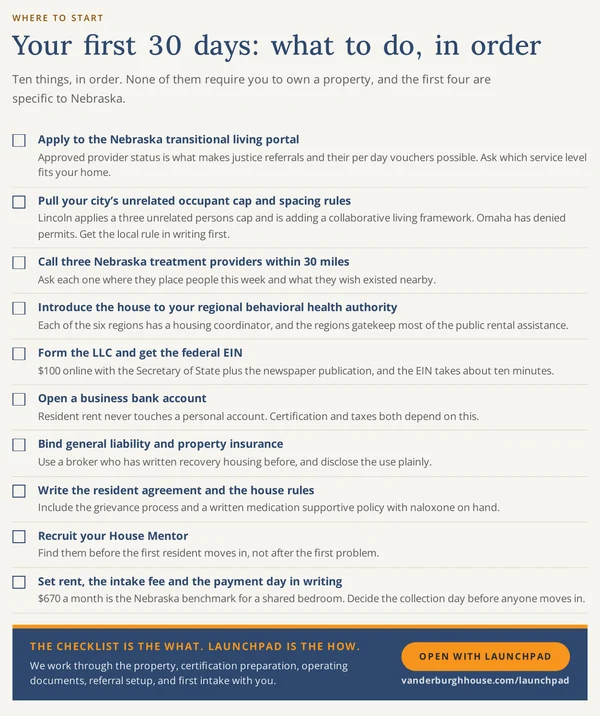
Most people ask whether they are allowed to open a recovery home. The better first question is whether the need and the money are there. This answers both, for your state.
- How many people need a bed, and how few beds exist
- Who actually pays the rent, and which programs are real
- What it costs to open on the purchase path and the lease path
How to Open a Sober House in Lincoln: Step-by-Step
The statewide sequence is in the Nebraska guide; this order is Lincoln’s, and it starts with zoning because in this city the arithmetic of the lot decides the size of the business. A house is a Collaborative Living Facility the moment a third unrelated resident moves in, and the number of residents allowed after that is set by square feet of lot area, not by bedrooms. Running that calculation before making an offer is the difference between a viable house and an expensive one.
Ten steps, in the order a Lincoln operator actually meets them.
Step 1. Run the Lot-Area and Spacing Math Before You Offer
Open the Lincoln/Lancaster County GIS viewer, search the address, and read two things off it: the zoning district and the parcel’s lot area. Divide the lot area by the figure for that district in LMC 27.62.050 and you have the maximum number of residents the code will allow, capped at ten however large the lot is.
Then check the block. The same section bars a Collaborative Living Facility within 1,000 feet of another one in R-1 through R-4, and within 500 feet elsewhere, measured lot line to lot line. Lincoln has an established Oxford House presence, so this is a live constraint rather than a formality, and the addresses already approved are named in the city’s own planning files.
Nebraska guideNebraska Zoning, Fair Housing, and Land Use Laws for Sober LivingWhere sober homes can operate in Nebraska and the legal protections that apply.→Step 2. Form the Entity and Publish the Notice
The entity signs the lease, not the person. A Nebraska LLC files a Certificate of Organization for $100 online or $110 in office, then publishes notice of organization in a legal newspaper for three successive weeks and files proof of publication with the Secretary of State for $25 online or $30 in office. Get the EIN and open the bank account before the first resident pays rent, so that rent never lands in a personal account.
Lincoln has no general business license, which surprises people who have opened businesses elsewhere. The city’s occupation taxes cover car rental, hotels, restaurants and bars, short-term rentals, and telecommunications, and a recovery residence is none of those (Lincoln City Treasurer). What can pull a house into a city permit is how the leases are written, which is the rooming-house question in the fire and building section below.
Nebraska guideHow to Form a Legal Entity for a Sober Living Business in NebraskaLLC, nonprofit, or both: how Nebraska operators structure the business and the property.→Step 3. Choose the Property and Pass the Household Test
The house has to read as a household, not as a facility. Lincoln’s definition of family in LMC 27.02.070 allows related persons plus not more than two unrelated people, which no recovery home meets, so the house is analyzed as a Collaborative Living Facility from the third unrelated resident onward. That is a use category the code allows, not a problem to hide.
- Shared kitchen and living space that everyone uses, with no locks turning bedrooms into separate units
- One lease or one agreement structure for the house, rather than per-room tenancies with their own terms
- Bedrooms meeting the 70 square foot minimum, with a compliant egress opening in every sleeping room
- Off-street parking at one space per two residents, the ratio the code applies to this use (LMC 27.67.040)
Two figures set the budget for this house and both are published. The FY2027 fair market rent for the Lincoln metro, effective October 1, 2026, is $1,703 for a three-bedroom and $1,915 for a four-bedroom. The median sale price in the Lincoln area was $309,900 for an existing home in August 2026. Those two numbers drive the cost table further down this page.
Nebraska guideSober Living Startup Costs in NebraskaEvery one-time cost to open, on the lease path and the purchase path, with the Nebraska figures behind each line.→Step 4. Settle Fire, Building, and the Certificate of Occupancy
Lincoln enforces the 2021 International Residential Code and 2021 International Fire Code as amended (Building and Safety). The requirements that catch first-time operators are not exotic: interconnected smoke alarms in every sleeping room and on every story including basements, a carbon monoxide alarm on each floor, and an egress opening of 5.7 square feet in every sleeping room, including basement bedrooms. Lincoln deleted the code exception that lets grade-floor openings drop to 5.0 square feet, so 5.7 applies everywhere.
The certificate of occupancy is the trap. Any change in the use or occupancy of a property requires a new certificate under LMC 27.77.010, and a building official may withhold further permits entirely where an earlier permit was never finaled. A house with an unpermitted finished basement, or a claimed prior care-facility use with no certificate on file, is a problem to solve before the offer, not after the inspection. The citations are in the fire and building section below.
Step 5. Write the Governing Documents Before You Open
Nebraska has no certifying body to review these, which means nobody will make you write them and everybody will ask for them anyway. Probation’s own service definition requires a transition plan within seven days of admission and a review every fourteen days, plus documented daily residency, so the paperwork has to exist before the first funded referral.
Write the house rules, the intake and discharge policy, the medication and overdose-response policy, the grievance process, and the resident agreement while the house is quiet. Add the one most templates leave out: a neighbor-relations plan naming who answers a neighbor’s call and what that person says.
Keep readingHouse Rules in Sober HousesThe rules that keep a recovery home safe, structured, and worth living in.→Step 6. Bind Insurance for the Specific Address
This is one of the lines the state cost model leaves as a range rather than a price, because carriers quote the address and the operation, not the state. Ask for general liability, property, and professional or abuse and molestation coverage, tell the carrier plainly that the house is shared recovery housing with no clinical services, and get the quote before the lease or the closing rather than after. Bind it before the first resident moves in.
Step 7. Move the House Mentor in First
The house mentor lives in the home, holds the structure, and is the reason a NARR Level II home works at all. Recruit locally through the recovery fellowships and the alumni networks of the treatment providers in the county, put the arrangement in writing including what the role does and does not cover, and move that person in before the first resident arrives. The mentor’s bed is unpaid, which is why the reference pro forma carries fourteen beds and counts twelve of them as revenue.
Step 8. Register With Nebraska Probation
There is no certification to pursue in Nebraska. NARR has no affiliate in the state, so no body inspects or credentials recovery residences here, and the standards that fill that gap belong to Probation’s Transitional Living service definition: a paid director, awake staff between 10pm and 6am or 24-hour on-call depending on level, staff who are not themselves under supervision, and documented compliance with local municipal codes. Registration is the step that turns a house into a place the system can send someone.
The sequence is short and the waiting is not.
- Submit the agency application through the Registered Service Providers portal, or call 888-471-0869
- Submit individual applications for each direct-service staff member, disclosing licensure and any criminal or probation history
- Get listed on the state transitional living portal, where Probation, Parole, and Corrections officers look for beds
Step 9. Open the Referral Doors Before You Open the House
Publicly funded placement in Lincoln runs through Probation District 3A and, for the clinical tier, through Region 5 Systems. Everything else is relationship work with discharge planners who keep short mental lists of homes that answer the phone and take a person the same day. Call the partners in the table below while the house is still being set up, invite three of them to tour it, and get listed with the crisis line and the coordinated entry system. Those weeks are far cheaper before the mortgage payment starts than after.
Step 10. Open, Then Hold Occupancy
The reference model breaks even at roughly 46% occupancy, about seven of fourteen beds, which sounds comfortable until the first quarter shows how slowly beds fill from a standing start. Admit deliberately rather than filling on urgency, because one bad placement in month two costs more than an empty bed in month three. Hold the weekly house meeting, track occupancy daily, and send a short monthly note to every referral partner saying how many beds are open.
Keep readingHow Sober Houses Fill Beds and Stay FullProven occupancy strategies from established recovery housing operators.→Most of the elapsed time sits in two places: closing on a property and registering with Probation.
| Phase | Weeks (estimated) | What gets done |
|---|---|---|
| Zoning and property search | 2 to 8 | Lot-area and spacing checks in the GIS viewer, permit history pulled on each candidate address, offers written only on addresses that clear. |
| Entity and publication | 3 to 6 | Certificate of Organization filed, notice published three successive weeks, proof of publication filed with the Secretary of State, EIN and bank account opened. |
| Closing or lease signing | 4 to 8 | Financing, inspection, and the certificate of occupancy question settled before keys change hands. |
| Code work and occupancy | 2 to 10 | Egress, alarms, and any unpermitted bedroom resolved; permits finaled; certificate of occupancy issued for the changed use. |
| Documents, insurance, and the house mentor | 2 to 4 | House rules, intake and discharge policy, neighbor-relations plan, bound coverage, and a live-in house mentor in place. |
| Probation registration and referral outreach | 6 to 16 | Agency application, then individual staff applications, then listing on the state transitional living portal; tours booked with discharge planners while the work is finishing. |
Timelines are estimated. Two things stretch a Lincoln timeline more than anything else. An open permit left unfinaled by a previous owner can block a new permit entirely until the inspections are done, and the Probation registration runs on its own schedule with no published turnaround.
Best Neighborhoods for a Sober Living Home in Lincoln
A workable Lincoln address passes four tests, and three of them are arithmetic rather than judgment.
- Lot area: The code allows one resident per 2,250 square feet of lot in R-1, 1,500 in R-2 and R-3, 1,100 in R-4 and R-5, and 875 in the remaining residential districts (LMC 27.62.050). A 15,000 square foot R-1 lot supports six residents, whatever the house holds.
- Spacing: A Collaborative Living Facility must sit at least 1,000 feet from any other one in R-1 through R-4 and at least 500 feet in the other residential districts, measured lot line to lot line.
- Transit: Residents arriving through the courts and coordinated entry frequently have no car, so a StarTran route within walking distance is a practical requirement rather than a nicety, and no route runs on Sunday.
- Housing stock: The house needs bedrooms that already meet the 70 square foot minimum and egress openings that already work, which in Lincoln points at the older neighborhoods with large homes and away from finished basements of unknown provenance.
Five areas are worth a search in Lincoln. Housing age and stock come from the city’s own subarea and redevelopment plans, and the routes come from StarTran.
| Area | Housing stock and transit | Siting notes for a sober living home |
|---|---|---|
| University Place | Median housing age 1952 against 1978 citywide, with 538 of 2,152 residential parcels holding buildings over 100 years old; 53.7% single-family; served by StarTran Route 49. | The advantage is supply: large older houses on generous lots, which is exactly what the lot-area formula rewards. The risk is that century-old houses carry century-old wiring and basement bedrooms that were finished without permits. |
| Havelock | Structures spanning 1890 to 1996, with an average structure age of 63 years and 95% of structures averaging 66 years; served by StarTran Route 41. | A genuine neighborhood center with services within walking distance, which residents without cars need. The risk is the same aging stock, plus a commercial spine where a rooming-house reading of a per-bed lease would be noticed sooner. |
| Clinton and Hartley | Development dating to the mid-1880s; city blight studies found average structure age of at least 40 years and estimated 75% to 82% of housing units in the study areas needed rehabilitation; seven weekday bus routes serve the corridor, four on Saturday. | The best transit coverage of any older area in the city, and the lowest entry prices. The risk is rehabilitation cost, and a corridor where the city has already designated blight, which means code enforcement is active rather than theoretical. |
| Malone and Woods Park | Inside the North 27th corridor plan area, same age and rehabilitation findings; close to the 11th and L transfer center and the downtown route network. | Walking distance to probation, the county attorney’s diversion office, and the courts, which matters for residents reporting weekly. The risk is density: smaller lots here mean the 875 square foot formula binds earlier than the bedroom count suggests. |
| Near South and Everett | Identified in the city’s Affordable Housing Coordinated Action Plan as core neighborhoods with some of the oldest housing and concentrated code violations; served by StarTran Route 13. | Large older homes on a direct route downtown, in the part of the city where most services sit. The risk is concentration: this is where existing shared housing clusters, so the 500 or 1,000 foot spacing rule is most likely to knock out an otherwise good address. |
Four house features decide it anywhere in Lincoln.
- Lot size before bedroom count: Pull the parcel’s square footage from the county property record and divide before scheduling a showing.
- Bedrooms that already comply: Every sleeping room needs 70 square feet, seven feet in any direction, and a seven-foot ceiling, and a basement sleeping room needs its own egress opening of 5.7 square feet (LMC 20.12.300, 20.12.312).
- A clean permit history: Run the address through the city’s building permit search and the occupancy permit search before the inspection, not after.
- Parking that exists: Off-street parking is what neighbors notice first, and it is the objection that shows up in every Lincoln accommodation file.
Lincoln’s zoning jurisdiction reaches three miles past the city limits (Planning and Development Services), so an address in the countryside outside town is often still inside Lincoln’s rules. Confirm which jurisdiction an address sits in before assuming a county reading is the one that applies.
- ✓Room-by-room requirements for a Level II home
- ✓Zoning and occupancy questions to ask before you tour
- ✓The red flags that should end a showing early
Who Regulates Sober Living Homes in Lincoln?
No single agency regulates sober living homes in Lincoln, which is why operators get contradictory answers depending on who they call first. The state licenses treatment, not housing. The city controls the use of the building, the building itself, and the fire code. The county courts and the state probation office control most of the money. Nobody certifies.
A sober living home is a shared residence where people in recovery live together under house rules, pay their own rent, and receive no treatment on site. That last clause is what keeps the house outside state licensure: Neb. Rev. Stat. § 71-413 lists the facility types Nebraska licenses and a recovery residence is not among them, while § 71-423 draws the line at professionally directed counseling, supervision, or treatment provided for more than twenty-four consecutive hours.
Lincoln’s own code reaches the same house from the other direction, defining a Collaborative Living Facility in LMC 27.02.040 as a structure where at least three unrelated people live together to accommodate a shared disability.
| Layer | Agency | What it controls for a sober living home |
|---|---|---|
| State licensing | Nebraska Department of Health and Human Services, Licensure Unit | Licenses treatment facilities under the Health Care Facility Licensure Act. A peer-run home needs no license; adding professionally directed counseling, supervision, or medication administration for more than 24 consecutive hours converts it into a licensed mental health substance use treatment center (§ 71-423), which is a different building with different rules. |
| State certification | None | Nebraska has no NARR affiliate, so no body certifies recovery residences here. There is no application, no fee, and no inspection. |
| City zoning | Planning and Development Services, Lincoln/Lancaster County Planning Department | Classifies the house as a Collaborative Living Facility, a conditional use in every residential district (LMC 27.06.080), capped at ten residents and limited by lot area and spacing (LMC 27.62.050). |
| City building | Building and Safety, Planning and Development Services | Enforces the 2021 IRC and IBC as amended (adopted codes) and issues the certificate of occupancy that LMC 27.77.010 requires on any change of use. |
| City fire | Lincoln Fire & Rescue, Bureau of Fire Prevention | Administers the 2021 International Fire Code as adopted at LMC Chapter 19.03, with the fire chief as the fire code official and plan review delegated to the planning department. |
| City rental permitting | Building and Safety | Licenses rental dwellings of three or more units and registers one- and two-unit rentals only once a complaint investigation opens (LMC 5.38). Per-bed leases without cooking facilities can create three or more rooming units, which is what pulls a house across that line. |
| State fire marshal | Nebraska State Fire Marshal | Inspects facilities licensed under the Health Care Facility Licensure Act, and has delegated plan review inside Lincoln to local fire prevention personnel. An unlicensed shared home falls outside every one of its inspection programs. |
| Public funding and referrals | Nebraska Probation District 3A; Region 5 Systems | Probation sets the standards and pays the per diem for Transitional Living beds. Region 5 Systems contracts the clinical residential tier for southeast Nebraska and runs Lincoln Permanent Housing for Lancaster County. |
The short version for an operator:
- State license: Not required for a peer-run home, and the line you must not cross is providing treatment on site.
- City license: Lincoln has no general business license. Zoning approval and a certificate of occupancy are what you need instead.
- Certification: There is no certifying body in Nebraska. Probation’s service definition is the standard that functions like one.
- Referrals: Registration with Probation opens the only per diem in the city, and the rest is relationship work with discharge planners.
Licensing is the easy part in Lincoln, and most operators spend their worry there. Zoning is what actually constrains the business, because it sets the resident count before the first lease is signed.
Lincoln Zoning Laws for Sober Living Homes
Lincoln has no sober living ordinance, no moratorium, and no registry aimed at recovery housing. What it has instead is a named use category that captures these homes precisely, a resident cap of ten, a lot-area formula, and a spacing rule, all of them in the zoning code and all of them applied administratively.
A dated search of the Lincoln Municipal Code, the Planning Commission’s staff reports and agenda packets for 2025 and 2026, and the City Council’s minutes and agenda archive found no sober-living-specific ordinance or resolution as of September 22, 2026.
How the Lincoln Municipal Code Treats a Sober Living Home
Lincoln is one of the few cities that names this use rather than leaving operators to argue by analogy. Three definitions decide how a house is classified, and the third unrelated resident is what moves it from one to the next.
- Family, LMC 27.02.070: Defined as one or more persons related by blood, marriage, or adoption living as a single housekeeping unit, plus not more than two persons who are unrelated. A recovery home passes this only at three total residents.
- Collaborative Living Facility, LMC 27.02.040: Defined as a structure in which not less than three persons unrelated by blood, marriage, or adoption reside for the purpose of accommodating their shared disability. This is the category a sober living home falls into.
- Group home, LMC 27.02.080: Reserved for a building licensed or approved by the state where more than three but fewer than sixteen disabled persons reside while receiving therapy or counseling. A home that provides no therapy is not a group home in Lincoln, and claiming to be one invites the licensure question.
- Where it is allowed: Collaborative Living Facilities are a conditional use in AG, AGR, R-1 through R-8, R-T, O-1, O-3, B-4, and B-5, and are not permitted by right in any residential district (LMC 27.06.080). Conditional here is administrative: LMC 27.62.020 has Building and Safety verify the conditions are met before issuing the permit or certificate of occupancy, with no hearing and no council vote.
- How many residents: Ten maximum in any allowed residential district, further limited to one person per 2,250 square feet of lot area in AG, AGR, and R-1, 1,500 in R-2 and R-3, 1,100 in R-4 and R-5, and 875 in the remaining residential districts (LMC 27.62.050).
The city’s own files show how this plays out. In a staff report dated March 5, 2026, planning staff applied the R-7 formula to a 3,356 square foot lot at 1035 S. 12th Street and arrived at a maximum of three unrelated residents, against an operator asking for eight (Misc. #26001). The house was not the constraint. The lot was.
Run the lot-area division before you make an offer, not after. A six-bedroom house on a small R-7 lot and a four-bedroom house on a large R-1 lot can have identical legal capacity, and the parcel square footage is public on the county property record.
What the Six-or-Fewer Rule Does and Does Not Do in Lincoln
Operators arrive quoting a six-or-fewer rule they read about in another state, expecting Nebraska to guarantee that a home of six unrelated people is treated as a family anywhere. Nebraska has no such statute, and Lincoln’s own threshold sits at three, not six.
- Neb. Rev. Stat. § 71-413: Lists the facility types Nebraska licenses and does not include recovery residences, which is a statement about licensure, not about zoning.
- Neb. Rev. Stat. § 71-423: Defines the treatment center a home becomes if it provides professionally directed services for more than twenty-four consecutive hours. Staying outside this definition is what keeps a home unlicensed, and it does nothing for zoning.
- Unlicensed homes and the city code: No Nebraska statute overrides Lincoln’s family definition or its resident cap. The state’s own planning-code framework leaves the classification to the city, and Lincoln’s answer is LMC 27.06.080 and 27.62.050.
The protection comes from disability status instead. People in recovery from substance use disorder are a protected class under the federal Fair Housing Act, and Lincoln has its own reasonable accommodation process in LMC Chapter 1.28 under which the Planning Commission holds a hearing and recommends and the City Council decides. Nebraska’s own fair housing law at Neb. Rev. Stat. § 20-318
is enforced by the Nebraska Equal Opportunity Commission and reaches zoning and use-permit decisions. Operators who understand requesting reasonable accommodation before they need it, and the shape of sober living zoning protections generally, are the ones who ask for more residents and get them.
Keep readingThe Federal Fair Housing Act and Sober Living: Everything You Need to KnowThe federal protections every operator, neighbor, and local official should understand.→The Oxford House Accommodation Files and What They Tell an Operator
Lincoln’s live regulatory activity on recovery housing is not an ordinance. It is a run of individual reasonable accommodation requests, each with a file number and a date, and together they are the clearest available record of what this city will actually approve.
The most recent is Misc. #26001, a March 5, 2026 staff report on Oxford House-Hansen Manor at 1035 S. 12th Street in R-7, asking for eight unrelated residents and for the four required parking spaces to be reduced to zero, with staff recommending approval subject to conditions. The one before it was Misc. #25010, a July 10, 2025 report on Oxford House-Orison at 1007 S. 16th Street asking that ten unrelated persons be permitted to live together as a family, heard by the Planning Commission on August 20, 2025.
- Treatment as the functional equivalent of a family, above the two-unrelated-person ceiling in the family definition
- A resident count above what the district’s lot-area formula would otherwise allow
- Relief from the parking requirement of one space per two residents
What did not change on either date matters more than what did. Neither file amended the text of the family definition, the Collaborative Living Facility definition, the lot-area formula, or the parking ratio, and the conditions attached make each grant specific to one address and one operator, not transferable and not running with the land. A new operator buying that same house inherits none of it. The 2020 city text amendment that operators sometimes cite covers transitional living facilities affiliated with alternatives to imprisonment, which is a different use category and not recovery housing.
- Oxford House-C v. City of St. Louis, 77 F.3d 249 (8th Cir. 1996):The governing circuit decision, which upheld an eight-person occupancy cap for group homes in single-family zones and held that failing to apply for a variance was fatal to the accommodation claim, because a city need not bypass its own procedures.
- Developmental Services of Nebraska v. City of Lincoln (D. Neb. 2006):A district court decision about this city, which found Lincoln’s spacing requirements and family definition rationally related to a legitimate purpose and not facially discriminatory, while letting the reasonable accommodation claim proceed to trial.
- Lincoln’s own accommodation record, 2022 to 2026: The city granted fourteen unrelated residents at 1923 B Street in 2022, considered ten at 1007 S. 16th Street in 2025, and considered eight at 1035 S. 12th Street in 2026 (Misc. #26001). The process works, and it is used.
Three moves follow from all of this.
- Design the house to the lot-area number first, and treat anything above it as an accommodation request rather than an assumption
- Where more residents are needed, file the LMC Chapter 1.28 request and go through the Planning Commission and City Council, because the Eighth Circuit has held that skipping the city’s own process sinks the claim
- Budget time for a public hearing, and bring the neighbor-relations plan to it, because the parking and concentration objections in these files are the ones that recur
How your home gets classified, where Fair Housing applies, and what to do if the city says no.
Lincoln Fire and Building Code Rules for Sober Living Homes
A Lincoln sober living home is a Group R-3 building, and the count that decides whether it stays one is the number of residents receiving care, not the number of people in the house. Three points decide what the building and fire departments ask for.
- The care-count line: R-3 covers congregate living for sixteen or fewer occupants and care facilities for five or fewer, and LMC 20.06.260 lets a care facility of five or fewer in a single-family dwelling comply with the residential code instead of the building code. A home characterized as providing care to six or more people leaves R-3 for R-4, which closes that door and brings sprinkler requirements with it (2021 IBC 903.2.8). A peer-run home providing no care is analyzed on the congregate-living branch.
- The certificate of occupancy: No change in the use or occupancy classification of a property is lawful until a new certificate is issued (LMC 27.77.010), and the same section treats the absence of a certificate for a claimed prior nonconforming use as evidence that the use never lawfully existed. A converted house with a care-facility history and no paperwork puts the burden on the buyer.
- The fire department’s scope: The fire code adopted at LMC Chapter 19.03 is administered with the fire chief as the fire code official, and the State Fire Marshal has delegated its authority inside Lincoln to local personnel. The State Fire Marshal’s own inspection programs all attach to licensed facility types, so an unlicensed shared home falls outside them.
Alarms and egress are where first-time operators fall short, and none of these requirements depends on who lives in the house. They apply to every dwelling in Lincoln.
| Requirement | What the rule says | Authority |
|---|---|---|
| Smoke alarms | Required in each sleeping room, outside each sleeping area, and on every story including basements, all interconnected | LMC 20.12.370, amending IRC R314 |
| Carbon monoxide alarms | One per floor of the dwelling unit, plus inside any bedroom with a fuel-burning appliance or an attached bathroom containing one | LMC 20.12.375, amending IRC R315.3 |
| Residential sprinklers | Not required on the residential-code path: Lincoln deleted IRC R313 in its entirety. They become required if the house is classified R-4, which happens at six or more residents receiving custodial care | LMC 20.12.365; 2021 IBC 903.2.8 |
| Emergency escape openings | At least one operable opening in every sleeping room, including every basement sleeping room; sill no higher than 44 inches; opening onto a public way, yard, or court | LMC 20.12.300, amending IRC R310.1 |
| Minimum opening size | 5.7 square feet net clear, 24 inches minimum height and 20 inches minimum width. Lincoln deleted the exception that allows 5.0 square feet at grade-floor openings, so 5.7 applies throughout | LMC 20.12.312; city egress detail |
| Window wells | Minimum 9 square feet of area with a 36 inch minimum projection and width where the opening is below grade | City of Lincoln egress window and well detail |
| Double-hung egress windows | Must meet the egress opening requirement without removing the upper sash | LMC 20.12.310 |
| Bedroom size and ceiling height | 70 square feet minimum floor area, not less than 7 feet in any horizontal dimension, and a 7 foot ceiling in habitable space | IRC R304 and R305 as adopted at LMC Chapter 20.12 |
| Overcrowding | The 2012 International Property Maintenance Code applies to existing structures, including its room-area-per-occupant requirements | LMC 21.05.010, Title 21 |
| Rooming house permit | A rental dwelling with three or more units requires a permit and annual inspection. Leasing per bed with no cooking facilities in the rooms can create three or more rooming units, which is what crosses this line | LMC 5.38.010 and 5.38.020 |
Nobody is coming to check. A single-family dwelling in Lincoln triggers no routine inspection, and the certificate of occupancy question surfaces only when a permit is pulled or a complaint is filed, which means the operator carries the burden voluntarily or carries it later at a worse moment. Run the occupancy math before the house opens rather than after, and determining maximum occupancy is a calculation worth doing with the code sections in front of you.
Alarms, egress, extinguishers, and the documentation an inspector expects on file.
Get the checklist freeNo cost, no obligation. Unsubscribe in one click.How Much Does It Cost to Open a Sober House in Lincoln?
The Nebraska reference model puts the all-in cost of opening between $30,442 and $104,151, split as $30,442 to $48,907 on the lease path and $85,686 to $104,151 on the purchase path. Lincoln changes two of those inputs and leaves the rest alone. The lease deposit moves because the metro fair market rent is higher than the statewide modeled lease, and the down payment moves because Lincoln’s median sale price is higher than the statewide basis. Everything else, from furnishings to the operating reserve, holds at the state figures.
| Line item | Lincoln figure | Source |
|---|---|---|
| Entity formation, year one | $125 online, or $140 filing in office: $100 Certificate of Organization plus $25 proof of publication, before the newspaper’s own charge | Nebraska Secretary of State, fee schedule |
| Publication of notice | Three successive weeks in a legal newspaper, billed by the line at a statutory maximum of 50 cents per line for the first insertion and 43.34 cents for each after | Neb. Rev. Stat. § 33-141 |
| City business license | $0. Lincoln has no general business license, and its occupation taxes do not reach a recovery residence | Lincoln City Treasurer, occupation taxes |
| State license | $0 for a peer-run home. A licensed treatment center is a different building under a different statute | Neb. Rev. Stat. § 71-413 |
| Certification | $0. Nebraska has no certifying body | National Alliance for Recovery Residences, affiliate directory |
| Lease path anchor | $5,745 for three months at the FY2027 four-bedroom fair market rent of $1,915, effective October 1, 2026 | HUD, FY2027 Fair Market Rents; Federal Register notice |
| Purchase path anchor | $66,938 down, being 20% of $334,692: the $309,900 August 2026 median existing home price carried at the state model’s 8% uplift for a house larger than the median | REALTORS Association of Lincoln / GPRMLS, August 2026; Census QuickFacts |
| Safety and code upgrades | $1,500 to $6,000, restated from the state model and unchanged by Lincoln; alarms, egress openings, and window wells are the usual line items | LMC Chapter 20.12, adopted residential code |
| Furnishings, supplies, and launch | $7,744 for furnishings and $2,227 for supplies, utility deposits, and launch, restated from the Nebraska reference model; both are cost-of-living scaled rather than quoted | MERIC cost of living data series |
| First-year insurance and operating reserve | $3,250 to $6,600 and $10,350 to $20,700, carried from the Nebraska reference model without adjustment. Insurance is the line to replace with a real quote for the address before closing | LMC Chapter 5.38, rental dwelling permitting |
Two swaps turn the statewide model into a Lincoln budget.
- Purchase path: Replacing the state model’s $60,390 down payment with Lincoln’s $66,938 moves the purchase path to an estimated $92,234 to $110,699 all in. That still excludes closing costs, any repair the inspection turns up, and the first mortgage payment.
- Lease path: The lease path barely moves, from $30,442 to $48,907 up to an estimated $31,041 to $49,506, because only the three-month deposit changes. Test any landlord’s quote against the FY2027 fair market rent of $1,703 for three bedrooms and $1,915 for four, and against the small-area rents HUD publishes by ZIP code, which run from $1,430 in 68502 and 68510 to $2,040 in 68516 for a three-bedroom.
Lincoln has no grant that helps an operator open. What it has is one program that pays for beds once the house is running.
- Nebraska Probation Transitional Living: Pays a per diem for up to 45 days for people under supervision who are assessed high risk, housing unstable, and unable to self-pay, at a rate set by contract rather than published (service definition, revised February 1, 2026).
- Region 5 Systems contracts: Fund the licensed clinical tier for southeast Nebraska, halfway house and supportive living, rather than non-clinical sober housing (adult services).
None of this is startup money. The Probation per diem arrives after a bed is filled by a referral that only comes after registration, Region 5’s contracts are for licensed services a peer-run home does not provide, and Nebraska’s dedicated recovery housing grant program is restricted to sites inside Omaha city limits. Nebraska Medicaid pays for behavioral health services and never for room and board. Plan to open on capital and let the per diem improve the operating year, not the other way round.
Nebraska guideNebraska Recovery Housing Funding: Why It Rarely Works the Way Operators ExpectBlock grants, opioid settlement dollars, Medicaid, and county contracts: what reaches a sober living home and what does not.→Is a Sober Living Home Profitable in Lincoln?
Yes, on the same condition that governs the model everywhere: occupancy. The Nebraska reference model runs a fourteen-bed house with twelve revenue beds at $155 a week, producing $6,802 in monthly revenue against $3,450 in operating costs, for $3,352 of net operating income before the owner’s labor, a 49% margin, and break-even at roughly 46% occupancy.
Lincoln changes exactly two inputs in that model: the mortgage, because houses cost more here than the statewide basis, and the property tax, because Lancaster County’s bill is higher than the state median.
That score describes Nebraska as a whole, and Lincoln pulls it in both directions at once: a stronger referral base and a deeper rental market on one side, a higher entry price and a higher property tax bill on the other. The table below restates the state model line for line and scales only the two property lines, holding revenue, bed count, and every other operating expense exactly where the state model puts them.
| Line | Nebraska reference model (14 beds) | Lincoln adjustment (estimated) |
|---|---|---|
| Beds, total and revenue-producing | 14 beds, 2 non-revenue (house mentor and network membership), 12 revenue beds | Unchanged |
| Rent per bed | $155 weekly, about $670 monthly | Unchanged |
| Total revenue | $6,802 monthly, after an 18% vacancy factor plus intake and laundry income | Unchanged |
| Mortgage payment | $1,527 on a $241,719 loan, 80% loan to value on a $302,149 basis | Estimated $1,691, on a $267,754 loan at the same 80% loan to value and 30-year terms, over Lincoln’s $334,692 basis (August 2026 median existing home price of $309,900 carried at the model’s 8% uplift) |
| Real estate tax | $337 monthly, from ACS median real estate taxes paid | Estimated $350 monthly, from Lancaster County’s ACS median of $4,204 a year on the same measure; the consolidated rate inside the city was 1.666284 per $100 of valuation for tax year 2025 |
| Property and liability insurance | $280 and $250 monthly | Unchanged, and worth a local quote before closing |
| Utilities, supplies, screens, maintenance, admin | $876 monthly combined | Unchanged |
| Total monthly operating costs | $3,450 | Estimated $3,627 |
| Net operating income, before owner’s labor | $3,352, a 49% margin | Estimated $3,175, a 47% margin |
| Break-even occupancy | About 46%, roughly 7 of 14 beds | Estimated 48%, still about 7 of 14 beds |
The Lincoln column is an estimate, not a quote. It holds revenue, bed price, vacancy, and every operating expense at the state model’s figures and scales only the mortgage and the property tax, which moves monthly costs up by $177 and the margin down from 49% to an estimated 47%. Three local factors will move that margin further than the mortgage does.
- Referral registration: Beds filled by Probation’s Transitional Living per diem fill faster and empty slower than private-pay beds, and the registration takes weeks. An unregistered house carries the same mortgage at lower occupancy.
- The Sunday transit gap: Residents who cannot reach work on Sunday lose jobs, and residents who lose jobs stop paying rent. A house on a route with weekend service holds occupancy better than the rent difference suggests.
- The lot-area cap: A house limited to six residents by lot area cannot reach the model’s twelve revenue beds at all, and no amount of good operating fixes that. This is the reason the zoning math belongs before the offer.
No real property matches a reference model, and finding out how far off yours sits takes a few minutes.
Will your property pencil out?
Get a custom projection for your Nebraska property, then compare it with typical returns.
Get my projectionFree calculator with your property’s numbers.See Nebraska profitabilityRealistic revenue, operating costs, and margins in Nebraska.How to Get Residents for a Sober Living Home in Lincoln
Nebraska Probation controls the only publicly funded per diem for non-clinical sober housing in Lincoln, and Region 5 Systems controls the clinical residential contracts. Everything else arrives through hospital and treatment discharge, the courts, and the coordinated entry system. Three doors open first.
- CenterPointe Crisis Response, (402) 475-6695: The local 24-hour line for southeast Nebraska for mental health, suicidal, and substance use emergencies, with walk-in crisis counseling weekdays at 2202 S. 11th Street (Region 5 Systems).
- Nebraska Probation Transitional Living: Level 1 is sober housing only, Level 2 adds employment and financial services, and Probation funds up to 45 days for people under court-ordered supervision who are assessed high risk and cannot self-pay. The referral comes from a probation officer, and the house has to be registered first (Registered Service Providers).
- Standards in place of certification: With no certifying body in Nebraska, what a referral partner checks is Probation’s own service definition: a paid director, awake or on-call staffing by level, staff who are not themselves under supervision, and documented compliance with local municipal codes (Transitional Living Level 1). Meeting it is the closest thing Lincoln has to a credential, and the NARR affiliate certification process used in other states is worth understanding as the standard operators here are measured against informally.
Twenty organizations, public agencies first because they control funded placement, then the hospitals and nonprofits whose discharge planners decide where someone goes on a Tuesday afternoon.
| Organization | Type | How residents reach you |
|---|---|---|
| Nebraska Probation District 3A | Court, public agency | A probation officer places someone under supervision into a Transitional Living bed with a per diem attached; 605 S. 10th Street, (402) 441-8474 |
| Region 5 Systems | Regional behavioral health authority | Authorizes and contracts the publicly funded residential tier for southeast Nebraska and runs Lincoln Permanent Housing; (402) 441-4343 |
| Nebraska Transitional Living Portal | State portal | Where a registered provider is listed so probation, parole, and corrections officers can find the beds |
| Lancaster County Community Corrections | County agency | Pretrial release, diversion, and 24/7 Sobriety participants who need a supervised sober address; (402) 441-3600 |
| Lancaster County Attorney, Adult Diversion and Problem-Solving Programs | Prosecutor, public agency | Diversion and treatment, mental health, or veterans track participants placed as a condition of the agreement |
| Lancaster County Adult Drug Court | Court | Post-plea felony participants who must establish a Lancaster County residence before bond-in; coordinator (402) 441-8122 |
| City of Lincoln Urban Development, Homeless Services | City agency | The NE-502 continuum of care and the Lincoln Homeless Coalition route transitional-housing-eligible households |
| All Doors Lead Home coordinated entry | Continuum of care | Assessed households are prioritized and matched out to housing programs; the single front door on the homelessness side |
| Lincoln-Lancaster County Health Department | Public health | People in its community health and overdose prevention programs who need stable housing; 3131 O Street, (402) 441-8000 |
| Lincoln Housing Authority | Public agency | Voucher and VASH holders needing a supported address, and residents graduating into their own units; (402) 434-5500 |
| Lincoln VA Clinic | Federal, VA | Veterans with substance use disorder get same-day mental health care with no referral and are routed on from there; 420 Victory Park Drive |
| VA Nebraska-Western Iowa, Homeless Veteran Care | Federal, VA | Transitional and permanent housing, addiction treatment, and help with the justice system, for veterans |
| Bryan Health | Hospital | Discharge from the 24-hour mental health emergency department or partial hospitalization; Counseling Center (402) 481-5991 |
| CHI Health St. Elizabeth | Hospital | Behavioral care discharge planning; 555 S. 70th Street, (402) 219-8000 |
| The Bridge Behavioral Health | Nonprofit provider | Step-down from adult residential treatment or the low-barrier drop-in; 24-hour line (402) 477-3951, 721 K Street |
| CenterPointe | Nonprofit provider | Crisis walk-ins, residential treatment step-down, and supportive housing overflow; 2202 S. 11th Street |
| People’s City Mission | Nonprofit shelter | Shelter guests and Help Center visitors ready for a sober, structured next step; (402) 475-1303 |
| Matt Talbot Kitchen & Outreach | Nonprofit | People moved from the meal program into housing through outreach; (402) 477-4116 |
| Family Service Lincoln | Nonprofit | People in rapid rehousing and housing case management who need a sober placement; 501 S. 7th Street |
| Community Action Partnership of Lancaster and Saunders Counties | Nonprofit | People in homelessness prevention and supportive housing, plus The Gathering Place; 210 O Street |
| Friendship Home | Nonprofit | Domestic violence survivors in shelter or long-term housing who also need recovery housing; crisis line (402) 437-9302 |
| CEDARS | Nonprofit | Transition-age young adults leaving youth shelter or transitional living; (402) 434-5437 |
| Released and Restored | Nonprofit, reentry | People leaving incarceration in the mentoring and job-skills pipeline who need a sober address |
Neither fellowship refers formally, and both are how a large share of residents actually find a home. Lincoln Central Service Office for Alcoholics Anonymous runs a 24-hour line at (402) 438-5214, and the Southeast Nebraska Area of Narcotics Anonymous runs a 24-hour helpline at 888-347-4446. Meeting secretaries and sponsors pass along the names of houses they trust, which is earned over months rather than requested.
If you are reading this because you or someone close to you needs a bed rather than a business plan, the next step is shorter than the rest of this page.
Take the next step
Apply, browse homes, or search the national directory.
Apply onlineGet a call back within 24 hours.View VSL homesSee Chartered recovery homes and find the right fit.Search the national directoryCertified sober houses anywhere in the US.Or call (844) 762-3747, weekdays 8a to 5p.
Common Mistakes When Opening a Sober House in Lincoln
These are the errors that show up in Lincoln homes struggling in their first year, and every one of them happens before the house opens.
- Signing before dividing: Making an offer on a six-bedroom house without dividing the parcel’s lot area by the district’s per-person figure. A small R-7 lot caps the house at three residents whatever the floor plan says, which is the exact finding in the city’s March 2026 staff report.
- Assuming a six-or-fewer rule protects the house: Nebraska has no such statute, and Lincoln’s family definition stops at two unrelated people. The third resident makes the house a Collaborative Living Facility, and the protections that matter come from disability status and the city’s own accommodation process, not from a resident count.
- Leasing per bed without reading Chapter 5.38: Per-bed agreements with no cooking facilities in the rooms can create three or more rooming units, turning the house into a rental dwelling that needs a permit, annual inspection, and a certificate of compliance at sale.
- Buying a house with an open permit: An earlier owner’s unfinaled permit lets the building official refuse further permits and inspections until it is closed, which can hold up the certificate of occupancy the change of use requires. The permit history is public and free to search.
- Pricing from statewide numbers: The Nebraska model’s lease and purchase basis both sit below Lincoln’s, so a budget built on the statewide figures understates the down payment by roughly $6,500 and the monthly mortgage by roughly $164.
- Waiting to register with Probation: The only per diem in the city requires an agency application, individual staff applications, and a portal listing before the first referral. Operators who start that after opening pay the mortgage through the wait.
- Ignoring parking and neighbors: Parking relief is the request in Lincoln’s accommodation files, and neighbor objections are what make those hearings long. A neighbor-relations plan written before anyone complains is worth more than a good argument afterward.
The Nebraska book and the Blueprint carry the templates, the checklists, and the operating detail this page points at but does not reproduce.
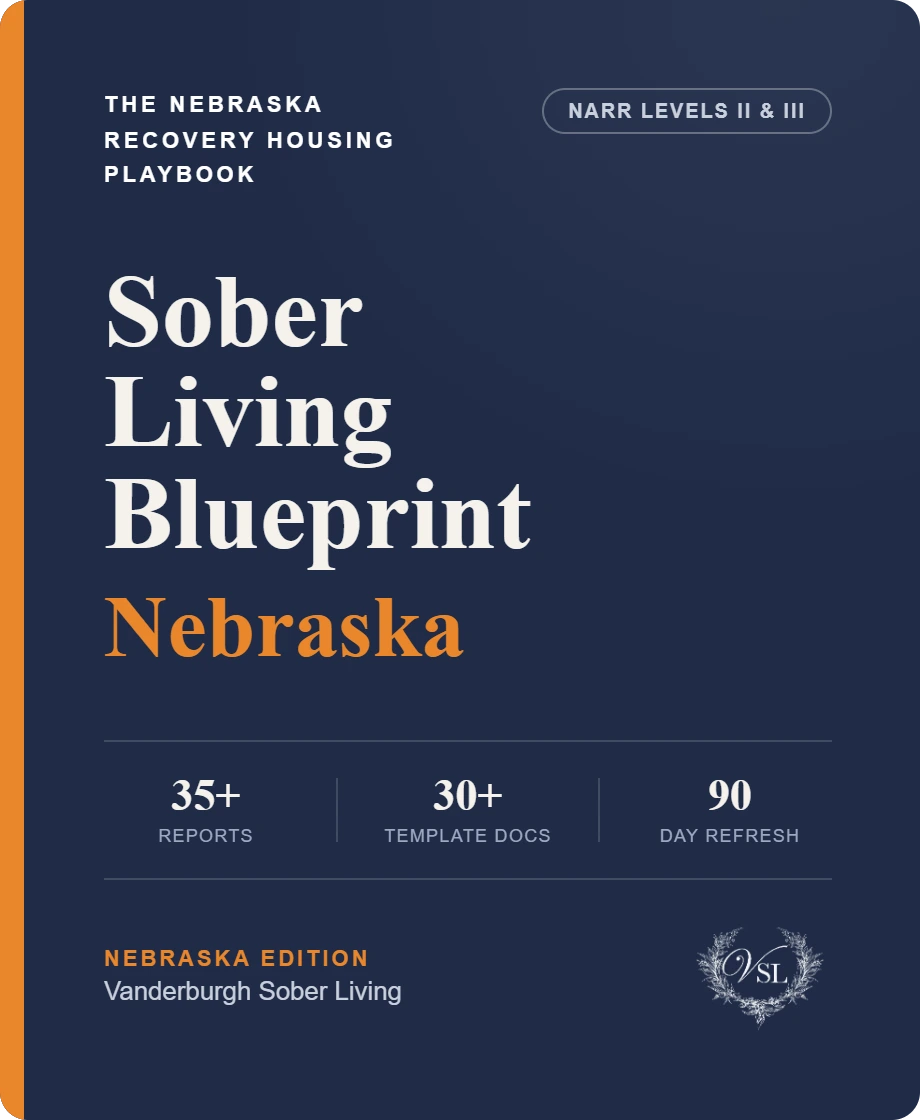
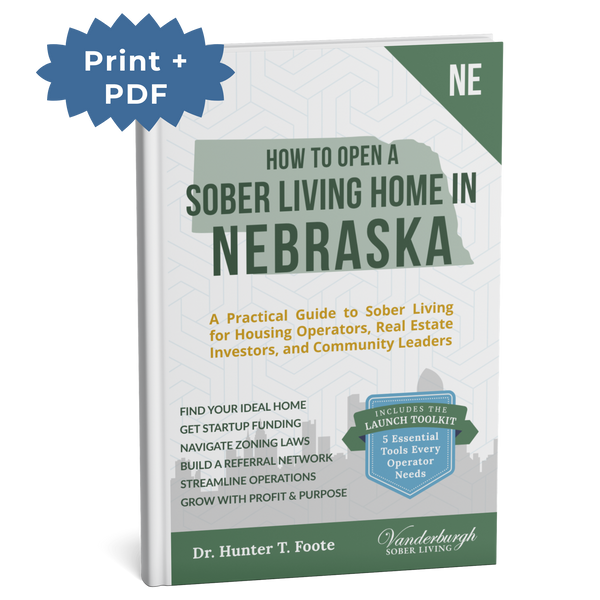
The book gives you the map to open a home. When you’re ready to launch, certify, and sustain, the Blueprint is the full playbook covering funding, legal, insurance, and operations.
Frequently Asked Questions About Opening a Sober House in Lincoln
Do you need a license to open a sober living home in Lincoln, NE?
No. Nebraska does not license peer-run recovery homes, and Lincoln has no general business license. A license becomes necessary only if the house provides professionally directed counseling, treatment, or supervision for more than twenty-four consecutive hours, which converts it into a mental health substance use treatment center under Neb. Rev. Stat. section 71-423. What Lincoln does require is zoning compliance and a certificate of occupancy.
How many residents can a sober living home have in Lincoln?
Ten at most, and often fewer. Lincoln classifies these homes as Collaborative Living Facilities and caps them at ten residents in any allowed residential district, then limits the count further by lot area: one person per 2,250 square feet in R-1, 1,500 in R-2 and R-3, 1,100 in R-4 and R-5, and 875 in the other residential districts. A 15,000 square foot R-1 lot supports six residents regardless of how many bedrooms the house has.
Can a sober living home go in a single-family neighborhood in Lincoln?
Yes. A Collaborative Living Facility is a conditional use in every residential district in Lincoln, including R-1, under LMC 27.06.080. Conditional here is administrative rather than discretionary: Building and Safety verifies the conditions are met before issuing the permit or certificate of occupancy, with no public hearing and no council vote, provided the lot area and the 1,000 foot spacing requirement are satisfied.
Is certification required for a sober living home in Nebraska?
No, and it is not available. Nebraska has no NARR affiliate, so there is no certifying body, no application, and no fee. The standard that functions in its place is Nebraska Probation’s Transitional Living service definition, which sets staffing, case management, and municipal code compliance requirements for any home that wants funded referrals.
What does it cost to open a sober house in Lincoln?
Between roughly $31,000 and $49,500 on the lease path, and between roughly $92,000 and $111,000 on the purchase path, both estimated. Those figures restate the Nebraska reference model and swap in two Lincoln anchors: a three-month deposit at the FY2027 four-bedroom fair market rent of $1,915, and a 20 percent down payment on a $334,692 basis drawn from the August 2026 median existing home price.
How do residents actually get to a new sober living home in Lincoln?
Through Nebraska Probation first. District 3A places people under supervision into Transitional Living beds with a per diem attached for up to 45 days, but only after the house registers as a provider and gets listed on the state portal. After that, referrals come from hospital and treatment discharge planners, the county drug court and diversion programs, and the All Doors Lead Home coordinated entry system.
How long does it take to open a sober living home in Lincoln?
Plan on four to nine months. The zoning and property search runs two to eight weeks, entity formation and the three-week publication requirement another three to six, closing four to eight, code work and the certificate of occupancy two to ten, and Probation registration and referral outreach six to sixteen. An unfinaled permit left by a previous owner is the most common thing that stretches it.
Your Lincoln Sober House Startup Checklist
Every item here is covered somewhere above, and none of them is optional in Lincoln.
Four evergreen guides cover the operating ground this page hands off.
How VSL Helps You Open a Sober House in Lincoln
Vanderburgh Sober Living charters independently operated recovery homes into a cooperative network, where the operator keeps ownership of the business and gains the brand, the operating standards, and the support of the Chartered Operator community. Most Chartered Operators opened their first home with no prior experience in recovery housing.
The help lands on exactly the points this page kept returning to: reading a lot-area calculation before an offer, deciding whether a house clears the code without expensive work, writing house rules and intake policy that hold up when a referral partner asks for them, and building a standards case in a state with no certifying body to point at.
There are two routes into it. The self-guided route is the Launchpad and the Chartered Operator path, where an operator works through the startup sequence on their own timeline with the network’s materials and community behind them. The done-with-you route is the Mastery Program, which is structured coaching through startup, standards, and the first year of operating. If you have a specific Lincoln address in mind, or you are weighing a lease against a purchase here, that is a conversation worth having before you sign: tell us what you are looking at and someone will walk through it with you.
Start your sober house
Pick the path that fits where you are in the process.
Download the free guidePath to Purposeful Recovery Housing, by Dr. Hunter T. Foote.Explore the Mastery ProgramHands-on startup, certification, and operating support.See how starting with VSL worksThe opportunity, the community, and what a Charter includes.Prefer to talk now? Call (844) 762-3747, weekdays 8a to 5p.
Educational only; not legal, financial, or medical advice. Fees, rents, and rules change, and the Lincoln adjustments above are estimates built on the Nebraska reference model. Confirm current requirements with Lincoln, Lancaster County, and qualified professionals before you sign or spend.
Research & Sources
- Foote, H. T. (2026). Vanderburgh Sober Living Operating Climate Index, 2026 Edition. Vanderburgh Sober Living. https://www.vanderburghhouse.com/research/operating-climate-index-2026/
- Nebraska Legislature. (n.d.). Neb. Rev. Stat. § 71-423: Mental health substance use treatment center, defined. https://nebraskalegislature.gov/laws/statutes.php?statute=71-423
- City of Lincoln. (n.d.). Lincoln Municipal Code Chapter 27.02: Definitions. https://online.encodeplus.com/regs/lincoln-ne/doc-viewer.aspx?tocid=001.028.002
- City of Lincoln. (n.d.). Lincoln Municipal Code Chapter 27.62: Conditional Uses. https://online.encodeplus.com/regs/lincoln-ne/doc-viewer.aspx?tocid=001.028.040
- National Center for Health Statistics. (2026). Provisional county-level drug overdose death counts. Centers for Disease Control and Prevention. https://www.cdc.gov/nchs/nvss/vsrr/prov-county-drug-overdose.htm
- U.S. Department of Housing and Urban Development. (2025). Continuum of care homeless populations and subpopulations report: NE-502 Lincoln/Lancaster County CoC. HUD Exchange. https://files.hudexchange.info/reports/published/CoC_PopSub_CoC_NE-502-2025_NE_2025.pdf
- Nebraska Judicial Branch. (n.d.). District 3A probation office, Lincoln. https://nebraskajudicial.gov/probation/probation-offices-reporting-centers/3a-district-office-lincoln
- Lancaster County, Nebraska. (n.d.). Adult drug court. https://www.lancaster.ne.gov/193/Adult-Drug-Court
- Lancaster County, Nebraska. (n.d.). Adult diversion services and problem-solving programs. https://www.lancaster.ne.gov/181/Adult-Diversion-Services
- Nebraska Department of Health and Human Services, Division of Public Health. (2026, August 14). State of Nebraska roster: Mental health and substance use treatment centers. https://dhhs.ne.gov/licensure/Documents/MHSU%20Roster.pdf
- University of Nebraska-Lincoln, Center on Children, Families, and the Law. (n.d.). All Doors Lead Home coordinated entry. https://community-services.unl.edu/coordinated-entry
- Lincoln-Lancaster County Health Department. (n.d.). Overdose prevention. City of Lincoln. https://www.lincoln.ne.gov/City/Departments/Health-Department/Health-Promotion-Outreach/OD
- Nebraska Judicial Branch. (n.d.). Quick look: Transitional living. https://nebraskajudicial.gov/sites/default/files/QLtl.pdf
- City of Lincoln Transportation and Utilities. (n.d.). StarTran bus routes. https://www.lincoln.ne.gov/City/Departments/LTU/StarTran/Routes
- City of Lincoln Transportation and Utilities. (2025). StarTran transfer center relocation. https://www.lincoln.ne.gov/City/Departments/LTU/StarTran/Transfer-Relocation
- Federal Transit Administration. (2024). National Transit Database annual agency profile: City of Lincoln (StarTran). U.S. Department of Transportation. https://www.transit.dot.gov/sites/fta.dot.gov/files/transit_agency_profile_doc/2024/70001.pdf
- City of Lincoln and Lancaster County. (n.d.). Lincoln/Lancaster County GIS viewer. https://gis.lincoln.ne.gov/apps/gisviewer/
- Nebraska Secretary of State. (n.d.). Business services: Forms and fee information. https://sos.nebraska.gov/business-services/forms-and-fee-information
- Nebraska Legislature. (n.d.). Neb. Rev. Stat. § 21-193: Limited liability company; notice of organization; publication. https://nebraskalegislature.gov/laws/statutes.php?statute=21-193
- City of Lincoln Finance Department, City Treasurer. (n.d.). Occupation taxes. https://www.lincoln.ne.gov/City/Departments/Finance/City-Treasurer/Occupation-Taxes
- U.S. Department of Housing and Urban Development. (2026, September 1). Fair market rents for the housing choice voucher program, fiscal year 2027. Federal Register, 91 FR. https://www.govinfo.gov/content/pkg/FR-2026-09-01/html/2026-17891.htm
- U.S. Department of Housing and Urban Development, Office of Policy Development and Research. (2026). Fiscal year 2027 fair market rents. https://www.huduser.gov/portal/datasets/fmr/fmr2027/FY27_FMRs.xlsx
- REALTORS Association of Lincoln and Great Plains Regional MLS. (2026, August). Lincoln area monthly housing statistics. https://gprmlsdocs.com/stats/2026/lincoln_8.pdf
- City of Lincoln Planning and Development Services. (n.d.). Adopted building and fire codes. https://www.lincoln.ne.gov/City/Departments/PDS/Building-Safety/Codes
- City of Lincoln. (n.d.). Lincoln Municipal Code Chapter 27.77: Certificates of Occupancy. https://online.encodeplus.com/regs/lincoln-ne/doc-viewer.aspx?tocid=001.028.050
- National Alliance for Recovery Residences. (n.d.). Affiliates. https://narronline.org/affiliates/
- Nebraska Judicial Branch, Office of Probation Administration. (2026, February 1). Adult service definition: Transitional living, Level 1. https://nebraskajudicial.gov/sites/default/files/Probation/servicedef/adult_sd/Transitional_Living_-_Level_1_UPDATE_2.1.26.pdf
- Nebraska Judicial Branch. (n.d.). Registered service providers. https://nebraskajudicial.gov/probation/registered-service-providers
- State of Nebraska. (n.d.). Nebraska transitional living portal. https://transitionalliving.nebraska.gov/
- Lincoln/Lancaster County Planning Department. (2025). University Place subarea plan. City of Lincoln. https://www.lincoln.ne.gov/files/sharedassets/public/v/1/planning/long-range-planning/university-place/uni-place-subarea-plan-final.pdf
- City of Lincoln Urban Development Department. (2015). Havelock redevelopment plan. https://www.lincoln.ne.gov/files/sharedassets/public/v/1/urban-development/redevelopment/havredev.pdf
- City of Lincoln Urban Development Department. (2019). North 27th Street corridor and environs redevelopment plan. https://www.lincoln.ne.gov/files/sharedassets/public/v/1/urban-development/redevelopment/n27corredev.pdf
- City of Lincoln Urban Development Department. (2020). Lincoln affordable housing coordinated action plan. https://www.lincoln.ne.gov/files/sharedassets/public/v/2/urban-development/lincoln-affordable-housing-coordinated-action-plan.pdf
- Lancaster County Treasurer. (n.d.). Property information search and tax payment. https://app.lincoln.ne.gov/aspx/cnty/cto/
- City of Lincoln. (n.d.). Lincoln Municipal Code Chapter 20.12: Residential Building Code. https://online.encodeplus.com/regs/lincoln-ne/doc-viewer.aspx?tocid=001.021.004
- City of Lincoln. (n.d.). Building permit search. https://app.lincoln.ne.gov/aspx/city/buildperm/default.aspx
- City of Lincoln. (n.d.). Occupancy permit search. https://app.lincoln.ne.gov/aspx/city/occupancy/default.aspx
- City of Lincoln Planning and Development Services. (n.d.). Development review: Zoning. https://www.lincoln.ne.gov/City/Departments/PDS/Planning/Development-Review/Zoning
- Nebraska Legislature. (n.d.). Neb. Rev. Stat. § 71-413: Health care facility, defined. https://nebraskalegislature.gov/laws/statutes.php?statute=71-413
- Nebraska Legislature. (n.d.). Neb. Rev. Stat. § 71-401: Health Care Facility Licensure Act. https://nebraskalegislature.gov/laws/statutes.php?statute=71-401
- City of Lincoln. (n.d.). Lincoln Municipal Code Chapter 27.06: Use Groups and Use Tables. https://online.encodeplus.com/regs/lincoln-ne/doc-viewer.aspx?tocid=001.028.004
- City of Lincoln. (n.d.). Lincoln Municipal Code Chapter 19.03: Fire Code. https://online.encodeplus.com/regs/lincoln-ne/doc-viewer.aspx?tocid=001.020.001
- City of Lincoln Planning and Development Services. (n.d.). Apartment licenses. https://www.lincoln.ne.gov/City/Departments/PDS/Building-Safety/Residential-Rental-and-Property-Maintenance/Apartment-Licenses
- City of Lincoln Planning and Development Services. (n.d.). Residential rental registrations. https://www.lincoln.ne.gov/City/Departments/PDS/Building-Safety/Residential-Rental-and-Property-Maintenance/Residential-Rental-Registrations
- Nebraska State Fire Marshal. (n.d.). Delegated authority and local authority. https://sfm.nebraska.gov/delegated-authority-and-local-authority
- Region 5 Systems. (n.d.). Adult services. https://region5systems.net/how-we-help/adult-services/
- Lincoln/Lancaster County Planning Department. (2025, July 10). Staff report, Misc. #25010: Reasonable accommodation, 1007 S. 16th Street. City of Lincoln. https://www.lincoln.ne.gov/files/sharedassets/public/v/1/planning/bampc/planning-commission/staff-reports-amp-minutes/2025/misc25010staffreport.pdf
- Lincoln/Lancaster County Planning Department. (2026, March 5). Staff report, Misc. #26001: Reasonable accommodation, 1035 S. 12th Street. City of Lincoln. https://www.lincoln.ne.gov/files/sharedassets/public/v/1/planning/bampc/planning-commission/staff-reports/2026/misc26001staffreport.pdf
- Nebraska Legislature. (n.d.). Neb. Rev. Stat. § 20-318: Nebraska Fair Housing Act, definitions. https://nebraskalegislature.gov/laws/statutes.php?statute=20-318
- Nebraska Equal Opportunity Commission. (2025). Housing law. https://neoc.nebraska.gov/sites/default/files/2025-09/HOUSING%20Law%20full%20page%208-25.pdf
- Lincoln/Lancaster County Planning Commission. (2025, August 20). Agenda packet. City of Lincoln. https://www.lincoln.ne.gov/files/sharedassets/public/v/1/planning/bampc/planning-commission/agenda-packets/2025/fullag082025.pdf
- Lincoln/Lancaster County Planning Department. (2020). Draft changes to Title 27: Zoning for transitional living facilities. City of Lincoln. https://www.lincoln.ne.gov/files/sharedassets/public/v/1/planning/development-review/transitional/draft-zoning-changes.pdf
- Oxford House-C v. City of St. Louis, 77 F.3d 249 (8th Cir. 1996). https://www.courtlistener.com/opinion/713080/oxford-house-c-an-unincorporated-association-oxford-house-inc-a/
- Developmental Services of Nebraska, Inc. v. City of Lincoln (D. Neb. 2006). https://www.courtlistener.com/opinion/2153469/developmental-services-of-neb-v-city-of-lincoln/
- City of Lincoln. (n.d.). Lincoln Municipal Code Chapter 20.06: Lincoln Building Code. https://online.encodeplus.com/regs/lincoln-ne/doc-viewer.aspx?tocid=001.021.002
- International Code Council. (2021). 2021 International Building Code: Use of fire sprinklers and alarms. https://www.iccsafe.org/wp-content/uploads/Session-7-and-9-2021-IBC-Use-of-Fire-Sprinklers-and-Alarms.pdf
- City of Lincoln Planning and Development Services. (n.d.). Typical egress window and well detail. https://www.lincoln.ne.gov/City/Departments/PDS/Building-Safety/Residential-Charts-and-Diagrams/Typical-Egress-Window-and-Well-Detail
- City of Lincoln. (n.d.). Lincoln Municipal Code Title 21: Housing. https://online.encodeplus.com/regs/lincoln-ne/doc-viewer.aspx?tocid=001.022
- City of Lincoln. (n.d.). Lincoln Municipal Code Chapter 5.38: Motels, Hotels, Rooming, Lodging, and Apartment Houses. https://online.encodeplus.com/regs/lincoln-ne/doc-viewer.aspx?tocid=001.006.015
- Nebraska Legislature. (n.d.). Neb. Rev. Stat. § 33-141: Legal notices; rates. https://nebraskalegislature.gov/laws/statutes.php?statute=33-141
- U.S. Census Bureau. (2025). QuickFacts: Lincoln city, Nebraska. https://www.census.gov/quickfacts/fact/table/lincolncitynebraska/PST045224
- Missouri Economic Research and Information Center. (n.d.). Cost of living data series. Missouri Department of Economic Development. https://meric.mo.gov/data/cost-living-data-series
- U.S. Department of Housing and Urban Development, Office of Policy Development and Research. (2026). Fiscal year 2027 small area fair market rents. https://www.huduser.gov/portal/datasets/fmr/fmr2027/FY27_safmrs.xlsx
- Nebraska Department of Economic Development. (n.d.). Recovery housing grants application. https://opportunity.nebraska.gov/nebraska-department-of-economic-development-opens-application-for-recovery-housing-grants/
- Nebraska Department of Health and Human Services. (2025). Nebraska Medicaid annual report, state fiscal year 2025. https://dhhs.ne.gov/Reports/Medicaid%20Annual%20Report%20-%202025.pdf
- U.S. Census Bureau. (2024). American Community Survey 5-year estimates, table B25103: Mortgage status by median real estate taxes paid, Lancaster County, Nebraska. https://data.census.gov/api/access/data/table?t=Financial%20Characteristics&g=050XX00US31109&y=2024&tid=ACSDT5Y2024.B25103
- Nebraska Department of Revenue, Property Assessment Division. (2026). Consolidated tax districts and rates, Lancaster County, tax year 2025. https://revenue.nebraska.gov/sites/default/files/doc/pad/research/valuation/2026/PDF%27s/55Lancaster_Tax_Districts.pdf
- Region 5 Systems. (n.d.). Other community resources. https://region5systems.net/how-we-help/other-community-resources/
- Lancaster County, Nebraska. (n.d.). Community corrections. https://www.lancaster.ne.gov/192/Community-Corrections
- City of Lincoln Urban Development Department. (n.d.). Homeless services. https://www.lincoln.ne.gov/City/Departments/Urban-Development/Housing/Homeless-Services
- City of Lincoln. (n.d.). Lincoln-Lancaster County Health Department. https://lincoln.ne.gov/City/Departments/Health-Department
- Lincoln Housing Authority. (n.d.). Lincoln Housing Authority. https://www.l-housing.com/
- U.S. Department of Veterans Affairs. (n.d.). Lincoln VA clinic, VA Nebraska-Western Iowa Health Care System. https://www.va.gov/nebraska-western-iowa-health-care/locations/lincoln-va-clinic/
- U.S. Department of Veterans Affairs. (n.d.). Health services, VA Nebraska-Western Iowa Health Care System. https://www.va.gov/nebraska-western-iowa-health-care/health-services/
- Bryan Health. (n.d.). Mental health services. https://www.bryanhealth.com/services/mental-health/
- CHI Health. (n.d.). CHI Health St. Elizabeth. https://www.chihealth.com/locations/st-elizabeth
- The Bridge Behavioral Health. (n.d.). The Bridge Behavioral Health. https://thebridgenebraska.org/
- CenterPointe. (n.d.). CenterPointe. https://centerpointe.org/
- People’s City Mission. (n.d.). People’s City Mission. https://www.pcmlincoln.org/
- Matt Talbot Kitchen & Outreach. (n.d.). Matt Talbot Kitchen & Outreach. https://www.mtko.org/
- Family Service Lincoln. (n.d.). Family Service Lincoln. https://www.familyservicelincoln.org/
- Community Action Partnership of Lancaster and Saunders Counties. (n.d.). Community Action Partnership. https://www.communityactionatwork.org/
- Friendship Home. (n.d.). Friendship Home. https://friendshiphome.org/
- CEDARS. (n.d.). CEDARS. https://www.cedarskids.org/
- Released and Restored. (n.d.). Released and Restored. https://www.releasedandrestored.org/
- Lincoln Central Service Office of Alcoholics Anonymous. (n.d.). Lincoln Nebraska A.A.https://lincaa.org/
- Southeast Nebraska Area of Narcotics Anonymous. (n.d.). Southeast Nebraska Area of Narcotics Anonymous. https://sena-na.net/