
Opening a sober living home in Honolulu means working inside three sets of rules at once, and only one of them is written for recovery housing. Hawaii issues no state license for a sober living home: the Hawaii Department of Health Office of Health Care Assurance licenses special treatment facilities and therapeutic living programs, and a shared residence that provides no treatment falls outside that scope. The City and County of Honolulu decides everything else through its Land Use Ordinance, which caps an unrelated household at five people and pushes a sixth resident into a different use class entirely. The demand is not in question: the Honolulu Department of the Medical Examiner recorded 248 accidental drug overdose deaths on Oahu in fiscal year 2025, up from 221 the year before, and the island counted 4,539 people experiencing homelessness in the 2026 point-in-time count.
What follows is the Honolulu layer: how the Land Use Ordinance classifies a recovery home, the one registration that changes that classification, which city desks an operator actually visits, what an Oahu property costs against the published rent and sale anchors, and the agencies that fill beds. Statewide rules, the Department of Health registration process, and the full cost model belong to the Hawaii guide below, and the shared figures on this page are restated from it rather than recalculated here.
Before you read onHow to Open a Sober Living Home in HawaiiThis post covers one piece of the process. The complete Hawaii guide walks through every step, from planning to your first resident.→Is Honolulu a Good Place to Open a Sober Living Home?
Honolulu is a good place to open a sober living home on need and on rules, and a hard one on money. The regulatory path is unusually clean: no license, a free registration, and a zoning code that treats a registered small home as a permitted use in every residential district. The cost side is the opposite. A four-bedroom carries a FY2027 fair market rent of $4,249 (HUD) and the median single-family house sold for $1,240,000 in August 2026 (Honolulu Board of REALTORS), and neither the lease path nor the purchase path clears comfortably at those numbers.
Recovery Housing Demand Across Oahu
Demand on Oahu arrives through four doors, and an operator who knows which one fills which bed prices the house correctly. The island is a single jurisdiction, so every referral pathway below is county-wide rather than neighborhood-specific.
- Treatment discharges: The Department of Health provider directory lists 22 adult substance use treatment providers on Oahu, and their discharge planners place people who finish residential care and have nowhere structured to land.
- The courts: O’ahu Drug Court has run since 1996 and reached 1,182 Oahu graduates by May 2026, and participants in the outpatient phases need a drug-free address the court can verify.
- The homelessness response: Partners In Care runs Oahu’s coordinated entry system, and the city’s CORE teams move people from street encounters into shelter and next-step housing.
- The recovery community: The O’ahu A.A. Intergroup publishes 220 in-person and 90 virtual meetings a week, and word of mouth inside those rooms fills more beds on this island than any formal referral channel.
These are the figures a lender, a landlord, or a discharge planner asks about before anything else, each one scoped to Oahu rather than to the state.
| Indicator | Honolulu figure | Why it matters to an operator |
|---|---|---|
| Accidental drug overdose deaths, Oahu | 248 in FY2025, up from 221 in FY2024 and 203 in FY2023; methamphetamine was present in 186 and fentanyl in 91 (Honolulu Medical Examiner, FY2025 annual report) | Three consecutive years of increase is the number that opens a conversation with a referral partner or a city council member. |
| Point-in-time homeless count, Oahu | 4,539 people in January 2026, split close to evenly between sheltered and unsheltered (Partners In Care) | The sheltered share is rising, which means more people are moving through a system that needs somewhere to send them next. |
| Licensed special treatment facilities, Oahu | 18 of the 27 statewide (Department of Health, Office of Health Care Assurance) | Clinical capacity concentrates here, and every one of those facilities discharges people who need a sober address. |
| Adults under community supervision, Hawaii | 14,370 on probation and 1,130 on parole as of December 2023 (Bureau of Justice Statistics) | Probation officers are a standing source of residents, and most of that caseload sits on Oahu. |
| Registered clean and sober homes | Listed and searchable in the Department of Health public registry | Check the registry before you choose a street, because it shows where registered capacity already sits. |
| Skyline rail | A record 12,902 weekday rides in January 2026, with 13 stations from East Kapolei to Kalihi Transit Center (Honolulu Department of Transportation Services) | Residents without cars can reach treatment, work, and meetings, which shortens the list of addresses that work. |
VSL’s Operating Climate Index scores Hawaii 7 out of 10 overall and classifies the state as lightly regulated, with a Legal Climate score of 10 and a Market Strength score of 6 (Foote, 2026). Honolulu carries almost all of that market strength, because the island holds most of the state’s treatment capacity, its courts, and its population. The legal score is the reason this page is shorter on compliance than a mainland city guide would be.
Hawaii’s clean and sober home registration is voluntary under state law. On Oahu it is close to compulsory in practice, because registering is what moves a six-to-eight bed home from a major conditional use to a permitted use under the Land Use Ordinance. That single step is worth more than any other decision on this page.
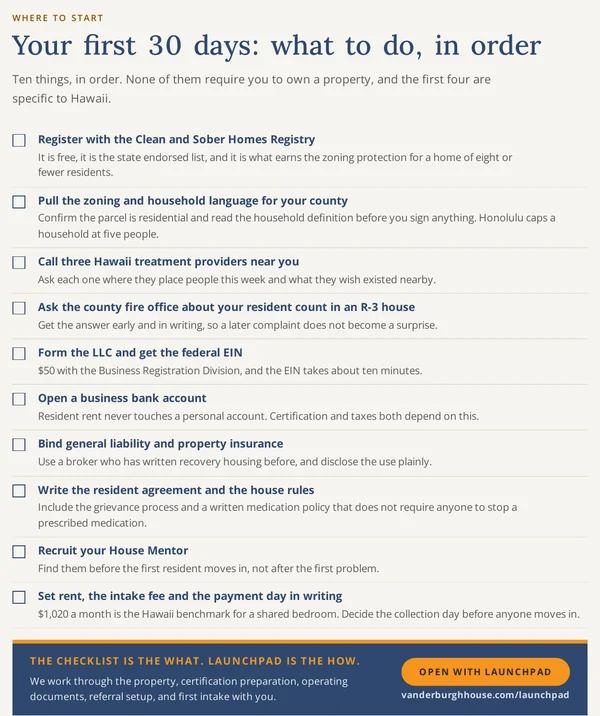
Most people ask whether they are allowed to open a recovery home. The better first question is whether the need and the money are there. This answers both, for your state.
- How many people need a bed, and how few beds exist
- Who actually pays the rent, and which programs are real
- What it costs to open on the purchase path and the lease path
How to Open a Sober House in Honolulu: Step-by-Step
The statewide sequence lives in the Hawaii guide. This version is ordered for Honolulu, where the bed count at step three is the decision the whole project turns on, because it determines whether the home needs a state registration and whether that registration makes it a permitted use or a conditional one. Expect 10 to 20 weeks from parcel check to first resident, with the property rather than the paperwork setting the pace.
Ten steps, in the order a Honolulu operator actually meets them.
Step 1. Check the Parcel Before You Tour the House
Start in the City and County of Honolulu Parcels and Zoning Information App, which returns the regulatory zoning, the flood layer, and the address as the Department of Planning and Permitting recognizes it. Read the district code off the parcel: R-20, R-10, R-7.5, R-5, and R-3.5 are the residential districts, and Table 21-5.1 treats all five of them identically for the uses on this page.
There is no city-versus-county question on Oahu. Hawaii has no incorporated places at all, so the City and County of Honolulu governs every address on the island under one Land Use Ordinance and one permitting department. An address in Kailua, Waipahu, or Wahiawa answers to exactly the same code as one in Manoa, which removes a whole category of risk that mainland metros carry.
Hawaii guideHawaii Zoning, Fair Housing, and Land Use Laws for Sober LivingWhere sober homes can operate in Hawaii and the legal protections that apply.→Step 2. Form the Entity and Open the GET Account
The entity signs the lease, not the person. Hawaii charges $50 to file articles of organization for an LLC and $15 for the annual report, which puts year one at $65 in state filing costs. Get the EIN and the business bank account open before the first resident pays rent.
Hawaii publishes no general business license, and neither does the City and County of Honolulu. What every business here does need is a general excise tax license, a one-time $20 filing on Form BB-1. The rate on Oahu is 4.5%, the 4.0% base plus the county surcharge, and it applies to rent collected from residents.
Hawaii guideHow to Form a Legal Entity for a Sober Living Business in HawaiiLLC, nonprofit, or both: how Hawaii operators structure the business and the property.→Step 3. Set the Bed Count, Then Price the Property
This is the decision the rest of the project hangs on. The Land Use Ordinance defines a family as people related by blood, adoption, guardianship, or marriage, or no more than five unrelated natural persons. A sixth resident moves the house out of household living and into group living, and Table 21-5.1 then splits on one question: has the State registered the home?
- Five or fewer unrelated residents: Household living, a permitted use in every residential district, with no discretionary approval at all.
- Six to eight residents, registered with the State: Small group living that is state regulated, marked P* in every residential district, a permitted use with standards. A live-in resident manager and their family are excluded from that count under HRS 46-4(d).
- Six to eight residents, not registered: Small group living that is not state regulated, marked C*, a major conditional use requiring a discretionary application.
- Nine or more residents: Large group living, marked C* in every residential district regardless of registration.
Once the bed count is set, two published figures set the budget. A four-bedroom in the Urban Honolulu metro carries a FY2027 fair market rent of $4,249 and a three-bedroom $3,520 (HUD FY2027 fair market rent schedule), and the median single-family sale price on Oahu was $1,240,000 in August 2026 (Honolulu Board of REALTORS). Those two anchors drive the cost table below, and they are the only lines Honolulu changes in the statewide model.
Hawaii guideSober Living Startup Costs in HawaiiEvery one-time cost to open, on the lease path and the purchase path, with the Hawaii figures behind each line.→Step 4. Settle the Alarms and the Certificate of Occupancy
Honolulu adopts the 2018 International Residential Code at ROH 16-1.2, so smoke alarms under IRC R314 belong in every sleeping room, outside each sleeping area, and on every story including basements, with carbon monoxide alarms under IRC R315 where the house has fuel-fired appliances or an attached garage. The Honolulu Fire Department publishes the same placement guidance, and the registry walk-through looks for all of it.
The trap is a change of use rather than the alarms. IRC R110.1 as adopted requires a new certificate of occupancy when the existing occupancy classification changes, so a house that previously ran as a licensed care home needs one, and so does any bedroom that appears on no permit. Resolve both with the Department of Planning and Permitting before residents move in, because the citations in the fire and building section below are far cheaper to satisfy while the house is empty.
Step 5. Write the Governing Documents and the Neighbor Plan
The registry standards checklist covers six domains, and the documents behind them are easier to write before opening than under pressure afterward. House rules, an intake and discharge policy, a grievance procedure, a resident agreement, a fee schedule, and a medication policy are what the walk-through looks for.
Add the document most templates skip: a neighbor-relations plan naming who answers a neighbor’s call and what they say. On Oahu this is not optional politeness. A five-resident home run by the island’s largest nonprofit provider drew a petition of roughly 200 signatures in Kane’ohe in 2025, and zoning compliance did nothing to prevent it.
Keep readingHouse Rules in Sober HousesThe rules that keep a recovery home safe, structured, and worth living in.→Step 6. Bind Insurance for the Specific Address
Quote the specific address before signing, because insurance is the line the statewide cost model leaves unpriced and the line Oahu moves most. Dwelling coverage here is written against a market where the median single-family sale price reached $1,240,000 in August 2026 (Honolulu Board of REALTORS), so the replacement-cost figure behind the premium is far above the statewide assumption.
Tell the carrier plainly that the home is a shared residence with no treatment on site, no clinical staff, and residents paying their own rent, then ask for general liability alongside property coverage. Proof of coverage is one of the things the registry standards checklist looks for, so bind before the walk-through rather than after it.
Step 7. Move the Live-In House Mentor In
The live-in house mentor is what makes a Level II home work, and it is the role the reference model pays for with an unpaid bed rather than a salary. Recruit from the recovery community on the island, where the meeting network is dense enough to find someone with real time in recovery, and put the arrangement in writing before anyone moves in. The mentor takes occupancy first, so the house has a culture before it has a census.
One detail is worth planning around: HRS 46-4(d) excludes a resident manager or resident supervisor and their family from the eight-resident count, so a house with eight residents plus a live-in house mentor still sits inside the state shield.
Step 8. Register the Home With the Department of Health
Registration is voluntary under HRS 321-193.7 and decisive in practice, because it is what satisfies the standard at ROH 21-5.50-2(a)(1): the use must be licensed, certified, registered, or monitored by the State. It is free at every stage, and the certificate runs two years.
- Put the six standard domains in place, then apply through the registry portal, which charges no application fee.
- Pass the Alcohol and Drug Abuse Division staff walk-through of the home.
- Hold the certificate with the lease, renew 90 days before expiration, and confirm the home appears in the public directory.
Step 9. Build the Referral List Before You Open
No county agency pays for recovery housing beds on Oahu, so referrals rather than contracts fill the house. Discharge planners place people they already know, which means calling the organizations in the referral table below while the house is still being furnished, inviting three of them to walk through it, and getting listed in the state registry directory so referral sources can find you at all. Those weeks cost almost nothing before the lease starts and a great deal after it.
Step 10. Open Slowly and Hold Occupancy
The Hawaii reference model breaks even at 77% occupancy, roughly seven of eight beds, which leaves little room for a slow first quarter in a market where the lease or mortgage line is the largest monthly cost by a wide margin. Admit two or three residents at a time rather than filling the house at once, run the house meeting weekly, and track occupancy daily. A short monthly note to referral partners saying how many beds are open is what turns a first placement into a pipeline.
Keep readingHow Sober Houses Fill Beds and Stay FullProven occupancy strategies from established recovery housing operators.→The phases below assume the property is already identified and the registration runs in parallel with the lease.
| Phase | Weeks (estimated) | What gets done |
|---|---|---|
| Zoning, bed count, and registration | 1 to 6 | Parcel check in the zoning app, the bed-count decision, the registry standards put in place, and the application filed. |
| Entity, GET license, and lease or purchase | 3 to 10 | LLC filed, GET license issued, lease signed or escrow opened with the Residential A classification checked. |
| Property work and inspection | 6 to 14 | Alarms, egress, any permit work, the certificate of occupancy question resolved, and the registry walk-through scheduled. |
| Documents, insurance, and house mentor | 8 to 14 | Governing documents written, coverage bound, the live-in house mentor recruited and moved in. |
| Referral outreach and opening | 10 to 20 | Partner calls and tours, registry listing live, first residents admitted two or three at a time. |
Timelines are estimated. What adds months in Honolulu is almost always the property rather than the paperwork. A permit for a garage conversion or an added bedroom runs through the Department of Planning and Permitting, and escrow on a $1.2 million house moves at its own pace.
Best Neighborhoods for a Sober Living Home in Honolulu
Oahu is one jurisdiction with one zoning code, so the address question here is not about which city you land in. It is about four things the island varies enormously on.
- Household size: Areas that already run large households read a six-bed home as ordinary rather than anomalous.
- Rail or frequent bus: Residents without cars need to reach treatment, work, and meetings, and Skyline now runs from East Kapolei to Kalihi Transit Center.
- Distance to providers: The treatment cluster sits in Kalihi, Iwilei, and Ko’olau Poko, and a discharge planner places closer before farther.
- Ownership rate: High owner-occupancy predicts organized opposition, and both documented Oahu disputes happened in high-ownership areas.
Six areas follow. Housing and tenure figures come from the Department of Planning and Permitting community profiles by development plan area and Census QuickFacts; transit comes from the TheBus route list and Honolulu Department of Transportation Services.
| Area | Housing stock and transit | Siting notes for a sober living home |
|---|---|---|
| Kalihi | The most rental-heavy large subarea in the Primary Urban Center Development Plan area, with 11,706 units in Kalihi-Palama and only 3,348 owner-occupied; Kalihi Valley up-valley runs larger and more owner-occupied. Kahauiki / Kalihi Transit Center is the current Skyline terminus and the hub for Routes 1, 2, and C. | Best transit and the closest proximity to the Iwilei provider cluster of any area on the island. The risk is saturation optics, because Kalihi already carries a heavy share of Oahu’s shelter and treatment capacity and its neighborhood board is active. |
| Mo’ili’ili and McCully | 14,179 units with only about 34% owner-occupied, dominated by low-rise walk-ups rather than single-family houses. Routes 1, 2, 4, and 13 plus the A and U lines to UH Manoa; no Skyline station is planned here. | The densest meeting geography on Oahu, with the A.A. central office on University Avenue. The risk is precedent: a men’s clean and sober home at McCully and Fern drew organized neighbor opposition in 2018 over its distance from Lunalilo Elementary, so site away from schools. |
| Waipahu | Plantation-era single-family stock at 4.27 persons per household, the highest of any area examined, and 59.7% owner-occupied. Median gross rent of $1,658 is the lowest of the six. Pouhala / Waipahu Transit Center has been a Skyline station since 2023. | The strongest price-to-transit ratio on the island, and a six-bed home is not visually unusual where households already run above four. The risk is parking on narrow plantation lots with no off-street capacity. |
| Pearl City | Large single-family hillside subdivisions, 71.5% owner-occupied with 2.95 persons per household, median gross rent $2,316. Two Skyline stations serve the area, Kalauao / Pearlridge and Waiawa / Pearl Highlands, plus Routes 51, 53, and 54. | Rail access without town prices, and a 25-minute ride to the Kalihi providers. The risk is classic high-ownership resistance, and neighboring ‘Aiea at $2,844 median rent prices a lease-path home out entirely. |
| Kane’ohe | Generous single-family lots under the Ko’olau Poko Sustainable Communities Plan, 76.4% owner-occupied with median gross rent of $2,269. Bus only, on Routes 60, 65, and 69 through the Likelike and Pali tunnels. | The densest treatment cluster on Oahu sits here and in Kailua, which shortens every discharge referral. The risk is the hardest siting on the island: a five-resident home run by the state’s largest nonprofit provider still drew roughly 200 petition signatures in 2025. |
| ’Ewa Beach | Newer master-planned subdivisions at 4.20 persons per household and 72.9% owner-occupied, with the lowest median home value of the six at $748,800 but median gross rent of $2,522. Skyline reaches Kapolei at East Kapolei and UH West Oahu; it does not reach ‘Ewa Beach itself. | The buy-side math is the friendliest on Oahu, and the housing stock suits a larger home. The risk is thin services, with the nearest residential provider in Wai’anae, and private covenants in master-planned tracts that bind before the zoning code does. |
Three house features decide it anywhere on the island, regardless of which area you choose.
- Bedroom count over square footage: Four bedrooms at the IRC minimum of 70 square feet each beat three large ones, because bed capacity is what the model turns on.
- Two full bathrooms: Six to eight residents sharing one bathroom fails the registry walk-through on practical grounds and turns over residents fast.
- A permitted, unconverted floor plan: Any bedroom that appears on no permit becomes a certificate of occupancy problem the week before you open.
There are no neighboring cities to check on Oahu. The City and County of Honolulu is a single consolidated jurisdiction covering the whole island, so the same Land Use Ordinance, the same Department of Planning and Permitting, and the same fire code apply from Ka’ena Point to Makapu’u.
- ✓Room-by-room requirements for a Level II home
- ✓Zoning and occupancy questions to ask before you tour
- ✓The red flags that should end a showing early
Who Regulates Sober Living Homes in Honolulu?
No single agency regulates sober living homes in Honolulu. The Department of Health decides whether a residence is a licensed treatment setting or not, the Department of Planning and Permitting decides where it can operate and what the building has to be, and the Department of Health’s registry decides which of those zoning paths applies. The state registry page states the position plainly: because the program is voluntary, no licenses are required.
A sober living home is a shared residence where people in recovery live together under house rules, pay their own rent, and receive no treatment on the premises. That definition is what keeps the home outside Hawaii’s care-home and treatment-facility licensing statutes, which reach settings providing care, diagnosis, treatment, or rehabilitation. The Land Use Ordinance reaches the same home from the other direction, through the number of unrelated people living in it rather than through what happens inside.
| Layer | Agency | What it controls for a sober living home |
|---|---|---|
| State licensing | Hawaii Department of Health, Office of Health Care Assurance (OHCA) | Licenses special treatment facilities and therapeutic living programs. A residence that adds clinical services, on-site counseling, or medical supervision crosses into that licensed category (OHCA State Licensing Section). |
| State registration | Hawaii Department of Health, Alcohol and Drug Abuse Division (ADAD) | Runs the voluntary clean and sober homes registry under HRS 321-193.7 and HAR Chapter 11-178, with no fee at any stage and a public directory. |
| City zoning | Honolulu Department of Planning and Permitting (DPP) | Administers the Land Use Ordinance, which sets the five-unrelated-person family definition and the group living classes at ROH 21-10.1 and their district permissions at Table 21-5.1. |
| City building | Honolulu Department of Planning and Permitting (DPP) | Enforces the Honolulu Building Code at ROH 16-1.1, which adopts the 2018 IBC and IRC with city amendments, and requires a permit to convert, enlarge, or alter a dwelling under ROH 18-3.1. |
| City fire | Honolulu Fire Department (HFD) | Enforces the NFPA 1 Fire Code adopted at ROH Chapter 20 but does not inspect the interiors of private dwellings, so a single-family recovery home is not on a routine inspection cycle. |
| State tax | Hawaii Department of Taxation | Issues the general excise tax license every business earning income in the state needs; the rate on Oahu is 4.5% including the county surcharge. |
The short version for an operator deciding whether Honolulu is workable.
- State license: Not required. Hawaii issues no license for a sober living home that provides no treatment.
- City license: None published. The City and County of Honolulu has no general business license; the state GET license is the registration that applies.
- Certification: Voluntary in law, decisive in zoning. Registering with ADAD makes a six-to-eight bed home a permitted use rather than a conditional one.
- Referrals: Registry-driven. The public directory is how discharge planners, probation officers, and drug court case managers find a home at all.
Licensing is the easy part in Honolulu, and it stays easy as long as no treatment happens in the house. Zoning is the part that constrains an operator, and it turns on two numbers: how many unrelated people live there, and whether the State has registered the home.
Honolulu Zoning Laws for Sober Living Homes
Honolulu has no sober living ordinance, no spacing rule, and no recovery-home resident cap on its books as of September 2026. A dated search of the Honolulu legislative document system, the Honolulu City Council record, and the Revised Ordinances found no bill or resolution specific to sober living homes, clean and sober homes, or recovery residences. What governs instead is the general Land Use Ordinance, and it governs tightly.
How the Land Use Ordinance Classifies a Sober Living Home
The Land Use Ordinance carries no sober living use category. It carries a family definition and a group living category, and a recovery home lands in one or the other purely on headcount and registration status.
- Family: “One or more natural persons, all related by blood, adoption, guardianship, marriage, or other duly authorized custodial relationship occupying a dwelling unit or lodging unit: or no more than five unrelated natural persons” (ROH 21-10.1).
- Group living, small, state regulated: “Type of group living that is licensed, certified, registered, or monitored by the State, where a dwelling unit is occupied by up to eight residents who do not meet the definition of a family” (ROH 21-10.1).
- Group living, large: Nine or more residents who do not meet the family definition, whether or not the State regulates the use (ROH 21-10.1).
- Residential districts: In R-20, R-10, R-7.5, R-5, and R-3.5 alike, Table 21-5.1 marks a single-unit dwelling P, small group living that is state regulated P*, small group living that is not state regulated C*, and large group living C*. P is a permitted use, C is a major conditional use, and the asterisk means standards apply.
A home is analyzed as a household when five or fewer unrelated residents live in it, and as group living at six. The city’s own use table is the clearest statement of position available: it distinguishes registered from unregistered small group living and gives them different entitlement paths in the same column. The standard behind the registered path, ROH 21-5.50-2(a)(1), asks only that the use be licensed, certified, registered, or monitored by the State.
Register the home with the Department of Health before the sixth resident moves in, not after. An unregistered six-bed home in a Honolulu residential district is a major conditional use, which means a discretionary application and a public process. The registered version of the same house, with the same residents, is a permitted use.
What the Eight-or-Fewer Rule Does and Does Not Do
Operators arrive quoting an eight-or-fewer protection as if it covered any recovery home in Hawaii. It does not. The rule is real, but it is conditional, and the condition is the part people drop.
- HRS 46-4(d): Bars any county ordinance or rule from prohibiting group living in facilities with eight or fewer residents, but only for purposes or functions “licensed, certified, registered, or monitored by the State,” and it excludes a resident manager or resident supervisor and their family from that resident count (HRS 46-4).
- HRS 321-193.7: Directs the Department of Health to establish a voluntary registry with organizational, fiscal, operational, recovery support, property, and neighbor standards, and contains no zoning language of its own (HRS 321-193.7).
- Unregistered homes: Reach neither protection. A home the State does not register is not “registered or monitored by the State,” so HRS 46-4(d) does not shield it and Table 21-5.1 classifies it as a major conditional use.
Where the registry does not reach, federal law does. People in recovery from substance use disorder are protected as individuals with disabilities under the Fair Housing Act, and the joint HUD and Department of Justice statement on group homes and land use sets out what a local government may and may not do with a residence for people with disabilities. The practical tool is a reasonable accommodation request, and the mechanics of requesting reasonable accommodation matter more here than the general shape of sober living zoning protections, because on Oahu the accommodation is usually a request to treat a registered household as the code already says it should be treated.
Keep readingThe Federal Fair Housing Act and Sober Living: Everything You Need to KnowThe federal protections every operator, neighbor, and local official should understand.→Ordinance 25-2 and the Code That Created These Categories
The categories above are new. Bill 64 (2023) was introduced on November 28, 2023, passed final reading on December 11, 2024, and was signed into law as Ordinance 25-2 on January 3, 2025. It is the first comprehensive rewrite of the Land Use Ordinance since 1990, and it is what replaced the old use vocabulary with the household living and group living framework a recovery home is now read against.
- Retired the boarding house category, which is why the code now defines only “rooming” as accessory accommodation for stays of 90 consecutive days or more.
- Replaced “single family detached dwelling” with “single-unit dwelling” and moved it under a household living heading.
- Created the three group living classes and split small group living by whether the State regulates the use (Table 21-5.1).
What did not change on that date is as important as what did. Ordinance 25-2 imposed no cap, no spacing requirement, and no registration mandate on recovery housing, and nothing in it singles sober living out. It changed the vocabulary an operator is classified under, and the classification now turns on a state registration rather than on a hearing. The federal law behind that reading has not moved.
- City of Edmonds v. Oxford House, Inc., 514 U.S. 725 (1995): Held that a zoning code’s cap on unrelated occupants is not an exempt “maximum occupancy restriction” under the Fair Housing Act, which is why a family definition like Honolulu’s is reachable by a reasonable accommodation request (HUD and DOJ joint statement).
- Olmstead v. L.C., 527 U.S. 581 (1999): Established that unjustified segregation of people with disabilities is discrimination under the Americans with Disabilities Act, which frames why community-based recovery housing sits where it does (Department of Justice).
- HUD and DOJ joint statement on group homes, local land use, and the Fair Housing Act: Warns that local governments may not apply special permit requirements to housing for people with disabilities that they do not apply to comparable households (joint statement).
What the current ordinance means for an operator deciding this month.
- Pull the parcel in the Parcels and Zoning Information App and note the district code before you tour the house.
- Decide the bed count first, then register with ADAD if that count is six or more, and keep the certificate with the lease.
- If the Department of Planning and Permitting reads the home as a conditional use despite a current registration, put the reasonable accommodation request in writing and cite Table 21-5.1 and HRS 46-4(d) together.
How your home gets classified, where Fair Housing applies, and what to do if the city says no.
Honolulu Fire and Building Code Rules for Sober Living Homes
A sober living home on Oahu is a Group R-3 occupancy, and Honolulu wrote that result into the code directly. ROH 16-1.1 amends IBC Section 310.4 so that Group R-3 expressly includes congregate living facilities and boarding houses that are non-transient with 16 or fewer occupants. A recovery home with six to eight residents and no care provided is squarely inside that language, which matters because R-3 is the light-touch classification.
- The care line: R-4 covers residential care facilities and assisted living with residents receiving care; a home that provides no care does not reach it, and Honolulu added a Group R-5 for transient congregate living, which is why a 90-day minimum stay matters to classification as well as to zoning (ROH 16-1.1).
- Certificate of occupancy: R-3 occupancies are routed out of the IBC certificate requirement and into IRC R110.1, which is triggered by a new building or a change in the existing occupancy classification. A house continuing as a dwelling usually needs nothing; a converted care home or an unpermitted bedroom does.
- Fire department scope: The Honolulu Fire Department inspects buildings and premises except the interiors of private dwellings, so no inspector will prompt a single-family recovery home to comply. An operator can request a voluntary inspection from the Fire Prevention Bureau at 808-723-7161.
Alarms are where first-time operators fall short of both the code and the registry walk-through. Every requirement below applies to the dwelling regardless of who lives in it, which is the point: none of this is a recovery-housing burden, and framing it that way with a landlord or a neighbor is both accurate and useful.
| Requirement | What the rule says | Authority |
|---|---|---|
| Smoke alarms | In each sleeping room, outside each separate sleeping area in the immediate vicinity of bedrooms, and on every story including basements. | IRC R314 as adopted at ROH 16-1.2; placement guidance from HFD. |
| Carbon monoxide alarms | Outside each separate sleeping area where the dwelling has fuel-fired appliances or an attached garage, for new work and for alterations requiring a permit. | IRC R315 as adopted at ROH 16-1.2. |
| Fire sprinklers | Not required in a detached one- or two-family dwelling. Hawaii bars counties from requiring them, and Honolulu requires a system only where a sprinkler equivalency for fire access road or water supply is needed. | HRS 46-19.8; IRC R313.2.2 at ROH 16-1.2. |
| Emergency escape openings | At least one in every sleeping room and in basement sleeping rooms, with a net clear openable area of 5.7 square feet and a sill no higher than 44 inches. | IRC R310 as adopted at ROH 16-1.2. |
| Minimum room size | One habitable room of at least 120 square feet, other habitable rooms at least 70 square feet with a minimum horizontal dimension of 7 feet, and a 7-foot ceiling height. | IRC R304 and R305 as adopted at ROH 16-1.2. |
| Permit for conversions | A permit is required to erect, enlarge, alter, convert, or move any building, which covers a garage conversion or an added bedroom. | ROH 18-3.1; fees per the DPP fee calculator. |
Because no inspector prompts a private dwelling, the burden sits entirely with the operator. Do the alarm and egress work before the registry walk-through rather than after it, and settle the bed-per-room question at the same time: determining maximum occupancy is a room-by-room exercise against the code minimums, not a judgment call made once residents are already in the house.
Alarms, egress, extinguishers, and the documentation an inspector expects on file.
Get the checklist freeNo cost, no obligation. Unsubscribe in one click.How Much Does It Cost to Open a Sober House in Honolulu?
The Hawaii reference model prices the lease path at $36,280 to $60,000 and the purchase path at $190,756, and Honolulu does not change most of those lines. Furniture, supplies, utility deposits, marketing, and the operating reserve are statewide figures that hold on Oahu. What Honolulu changes is the two anchors that dominate the budget: what a house costs to rent, and what one costs to buy.
| Line item | Honolulu figure | Source |
|---|---|---|
| Entity formation, year one | $65 ($50 articles of organization plus the $15 annual report) | Hawaii DCCA Business Registration Division |
| General excise tax license | $20 one-time; 4.5% rate on Oahu including the county surcharge | Hawaii Department of Taxation and county surcharge schedule |
| City business license | None published by the City and County of Honolulu | Honolulu Department of Budget and Fiscal Services |
| State license | $0, because no license is issued for a sober living home providing no treatment | Hawaii DOH Office of Health Care Assurance |
| Clean and sober home registration | $0 at application, inspection, and renewal | Hawaii DOH clean and sober homes registry |
| Lease anchor, four bedrooms | $4,249 per month (three-bedroom, $3,520) | HUD FY2027 fair market rent schedule, Urban Honolulu |
| Purchase anchor | $1,240,000 median Oahu single-family sale price; 20% down is $248,000 | Honolulu Board of REALTORS, August 2026 |
| Property tax, if you buy | $4.00 per $1,000 to $1,000,000 of value and $11.40 above it in the Residential A class | Honolulu Real Property Assessment Division, FY2027 |
| Permit work, if the house needs it | Set by valuation under Table 18-A, with plan review at 20% of the permit fee | ROH 18-6.2 and the DPP fee calculator |
Two adjustments turn the statewide model into a Honolulu budget.
- Purchase path: The state model assumes 20% down on a $797,400 property, or $159,480. At the August 2026 Oahu median of $1,240,000 the same 20% is $248,000, which lifts the purchase-path total to roughly $279,000, estimated. Closing costs, any permit work, and the higher Residential A tax are all still outside that figure.
- Lease path: The lease path moves much less, because the model’s deposit line scales with rent rather than with price. Use $4,249 as the figure to test a landlord’s quote against: a four-bedroom asking materially more than the published fair market rent will not carry an eight-bed house at the statewide per-bed price.
There are no Honolulu-specific startup grants for recovery housing. Two things reduce the bill rather than fund it, and both are worth taking.
- Registration costs nothing: The clean and sober homes registry charges no application, inspection, or renewal fee, which is unusual; most states charge several hundred dollars for the equivalent credential.
- No sprinkler retrofit:HRS 46-19.8 bars counties from requiring sprinklers in detached one- and two-family dwellings, removing a line that runs into five figures in many mainland markets.
Neither of those is money arriving. They are costs that never appear, and an operator who counts them as funding will be short at closing. The Department of Health contracts treatment providers rather than housing, so no public dollar reaches a sober living home’s startup budget on Oahu.
Hawaii guideHawaii Recovery Housing Funding: Why It Rarely Works the Way Operators ExpectBlock grants, opioid settlement dollars, Medicaid, and county contracts: what reaches a sober living home and what does not.→Is a Sober Living Home Profitable in Honolulu?
Both paths are hard in Honolulu, and they fail for different reasons. The Hawaii reference model runs eight beds at $1,020 per bed, producing $5,065 in total monthly revenue against $4,674 in costs, for $391 a month, an 8% margin, and a breakeven at 77% occupancy. Honolulu changes exactly one of those inputs, the lease payment, and that single line is enough to turn the leased model negative.
That score is a statewide reading, and Honolulu sharpens both halves of it. The legal side is easier here than the state average, because the Land Use Ordinance gives a registered home a permitted use rather than a hearing. The capital side is harder, because Oahu carries the state’s highest rents and sale prices. The table restates the Hawaii model line for line and scales only the property line.
| Line | Hawaii reference model (8 beds) | Honolulu adjustment (estimated) |
|---|---|---|
| Beds | 8 | Unchanged |
| Rent per bed, monthly | $1,020 | Unchanged |
| Potential rent | $8,160 | Unchanged |
| Less house mentor bed | ($1,020) | Unchanged |
| Less network membership | ($1,020) | Unchanged |
| Less vacancy allowance, 18% | ($1,469) | Unchanged |
| Net rent income | $4,651 | Unchanged |
| Plus intake fees and laundry | $414 | Unchanged |
| Total monthly revenue | $5,065 | Unchanged |
| Lease payment | $3,154 | $4,249, the FY2027 fair market rent for a four-bedroom in Urban Honolulu (estimated; HUD) |
| All other operating costs | $1,520 | Unchanged |
| Total monthly costs | $4,674 | $5,769 (estimated) |
| Net operating income | $391 | ($704) (estimated) |
| Margin | 8% | Negative at this lease anchor (estimated) |
| Breakeven occupancy | 77% | The state model’s 77% does not hold at this lease line (estimated) |
That adjustment holds every input except the lease constant, and it is an estimate rather than a quote. An eight-bed home paying market rent for a four-bedroom on Oahu does not clear at the statewide per-bed price, and buying instead trades that rent line for roughly $248,000 down on the August 2026 median. Three local factors move the outcome more than either property decision does.
- Bed count: A house that supports 10 to 14 beds spreads the same lease across more revenue, which is why larger sober living homes carry the economics on expensive islands. Above eight residents the home becomes large group living and needs a conditional use permit, so the gain is real but the entitlement changes.
- Per-bed price: The statewide $1,020 is a floor on Oahu, not a ceiling. Honolulu private-pay rates sit above the state model, and sober living rent pricing set against the local market rather than the state average is the fastest route back to a positive margin.
- Lease or buy: Buying removes the rent line that breaks the leased model and replaces it with the heaviest capital requirement in the set: 20% down on the Oahu median is roughly $248,000, and Hawaii scores 1 out of 10 on startup burden (Foote, 2026). The lease vs. operate decision matters more here than in almost any other market, and neither answer is comfortable.
No real property matches a reference model. Running your own address, bedroom count, and rent through the calculator takes a few minutes and produces a figure you can actually plan against.
Will your property pencil out?
Get a custom projection for your Hawaii property, then compare it with typical returns.
Get my projectionFree calculator with your property’s numbers.See Hawaii profitabilityRealistic revenue, operating costs, and margins in Hawaii.How to Get Residents for a Sober Living Home in Honolulu
No county agency pays for recovery housing beds on Oahu. The Department of Health contracts treatment providers rather than housing, and those providers run their own clean and sober housing as a program component. That makes residents on Oahu largely private pay, and it makes the public doors below referral channels rather than payers.
- Hawaii CARES 988: The statewide behavioral health access line, reachable at 988 or (808) 832-3100, screens callers and links them to treatment and recovery services; it is the number every other agency on this island hands out (Hawaii CARES).
- The clean and sober homes registry: Not a payer but the directory referral sources search. Registration is free, the certificate runs two years, and only homes in good standing appear in the public database.
- Med-QUEST community integration services: Hawaii Medicaid covers pre-tenancy and tenancy-sustaining supports for members who are homeless or exiting an institution, and the CIS+ benefit effective July 2026 adds short-term room and board with clinical services. Recovery housing is not itself a covered benefit (Med-QUEST).
Seventeen organizations follow, public agencies first, because on Oahu the public bodies control the flow and the nonprofit providers supply the residents.
| Organization | Type | How residents reach you |
|---|---|---|
| Hawaii DOH Alcohol and Drug Abuse Division | State agency | Registers the home, lists it in the public directory, and contracts the treatment providers that discharge into it. |
| Hawai’i CARES 988 | State access line | Screens callers island-wide and links them to treatment, which then steps down to sober housing. |
| O’ahu Drug Court, First Circuit | Courts | Participants under court supervision need verifiable drug-free housing during the outpatient phases. |
| HOPE Probation, First Circuit | Courts | Probation officers on this high-intensity Oahu caseload look for structured housing when a probationer is unstably housed. |
| Hawaii DCR Rehabilitation Services and Programs | State corrections | Furlough and reentry releases from Oahu facilities need a sober address at discharge. |
| Honolulu Homeless Initiatives Unit | County agency | Coordinates the city’s Housing First, outreach navigation, and shelter programs, and its navigators move people from shelter into next-step housing. |
| CORE, Honolulu Emergency Services | County agency | Field teams place unsheltered people into shelter or transitional housing after a non-emergency 911 encounter. |
| VA Pacific Islands Health Care System | Federal | The homeless veteran care program pairs transitional housing with substance use and mental health treatment. |
| The Queen’s Medical Center Day Treatment | Hospital | Dual-diagnosis intensive outpatient and a community transition program on Nu’uanu Avenue discharge into sober housing. |
| Partners In Care | Continuum of care | Runs Oahu’s coordinated entry system and the referral directory the housing providers work from. |
| Hina Mauka | Nonprofit provider | The Kane’ohe residential program states that its treatment team helps people in treatment secure sober living arrangements before discharge. |
| Salvation Army Addiction Treatment Services | Nonprofit provider | A 66-bed detox and residential program on Waokanaka Street whose residents step down after residential care. |
| Salvation Army Family Treatment Services | Nonprofit provider | Serves pregnant and parenting women and holds its own registration for up to 36 clean and sober beds. |
| Po’ailani, Inc. | Nonprofit provider | Thirty-two licensed special treatment facility beds for co-occurring adults in Kailua and Kane’ohe, discharging into community housing. |
| Institute for Human Services | Nonprofit provider | Oahu’s largest homeless services nonprofit, running recovery homes and triage for people entering treatment. |
| CARE Hawaii | Nonprofit provider | Intensive outpatient, therapeutic living, and crisis residential, with case managers moving people into next-step housing. |
| Catholic Charities Hawai’i | Nonprofit provider | The housing placement program covers deposits and first month’s rent for households exiting homelessness. |
| Kū Aloha Ola Mau | Nonprofit provider | People receiving medication-assisted treatment in Honolulu are a standing source of residents for homes that accept them. |
The fellowships are not a formal referral channel, and they fill more beds on Oahu than any channel that is. The O’ahu A.A. Intergroup 24-hour helpline answers at (808) 946-1438 and the Intergroup publishes 220 in-person and 90 virtual meetings a week islandwide; Narcotics Anonymous Hawai’i runs an Oahu helpline at (808) 734-4357. Meeting secretaries and sponsors are how most residents hear about a house.
If you came here looking for a bed rather than a business plan, the next step is the application below rather than anything above it.
Take the next step
Apply, browse homes, or search the national directory.
Apply onlineGet a call back within 24 hours.View VSL homesSee Chartered recovery homes and find the right fit.Search the national directoryCertified sober houses anywhere in the US.Or call (844) 762-3747, weekdays 8a to 5p.
Common Mistakes When Opening a Sober House in Honolulu
These are the errors that show up in Honolulu homes struggling through year one, and every one of them happens in the first ten weeks, before a single resident arrives.
- Signing the lease before registering: An unregistered six-bed home is a major conditional use under Table 21-5.1, and the registration that would have made it a permitted use is free. Doing it in the wrong order converts a paperwork step into a discretionary hearing.
- Putting a sixth resident in a five-person house: The Land Use Ordinance family definition stops at five unrelated people. A home that opened at five and quietly grew to six without registering has changed use class without changing anything a neighbor can see, which is exactly how a complaint starts.
- Pricing the lease path from the state model: At the FY2027 fair market rent of $4,249 for a four-bedroom, the statewide eight-bed model runs negative. An operator who budgets from the state figure rather than the Honolulu anchor discovers it in month two.
- Missing the Residential A tax tier: The median Oahu house clears $1,000,000, so an investor-owned recovery home with no home exemption is usually taxed at the Residential A rates rather than the standard residential rate. That gap is thousands a year and it is rarely in the first pro forma.
- Treating neighbor relations as optional: A five-resident home run by the island’s largest nonprofit provider drew roughly 200 petition signatures in Kane’ohe in 2025. Zoning compliance does not prevent that, and a written plan naming who answers a neighbor’s call is the cheapest insurance on this page.
The Hawaii book and the Blueprint carry the checklists, the document templates, and the operating detail this page points at but does not reproduce.

The book gives you the map to open a home. When you’re ready to launch, certify, and sustain, the Blueprint is the full playbook covering funding, legal, insurance, and operations.
Frequently Asked Questions About Opening a Sober House in Honolulu
Do you need a license to open a sober living home in Honolulu?
No. Hawaii issues no license for a sober living home that provides no treatment on site. The Department of Health Office of Health Care Assurance licenses special treatment facilities and therapeutic living programs, and a shared residence where residents pay their own rent and follow house rules falls outside that scope. The City and County of Honolulu publishes no general business license either.
How many residents can live in a sober living home in Honolulu?
Five unrelated residents is the limit for a household under the Honolulu Land Use Ordinance family definition at ROH 21-10.1. Six to eight residents is small group living, permitted in every residential district if the home is registered with the state, and HRS 46-4(d) excludes a live-in resident manager and their family from that count. Nine or more is large group living and requires a major conditional use permit anywhere on Oahu.
Does registering with the state change Honolulu zoning?
Yes, decisively. Table 21-5.1 of the Land Use Ordinance marks small group living that is state regulated as a permitted use in every residential district, and small group living that is not state regulated as a major conditional use. Registration with the Department of Health Alcohol and Drug Abuse Division is free and is what satisfies the standard at ROH 21-5.50-2(a)(1).
Can a sober living home open in a residential neighborhood in Honolulu?
Yes. In Honolulu a registered home of eight or fewer residents is a permitted use in the R-20, R-10, R-7.5, R-5, and R-3.5 residential districts alike, with no discretionary approval. HRS 46-4(d) reinforces this by barring county ordinances from prohibiting group living of eight or fewer residents in uses the State registers or monitors.
How much does it cost to open a sober living home in Honolulu?
The Hawaii model prices the lease path at $36,280 to $60,000 and the purchase path at $190,756, and Honolulu raises only the property anchors. Twenty percent down on the August 2026 Oahu median of $1,240,000 is $248,000, which lifts the purchase path to roughly $279,000. Entity formation runs $65 and registration is free.
Is a sober living home profitable in Honolulu?
Both paths are difficult, for different reasons. The Hawaii reference model nets $391 a month on an eight-bed leased home, but substituting the FY2027 four-bedroom fair market rent of $4,249 for the state lease line turns that negative. Buying avoids the rent problem and replaces it with roughly $248,000 down on the August 2026 Oahu median. More beds or higher per-bed pricing is what closes the gap.
Your Honolulu Sober House Startup Checklist
Every item below is covered somewhere above, and on Oahu none of them is optional. Work them in order, because several of them stop being cheap once the lease is signed.
Four evergreen guides cover the operating questions this page hands off.
How VSL Helps You Open a Sober House in Honolulu
Vanderburgh Sober Living charters independently operated recovery homes into a cooperative network, where the operator keeps ownership of the business and gains the brand, the operating standards, and the startup support of the Chartered Operator community. The support is aimed at the points this page kept returning to: choosing between five beds and eight, timing the state registration against the lease, testing a landlord’s rent against the published anchor, and deciding whether an Oahu property works on a lease at all.
There are two routes in. The Launchpad Program is self-guided training you work through at your own pace, and the Mastery Program is done-with-you support through startup, registration, and the first year of operating. If you want to talk through a specific Honolulu address, or the lease-versus-buy question this market makes unusually consequential, get in touch with the VSL team.
Start your sober house
Pick the path that fits where you are in the process.
Download the free guidePath to Purposeful Recovery Housing, by Dr. Hunter T. Foote.Explore the Mastery ProgramHands-on startup, certification, and operating support.See how starting with VSL worksThe opportunity, the community, and what a Charter includes.Prefer to talk now? Call (844) 762-3747, weekdays 8a to 5p.
Educational only; not legal, financial, or medical advice. Fees, rents, and rules change, and the Honolulu adjustments above are estimates built on the Hawaii reference model. Confirm current requirements with Honolulu, Honolulu County, and qualified professionals before you sign or spend.
Research & Sources
- Foote, H. T. (2026). Vanderburgh Sober Living Operating Climate Index, 2026 Edition. Vanderburgh Sober Living. https://www.vanderburghhouse.com/research/operating-climate-index-2026/
- Hawaii Department of Health, Office of Health Care Assurance. (2026). State Licensing Section. health.hawaii.gov
- American Legal Publishing. (2026). Revised Ordinances of Honolulu, § 21-10.1, Definitions. City and County of Honolulu. codelibrary.amlegal.com
- Honolulu Department of the Medical Examiner. (2026). Annual statistical reports. City and County of Honolulu. honolulu.gov
- Honolulu Department of the Medical Examiner. (2026). Annual report, fiscal year 2024–2025. City and County of Honolulu. public.powerdms.com
- Partners In Care. (2026). Oahu point-in-time count. partnersincareoahu.org
- Hawaii Department of Health, Alcohol and Drug Abuse Division. (2025). Treatment and Recovery Branch provider directory, 2024–2026. health.hawaii.gov
- Hawaii State Judiciary. (2026). Hawai’i celebrates 30 years of drug court during specialty court graduation ceremony. courts.state.hi.us
- City and County of Honolulu, Department of Emergency Services. (2026). CORE: Community Outreach Response and Engagement. emergencyservices.honolulu.gov
- O’ahu A.A. Intergroup of Hawaii. (2026). Meetings and services. oahuaa.org
- Hawaii Department of Health, Office of Health Care Assurance. (2025). Special treatment facilities. health.hawaii.gov
- Bureau of Justice Statistics. (2025). Probation and parole in the United States, 2023. U.S. Department of Justice. bjs.ojp.gov
- Hawaii Department of Health. (2026). Clean and sober homes registry. cshome.ehawaii.gov
- City and County of Honolulu, Department of Transportation Services. (2026). Skyline sets weekday ridership record. honolulu.gov
- City and County of Honolulu, Department of Planning and Permitting. (2026). Parcels and zoning information app. cchnl.maps.arcgis.com
- U.S. Census Bureau. (2024). Hawaiian geography and the Census Bureau. census.gov
- American Legal Publishing. (2026). Revised Ordinances of Honolulu, § 21-5.30, Use table. City and County of Honolulu. codelibrary.amlegal.com
- American Legal Publishing. (2026). Revised Ordinances of Honolulu, § 21-5.50-2, Group living. City and County of Honolulu. codelibrary.amlegal.com
- Hawaii Revised Statutes. (2025). § 321-193.7, Clean and sober homes registry. law.justia.com
- Hawaii Revised Statutes. (2025). § 46-4, County zoning. law.justia.com
- Hawaii Department of Health, Alcohol and Drug Abuse Division. (2024). Clean and sober home registry standards checklist. health.hawaii.gov
- Hawaii Department of Commerce and Consumer Affairs. (2026). Limited liability company fees. cca.hawaii.gov
- Hawaii Department of Taxation. (2026). Licensing information. tax.hawaii.gov
- Hawaii Department of Taxation. (2026). County surcharge on general excise and use tax. tax.hawaii.gov
- U.S. Department of Housing and Urban Development. (2026). FY2027 fair market rent schedule. huduser.gov
- Honolulu Board of REALTORS. (2026). Monthly market report, August 2026. hicentral.com
- City and County of Honolulu, Real Property Assessment Division. (2026). Residential A classification. realproperty.honolulu.gov
- City and County of Honolulu, Real Property Assessment Division. (2026). Real property tax rates, fiscal year 2027. realproperty.honolulu.gov
- American Legal Publishing. (2026). Revised Ordinances of Honolulu, § 16-1.2, Residential code. City and County of Honolulu. codelibrary.amlegal.com
- American Legal Publishing. (2026). Revised Ordinances of Honolulu, § 16-1.1, Building code. City and County of Honolulu. codelibrary.amlegal.com
- Honolulu Fire Department. (2026). Smoke alarms. City and County of Honolulu. fire.honolulu.gov
- Honolulu Fire Department. (2026). Inspections. City and County of Honolulu. fire.honolulu.gov
- Hawaii Revised Statutes. (2025). § 46-19.8, Fire sprinklers; residences. law.justia.com
- American Legal Publishing. (2026). Revised Ordinances of Honolulu, § 18-3.1, Permits required. City and County of Honolulu. codelibrary.amlegal.com
- American Legal Publishing. (2026). Revised Ordinances of Honolulu, § 18-6.2, Building permit fees. City and County of Honolulu. codelibrary.amlegal.com
- City and County of Honolulu, Department of Planning and Permitting. (2026). Building permit fee calculator. honolulu.gov
- Honolulu City Council. (2025). Bill 64 (2023), relating to use regulations. City and County of Honolulu. honolulucitycouncil.org
- City and County of Honolulu. (2026). Honolulu legislative documents. hnldoc.ehawaii.gov
- U.S. Department of Housing and Urban Development & U.S. Department of Justice. (1999). Joint statement on group homes, local land use, and the Fair Housing Act. hud.gov
- U.S. Department of Housing and Urban Development. (2026). Housing discrimination under the Fair Housing Act. hud.gov
- U.S. Department of Justice. (2011). Olmstead: Community integration for everyone. ada.gov
- City and County of Honolulu, Department of Planning and Permitting. (2026). Community profiles by development plan area, 2019–2023. honolulu.gov
- City and County of Honolulu, Department of Planning and Permitting. (2025). Primary Urban Center Development Plan. honolulu.gov
- City and County of Honolulu, Department of Planning and Permitting. (2021). Central O’ahu Sustainable Communities Plan. honolulu.gov
- City and County of Honolulu, Department of Planning and Permitting. (2017). Ko’olau Poko Sustainable Communities Plan. honolulu.gov
- City and County of Honolulu, Department of Planning and Permitting. (2020). ’Ewa Development Plan. honolulu.gov
- City and County of Honolulu, Department of Transportation Services. (2026). Skyline stations and parking. honolulu.gov
- City and County of Honolulu. (2026). TheBus routes and schedules. thebus.org
- U.S. Census Bureau. (2026). QuickFacts: Urban Honolulu CDP, Hawaii. census.gov
- U.S. Census Bureau. (2026). QuickFacts: Honolulu County, Hawaii. census.gov
- U.S. Census Bureau. (2026). QuickFacts: Waipahu CDP, Hawaii. census.gov
- U.S. Census Bureau. (2026). QuickFacts: Pearl City CDP, Hawaii. census.gov
- U.S. Census Bureau. (2026). QuickFacts: Kane’ohe CDP, Hawaii. census.gov
- U.S. Census Bureau. (2026). QuickFacts: ’Ewa Beach CDP, Hawaii. census.gov
- Hawaii CARES. (2026). How we help. Hawaii Department of Health. hicares.hawaii.gov
- Hawaii Med-QUEST Division. (2026). Community integration services. homelessness.hawaii.gov
- Hawaii State Judiciary. (2026). About HOPE probation. courts.state.hi.us
- Hawaii Department of Corrections and Rehabilitation. (2026). Rehabilitation Services and Programs Division. dcr.hawaii.gov
- City and County of Honolulu, Department of Community Services. (2026). Homeless Initiatives Unit programs. honolulu.gov
- Partners In Care. (2026). Get help. partnersincareoahu.org
- U.S. Department of Veterans Affairs. (2026). Homeless veteran care, Pacific Islands Health Care System. va.gov
- The Queen’s Medical Center. (2026). Day treatment services. queens.org
- Hina Mauka. (2026). Residential treatment services. hinamauka.org
- The Salvation Army. (2026). Addiction Treatment Services Hawaii. salvationarmy.org
- The Salvation Army. (2026). Family Treatment Services, Hawaiian and Pacific Islands. salvationarmyusa.org
- Po’ailani, Inc. (2026). Services. poailani.org
- Institute for Human Services. (2026). Substance abuse recovery homes. ihshawaii.org
- CARE Hawaii. (2026). Services. carehawaii.com
- Catholic Charities Hawai’i. (2026). Housing placement program. catholiccharitieshawaii.org
- Kū Aloha Ola Mau. (2026). Medication-assisted treatment. kualoha.com
- O’ahu A.A. Intergroup of Hawaii. (2026). 24-hour helpline. oahuaa.org
- Narcotics Anonymous Hawai’i. (2026). Helplines. na-hawaii.org
- Hawaii Department of Health. (2019). Hawaii Administrative Rules, Chapter 11-178, Clean and sober homes registry. health.hawaii.gov
- Hawaii Revised Statutes. (2025). § 321-15.6, Adult residential care homes; licensing. law.justia.com
- Hawaii Department of Accounting and General Services. (2021). 2018 Hawaii state building code. ags.hawaii.gov
- Hawaii Department of Accounting and General Services. (2020). 2018 Hawaii state residential code. ags.hawaii.gov
- City and County of Honolulu, Department of Budget and Fiscal Services. (2026). Treasury Division. honolulu.gov
- City and County of Honolulu, Department of Planning and Permitting. (2026). Short-term rental frequently asked questions. honolulu.gov
- National Alliance for Recovery Residences. (2026). Affiliates. narronline.org
- Substance Abuse and Mental Health Services Administration. (2023). Best practices for recovery housing (PEP23-10-00-002). library.samhsa.gov