Opening a sober living home in Indianapolis means satisfying three separate layers of rule, and as of 2026 only one of them is new. The state does not license a peer-run recovery home, but since July 1, 2026 the owner of every recovery residence in Indiana must register with the Division of Mental Health and Addiction under Indiana Code 12-23-25, at $500 per residence for a two-year term. Marion County’s zoning ordinance, administered countywide by the Metropolitan Development Commission, permits a group home by right in every dwelling district, and Sec. 740-202 of the Revised Code defines that use by reference to federal disability status rather than to a licence. In March 2026 a federal court ordered Indiana to stop treating recovery homes as commercial structures, which removed the single largest construction cost an Indianapolis operator faced. The demand behind all of it is not in doubt: Marion County recorded 669 accidental overdose deaths in 2023, and the Indianapolis continuum of care counted 1,815 people experiencing homelessness in January 2025, 401 of them chronically.
What follows is the Indianapolis-specific layer: how the Revised Code classifies the house, which city desks you deal with, what the March 2026 ruling changed about the building code, what a Marion County property costs, and which local agencies put residents in beds. Statewide rules, the certification process, and the full startup and revenue models belong to the Indiana guide below. Where this page carries a state figure it restates that figure and adjusts only the lines Indianapolis genuinely changes, which are the lease anchor, the purchase price, the mortgage, and the property tax.
Before you read onHow to Open a Sober Living Home in IndianaThis post covers one piece of the process. The complete Indiana guide walks through every step, from planning to your first resident.→Is Indianapolis a Good Place to Open a Sober Living Home?
Yes, and Indianapolis is one of the more forgiving large cities in the country to open in. A group home is a permitted use in every residential district rather than a variance fight, houses large enough for a Level II home sell at a Marion County median of $258,500, and the county’s justice and behavioral-health systems already route people into recovery housing. The caveats are specific. The state registration application asks for written confirmation that the address complies with local zoning, so a bad address now blocks a state credential. A non-homestead house pays property tax at Indiana’s 2% constitutional cap rather than at the statewide average. And the referral money moves only after the Division of Mental Health and Addiction designates the home.
Recovery Housing Demand in Marion County
Residents reach an Indianapolis recovery home through four pipelines, and three of them are public.
- The justice system: Marion Superior runs four problem-solving courts certified by the Indiana Office of Court Services, and Marion County Community Corrections supervises work release, home detention, and day reporting. Both approve the address a participant lives at, which makes them the steadiest source of placements in the county.
- Treatment discharge: Eskenazi Health’s Sandra Eskenazi Mental Health Center is the county’s safety-net community mental health center, and IU Health, Community Fairbanks, and Wheeler Mission all run residential or intensive outpatient programs that discharge people who need somewhere structured to go next.
- The homelessness response: The Coalition for Homelessness Intervention and Prevention runs coordinated entry for the Indianapolis continuum of care, assessing people at any participating agency and routing them by eligibility rather than by who they called first.
- The recovery community: Peer recovery coaches funded through the Indiana Recovery Network, and the meeting rooms themselves, produce the private-pay referrals that fill the beds the public pipelines do not.
These are the Marion County numbers a lender, a landlord, or a discharge planner asks about before anything else.
| Indicator | Indianapolis figure | Why it matters to an operator |
|---|---|---|
| Accidental overdose deaths, Marion County | 669 in 2023, down 18% from 801 the year before, with opioids in 561 of them and fentanyl present in 97% of those (Marion County Overdose Fatality Review) | The need is enormous and the direction is improving, which is the combination funders reward. Cite the decline, not just the total, when you approach a county partner. |
| People experiencing homelessness, Indianapolis continuum of care | 1,815 counted on 22 January 2025, up 7%, with 401 chronically homeless, up 24% (CHIP point-in-time brief) | Chronic homelessness is the segment coordinated entry prioritises, and a structured recovery bed is one of the few placements that fits it. |
| Median sale price, Marion County | $258,500 in August 2026 (Indiana Association of REALTORS Housing Hub) | This is the purchase anchor for the cost table below. It runs about 21% under the 14-county MIBOR median, so metro-wide figures will overstate what you pay inside the county. |
| Fair market rent, Indianapolis-Carmel HUD metro area | $1,991 for three bedrooms and $2,425 for four, effective 1 October 2026 (HUD FY2027 FMR schedule) | The lease anchor, and the number to test a landlord’s asking rent against. It is also the rent voucher programs will pay. |
| Transit | 28 fixed routes plus the Red and Purple bus rapid transit lines, carrying 7,133,338 trips in 2024 (National Transit Database) | Residents without a car need to reach work, court, and meetings. A house within walking distance of a BRT station removes the most common reason a placement fails in month two. |
| The public payer for recovery beds | Recovery Works, the Division of Mental Health and Addiction voucher program for justice-involved adults (DMHA) | There is no county-run bed rate here. The state program is the public money, and it only reaches homes the state has designated at Level II or above. |
Foote (2026) scores Indiana at 8 for market strength and 7 for operator funding access, but only 4 for resident funding access, and classifies the state as moderately regulated in the Operating Climate Index. Marion County is most of the reason the market strength score sits where it does: it holds the state’s largest concentration of treatment providers, its busiest problem-solving courts, and the single referral intake operation that routes Recovery Works cases for all 92 counties. The resident funding score is the warning attached to it. An Indianapolis operator reaches real money through institutions, not through individual residents who arrive holding a voucher.
Indianapolis zoning is no longer only a local question. The state recovery residence registration application asks for written confirmation that the property complies with local zoning, so the Marion County classification of your address now sits between you and a state credential. Get the zoning confirmation in writing before you sign anything.
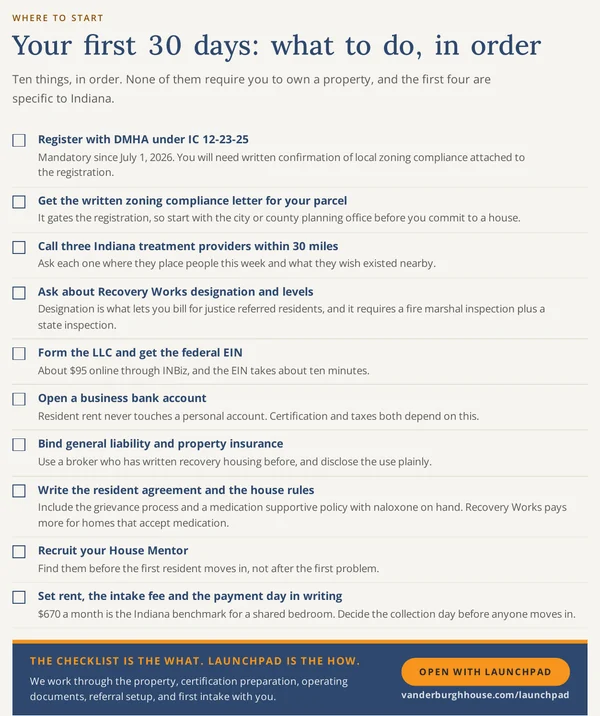
Most people ask whether they are allowed to open a recovery home. The better first question is whether the need and the money are there. This answers both, for your state.
- How many people need a bed, and how few beds exist
- Who actually pays the rent, and which programs are real
- What it costs to open on the purchase path and the lease path
How to Open a Sober House in Indianapolis: Step-by-Step
The statewide sequence lives in the Indiana guide. This version is ordered for Indianapolis, and the reason the order differs is the registration statute: because the state asks for written local zoning confirmation before it will register the home, the zoning check is no longer something you do in parallel with the paperwork. It is the thing everything else waits on. Expect four to seven months from first property search to first resident, with the property itself driving most of that.
Ten steps, in the order an Indianapolis operator actually meets them.
Step 1. Confirm How the Revised Code Classifies the Address
Pull the parcel on the Indy Zoning Browser before you make an offer, and note the district letter. Marion County runs on a consolidated zoning ordinance that the Metropolitan Development Commission administers across the entire county, including inside the four excluded cities, so there is no separate unincorporated-county test to clear and no municipal boundary that changes the rulebook. What the district letter tells you is whether the dwelling districts apply, and in the D-series a group home is a permitted use rather than a variance request.
The classification question that actually decides your exposure is which use category the house falls into, not which district it sits in. A group home is permitted by right across the dwelling districts; transitional living quarters, the code’s other residential-support category, is not, and reaching it in a dwelling district takes a use variance from the Metropolitan Board of Zoning Appeals. That route works, but it is slow and public: in Case 2026-UV3-004, approved on 12 May 2026, the board granted a transitional living quarters use on Shriver Avenue in Center Township only after an amended filing that also carried a parking deficiency. Ask the Division of Planning which category it will apply to your model, and get the answer in writing.
Indiana guideIndiana Zoning, Fair Housing, and Land Use Laws for Sober LivingWhere sober homes can operate in Indiana and the legal protections that apply.→Step 2. Form the Indiana Entity and Register as a Landlord
The entity signs the lease or takes title, never you personally. Articles of Organization for an Indiana LLC cost $100 on paper and $95 filed online through INBiz, and the business entity report comes due every two years at $32 online. Add the $500 state recovery residence registration covered in Step 8 and year one of compliance paperwork runs roughly $600. Get the EIN and open the business bank account before a single resident hands over money, because commingling is the first thing a designation reviewer notices.
Indianapolis has no general business licence, but it does have a landlord registry. Chapter 851 of the Revised Code requires the owner of a residential rental to register with the Department of Business and Neighborhood Services, at a $5 fee per owner regardless of how many properties you hold. That ceiling is statutory rather than generous: IC 36-1-20-5 caps what any Indiana political subdivision may charge for rental registration at five dollars. Register it and keep the receipt with the zoning letter.
Indiana guideHow to Form a Legal Entity for a Sober Living Business in IndianaLLC, nonprofit, or both: how Indiana operators structure the business and the property.→Step 3. Buy or Lease a House That Reads as One Household
The Revised Code defines a group home by reference to who lives there rather than by how the rooms are arranged, but the building code cares a great deal about how the residents hold their rooms. A house occupied by three or more people on separate individual agreements can be pulled out of the residential code and into the commercial one, so the structure of your resident agreement is a property decision as much as a legal one.
- Four or five real bedrooms above grade, with conforming egress windows, since bedrooms added in a basement without permits are the most common deal-killer in Indianapolis housing stock of this era.
- One bathroom for every four to five residents, and a kitchen and living room that genuinely seat the whole house rather than a converted double where the two halves never meet.
- Off-street parking, because the older neighbourhoods where the large houses are have the least street parking and the most organised neighbours.
- A single household agreement covering the whole group rather than a stack of room rentals, which is the structural argument that keeps the house inside the residential code.
Two published figures drive the cost table further down this page. The lease anchor is the HUD fair market rent for the Indianapolis-Carmel metro area effective 1 October 2026, which is $1,991 for a three-bedroom and $2,425 for a four-bedroom. The purchase anchor is the Marion County median sale price of $258,500 in August 2026. Everything else in the budget is small beside these two.
Indiana guideSober Living Startup Costs in IndianaEvery one-time cost to open, on the lease path and the purchase path, with the Indiana figures behind each line.→Step 4. Settle the Building Classification and the Alarms
Indiana sorts buildings into Class 1 and Class 2, and the difference is expensive. A Class 2 structure follows the Indiana Residential Code; a Class 1 structure follows the commercial building code, which brings sprinklers and a state design release with it. Until 2026 the Department of Homeland Security read a recovery home with three or more residents as Class 1. A federal court ended that reading in March 2026, and the fire and building section below sets out what it means for your house. Do not let a plan reviewer reinstate it by assumption.
Alarms are where first-time operators fall short of both the code and the designation inspection. The Indiana Residential Code requires interconnected smoke alarms in every sleeping room, outside each sleeping area, and on every storey including the basement, hard-wired with battery backup, plus carbon monoxide alarms outside the sleeping areas wherever the house has a fuel-fired appliance or an attached garage. Settle any unpermitted-bedroom or prior-use problem with the Department of Business and Neighborhood Services before the inspection rather than after, because Marion County requires a certificate of completion and compliance to be filed before occupancy.
Step 5. Write the Governing Documents Before You Open
The state reviews written policy at designation, not at a follow-up visit, and writing it after the house is full means writing it under pressure. You need house rules, a resident agreement, an intake and screening policy, a discharge and appeals process, a medication policy that does not exclude people taking prescribed medication for opioid use disorder, a grievance route, and financial controls showing resident money is handled separately from yours. Add the document most templates skip: a neighbour-relations plan naming the person who answers the phone when a neighbour calls and the first three things they say.
Keep readingHouse Rules in Sober HousesThe rules that keep a recovery home safe, structured, and worth living in.→Step 6. Quote Insurance on the Specific Address
This is one of the lines the state cost model leaves unpriced for a reason: carriers rate the address, the census, and the resident agreement, not the business type. Ask for general liability with a sober-living or recovery-residence endorsement, professional liability if any staff member does anything resembling counselling, and a property policy written for a rental rather than an owner-occupied home if you buy. Get the quote before you sign the purchase agreement or the lease, and bind it before the first resident moves in, not before the first inspection.
Step 7. Recruit the Live-In House Mentor
A Level II home is monitored rather than staffed, and the house mentor is what makes that work. This is a senior resident who lives in the house, runs the weekly house meeting, enforces the rules in the moment, and escalates to you. Recruit from the recovery community you are already in rather than from a job board: the Indianapolis peer network, alumni of the programs that will refer to you, and people who have already lived in a certified home somewhere else. Put the arrangement in writing, move the mentor in before the first resident arrives, and price the mentor bed as unpaid, because the reference model does exactly that and the pro forma below carries it.
Step 8. Register With the State, Then Apply for Designation
Registration and certification are two different things in Indiana and operators conflate them constantly. Registration is mandatory and cheap. Designation is voluntary in law and close to mandatory in practice here, because it is what makes the home eligible for Recovery Works money and visible on the state locator that Marion County case managers search.
- Register the residence with the Division of Mental Health and Addiction under IC 12-23-25, at $500 per residence for a two-year term, before you advertise the home, because the statute also restricts how an unregistered home may describe itself.
- Apply through the DMHA Provider Portal for Level II designation, which is built on the NARR standard and carries an on-site inspection. Most new homes are Level II.
- Send it to the state, not to the affiliate. The Indiana Affiliation of Recovery Residences hosts the standards, the training, and the grievance process, but it does not issue the credential, and applications routed there lose weeks.
Step 9. Open the Referral Relationships Before You Open the House
Publicly funded placements in Marion County move through Recovery Works, and the referral intake for the whole state is run from Indianapolis by Public Advocates in Community re-Entry. Discharge planners and probation officers do not find new homes by searching; they place where they placed last month. Call the partners in the table further down this page while the house is still being painted, invite three of them to walk through it, get listed on the state locator and with Indiana 211, and join the Marion County Reentry Coalition, which puts every criminal-justice partner in one room. Those weeks cost you nothing before the mortgage starts and everything after it.
Step 10. Open, Then Hold Occupancy
The reference model assumes 18% vacancy across the year, which is the honest planning number and not a failure state. The first quarter is for proving to three or four referral partners that you answer the phone, take the difficult placement, and tell them when someone leaves. Admit at a pace the house culture can absorb rather than filling every bed in three weeks, hold the weekly house meeting without exception, track occupancy daily, and send referral partners a short note every month saying how many beds are open. Occupancy is the line that moves the margin more than anything you negotiate on the mortgage.
Keep readingHow Sober Houses Fill Beds and Stay FullProven occupancy strategies from established recovery housing operators.→These phases run partly in parallel, and the property search is the one that stretches.
| Phase | Weeks (estimated) | What gets done |
|---|---|---|
| Zoning and property search | 4-12 | Parcel checks on the zoning browser, written confirmation from the Division of Planning, showings, and an accepted offer or signed lease. |
| Entity, registration and insurance | 2-4 | INBiz filing, EIN, bank account, Chapter 851 landlord registration, and bound insurance on the specific address. |
| Renovation, alarms and inspection | 3-10 | Egress and alarm work, any permitted-bedroom correction, and the certificate of completion and compliance filed with Business and Neighborhood Services. |
| State registration and designation | 4-12 | IC 12-23-25 registration, then the Level II designation application and on-site inspection through the DMHA Provider Portal. |
| Referral outreach and first admissions | 4-8 | Partner visits, listing with the state locator and Indiana 211, house mentor in residence, and admissions beginning. |
Timelines are estimated. In Indianapolis the two things that add months are an older house with unpermitted bedrooms, which turns a three-week alarm job into a permit-and-inspection cycle, and a property in a designated historic district, where exterior work needs a certificate of appropriateness from the Indianapolis Historic Preservation Commission before it starts.
Best Neighborhoods for a Sober Living Home in Indianapolis
A workable Indianapolis address passes four tests, and only one of them is about zoning.
- Housing stock: The house has to be big enough. Indianapolis has genuine four- and five-bedroom stock, but it is concentrated in the pre-1930 neighbourhoods rather than spread evenly, and the postwar and infill areas will not produce a Level II census without an addition.
- Transit: Residents arriving from jail, treatment, or shelter rarely have a car. Walking distance to a Red Line, Purple Line, or Route 8 stop is the difference between a resident holding a job and losing one.
- Providers and courts: Proximity to Eskenazi, IU Health Methodist, the Community Justice Campus, and the downtown courts shortens the trip for the appointments that keep a placement alive.
- Design review: A property inside an Indianapolis Historic Preservation Commission district or conservation district needs a certificate of appropriateness before exterior work, which reaches egress windows, ramps, and parking pads. It is not a barrier, but it is a timeline and a budget.
Six areas are worth a first look. The housing-stock characterisations below come from the Polis Center’s Encyclopedia of Indianapolis, the transit detail from IndyGo, and the historic-district status from the city’s own designation record.
| Area | Housing stock and transit | Siting notes for a sober living home |
|---|---|---|
| Mapleton-Fall Creek | Homes built mostly between 1900 and 1930 in Tudor, Colonial Revival and Arts and Crafts, mixed with doubles, and architect-designed houses in the Meridian Park sub-area; the best supply of genuine five- and six-bedroom stock in the city (Encyclopedia of Indianapolis). Served by the Red Line on College and Meridian and the Purple Line on 38th Street. | The strongest combination of house size and transit in Indianapolis, with IU Health Methodist a short ride down the Red Line. Not itself a preservation district, but Herron-Morton Place immediately south is, so confirm the parcel. Some blocks already carry several group residences, which is where neighbourhood-association attention concentrates. |
| Near Eastside, including Windsor Park and Cottage Home | Late-nineteenth and early-twentieth-century frame singles and Indianapolis doubles, with four- and five-bedroom houses among the larger Windsor Park and Cottage Home Victorians. Route 8 runs the southern edge on Washington Street, where the Blue Line bus rapid transit is under construction. | Close to Community East and the Community Justice Campus, and part of the East Tenth Street Lift Indy target area, which brings city reinvestment with it. Cottage Home is a conservation district, so design review applies there. Prices are rising fast, which makes this the area where waiting costs the most. |
| Irvington | An 1870s Second Empire and Italianate core with 1910s and 1920s bungalow additions in Pleasanton and Irvington Terrace; the larger Victorians carry real four- and five-bedroom layouts (Encyclopedia of Indianapolis). Route 8 on Washington Street, with the Blue Line planned through it. | Good stock and a genuine walkable centre, but the highest regulatory friction on this list. Much of Irvington is a local historic district on top of several National Register districts, so exterior work, egress windows and parking all face certificate-of-appropriateness review, and the community council is unusually active. |
| Bates-Hendricks and Garfield Park | Worker cottages, Queen Anne and Italianate houses from the 1880s to the 1910s, with the larger stock in Bates-Hendricks. The Red Line runs the corridor with Fountain Square, Pleasant Run, Raymond, Garfield Park, Troy and University stations. | The best transit on the south side and a direct ride to Eskenazi and the downtown courts. Neither area is a local historic district, unlike Fountain Square immediately north, which usually makes them the cleaner siting choice. Acquisition price is now the constraint rather than availability. |
| Martindale-Brightwood | Small working-class houses intermixed with former industry, with a postwar housing surplus and a street grid cut by I-70 (Encyclopedia of Indianapolis). The Purple Line runs the 38th Street edge and the Red Line is a short distance west. | The cheapest acquisition in the study area and a designated Lift Indy neighbourhood, which means public reinvestment is flowing in. The honest risk is that four- and five-bedroom houses are scarce here, vacancy and abandonment are high, and the rail-yard and foundry legacy makes an environmental review worth its cost. |
| Haughville and the Near Westside | Narrow-lot one-and-a-half-storey frame cottages built for foundry workers, with 329 contributing buildings in the 1992 National Register district (Encyclopedia of Indianapolis). Route 8 and the Blue Line run just south on Washington Street. | Walking distance to Eskenazi Health, which is the strongest clinical-referral adjacency in the city and matters more than it sounds for a first home. The stock is the problem: a one-and-a-half-storey cottage rarely yields five bedrooms without an addition. The district is National Register only, so there is no local design review. |
Three features decide a house anywhere in Marion County, whichever area you land in.
- Bedrooms above grade: Basement bedrooms added without a permit are the most common problem in Indianapolis houses of this vintage, and correcting egress after closing costs far more than walking away did.
- Off-street parking: The neighbourhoods with the large houses have the narrowest streets, and parking is the complaint that turns a quiet arrival into a neighbourhood meeting.
- A furnace and roof with life left: Indiana winters are the reason this belongs on a siting list rather than a maintenance one. A failed furnace in January empties a house.
Four municipalities keep their own mayors and councils inside Marion County: Lawrence, Beech Grove, Speedway and Southport. Under the consolidated government they still sit under the same county zoning ordinance, so the group home classification travels with you. The suburbs that do write their own rules are outside the county line, in places like Carmel, Fishers, Noblesville, Greenwood and Avon, and an address there needs its own zoning check against a different ordinance.
- ✓Room-by-room requirements for a Level II home
- ✓Zoning and occupancy questions to ask before you tour
- ✓The red flags that should end a showing early
Who Regulates Sober Living Homes in Indianapolis?
No single agency regulates a sober living home in Indianapolis, which is why operators get contradictory answers depending on who they call. Four bodies matter: the Division of Mental Health and Addiction holds the state registry and the voluntary designation, the Metropolitan Development Commission and its Division of Planning control the land use, the Department of Business and Neighborhood Services handles permits, occupancy and the landlord registry, and the Indiana Department of Homeland Security sets the building classification the whole thing is built on.
A sober living home is a shared residence where adults in recovery pay their own rent, follow house rules, and receive no treatment on site. That last clause is what keeps it outside state treatment licensure, and it is also what the local code is reaching for: Sec. 740-202 defines a group home as a residential facility for two or more people who meet the definition of a handicapped person under the federal Fair Housing Act, which means the classification turns on who the residents are rather than on what the operator does.
| Layer | Agency | What it controls for a sober living home |
|---|---|---|
| State registry | Indiana Division of Mental Health and Addiction (DMHA) | Mandatory registration of every recovery residence owner under IC 12-23-25 since 1 July 2026, at $500 per residence for a two-year term, plus a public list of registered homes and a restriction on how an unregistered home may describe itself. |
| State designation, voluntary | DMHA, with standards hosted by the Indiana Affiliation of Recovery Residences (INARR) | Levels II, III and IV built on the NARR standard, with an on-site inspection. Not required to operate, but required to bill Recovery Works and to appear on the state locator that Marion County case managers search. |
| State building classification | Indiana Department of Homeland Security and the Fire Prevention and Building Safety Commission | Whether the house is a Class 1 or Class 2 structure under IC 22-12-1-4 and IC 22-12-1-5, which decides whether the residential code or the commercial code applies. A federal court restricted how the agency may apply that test to recovery homes in March 2026. |
| County land use | Metropolitan Development Commission, Division of Planning | The consolidated zoning ordinance for all of Marion County, including the four excluded cities. Group home and transitional living quarters are the two residential-support categories, both carried in Chapter 743. |
| Zoning relief | Metropolitan Board of Zoning Appeals (BZA) | Use variances and special exceptions, heard in three divisions. This is the route where the use category does not permit the model outright, and the hearing is public. |
| City permits and occupancy | Indianapolis Department of Business and Neighborhood Services (BNS) | Building permits, the certificate of completion and compliance that must be filed before occupancy, and the Chapter 851 landlord registry at $5 per owner. |
| Fire | Indianapolis Fire Department (IFD) | Inspection authority runs through local ordinance rather than the model code, because Indiana deleted the International Fire Code inspection article in its entirety. In practice a true single-family dwelling is not routinely inspected, and a building that crosses into Class 1 is. |
| Public referrals and funding | DMHA Recovery Works, delivered locally through Marion County courts, community corrections and PACE | The only public payer for a recovery bed here. Eligibility runs on criminal-justice involvement and income, and the home must hold a Level II or higher designation (DMHA). |
The short version for an operator deciding whether this is workable.
- State license: Not required. Indiana has never licensed a non-clinical, peer-run recovery home, and adding services that amount to treatment is what would change that.
- State registration: Required since 1 July 2026, $500 per residence for a two-year term, with a $350 renewal and a $2,000 ceiling on what one owner pays across any two-year period.
- City license: None, beyond the $5 landlord registration and the permits any renovation would need anyway.
- Certification: Voluntary in law, and effectively required for public referrals, because Recovery Works will not pay a home the state has not designated at Level II or above.
Registration and designation are paperwork with published fees and known timelines, and neither is the hard part here. The constraint is the land use, because the state now asks for written confirmation of local zoning compliance before it will register the home, and that makes a Marion County classification question into a state credential question.
Indianapolis Zoning Laws for Sober Living Homes
Indianapolis has no sober living ordinance. There is no spacing rule keeping recovery homes a set distance apart, no cap on how many unrelated residents may share a house, no registration with the city, and no conditional-use hearing standing between an operator and a residential address. We searched the City-County Council proposal system, the full text of Chapters 740, 742, 743 and 744 of the Revised Code, and the Board of Zoning Appeals dockets on 16 September 2026 and found no Indianapolis or Marion County legislation directed at sober living homes or recovery residences. What governs instead is the general use table, and it is unusually favourable.
How the Revised Code Treats a Sober Living Home
The consolidated zoning ordinance does carry a category that fits, and it is written in terms of federal disability law rather than local licensing. Three definitions in Sec. 740-202 decide where a house lands.
- Group home: Defined as “a residential facility for 2 or more individuals meeting the definition of a handicapped person under the Federal Fair Housing Act and court decisions interpreting that act,” expressly including residential living facilities for people with addictions licensed by the Division of Mental Health and Addiction (Sec. 740-202). This is the category a Level II recovery home fits.
- The exclusion inside that definition: The same section says the term handicapped “does not include persons currently using or addicted to alcohol or controlled substances who are not in a recognized recovery program, nor does it include half-way houses for individuals in the criminal justice system, or diversion centers” (Sec. 740-202). A home running an abstinence-based recovery program sits on the protected side of that line; a home marketed as criminal-justice transitional placement does not.
- Transitional living quarters: Defined as “a residential facility providing temporary lodging for families or individuals in immediate need,” which may also provide limited counselling, referral and mediation. This is the wrong category for a rent-paying recovery residence, and it is the one that needs a use variance in a dwelling district.
- Boarding house: Defined as a building “containing accommodation facilities in common where lodging, typically with meals reserved solely for the occupants of the facility, is provided for a fee.” A house let room by room on separate agreements is the fact pattern that invites this classification, and it is a commercial use.
- The districts: Group home and transitional living quarters both sit in the Group Living use category in Chapter 743, with use-specific standards at Sec. 743-302.I and Sec. 743-302.K. Group home is permitted by right across the full D-series of dwelling districts; transitional living quarters is not, and reaching it takes relief from the Board of Zoning Appeals.
The practical effect is that Indianapolis has already decided the question most cities make operators litigate. A recovery residence whose residents are people in a recognised recovery program is a group home, and a group home belongs in a residential neighbourhood by right. The city’s own definition says so, and it cites the Fair Housing Act to say it.
Do not let the rent structure undo the zoning. Renting the house room by room on separate individual agreements is what turns a protected group home into a boarding house in the eyes of the zoning code, and into a Class 1 commercial structure in the eyes of the building code. One household agreement covering the whole group protects both classifications at once.
What the “Three or More Tenants” Rule Does and Does Not Do
Every Indiana operator eventually hears that a house with three or more residents becomes a commercial building. The sentence has a real statutory root, it was applied against recovery homes for years, and as of March 2026 it can no longer be applied the way operators were told.
- IC 22-12-1-4: Defines a Class 1 structure to include a building occupied or used in any part by “three (3) or more tenants,” which pulls it under the commercial building code (Indiana Code Title 22, Article 12).
- IC 22-12-1-5: Defines a Class 2 structure as a building containing only one or two dwelling units, unless any part is regularly used as a Class 1 structure (IC 22-12-1-5).
- The agency reading: The Department of Homeland Security published an interpretation holding that occupying a one- or two-dwelling-unit structure on a membership basis is regular use as a Class 1 structure where three or more members live there (IDHS interpretation). That reading is what put sprinklers and a state design release in front of recovery homes.
- What it does not do: It is a building-code test, not a zoning test, and it never touched the Marion County use table. No Indiana statute preempts local zoning for recovery residences, so the group home category in Sec. 740-202 stands on its own.
The protection an Indianapolis operator actually relies on is federal and state disability law rather than anything in the building code. People in recovery from substance use disorder are protected under the Fair Housing Act, the joint statement issued by the Department of Justice and HUD on land use sets out how that reaches local zoning decisions, and Indiana Code 22-9.5 carries the state fair housing act with the reasonable accommodation duty the Civil Rights Commission enforces. The mechanics of requesting reasonable accommodation are worth learning before you need them rather than during a hearing.
Keep readingThe Federal Fair Housing Act and Sober Living: Everything You Need to KnowThe federal protections every operator, neighbor, and local official should understand.→Case 2026-UV3-004 and the March 2026 Ruling That Changed the Math
The only live local regulatory activity concerning recovery-style housing in Indianapolis is case-by-case adjudication at the Metropolitan Board of Zoning Appeals, not legislation. In Case 2026-UV3-004 (Amended), heard by Division I on 12 May 2026, the board approved a use variance for a transitional living quarters use at 2705 Shriver Avenue in Center Township, in a D-5 district, together with a parking deficiency where five spaces were required. Three things are worth reading off that docket entry.
- Transitional living quarters genuinely is not a permitted use in a dwelling district, so the applicant had to ask.
- The board granted it, which tells you the route works when the application is prepared.
- The filing had to be amended and carried a parking problem, which is where these applications usually get stuck and what an operator can avoid by choosing the group home category instead.
Nothing in that case changed the rules for anyone else, and no ordinance binds an Indianapolis operator today beyond the general use table. The change that did matter arrived two months earlier, from a federal court rather than the council.
- Place of Grace, Inc. v. Executive Director, Indiana Department of Homeland Security, No. 1:24-cv-01272-TWP-MKK (S.D. Ind. Mar. 10, 2026): Chief Judge Tanya Walton Pratt granted summary judgment to four nonprofit recovery home operators, holding that classifying their homes as Class 1 commercial structures rather than Class 2 residential violated the Fair Housing Act, the Americans with Disabilities Act and the Rehabilitation Act, permanently enjoining the practice and awarding $206,232.11 in damages for excess construction costs (ACLU of Indiana, Indiana Lawyer).
- United States v. City of Columbus, Indiana: The Department of Justice resolved a land-use discrimination suit against an Indiana city over its treatment of housing for people with disabilities, which is the template for what happens when a local government uses its zoning power this way (Justice Department).
- Joint statement of the Department of Justice and HUD on state and local land use, November 2016: Warns that limits on group living aimed at people with disabilities, including spacing requirements and definitions of family drawn to exclude them, violate the Fair Housing Act unless the jurisdiction can justify them (Justice Department and HUD).
For an operator opening in Indianapolis this year, the practical position is better than it has been in a decade, and the three moves that follow from it are concrete.
- Write to the Division of Planning with the parcel number and a plain description of the model, and ask it to confirm in writing that the use is a group home under Sec. 740-202. You need that letter for the state registration application anyway.
- If a plan reviewer or an inspector raises Class 1 and sprinklers, put the March 2026 ruling in front of them in writing before you price the work. That conversation is now a citation rather than an argument.
- Keep the household structure clean: one agreement for the whole house, a shared kitchen and common rooms actually used in common, and no room-by-room lettings. It is the same fact that protects the zoning category and the building classification.
How your home gets classified, where Fair Housing applies, and what to do if the city says no.
Indianapolis Fire and Building Code Rules for Sober Living Homes
Whether an Indianapolis sober living home is treated as a house or as a commercial building comes down to one classification, and that classification was contested until this year. Three points decide what the building and fire departments ask you for.
- The Class 1 line: Indiana pulls a one- or two-dwelling-unit structure out of the residential code and into the commercial code where it is regularly used by three or more tenants (IC 22-12-1-4 and IC 22-12-1-5). Crossing that line triggers Group R sprinkler requirements and a state construction design release, which carries a $30 filing fee plus a $320 or $505 plan review depending on the systems involved (675 IAC 15-1.6-2). Since March 2026 the Department of Homeland Security may not apply that classification to a recovery residence, which is why the renovation line in the budget below looks nothing like it did two years ago.
- Certificate of completion and compliance: Indianapolis does not issue a certificate of occupancy in the form most operators expect. Marion County requires a certificate of completion and compliance to be filed with the Department of Business and Neighborhood Services within fourteen days of completion and before occupancy, under Sec. 536-301 through 536-304 of the Revised Code. The trap is a house whose previous owner finished a basement or added a bedroom without a permit, because that correction lands on you and it lands before the inspection.
- The fire department’s reach: Indiana deleted the International Fire Code’s inspection article in its entirety, without substitution, so the Indianapolis Fire Department’s inspection authority runs through local ordinance rather than the model code. In practice a genuine single-family dwelling is not routinely inspected, which sounds like relief and is actually the risk: nobody will prompt you to comply.
That is why alarms are where first-time operators fall short of both the code and the Level II inspection. The requirements below apply to every dwelling in Indiana regardless of who lives in it, and they are the items a designation reviewer photographs.
| Requirement | What the rule says | Authority |
|---|---|---|
| Smoke alarms, interconnected | One in each sleeping room, one outside each separate sleeping area, and one on every additional storey including basements, wired so that actuation of one alarm sounds all of them. | 2020 Indiana Residential Code R314.3, R314.4 and R314.6, adopted at 675 IAC 14-4.4-1 |
| Smoke alarm power | Primary power from the building wiring with battery backup, not battery-only units. | 2020 Indiana Residential Code R314.6 (code text) |
| Carbon monoxide alarms | Required outside each separate sleeping area, in the immediate vicinity of the bedrooms, wherever the dwelling has a fuel-fired appliance or an attached garage communicating with it; interconnected and wired with battery backup. | 2020 Indiana Residential Code R315.2.1, R315.3, R315.5 and R315.6 |
| Egress from every sleeping room | Each bedroom needs a conforming emergency escape and rescue opening. This is the requirement a basement bedroom added without a permit almost always fails. | 2020 Indiana Residential Code R310, adopted at 675 IAC 14-4.4-1 |
| Sprinklers | Not required in a Class 2 residential structure. Required throughout a building with a Group R fire area once it is treated as Class 1, which is precisely the classification the March 2026 ruling bars for a recovery residence. | Indiana Building Code, adopted at 675 IAC 13-2.6; Place of Grace v. IDHS |
| Extinguishers, posted evacuation plan and documented drills | Not a residential code mandate. These are part of the standard the state inspects against at Level II designation, so treat them as required in practice rather than in law. | DMHA recovery residence designation |
Nobody in Indianapolis will knock on the door of a single-family house and ask about alarms, which means the burden is entirely yours and the first person to check will be the designation inspector or, much worse, an insurer after an incident. Settle the census before that visit rather than after: determining maximum occupancy is a bedroom-by-bedroom calculation, and a house that fails it on inspection day has already signed the leases it cannot honour.
Alarms, egress, extinguishers, and the documentation an inspector expects on file.
Get the checklist freeNo cost, no obligation. Unsubscribe in one click.How Much Does It Cost to Open a Sober House in Indianapolis?
The Indiana reference model puts the all-in cost of opening a certified home at $24,301 to $47,658 on the lease path and $85,673 to $108,333 on the purchase path, reserve included. Those are the floor. Indianapolis changes exactly three inputs: the rent a landlord will ask, the price of the house, and the property tax that follows from owning it. Everything else in that budget, from furnishings to the operating reserve, is the state figure and is restated here rather than recomputed.
| Line item | Indianapolis figure | Source |
|---|---|---|
| Indiana LLC formation | $100 filed on paper, $95 filed online, plus a $32 business entity report every two years | Indiana Secretary of State, Articles of Organization and INBiz |
| Indianapolis landlord registration | $5 per owner, however many properties you hold | Revised Code Ch. 851, capped by IC 36-1-20-5 |
| State recovery residence registration | $500 per residence for a two-year term, $350 to renew, and no owner pays more than $2,000 across any two-year period | IC 12-23-25, added by House Enrolled Act 1296 (2026) |
| State operating licence | $0. Indiana does not license a non-clinical recovery home, and adding clinical services is what would change that | Indiana Division of Mental Health and Addiction |
| Lease path: deposit and first month | $4,850 to $7,275, being two to three months at the $2,425 four-bedroom fair market rent effective 1 October 2026 | HUD FY2027 fair market rents, Indianapolis-Carmel metro area |
| Purchase path: down payment | $51,700, being 20% of the $258,500 Marion County median sale price, plus $5,170 to $7,755 in closing costs | Indiana Association of REALTORS Housing Hub, Marion County, August 2026 |
| Renovation and code upgrades | $3,000 to $15,000 for egress, interconnected smoke and carbon monoxide alarms, handrails and bedroom corrections. Sprinklers and a state design release are not on this list for a recovery residence, and that is new since March 2026 | Place of Grace v. IDHS; Indiana reference model, estimated |
| Insurance, first year | $3,250 to $5,394, general liability alone at the low end and general liability plus a sober-living-rated property policy if you own | Indiana reference model, estimated. Quote the specific address before you sign |
| Furnishings, supplies, utility deposits, marketing and operating reserve | $13,653 to $20,567 combined, of which $6,228 to $9,342 is the two-to-three-month operating reserve | Indiana reference model, unchanged by the city. The startup-costs card above carries the full line-by-line budget |
Two lines in that model move when you put the house in Marion County, and they move in opposite directions.
- Purchase path: The Indiana model prices a house at $281,673 and a 20% down payment at $56,335. At the Marion County median of $258,500 the down payment falls to an estimated $51,700, which takes the all-in purchase-path opening cost to roughly $81,000 to $103,700. That figure still excludes any repair the inspection turns up, and it assumes the house you want exists at the median, which in the neighbourhoods with five-bedroom stock it often does not.
- Lease path: This one moves against you. The state model assumes a $1,699 monthly recovery-housing lease rate, and the HUD fair market rent for a four-bedroom in this metro is $2,425 from 1 October 2026. Treat $2,425 as the number to test a landlord’s asking rent against rather than as a bargain, and budget the deposit on that basis.
Two local sources of money can offset part of this, and neither arrives before you open.
- Indiana Recovery Housing Program: The Office of Community and Rural Affairs has administered $4.9 million in federal Recovery Housing Program funds across five allocations, for acquisition, rehabilitation and rent or utility subsidy at Level II through IV residences, capped at $750,000 per grant. The applicant has to be a unit of local government, so an Indianapolis operator applies through the city rather than directly, and a state designation is worth up to 30 scoring points (OCRA action plan).
- Marion County opioid settlement grants: The Indianapolis Office of Public Health and Safety and the Marion County Coroner’s Office awarded roughly $800,000 across 17 organisations in one recent round, with recovery housing a funded category and Dove Recovery House for Women among the recipients (WFYI).
Be honest with yourself about what these are. Neither is startup capital. Both are competitive, both are reimbursement or programme funding rather than a cheque at closing, and the recovery housing programme runs through a local government sponsor on a schedule you do not control. Plan the opening on money you already have, and treat either of these as something that improves year two.
Indiana guideIndiana Recovery Housing Funding: Why It Rarely Works the Way Operators ExpectBlock grants, opioid settlement dollars, Medicaid, and county contracts: what reaches a sober living home and what does not.→Is a Sober Living Home Profitable in Indianapolis?
Yes, on the same condition that decides it anywhere: occupancy. The Indiana reference model runs a 14-bed Level II home at $670 per bed per month with an 18% vacancy allowance, producing $6,802 in total monthly revenue against $3,114 in operating costs and leaving about $3,688 a month in net operating income before the owner’s own labour. Indianapolis changes two lines in that model and leaves everything else alone: the mortgage payment, which falls, and the property tax, which rises by more than the mortgage saves.
That score is a statewide reading, and Indianapolis sharpens both halves of it. The property is cheaper here than in the metro around it, which is the numerator working in your favour. The resident fee is the same $670 it is anywhere in Indiana, because the rate is set by what a working resident can pay rather than by the local housing market. The table below restates the state model line by line and scales only the two property lines.
| Line | Indiana reference model ([N] beds) | Indianapolis adjustment (estimated) |
|---|---|---|
| Potential rent at full occupancy (14 beds x $670) | $9,380 | Unchanged |
| Less: house mentor bed | ($670) | Unchanged |
| Less: membership and scholarship allowance | ($670) | Unchanged |
| Less: vacancy allowance (18%) | ($1,688) | Unchanged |
| Net rent income | $6,352 | Unchanged |
| Plus: intake fee and laundry income | $450 | Unchanged |
| Total revenue | $6,802 | Unchanged |
| Mortgage payment | $1,424 | $1,307, being principal and interest on 80% of the $258,500 Marion County median sale price over 30 years at the model’s 6.5% |
| Real estate tax | $162 | $431, applying Indiana’s 2% constitutional cap on non-homestead residential property to a $258,500 assessment, since Marion County certified gross rates exceed the cap |
| All other operating expenses | $1,528 | Unchanged |
| Total operating expenses | $3,114 | $3,266 |
| Net operating income, before owner’s labour | $3,688 | $3,536 |
That adjustment holds every revenue line and every non-property expense constant, and it is an estimate rather than a quote: your assessment, your rate, your interest rate and your purchase price will all differ. On those figures an Indianapolis home nets about $3,536 a month before the owner’s own labour, a margin near 52%, roughly $152 a month behind the state model. The cheaper house does not quite pay for the tax that comes with it. Three local factors move the number far more than the mortgage does.
- The property tax cap: A sober living home held in an entity is not a homestead, so the 1% homestead cap does not reach it and the 2% cap on other residential property does. Marion County’s certified gross rates run from about 2.36 to 3.88 per $100 of assessed value, which means a non-homestead house here sits at the cap rather than below it. That single line costs $269 a month more than the state model assumes, more than twice what the cheaper mortgage returns.
- Occupancy: One bed empty for a year is $8,040 of revenue, against $1,404 a year of mortgage difference. Every hour spent on referral relationships outranks every hour spent negotiating the note.
- Designation timing: Recovery Works will not pay for a bed in a home the state has not designated at Level II or above. Weeks spent waiting on that application are weeks the publicly funded half of your pipeline is closed, and they land in exactly the months when the mortgage has started and the house has not filled.
Your house will not be the model house. Finding out how far off it is takes a few minutes and is worth doing before you make an offer rather than after.
Will your property pencil out?
Get a custom projection for your Indiana property, then compare it with typical returns.
Get my projectionFree calculator with your property’s numbers.See Indiana profitabilityRealistic revenue, operating costs, and margins in Indiana.How to Get Residents for a Sober Living Home in Indianapolis
There is no county bed rate in Marion County. The public money for a recovery bed is a state voucher delivered locally, and everything else is courts, hospital discharge and private pay. Three doors matter more than the rest.
- Indiana 211, dialled as 2-1-1: Screens callers for treatment, housing and recovery residences and runs the state substance-use locator, which is where a family member searching at midnight usually lands (Indiana 211). The Indiana Addiction Hotline and the national helpline on 1-800-662-HELP sit alongside it, and 988 handles crisis.
- Recovery Works: The Division of Mental Health and Addiction voucher that pays providers for recovery residence stays for justice-involved adults who are uninsured or underinsured, at or below 200% of the federal poverty level. Referrals come from a criminal justice partner rather than from the resident, and statewide intake is operated from Indianapolis by Public Advocates in Community re-Entry (DMHA, PACE).
- Designation as the gate: Recovery Works will not pay a residence the state has not designated at Level II, III or IV, the Recovery Housing Program awards up to 30 evaluation points for it, and Marion County courts and community corrections use it as their screen for an approved address (DMHA recovery residence designation). In Indiana, certification is not a marketing badge. It is the meter.
Fourteen organisations follow, public agencies first, because in Marion County the agencies control the placements that carry money and the nonprofits control the ones that carry volume. Work the top of this list before the bottom.
| Organization | Type | How residents reach you |
|---|---|---|
| Marion County Public Health Department, Substance Use Outreach Services | County public health | Street outreach and substance use case management; case managers refer directly into supportive housing. Main line 317-221-2000, programme line 317-221-4618. |
| Marion County Community Corrections | Criminal justice | Work release, home detention and day reporting participants need an approved address of record, and case managers place into designated residences. Also a criminal justice partner for Recovery Works referrals. |
| Marion Superior Court problem-solving courts | Courts | Four courts certified by the Indiana Office of Court Services order or approve residential placement: adult drug and reentry court on 317-327-5353, mental health court on 317-327-3202, and veterans court on 317-327-3901. |
| Marion Superior Court, Probation Adult Services | Criminal justice | Probation officers impose treatment and approved sober housing as a condition of supervision, and approve the address before a client moves in. |
| Marion County Sheriff, Jail Re-Entry Services | Criminal justice | A walk-in centre for people leaving the Marion County Jail; staff hand off to partner agencies for housing and treatment placement at release. |
| Marion County Prosecutor, diversion programmes | Criminal justice | Felony and drug diversion agreements carry treatment and housing conditions, which is the earliest point in the system a placement can be arranged. |
| Richard L. Roudebush VA Medical Center, homeless and addiction programmes | Federal health | Substance use programme discharge planning and HUD-VASH and HCHV coordinators place veterans in contracted transitional and recovery housing. |
| Sandra Eskenazi Mental Health Center, Eskenazi Health | Community mental health | The county safety-net community mental health centre. Assessment through the access line on 317-880-8491, then case-managed referral into residential and recovery housing. |
| Coalition for Homelessness Intervention and Prevention, coordinated entry | Continuum of care lead | Any skilled assessor in the Indianapolis continuum can complete the assessment, and referrals route by eligibility and need rather than by who called first. |
| IU Health Addiction Treatment and Recovery Center | Hospital system | Detox and intensive outpatient discharge planning, plus virtual peer recovery coaching, both of which route patients to sober living. |
| Community Fairbanks Recovery Center | Treatment provider | Counsellor assessment sets a level of care, then continuing-care planning refers out. Twenty-four hour line 800-777-7775. |
| Public Advocates in Community re-Entry (PACE) | Reentry nonprofit | Pre-release and post-release case management and recovery coaching, and the operator of the statewide Recovery Works referral intake from its Indianapolis office. |
| Wheeler Mission | Shelter and residential recovery | Emergency shelter walk-in and addiction recovery programmes that step residents down into sober housing on completion. |
| Indiana Recovery Network | Peer recovery | A DMHA-funded network of recovery community organisations whose peer coaches refer people into housing directly. Getting listed with the local organisations is free. |
Two fellowship channels fill beds that no agency touches. Indianapolis AA Intergroup runs a 24-hour line on 317-632-7864 and maintains the city meeting list, and the Central Indiana Area of Narcotics Anonymous covers the Indianapolis meetings and helpline. Neither refers formally, and neither should be treated as a referral partner. What actually happens is that meeting secretaries and sponsors learn a house is decent and mention it, and that is how a large share of private-pay residents find a home.
If you came to this page looking for a bed rather than a business plan, you are in the right place and the next step is simpler.
Take the next step
Apply, browse homes, or search the national directory.
Apply onlineGet a call back within 24 hours.View VSL homesSee Chartered recovery homes and find the right fit.Search the national directoryCertified sober houses anywhere in the US.Or call (844) 762-3747, weekdays 8a to 5p.
Common Mistakes When Opening a Sober House in Indianapolis
These are the errors that show up in Indianapolis homes that struggle in year one, and almost all of them happen before the first resident arrives.
- Signing before the zoning letter: The Revised Code puts a group home in every dwelling district by right, which makes operators skip the confirmation. Then the state registration application asks for written confirmation of local zoning compliance and the closing date has already passed. Write to the Division of Planning with the parcel number first.
- Letting a plan reviewer reinstate Class 1: Sprinklers and a state design release on a converted single-family house add tens of thousands of dollars, and a reviewer working from the old Department of Homeland Security interpretation will still ask for them. The March 2026 injunction is the answer, and it has to be in writing in front of the right person before you price the work.
- Renting room by room: Separate individual agreements are what turn the house into a boarding house under Sec. 740-202 and into a building occupied by three or more tenants under IC 22-12-1-4. One household agreement is a five-minute drafting decision that protects both classifications.
- Budgeting the property tax at the statewide average: The Indiana model carries $162 a month. A non-homestead house in Marion County sits at the 2% constitutional cap, which on a median-priced property is roughly $431. Budgeting the state average costs you $269 a month you did not plan for, every month.
- Opening before designation: Recovery Works, the courts and community corrections all screen for a Level II designation. A home that opens while the application is pending has a mortgage running and the entire publicly funded half of its pipeline closed, which is the worst possible order to do those two things in.
- Buying the wrong house in the right neighbourhood: Haughville and Martindale-Brightwood are affordable for a reason, and the reason is that one-and-a-half-storey cottages and small working-class houses will not produce a 14-bed census without an addition. The model that makes the numbers work needs bedrooms, and in this city bedrooms are concentrated in the pre-1930 stock.
The Indiana book and the Blueprint carry the document templates, the budget worksheets, and the application walk-throughs this page can only summarise.
The book gives you the map to open a home. When you’re ready to launch, certify, and sustain, the Blueprint is the full playbook covering funding, legal, insurance, and operations.
Frequently Asked Questions About Opening a Sober House in Indianapolis
Do I need a license to open a sober living home in Indianapolis?
No. Indiana does not license a non-clinical, peer-run recovery home, and Indianapolis issues no city licence for one. Since 1 July 2026 the owner must register the residence with the Division of Mental Health and Addiction under IC 12-23-25, at $500 for a two-year term. Voluntary Level II designation is separate, and it is what unlocks public referrals.
Can a sober living home go in a single-family neighbourhood in Indianapolis?
Yes. The Marion County zoning ordinance permits a group home by right across the full D-series of dwelling districts, and Sec. 740-202 defines a group home by reference to federal Fair Housing Act disability status rather than to a licence. Confirm the parcel’s district on the Indy Zoning Browser and get the classification in writing from the Division of Planning.
Is there a limit on how many residents can live in the house?
Indianapolis has no sober-living resident cap and no spacing rule between recovery homes. The limits that bind are practical and code-based: conforming bedrooms with proper egress, bathroom capacity, and the occupancy the house can actually support. The building code’s three-or-more-tenants test no longer converts a recovery residence into a commercial structure.
Do I have to install sprinklers?
Not in a recovery residence. In March 2026 the Southern District of Indiana held in Place of Grace v. Indiana Department of Homeland Security that classifying recovery homes as Class 1 commercial structures violated the Fair Housing Act, the ADA and the Rehabilitation Act, and permanently enjoined the practice. A Class 2 residential structure follows the Indiana Residential Code, which requires interconnected smoke and carbon monoxide alarms, not sprinklers.
What does it cost to open a sober house in Indianapolis?
The Indiana model puts it at $24,301 to $47,658 on the lease path and $85,673 to $108,333 on the purchase path. Adjusted for Marion County’s $258,500 median sale price, the purchase path runs roughly $81,000 to $103,700 estimated. Budget the lease deposit against the $2,425 four-bedroom fair market rent rather than the state’s modelled rate.
Is certification required to get residents in Marion County?
Not by law, and effectively yes in practice. Recovery Works will not pay for a bed in a home the state has not designated at Level II or above, and Marion County’s courts and community corrections use designation as the screen for an approved address. A home without it is limited to private pay and hospital discharge.
How long does it take to open?
Four to seven months is realistic, with the property search stretching longest. An older house with unpermitted bedrooms adds a permit and inspection cycle, and a property inside an Indianapolis Historic Preservation Commission district needs a certificate of appropriateness before exterior work begins.
Your Indianapolis Sober House Startup Checklist
Every item below is covered somewhere on this page, and none of them is optional in Marion County. They are in the order you will meet them.
Four guides cover the parts of this that are the same wherever you open.
How VSL Helps You Open a Sober House in Indianapolis
Vanderburgh Sober Living charters independently operated recovery homes into a cooperative network, and it is the largest network of Level II Chartered homes in the country, supported by the Vanderburgh Foundation, a 501(c)(3) charitable foundation. The operator keeps ownership of the business. What the Charter adds is the part of this page that is hardest to do alone: getting a zoning classification confirmed in writing before a closing date, holding the line when a plan reviewer asks for sprinklers a federal court has already ruled out, drafting the governing documents the state reviews at designation, and walking into Marion County Community Corrections with an operating record behind you instead of a business card.
There are two ways in. The Launchpad course is the self-guided route for someone still deciding whether the numbers work and wanting to move at their own pace. The Mastery Program is done with you, through the startup, the state registration and designation, and the first year of operating. If you have a specific Indianapolis address in front of you, or you are weighing a $258,500 purchase against a $2,425 lease and cannot tell which one this market rewards, that is a conversation worth having before you commit, and you can start it through the VSL contact form.
Start your sober house
Pick the path that fits where you are in the process.
Download the free guidePath to Purposeful Recovery Housing, by Dr. Hunter T. Foote.Explore the Mastery ProgramHands-on startup, certification, and operating support.See how starting with VSL worksThe opportunity, the community, and what a Charter includes.Prefer to talk now? Call (844) 762-3747, weekdays 8a to 5p.
Educational only; not legal, financial, or medical advice. Fees, rents, and rules change, and the Indianapolis adjustments above are estimates built on the Indiana reference model. Confirm current requirements with Indianapolis, Marion County, and qualified professionals before you sign or spend.
Research & Sources
- Foote, H. T. (2026). Vanderburgh Sober Living Operating Climate Index, 2026 Edition. Vanderburgh Sober Living. https://www.vanderburghhouse.com/research/operating-climate-index-2026/
- Indiana General Assembly. (2026). House Enrolled Act 1296, Public Law 32, adding Indiana Code 12-23-25 (recovery residences). https://iga.in.gov/legislative/2026/bills/house/1296/details
- Indiana General Assembly. (2026). House Bill 1296, enrolled act text. https://iga.in.gov/pdf-documents/124/2026/house/bills/HB1296/HB1296.04.ENRS.pdf
- City of Indianapolis and Marion County. (n.d.). Revised Code Sec. 740-202, definitions. Municode. https://library.municode.com/in/indianapolis_-_marion_county/codes/code_of_ordinances/358893
- Indiana Department of Homeland Security. (n.d.). Marion County zoning code information affidavit (reproducing Sec. 740-202 definitions). https://www.in.gov/dA/3eda2d6e11/ZoningCodeInforAffidavitAppMarionCo.pdf
- City of Indianapolis and Marion County. (n.d.). Revised Code Chapter 743, use and use-specific standards. Municode. https://library.municode.com/in/indianapolis_-_marion_county/codes/code_of_ordinances
- City of Indianapolis. (n.d.). Indy Zoning Browser. https://maps.indy.gov/Zoning/
- City of Indianapolis. (n.d.). Zoning research tools. https://www.indy.gov/activity/zoning-research-tools
- Metropolitan Board of Zoning Appeals, Division I. (2026, May 12). Meeting minutes, Case 2026-UV3-004 (Amended). City of Indianapolis and Marion County. https://mccmeetings.blob.core.usgovcloudapi.net/indymarion-pubu/MEET-Minutes-aa2fab9a6ee943ff9ab460e2e85e9cda.pdf
- American Civil Liberties Union of Indiana. (2026, March). Federal court finds Indiana unlawfully discriminated against recovery homes. https://www.aclu-in.org/press-releases/federal-court-finds-indiana-unlawfully-discriminated-against-recovery-homes/
- Indiana Lawyer. (2026, March). Federal court finds Indiana DHS unlawfully discriminated against persons with disability. https://www.theindianalawyer.com/articles/federal-court-finds-indiana-dhs-unlawfully-discriminated-against-persons-with-disability
- Place of Grace, Inc. v. Executive Director, Indiana Department of Homeland Security, No. 1:24-cv-01272-TWP-MKK (S.D. Ind. filed July 29, 2024; summary judgment March 10, 2026). Docket. https://dockets.justia.com/docket/indiana/insdce/1:2024cv01272/216080
- WFYI. (2026, March). Federal judge rules state discriminated against recovery homes. https://www.wfyi.org/news/articles/federal-judge-rules-state-discriminated-against-recovery-homes
- Indiana General Assembly. (2025). Indiana Code Title 22, Article 12 (building law definitions, Class 1 and Class 2 structures). https://iga.in.gov/laws/2025/ic/titles/22#22-12
- Indiana General Assembly. (2025). Indiana Code 22-12-1-5 (Class 2 structure). https://iga.in.gov/laws/2025/ic/titles/22#22-12-1-5
- Indiana Department of Homeland Security. (n.d.). Interpretation of IC 22-12-1-5: regular use of a one- or two-dwelling-unit structure by three or more tenants. https://www.in.gov/dhs/files/IC-22-12-1-5-Regular-use-of-a-one-or-two-dwelling-unit-structure-by-3-or-more-tenants.pdf
- Indiana Fire Prevention and Building Safety Commission. (2019). 675 IAC 14-4.4-1, Indiana Residential Code. https://www.law.cornell.edu/regulations/indiana/675-IAC-14-4.4-1
- Indiana Fire Prevention and Building Safety Commission. (2014). 675 IAC 22-2.5-2, Indiana Fire Code amendments. https://www.law.cornell.edu/regulations/indiana/675-IAC-22-2.5-2
- Indiana Fire Prevention and Building Safety Commission. (n.d.). 675 IAC 15-1.6-2, construction design release fees. https://www.law.cornell.edu/regulations/indiana/675-IAC-15-1.6-2
- City of Auburn, Indiana. (n.d.). Smoke and carbon monoxide alarms, 2020 Indiana Residential Code R314 and R315. https://www.ci.auburn.in.us/DocumentCenter/View/1678/Smoke–Carbon-Monoxide-Alarms
- Indianapolis Department of Business and Neighborhood Services. (n.d.). Certificate of completion and compliance guidance, Revised Code Secs. 536-301 to 536-304. https://us-east-1-indy.graphassets.com/ActDBC5rvRWeCZlNNnLrDz/cmk1a38j44o7z06lkouxmu0ka
- City of Indianapolis. (n.d.). Landlord registration program, Revised Code Chapter 851. https://www.indy.gov/activity/landlord-registration-program
- Indiana General Assembly. (n.d.). Indiana Code 36-1-20-5, rental registration fee cap. https://law.justia.com/codes/indiana/title-36/article-1/chapter-20/section-36-1-20-5/
- Indiana General Assembly. (n.d.). Indiana Code 36-1-20-4.1, limits on local rental inspection programs. https://law.justia.com/codes/indiana/title-36/article-1/chapter-20/section-36-1-20-4-1/
- Indiana Department of Local Government Finance. (2024). Circuit breaker caps fact sheet. https://www.in.gov/dlgf/files/240429-Fact-Sheet-Circuit-Breaker-Caps.pdf
- Indiana Department of Local Government Finance. (2026). 2026 certified tax rates by district. https://www.in.gov/dlgf/files/2026-reports/2026_Certifed_Tax_Rates_By_District.pdf
- Indiana Secretary of State. (2026). Articles of Organization, State Form 49459. https://forms.in.gov/Download.aspx?id=16989
- INBiz, State of Indiana. (n.d.). Business entity reports. https://inbiz.in.gov/business-filings/business-entityreport
- Marion County Public Health Department. (2024). Marion County overdose fatality review annual report. https://marionhealth.org/wp-content/uploads/2025/04/Marion-County_OFR_AnnualReport_2024.pdf
- Marion County Public Health Department. (n.d.). Substance use outreach services. https://marionhealth.org/programs/population-health/substance-use-outreach-services/
- Coalition for Homelessness Intervention and Prevention. (2025). 2025 point-in-time count brief, Indianapolis continuum of care. https://www.chipindy.org/wp-content/uploads/2025/07/2025-PIT-Count-Brief-For-Website-7.22.2025.pdf
- Coalition for Homelessness Intervention and Prevention. (n.d.). Coordinated entry system. https://www.chipindy.org/ces-2/
- U.S. Census Bureau. (2025). QuickFacts: Indianapolis city (balance), Indiana. https://www.census.gov/quickfacts/fact/table/indianapoliscitybalanceindiana/PST045225
- U.S. Census Bureau. (2025). QuickFacts: Marion County, Indiana. https://www.census.gov/quickfacts/fact/table/marioncountyindiana/PST045224
- Indiana Association of REALTORS. (2026). Housing Hub monthly market report, Marion County, August 2026. https://data.indianarealtors.com/market/18097/
- MIBOR REALTOR Association. (2026). Monthly market report, August 2026. https://www.mibor.com/mibor-monthly-market-report-august-2026/
- U.S. Department of Housing and Urban Development. (2026). FY2027 fair market rent schedule. https://www.huduser.gov/portal/datasets/fmr/fmr2027/FY2027_FMR_Schedule.pdf
- U.S. Department of Housing and Urban Development. (2025). FY2026 fair market rent schedule. https://www.huduser.gov/portal/datasets/fmr/fmr2026/FY2026_FMR_Schedule.pdf
- Federal Transit Administration. (2024). National Transit Database agency profile: IndyGo (NTD ID 50050). https://www.transit.dot.gov/sites/fta.dot.gov/files/transit_agency_profile_doc/2024/50050.pdf
- Indiana Department of Transportation. (2025). Indiana public transit annual report 2024. https://www.in.gov/indot/files/2024-Transit-Annual-Report-September-25,-2025_.pdf
- IndyGo. (n.d.). Routes and schedules. https://www.indygo.net/routes/
- IndyGo. (n.d.). Blue Line bus rapid transit. https://www.indygo.net/blue-line/
- IndyGo. (n.d.). Purple Line bus rapid transit. https://www.indygo.net/purple-line/
- Indiana Family and Social Services Administration, Division of Mental Health and Addiction. (n.d.). Recovery Works. https://www.in.gov/fssa/dmha/recovery-works/
- Indiana Family and Social Services Administration, Division of Mental Health and Addiction. (n.d.). Recovery Works: information for participants. https://www.in.gov/fssa/dmha/recovery-works/participants
- Indiana Family and Social Services Administration, Division of Mental Health and Addiction. (n.d.). Recovery residence designation. https://www.in.gov/fssa/dmha/addiction-services/recovery-residence-designation/
- Indiana Family and Social Services Administration, Division of Mental Health and Addiction. (2026). Certified and licensed mental health and addiction providers. https://www.in.gov/fssa/dmha/quality-assurance-quality-improvement/mental-health-and-addiction-providers/
- Public Advocates in Community re-Entry. (n.d.). Recovery Works referral portal. https://www.pacerecoveryworks.org/
- Public Advocates in Community re-Entry. (n.d.). Our services. https://paceindy.org/our-services
- Indiana Affiliation of Recovery Residences. (n.d.). Indiana Affiliation of Recovery Residences. https://inarr.org/
- Indiana Affiliation of Recovery Residences. (n.d.). DMHA certified recovery residence locator. https://inarr.org/dmha-certified-recovery-residence-locator/
- Indiana 211. (n.d.). Indiana 211 resource directory. https://in211.communityos.org/
- Indiana Department of Health. (n.d.). Helplines and healthcare services. https://secure.in.gov/health/overdose-prevention/general-information/helplines-and-healthcare-services/
- Indiana Office of Court Services. (n.d.). Certified problem-solving court directory. https://courtapps.in.gov/reports/api/pscdirectory
- Marion County Community Corrections. (n.d.). Marion County Community Corrections. https://www.indy.gov/agency/marion-county-community-corrections
- Marion Superior Court. (n.d.). Probation, adult services division. https://www.indycourts.org/probation-adult-services
- Marion County Sheriff’s Office. (n.d.). Marion County Jail re-entry services. https://www.marionso.com/mcjreentryservices
- Marion County Prosecutor’s Office. (n.d.). Diversion programs. https://www.indy.gov/activity/diversion-programs-through-the-marion-county-prosecutors-office
- Marion County Reentry Coalition. (n.d.). Marion County Reentry Coalition. https://www.marioncountyreentrycoalition.org/
- U.S. Department of Veterans Affairs. (n.d.). VA Indiana health care: homeless veteran care. https://www.va.gov/indiana-health-care/health-services/homeless-veteran-care
- U.S. Department of Veterans Affairs. (n.d.). VA Indiana health care: addiction and substance use care. https://www.va.gov/indiana-health-care/health-services/addiction-and-substance-use-care
- Eskenazi Health. (n.d.). Sandra Eskenazi Mental Health Center addiction services. https://www.eskenazihealth.edu/mental-health/sandra-eskenazi-mental-health-center/addiction-services
- Indiana University Health. (n.d.). Addiction treatment and recovery. https://iuhealth.org/find-medical-services/addiction-treatment
- Community Health Network. (n.d.). Community Fairbanks Recovery Center admissions. https://www.ecommunity.com/locations/community-fairbanks-recovery-center/admissions
- Wheeler Mission. (n.d.). Get help. https://www.wheelermission.org/get-help/
- Indiana Recovery Network. (n.d.). Recovery community organizations. https://indianarecoverynetwork.org/recovery-community-organizations/
- Indiana Office of Community and Rural Affairs. (2025). Recovery Housing Program action plan amendment four. https://www.in.gov/ocra/cdbg/files/RHP-Action-Plan-Amendment-Four-Final_Approved-September-11.2025.pdf
- WFYI. (2024). Opioid settlements will boost 17 Marion County organizations. https://www.wfyi.org/news/articles/opioid-settlements-will-boost-17-marion-county-organizations
- Indiana Family and Social Services Administration. (n.d.). Indiana Medicaid substance use disorder treatment. https://www.in.gov/medicaid/providers/clinical-services/substance-use-disorder-treatment/
- U.S. Department of Justice and U.S. Department of Housing and Urban Development. (2016). Joint statement on state and local land use laws and practices and the application of the Fair Housing Act. https://www.justice.gov/crt/joint-statement-department-justice-and-department-housing-and-urban-development
- U.S. Department of Justice, Civil Rights Division. (n.d.). The Fair Housing Act. https://www.justice.gov/crt/fair-housing-act-1
- U.S. Department of Justice. (n.d.). Justice Department resolves housing discrimination lawsuit with the City of Columbus, Indiana. https://www.justice.gov/opa/pr/justice-department-resolves-housing-discrimination-lawsuit-city-columbus-indiana
- Indiana General Assembly. (2025). Indiana Code 22-9.5, Indiana Fair Housing Act. https://iga.in.gov/laws/2025/ic/titles/22#22-9.5
- Indiana Civil Rights Commission. (n.d.). Reasonable accommodations in housing. https://www.in.gov/icrc/enforcement/housing/reasonable-accommodations
- Polis Center, Indiana University Indianapolis. (n.d.). Mapleton-Fall Creek. Encyclopedia of Indianapolis. https://indyencyclopedia.org/mapleton-fall-creek/
- Polis Center, Indiana University Indianapolis. (n.d.). Irvington. Encyclopedia of Indianapolis. https://indyencyclopedia.org/irvington/
- Polis Center, Indiana University Indianapolis. (n.d.). Martindale-Brightwood. Encyclopedia of Indianapolis. https://indyencyclopedia.org/martindale-brightwood/
- Polis Center, Indiana University Indianapolis. (n.d.). Haughville. Encyclopedia of Indianapolis. https://indyencyclopedia.org/haughville/
- Polis Center, Indiana University Indianapolis. (n.d.). Historic districts. Encyclopedia of Indianapolis. https://indyencyclopedia.org/historic-districts/
- Indy East Promise Zone. (n.d.). City of Indianapolis designates portion of East Tenth Street as Lift Indy neighborhood. https://indyeast.org/city-of-indianapolis-designates-portion-of-east-10th-street-as-lift-indy-neighborhood/
- Intend Indiana. (2021). Martindale-Brightwood named second Lift Indy neighborhood. https://intendindiana.org/martindale-brightwood-second-lift-indy-neighborhood/
- Indianapolis Intergroup of Alcoholics Anonymous. (n.d.). Indianapolis AA. https://indyaa.org/
- Central Indiana Area of Narcotics Anonymous. (n.d.). Central Indiana Area of Narcotics Anonymous. https://centralindianana.org/