
Opening a sober living home in Kansas City means working inside three sets of rules at once, and the city layer is the one that surprises people, because it works in an operator’s favor. Missouri requires no license for non-clinical recovery housing: RSMo 630.005 reaches premises where care or treatment is provided and excepts a person’s own dwelling. Kansas City goes further than most cities and writes recovery into its zoning code, where Section 88-810-700 counts a group of eight or fewer unrelated disabled persons, including people recovering from alcohol or drug addiction, plus up to two houseparents, as a household. Jackson County controls the money, through the COMBAT quarter-cent tax and the state-funded beds it sits beside. The need is not in question: Jackson County recorded 220 drug overdose deaths in the 12 months ending December 2025, and the January 2025 point-in-time count found 2,654 people homeless across the Kansas City continuum, 1,013 of them unsheltered.
What follows is the Kansas City layer: how Chapter 88 classifies the house, what Ordinance No. 230936 changed in December 2023, which desks issue what, the local lease and purchase anchors, and the agencies that decide whether beds fill. Statewide rules, the Missouri Coalition of Recovery Support Providers (MCRSP) accreditation process, and the full startup and revenue model belong to the Missouri guide, and the figures that come from it are restated here rather than recalculated, with only the local property lines swapped in.
Before you read onHow to Open a Sober Living Home in MissouriThis post covers one piece of the process. The complete Missouri guide walks through every step, from planning to your first resident.→Is Kansas City a Good Place to Open a Sober Living Home?
Yes, on the regulatory side Kansas City is one of the easier large metros in the country to open a sober living home in, and the constraint is money rather than permission. The zoning code already treats a recovery household as a household, the state issues no license, and the housing stock includes large pre-war homes at prices well under the coastal metros. The caution sits on the revenue side: publicly funded beds run through a small number of programs with real eligibility gates, so a first house has to be planned around private pay and referral relationships, not around a county contract.
Recovery Housing Demand in Jackson County
Residents reach a Kansas City sober living home through four pipelines, and each one behaves differently when a house is new. Knowing which one a house is built around decides how fast the beds fill.
- Treatment discharge: Seven Missouri Department of Mental Health certified organizations run adult substance use programs at 37 program addresses across Jackson County, and their discharge planners place people who finish care but have nowhere stable to go.
- The justice system: Jackson County was the sentencing county for 1,323 people on probation and 537 on parole as of June 30, 2025, and a supervision plan that requires an approved address turns into a referral.
- The homelessness response: The Greater Kansas City Coalition to End Homelessness runs coordinated entry for the region, and its 2025 count recorded 504 people as chronically homeless, 367 of them unsheltered.
- The recovery community: The Kansas City Area Central Office of Alcoholics Anonymous and Kansas City Narcotics Anonymous both run 24-hour lines, and word of mouth inside those rooms fills more beds in a first year than any marketing budget.
Five numbers come up in every conversation with a lender, a landlord, or a referral partner in this market.
| Indicator | Kansas City figure | Why it matters to an operator |
|---|---|---|
| Overdose deaths, Jackson County | 220 in the 12 months ending December 2025, down from 309 in 2022 and 266 in 2024 | Deaths are falling, which is the argument for recovery housing rather than against it: more people are surviving and needing somewhere to live afterward. |
| People homeless, Kansas City continuum | 2,654 counted in January 2025, up from 1,986 in 2023 | A 34% rise in two years is the demand signal a referral partner responds to, and the reason coordinated entry is worth joining early. |
| Certified adult treatment organizations in the county | 7 organizations across 37 program addresses (directory current to April 2026) | A small, named set of discharge desks. Ten introductions cover most of the county’s treatment pipeline. |
| Adults under field supervision | 1,860 sentenced in Jackson County (1,323 probation, 537 parole, June 2025) | Probation and parole officers need addresses they trust, and they reuse the ones that answer the phone. |
| Transit ridership | 12.6 million trips in 2024 across RideKC, plus the Main Street streetcar extension that opened October 24, 2025 | Residents without cars need to reach work and meetings, so a house near a frequent line holds occupancy better. |
| Fair market rent, four-bedroom | $2,419 for FY2027 in the Kansas City, MO-KS metro area, effective October 1, 2026 | This is the number a landlord’s asking rent gets tested against, and the ceiling on what a leased house can carry. |
Missouri scores 7 out of 10 on the composite Operating Climate Score and is classified as lightly regulated, with market strength scored at 8, its highest sub-index (Foote, 2026). Market strength is the part Kansas City supplies. The metro carries roughly a third of the state’s population inside one behavioral health and court system, which is what turns a scored market into filled beds.
The single most useful thing to know about Kansas City is that the zoning fight most operators brace for has already been settled here in writing. A group of eight or fewer unrelated people in recovery, plus two houseparents, is a household under Section 88-810-700, and households are permitted in every residential district.
Most people ask whether they are allowed to open a recovery home. The better first question is whether the need and the money are there. This answers both, for your state.
- How many people need a bed, and how few beds exist
- Who actually pays the rent, and which programs are real
- What it costs to open on the purchase path and the lease path
How to Open a Sober House in Kansas City: Step-by-Step
The zoning question comes first in most cities. In Kansas City it comes first for the opposite reason: the answer is usually yes, and confirming it in an afternoon lets an operator move to the property and the money, which are the real constraints here. Expect four to six months from first search to first resident, with the property search and the MCRSP file taking most of it.
Ten steps, in the order a Kansas City operator actually meets them.
Step 1. Confirm the Zoning and the City Limits
Run the address through the city’s Parcel Viewer before anything else. It returns the zoning classification, the council district, and the school district for any parcel inside Kansas City, and a parcel it cannot find is not in the city, which means Jackson County’s own code governs instead. For a written answer the City Planning and Development Department issues a zoning compliance letter at $143 per parcel, in about 15 business days.
Check the block as well as the parcel. Kansas City has no spacing rule for group homes: the 1,500-foot separation in Section 88-352 applies to halfway houses, a public and civic use defined around on-site treatment and referrals from a public agency, and Ordinance No. 230936 did not add one. An existing recovery home nearby is therefore a fair housing neighbor, not a legal obstacle.
Missouri guideMissouri Zoning, Fair Housing, and Land Use Laws for Sober LivingWhere sober homes can operate in Missouri and the legal protections that apply.→Step 2. Form the Entity and Register the Business
The entity signs the lease or the note, not the person. Missouri articles of organization for an LLC cost $50 filed online or $105 on paper, the state requires a registered agent with a Missouri address, and there is no annual report fee for an LLC on the Secretary of State’s schedule. The federal employer identification number is free directly from the IRS, and it comes before the bank account, which comes before the first resident payment.
Kansas City then requires a business license, a gross-receipts tax administered by the Revenue Division. Section 40-61 reaches every person or company doing business in the city, the fee starts at $25 on annual gross receipts up to $28,000, and it runs to December 31 with renewal due by the last day of February. Separately, Section 56-352 requires annual registration of any rental dwelling with the city at no charge, and a rented room counts.
Missouri guideHow to Form a Legal Entity for a Sober Living Business in MissouriLLC, nonprofit, or both: how Missouri operators structure the business and the property.→Step 3. Find a House That Passes the Household Test
A Kansas City house has to satisfy a use test and a physical test at the same time, and the use test is the cheap one to get wrong.
- Eight or fewer unrelated residents
- Plus up to two houseparents, which is the line Section 88-810-700 draws between a household and a group living use that needs a special use permit outside the densest districts.
Two numbers set the budget here. A four-bedroom in the Kansas City, MO-KS metro carries a FY2027 fair market rent of $2,419, effective October 1, 2026, up from $2,103 the year before. The median listing price in Jackson County was $285,000 in August 2026. Those two figures drive the cost table below and the only lines of the state model this page changes.
Missouri guideSober Living Startup Costs in MissouriEvery one-time cost to open, on the lease path and the purchase path, with the Missouri figures behind each line.→Step 4. Clear the Certificate of Occupancy and the Alarms
Alarms are code, not preference. Kansas City adopted the 2018 International Residential Code for one- and two-family dwellings without amending its smoke alarm or carbon monoxide provisions, so Sections R314 and R315 apply to the house exactly as they apply to any other dwelling. MCRSP inspects against NARR Standard 3.0 on top of that, and its walk-through is where missing documentation shows up rather than missing hardware.
The certificate of occupancy is the trap. Section 18-23 bars occupancy of a building, or any change in its occupancy classification, until the building official issues one, and the building official in Kansas City is the director of city planning and development. A finished basement bedroom added without a permit, or a house that last operated as a care facility, has to be resolved with that office before an inspection is scheduled, not after a lease is signed.
Step 5. Write the Governing Documents
MCRSP reviews a written package at application, and a house that opens first writes it under pressure later. The set is house rules, the resident agreement, the fee and refund schedule, the grievance procedure, the medication policy, the discharge and readmission policy, and an emergency plan. Add the one most templates skip, and the one that matters most in a city where the classification is granted as-of-right: a neighbor relations plan naming who answers a neighbor’s call and what that person says. In Kansas City there is no hearing where concerns get aired, so the house is the first and only place a neighbor takes them.
Keep readingHouse Rules in Sober HousesThe rules that keep a recovery home safe, structured, and worth living in.→Step 6. Quote the Insurance on the Actual Address
Insurance is priced on the building, the bed count, and the claims history of the block, so a statewide average tells an operator nothing useful. Get a quote on the specific address before signing, ask the carrier directly whether the policy covers a shared residence with unrelated occupants, and confirm general liability sits alongside the property policy. One Kansas City question belongs in that call: the city’s own housing policy records that in older low-income neighborhoods over 90% of the housing stock contains lead-based paint, so a pre-1978 house raises a liability question a carrier should answer in writing. Bind the policy before the first resident moves in, not before the first inspection.
Step 7. Recruit the Live-In House Mentor
The house mentor lives in the home, holds the weekly house meeting, runs the drug screens, and is the person a neighbor or a probation officer reaches at nine at night. That role is what separates a NARR Level II recovery residence from a rooming house, and house mentors at Vanderburgh Sober Living homes do the same job under a written agreement. Recruit through the Kansas City fellowship rooms and the alumni networks of the seven certified treatment organizations operating in Jackson County, put the arrangement in writing, and move the mentor in before the first resident. The mentor’s bed is unpaid, which is why the revenue model counts 12 paying beds in a 14-bed house.
Step 8. Apply to MCRSP
Accreditation is voluntary in Missouri law and close to mandatory in practice for publicly funded referrals, because the Department of Mental Health points providers at MCRSP and at NARR accreditation when its recovery support contracts open. The sequence is short.
- Self-assess against MCRSP’s adoption of NARR Standard 3.0 and pick the support level the house will run at.
- Submit the application with the document package and the fees: $400 for an agency member or $700 for a non-member, plus $300 for the first day of the onsite visit.
- Pass the onsite visit and the resident interviews, then wait for board approval, with a 90-day window to cure any deficiency and a two-year term once granted.
Step 9. Open the Referral Relationships Early
Publicly funded beds in Jackson County run through COMBAT and through Department of Mental Health contracts, and neither moves quickly for a house nobody has seen. Discharge planners refer to addresses they have visited. Call the partners in the table below while the house is still being furnished, invite three of them to tour it, and get listed with the region’s helplines. Those weeks cost nothing before the mortgage starts and are the cheapest occupancy work an operator will ever do.
Step 10. Open, Then Hold Occupancy
The Missouri reference model breaks even at 47% house occupancy, which is 7 of 14 beds, or 5 of the 12 paying beds. That is the number the first quarter is really about. Admit at a pace the house mentor can absorb, hold the weekly house meeting from week one, track occupancy daily rather than monthly, and send referral partners a short note each month saying how many beds are open. Occupancy is a habit, not an event.
Keep readingHow Sober Houses Fill Beds and Stay FullProven occupancy strategies from established recovery housing operators.→Four to six months is the realistic range, and the phases overlap more than a first-time operator expects.
| Phase | Weeks (estimated) | What gets done |
|---|---|---|
| Zoning check and property search | 2-8 | Parcel Viewer checks on candidate addresses, the optional $143 zoning compliance letter, and offers or lease negotiations on houses that pass the household test. |
| Entity, registration, and insurance | 1-3 | Articles of organization, EIN, bank account, Kansas City business license, rental dwelling registration, and bound insurance on the specific address. |
| Repairs, alarms, and certificate of occupancy | 3-10 | Permit work on any unpermitted bedroom, smoke and carbon monoxide alarms to the adopted residential code, furnishing, and the certificate of occupancy. |
| Documents and MCRSP application | 4-8 | The written policy package, the application and fees, the onsite visit, and any 90-day deficiency cure. |
| Referral outreach and first admissions | 4-12 | Tours for discharge planners and probation officers, listing with the helplines, and admissions paced to the house mentor. |
Timelines are estimated. Two things stretch the schedule in Kansas City specifically. A house with unpermitted work behind it can add a permit and inspection round before the certificate of occupancy, and the MCRSP file has no guaranteed timeline, so the application goes in as soon as the documents exist rather than after the house opens.
Best Neighborhoods for a Sober Living Home in Kansas City
A workable Kansas City address passes four tests, and price is the one that misleads people most.
- The household test: The house has to hold eight residents plus a house mentor in real bedrooms, which in this market usually means a pre-war four-bedroom or a large post-war house with a finished, permitted lower level.
- The transit test: Residents in early recovery often have no car and sometimes no license, so a frequent RideKC line or a streetcar stop within walking distance decides whether they keep a job.
- The provider test: Being within a short trip of the treatment organizations, the courts, and the probation offices that refer residents shortens the distance a referral has to travel.
- The block test: Owner-occupied blocks with active neighborhood associations are the ones where a neighbor relations plan earns its keep, and where a house that communicates early is left alone.
Five areas cover most of what a first house can realistically buy or lease here. The housing and transit descriptions come from Kansas City’s adopted area plans and the transit authority, and the vacancy figures come from the plans themselves.
| Area | Housing stock and transit | Siting notes for a sober living home |
|---|---|---|
| Midtown and the Plaza | Multi-family is about two thirds of the units and 71% of the stock was built before 1960, with owner-occupancy at 33% against 56% citywide (Midtown/Plaza Area Plan). Served by the Main Street streetcar extension that opened in October 2025, plus Main MAX and Troost MAX. | The strongest transit in the metro and a genuine supply of large old houses. Prices are the highest of these five, and the plan itself notes multi-family units being converted back to single-family, so competition for the big houses is real. |
| Heart of the City | The urban core between I-70 and Emanuel Cleaver II Boulevard, where vacant lots run to about 24% of parcels and 4,127 of them are residential (Heart of the City Area Plan, adopted April 2011). Prospect Avenue, Truman Road, and Linwood Boulevard carry the primary transit. | The lowest acquisition prices and the shortest distance to the county’s referral infrastructure. Pre-1978 stock means lead paint work on many houses, which the city’s own housing policy flags as near-universal in older low-income neighborhoods. |
| Washington Wheatley | Roughly 800 vacant residential parcels, about 40% of the residential lots, in 1880s to 1930s brick colonnades, shirtwaists, and bungalows (Washington Wheatley Neighborhood Redevelopment Action Plan, 2025). Benton Boulevard bisects it and the plan backs bus rapid transit on Prospect. | Large floor plans at the lowest cost per bedroom in the city, and an active redevelopment plan that makes rehab financing easier to explain. Many parcels sit with the Land Bank, so title and condition work is the price of entry. |
| Country Club and Waldo | Overwhelmingly single-family detached, with the city’s highest owner-occupancy and home values in its northwest portion (Country Club Waldo Area Plan, approved February 2018). Main MAX and Troost MAX run its northern edge. | Stable blocks, good schools, and residents who can reach jobs on the south side. The plan explicitly directs multi-family and non-residential uses away from established single-family areas, so a house here is worth siting as a household and documenting as one from day one. |
| Greater Downtown | Fourteen neighborhoods including the River Market, the Westside, and Crown Center, with land use ranging from single-family at 4 to 8.7 units per acre to townhomes and apartments (Greater Downtown Area Plan). The original streetcar line runs River Market to Union Station. | Walkable to the courts, the health department, and several providers, which matters for residents without cars. Large single-family houses are scarce, and the plan asks that uses it calls sensitive be spread rather than concentrated. |
Inside any of those areas, the same house features decide whether a property works.
- Four or more real bedrooms: Eight residents plus a house mentor is the ceiling the zoning code sets, and the revenue model assumes the house reaches it.
- Two full bathrooms, minimum: One bathroom for nine people produces morning conflict, missed work, and the kind of turnover that shows up as vacancy.
- Permitted, egress-compliant sleeping rooms: An unpermitted basement bedroom is the most common reason a certificate of occupancy stalls in an older Kansas City house.
Jackson County contains other cities with their own codes, so an address in Independence, Lee’s Summit, Blue Springs, or Raytown is governed by that city’s zoning rather than Chapter 88, and an address outside every city limit falls under the county’s own development code, which is stricter. Confirm which applies before making an offer.
- ✓Room-by-room requirements for a Level II home
- ✓Zoning and occupancy questions to ask before you tour
- ✓The red flags that should end a showing early
Who Regulates Sober Living Homes in Kansas City?
No single agency regulates sober living homes in Kansas City. Four layers each control one piece: the Missouri Department of Mental Health (DMH) decides when a residence becomes a licensed treatment setting, MCRSP accredits voluntarily against national standards, the City Planning and Development Department and the Kansas City Fire Department (KCFD) control the building and the land use, and Jackson County controls most of the public money. DMH’s own certification page describes recovery support programs as a certification track, separate from the licensure of residential facilities under RSMo 630.705.
A sober living home is a shared residence where people in recovery live under house rules, pay their own rent, and receive no treatment on site. That definition is what keeps the home outside state licensure, because RSMo 630.005 defines a residential facility around premises where care or treatment is provided and excepts the person’s dwelling. Kansas City has already written the same idea into its zoning code, where a group home is defined as a dwelling occupied by unrelated persons with disabilities, including people recovering from alcohol or drug addiction, and expressly excludes halfway houses, which are the settings that do provide on-site treatment.
| Layer | Agency | What it controls for a sober living home |
|---|---|---|
| State licensing | Missouri Department of Mental Health, Division of Behavioral Health (DMH) | No license for non-clinical recovery housing under RSMo 630.005. A home crosses into licensure by providing counseling or therapy on site, dispensing or holding medication, doing withdrawal management, or contracting with DMH to deliver treatment. |
| State certification, voluntary | Missouri Coalition of Recovery Support Providers (MCRSP) | Accredits recovery residences against NARR Standard 3.0 for a two-year term, and publishes the accredited residence list referral sources work from. |
| City zoning | Kansas City Planning and Development Department | Classifies the house through Section 88-810-700 and Table 110-1, and runs the no-fee reasonable accommodation process in Section 88-571. |
| City building | Kansas City Planning and Development Department, whose director is the building official | Issues the certificate of occupancy under Section 18-23 and enforces the 2018 International Residential Code as adopted. |
| City fire | Kansas City Fire Department (KCFD), Fire Prevention Division | Enforces the 2018 International Fire Code and NFPA 101, and issues fire code permits at $120 after inspection. Non-regulatory walkthroughs can be requested directly. |
| City revenue and county funding | Revenue Division of the Finance Department; Jackson County COMBAT | The business license under Section 40-61 and rental dwelling registration under Section 56-352; the county’s quarter-cent tax funds a standing recovery houses category. |
The short version, for an operator deciding what to do first.
- State license: None to operate non-clinical recovery housing in Missouri, and none to apply for.
- City license: A business license from the Revenue Division, starting at $25, plus free annual rental dwelling registration.
- Certification: Voluntary through MCRSP, and worth doing early because it is what publicly funded referrals look for.
- Referrals: County and state programs, not a city desk, which is why the referral section below matters more than the permit desk.
Licensing is the easy layer here and certification is a matter of time and paperwork. Zoning is where operators in most cities lose months, so it is worth understanding exactly why Kansas City is different.
Kansas City Zoning Laws for Sober Living Homes
Kansas City has no sober living ordinance, no spacing rule for recovery homes, and no resident cap beyond the one built into its definition of a household. A search of the city’s legislative information system back to 1990 and of the current municipal code, run on September 17, 2026, returns no ordinance, resolution, or moratorium using the terms sober living, recovery residence, recovery housing, or rooming house. What governs instead is the zoning code’s definition of a household, a state statute that preempts local zoning for small group homes, and a 2023 ordinance that created a process for anything those two do not cover.
How the Kansas City Zoning and Development Code Treats a Sober Living Home
Chapter 88 carries no definition of family at all. It uses household instead, and it wrote recovery into that definition, which is why the classification question resolves faster here than in most cities.
- Household: A group of eight or fewer unrelated disabled persons, in the code’s words “including those recovering from alcoholism or addiction to drugs,” and up to two more acting as houseparents or guardians (Section 88-810-700). Ordinary unrelated groups are capped at five.
- Group home: A single dwelling occupied on a permanent basis by unrelated persons with disabilities. Homes of eight or fewer “are considered ‘households’ and are allowed as-of-right in all districts that allow household living uses” (Section 88-805-02-B.1), and the category expressly excludes halfway houses.
- Residential districts: Household living is permitted by right in all ten R districts under Table 110-1, from R-80 through R-0.3. Group living above the household threshold is not permitted in R-80 through R-2.5 and needs a special use permit in the denser districts.
- Lot area and spacing: Group living uses need 500 square feet of lot area per resident. The 1,500-foot separation operators hear about sits in Section 88-352 and applies to halfway houses, not to group homes.
A house with eight or fewer residents plus a house mentor is analyzed as a household, full stop, and needs no special use permit anywhere household living is allowed. Exposure starts above that line. A ninth unrelated resident, beds rented week to week rather than on tenancy of 30 days or more, or a house presented as offering treatment on site pushes the use toward group living or toward the halfway house category, and those carry permits, hearings, and in the halfway house case a two-year permit term.
Write the house at eight residents and two house mentors and the entire Kansas City zoning question is answered before an offer is made. The number to protect is eight, and the documents that prove it are the resident agreement and the rent roll.
What the Eight-or-Fewer Rule Does and Does Not Do
Operators quote the eight-or-fewer rule as though it were a Kansas City invention. It is a state statute, it is broader than the city code in one way and narrower in another, and the difference decides what happens when a city official pushes back.
- RSMo 89.020.2: For any zoning law, the classification single-family dwelling “shall include any home in which eight or fewer unrelated mentally or physically handicapped persons reside,” plus two houseparents (RSMo 89.020). It binds every city, town, and village in Missouri.
- What the statute leaves to the city: The same section lets a local zoning authority require that the exterior appearance conform to neighborhood standards and set reasonable density standards between such homes. Kansas City has adopted no such density rule for group homes.
- What it does not reach: It is a zoning provision, so it does not create a license, a certification, or a funding entitlement, and it does not touch the building code. Private covenants cannot be used to defeat it either: RSMo 89.020.3 voids contracts restricting group homes.
Above eight residents, or where a local official reads the code differently, the protection comes from disability status rather than from zoning. People in recovery from substance use disorder are protected under the federal Fair Housing Act, and the duty to make a reasonable accommodation in rules, policies, and practices is what converts that protection into a permit. Kansas City wrote its own procedure for exactly that purpose, and requesting a reasonable accommodation is a written process rather than a negotiation. The broader legal protections for recovery housing follow the same logic in every state.
Keep readingThe Federal Fair Housing Act and Sober Living: Everything You Need to KnowThe federal protections every operator, neighbor, and local official should understand.→Ordinance No. 230936 and the Reasonable Accommodation Process
Kansas City’s one on-point regulatory action is Ordinance No. 230936, introduced by the director of city planning and development on September 20, 2023 and passed on December 14, 2023. Its title is to amend Chapter 88 “for the purpose of creating a process to allow persons with disabilities to apply for a reasonable accommodation,” enacting a new Section 88-571 and re-enacting the residential use group and household definitions “for the purpose of ensuring the City’s regulations are in compliance with federal law.” It is a pro-operator ordinance, and Section 88-571 sets out what it requires.
- A request may be made orally or in writing on a city form, and the city charges no fee for the request or for an appeal.
- The director of city planning and development decides within 30 days, and a request not decided in that window is deemed granted.
- An appeal goes to the Board of Zoning Adjustment within 15 days, and while a request or appeal is pending the city will not enforce the subject zoning ordinance against the applicant.
What did not change on December 14, 2023 is as important as what did. The ordinance rezoned nothing, created no sober living license, and left Table 110-1 untouched, and it says plainly that nothing in it requires an operator already complying with zoning to seek an accommodation. An approval is also personal to the applicant, does not run with the land, and expires in 24 months unless established. The reason a written city process matters this much in Missouri is the case law behind it.
- Oxford House-C v. City of St. Louis, 77 F.3d 249 (8th Cir. 1996): The Eighth Circuit reversed judgment for the recovery homes and vacated the injunction against an eight-person zoning restriction, holding the homes had to use the city’s own accommodation procedures first (opinion).
- Oxford House-A v. City of University City, 87 F.3d 1022 (8th Cir. 1996): The companion decision put it directly: the homes “must give the City a chance to accommodate them through the City’s established procedures” before suing (opinion).
- Familystyle of St. Paul v. City of St. Paul, 923 F.2d 91 (8th Cir. 1991): The same circuit upheld dispersal requirements for group homes against a Fair Housing Act challenge, which is why a future density rule adopted under RSMo 89.020 would not be simple to defeat (opinion).
Three moves follow from all of that, and they cost an afternoon each.
- Run the address through the Parcel Viewer and keep the result, so the household classification is documented before an offer.
- Hold the house at eight residents plus two house mentors, and write the number into the resident agreement rather than leaving it to practice.
- If a city official disputes the classification, file the Section 88-571 request in writing the same week, because it is free, it runs on a 30-day clock, and it suspends enforcement while it is pending.
Unincorporated Jackson County: The Six-Person Family Test
Outside every city limit, Jackson County’s own Unified Development Code applies, and its definitions are narrower than Kansas City’s in every direction that matters.
- Family: Two or more people related by blood or marriage, “or a group of not more than six (6) (excluding servants) living together by joint agreement and occupying a single housekeeping unit with single kitchen facilities, on a nonprofit cost-sharing basis” (Section 24002.2).
- Group home: The county limits the term to “a facility licensed by the State for developmentally disabled residents requiring custodial care,” which a sober living home is not, so the county category offers no shelter.
- Group quarters: Shared living without separate dwelling units, the classification a larger unincorporated house would fall into. The practical instruction is simple: for a house of this size, stay inside a city’s limits, and confirm it with the Parcel Viewer before an offer.
How your home gets classified, where Fair Housing applies, and what to do if the city says no.
Kansas City Fire and Building Code Rules for Sober Living Homes
A single-family house in Kansas City with eight residents and a house mentor stays in the one- and two-family dwelling world, and three points decide what the building and fire departments ask for.
- The occupant-count line: Kansas City adopted the 2018 International Building Code without amending the R-3 classification for nontransient boarding arrangements of 16 or fewer occupants, and its amendments about custodial or medical care apply to homes providing that care, which a sober living home does not.
- The certificate of occupancy: No building may be occupied, and no occupancy classification changed, until the building official issues one (Section 18-23). A converted house with unpermitted bedrooms, or one that previously operated as a care setting, resolves that first.
- The fire department’s scope: KCFD’s Fire Prevention Division enforces the adopted fire code and issues permits after inspection. Its customer service requests include non-regulatory walkthroughs and fire drill help, which a new operator can ask for without opening a file.
Alarms are where first-time operators fall short of both the code and the MCRSP inspection, and none of the requirements below exist because the residents are in recovery. They apply to every dwelling in Kansas City regardless of who lives in it.
| Requirement | What the rule says | Authority |
|---|---|---|
| Smoke alarms | In each sleeping room, outside each sleeping area, and on every storey, interconnected and with battery backup, as the adopted residential code requires. | KCMO Section 18-57, adopting 2018 IRC R314 |
| Carbon monoxide alarms | Outside each separate sleeping area where fuel-fired appliances or an attached garage are present. | KCMO Section 18-57, adopting 2018 IRC R315 |
| Certificate of occupancy | Required before occupancy and before any change of occupancy classification, issued by the building official. | KCMO Section 18-23 |
| Fire code permits and inspection | Permits requiring a fire code permit are issued only after inspection by the fire code official, at a $120 fee. | KCMO Section 26-105.1.1 |
| Egress, extinguishers, and documentation | Not a Kansas City mandate but part of the standard MCRSP inspects against, alongside written emergency procedures and drill records. | MCRSP adoption of NARR Standard 3.0 |
Nobody inspects a single-family house in Kansas City on a schedule, which means the operator carries the burden and the first time the work gets checked is often the MCRSP visit or an insurance claim. Bedroom count is the other half of the same question, and determining maximum occupancy in a recovery home is work that belongs before the inspection rather than after it.
Alarms, egress, extinguishers, and the documentation an inspector expects on file.
Get the checklist freeNo cost, no obligation. Unsubscribe in one click.How Much Does It Cost to Open a Sober House in Kansas City?
The Missouri reference figures put opening a sober living home at roughly $30,464 on the lease path to $126,151 on the purchase path, with the lease end assuming three months up front and the purchase end assuming 20% down on a $287,100 property. Kansas City changes two of those inputs and leaves the rest alone. The lease deposit rises with metro rents, the down payment falls slightly against the county’s median listing price, and the fee lines are city rather than state figures. Furnishings, insurance, and the operating reserve are not repriced here.
| Line item | Kansas City figure | Source |
|---|---|---|
| Entity formation, year one | $50 filed online, or $105 on paper | Missouri Secretary of State fee schedule |
| Federal employer identification number | $0 | IRS |
| Kansas City business license | From $25 on gross receipts up to $28,000, renewed annually | KCMO Section 40-63 |
| Zoning compliance letter, optional | $143 per parcel, about 15 business days | City Planning and Development |
| State operating license | $0, because none is required | RSMo 630.005 |
| MCRSP accreditation, first term | $700 for an agency member, $1,000 for a non-member, covering application and the first day of the onsite visit | MCRSP accreditation process |
| Lease anchor, three months up front on a four-bedroom | $7,257, from a FY2027 fair market rent of $2,419 effective October 1, 2026 | HUD FY2027 fair market rents. Furnishings, renovation, insurance, and the operating reserve are restated from the Missouri model rather than repriced here. |
Two adjustments turn the statewide model into a Kansas City budget, and only one of them moves much.
- Purchase path: The Missouri model assumes 20% down on a $287,100 property, or $57,420. Jackson County’s median listing price was $285,000 in August 2026, so 20% is $57,000 and the purchase-path total lands near $125,700, estimated. Closing costs, repairs beyond the model’s renovation line, and any lead paint work in older stock sit outside that figure.
- Lease path: Three months up front at the FY2027 four-bedroom fair market rent is $7,257 against the model’s $4,959, which pushes the lease-path floor to about $32,800, estimated. Use $2,419 a month as the number a landlord’s asking rent gets tested against.
Two local offsets exist, and both pay for beds rather than for opening.
- Jackson County COMBAT: The county’s quarter-cent tax funds a standing recovery houses category and has solicited residential support covering room and board (COMBAT treatment programs). Funding is reimbursement-based, and eligibility requires a Jackson County office, 501(c)(3) status, two years of operating history or a fiscal agent, and an audit.
- State-funded bed rates: Missouri’s State Opioid Response recovery housing benefit pays $25.88 a day for up to 90 days through a treatment provider, and Recovery Support Services housing is priced at $44.57 a day through regional access sites.
Neither of those is startup money. COMBAT reimburses after the fact and, as of September 2026, is not accepting funding applications for 2025 or 2026, the state rates arrive per resident per night once someone is placed, and both sit behind eligibility gates a house cannot satisfy on day one. Plan the opening on private pay and personal or borrowed capital, and treat public dollars as something that improves year two.
Missouri guideMissouri Recovery Housing Funding: Why It Rarely Works the Way Operators ExpectBlock grants, opioid settlement dollars, Medicaid, and county contracts: what reaches a sober living home and what does not.→Is a Sober Living Home Profitable in Kansas City?
Yes, on the same terms as anywhere in Missouri: the margin comes from occupancy, and the property line is what a city changes. The Missouri reference model runs a 14-bed house with 12 paying beds at $650 a bed per month, $6,612 in monthly revenue after an 18% vacancy allowance, $3,412 in operating costs, $3,200 of net operating income before the owner’s labor, a 48.4% margin, and breakeven at 47% house occupancy. Kansas City changes two inputs in that model and nothing else: the mortgage, because the local purchase price differs, and the property tax, because the levy is local.
That score is a statewide reading, and Kansas City sharpens it in both directions. Entry is cheaper than the state model assumes, at a $285,000 county median listing price against $287,100, while the county’s property tax levy is higher than a rural Missouri one, so the tax line rises more than the mortgage falls. The table restates the Missouri model and scales only those two lines.
| Line | Missouri reference model (14 beds) | Kansas City adjustment (estimated) |
|---|---|---|
| Beds | 14 total, 12 paying after the house mentor and scholarship beds | Unchanged |
| Rent per bed | $650 a month, or $150 a week | Unchanged |
| Total monthly revenue | $6,612, after an 18% vacancy allowance, including intake and laundry | Unchanged |
| Mortgage principal and interest | $1,474 on a $229,680 loan at 6.65% over 30 years | $1,464 estimated, on 80% of the $285,000 Jackson County median listing price at the same rate and term |
| Real estate tax | $182 a month | $379 a month estimated, at Missouri’s 19% residential assessment ratio and a 2025 Kansas City levy of 8.3882 per $100 of assessed value |
| All other operating costs | $1,756 a month across utilities, insurance, supplies, screens, and maintenance | Unchanged |
| Total operating costs | $3,412 a month | $3,599 a month estimated |
| Net operating income before owner’s labor | $3,200 a month, a 48.4% margin, breakeven at 47% house occupancy | $3,013 a month estimated, about 46%, with breakeven still at 5 of the 12 paying beds |
That adjustment holds revenue, per-bed price, and every other operating line constant and scales only the mortgage and the tax, and it is an estimate rather than a quote: an actual purchase price, an actual rate, and an actual assessment will all differ. On those numbers the Kansas City house clears roughly $3,013 a month before the owner’s labor, about 46%, and still breaks even at five paying beds. Three local factors move that margin more than the mortgage does.
- Vacancy between admissions: One empty bed for a month costs $650, which is more than the entire estimated tax increase over the state model, and vacancy is the line an operator controls directly.
- Utilities in older stock: A pre-1960 house in Midtown or the urban core can carry heating costs well above the model’s $205 a month, and insulation work pays back faster than any rate negotiation.
- Turnover and damage: A house that admits faster than its house mentor can absorb produces early discharges, and the repair and re-fill cycle costs more than the difference between any two mortgages.
No property matches a model, and finding out how far off a specific address is takes a few minutes with real numbers.
Will your property pencil out?
Get a custom projection for your Missouri property, then compare it with typical returns.
Get my projectionFree calculator with your property’s numbers.See Missouri profitabilityRealistic revenue, operating costs, and margins in Missouri.How to Get Residents for a Sober Living Home in Kansas City
Jackson County controls most of the publicly funded beds in Kansas City, through COMBAT and through state contracts delivered locally, and private pay plus court and hospital referrals fills the rest. Three doors matter most to a new house.
- First Call, 816-361-5900: The region’s 24-hour addiction resource line, which screens callers and hands them to recovery and reentry navigators, including people releasing from jail or prison who need an address that day.
- Jackson County COMBAT: The quarter-cent tax funds roughly 20 treatment programs and a standing recovery houses category, and it has solicited residential support covering room and board. Eligibility runs on 501(c)(3) status, a Jackson County office, two years of history or a fiscal agent, an audit, and reimbursement rather than advance payment.
- MCRSP accreditation: The Department of Mental Health points recovery support bidders at DMH certification or NARR accreditation and maintains a State Opioid Response recovery housing directory, which is the list placements are made from. Accreditation is not a legal requirement, and it is close to one in practice for funded referrals.
Twelve organizations place residents in Kansas City, and public agencies lead the list because they refer on a schedule rather than on a relationship.
| Organization | Type | How residents reach you |
|---|---|---|
| Jackson County COMBAT | County funder | Funds the treatment program that refers, and funds recovery house beds directly where a contract is in place. |
| KCMO Municipal Court problem-solving courts | Court | Wellness, Veterans, Women’s, and C.A.R.E. court participants need a compliant sober address, and Beyond the Bench KC works on housing. |
| Jackson County Drug Court | Court | Twelve to eighteen months of supervised treatment diversion, where stable housing is part of compliance. |
| RENEW KC, Kansas City Health Department | City outreach | Peer support specialists reach overdose survivors after the event and hand them directly to housing. |
| REACH pre-arrest diversion, Kansas City Health Department | City diversion | People diverted from a behavioral health arrest need placement the same day rather than a booking. |
| Missouri Probation and Parole, Kansas City districts | State supervision | Officers approve residences at release and reuse the addresses that answer the phone. |
| Kansas City VA Medical Center homeless programs | Federal health | HUD-VASH and health care for homeless veterans coordinators place veterans needing sober transitional housing. |
| University Health behavioral health | Hospital | Discharge planners and the Center for Recovery and Wellness place patients leaving detox and inpatient care. |
| ReDiscover | Community behavioral health | Its 24-hour crisis line, 888-279-8188, and behavioral health urgent care route people needing housing after stabilization. |
| Swope Health | Community behavioral health | Imani House outpatient clients and street outreach contacts who need a sober address. |
| Heartland Center for Behavioral Change | Treatment provider | Step-downs from its detox, residential, and transitional programs into independent recovery housing. |
| Greater Kansas City Coalition to End Homelessness | Continuum of care | Runs coordinated entry and the regional data system, which is how unsheltered referrals reach a bed. |
The fellowship rooms fill beds that no agency touches. The Kansas City Area Central Office of Alcoholics Anonymous runs a 24-hour line at 816-471-7229 from 4047 Central Street, and Kansas City Narcotics Anonymous runs a 24-hour helpline at 800-561-2250. A house mentor who is known in those rooms hears about someone needing a bed before any referral form is filled in.
Looking for a bed rather than planning a house? Vanderburgh Sober Living homes take applications directly.
Take the next step
Apply, browse homes, or search the national directory.
Apply onlineGet a call back within 24 hours.View VSL homesSee Chartered recovery homes and find the right fit.Search the national directoryCertified sober houses anywhere in the US.Or call (844) 762-3747, weekdays 8a to 5p.
Common Mistakes When Opening a Sober House in Kansas City
These are the errors that show up in Kansas City homes that struggle in the first year, and most of them happen in the first six weeks, before a single resident moves in.
- Signing before running the Parcel Viewer: An address a block outside the city limits is governed by Jackson County’s six-person family definition instead of Chapter 88’s eight-plus-two household, and that discovery after signing costs a lease.
- Planning for nine or more residents: Eight unrelated residents plus two house mentors is the household ceiling in Section 88-810-700. Crossing it turns the home into a group living use needing a special use permit in the few districts that allow one at all.
- Budgeting the lease from the state model: Three months up front at the metro’s FY2027 four-bedroom fair market rent is $7,257, against $4,959 in the statewide figures, and the gap is real money at signing.
- Treating COMBAT or the state day rates as opening capital: COMBAT reimburses after the fact and requires 501(c)(3) status and an operating history, and the state’s $25.88 and $44.57 day rates arrive per resident per night through a contracted provider, not before.
- Skipping the neighbors because the code is on your side: Kansas City grants the classification as-of-right, which means a neighbor’s first contact is with the house rather than with a hearing. A named contact and a written neighbor relations plan settle most of it before it starts.
The Missouri book and the state blueprint carry the templates behind every step above, including the documents MCRSP reviews.
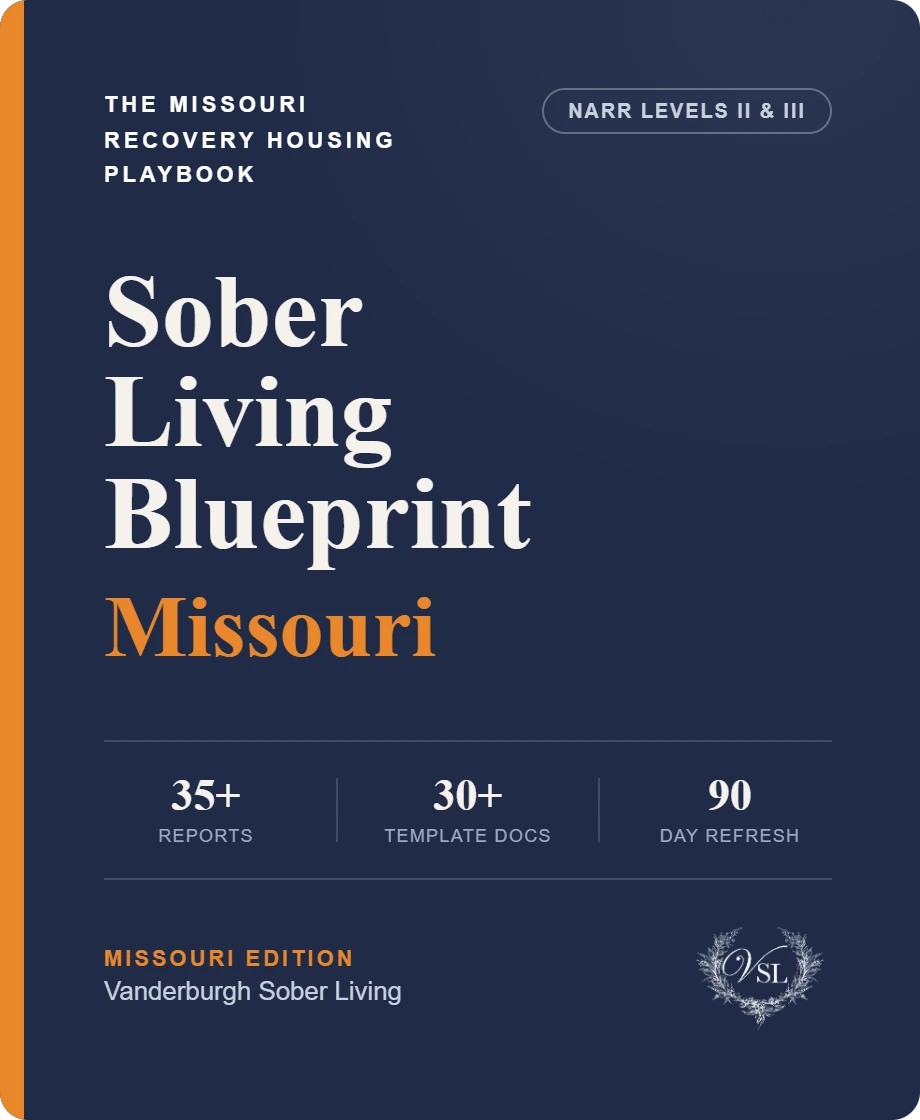
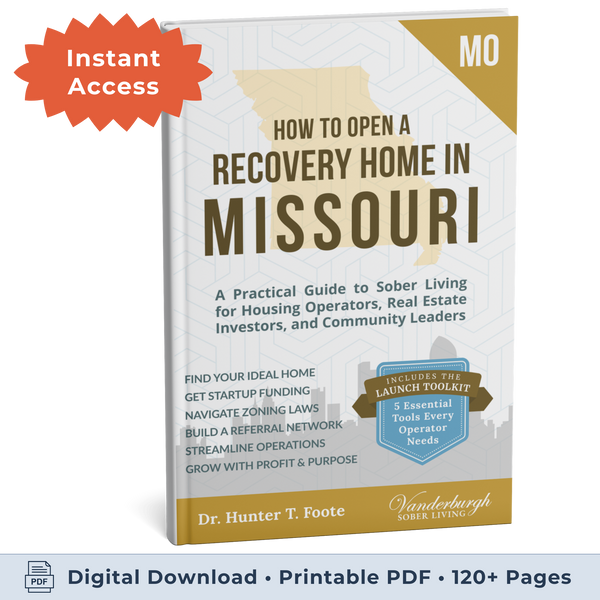
The book gives you the map to open a home. When you’re ready to launch, certify, and sustain, the Blueprint is the full playbook covering funding, legal, insurance, and operations.
Frequently Asked Questions About Opening a Sober House in Kansas City
Do You Need a License to Open a Sober Living Home in Kansas City?
No. Missouri does not license non-clinical recovery housing, because RSMo 630.005 defines a residential facility around premises where care or treatment is provided and excepts a person’s own dwelling. A home crosses into licensure when it adds on-site counseling, manages or dispenses medication, or performs withdrawal management.
Can a Sober Living Home Operate in a Kansas City Single-Family Neighborhood?
Yes. Kansas City’s zoning code counts a group of eight or fewer unrelated disabled persons, including people recovering from alcohol or drug addiction, plus up to two houseparents, as a household under Section 88-810-700, and household living is permitted by right in all ten residential districts under Table 110-1.
Is There a Resident Limit for a Sober Living Home in Kansas City?
Eight unrelated residents, plus up to two people acting as houseparents or guardians. Above that the home is a group living use rather than a household, which is not permitted in the lower-density residential districts and needs a special use permit in the denser ones. Missouri’s RSMo 89.020 sets the same eight-person floor statewide.
Is MCRSP Accreditation Required in Kansas City?
Not by law. Accreditation through the Missouri Coalition of Recovery Support Providers is voluntary, and it is close to mandatory in practice for publicly funded referrals, because the Department of Mental Health points recovery support bidders at NARR accreditation and places residents from its recovery housing directory.
How Much Does It Cost to Open a Sober House in Kansas City?
The Missouri figures run from about $30,464 on the lease path to $126,151 on the purchase path. Kansas City changes two lines: three months up front on a four-bedroom is $7,257 at the FY2027 fair market rent of $2,419, and 20% down on the county’s $285,000 median listing price is $57,000. Both are estimates.
How Long Does It Take to Open a Sober Living Home in Kansas City?
Four to six months is realistic. The property search runs two to eight weeks, entity and registration one to three, repairs and the certificate of occupancy three to ten, and the MCRSP file four to eight weeks with no guaranteed decision date. Referral outreach overlaps all of it and should start early.
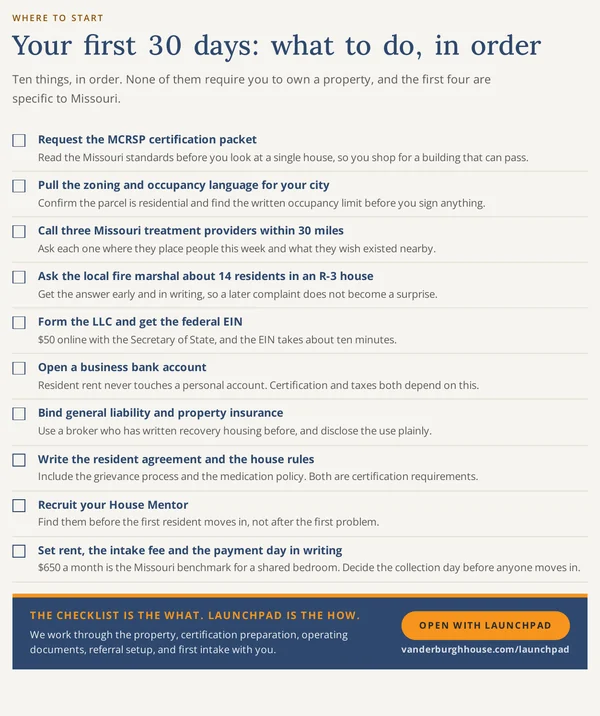
Your Kansas City Sober House Startup Checklist
Every item below is covered somewhere on this page, and none of them is optional for a Kansas City house. Work them in order and the expensive surprises disappear.
Four guides cover the operating questions that come after opening day.
How VSL Helps You Open a Sober House in Kansas City
Vanderburgh Sober Living charters independently operated recovery homes into a cooperative network, where the operator keeps ownership of the business and gains the brand, the operating standards, and the startup and certification support of the Chartered Operator community. The points this page kept returning to are the ones that support covers: holding the house at the household threshold and documenting it, writing the policy package MCRSP reviews before the application rather than after, pricing a lease against the metro’s fair market rent instead of a statewide average, and building the referral list before the mortgage starts.
Two routes lead there. The Launchpad program is self-paced training for an operator who wants the sequence and the templates and intends to run the process themselves. The Mastery Program is done with you, with coaching through the property decision, the documents, and the certification file. If a specific Kansas City address or a lease-versus-buy question is the thing standing in the way, tell us about it and we will work through it with you.
Start your sober house
Pick the path that fits where you are in the process.
Download the free guidePath to Purposeful Recovery Housing, by Dr. Hunter T. Foote.Explore the Mastery ProgramHands-on startup, certification, and operating support.See how starting with VSL worksThe opportunity, the community, and what a Charter includes.Prefer to talk now? Call (844) 762-3747, weekdays 8a to 5p.
Educational only; not legal, financial, or medical advice. Fees, rents, and rules change, and the Kansas City adjustments above are estimates built on the Missouri reference model. Confirm current requirements with Kansas City, Jackson County, and qualified professionals before you sign or spend.
Research & Sources
- Foote, H. T. (2026). Vanderburgh Sober Living Operating Climate Index, 2026 Edition. Vanderburgh Sober Living. https://www.vanderburghhouse.com/research/operating-climate-index-2026/
- Missouri Revisor of Statutes. (2026). Section 630.005, definitions. Missouri General Assembly. https://revisor.mo.gov/main/OneSection.aspx?section=630.005
- Missouri Revisor of Statutes. (2026). Section 630.705, licensure of residential facilities and day programs. Missouri General Assembly. https://revisor.mo.gov/main/OneSection.aspx?section=630.705
- Missouri Revisor of Statutes. (2026). Section 89.020, zoning classification of group homes. Missouri General Assembly. https://revisor.mo.gov/main/OneSection.aspx?section=89.020
- Missouri Revisor of Statutes. (2026). Section 137.115, assessment of real property. Missouri General Assembly. https://www.revisor.mo.gov/main/OneSection.aspx?section=137.115
- Missouri Revisor of Statutes. (2026). Section 347.039, registered agent and registered office. Missouri General Assembly. https://revisor.mo.gov/main/OneSection.aspx?section=347.039
- City of Kansas City, Missouri. (2023). Zoning and Development Code section 88-810-700, household. Municode Library. https://library.municode.com/mo/kansas_city/codes/zoning_and_development_code?nodeId=ZODECOKAMI_800_SERIESTEME_88-810DE_88-810-700HO
- City of Kansas City, Missouri. (2023). Zoning and Development Code section 88-805-02, residential use group. Municode Library. https://library.municode.com/mo/kansas_city/codes/zoning_and_development_code?nodeId=ZODECOKAMI_800_SERIESTEME_88-805USGRCA_88-805-02REUSGR
- City of Kansas City, Missouri. (2018). Zoning and Development Code section 88-805-03, public and civic use group. Municode Library. https://library.municode.com/mo/kansas_city/codes/zoning_and_development_code?nodeId=ZODECOKAMI_800_SERIESTEME_88-805USGRCA_88-805-03PUCIUSGR
- City of Kansas City, Missouri. (2026). Zoning and Development Code section 88-110-03, residential district use table 110-1. Municode Library. https://library.municode.com/mo/kansas_city/codes/zoning_and_development_code?nodeId=ZODECOKAMI_100_SERIESBAZODI_88-110REDI_88-110-03US
- City of Kansas City, Missouri. (2026). Zoning and Development Code section 88-350, group living and household living use standards. Municode Library. https://library.municode.com/mo/kansas_city/codes/zoning_and_development_code?nodeId=ZODECOKAMI_300_SERIESUSRE_88-350GRLINUHO
- City of Kansas City, Missouri. (2016). Zoning and Development Code section 88-352, halfway houses. Municode Library. https://library.municode.com/mo/kansas_city/codes/zoning_and_development_code?nodeId=ZODECOKAMI_300_SERIESUSRE_88-352HAHO
- City of Kansas City, Missouri. (2023). Zoning and Development Code section 88-571, relief for reasonable accommodation. Municode Library. https://library.municode.com/mo/kansas_city/codes/zoning_and_development_code?nodeId=ZODECOKAMI_500_SERIESREAPPR_88-571REREAC
- Kansas City, Missouri City Council. (2023). Ordinance No. 230936. Kansas City Legislative Information Center. https://kansascity.legistar.com/LegislationDetail.aspx?ID=47294&GUID=7472451A-0852-40BD-AD58-0559ED97293B
- Kansas City Legislative Information Center. (2026). Legislation search. City of Kansas City, Missouri. https://kansascity.legistar.com/Legislation.aspx
- City of Kansas City, Missouri. (2020). Code of Ordinances section 18-1, title, scope and building official. Municode Library. https://library.municode.com/mo/kansas_city/codes/code_of_ordinances?nodeId=PTIICOOR_CH18BURECO_ARTIINGE_S18-1TICHDEBUOF
- City of Kansas City, Missouri. (2026). Code of Ordinances section 18-23, certificate of occupancy. Municode Library. https://library.municode.com/mo/kansas_city/codes/code_of_ordinances?nodeId=PTIICOOR_CH18BURECO_ARTIINGE_S18-23CEOC
- City of Kansas City, Missouri. (2022). Code of Ordinances section 18-40, adoption of the International Building Code, 2018 edition, with amendments. Municode Library. https://library.municode.com/mo/kansas_city/codes/code_of_ordinances?nodeId=PTIICOOR_CH18BURECO_ARTIIBUCO_S18-40ADINBUCO2018AM
- City of Kansas City, Missouri. (2022). Code of Ordinances section 18-57, adoption of the International Residential Code, 2018 edition, with amendments. Municode Library. https://library.municode.com/mo/kansas_city/codes/code_of_ordinances?nodeId=PTIICOOR_CH18BURECO_ARTIIIRECOOMIDW_S18-57ADINRECO2018AM
- City of Kansas City, Missouri. (2019). Code of Ordinances section 26-100, adoption of the International Fire Code and NFPA 101. Municode Library. https://library.municode.com/mo/kansas_city/codes/code_of_ordinances?nodeId=PTIICOOR_CH26FIPRPR_ARTIIFIPRCO_S26-100ADINFICO2018EDNF101LISACO2018ED
- City of Kansas City, Missouri. (2019). Code of Ordinances section 26-103, fire prevention division. Municode Library. https://library.municode.com/mo/kansas_city/codes/code_of_ordinances?nodeId=PTIICOOR_CH26FIPRPR_ARTIIFIPRCO_S26-103FIPRDI
- City of Kansas City, Missouri. (2019). Code of Ordinances section 26-105, permits. Municode Library. https://library.municode.com/mo/kansas_city/codes/code_of_ordinances?nodeId=PTIICOOR_CH26FIPRPR_ARTIIFIPRCO_S26-105PE
- City of Kansas City, Missouri. (2014). Code of Ordinances section 34-601, lodging establishment definitions. Municode Library. https://library.municode.com/mo/kansas_city/codes/code_of_ordinances?nodeId=PTIICOOR_CH34HESA_ARTXVILOES_DIV1PUINARDE_S34-601DE
- City of Kansas City, Missouri. (2009). Code of Ordinances section 40-61, business activities for which a license is required. Municode Library. https://library.municode.com/mo/kansas_city/codes/code_of_ordinances?nodeId=COORKAMIVOII_CH40LIMIBURE_ARTIISCLIFE_S40-61BUACWHLIISRE
- City of Kansas City, Missouri. (1977). Code of Ordinances section 40-63, computation of fees generally. Municode Library. https://library.municode.com/mo/kansas_city/codes/code_of_ordinances?nodeId=COORKAMIVOII_CH40LIMIBURE_ARTIISCLIFE_S40-63COFEGE
- City of Kansas City, Missouri. (2008). Code of Ordinances division 7, registration of rental dwellings. Municode Library. https://library.municode.com/mo/kansas_city/codes/code_of_ordinances?nodeId=COORKAMIVOII_CH56PRMACO_ARTIIREPR_DIV7REREDW
- City of Kansas City, Missouri. (2026). Parcel viewer. KCMO Maps. https://maps.kcmo.org/apps/parcelviewer/
- City of Kansas City, Missouri. (2026). Zoning verification. City Planning and Development Department. https://www.kcmo.gov/city-hall/departments/city-planning-development/zoning-verification
- City of Kansas City, Missouri. (2026). Business license. Finance Department, Revenue Division. https://www.kcmo.gov/city-hall/departments/finance/business-license
- Kansas City Fire Department. (2026). Fire marshal and fire prevention. City of Kansas City, Missouri. https://www.kcmo.gov/city-hall/departments/fire/fire-marshal-fire-prevention
- Kansas City Fire Department. (2026). KCFD requests. City of Kansas City, Missouri. https://www.kcmo.gov/city-hall/departments/fire/kcfd-requests
- Jackson County, Missouri. (2020). Unified development code. Jackson County Government. https://www.jacksongov.org/files/sharedassets/public/v/1/our-county/boards-amp-commissions/udc_2020_202011171015160283.pdf
- Jackson County, Missouri. (2025). 2025 real property tax levy schedule. Collection Department. https://www.jacksongov.org/files/sharedassets/public/v/1/departments/collections/2025-rp-levy-sheet.pdf
- Oxford House-C v. City of St. Louis, 77 F.3d 249 (8th Cir. 1996). CourtListener. https://www.courtlistener.com/opinion/3016233/oxford-house-c-v-city-of-st-louis/
- Oxford House-A v. City of University City, 87 F.3d 1022 (8th Cir. 1996). Justia. https://law.justia.com/cases/federal/appellate-courts/F3/87/1022/610807/
- Familystyle of St. Paul, Inc. v. City of St. Paul, 728 F. Supp. 1396 (D. Minn. 1990), aff’d 923 F.2d 91 (8th Cir. 1991). Justia. https://law.justia.com/cases/federal/district-courts/FSupp/728/1396/2596751/
- U.S. Department of Housing and Urban Development. (2026). Fiscal year 2027 fair market rents. Office of Policy Development and Research. https://www.huduser.gov/portal/datasets/fmr/fmr2027/FY27_FMRs.xlsx
- U.S. Department of Housing and Urban Development. (2025). 2025 annual homeless assessment report, part 1: point-in-time estimates of homelessness. Office of Policy Development and Research. https://www.huduser.gov/portal/datasets/ahar/2025-ahar-part-1-pit-estimates-of-homelessness-in-the-us.html
- U.S. Census Bureau. (2025). QuickFacts: Kansas City city, Missouri. https://www.census.gov/quickfacts/fact/table/kansascitycitymissouri/PST045224
- U.S. Census Bureau. (2025). QuickFacts: Jackson County, Missouri. https://www.census.gov/quickfacts/fact/table/jacksoncountymissouri/PST045224
- National Center for Health Statistics. (2026). VSRR provisional county-level drug overdose death counts. Centers for Disease Control and Prevention. https://data.cdc.gov/NCHS/VSRR-Provisional-County-Level-Drug-Overdose-Death-/gb4e-yj24/
- Federal Reserve Bank of St. Louis. (2026). Housing inventory: median listing price in Jackson County, MO. FRED. https://fred.stlouisfed.org/series/MEDLISPRI29095
- Federal Transit Administration. (2024). National transit database agency profile: Kansas City Area Transportation Authority. U.S. Department of Transportation. https://www.transit.dot.gov/sites/fta.dot.gov/files/transit_agency_profile_doc/2024/70005.pdf
- Kansas City Streetcar Authority. (2025). Main Street extension. https://kcstreetcar.org/about-streetcar/mainstreet-extension/
- Internal Revenue Service. (2026). Apply for an employer identification number online. https://www.irs.gov/businesses/small-businesses-self-employed/apply-for-an-employer-identification-number-ein-online
- Missouri Secretary of State. (2026). Schedule of fees and charges, corporations division. https://www.sos.mo.gov/CMSImages/Business/fees.pdf
- Missouri Department of Mental Health. (2026). Certification. Division of Behavioral Health. https://dmh.mo.gov/behavioral-health/certification
- Missouri Department of Mental Health. (2026). Recovery support services. Division of Behavioral Health. https://dmh.mo.gov/behavioral-health/treatment-services/specialized-programs/recovery-support-services
- Missouri Department of Mental Health. (2026). Directory of adult substance use treatment programs. https://dmh.mo.gov/sites/g/files/zuston541/files/media/pdf/2026/04/directory-adult-substance-use-treatment-programs.pdf
- Missouri Department of Mental Health. (2026). State opioid response recovery housing directory. https://dmh.mo.gov/media/pdf/sor-recovery-housing-directory
- Missouri Department of Mental Health. (2026). Provider implementation guide, state opioid response grant. https://dmh.mo.gov/media/pdf/provider-implementation-guide-state-opioid-response-grant-opioid-sor
- Missouri Department of Mental Health. (2026). Recovery support services pricing. https://dmh.mo.gov/media/pdf/recovery-support-services-pricing
- Missouri Department of Corrections. (2026). Offender profile, fiscal year 2025. https://doc.mo.gov/media/pdf/offender-profile-fy25
- Missouri Department of Corrections. (2026). Probation and parole office address listing. https://doc.mo.gov/facilities/probation-parole/address-listing
- Missouri Coalition of Recovery Support Providers. (2026). Recovery residence accreditation. https://mcrsp.org/
- Missouri Coalition of Recovery Support Providers. (2023). Recovery residence accreditation and renewal accreditation process. https://mcrsp.org/wp-content/uploads/2024/02/MCRSP-Recovery-Residence_Accreditation-Renewal-Accreditation-Process-11-2023-1.pdf
- Missouri Coalition of Recovery Support Providers. (2024). MCRSP-NARR standards 3.0. https://mcrsp.org/wp-content/uploads/2023/12/MCRSP-NARR-Standards-3.0_10_15_24.pdf
- Missouri Coalition of Recovery Support Providers. (2026). Accredited residences. https://mcrsp.org/accredited-residences-2/
- Missouri Coalition of Recovery Support Providers. (2026). Recovery support services access sites. https://mcrsp.org/access-sites/
- Jackson County COMBAT. (2026). Treatment programs. Jackson County, Missouri. https://www.jacksoncountycombat.com/508/Treatment
- Jackson County COMBAT. (2026). Eligibility for funding. Jackson County, Missouri. https://www.jacksoncountycombat.com/152/Eligibility-for-Funding
- Jackson County COMBAT. (2026). Drug court. Jackson County, Missouri. https://www.jacksoncountycombat.com/168/Drug-Court
- City of Kansas City, Missouri. (2026). RENEW KC substance abuse prevention and recovery program. Health Department. https://www.kcmo.gov/city-hall/departments/health/mental-health/renew-kc-substance-abuse-prevention-and-recovery-program
- City of Kansas City, Missouri. (2026). REACH pre-arrest diversion program. Health Department. https://www.kcmo.gov/city-hall/departments/health/mental-health/reach-prearrest-diversion-program
- City of Kansas City, Missouri. (2026). Probation and problem-solving courts. Municipal Court. https://www.kcmo.gov/city-hall/departments/municipal-court/probation-and-problem-solving-courts
- U.S. Department of Veterans Affairs. (2026). Homeless veteran care. Kansas City VA Medical Center. https://www.va.gov/kansas-city-health-care/health-services/homeless-veteran-care/
- University Health. (2026). Behavioral health services. https://www.universityhealthkc.org/services/behavioral-health/
- ReDiscover. (2026). Behavioral health services and crisis line. https://www.rediscovermh.org/
- Swope Health. (2026). Behavioral health. https://swopehealth.org/services/behavioral-health/
- Heartland Center for Behavioral Change. (2026). Treatment and transitional living programs. https://www.heartlandcbc.org/
- First Call. (2026). Addiction resources, recovery and reentry services. https://www.firstcallkc.org/
- Greater Kansas City Coalition to End Homelessness. (2026). Point-in-time count. https://www.gkcceh.org/point-in-time
- Kansas City Area Central Office of Alcoholics Anonymous. (2026). Meetings and 24-hour line. https://kc-aa.org/
- Kansas City Narcotics Anonymous. (2026). Helpline and meetings. https://www.kansascityna.org/
- City of Kansas City, Missouri. (2016). Midtown/Plaza area plan. City Planning and Development Department. https://www.kcmo.gov/home/showpublisheddocument/10630/638200864554270000
- City of Kansas City, Missouri. (2011). Heart of the City area plan. City Planning and Development Department. https://www.kcmo.gov/home/showdocument?id=14998&t=638808415324360386
- City of Kansas City, Missouri. (2025). Washington Wheatley neighborhood redevelopment action plan. City Planning and Development Department. https://www.kcmo.gov/home/showpublisheddocument/15178/638846392743330000
- City of Kansas City, Missouri. (2018). Country Club Waldo area plan. City Planning and Development Department. https://areaplans.kcmo.gov/pages/template-current-area-plan-3-1
- City of Kansas City, Missouri. (2026). Greater Downtown area plan. City Planning and Development Department. https://www.kcmo.gov/home/showpublisheddocument/10588/638200006370030000
- City of Kansas City, Missouri. (2019). Housing policy. https://www.kcmo.gov/home/showdocument?id=3260
- 16th Judicial Circuit Court of Jackson County, Missouri. (2026). Landlord and tenant docket. https://www.16thcircuit.org/landlord-tenant
- Missouri Revisor of Statutes. (2026). Section 441.005, landlord and tenant definitions. Missouri General Assembly. https://revisor.mo.gov/main/OneSection.aspx?section=441.005