A license to open a sober living home in Florida is not something the state issues, and that single fact surprises most people who start researching the business. Florida runs one of the most heavily written recovery-housing statutes in the country, yet nothing in it creates an operating license for a peer-supported, alcohol-free and drug-free home. What the statute creates instead is a voluntary certification, a credentialed administrator requirement that attaches to that certification, and a referral rule that decides which homes licensed treatment centers are allowed to work with. The Florida answer sits within the national picture of whether you need a license to open a sober living home, which differs widely from state to state.
That gap between “no license” and “no rules” is where new operators lose money. Florida’s real gates are a felony line around clinical services, a set of building and fire thresholds that turn on how many people sleep in the house, a local business tax receipt in every county and city, and a certification that is optional on paper and close to mandatory in practice. This page sorts out which of those apply to you, in what order, and what each one actually costs.
Before you read onHow to Open a Sober Living Home in FloridaThis post covers one piece of the process. The complete Florida guide walks through every step, from planning to your first resident.→Do You Need a License to Open a Sober Living Home in Florida?
No. Florida does not license or register sober living homes. A residence that provides peer support and housing without clinical services needs no state operating license. Certification under Fla. Stat. §397.487 is voluntary. Providing treatment without a license, however, is a third-degree felony under §397.401.
Florida’s recovery-housing framework sits in Chapter 397, Florida Statutes, the substance abuse services chapter. In 2015 the Legislature declined to license recovery residences and instead built a voluntary certification program at §397.487, administered not by the state but by a private credentialing entity the Florida Department of Children and Families (DCF) approves.
The department’s own framing is the one to hold onto: certification is a program a home opts into, not permission the state grants before a home may open. DCF publishes its information for operators on its page for recovery residences and recovery residence administrators, and that page points to credentialing entities rather than to an application of its own.
So the answer to the title question depends entirely on what the home does, not what it is called. Housing plus peer accountability plus house rules is unlicensed activity in Florida. Counseling, clinical assessment, detox monitoring, or a structured treatment schedule delivered to the people living there is licensed activity, and the line between them is enforced with a felony statute rather than a fine.
How your home gets classified, where Fair Housing applies, and what to do if the city says no.
Florida Sober Living Licensing at a Glance
The table below is the compressed version of Florida’s scheme, current as of September 2026. Each row is expanded in the sections that follow.
| Item | Detail | What it means |
|---|---|---|
| State license required | No | A non-clinical sober living home opens without a state license or permit. The only DCF license in play is the substance abuse service provider license required by Fla. Stat. §397.401. |
| Registry or certification mandate | None; certification is voluntary | Florida keeps no roster of sober living homes, and certification under §397.487 is a program a home opts into. The public directory of certified homes is maintained by the credentialing entity. |
| Administering agency | Florida Department of Children and Families (DCF), Substance Abuse and Mental Health Program Office | DCF approves credentialing entities and licenses treatment providers; it does not certify or inspect sober living homes itself. |
| Governing statute | Fla. Stat. §397.487, §397.4871, §397.4873 | Voluntary certification, the administrator credential, and the referral restriction. |
| Thresholds that trigger licensure | Delivering a licensable service component under Fla. Stat. §397.401 and Fla. Admin. Code ch. 65D-30 | Clinical or treatment services require a DCF provider license, and acting as a substance abuse service provider without one is a third-degree felony. |
| Express statutory mention | “Recovery residence” defined at Fla. Stat. §397.311, and transient public lodging defined at §509.013(4)(a) | Florida names and defines the use in statute without licensing it. The public lodging definition is the one adjacent statute that can pull a home into a license, and only when occupancy is structured as sub-30-day transient rental. |
| Voluntary certification body | Florida Association of Recovery Residences (FARR) | The DCF-approved credentialing entity for residences. Fee caps at §397.487(2)(e) hold the application and the annual renewal at $100 each, with inspection fees set at actual cost, and the certificate is what unlocks treatment-provider referrals under §397.4873. |
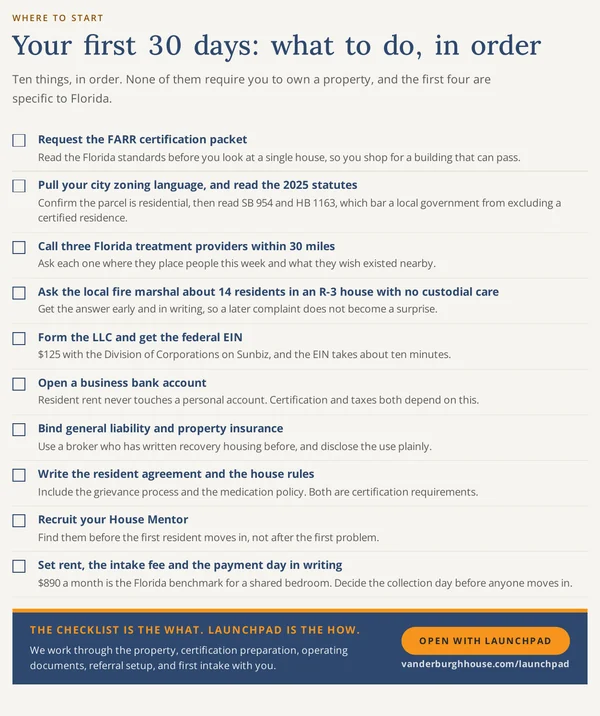
Most people ask whether they are allowed to open a recovery home. The better first question is whether the need and the money are there. This answers both, for your state.
- How many people need a bed, and how few beds exist
- Who actually pays the rent, and which programs are real
- What it costs to open on the purchase path and the lease path
How Florida Regulates Sober Living Homes
Florida regulates recovery housing by defining it, then attaching consequences to certification rather than to operation. The definition sits at Fla. Stat. §397.311, which covers a residential dwelling unit, the community housing component of a licensed day or night treatment provider, or other group housing held out to the public as a peer-supported, alcohol-free and drug-free living environment. The same section carries the four-level classification, running from a democratically self-run Level I home through Level IV community housing tied to a licensed provider.
Three agencies and bodies matter, and operators routinely confuse them. The Florida Department of Children and Families (DCF) is the state agency: it licenses substance abuse service providers, approves the credentialing entities, and maintains the public information page on recovery residences and recovery residence administrators, but it does not certify or inspect sober living homes. The Florida Association of Recovery Residences (FARR) is the DCF-approved credentialing entity for residences and the state affiliate of the National Alliance for Recovery Residences (NARR), and it sets the certification standards, inspects, and issues the certificate. The Florida Certification Board (FCB) is the DCF-approved credentialing entity for administrators, and it issues the Certified Recovery Residence Administrator credential to individuals rather than to homes.
Recent legislative attention has run toward tightening the certified side rather than licensing the uncertified side. In VSL’s Operating Climate Index, Florida rates 8 for legal climate, a score that reflects exactly this posture: a detailed statute that leaves the front door open (Foote, 2026). The reason is structural rather than permissive. The state writes a great deal of recovery-housing law but points almost none of it at the front door, so entry is fast, while the statute concentrates its force on certified homes through referral restrictions, an administrator credential, and discharge powers. Operators get an open market and a clearly marked line at clinical services.
License vs. Certification vs. Registration: What Each Term Means
These three words describe three different relationships, and Florida uses all three at once. Sorting them out is the difference between a compliant opening and a wasted six months chasing a credential you do not need.
License
A license is government permission to conduct an activity the state has decided may not be conducted without it. In Florida, Fla. Stat. §397.401 makes it unlawful for any person or agency to act as a substance abuse service provider unless licensed or exempt, and makes a violation a third-degree felony. DCF issues that license through its substance use disorder licensing program.
No Florida statute requires a license to provide housing and peer support, so a sober living home that stays out of the service-provider definition needs nothing from DCF. The practical consequence is that the operator’s compliance work moves to the property, the local business tax receipt, and the certification decision instead.
Certification
Certification is a third-party review against published standards. In Florida it is created by Fla. Stat. §397.487 as an expressly voluntary program, and FARR administers it: an application, a policy and procedures manual, proof of insurance, proof of satisfactory fire, safety and health inspections, level 2 background screening for owners, directors and chief financial officers, an onsite inspection, and a certificate that terminates automatically one year after issuance unless renewed.
Statutory fee caps at §397.487(2)(e) hold the application and the annual renewal at $100 each, with inspection fees set at actual cost, which is why the certificate is cheap in fees and expensive in preparation. Operators who want the full sequence, packet by packet, should work through how to certify a sober living home with FARR in Florida.
Registration
Registration is a mandatory listing on a state roster, short of full licensure: the state records that an operation exists rather than reviewing how it runs. Florida has no such roster for sober living homes. No statute requires a residence to file with DCF or with any other state office before it opens or while it operates, and there is no registration deadline and no registration penalty.
The one statewide list of homes is the directory of certified residences the credentialing entity maintains, and appearing on FARR’s Find Certified Housing directory follows from holding a current certificate rather than from any duty to register. An operator who never seeks certification has nothing to file and no roster to appear on.
Of the three, only the license is compulsory in Florida, and only for a home that delivers a licensable service component; certification is voluntary and administered by FARR, and registration does not exist. A fourth relationship sits outside all three. A charter is a membership agreement between a home and a private network whose standards the home agrees to run by. It is not government permission and it is not a third-party audit, so no agency issues it and no agency revokes it. What it carries is a rulebook, a name, and accountability to the organization behind it. Oxford House charters homes that are democratically self-run and financially self-supporting, require immediate departure on a return to use, and operate with no paid staff in the house. Vanderburgh Sober Living charters independently operated homes into a cooperative network, where the operator keeps ownership of the business and gains the brand, the operating standards, and the startup and certification support of the Chartered Operator community. Florida’s referral statute takes explicit notice of the charter model, carving out congressionally chartered, democratically operated residences with no financial referral relationship.
| Credential | Required? | Administering body |
|---|---|---|
| License | Yes, if the home delivers a licensable service component | Florida Department of Children and Families |
| Certification | No, voluntary | Florida Association of Recovery Residences |
| Registration | No; Florida maintains no registry of sober living homes | None. The related administrator credential, required for a home to hold certification and not to operate, is issued by the Florida Certification Board |
When a Sober Living Home Crosses Into Licensed Treatment
The felony line is the one part of Florida law worth reading twice. Fla. Admin. Code ch. 65D-30 lists the licensable service components, and DCF’s substance use disorder licensing program administers them. A sober living home crosses into licensure when it starts doing any of the following:
- Delivering a licensable component on site: Residential treatment, day or night treatment, intensive outpatient, outpatient, detoxification, aftercare, intervention, or medication-assisted treatment for opioid use disorders, each named in ch. 65D-30.
- Operating community housing for a treatment provider: Day or night treatment with community housing is itself a licensed component, which is why a Level IV residence is regulated as part of a treatment provider rather than as independent housing.
- Providing custodial or personal care: Assistance with activities of daily living, medication administration rather than storage, or supervision of a resident’s clinical needs pulls the home toward both licensure and a heavier building occupancy class.
- Bundling housing with a clinical schedule: Requiring residents to attend the operator’s own counseling or group programming as a condition of the bed blurs housing into treatment, whatever the marketing calls it.
- Billing insurance for services delivered to residents: Reimbursement for a clinical service is evidence that a clinical service was delivered.
Peer support, house meetings, drug testing, curfews, chore systems, and a house mentor living on site are not treatment. Keeping sober house rules squarely in the accountability lane rather than the clinical lane is the practical way most Florida operators stay on the unlicensed side of §397.401.
What’s Changed in Florida Sober Living Law
Florida’s scheme has been amended almost every session since it was written. The milestones below still shape an opening in 2026.
The Legislature created the voluntary certification program at §397.487 and the administrator credential at §397.4871 through CS/CS/HB 21 (2015), ch. 2015-100, and DCF approved FARR and the Florida Certification Board as credentialing entities.
The referral restriction at §397.4873 took its current shape, barring licensed providers from referring to or accepting referrals from uncertified residences, with a narrow carve-out for pre-existing wholly owned subsidiary arrangements.
The active-management requirement at §397.4871 took effect, obliging a certified residence to be managed by a CRRA and capping the residents one administrator may manage.
§397.487(13) took effect, barring a certified residence from denying housing solely because a resident has been prescribed a federally approved medication for substance use disorder.
Under §397.487(15), added by CS/CS/CS/SB 954 (2025), ch. 2025-182, every Florida county and municipality was required to adopt an ordinance establishing a review and approval process for certified recovery residences, including a written reasonable accommodation process with a 60-day determination deadline.
The multifamily stay-duration provision at §397.487(14) expired by its own terms and is no longer operative, and CS/CS/SB 1030 (2026), ch. 2026-123 took effect, tightening ownership-transfer and background screening rules on the licensed provider side.
Bills that would have converted certification into a requirement, HB 1165 and its Senate companion, died in committee. Certification remains voluntary as of September 2026.
Florida’s Occupancy and Building-Safety Thresholds
No state license does not mean no state code. Florida’s building and fire requirements are statewide and uniform, and they escalate on headcount and on whether care is provided, not on whether the home is a recovery residence.
- The 16-occupant line: The Florida Building Code, adopted statewide under Fla. Stat. §553.73 and published in its 8th Edition (2023), places non-transient congregate residential occupancies of 16 or fewer people in Group R-3, and moves buildings housing more than five but not more than 16 people who receive custodial care into Group R-4. Above 16 occupants the classification becomes institutional, with a full commercial fire and life-safety package.
- The lodging or rooming house line: The Florida Fire Prevention Code, adopted at Fla. Admin. Code ch. 69A-60 from NFPA 1 and NFPA 101, treats a building sleeping 16 or fewer people without personal care services as a lodging or rooming house. Personal care services provided to four or more unrelated residents push the building into residential board and care instead, regardless of a modest headcount.
- The 30-day rental line: Under Fla. Stat. §509.013(4)(a), a dwelling rented to guests more than three times in a calendar year for periods of less than 30 consecutive days, or advertised as regularly available on those terms, is a transient public lodging establishment and needs a license from the Department of Business and Professional Regulation. The separate exclusions from that definition, including the one for a property with four or fewer rental units, sit at §509.013(4)(b) and are taken up in the zoning guide. Florida sober living homes that price by the week and advertise short stays walk into this without meaning to. Charging weekly is fine; structuring occupancy as sub-30-day transient lodging is not.
- Change of use: Converting a single-family dwelling into a higher occupancy class triggers plan review, permitting, and code upgrades through the local building department, with fire inspection by the local fire official.
Local land use sits on top of all of this, and it is where most Florida disputes actually happen. The bed-count decision, the accommodation request, and the ordinance every jurisdiction had to adopt in 2026 run through Florida zoning laws and regulations for sober living homes.
Florida guideFlorida Zoning, Fair Housing, and Land Use Laws for Sober LivingWhere sober homes can operate in Florida and the legal protections that apply.→What’s Still Required Without a License
Opening without a state license still means clearing a compliance floor. Every Florida sober living home carries these obligations:
- A legal entity: Formed with the Florida Division of Corporations before the lease is signed, so the business and not the individual holds the property interest. The choice between an LLC and a nonprofit, and the reasons to hold the real estate in a separate entity, turn on how you form a legal entity for a sober living business in Florida.
- A local business tax receipt: Counties may levy a business tax under Fla. Stat. §205.032 and municipalities under §205.042, and most Florida jurisdictions require the receipt before the business operates. This is the closest thing to a license a Florida sober living home routinely holds, and it is a tax registration, not a program approval.
- Building and fire code compliance: Smoke and carbon monoxide alarms, egress, and any upgrades a change of occupancy triggers. Where a code official demands a sprinkler system, the sober living fire safety question is worth resolving before signing.
- Fair housing compliance: People in recovery from substance use disorder are protected under the Fair Housing Act and Title II of the ADA, which constrains what a municipality may demand and what an operator may ask an applicant.
- Insurance: Certification requires proof of liability coverage, and lenders and landlords usually require it regardless. Sober house insurance is priced on occupancy and services, so quote it before finalizing the bed count.
- Patient brokering compliance: Fla. Stat. §817.505 makes it a felony to pay or receive any commission, kickback, bribe, rebate, or split fee to induce patient referrals, with mandatory fines starting at $50,000 and rising to $500,000 where 20 or more patients are involved. Paying for referrals is the single largest criminal exposure in Florida recovery housing.
Every item on that list applies whether or not the home ever seeks certification, and the local business tax receipt is the one operators most often mistake for the state license Florida never issues.
How Voluntary FARR Certification Works Here
Certification is optional in law and close to compulsory in commerce. A FARR certificate is what licensed treatment providers, drug courts, and hospitals look for before they will send anyone, and it is what unlocks the statutory tools that make a home easier to run: the immediate discharge and transfer power at §397.487(11), the trespass offense at §397.487(12) for a discharged person who refuses to leave, and the local reasonable accommodation pathway added in 2025.
The credential that attaches to it is individual, not corporate. Under Fla. Stat. §397.4871, a certified residence must be actively managed by a CRRA, who may not manage more than 50 residents without written justification approved by the credentialing entity, or more than 100 residents in any case, with a narrow exception at §397.4871(8)(c) for a Level IV certified recovery residence operating as community housing that is wholly owned or controlled by a licensed service provider and managed by an administrator approved for 100 residents: up to 150 residents at a 1:8 provider personnel-to-patient ratio with 1:10 onsite supervision while residents are present, or up to 300 residents at the same 1:8 provider ratio with 1:6 onsite supervision. Three hundred is the ceiling. The Florida Certification Board sets the CRRA requirements: a high school diploma or GED, 100 hours of approved training, 1,000 hours of experience in a residential recovery or related setting, 10 hours of supervised experience, three letters of recommendation, and a passing score of 70 percent or better on the 75-item CRRA examination. The board’s fee schedule sets the application, examination, and certification charges and the annual renewal. If a certified home loses its administrator, it has 90 days to replace them.
Florida guideHow to Certify a Sober Living Home with FARR in FloridaThe step-by-step FARR application, costs, timelines, and inspection checklist.→What Skipping FARR Certification Costs You
Nothing happens to an uncertified Florida sober living home directly. The costs are all indirect, and they compound. The referral pipeline closes first: Fla. Stat. §397.4873 prohibits a licensed substance abuse service provider from making or accepting a referral to or from a residence unless the residence holds a valid certificate and is actively managed by a CRRA, and a willful and knowing violation is a first-degree misdemeanor for the provider plus a $1,000 administrative fine per occurrence. The penalty lands on the treatment center, which is precisely why treatment centers will not take the risk. Filling an uncertified home means building referral sources entirely outside the licensed treatment system.
Removals also run through the courts. The immediate discharge power at §397.487(11) applies to certified residences with an approved discharge policy, so an uncertified home removes a resident under ordinary Chapter 83 landlord and tenant procedure, with the notice periods and court timeline that come with it. The local accommodation pathway is narrower as well, because the ordinances counties and municipalities adopted under §397.487(15) run to certified recovery residences. Advertising exposure is real too: advertising a residence as a certified recovery residence without a current certificate is a first-degree misdemeanor under §397.487(9).
Steps to Open a Florida Sober House Legally
The order matters more than the pace, because each step produces a document the next one needs. This is the sequence that works in Florida.
- Form the entity. Register with the Florida Division of Corporations and open the business bank account before signing anything, so the entity and not the individual holds the lease or the deed. The Florida entity guide walks through the LLC and nonprofit choice.
- Choose a property that clears the code thresholds. Keep the home at or under 16 residents and out of custodial care unless you intend to build for a heavier occupancy class. Work through determining maximum occupancy before the lease, not after.
- Register locally. Obtain the county and municipal business tax receipts under Fla. Stat. §205.032 and §205.042, and confirm the jurisdiction’s §397.487(15) review process.
- Meet building and fire requirements. Schedule the inspections that certification will later require documentation of anyway, under the Florida Building Code and the Florida Fire Prevention Code.
- Write the operating documents. House rules, intake, drug testing, relapse, good neighbor, fee, refund, and discharge policies, which double as the certification packet.
- Credential an administrator. Put an owner or manager through the CRRA pathway with the Florida Certification Board.
- Apply for FARR certification. File once the home is furnished, staffed, and ready to function. The full packet sequence is in the Florida certification guide.
- Open, and keep the certificate current. It terminates automatically one year after issuance unless renewed, and the renewal fee is capped at $100 by §397.487(2)(e).
Support for every stage
Pick the level of support that fits where you are.
Just getting startedSee how the sober living opportunity works and what starting with VSL looks like. LaunchpadGuided pre-launch program: one-on-one strategy, Academy training, weekly coaching, and templates. MasteryHands-on startup, certification, and operating support inside the Chartered Operator community.Questions first? Call (844) 762-3747, weekdays 8a to 5p.
Sober Living Guides Every Operator Needs
These evergreen guides apply in every state and cover what matters once you know the licensing picture: the standards you certify to, the fair-housing protections behind you, the property you choose, and the referrals that certification unlocks.
Frequently Asked Questions About Sober Living Licensing in Florida
Do you need a license to open a sober living home in Florida?
No. Florida issues no operating license for recovery residences. A home providing peer-supported, alcohol-free and drug-free housing without clinical services opens without state permission. Certification under Fla. Stat. §397.487 is voluntary, and the only state license in play is the substance abuse service provider license, which applies to treatment.
Is an uncertified sober living home legal in Florida?
Yes. Operating an uncertified sober living home is lawful in Florida as of September 2026. The consequence is commercial rather than legal: licensed treatment providers may not refer residents to or accept referrals from an uncertified home under §397.4873, so the home is cut off from the treatment referral pipeline.
How much does Florida certification cost?
Fla. Stat. §397.487(2)(e) caps the FARR application fee at $100 and the annual renewal at $100, with onsite inspection fees set to reflect actual cost. The administrator credential adds the application, examination, certification, and annual renewal charges published on the Florida Certification Board fee schedule.
What makes a sober living home need a DCF license?
Delivering a licensable service component makes the difference. Residential treatment, day or night treatment, intensive outpatient, detoxification, and medication-assisted treatment are licensed under Fla. Admin. Code ch. 65D-30. Acting as a substance abuse service provider without a license is a third-degree felony under Fla. Stat. §397.401.
Does Florida require a recovery residence administrator?
Only for certified homes. Fla. Stat. §397.4871 requires a certified recovery residence to be actively managed by a Certified Recovery Residence Administrator credentialed by the Florida Certification Board. An uncertified home has no administrator requirement, and one administrator may manage no more than 50 residents without approved written justification.
How long does it take to open a sober living home in Florida?
There is no guaranteed timeline. Entity formation and local business tax receipts take days to weeks. The longer items are the property, the code inspections, and the CRRA credential, which requires 100 training hours and 1,000 experience hours. Operators who start the administrator pathway early usually reach certification fastest.
Your Next Step Toward Opening Legally in Florida
Florida rewards operators who understand the difference between the license they do not need and the certification they almost certainly want. Get the entity, the property, the local receipts, and the code inspections right first, then treat FARR certification and the CRRA credential as the business decision they are rather than a legal hurdle.
Research & Sources
- Foote, H. T. (2026). Vanderburgh Sober Living Operating Climate Index, 2026 Edition. Vanderburgh Sober Living. https://www.vanderburghhouse.com/research/operating-climate-index-2026/
- The Florida Senate, 2026 Florida Statutes §397.487, Voluntary certification of recovery residences. https://www.flsenate.gov/Laws/Statutes/2026/397.487
- The Florida Senate, 2026 Florida Statutes §397.4871, Recovery residence administrator certification. https://www.flsenate.gov/Laws/Statutes/2026/397.4871
- The Florida Senate, 2026 Florida Statutes §397.4873, Referrals to or from recovery residences; prohibitions; penalties. https://www.flsenate.gov/Laws/Statutes/2026/397.4873
- The Florida Senate, 2026 Florida Statutes §397.401, Licensure required; penalty; injunction. https://www.flsenate.gov/Laws/Statutes/2026/397.401
- The Florida Senate, 2026 Florida Statutes §397.311, Definitions. https://www.flsenate.gov/Laws/Statutes/2026/397.311
- The Florida Senate, 2026 Florida Statutes, Chapter 397, Substance Abuse Services. https://www.flsenate.gov/Laws/Statutes/2026/Chapter397
- The Florida Senate, 2026 Florida Statutes §817.505, Patient brokering prohibited; exceptions; penalties. https://www.flsenate.gov/Laws/Statutes/2026/817.505
- The Florida Senate, 2026 Florida Statutes §509.013, Public lodging establishments; definitions. https://www.flsenate.gov/Laws/Statutes/2026/509.013
- The Florida Senate, 2026 Florida Statutes §205.032, County business tax; authority to levy. https://www.flsenate.gov/Laws/Statutes/2026/205.032
- The Florida Senate, 2026 Florida Statutes §205.042, Municipal business tax; authority to levy. https://www.flsenate.gov/Laws/Statutes/2026/205.042
- The Florida Senate, 2026 Florida Statutes, Chapter 83, Landlord and Tenant. https://www.flsenate.gov/Laws/Statutes/2026/Chapter83
- The Florida Senate, CS/CS/HB 21 (2015), ch. 2015-100, Controlled Substances. https://www.flsenate.gov/Session/Bill/2015/21
- The Florida Senate, CS/CS/CS/SB 954 (2025), ch. 2025-182, enrolled bill text. https://www.flsenate.gov/Session/Bill/2025/954/BillText/er/HTML
- The Florida Senate, CS/CS/SB 1030 (2026), Recovery Residences, ch. 2026-123. https://www.flsenate.gov/Session/Bill/2026/1030
- The Florida Senate, HB 1165 (2026), Certified Recovery Residences, bill history. https://www.flsenate.gov/Session/Bill/2026/1165
- Florida Administrative Code, Chapter 65D-30, Substance Abuse Services Office. https://www.flrules.org/gateway/ChapterHome.asp?Chapter=65D-30
- Florida Administrative Code, Chapter 69A-60, Florida Fire Prevention Code. https://www.flrules.org/gateway/ChapterHome.asp?Chapter=69A-60
- Florida Department of Children and Families, Recovery Residence Administrators and Recovery Residences. https://www.myflfamilies.com/services/samh/recovery-residence-administrators-and-recovery-residences
- Florida Department of Children and Families, Substance Use Disorder Licensing and Regulation. https://www.myflfamilies.com/services/licensing/samh/
- The Florida Senate, 2026 Florida Statutes §553.73, Florida Building Code. https://www.flsenate.gov/Laws/Statutes/2026/553.73
- Florida Building Commission, Florida Building Code, 8th Edition (2023), code text. https://floridabuilding.org/c/default.aspx
- Florida Division of State Fire Marshal, Florida Fire Prevention Code. https://www.myfloridacfo.com/division/sfm/bfp/florida-fire-prevention-code
- Florida Certification Board, Certified Recovery Residence Administrator (CRRA). https://flcertificationboard.org/certifications/certified-recovery-residence-administrator-crra/
- Florida Certification Board, CRRA Requirements and Application, Pathway 2. https://flcertificationboard.org/certifications/crra-requirements-application-pathway-2/
- Florida Certification Board, Fees. https://flcertificationboard.org/fees/
- Florida Association of Recovery Residences, Find Certified Housing. https://www.farronline.info/providers